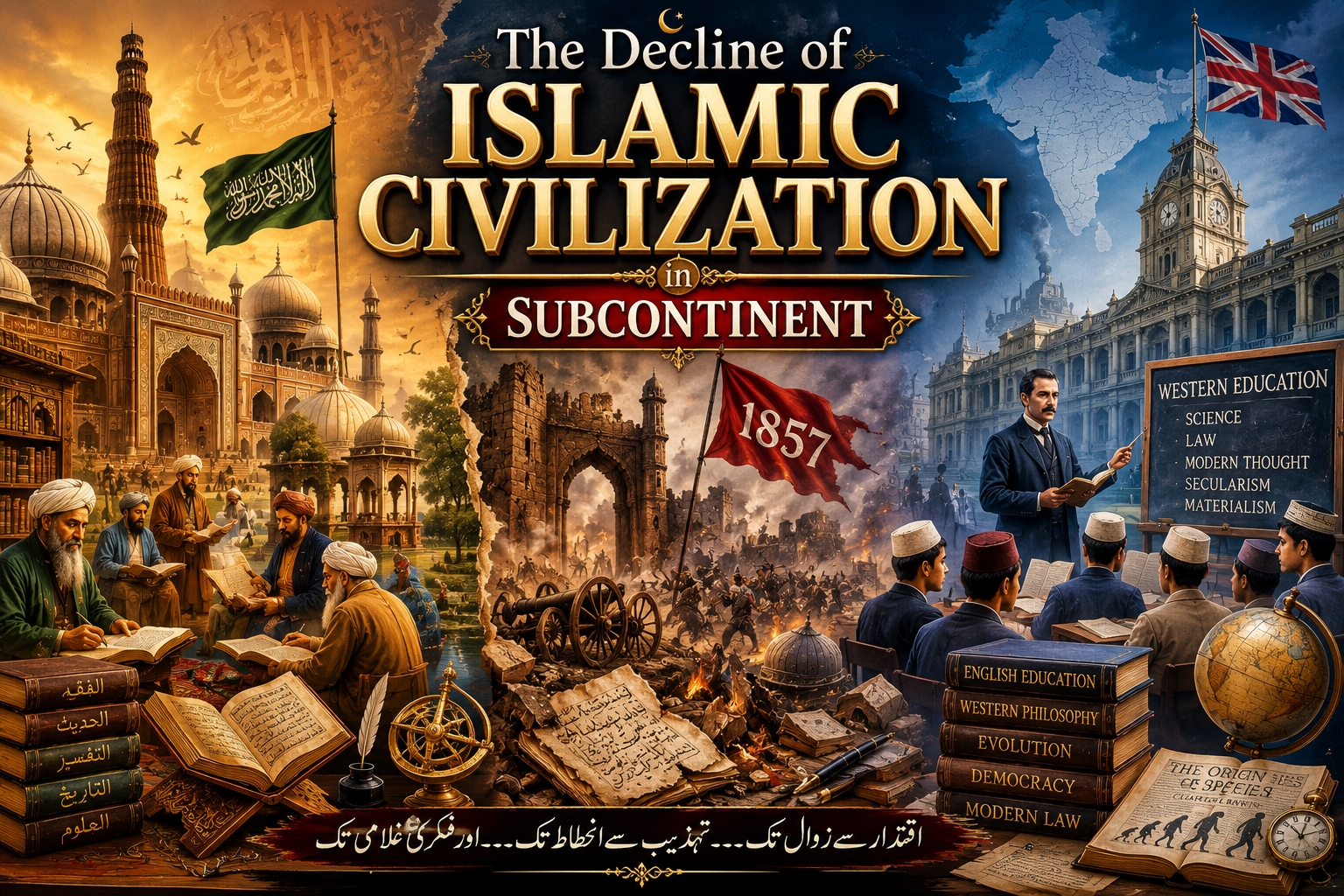

The Decline of Islamic Civilisation in the Subcontinent
The Muslim Conquests
The greater part of the Islamic world comprises those territories that were conquered through the profound struggles of the companions and warriors of the early Islamic era. The individuals who secured those lands did not venture forth for imperial expansion or the acquisition of material spoils; rather, they went out ready to sacrifice their lives to elevate the Word of God in the world. Consumed by the pursuit of the ultimate afterlife rather than the desire for mundane wealth, they did not content themselves with merely reducing the vanquished populations to subjection and tribute. Instead, they imbued them thoroughly with the spirit of Islam, absorbing the entirety, or at least the vast majority, of these populations into the unified Muslim community. Through the sheer force of knowledge and practical character, they so deeply ingrained Islamic thought and civilization within them that these very populations eventually became the standard-bearers of Islamic culture and the custodians of its sciences.
Succeeding these regions are those lands conquered during later eras, when the initial religious fervour had cooled, and the desire for territorial acquisition had largely supplanted the pure spirit of striving solely for the sake of God within the hearts of the conquerors. Yet, despite this shift, Islam still succeeded in spreading and taking firm root in those regions, ultimately achieving the status of both a national religion and a comprehensive cultural identity.
https://mrpo.pk/portrait-of-a-believer/
Popular opinions on the decay of Islamic Civilizations:
The most prevalent diagnoses and remedies for the decay of Islamic civilizations fall in two categories. The most popular view seems to be that the Muslims have veered away from the teachings of Islam. The remedy offered is, “If only we became good Muslims, we would regain the momentum and revive the grandeur of the past.”
The second conventional view is that our travails started with the ascendance of the West. It led to eventual Western colonialism of Muslim lands and its materialistic hegemony stifled the Islamic Civilizations. The popular remedy suggested is that we should get away from materialism, support education with the spiritualism of Islam to be the leaders again.
Both observations are partly correct but confuse causes and effects. Not that the West has not been hegemonic and should not be blamed. Yielding uncritically to this mindset absolves Muslims of centuries of sloth and is a complete intellectual surrender to the hegemony of the West. It pulls at the heartstrings with the innocence of idealism, but the understanding of the early Islamic history and human nature does not substantiate such simplistic explanations.
https://www.countercurrents.org/beg-250706.htm
Islamic Civilization in the Subcontinent
Regrettably, the historical trajectory of India stands in contrast to both of these categories of nations. During the golden dawn of Islam, only a very negligible portion of this subcontinent was conquered. Even the rudimentary impressions of Islamic education and civilization that managed to form there were subsequently obliterated by the rising tide of esoteric, heterodox movements. Later, when the primary wave of Muslim conquests swept through India, the conquerors no longer possessed the distinctive spiritual and moral attributes of the early Muslims. Instead of dedicating their energies to the propagation of faith, they expended their strength in expanding the frontiers of their empires, demanding personal allegiance and tribute from the people rather than absolute obedience to God and His Messenger.
Consequently, despite centuries of uninterrupted Muslim sovereignty, the vast majority of the Indian population remained non-Muslim. Islamic civilization failed to strike deep, permanent roots. Among the native inhabitants who did embrace Islam, no systematic arrangement was established for their comprehensive spiritual and moral education. As a result, neo-Muslim communities retained their ancient Hindu concepts, customs, and rituals to varying degrees. Concurrently, the older Muslim populations who migrated from abroad gradually adopted a policy of undue compromise toward polytheistic practices and began conforming to many ignorant local customs due to prolonged social intermingling.
A careful study of Indo-Islamic history and its contemporary realities reveals that even during the eras when Muslim political authority was at its zenith, the actual influence of Islam remained weak, and the ambient environment was never a purely Islamic one. Although the indigenous religious and cultural systems of the land were inherently fractured—and rendered even weaker by virtue of being the systems of a politically subjugated populace—they nevertheless continued to dominate the vast majority of the country due to the leniency and systematic negligence of the Muslim rulers. Because this non-Islamic ethos loomed large over the Indian atmosphere, and because the religious education of the Muslims themselves remained systematically incomplete, a large segment of Indian Muslims could never become as doctrinally sound, culturally pure, or completely realized in their faith as they would have been within an unadulterated Islamic environment.
The Collapse of Muslim Political Power
In the eighteenth century, even that political authority which had served as the greatest external bulwark for Islamic civilization in India was completely wrested from the Muslims. Initially, the central Muslim empire fractured into smaller, decentralized principalities. Subsequently, the aggressive expansions of the Marathas, the Sikhs, and the British systematically dismantled most of these states one by one. Ultimately, the divine decree ordained British rule over this land, and before a century had passed, the Muslims were reduced to a state of absolute subjugation and defeat within the very territory they had governed for centuries.
Colonial Rule and the Dismantling of Islamic Institutions
As the British Empire expanded, it systematically stripped the Muslims of all institutional mechanisms that had kept Islamic civilization afloat in India. It replaced Persian and Arabic with English as the medium of instruction, abolished Islamic statutory laws, dismantled the traditional Sharia courts, and enforced its own legal codes in civil and criminal matters. The application of Islamic law was drastically restricted to personal matters such as marriage and divorce among Muslims.
Compounding this cultural erasure, the deliberate policy of the British administration from its inception sought to economically decimate the Muslims, thereby crushing that sense of collective national pride which had been nurtured in their hearts for centuries as a ruling class. Within the span of a single century, this targeted policy left the community impoverished, uneducated, intellectually degraded, morally compromised, and thoroughly humiliated.
The Aftermath of 1857
The final catastrophic blow to this declining community came with the upheaval of 1857. This event did not merely obliterate the residual political power of the Muslims; it completely shattered their collective morale, casting dense clouds of despair and a deep sense of humiliation over their hearts. They were so thoroughly awed and terrified by British power that not a shred of national self-respect remained within them.
Having sunk into the absolute depths of degradation, they felt compelled to believe that the only means of ensuring physical survival lay in absolute obedience to the Englishman, the only avenue to honour lay in serving him, and the sole path to progress lay in uncritical imitation of his ways. Conversely, they came to view their own inheritance of knowledge and civilization as something contemptible, a source of humiliation, and a harbinger of ruin.
The Western Takeover
When the Muslims attempted to consciously rally and rise again during the second half of the nineteenth century, they were crippled by a dual vulnerability:
Internal Ideological Weakness
Intellectually and practically, they were already poorly grounded in Islamic beliefs and culture, while a non-Islamic environment surrounded them with its ignorant philosophies and social systems.
The Psychology of Subjugation
Servitude, with all its inherent vices, had taken firm hold not merely of their bodies, but of their hearts and souls. They had been utterly stripped of all institutional powers through which a nation preserves its culture and civilization.
The Rise of Western Education
In this state of dual weakness, the Muslims discovered that economic advancement had become inseparable from Western education. Under the leadership of Sir Syed Ahmad Khan, a powerful movement emerged that persuaded Muslims of the necessity of English education. The resistance of traditionalists gradually collapsed, and the most talented youth of the community entered English schools and colleges while traditional seminaries increasingly became confined to producing religious functionaries.
The Intellectual Climate of Nineteenth-Century Europe
This coincided with the final quarter of the nineteenth century, an era when materialism had reached its zenith in Europe. Science, philosophy, and modern social theories had profoundly weakened the authority of religion and established an entirely new secular civilization.
The Rise of Secular Materialism
Although no scientific discipline had conclusively disproved belief in God, influential intellectual circles increasingly rejected the divine conception of the universe. Denial of God, skepticism toward religion, and confidence in secular naturalism became fashionable hallmarks of enlightenment.
Darwinism and the Crisis of Faith
The publication of Charles Darwin’s On the Origin of Species in 1859 further strengthened this intellectual trend. Whether justified or not, Darwinism was rapidly embraced and employed as a powerful weapon against religion. Religious opposition proved ineffective, and scientific naturalism increasingly became the dominant intellectual force in Europe.
Western Education and the Muslim Mind
This was the precise historical moment when Muslim youth, largely deprived of a strong Islamic intellectual foundation, entered Western educational institutions. Already overawed by British power and impressed by European civilization, they absorbed Western ideas with little critical resistance.
Conflicting Foundations: Islam and the West
The worldview conveyed through Western education differed fundamentally from Islam in matters of religion, revelation, law, politics, economics, ethics, and social organization. Islam viewed religion as a complete system of life, whereas the modern West increasingly confined religion to the private sphere.
Measuring Islam by Western Standards
When this Western-educated generation encountered differences between Islamic teachings and modern Western ideas, they generally assumed that the Western position was correct. Rather than questioning Western assumptions, they frequently sought to reinterpret, modify, or abandon aspects of Islamic thought to bring them into conformity with prevailing Western standards.
Conclusion
Whatever economic or political benefits Western education may have brought to Indian Muslims, the damage inflicted upon their religious outlook and civilizational consciousness was immeasurably greater.
The broader lesson is that a colonized elite, when educated entirely through a foreign intellectual framework without adequate grounding in its own tradition, gradually internalizes the assumptions and prejudices of the colonizer. Intellectual subjugation thus becomes more enduring and destructive than military defeat, for it transforms the way a community understands itself, its heritage, and its future.