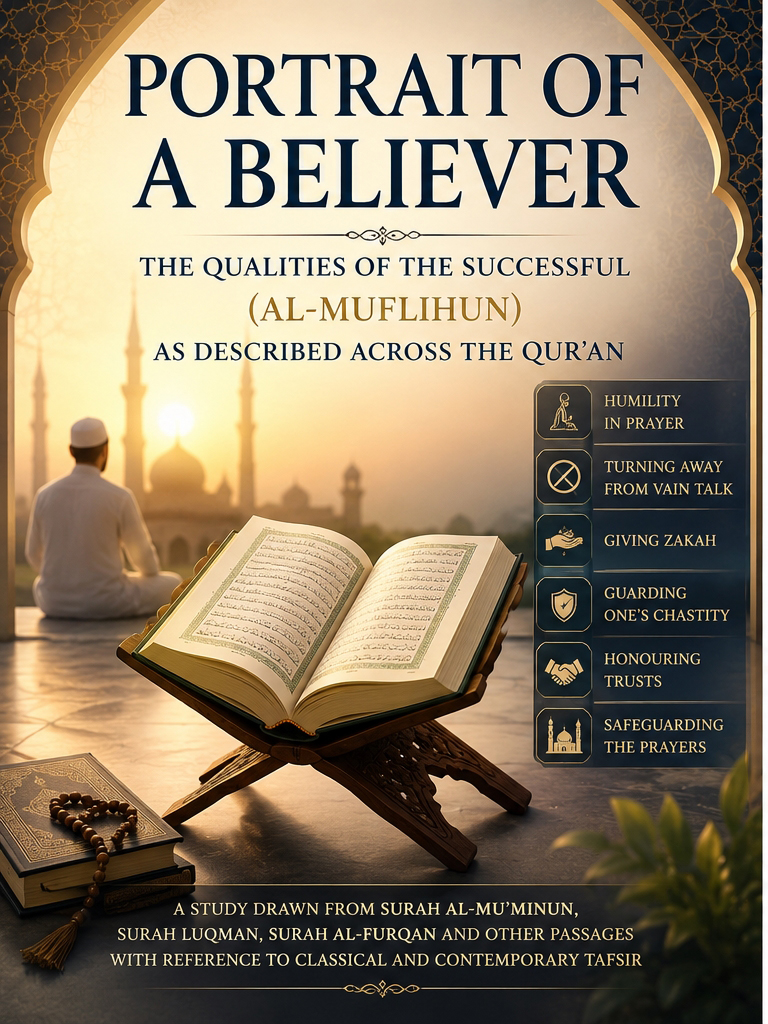

PORTRAIT OF A BELIEVER
Portrait of a Believer: The Qualities of the Successful (Al-Muflihun) as Described Across the Qur’an
A study drawn from Surah Al-Mu’minun, Surah Luqman, Surah Al-Furqan, and other passages of the Qur’an, with reference to classical and contemporary Tafsir
Introduction
Success, as most people chase it, is measured in money earned, status gained, or comfort secured. The Qur’an offers a different measuring stick altogether. In more than a dozen places, scattered across Makkan and Madinan surahs alike, Allah does not merely tell believers to “be good.” He draws a portrait — feature by feature, habit by habit — of the person who has actually succeeded, both in this world and in the life to come.
This short study gathers that portrait from four of its clearest sources: the opening verses of Surah Al-Mu’minun, the fatherly counsel of Luqman to his son, the description of the “servants of the Most Merciful” in Surah Al-Furqan, and a handful of shorter but equally rich passages spread across Al-Baqarah, Al-Anfal, Al-Ahzab, Al-Hujurat, and At-Tawbah. Alongside each set of verses, this study brings in explanations from early scholars such as Ibn Kathir, Al-Tabari, and Al-Qurtubi, as well as more recent commentators such as Sayyid Abul A’la Maududi and Mufti Muhammad Shafi, so that the meaning is not just translated but properly unpacked.
The aim is simple: to let the Qur’an describe, in its own words and through its most trusted interpreters, what a successful believer actually looks like — in the heart, in the home, and in the street — so that readers of every age and background can hold this description up as a mirror.
Part One: The Believers Who Have Truly Succeeded
Surah Al-Mu’minun 23:1–11
Surah Al-Mu’minun opens with a declaration rather than a question: “The believers have certainly succeeded.” The word used for success, falah, is stronger than the everyday idea of winning or prospering. Classical lexicographers explain that falah means to obtain what one truly desires while being safe from what one fears — success that is complete, not partial or temporary. Imam Ibn Kathir notes that this opening line is a firm, unqualified statement: these people have already attained victory; nothing remains uncertain about their outcome. Sayyid Maududi adds an important piece of context: this verse was revealed at a time when the Makkan elite mocked the small, often poor, community of believers as failures. The Qur’an corrects the world’s scorecard entirely — true success is not wealth or numbers, but a certain kind of character. Six such character traits follow, one after another, like the movements of a single piece of music.
- Humility in Prayer (Khushu‘). The first quality named is that they are humbly submissive in their prayer. Khushu‘ is not merely bowing the body; the early scholars, including Ibn Abbas, Mujahid, and Al-Hasan Al-Basri, explained it as a stillness and reverence that begins in the heart and only then shows on the limbs — a lowering of the gaze, a quieting of restlessness, a mind that is present rather than wandering. Al-Hasan Al-Basri went so far as to say that a person can be physically still in prayer while their heart is elsewhere, and that real khushu‘ is the heart’s engagement, not just the body’s posture.
- Turning Away from Vain Talk. The second trait is that they turn away entirely from laghw — idle, frivolous, or harmful talk and activity. Commentators note this is a stronger word than simply “avoiding” laghw; it implies a deliberate turning of the back on gossip, mockery, and anything that wastes time and corrodes character, even when such things are technically permissible.
- Giving Zakah. The third quality is that they are active in paying zakah. Some early scholars understood this narrowly as the obligatory charity on wealth; others, including a number of Makkan-era commentators, read it more broadly as purifying both wealth and soul, since zakah shares its root with tazkiyah (purification). Either way, the verse ties financial generosity directly to spiritual success — a person’s relationship with their money is treated as a measure of their faith.
- Guarding One’s Chastity. The fourth trait concerns guarding one’s private parts, except within the bounds Allah has permitted through marriage. The verse frames chastity not as mere restriction but as a form of protection — those who transgress this boundary are described as having overstepped a limit set for their own good.
- Honouring Trusts and Covenants. The fifth quality is faithfulness to whatever is entrusted to them and to whatever promises they make. Classical commentators point out that this covers everything from formal contracts to the small trusts of daily life — a secret shared, a job assigned, an oath given. A believer’s word, in other words, is treated as a form of worship in itself.
- Safeguarding the Prayers. The list closes as it began — with prayer, but now described with a different word, muhafazah, meaning careful, consistent guarding across time, through all five daily prayers and their proper conditions. Ibn Kathir observes that Allah opens and closes this list of praiseworthy qualities with prayer, which he takes as a sign of its central importance: The Prophet (peace Be Upon Him) is reported to have said that the best of deeds is prayer, and that only a true believer preserves it consistently.
The Promised Reward
Having named these six qualities, the surah states plainly: these are the true inheritors, who will inherit Al-Firdaws, the highest level of Paradise, and remain there forever. Several hadith cited by Ibn Kathir describe Al-Firdaws as the middle and highest part of Paradise, from which its rivers flow — a reward described in terms that match the completeness of the falah promised at the very start of the passage.
Part Two: A Father’s Wisdom
Luqman’s Advice to His Son — Surah Luqman 31:12–19
Where Surah Al-Mu’minun reads like a formal list, Surah Luqman delivers its wisdom through the tender, unmistakably personal voice of a father speaking to his son. Luqman, described by the Qur’an as a man given hikmah (wisdom) rather than prophethood, is held up as a model precisely because a parent’s private advice to a child is assumed to be sincere — free of any motive except genuine care. What he tells his son doubles as Allah’s own instruction to every reader.
- The Foundation: Reject Shirk. Luqman’s very first piece of advice is the most fundamental — do not associate partners with Allah, for such association is a profound wrongdoing. Commentators note the word chosen here — zulm, injustice or wrongdoing — rather than simply “sin,” because shirk means placing something in a rank it was never created to hold, which is the deepest kind of imbalance a person can commit.
- Gratitude and Kindness to Parents. Immediately after, in what scholars describe as a parenthetical but deliberately placed reminder, Allah commands kindness to parents, recalling the hardship a mother endures in pregnancy and the two years of nursing that follow. Even where parents insist on disbelief, the son is told not to obey them in that one matter, yet still to keep their company in this world with kindness. The juxtaposition — obedience to Allah takes precedence, yet basic decency toward parents never lapses — is treated by commentators as one of the Qur’an’s clearest lessons in balancing competing loyalties.
- Awareness that Allah Sees All. Luqman then tells his son that even something as small as a mustard seed, hidden inside a rock or anywhere in the heavens or earth, will be brought forth by Allah on the Day of Judgment, for Allah is subtle and fully aware. Commentators read this as the psychological anchor beneath everything else Luqman says: a person who truly believes nothing escapes Allah’s knowledge has little need for outward policing of their behaviour.
- Establish Prayer, Enjoin Good, Forbid Evil, and Be Patient. Luqman’s next counsel bundles four duties together: maintain the prayer, command what is right, forbid what is wrong, and bear patiently whatever difficulty results. Scholars such as Ibn Kathir note the realism embedded here — Luqman does not promise his son an easy road for speaking the truth; he tells him plainly that enjoining good will bring hardship from people, and that patience is the necessary companion of that calling, not an afterthought.
- Humility in Character, Moderation in Walk and Voice. The passage closes with instructions about outward bearing: do not turn your cheek away from people out of arrogance, do not walk through the earth exultantly, and walk at a moderate pace. Luqman adds a memorable image — lower your voice, for the harshest of sounds is the braying of a donkey. Commentators read these final lines as proof that Qur’anic character is not confined to ritual or belief; it extends to posture, tone of voice, and everyday manners, the small things by which people actually judge one another.
Part Three: The Servants of the Most Merciful
Surah Al-Furqan 25:63–77
Toward the close of Surah Al-Furqan, Allah introduces a title reserved for a special group: Ibad-ur-Rahman, “the servants of the Most Merciful.” Commentators point out the significance of the choice of name — out of all of Allah’s beautiful names, He selects Ar-Rahman, the Most Merciful, to describe His relationship with this group, hinting that mercy is what both produces and rewards their character.
The passage describes them through a chain of habits. They walk upon the earth gently, without arrogance in their step — Al-Hasan Al-Basri commented that their humility is so complete that a stranger might mistake it for illness, when in truth it is nothing but awe of Allah. When ignorant or foolish people address them harshly, they do not retaliate; they simply reply with words of peace, a restraint that scholars describe as strength of character rather than weakness. They spend portions of the night in prayer, standing and prostrating before their Lord. They plead for protection from the punishment of Hell, aware that no one — however righteous they feel — should take their own salvation for granted. When they spend their wealth, they are neither extravagant nor stingy, but hold to a steady middle path.
They keep clear of the gravest sins — associating partners with Allah, taking a life unjustly, and unlawful sexual relations — and where they have erred, they turn to Allah in sincere repentance, trusting that He can transform even past wrongdoing into good, provided the return to Him is genuine. They do not bear false witness, and when they pass by idle or vain talk, they walk past it with dignity rather than stopping to take part. When reminded of the verses of their Lord, they do not turn away deaf and blind, but actually listen and respond. And finally, they are the ones who pray for their spouses and children to be a comfort to their eyes, and ask to be made leaders for those mindful of Allah — a household aspiration, not merely a personal one.
Their reward, the surah says, is a lofty chamber in Paradise, granted because of their patience, where they will be welcomed with greetings of honour and peace — a description, scholars such as Al-Qurtubi discuss at length, noting that this “chamber” (ghurfah) refers to the loftiest, most honoured stations of Paradise.
Part Four: Other Places in the Qur’an
The Qur’an revisits this theme repeatedly, sometimes in a few lines, always with the same underlying message: character, not claim, is what faith is measured by.
The God-Conscious — Surah Al-Baqarah 2:2–5. Near the very opening of the Qur’an, the muttaqin (those mindful of Allah) are described as people who believe in the unseen, establish prayer, spend from what Allah has provided them, believe in what was revealed to the Prophet (peace Be Upon Him) and to the messengers before him, and hold firm certainty about the Hereafter. The surah adds that it is precisely such people who are truly guided and who will prosper — the same word, falah, used again here as in Al-Mu’minun.
The True Believers — Surah Al-Anfal 8:2–4. Here the description turns inward, toward the emotional texture of faith itself: believers are those whose hearts tremble when Allah is mentioned, whose faith increases when His verses are recited to them, who place their trust in their Lord, who keep up the prayer, and who spend from what they have been given. The surah closes this short passage by calling them, without qualification, the truly (‘haqqan’) believers — a rare emphasis suggesting that everything short of this inward and outward combination falls short of the mark.
The Believing Men and Women — Surah Al-Ahzab 33:35. In one of the Qur’an’s most complete lists, ten matched pairs of qualities are named for men and women together: Muslim men and Muslim women, believing men and believing women, obedient men and women, truthful men and women, patient men and women, humble men and women, charitable men and women, fasting men and women, men and women who guard their chastity, and men and women who remember Allah often. For all of them, the verse promises forgiveness and a mighty reward — a passage commentators cite as clear evidence that spiritual excellence is not gendered; the standard and the reward are identical.
The Successful Believers — Surah Al-Hujurat 49:15. Here the Qur’an gives perhaps its most concise definition: the true believers are only those who believe in Allah and His Messenger without ever doubting again, and who then strive with their wealth and their very selves in the way of Allah. Sincerity, in other words, is proven by follow-through, not by the initial claim of faith.
The Repentant Worshippers — Surah At-Tawbah 9:112. A further list describes those who repent, who worship, who praise Allah, who journey and strive in His way, who bow and prostrate in prayer, who enjoin good and forbid wrong, and who observe the limits Allah has set — and the surah adds, simply, give good news to such believers.
Part Five: Weaving the Threads Together
Read side by side, these passages are not a random collection of virtues; they repeat and reinforce a handful of themes. Prayer, mentioned in nearly every passage above, is treated as the anchor of the believer’s day, not one duty among many. Generosity — whether named as zakah, spending in moderation, or simply “spending from what We have provided” — appears just as consistently, tying financial conduct directly to spiritual standing. Self-restraint shows up repeatedly too: guarding one’s chastity, controlling one’s tongue and temper, avoiding idle talk, responding to provocation with peace rather than retaliation.
Trustworthiness and truthfulness, patience in the face of hardship, humility in bearing and speech, and remembrance of Allah in the heart round out a picture that is remarkably consistent whether the surah was revealed in Makkah in the earliest years or in Madinah after the community had grown.
What stands out most is that none of these passages describe success as an accident of birth, wealth, or status. Every quality named is something a person can choose, practice, and build — which is itself the Qur’an’s quiet argument that true success is within reach of anyone willing to work at their own character.
Conclusion
Put together, these verses do not read like a checklist to be ticked off once and forgotten. They read more like a mirror that a person can return to again and again — in prayer, in the marketplace, at home with parents and children, in a moment of provocation, in how money is spent, in how a promise is kept. The Qur’an’s early commentators approached these verses as a curriculum for the heart before they were ever a curriculum for behaviour, and later scholars such as Maududi and Mufti Shafi carried that same emphasis forward into the modern era, insisting that outward practice without inward sincerity falls short of what these verses actually describe.
Perhaps that is the quiet lesson beneath all four passages gathered here: success, in the Qur’an’s own vocabulary, is not something achieved once and then possessed forever, like a certificate on a wall. It is a way of being — humble in prayer, careful with wealth, guarded in speech and conduct, patient under provocation, faithful to promises, and constantly mindful that Allah is watching. Whoever builds a life on that foundation, the Qur’an promises, has already succeeded — whatever the world’s own scorecard might say.
Select References
Translations consulted: Sahih International; Abdullah Yusuf Ali; Muhammad Marmaduke Pickthall; Maulana Muhammad Ali.
Classical Tafsir: Tafsir Ibn Kathir (Imam Isma’il ibn Kathir); Tafsir Al-Tabari (Imam Muhammad ibn Jarir Al-Tabari); Tafsir Al-Qurtubi (Imam Al-Qurtubi).
Recent-past scholarship: Tafhim-ul-Qur’an (Sayyid Abul A’la Maududi); Ma’ariful Qur’an (Mufti Muhammad Shafi); Fi Zilal al-Qur’an (Sayyid Qutb).