
Hantavirus vs Plague: The Truth Behind the Fear, Pandemic Questions, and Global Health Risks
Hantavirus vs Plague truth behind the fear. What if the next global health scare does not begin in a laboratory, but inside abandoned buildings, grain stores, and rodent-infested spaces?
https://mrpo.pk/cognitive-bias/

After COVID-19, the world reacts differently to every disease outbreak. Fear spreads quickly across social media, and many people immediately wonder whether another pandemic could be approaching. Recently, videos and headlines discussing Hantavirus created global anxiety, with some claiming it could become “more dangerous than COVID-19.”
At the same time, comparisons with the plague, one of history’s deadliest diseases, started appearing online. But how much of the fear is based on science, and how much is amplified by sensational media narratives?
This article explains the scientific reality behind Hantavirus and plague, their history, symptoms, transmission, global risks, and the psychological impact of outbreak fears in simple human language.
Why Are People Suddenly Talking About Hantavirus Again?
COVID-19 permanently changed how people react to disease outbreaks. Today, even a small outbreak in one region can quickly become global news.
Social media creators understand this fear very well. That is why many viral thumbnails include phrases such as:
- “WHO WARNING”
- “NEXT PANDEMIC?”
- “MORE DANGEROUS THAN COVID?”
- “GLOBAL EMERGENCY”
Fear-based content generates clicks, watch time, and engagement. As a result, scientific information often becomes mixed with exaggeration, speculation, and conspiracy theories.
Can fear spread faster than disease itself? The growing panic around Hantavirus reveals how deeply COVID changed global psychology.
What Is Hantavirus? Hantavirus vs Plague Truth Behind the Fear
Understanding Hantavirus in Simple Words
Hantavirus is a group of viruses mainly carried by rodents such as rats and mice.
Humans usually become infected when they:
- Breathe contaminated dust
- Touch rodent urine or droppings
- Clean infested areas without protection
- Come into contact with contaminated surfaces
Unlike COVID-19, most Hantavirus strains do not spread easily between humans.
Scientists have known about hantaviruses for decades. It is not a newly discovered disease.
Is there any Vaccine or Treatment?
Currently:
- No widely available universal vaccine exists for most hantavirus infections
- No specific antiviral cure is universally approved
Treatment mainly involves:
- Intensive supportive care
- Oxygen therapy
- Ventilation support
- Early hospitalization
The earlier severe cases are recognised, the better the survival chances.
Can Hantavirus become a global pandemic?
Current scientific evidence suggests it is unlikely to become a COVID-style global pandemic. (washingtonpost.com)
For a pandemic to happen, a virus usually needs:
- Efficient human-to-human spread
- Fast international transmission
- Silent/asymptomatic transmission
- Sustained community spread
Most hantavirus strains lack these characteristics.
However, scientists still monitor mutations and unusual outbreaks carefully because viruses evolve over time.
How deadly is Hantavirus compared to COVID-19?
In severe cases, Hantavirus can have a much higher fatality rate than COVID-19.
Some forms of Hantavirus Pulmonary Syndrome have fatality rates around 30–40%. (cdc.gov)
But this comparison can be misleading because:
- COVID spread extremely easily worldwide
- Hantavirus infections are relatively rare
- Most hantavirus strains do not spread efficiently between humans
COVID caused millions of deaths largely because transmission was rapid and global. Hantavirus is deadlier per severe case, but far less contagious.
Why are rodents central to transmission?
Rodents act as natural reservoirs for the virus.
This means:
- The virus lives inside certain rodent species
- The animals often show little or no illness
- Humans become infected accidentally through exposure
Common transmission sources:
- Rat or mouse droppings
- Urine-contaminated dust
- Poorly ventilated storage areas
- Abandoned buildings
- Grain storage facilities
- Rural environments
Climate changes, food shortages, flooding, and poor sanitation can increase rodent populations, raising outbreak risks.
Is Hantavirus actually airborne between humans?
Mostly, no.
Most strains of Hantavirus spread from rodents to humans, not from person to person. Infection usually happens when contaminated dust from rodent urine, saliva, or droppings becomes airborne and is inhaled. (cdc.gov)
However, one important exception exists:
- The Andes strain found in parts of South America has shown limited human-to-human transmission in close-contact settings. (reuters.com)
This is very different from highly contagious airborne viruses like COVID-19, measles, or influenza.
What Is Plague?
Understanding the Plague Disease
Plague is caused by bacteria called Yersinia pestis.
Historically, plague caused one of the deadliest pandemics in human history:
The disease spread through infected fleas, rodents, and, in some cases, respiratory droplets.
Unlike Hantavirus, plague is bacterial, meaning antibiotics can treat it effectively if detected early.

The History of Plague: One of Humanity’s Deadliest Diseases
How the Black Death Changed Human Civilisation
The Black Death swept across Europe, Asia, and parts of Africa during the 14th century.
Historians estimate that the plague killed:
- 25 to 50 million people in Europe alone
- Possibly up to 200 million globally
At that time, people did not understand:
- Bacteria
- Infection control
- Sanitation
- Public health systems
Cities were overcrowded, hygiene conditions were poor, and rats carrying infected fleas spread the disease rapidly.
Entire villages disappeared. Economies collapsed. Fear transformed societies.
From the Black Death to modern outbreak fears, humanity continues to battle the same invisible enemies: disease, panic, misinformation, and environmental imbalance.
Was Plague Eliminated Completely?
The Important Truth Most People Do Not Know
No, plague was never eliminated.
This surprises many people because plague is often viewed as an ancient disease that disappeared centuries ago.
In reality, the bacteria still survive naturally in wild rodent populations around the world.
However, modern medicine dramatically reduced its danger through:
- Antibiotics
- Sanitation systems
- Pest control
- Public health monitoring
- Quarantine systems
Today, outbreaks are usually controlled quickly before becoming large-scale disasters.
Why Does Plague Still Exist Today?
The plague bacteria survive inside:
- Wild rodents
- Fleas
- Natural animal reservoirs
This means plague can still reappear under certain conditions, especially where:
- Sanitation is poor
- Rodent populations increase
- Healthcare access is limited
- Poverty and overcrowding exist
Difference Between Plague and Hantavirus: Hantavirus vs Plague Truth Behind the Fear
Although both diseases are associated with rodents and can become serious, Plague and Hantavirus are very different in cause, transmission, symptoms, treatment, and pandemic potential.
| Feature | Plague | Hantavirus |
|---|---|---|
| Cause | Bacteria (Yersinia pestis) | Virus (Hantavirus family) |
| Type of Disease | Bacterial infection | Viral infection |
| Main Carrier | Fleas on rodents | Rodent urine, droppings, saliva |
| Human Transmission | Possible in pneumonic plague | Rare in most strains |
| Treatment | Antibiotics work effectively | No specific universal cure |
| Vaccine | Limited/special-use vaccines | No widely available vaccine |
| Historical Impact | Caused the Black Death | Mostly localised outbreaks |
| Pandemic Potential | Historically very high | Currently considered lower |
| Main Organs Affected | Lymph nodes, blood, lungs | Mainly lungs and kidneys |
| Mortality | High if untreated | High in severe cases |
Main Differences Between Hantavirus and Plague
Hantavirus:
- Viral disease
- Spread mainly through rodent waste
- Mostly affects the lungs and kidneys
- No universal cure or vaccine
- Human spread is rare
Plague:
- Bacterial disease
- Spread through fleas and infected animals
- Can affect lymph nodes, blood, and lungs
- Treatable with antibiotics
- Some forms spread between humans
Both diseases are serious, but they behave very differently.
Can Hantavirus Become the Next COVID-19?
Scientific Reality vs Internet Fear
This is one of the biggest questions spreading online.
Current scientific evidence suggests Hantavirus is unlikely to become a COVID-style global pandemic.
Why?
Because pandemics usually require:
- Efficient human-to-human transmission
- Rapid international spread
- Silent or asymptomatic transmission
- Sustained community outbreaks
Most Hantavirus strains do not spread efficiently between humans.
However, some strains, such as the Andes virus in South America, showed limited human-to-human transmission in close-contact situations.
This is why scientists still monitor outbreaks carefully.
Symptoms of Hantavirus
Early Symptoms
- Fever
- Fatigue
- Muscle pain
- Headache
- Chills
- Nausea
Severe Symptoms
- Breathing difficulty
- Fluid buildup in the lungs
- Respiratory failure
Severe cases can become life-threatening.
Symptoms of Plague
Bubonic Plague Symptoms
- Swollen lymph nodes
- Fever
- Weakness
- Chills
Pneumonic Plague Symptoms
- Cough
- Chest pain
- Breathing difficulty
Pneumonic plague is especially dangerous because it can spread through respiratory droplets.
Why Are Rodents Connected to So Many Diseases?
Rodents reproduce rapidly, live near humans, contaminate food and surfaces, and carry multiple dangerous pathogens.
Both plague and Hantavirus become more dangerous when:
- Sanitation declines
- Rodent populations increase
- Urban overcrowding grows
- Environmental balance is disturbed
Regions Still Prone to Hantavirus and Plague
Regions More Prone to Plague
- Madagascar
- Democratic Republic of the Congo
- Peru
- Southwestern parts of the United States
Regions More Prone to Hantavirus
- Argentina
- Chile
- China
- South Korea
- Parts of Russia
- Rural western United States
These regions often share:
- Rodent exposure
- Sanitation problems
- Environmental disruption
- Close human-wildlife interaction
Most Important Precautions to Reduce Risk
Rodent Control
- Seal holes in homes
- Store food properly
- Remove garbage quickly
- Clean storage spaces regularly
Never Sweep Rodent Droppings Dry
Dry sweeping can release contaminated particles into the air.
Instead:
- Wear gloves and masks
- Spray disinfectant first
- Use wet cleaning methods
Improve Sanitation
- Proper waste disposal
- Clean kitchens
- Safe grain storage
- Clean drainage systems
Use Protective Equipment
Wear masks and gloves while cleaning:
- Barns
- Warehouses
- Abandoned homes
- Rodent-infested areas

Most Important Precautions to Reduce Risk
Why Do Conspiracy Theories Spread During Outbreaks?
Fear and uncertainty make people search for explanations.
This is why outbreaks often trigger:
- Biological warfare theories
- Depopulation narratives
- Secret agenda claims
Currently, there is no verified evidence linking Hantavirus outbreaks to engineered population-control programs.
Most scientific evidence supports natural animal-to-human transmission.
Fear Spreads Faster Than Disease
Modern outbreaks reveal something important: fear itself can become contagious.
Panic spreads through:
- Social media
- Viral headlines
- Emotional videos
- Misinformation
- Repeated exposure
Millions survived the COVID pandemic, but the psychological impact remains. That trauma is now shaping how the world reacts to every new virus headline.

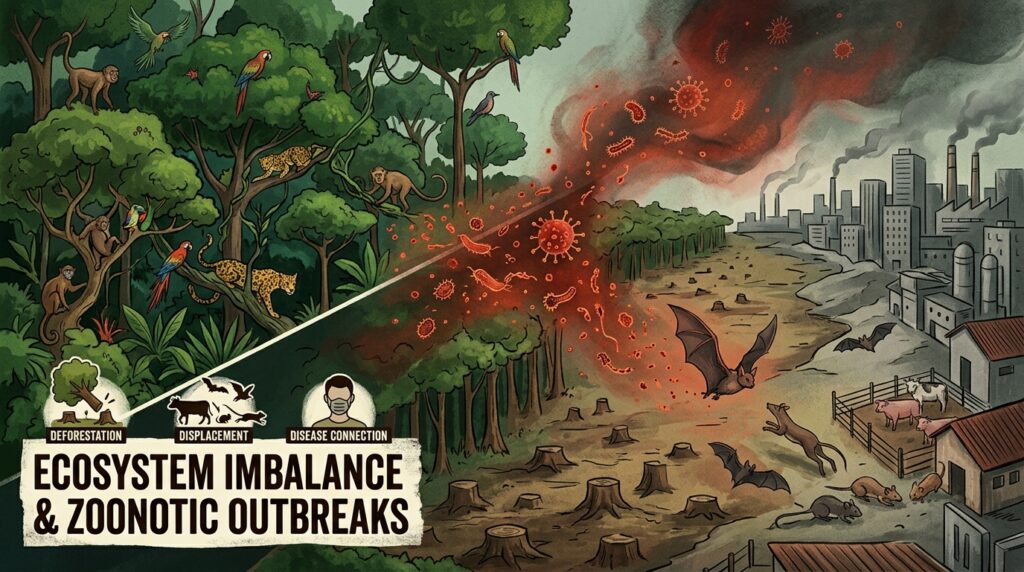
Environmental Problems and Future Disease Risks
Scientists increasingly warn that:
- Climate change
- Deforestation
- Urban overcrowding
- Wildlife habitat destruction
can increase the risk of zoonotic diseases worldwide.
Human health is deeply connected to environmental balance.
The Most Important Lesson
The biggest danger is not only the disease itself.
It is also:
- Misinformation
- Panic
- Sensationalism
- Distrust
- Poor public awareness
People need:
- Facts
- Calm explanations
- Practical prevention guidance
Not exaggerated fear.
Purpose of the Article
The purpose of this article is to:
- explain the scientific reality behind Hantavirus and plague
- separate facts from fear-based misinformation
- educate readers about transmission, symptoms, and prevention
- Examine how social media amplifies disease panic
- Analyse the psychological impact of post-COVID outbreak fears
- promote awareness without spreading unnecessary hysteria
- Encourage responsible public health understanding globally
Millions survived the COVID pandemic, but the psychological impact remains. That trauma is now shaping how the world reacts to every new virus headline.
6 Important FAQs
1. Is Hantavirus more dangerous than COVID-19?
Hantavirus can have a higher fatality rate in severe cases, but it spreads far less efficiently between humans than COVID-19. Current evidence does not suggest it has the same pandemic potential.
2. Can plague still spread in modern times?
Yes. Plague still exists in some regions, but modern antibiotics and public health systems make large-scale outbreaks far less likely than during the medieval period.
3. Why are rodents connected to so many diseases?
Rodents reproduce rapidly, live near humans, contaminate food and surfaces, and carry multiple pathogens. Poor sanitation and overcrowding increase transmission risks.
4. Can Hantavirus spread from person to person?
Most strains do not spread easily between humans. However, the Andes strain in South America has shown limited human-to-human transmission in close-contact settings.
5. Why do outbreak videos spread so quickly online?
Fear-based content generates strong emotional reactions, which social media algorithms reward with more visibility, engagement, and sharing.
6. What are the most effective ways to reduce risk?
The most important prevention measures include:
- Rodent control
- Sanitation improvement
- Safe cleaning practices
- Proper waste disposal
- Wearing protective equipment in contaminated areas
Conclusion
Hantavirus and Plague are both serious diseases connected to rodents, but they are very different in transmission, treatment, and global risk.
Plague historically caused devastating pandemics, but is now treatable with antibiotics. Hantavirus can be deadly in severe cases, but it spreads much less efficiently between humans.
Current evidence does not suggest that Hantavirus is becoming another COVID-style global catastrophe.
However, these outbreaks remind humanity of an important reality: public health, sanitation, environmental balance, accurate information, and psychological stability all play a critical role in preventing future crises.
References
Scientific and Medical References
- Centers for Disease Control and Prevention (CDC) – Hantavirus Information
- World Health Organization (WHO)
- Reuters – WHO Monitoring Cruise Ship Hantavirus Cases
- Reuters – Experts Discuss Hantavirus Containment
- Washington Post – Hantavirus and Pandemic Fears
- CDC – Plague Information
- National Institutes of Health (NIH)