
Trump’s Secretive Deal Talks: The New Iran Gamble, Israel’s Anxiety, and the Global Power Shift
Trump’s Secretive Deal Talks, Oil markets are nervous. Diplomats are speaking carefully. Military forces remain on alert. And behind closed doors, one of the world’s most dangerous rivalries may be entering a completely new phase.
https://mrpo.pk/war-first-casualty-is-truth/
Recent developments surrounding the United States and Iran have triggered intense global debate. Reports about indirect negotiations, possible ceasefire arrangements, sanctions relief, and nuclear restrictions are now dominating international headlines.
At the centre of the discussion is Donald Trump’s dramatic announcement claiming that a major agreement with Iran is “largely negotiated.”
But what is really happening behind the scenes?
Is this the beginning of historic peace? Or simply a temporary pause before another dangerous escalation?
The answers could reshape the future of the Middle East, global energy markets, U.S. foreign policy, Israel’s security calculations, and the growing power competition involving China and Russia.
US-Iran peace deal has been ‘largely negotiated’, Trump says
President Donald Trump has said a broad agreement between the US and Iran has been “largely negotiated”.
“An Agreement has been largely negotiated, subject to finalization between the United States of America, the Islamic Republic of Iran, and the various other Countries,” Trump wrote on Truth Social on Saturday evening.
Iran suggested there were “narrowing differences” in the negotiations after Pakistan’s army chief held further peace talks in Tehran and US Secretary of State Marco Rubio told journalists in India that “there’s been some progress made” and “there may be news later today”.
The officials expressed hope that a final decision on the Pakistan-prepared draft could come within 48 hours as both sides review it. They spoke on condition of anonymity because they were not authorised to talk to the media.
https://www.itv.com/news/2026-05-23/us-and-iran-closer-to-ending-the-war-officials-say
Purpose of This Article: Trump’s Secretive Deal Talks
This comprehensive investigative analysis explores:
- The real meaning behind the recent US-Iran negotiations
- Trump’s latest statements and negotiation strategy
- Whether Iran may actually reduce its nuclear activities
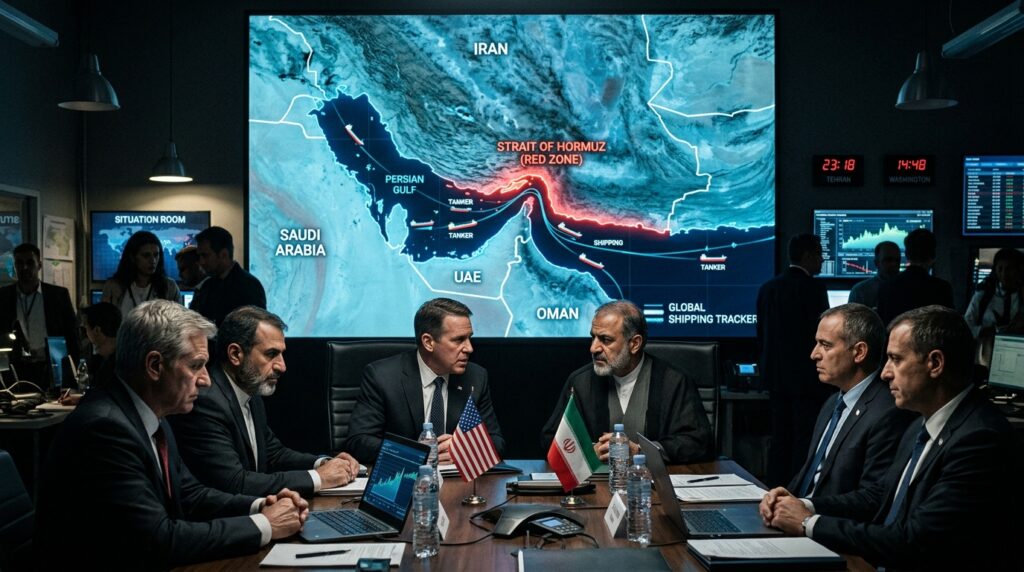
- Why the Strait of Hormuz has become central
- Israel’s reaction and growing concerns
- The online narrative claiming Zionism is sidelined
- How global powers like China and Russia benefit
- Whether Trump’s threats are usually real or strategic pressure
- The possible consequences if diplomacy collapses
A New US-Iran Deal May Already Be Taking Shape
Recent international reports suggest that Washington and Tehran may already have agreed on broad guiding principles for a future agreement.
Although final details remain unclear, discussions reportedly include:
- Limited sanctions relief
- Restrictions on uranium enrichment
- International monitoring mechanisms
- Temporary ceasefire understandings
- Protection of commercial shipping routes
- Stability in the Strait of Hormuz
Unlike the 2015 nuclear agreement, these talks appear to involve much broader geopolitical and economic concerns.
This is no longer only about nuclear centrifuges.
This is about global power, energy security, and avoiding a regional war that could damage the world economy.
Why the Strait of Hormuz Suddenly Matters Again
The World’s Most Important Oil Route
The Strait of Hormuz is one of the most strategically important waterways on Earth.
Around one-fifth of the global oil trade passes through this narrow route every day.
If conflict disrupts shipping there, the consequences could include:
- Massive fuel price increases
- Global inflation spikes
- Economic pressure in Europe and America
- Supply chain disruptions
- Financial market instability
This explains why recent negotiations reportedly focus heavily on maritime security and uninterrupted oil transportation.
Many analysts now believe the United States is not only trying to slow Iran’s nuclear progress, but also trying to protect the fragile global economy from another energy crisis.
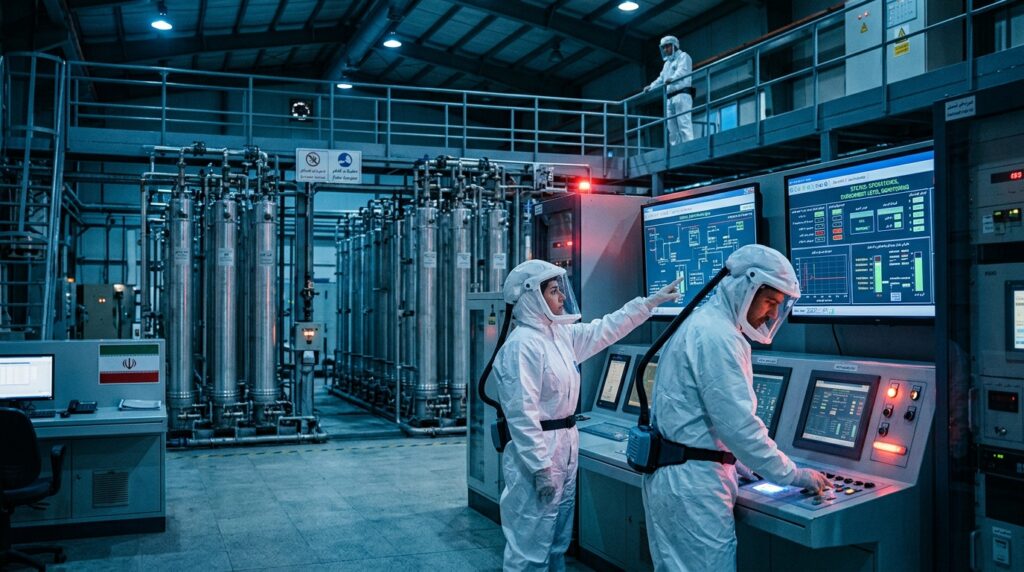
Is Iran Really Willing to Reduce Uranium Enrichment?
This remains the biggest question.
Iran continues to insist that its nuclear program is peaceful and that uranium enrichment is its sovereign right.
Meanwhile, the United States and European allies fear Iran could eventually gain weapons-grade nuclear capability.
Experts believe Iran may potentially agree to:
- Cap enrichment levels
- Export portions of highly enriched uranium
- Accept international monitoring
- Slow advanced centrifuge expansion
However, full dismantlement appears unlikely.
The reason is simple:
Trump’s Secretive Deal Talks: Nuclear knowledge cannot easily be erased.
Even if uranium stockpiles shrink, Iran still possesses decades of scientific expertise, infrastructure, and technological experience.
Can International Inspectors Truly Verify Compliance?
The role of the International Atomic Energy Agency is central to any future agreement.
But serious concerns remain:
- Will inspectors receive unrestricted access?
- Can hidden facilities be discovered quickly?
- Will Iran allow surprise inspections?
- What happens if violations occur?
Verification systems can reduce risk, but they cannot eliminate uncertainty completely.
This is one reason why Israel and many Western security analysts remain sceptical of temporary agreements.
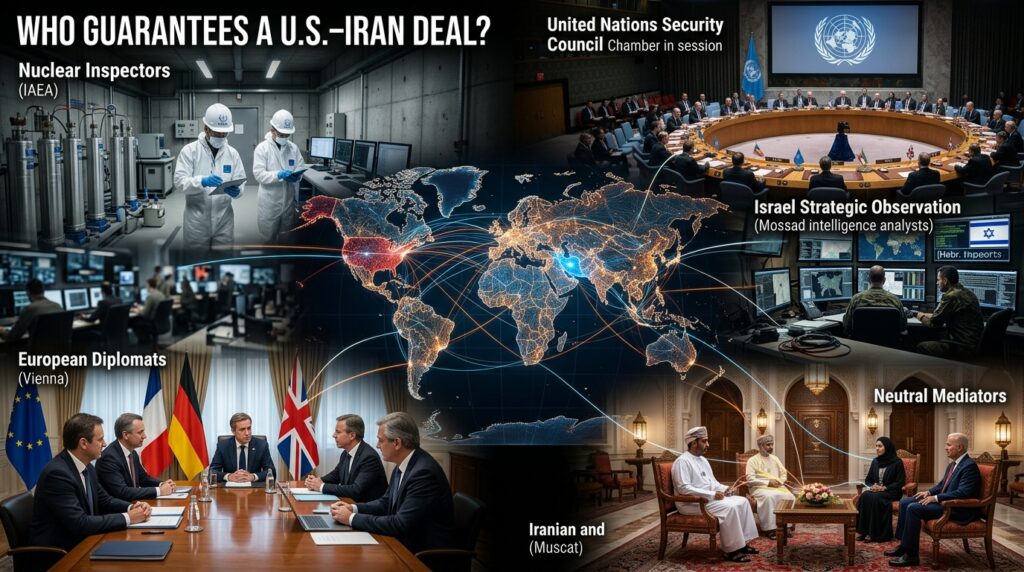
Who Guarantees a US–Iran Deal When Neither Side Fully Trusts the Other?
A vital question remains unresolved in any potential US–Iran agreement: if Washington and Tehran do not fully trust each other, who actually guarantees that the deal is implemented, verified, and sustained, especially when Israel is also a major stakeholder in the wider regional security equation?
The short answer is that there is no single global guarantor. Instead, enforcement is distributed across multiple institutions, each responsible for a different layer of verification, diplomacy, and deterrence. The system is designed not on trust, but on a balance of pressure.
The Real Enforcement Structure Behind Iran Agreements
1. IAEA as the Primary Verification Authority
The International Atomic Energy Agency is the core technical body responsible for monitoring Iran’s nuclear activities.
Its role includes:
- Inspecting declared nuclear facilities
- Monitoring uranium enrichment levels
- Tracking nuclear material stockpiles
- Verifying compliance through on-site inspections and surveillance
However, the IAEA does not enforce penalties. It can only verify and report findings to the international community. This makes it a technical watchdog, not an enforcement authority.
2. The UN Security Council as the Legal Enforcement Layer
In theory, violations can be escalated to the United Nations Security Council, which has the authority to impose or reimpose international sanctions.
This creates legal legitimacy for collective punishment measures such as:
- Economic sanctions
- Arms embargoes
- International restrictions on trade and finance
However, this mechanism is limited by geopolitical realities, especially veto power held by permanent members such as the United States, Russia, and China. As a result, enforcement is often politically constrained rather than automatic.
3. EU and Joint Commission Mechanisms for Dispute Resolution
Previous agreements, including the 2015 nuclear deal framework, established a Joint Commission consisting of Iran, European powers, and other participating states.
This structure is designed to manage disputes through:
- Technical-level consultations
- Diplomatic escalation channels
- Arbitration between parties
While useful for managing disagreements, this mechanism lacks independent enforcement power. Its effectiveness depends entirely on political cooperation among major actors.
4. Regional Mediators as Crisis Stabilisers
Neutral regional actors such as Oman and Qatar often play behind-the-scenes diplomatic roles in facilitating communication between Washington and Tehran.
In certain developments, other regional players, including Pakistan, have also been mentioned as possible communication channels.
Their function is limited to:
- Backchannel communication
- Crisis de-escalation
- Maintaining dialogue during breakdowns
These actors do not enforce compliance but help prevent the total collapse of negotiations.

Where Israel Fits Into the Enforcement Equation
Israel is not a formal guarantor in any proposed agreement. However, it plays a powerful indirect role in shaping enforcement dynamics through three key mechanisms.
1. Independent Intelligence Monitoring
Israel maintains advanced intelligence capabilities that allow it to independently track Iranian nuclear activity. In many cases, Israeli intelligence assessments influence U.S. and European understanding of compliance or violations.
This creates a parallel verification system outside official diplomatic structures.
2. Military Deterrence Capability
Israel’s military capability acts as an external pressure factor on the entire framework. While not part of formal enforcement, it introduces the possibility of unilateral action if Israel believes a critical threat is emerging.
This functions as a deterrence layer rather than a legal enforcement mechanism.
3. Political Influence on Western Policy
Israel also plays a significant role in shaping U.S. congressional sentiment, sanctions policy, and broader Western strategic positioning toward Iran.
This influence indirectly affects how strictly agreements are enforced over time.
Why No Single Country Can Act as a Guarantor
A centralised guarantor system is not possible in this context because each major actor rejects the idea of placing enforcement authority in the hands of a rival or neutral power.
For example:
- Iran would reject Western enforcement control
- The United States would not accept external oversight of its decisions
- Israel would oppose any system that weakens its security autonomy
- Russia and China would resist Western-dominated enforcement structures
As a result, enforcement is intentionally distributed across multiple institutions rather than centralised in a single authority.
The Structural Reality: A System Built on Pressure, Not Trust
The US–Iran framework does not operate on mutual trust. Instead, it relies on a carefully balanced system of verification, diplomatic management, legal pressure, and military deterrence.
This includes:
- Technical verification by the IAEA
- Diplomatic coordination through European and multilateral channels
- Legal consequences via the United Nations system
- Economic pressure through sanctions mechanisms
- Strategic deterrence through military capabilities, particularly involving the United States and Israel
Each layer compensates for the weaknesses of the others.
Conclusion: A Fragile Equilibrium Instead of a Guaranteed Peace System
The most important conclusion is that there is no absolute guarantor of a US–Iran agreement. Instead, the system functions as a fragile equilibrium where stability depends on continuous balance among competing powers.
As long as major stakeholders prefer controlled tension over open conflict, the system can hold. But if trust collapses or verification fails, there is no single authority capable of enforcing compliance independently.
This makes any future agreement less of a permanent solution and more of a managed geopolitical containment structure.
What Trump Recently Claimed: Trump’s Secretive Deal Talks
Trump recently announced that an agreement with Iran was largely negotiated while simultaneously warning that military action could still happen if talks fail.
His messaging included:
- Claims of diplomatic progress
- Warnings of overwhelming retaliation
- References to military readiness
- Statements about protecting global stability
This combination of diplomacy and threats reflects Trump’s long-standing negotiation style.
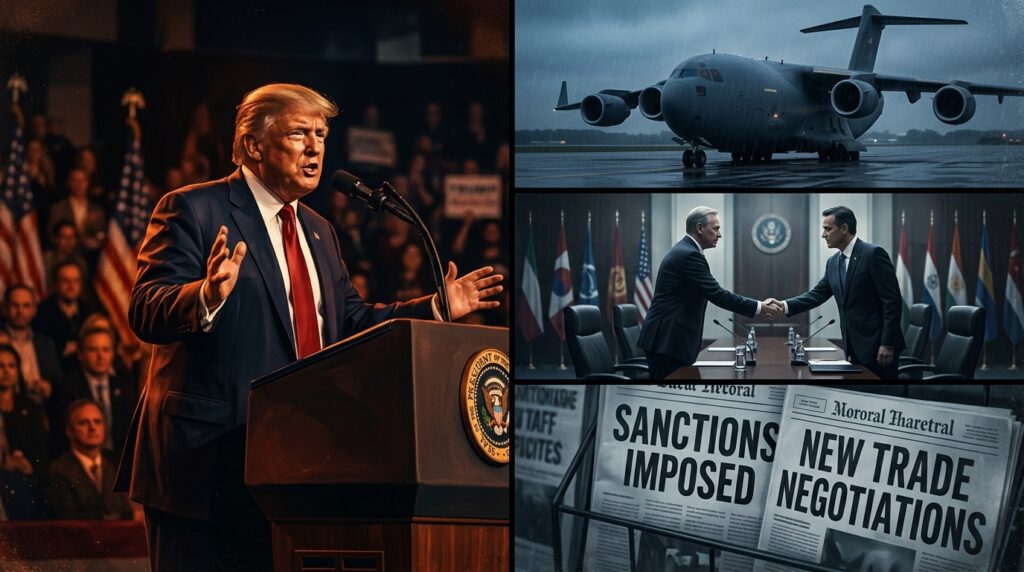
How Many Trump Threats Actually Become Reality?
This is one of the most important questions surrounding the current crisis.
Cases Where Trump’s Threats Became Real
- The maximum pressure sanctions campaign against Iran
- Major economic restrictions and oil sanctions
- The killing of Iranian General Qassem Soleimani
- Military deployments and airstrikes
Cases Where Threats Were Exaggerated or Reversed
- Statements about a whole civilisation dying
- Claims that Iran’s nuclear program was completely obliterated
- Predictions of immediate escalation that never happened
The pattern suggests Trump often uses:
- Psychological pressure
- Strategic unpredictability
- Media dominance
- Negotiation leverage
His statements should therefore neither be fully dismissed nor taken literally at face value.
Why Israel Is Nervous About the Emerging Deal?
Israel’s reaction to Trump’s announcement appears cautious and deeply concerned.
Israeli leadership has long argued that Iran must never retain the ability to eventually build a nuclear weapon.
Many Israeli security officials fear temporary agreements could:
- Reduce pressure on Iran too early
- Allow Tehran to regroup
- Preserve nuclear infrastructure
- Delay rather than solve the problem
Reports suggest tensions emerged between Israeli Prime Minister Benjamin Netanyahu and Trump regarding the pace and direction of negotiations.
Trump and Israel May Define Success Differently
Trump’s Priority
- Avoid a wider regional war
- Protect oil markets
- Stabilise the global economy
- Achieve a diplomatic victory
Israel’s Priority
- Permanently limit Iran’s nuclear capability
- Maintain strategic pressure
- Prevent weak enforcement systems
- Avoid temporary freeze agreements
These goals overlap partly but not completely.
That strategic difference explains the visible tension behind recent announcements.
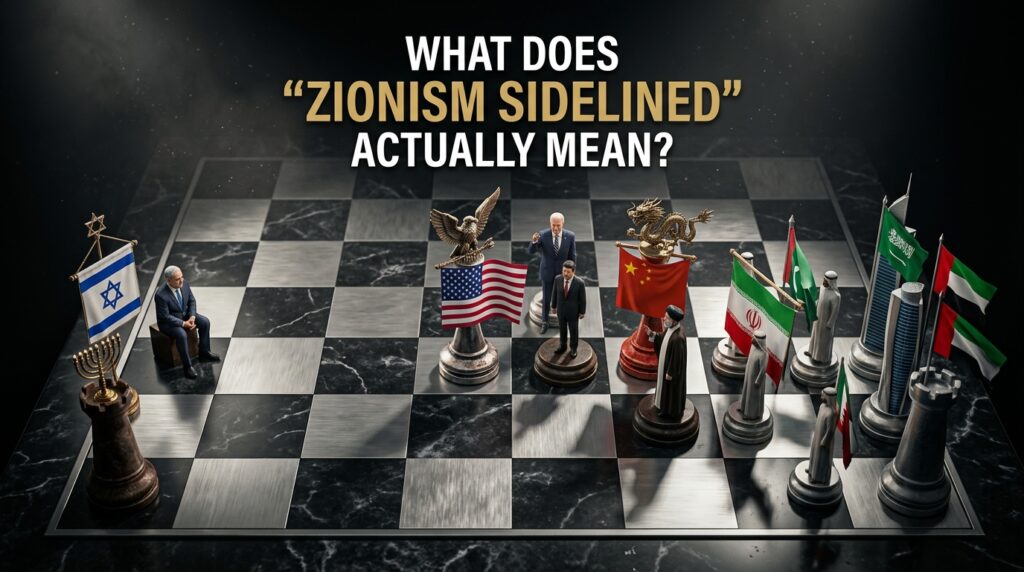
Trump’s Secretive Deal Talks: What Does Zionism Sidelined Actually Mean?
Some online commentators claimed recent developments show that Zionism has been sidelined.
In reality, this phrase is often oversimplified and emotionally charged.
Most analysts using this phrase are usually referring to one specific perception:
The United States may currently prioritise economic stability and regional de-escalation over the harder line preferences of some Israeli political factions.
This does not mean:
- The US-Israel alliance has collapsed
- Israel lost all influence
- America abandoned Israel
Instead, it likely reflects a tactical disagreement about how much conflict the region and the global economy can currently absorb.
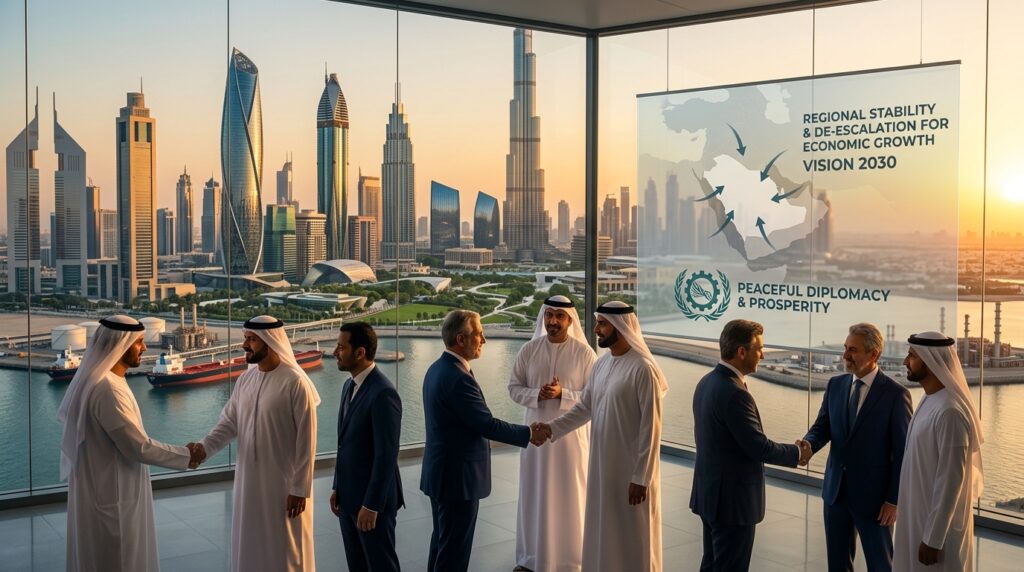
Why Gulf Arab States Also Support De-Escalation
Countries like Saudi Arabia, the UAE, Qatar, and Oman increasingly prioritise:
- Economic modernization
- Regional stability
- Foreign investment
- Protected energy exports
A major regional war threatens all of those goals.
This changing regional landscape helps explain why diplomacy is receiving broader support than in previous years.
China and Russia’s Hidden Interests
China Benefits From Stability
China depends heavily on Middle Eastern energy imports.
Stable Gulf shipping routes help Beijing by:
- Protecting energy supplies
- Reducing economic uncertainty
- Supporting long-term infrastructure investments
- Expanding Chinese regional influence
Russia’s More Complicated Position
Russia benefits from high oil prices but also wants to avoid uncontrolled regional chaos.
Moscow, therefore, has mixed strategic incentives regarding the negotiations.
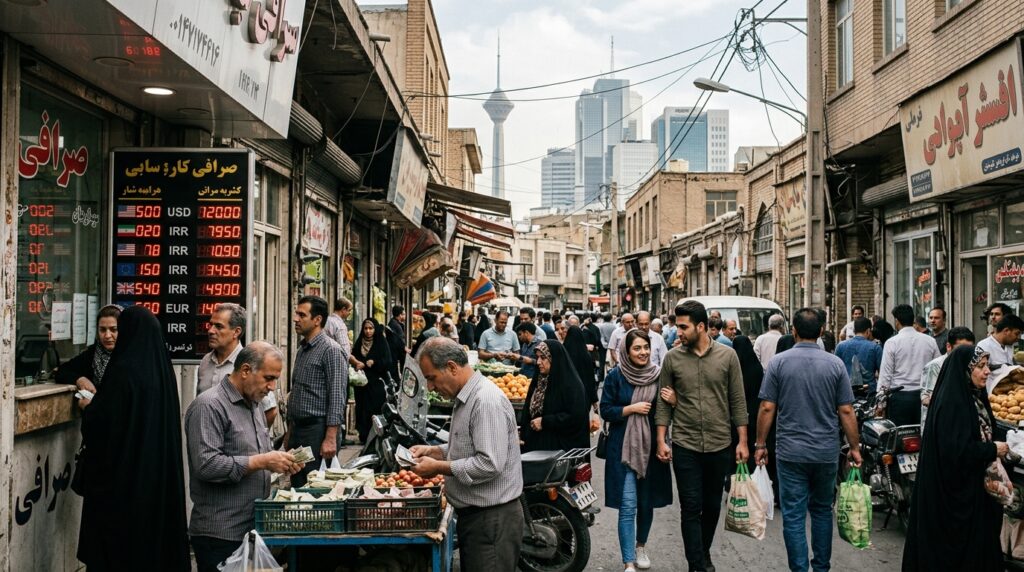
Could Iran’s Economy Recover? Trump’s Secretive Deal Talks
Years of sanctions severely damaged Iran’s economy.
The country continues to struggle with:
- Inflation
- Currency weakness
- Youth unemployment
- Public frustration
If sanctions ease, Iran could potentially:
- Increase oil exports
- Recover frozen assets
- Attract foreign investment
- Improve domestic stability
However, long-term economic recovery would still face serious obstacles.
What Happens If The Talks Collapse?
The consequences could be severe for the entire world.
Possible Scenarios
- Oil price shock
- Regional military escalation
- Cyber warfare
- Proxy conflicts
- Global market instability
- Growing nuclear tensions
This explains why so many governments currently support de-escalation efforts despite ongoing mistrust.
The Bigger Geopolitical Reality
The current US-Iran negotiations are not simply about nuclear technology.
They are about:
- Global energy security
- American political strategy
- Israel’s long-term security fears
- China’s expanding influence
- Russia’s geopolitical calculations
- The future balance of power in the Middle East
The world may now be witnessing either:
- The beginning of cautious stabilisation
- Or merely another pause before future confrontation
Trump’s Secretive Deal Talks: Final Analysis
The most realistic conclusion is this:
Neither the United States nor Iran fully trusts the other. Neither side wants a catastrophic regional war. Both sides also understand that the global economy has become too fragile for uncontrolled escalation.
That creates a narrow but important space for diplomacy.
Whether this space leads to lasting stability or simply temporary calm may define the next decade of Middle Eastern geopolitics.
FAQs
1. Is the US-Iran deal already finalised?
No. Reports suggest broad principles may have been discussed, but no fully finalised agreement has officially been confirmed.
2. Why is the Strait of Hormuz so important?
The Strait of Hormuz carries a major portion of the world’s oil supply. Any disruption there can impact fuel prices and the global economy.
3. Why is Israel worried about the talks?
Israel fears Iran could preserve long-term nuclear capability even under temporary agreements and weaker enforcement systems.
4. Does Trump usually follow through on threats?
Sometimes yes and sometimes no. Trump often uses aggressive rhetoric as negotiation leverage, but he has also authorised real military and economic actions in the past.
5. What does Zionism sidelined mean in this context?
It generally refers to perceptions that U.S. economic and diplomatic priorities may currently outweigh the preferences of some Israeli hardline factions. It does not mean the US-Israel alliance has ended.
6. What could happen if the negotiations fail?
Possible consequences include oil price spikes, regional war, cyber attacks, economic instability, and renewed nuclear escalation.
Editorial Policy Statement
This article is an investigative geopolitical analysis based on publicly available international reporting, historical context, strategic assessments, and expert commentary available at the time of writing. The purpose is to explain complex developments in simple, balanced, and accessible language for a global audience. The article does not promote political propaganda, religious hostility, antisemitism, or support for any state actor. Geopolitical situations evolve rapidly, and some claims discussed remain subject to ongoing verification.
References
- Reuters reports on U.S. Iran negotiations and Strait of Hormuz discussions
- Reuters coverage of Trump statements regarding Iran negotiations
- The Guardian analysis of Trump’s Iran diplomacy and regional implications
- Axios reports on U.S. Israel tensions regarding Iran negotiations
- PBS NewsHour coverage of Trump warnings and Middle East developments
- FactCheck.org analysis of Trump claims regarding Iran’s nuclear capabilities
- Politifact examination of escalation rhetoric and military claims
- International Atomic Energy Agency reports and monitoring discussions
- Academic analyses on sanctions, energy security, and Middle East geopolitics