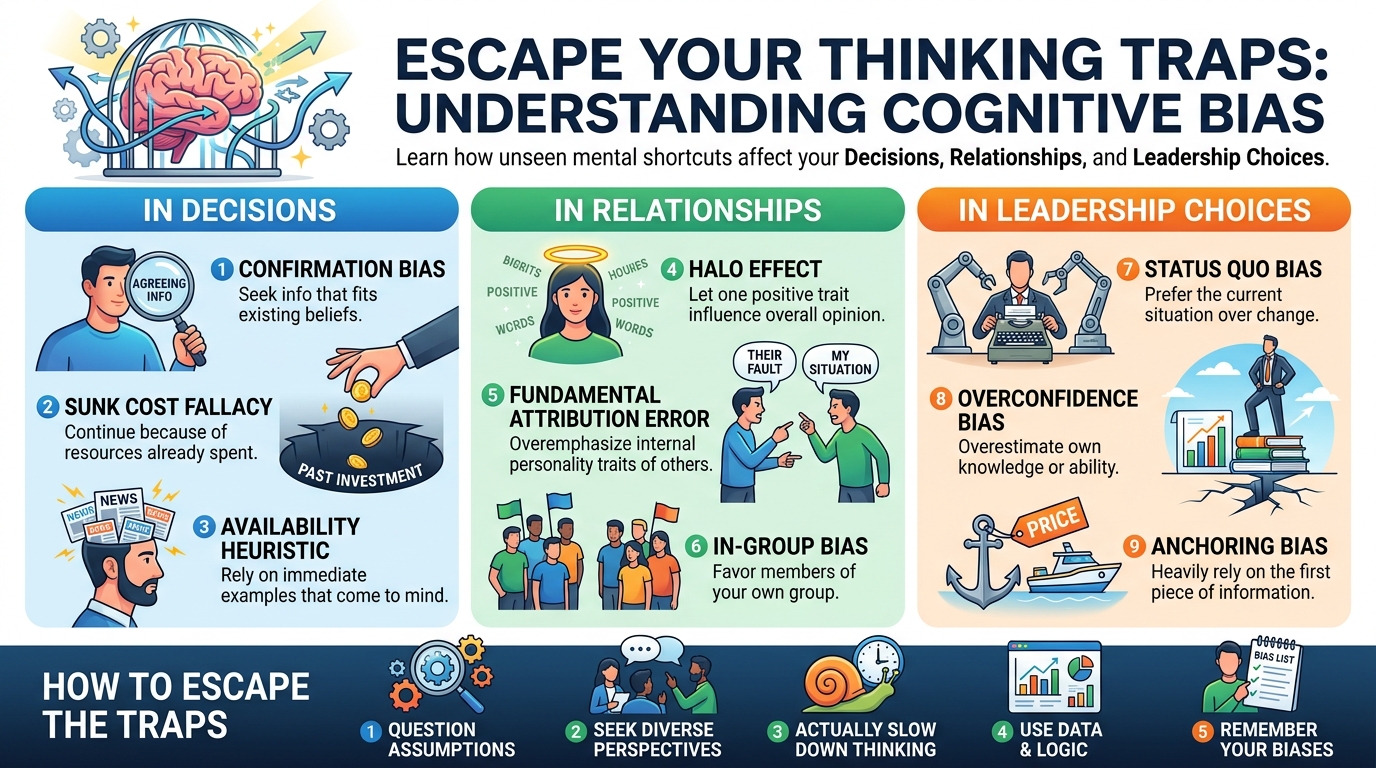

Cognitive Bias: Escape Your Thinking Traps
Cognitive Bias: Escape Your Thinking Traps, learn how cognitive biases shape your decisions, relationships, and leadership choices. Discover five proven ways to escape thinking traps and improve judgment every day.
https://mrpo.pk/understanding-humans/
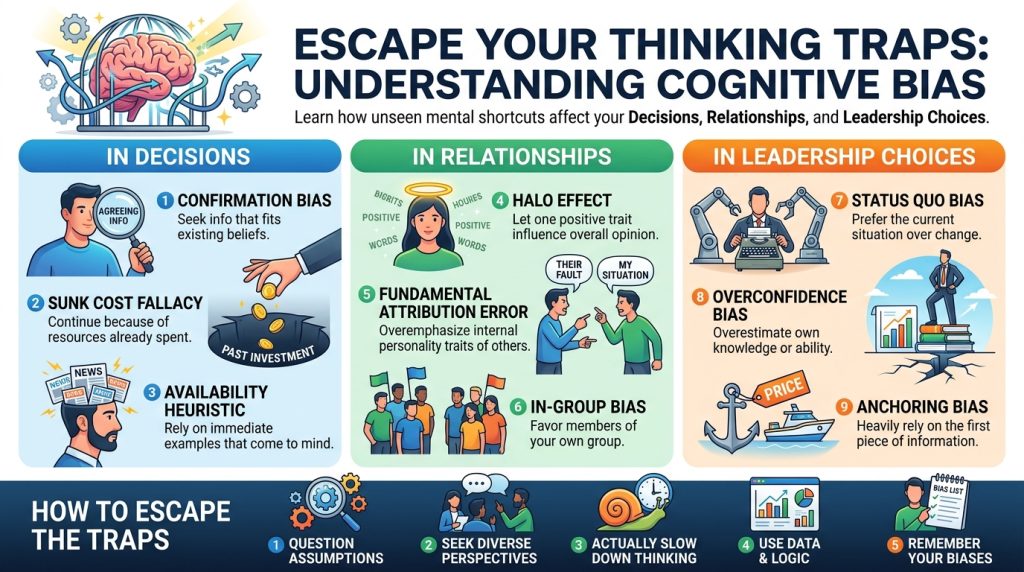
Introduction: The Trap of Being Right
What if the biggest mistake you make today isn’t what you don’t know… but what you’re sure about?
Imagine a workplace meeting.
A manager presents a new strategy. Team members raise concerns. Some numbers don’t match reality.
But the manager refuses to listen.
“I know what I’m doing.”
Six months later, the project fails.
The failure didn’t happen because of a lack of intelligence.
It happened because of certainty without questioning.
This is how cognitive bias works, quietly, confidently, and often invisibly.
We all want to be right.
But the desire to be right sometimes blocks the path to truth.
And when that happens, mistakes grow in silence.
What Are Cognitive Biases?
Cognitive biases are mental shortcuts the brain uses to make fast decisions.
Without them, daily life would feel slow and overwhelming.
But shortcuts have trade-offs.
They increase speed , but sometimes reduce accuracy.
These thinking shortcuts affect how we judge people, events, risks, and decisions.
Common Cognitive Biases
Confirmation Bias
The tendency to search for information that supports existing beliefs.
People notice supportive facts — and ignore conflicting ones.
Anchoring Bias
Relying too heavily on the first piece of information received.
Even when new information appears, the first number sticks.
Availability Bias
Judging risk based on recent or memorable events.
Dramatic stories feel more common than they really are.
Why Smart People Still Get Things Wrong
Intelligence alone does not protect against bias.
In some cases, intelligence strengthens bias.
Why?
Because intelligent people are skilled at defending their ideas.
Even incorrect ones.

The Ego Factor
Beliefs often connect to identity.
Changing an opinion can feel like losing confidence or respect.
So instead of questioning ideas, people defend them.
Even when evidence suggests change is needed.
The Hidden Cost of Always Being Right
Always needing to be correct may feel powerful.
But it comes with hidden costs.
Workplace Consequences
Teams perform best when ideas are tested.
When leaders reject feedback, mistakes increase.
Innovation slows.
Morale drops.
Relationship Consequences
Listening builds trust.
Defensiveness destroys it.
When conversations become battles, relationships weaken.
Leadership Consequences
History repeatedly shows the same pattern:
Unchecked certainty leads to big mistakes.
Not because leaders lack intelligence.
But because they lack self-questioning.
The 5 Ways to Escape Your Own Bias
These five strategies act like tools.
Use them regularly, and thinking becomes clearer.
1. Admit You Might Be Wrong
This is the foundation of clear thinking.
Not weakness.
Strength.
Asking:
“What if I am wrong?”
opens the door to improvement.
2. Seek Disagreement
Opposing views strengthen thinking.
Echo chambers weaken it.
Healthy disagreement creates stronger decisions.
3. Consider the Opposite
Before making a decision, imagine failure.
Ask:
“What reasons might prove this wrong?”
This method reveals hidden risks.
4. Slow Down Your Thinking
Fast reactions increase mistakes.
Slower thinking improves accuracy.
Pause before deciding.
Especially when emotions are strong.

5. Broaden Your Information Sources
Relying on one source limits understanding.
Multiple sources reveal missing details.
Truth rarely lives in one place.
Real-Life Consequences of Bias
Bias influences daily life in powerful ways.
Often without warning.
In Business
Ignoring customer feedback leads to failure.
Companies collapse not from competition, but from overconfidence.
In Politics
Leadership decisions shape nations.
Bias in leadership creates long-term consequences.
Listening prevents disaster.
In Personal Life
Misunderstandings grow when listening stops.
Relationships weaken when certainty replaces curiosity.
How to Build a Bias-Resistant Mind
Strong thinking requires practice.
Not perfection.
Daily Thinking Habits
- Write important decisions
- Ask for honest feedback
- Review past mistakes
- Reflect regularly
Reflection builds awareness.
Awareness reduces error.
The Mindset Shift From Winning to Learning
Many people treat conversations like competitions.
They want to win.
But wise thinkers seek understanding.
Winning arguments creates pride.
Learning creates progress.
Powerful Supporting Quotes
“The greatest enemy of knowledge is not ignorance, it is the illusion of knowledge.”
— Stephen Hawking
“It is the mark of an educated mind to be able to entertain a thought without accepting it.”
— Aristotle
“If you are not willing to risk being wrong, you will never come up with anything original.”
— Ken Robinson
Conclusion: The Courage to Question Yourself
Being right feels rewarding.
But being accurate creates lasting success.
Clear thinking begins with humility.
No doubt.
Awareness.
The strongest thinkers are not those who never make mistakes.
They are those who notice mistakes early —
and correct them quickly.
Call-to-Action
Before closing this page, take a moment.
Ask yourself:
What belief should I question today?
Growth begins with one honest question.
Frequently Asked Questions (FAQs)
What is cognitive bias in simple terms?
A thinking shortcut that helps make quick decisions, but sometimes leads to mistakes.
Why do people resist changing opinions?
Because beliefs connect to pride and identity.
Changing them can feel uncomfortable.
Can intelligent people be biased?
Yes. Intelligence does not remove bias.
How do I reduce thinking bias?
Seek opposing views, slow down decisions, and question assumptions.
What is confirmation bias?
Searching for information that supports beliefs while ignoring contradictions.
Why is intellectual humility important?
It improves learning and reduces costly mistakes.
References
Books
- Thinking, Fast and Slow — by Daniel Kahneman
- The Art of Thinking Clearly — by Rolf Dobelli
Academic Fields
- Behavioral Economics
- Cognitive Psychology