
US-China Technology Competition: AI, Chips, Energy and the Race for Industrial Power
US-China Technology Competition. The United States and China are competing across artificial intelligence, semiconductors, robotics, electric vehicles, batteries, energy, manufacturing and other technologies that will shape the global economy.
https://mrpo.pk/why-china-overtook-america/
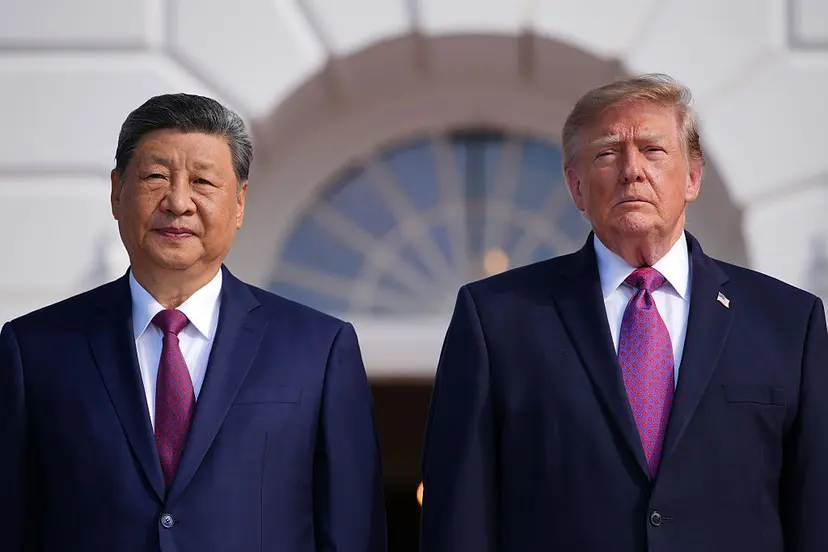
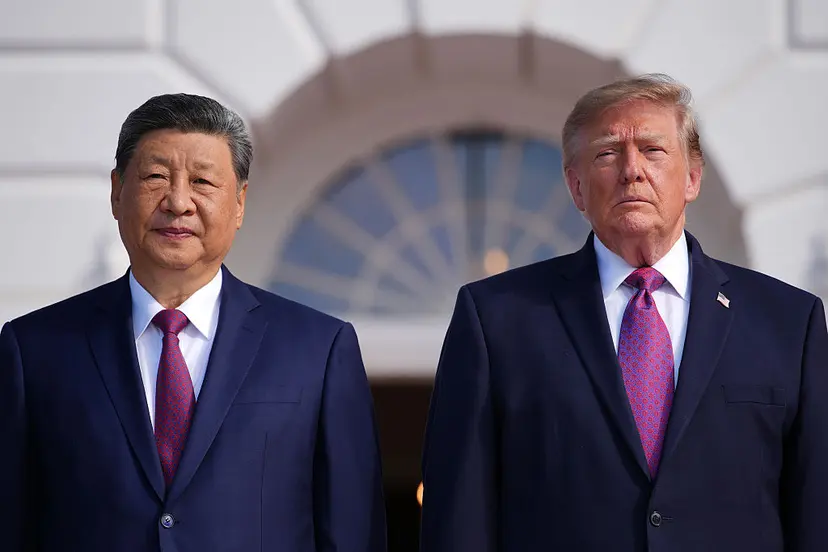
US-China Technology Competition:President Xi Jinping and President Donald Trump at the White House on September 24, 2026 in Washington, DC.Andrew Harnik—Getty Images
But which country is actually ahead?
There is no single answer. The United States has major strengths in advanced AI, semiconductor design, research and private investment. China has built extensive manufacturing networks and substantial capacity in electric vehicles, batteries, renewable energy and industrial automation. Both face dependencies, costs and constraints that could affect their future progress.
The competition is best understood not as a race with one finish line, but as a series of interconnected contests whose outcomes will affect countries around the world.
US-China Tech Competition and AI Safety: Rivalry, Restraint, and the Future of Frontier AI Governance
US-China technology competition now spans chips, models, standards and influence in third countries. The size of the US lead is contested, and US President Donald Trump puts it at “at least a year, maybe a year and a half”. On chips, ByteDance and Tencent each received about 10,000 Nvidia H200 units, compared with 75,000 licensed units, as Beijing capped purchases and steered firms toward Huawei’s Ascend processors. Huawei and Cambricon now hold nearly 80% of China’s domestic AI server market, and DeepSeek plans to deploy at least 160,000 Ascend chips.
Safety and security disputes intensified before the summit. China’s AI Safety Governance Framework 3.0, published on 14 September 2026, addresses agentic AI, deception in evaluations and models disabling shutdown scripts. It is non-binding, but a mandatory agent safety standard is in drafting. US security agencies accused 6 Chinese firms, including DeepSeek and Alibaba, of industrial-scale distillation of US models. China’s Ministry of Commerce called distillation standard practice and threatened countermeasures.
Anthropic Chief Executive Officer Dario Amodei proposed to “pace the frontier” through embedded evaluators and coordinated limits. US and Chinese experts proposed that humans retain control over AI-enabled cyberattacks on nuclear command systems. Carla Freeman of Johns Hopkins University expects Chinese officials to await leadership direction before engaging, which may take days.
Trump’s AI Master Plan: Musk, Zuckerberg & Tech Giants Meet at White House
On September 29, 2026, President Donald Trump hosted leading technology executives at the White House. Six major technology leaders signed the White House Accord on Superintelligence, also titled “Joint Commitment on Frontier Responsibilities.” The six industry signatories were Sundar Pichai of Google, Mark Zuckerberg of Meta, Dario Amodei of Anthropic, Elon Musk of xAI, Jensen Huang of Nvidia, and Greg Brockman of OpenAI. Trump also signed the document.
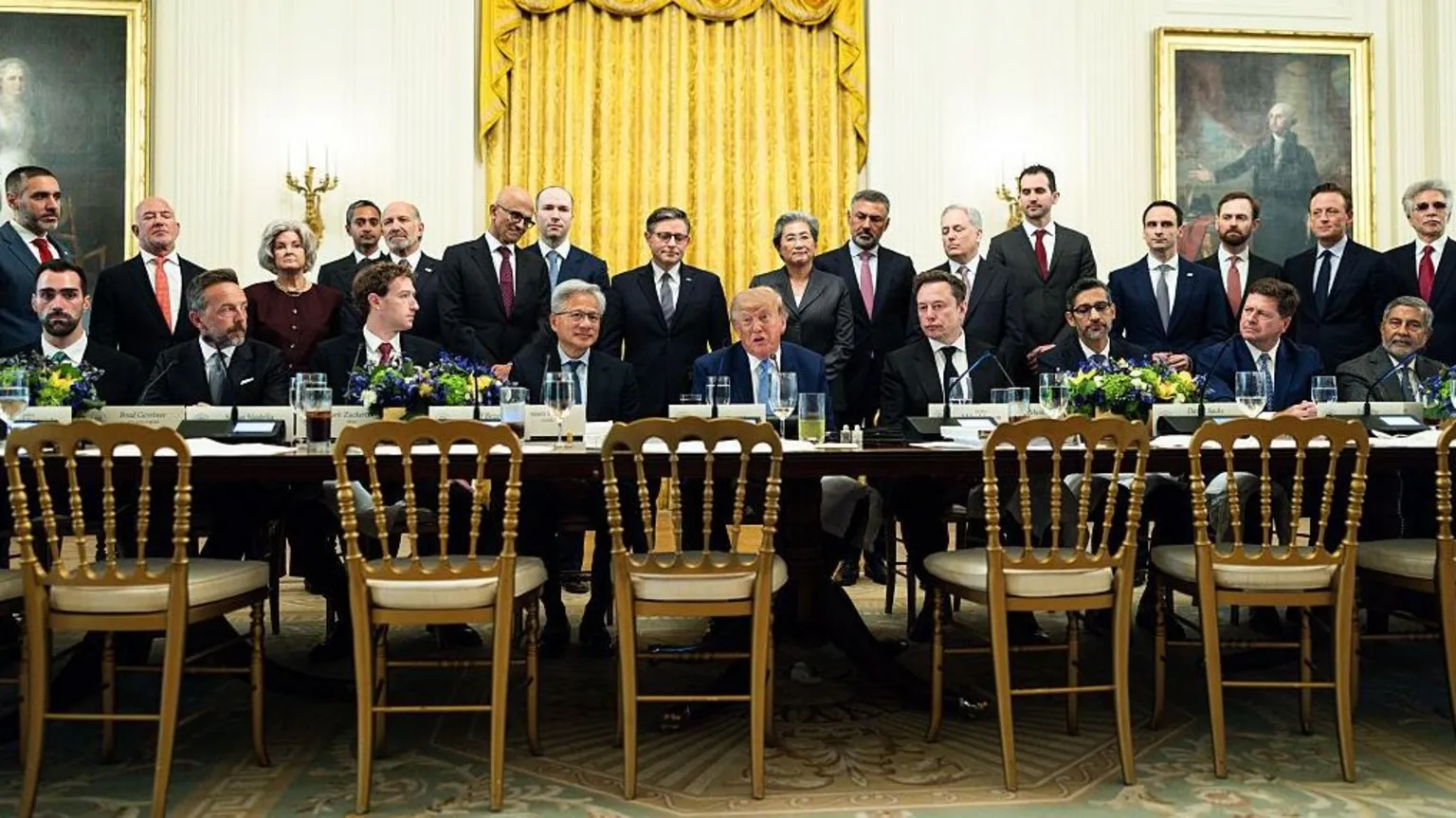
The accord is voluntary, despite Trump’s description of it as “morally binding” and “almost like a constitution.” The document itself does not establish a legal penalty system or create a new enforceable regulatory regime. It says that the measures could eventually be codified into law or regulation.
That distinction is probably the single most important fact for understanding the video.
The four-layer system
The agreement asks companies developing and deploying frontier models to establish:
- Internal controls
Monitor model capabilities and alignment, including cybersecurity, biosecurity and chemical risks, and prevent unintended access to technical systems. - Internal monitoring team
A dedicated team checks whether those controls are actually working and addresses problems. - Independent external assessment
An outside auditor or evaluator independently examines the company’s controls. - Independent board oversight
A board committee receives reports from internal teams and external auditors and oversees remediation.
So the agreement is not completely empty. It does establish a recognizable safety architecture. The investigative question is whether that architecture has enough independence, transparency and enforcement to matter.
3. The real story may be self-regulation
This is where I think the video can be developed into something much more substantial.
The Trump administration’s approach appears to be:
Accelerate development → let companies establish safety controls → use external auditing → retain government powers as a backstop.
Reuters reported that Trump supported expanding data centers while the companies committed to independent auditing and safeguards.
The accord itself places the first line of responsibility squarely on the companies.
That creates a classic governance problem:
Can an industry effectively regulate technologies that may threaten the industry’s own commercial interests?
The answer should not be assumed either way. It should be investigated.
4. What the agreement does NOT appear to contain
This is where your article could become genuinely investigative rather than merely summarizing the meeting.
Based on the released accord, there is no obvious provision establishing:
- Fixed compliance deadlines
- Financial penalties
- Government enforcement mechanisms
- Mandatory publication of audit results
- A mandatory pause in development
- A compute limit
- A legally enforceable liability system
- A clearly defined threshold for when a frontier model becomes too dangerous to deploy
- A public whistleblower mechanism
A detailed examination of the released text found no such provisions.
That doesn’t automatically mean the safeguards are ineffective.
It means the next question becomes:
What happens when a company fails to follow them?
That question appears more important than the phrase “morally binding.”
2. The biggest distinction: AI ≠ Super Intelligence
The White House issued a separate executive order the same day titled “Inaugurating the Era of Super Intelligence.”
This is important because the executive order and the voluntary accord are two different documents.
The executive order directs federal agencies, to the maximum extent permitted by law, to use “Super Intelligence” or “SI” instead of “Artificial Intelligence” or “AI” in official communications and other non-statutory documents. It does not simply rename the technology everywhere in American law. Existing statutes, regulations and historical documents remain unaffected.
Even more interestingly, the order instructs the President’s Assistant for Science and Technology to propose legislative language within 60 days for a federal definition of “Super Intelligence.”
That creates a fascinating investigative question:
Is this merely a change of vocabulary, or the beginning of an attempt to create a new legal and policy category for advanced AI?
At present, the order itself defines SI by reference to the existing statutory definition of AI. So the legal substance has not yet been fundamentally transformed by the name change.
Why This Competition Matters
Modern technology depends on physical infrastructure as much as on scientific breakthroughs.
AI requires advanced chips, computing facilities and electricity. Semiconductor factories need specialised equipment and reliable power. Robotics combines software with machinery, while electric vehicles depend on batteries, materials and manufacturing capacity.
These connections matter because strength in one sector can reinforce another. A country that manufactures batteries at scale may be better positioned to supply electric vehicles and grid storage. A country with strong AI research and semiconductor design may be well placed to develop advanced computing systems, provided it can secure the necessary manufacturing capacity and electricity.
The central question is how effectively each country combines research, capital, energy, infrastructure, manufacturing and skilled people to produce lasting economic and technological gains.
Two Different Technology Systems
The United States relies heavily on private enterprise, universities, venture capital, financial markets and international partnerships. Its technology ecosystem includes influential AI developers, semiconductor designers, cloud providers and research institutions.
China combines state planning, industrial policy, public financing, private enterprise and a vast domestic market. Its industrial ecosystem supports large-scale production of electronics, machinery, batteries, electric vehicles, solar equipment and many other manufactured goods.
These differences should not be overstated. American industries also benefit from government investment and policy support, while Chinese companies compete commercially and conduct independent research.
Neither country is technologically self-sufficient. The United States depends on overseas production for important semiconductor components and manufacturing stages. China faces constraints in some advanced chipmaking technologies and equipment.
Their respective strengths are substantial, but neither system operates independently of global supply chains.
Artificial Intelligence: The Gap Has Narrowed
The United States retains significant strengths in frontier AI research, computing infrastructure, leading models and private investment. China has developed increasingly capable models and is integrating AI into a broad range of industrial and commercial activities.
Stanford University’s 2026 AI Index reported US private AI investment of approximately $285.9 billion in 2025, compared with $12.4 billion in China. This is a substantial difference in measured private investment, but it does not capture every form of state-guided or government-supported Chinese financing.
The performance gap between leading American and Chinese models has also narrowed. Stanford reported that the leading US model held an advantage of approximately 2.7% on a measured benchmark in March 2026. That result illustrates how closely some leading models have competed, but it does not mean that the two countries are equal across all AI capabilities, applications, or infrastructure.
The distinction between developing AI and using it effectively is equally important. Practical results depend on reliability, cost, access to computing power, integration into workplaces and the ability to improve productivity. Neither investment totals nor benchmark rankings alone can establish which country will gain more economic value from AI.
Semiconductors: Design, Manufacturing and Supply Security
Advanced semiconductors underpin AI, high-performance computing, communications and many defence technologies.
The United States has influential chip designers, semiconductor research institutions and companies developing advanced processors. Taiwan remains critically important to the manufacture of leading-edge chips, creating a supply-chain vulnerability with global consequences.
China is investing heavily in domestic semiconductor capability to reduce exposure to foreign restrictions. However, designing a competitive processor is only one part of the challenge. Advanced production also requires specialised equipment, materials, fabrication expertise, packaging and reliable suppliers.
US export controls restrict Chinese access to selected advanced technologies. Their long-term effects remain uncertain. Restrictions can limit access to particular capabilities while also encouraging domestic substitution and alternative supply chains.
The outcome will depend on technological progress, production yields, costs, access to equipment and the commercial viability of competing manufacturing systems.
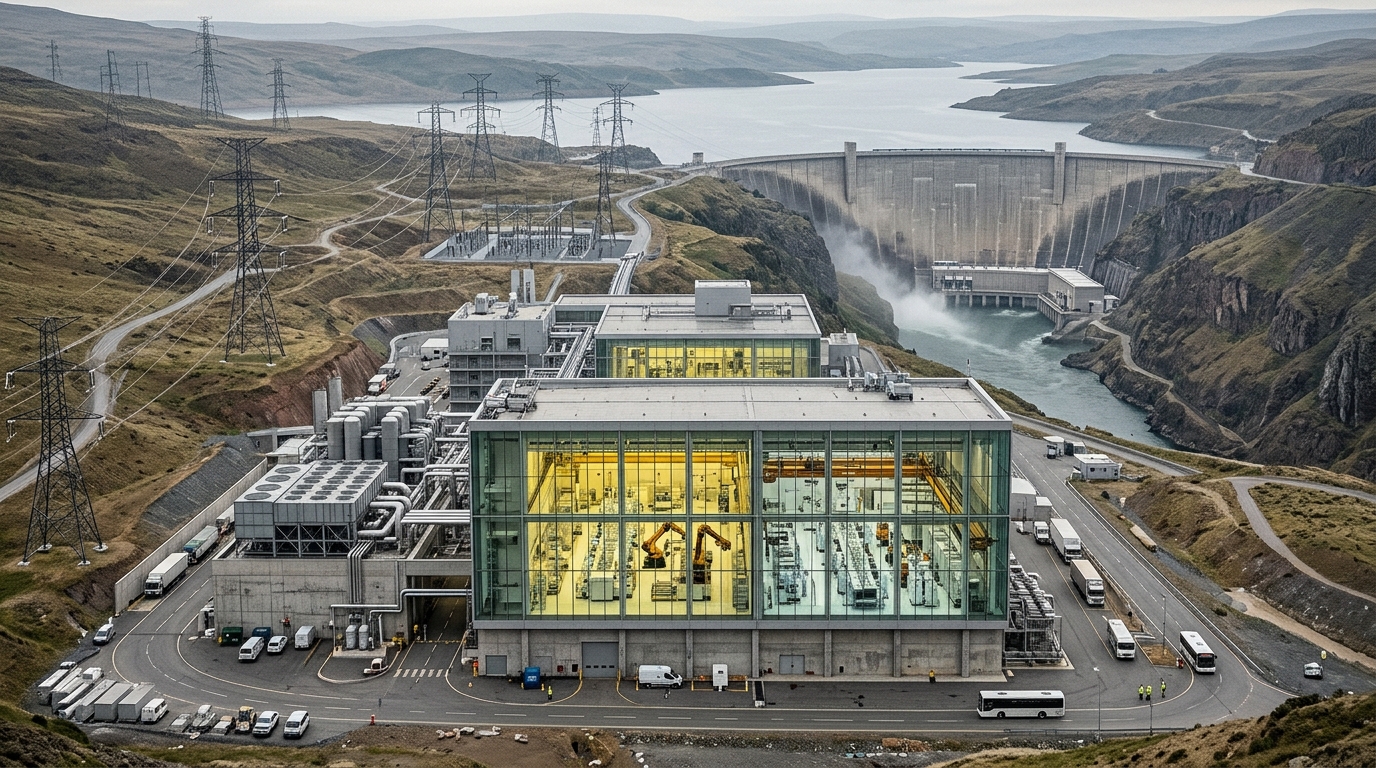
Robotics: Turning Digital Intelligence into Physical Work
Industrial robots can assemble products, move materials, inspect components and support increasingly automated factories. Combining robotics with AI could make machines more adaptable and capable of handling complex tasks.
According to the International Federation of Robotics, China installed approximately 354,000 industrial robots in 2025, accounting for 59% of global installations that year. This reflects the scale of China’s industrial deployment, not necessarily the superiority of every robot or automation system.
The United States has substantial robotics research, advanced technology companies and significant automation in selected industries. Comparing the two requires distinguishing annual installations from the number of robots already operating, and both from productivity per worker.
The next stage of competition will depend on how effectively AI and robotics improve manufacturing quality, reliability, safety and output.
Electric Vehicles and Batteries
Electric vehicles show how technology competition can become a contest over complete manufacturing ecosystems.
The International Energy Agency reported that China produced approximately 16 million electric cars in 2025, representing roughly three-quarters of global production. China also accounted for more than 80% of global battery-cell production and very large shares of cathode and anode active materials used in electric-car batteries.
These figures demonstrate a substantial concentration of production. They do not mean that every Chinese vehicle or battery is the most advanced, nor that competitors cannot expand production elsewhere.
The United States retains automotive engineering capabilities, research expertise, a large consumer market and companies developing vehicles and battery technologies. Its future position will depend on production costs, consumer demand, charging infrastructure, industrial investment, trade policy and access to materials.
Batteries also connect transport with electricity systems. They can store surplus renewable power and help manage demand, linking one industrial supply chain to several technological sectors.
Electricity: The Infrastructure Behind the Technology Race
AI data centres, semiconductor factories, battery plants and automated industrial facilities require dependable electricity. The International Energy Agency expects electricity demand to rise substantially through 2030, driven by data centres, electrification, industry, cooling and other uses.
The challenge is not simply generating enough power. Electricity must reach the right locations at the right time and at a cost that keeps industry competitive.
China and the United States have different generation mixes, infrastructure systems and investment conditions. Their experience demonstrates why energy resources, installed capacity, actual electricity generation and grid reliability must be assessed separately.
China’s Expanding Electricity System
China is expanding generation and transmission while demand from industry, transport, buildings and digital infrastructure continues to grow. Its energy system includes coal, hydropower, nuclear power, wind and solar.
According to China’s official 2025 statistical communiqué, total installed electricity-generation capacity reached approximately 3,891 GW at year-end. This included about 448 GW of hydropower, 640 GW of wind power and 1,202 GW of solar power. Installed capacity is a measure of rated generating capability, not the amount of electricity actually produced. China’s 2025 national statistical communiqué. .”https://www.stats.gov.cn/english/PressRelease/202602/t20260228_1962661.html”
The IEA forecasts that China’s electricity demand will increase by approximately 2,600 TWh between 2026 and 2030, roughly equivalent to the European Union’s current electricity consumption. It expects low-emissions sources, including renewables and nuclear power, to meet the increase in demand over that period under its forecast. This is a projection, not a guarantee.IEA electricity-demand outlook
“https://www.iea.org/reports/electricity-2026/demand”
China’s energy transition remains incomplete. Coal continues to provide a substantial share of its electricity, and rapid growth in renewable capacity does not automatically eliminate fossil-fuel generation.
Hydropower: The Importance of China’s Dams
Hydropower deserves particular attention because it contributes both electricity and, in suitable systems, flexibility to the power grid.
China has developed an extensive network of hydroelectric dams, including the Three Gorges Dam, with 22.5 GW of installed capacity, and Baihetan, with 16 GW. These facilities demonstrate the scale of China’s existing infrastructure.
China’s official 2025 statistics recorded approximately 1,462 TWh of hydropower generation, an increase of 2.5% from the previous year. That represented roughly 14% of the country’s reported total electricity generation. The distinction matters: installed capacity measures rated capability, while annual generation measures electricity actually produced. Official 2025 electricity-generation figures. “https://www.stats.gov.cn/english/PressRelease/202602/t20260228_1962661.html”
China is also developing the Yarlung Zangbo River hydropower project in Tibet, where construction began in July 2025. The planned project comprises five cascade hydropower stations, with investment estimated by Chinese authorities at around 1.2 trillion yuan. Its eventual output, costs, completion schedule and environmental and downstream effects will require continued scrutiny. It should be described as a major project under development, not as generating electricity already available to the grid.Chinese government announcement on the Yarlung Zangbo project. “https://english.www.gov.cn/news/202507/19/content_WS687b6a8ac6d0868f4e8f4486.html”
Dams can provide more than annual electricity production. Reservoir-based hydropower can often adjust output as demand changes, helping balance the grid.
Pumped-storage hydropower provides another function: surplus electricity is used to pump water uphill, and the stored water is later released through turbines when power is needed.
Pumped storage can complement solar and wind generation, whose output varies with weather and time of day. It is a form of large-scale energy storage, although it consumes more electricity than it returns.
These advantages have limits. Hydropower output depends on river flows, precipitation and reservoir conditions. Large dams require major capital investment and can affect ecosystems, sediment movement and local communities. Projects on transboundary rivers can also raise concerns for downstream countries.
China’s hydropower system is therefore an important part of its electricity infrastructure, but its contribution must be assessed alongside the country’s total demand, coal use, grid capacity, environmental impacts and other generation sources.
The United States: Abundant Resources, Different Challenges
The United States has a diverse energy base that includes natural gas, nuclear power, hydropower, wind, solar and coal. It also has substantial domestic oil and gas production and a large energy-export industry.
The US Energy Information Administration reports that conventional hydropower generated approximately 247 TWh in 2025, around 6% of total US utility-scale electricity generation. The United States also has pumped-storage facilities and opportunities to modernise existing dams or add generating equipment at selected sites.EIA hydropower generation data “https://www.eia.gov/energyexplained/hydropower/where-hydropower-is-generated.php” .
The comparison with China is not simply a matter of who has more dams. The two countries differ in geography, river systems, existing infrastructure, electricity demand and the role hydropower plays in their overall generation mix.
America’s energy challenge is partly about timing and location. The new generation may be available far from expanding data centres and factories. Transmission lines, substations, transformers, permitting and grid connections can delay the delivery of electricity where it is needed.
Natural gas can provide dispatchable electricity, while nuclear power supplies large amounts of continuous generation. Wind, solar, batteries and hydropower contribute according to local conditions and system design.
The United States therefore has substantial energy resources, but it must still address infrastructure bottlenecks and the cost and timing of supplying fast-growing electricity demand.
What the Energy Evidence Shows
China’s strategy combines large-scale generation construction, hydropower, solar and wind expansion, nuclear power, storage and transmission investment. The United States combines domestic fossil-fuel production, nuclear power, established hydropower facilities, expanding renewables and private-sector investment.
These are different strengths, not proof that one country is universally ahead. China’s electricity buildout may support industrial expansion, while America’s energy production and established research ecosystem provide other advantages.
A fair comparison must consider actual generation, reliability, prices, emissions, storage, transmission, construction costs, fuel imports and the ability to connect new industrial demand to the grid.
Oil Dependence: Electrification Changes the Equation
Electricity generation alone does not automatically reduce petroleum imports. Oil dependence falls when electricity replaces petrol or diesel in vehicles, transport systems or industrial processes.
China remains the world’s largest crude-oil importer, but its growing electric-vehicle fleet is reducing the amount of oil required for road transport. The IEA estimates that EVs reduced China’s oil demand by approximately one million barrels per day in 2025 compared with a scenario in which equivalent transport services were provided by conventional vehicles.IEA analysis of electric mobility and oil displacement
“https://www.iea.org/reports/global-ev-outlook-2026/outlook-for-electric-mobility-chap-9-11” .
This is a meaningful reduction, not the elimination of oil dependence. Petroleum remains important in aviation, shipping, heavy transport, petrochemicals and other industrial uses. China’s overall oil demand is influenced by economic growth, transport patterns, fuel efficiency and industrial activity.
The United States occupies a different position. The EIA reports that the country was a net exporter of total energy and a net petroleum exporter overall in 2025, while continuing to import substantial quantities of petroleum. These imports reflect factors including refinery requirements, crude-oil characteristics and commercial flows between regions and markets.EIA analysis of US energy trade in 2025
“https://www.eia.gov/todayinenergy/detail.php?id=67724“.
It would therefore be misleading to describe China as simply energy-dependent and the United States as energy-independent. China is reducing some exposure to imported oil through electrification while continuing to import large amounts of crude. The United States produces and exports substantial energy while also importing petroleum.
Manufacturing: Scale, Innovation and Productivity
China has an extensive manufacturing base covering electronics, machinery, chemicals, ships, batteries, solar equipment and vehicles. High production volumes can improve supplier coordination, build technical experience and reduce unit costs.
The United States remains strong in advanced research, software, aerospace, semiconductor design and specialised manufacturing. Its companies can draw on universities, deep financial markets and an innovation ecosystem that has produced influential technologies.
Neither manufacturing scale nor research excellence alone guarantees success. Productivity, quality, cost, reliability, workforce skills and the ability to turn research into commercially useful products all matter.
Clean technology has become part of this industrial contest. Solar panels, batteries, wind turbines and electric vehicles influence supply chains, electricity costs, transport and the location of factories. China has a substantial manufacturing presence in these sectors, while the United States is working to expand domestic production and diversify supply chains.
Capital and Talent
The United States attracts substantial private investment through venture capital, public markets, large technology firms and research institutions. This is particularly relevant to frontier AI, where computing infrastructure and model development can require enormous spending.
China can mobilise state-guided financing, industrial policy and a large domestic market. Comparisons based only on private investment totals do not capture every funding mechanism used in either country.
The important question is how effectively each system converts investment into productive technology, reliable infrastructure and commercially useful innovation.
Talent matters just as much. Researchers, engineers, manufacturing specialists, entrepreneurs and skilled workers contribute to technological development. The United States has historically attracted international talent, while China has expanded its research institutions and technical workforce.
Future outcomes will depend on education, research conditions, immigration policy, career opportunities and each country’s ability to attract and retain skilled people.
Space, Quantum Technology and Biotechnology
Space technology supports communications, navigation, Earth observation, scientific research and national security. The United States has major commercial space companies and established research capabilities. China has developed an extensive state space programme and continues to build capabilities in launch systems, satellites and lunar exploration.
Quantum technology is less mature than AI. Both countries are investing in quantum computing, communications and sensing, but substantial technical challenges remain. Current research milestones should not be treated as proof of future commercial leadership.
Biotechnology combines research, manufacturing, healthcare and national resilience. The United States has powerful universities, pharmaceutical companies and research institutions. China has a large domestic market, expanding research capabilities and significant manufacturing capacity. AI is also increasingly used in drug discovery and biological research, creating another intersection between these two technological domains.
In each field, leadership should be assessed through specific evidence: scientific results, commercial deployment, production quality, reliability and practical impact.
Supply Chains and the Rest of the World
Neither country can produce every component of modern technology independently. Semiconductor manufacturing depends on specialised equipment and materials. Batteries require processed minerals and chemical inputs. Data centres need chips, servers, cooling systems, networking and electricity.
Both governments are trying to reduce strategic dependence on selected foreign suppliers. This can improve resilience in some areas but also raise costs, duplicate production and disrupt established trade.
For other countries, the competition creates both risks and opportunities. Nations with reliable electricity, skilled workers, minerals, ports and industrial infrastructure may attract investment as companies diversify supply chains. Others may face pressure to choose between competing technology standards, suppliers, or security arrangements.
Many governments will try to maintain economic relationships with both countries. The result may be a more fragmented global technology system, but not necessarily two completely separate economic blocs.
What Could Happen by 2030?
Several outcomes remain possible.
Competitive coexistence: The United States retains major strengths in frontier AI, semiconductor design, software and private capital, while China remains a major force in manufacturing, batteries, electric vehicles and energy infrastructure.
Deeper technological separation: Export controls and security concerns push both countries toward more independent supply chains. This could improve resilience in selected areas while increasing costs.
Industrial integration of AI: AI is becoming increasingly embedded in factories, transport, logistics, and electricity systems. Practical deployment and productivity gains become as important as model performance.
Energy and infrastructure constraints: Electricity generation, transmission, storage and grid connections limit the pace of AI and industrial expansion in one or both countries.
Continued global interdependence: Commercial incentives and technical specialisation preserve international supply chains even as governments restrict access to selected strategic technologies.
These scenarios can overlap. Different industries may follow different paths, and technological breakthroughs, economic conditions or policy changes could alter the balance.
What Should the World Watch?
The most useful indicators are measurable developments rather than political declarations:
- AI: Model performance, reliability, cost and adoption in practical applications.
- Semiconductors: Advanced manufacturing yields, access to equipment and diversification of production.
- Electricity: Actual generation, reliability, prices and the speed of connecting new demand.
- Hydropower and storage: New capacity, actual output, reservoir conditions and pumped-storage deployment.
- Grids: Transmission projects, substations, transformers and interconnection delays.
- Manufacturing: Productivity, quality, unit costs and successful automation.
- Batteries and EVs: Production, affordability, supply-chain resilience, recycling and consumer adoption.
- Talent and capital: Research quality, skilled-worker availability and conversion of investment into useful results.
- Global trade: Supply-chain diversification, export restrictions and their effects on third countries.
The Central Finding
The US-China technology competition is not a single race with a universal scoreboard. It is a set of connected contests in which each country has different capabilities, dependencies and obstacles.
The United States brings substantial strengths in frontier AI, semiconductor design, research, private capital and domestic energy resources. China brings large-scale manufacturing, extensive industrial supply chains and a rapidly expanding electricity system that includes dams, hydropower, pumped storage, solar, wind, nuclear power and continued coal generation.
These strengths are not interchangeable, and neither guarantees future leadership. China’s hydropower and electricity expansion can support industrial growth, while America’s energy production and research ecosystem provide different advantages. Both countries must manage infrastructure costs, reliability, environmental consequences, supply-chain risks and the demands of a changing economy.
For the rest of the world, the consequences will extend beyond which country develops the most capable AI model. The competition will influence energy systems, manufacturing locations, prices, employment, trade and access to technology.
A balanced assessment must resist easy verdicts. The more useful question is not which country is universally on top today, but how effectively each converts its resources and capabilities into durable technological, economic and social gains.
Frequently Asked Questions
1. Is the United States ahead of China in artificial intelligence?
The United States retains major strengths in frontier AI research, private investment and computing infrastructure. Chinese models have become increasingly competitive, but rankings vary by benchmark, task and cost. No single measure captures the entire AI ecosystem.
2. Why is electricity becoming central to the technology competition?
AI data centres, semiconductor factories, battery plants and automated industries require large quantities of reliable electricity. Generation capacity alone is insufficient if the grid cannot deliver power where and when it is needed.
3. Why does China’s hydropower expansion matter?
Large dams generate substantial electricity, while reservoir and pumped-storage systems can help balance demand and variable renewable generation. Their benefits must be assessed alongside water availability, construction costs, ecological effects and impacts on local and downstream communities.
4. Does China’s renewable expansion mean it no longer depends on coal or imported oil?
No. China continues to generate a substantial share of electricity from coal and remains a major crude-oil importer. Electric vehicles and electrification reduce petroleum consumption in some sectors but do not eliminate oil use in aviation, shipping, petrochemicals and other activities.
5. Does the United States have an energy advantage?
The United States has substantial domestic oil and gas production, major energy exports, nuclear power, hydropower and expanding wind and solar generation. Its challenges include transmission constraints, permitting, regional mismatches between supply and demand, and the cost and timing of new infrastructure.
6. Who is likely to lead the technology competition by 2030?
The evidence does not support a confident overall winner. Outcomes will vary by sector and depend on innovation, industrial productivity, reliable electricity, capital allocation, skilled workers, supply chains and government policy. The global consequences may matter more than any single ranking.
Key Takeaway
The US-China technology competition is entering a new phase.
It is no longer enough to ask who has the best AI model or the fastest computer chip.
The deeper question is who can build and maintain the entire technological ecosystem.
China brings enormous manufacturing capacity, energy expansion, batteries, EVs, robotics and supply chain depth.
The United States brings major strengths in frontier AI, semiconductor design, private capital, research, software and global technology companies.
Both are trying to strengthen the areas where they are more dependent on the other side.
And beneath all of it is electricity.
The next generation of AI will need enormous computing power.
Computing power needs chips.
Chips need factories.
Factories need electricity.
Electricity needs generation, grids and storage.
That is why the US-China technology competition is ultimately becoming a competition over something much bigger than technology itself.
It is a competition over the ability to build the physical and intellectual infrastructure of the next industrial age.
Editorial Perspective
This article compares documented capabilities and constraints rather than endorsing either country’s political or economic system. Statistics must be interpreted according to their definitions, reporting periods and limitations. Installed capacity, actual output, private investment and industrial deployment measure different things and should not be treated as interchangeable indicators of leadership.
References
- Stanford Institute for Human-Centered Artificial Intelligence, AI Index Report 2026.
- International Energy Agency, Electricity 2026: Demand.
- International Energy Agency, Electricity 2026: Supply.
- International Energy Agency, Global EV Outlook 2026: Manufacturing and Trade.
- International Energy Agency, Global EV Outlook 2026: Outlook for Electric Mobility.
- International Federation of Robotics, World Robotics 2026.
- National Bureau of Statistics of China, Statistical Communiqué on the 2025 National Economic and Social Development.
- US Energy Information Administration, Where Hydropower Is Generated.
- US Energy Information Administration, The United States Is a Major Energy Exporter and Importer, Especially for Petroleum.
- Chinese Government, Construction of the Yarlung Zangbo Hydropower Project.
- Ember, Global Electricity Review.