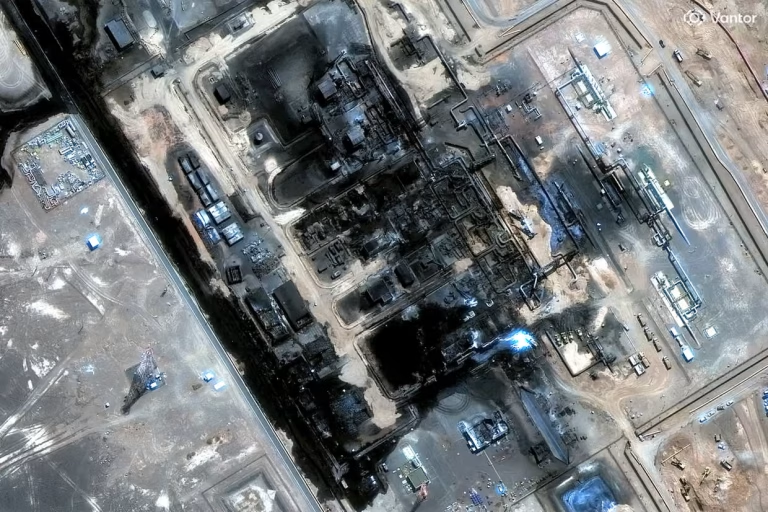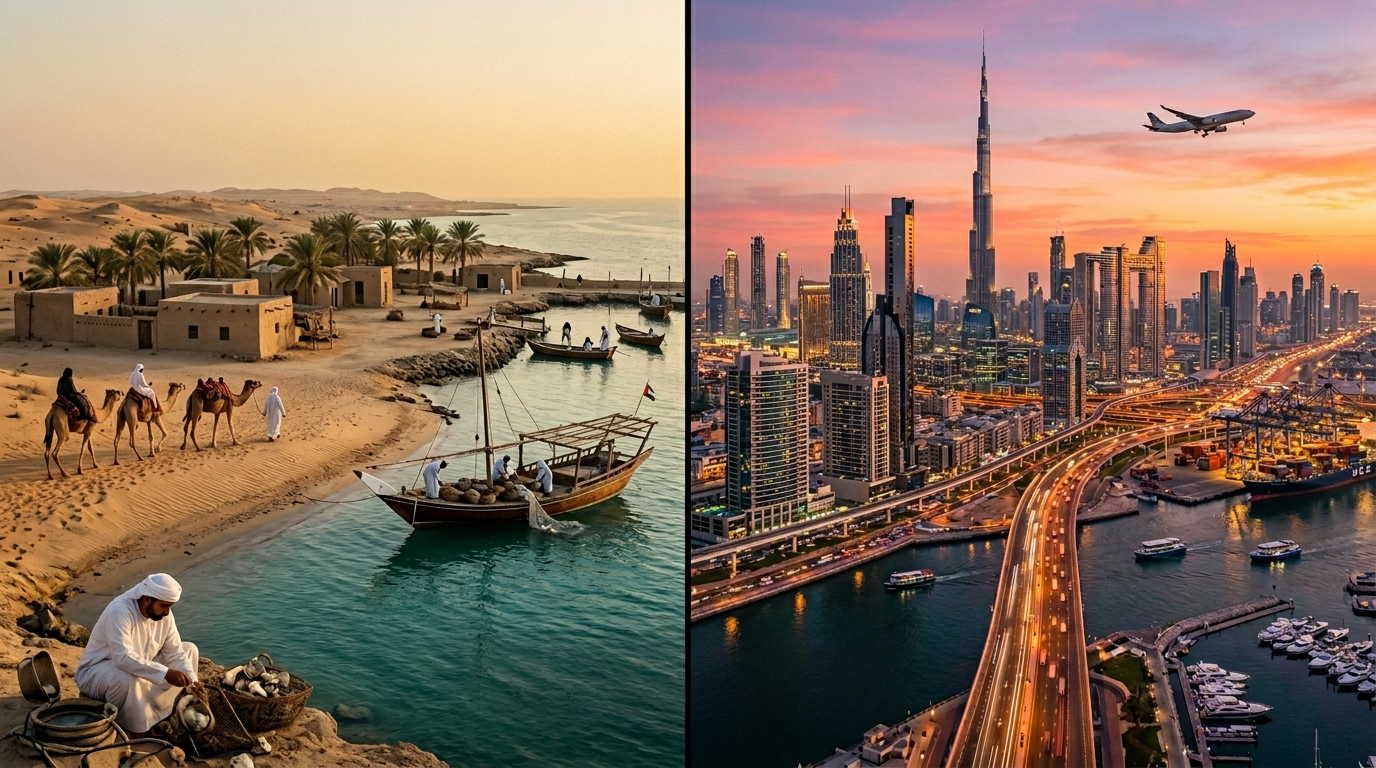

UAE Facing the Limits of Geography
UAE Facing the Limits of Geography. From pearl-diving villages to glittering skylines, the United Arab Emirates has built one of the most astonishing economic transformations in modern history. But beneath the glass towers and luxury headlines lies a difficult question few are willing to ask:
Can a nation built on global openness survive in a world growing more unstable, fragmented, and geopolitical? This is not an attack on the UAE. Nor is it a prediction of collapse.
It is a deeper investigation into how one of the world’s most successful modern state projects rose from the desert, and why the same forces that created its spectacular success may also shape its future vulnerabilities.
https://mrpo.pk/uae-lone-ranger-of-the-gulf/
Topography
The UAE is largely an arid land with vast sand deserts, but is also characterised by sand dunes, oases, rock mountains, valleys, marshes, mangroves and salt plains.
The oases are mostly of date palms; most oases are located in the emirate of Abu Dhabi.
Along the eastern borders are the Hajjar Mountains that run north-south. These mountains are complemented by valleys (called wadis in Arabic). The wadis are usually dry. However, in cooler months when it rains, they flourish with brooks and pools.
Mangroves (called qurms in Arabic) form an integral part of the marine ecosystem.
Salt plains (called sabkhas in Arabic) are also a common feature. The present-day sabkha started to form some 4000 years ago.
The UAE Before Oil: Sand, Pearls, and Survival
Today, the United Arab Emirates is associated with:
- Futuristic skylines
- Global airlines
- Sovereign wealth
- Luxury tourism
- Financial power
But only a few generations ago, this region looked completely different. Before oil, the Gulf coast consisted of small tribal sheikhdoms dependent on:
- Pearl diving
- Fishing
- Small-scale trade
- Harsh desert survival
Life was difficult. There were few paved roads, almost no modern hospitals, limited education systems, and severe water shortages. Summer temperatures were brutal. Entire communities depended on the sea for survival. Many older Gulf residents still remember an era when electricity itself was considered a luxury.
The British Withdrawal That Changed Everything
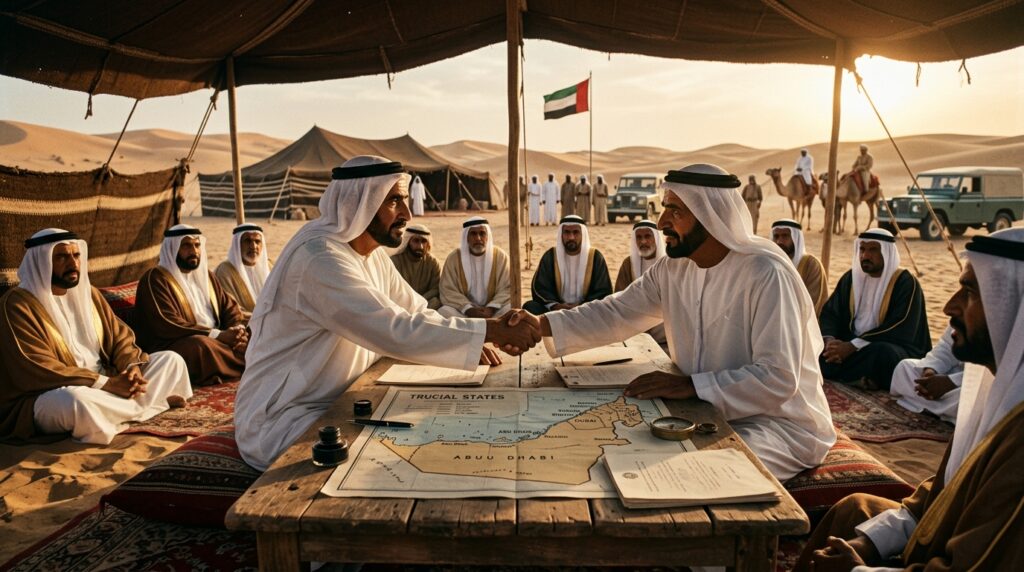
In 1968, Britain announced it would withdraw its military presence from the Gulf. For the small Gulf states, this was a historic turning point.
Suddenly, questions of:
- Security
- Sovereignty
- Regional power balance
- Long-term survival
became urgent realities.
That moment pushed regional leaders, especially Sheikh Zayed bin Sultan Al Nahyan and Sheikh Rashid bin Saeed Al Maktoum, toward a bold idea: Unity instead of fragmentation.
On December 2, 1971, six emirates formed the United Arab Emirates. Ras Al Khaimah joined shortly afterwards. The UAE was not merely a political union. It was a survival strategy.
Sheikh Zayed’s Vision: Oil Alone Would Never Be Enough
One of the UAE’s greatest strengths was that its founding leadership understood a critical truth early:
Oil wealth could create prosperity, but it could not guarantee long-term survival. That realisation shaped the UAE’s development model.
Massive investments were made into:
- Roads
- Ports
- Airports
- Healthcare
- Education
- State institutions
Abu Dhabi provided financial power through oil revenues.
Dubai pursued something different:
- Trade
- Tourism
- Logistics
- Global finance
- International connectivity
Together, they created a hybrid economic model unlike anything else in the Arab world.
The Human Story Behind the UAE Miracle: UAE Facing the Limits of Geography
The UAE’s rise was not built by oil money alone. It was built by millions of people from across the world who arrived carrying:
- Ambition
- Sacrifice
- Hope
- Desperation
Workers from:
- Pakistan
- India
- Bangladesh
- The Philippines
- Egypt
- African countries
helped transform empty desert landscapes into modern cities.
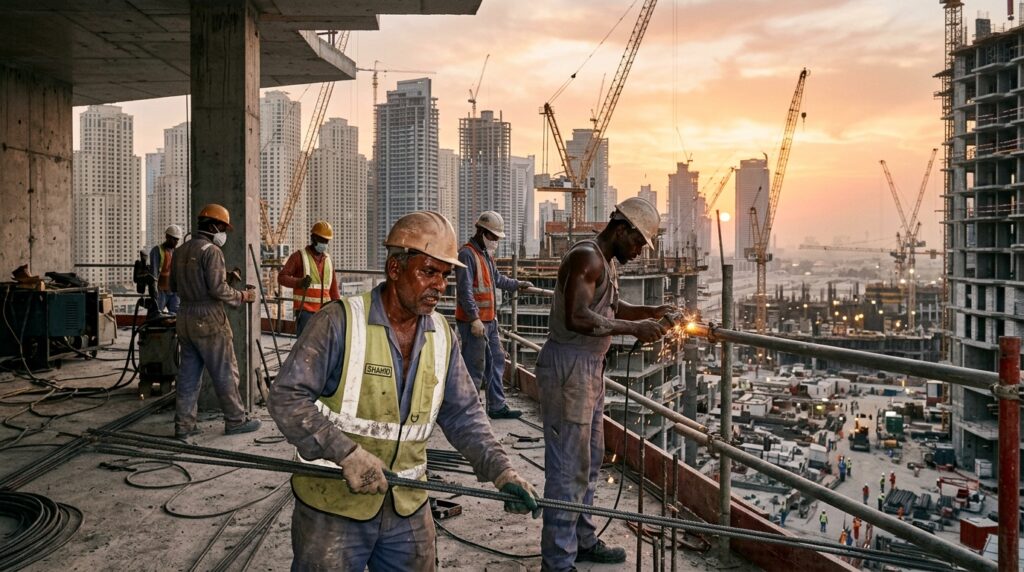
Construction workers laboured under intense Gulf heat to build highways, airports, ports, skyscrapers, and entire urban districts. Many lived far away from their families for years. Taxi drivers worked endless shifts. Engineers designed city systems from scratch. Nurses staffed expanding hospitals. Pilots and technicians transformed Dubai into one of the world’s most connected aviation hubs.
Behind every shining tower was human exhaustion, migration, sacrifice, and resilience.
From Desert Outpost to Global Hub
Dubai especially pursued an ambitious vision. Instead of relying entirely on oil, it focused on:
- Aviation
- Real estate
- Shipping
- Tourism
- Finance
- Global connectivity
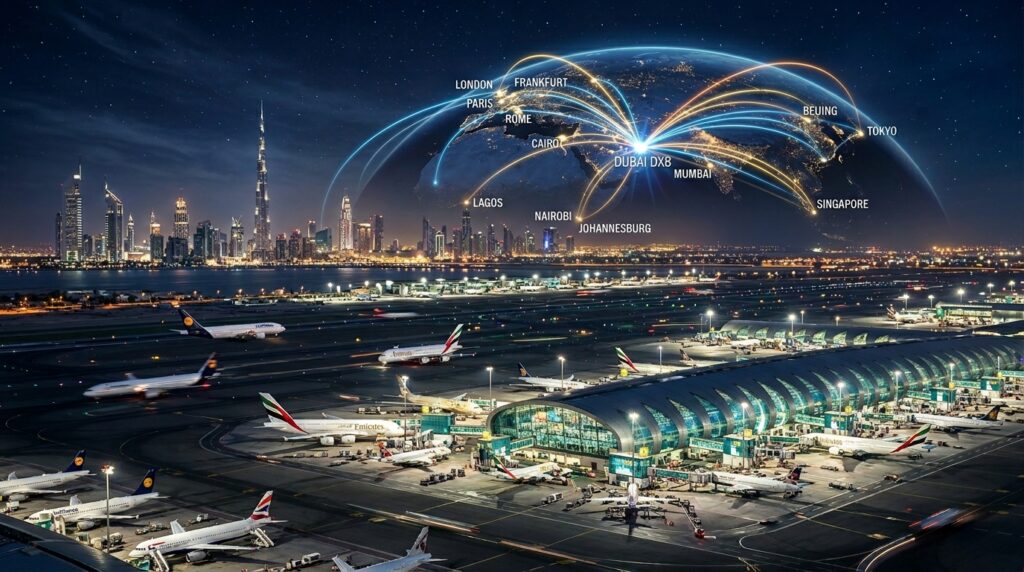
Projects such as Jebel Ali Port, Emirates Airline, free economic zones, and financial centres were designed with one goal:
Turn Dubai into the crossroads of the world. Remarkably, the strategy worked.
Within just a few decades:
- The desert became a global transit hub
- Multinational corporations relocated operations
- Tourism exploded
- The UAE became one of the world’s most globalised economies
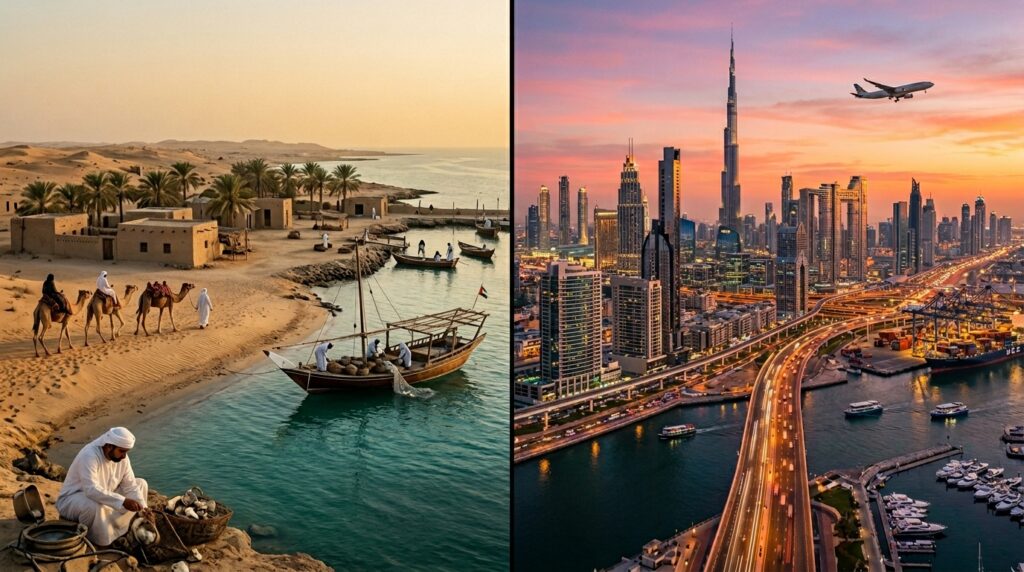
From Desert Outpost to Global Hub: Dubai_global_transit_hub_
But Globalisation Created a Hidden Fragility
The same openness that created the UAE’s success also created structural vulnerabilities.
The country became deeply dependent on:
- Regional stability
- Investor confidence
- Open airspace
- Global trade
- Foreign expertise
- International financial flows
That dependence created extraordinary prosperity during stable times. But it also created exposure during instability.
Geography: The One Thing Money Cannot Buy
Modern wealth creates the illusion that every strategic weakness can be solved financially. Geography says otherwise.
The UAE remains:
- Geographically narrow
- Strategically compressed
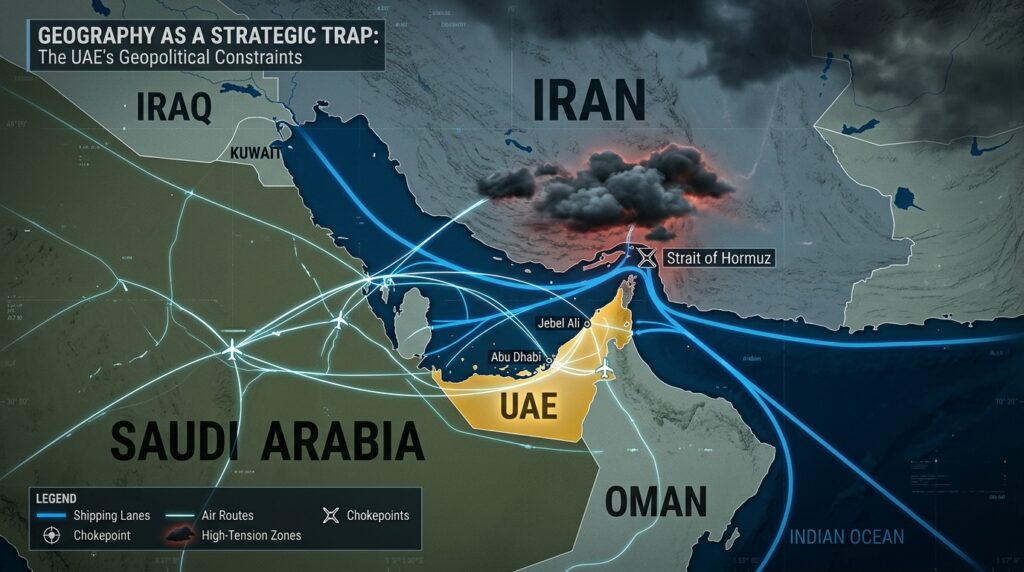
- Surrounded by larger regional powers
Unlike large continental states, it lacks:
- Agricultural depth
- Large internal populations
- Extensive strategic buffers
- Broad territorial resilience
If shipping routes become unstable, airspace becomes restricted, or regional tensions escalate, the pressure reaches the economic core almost immediately.
Dubai Is a Confidence Economy
Dubai runs primarily on:
- Confidence
- Connectivity
- Perception
- Global movement
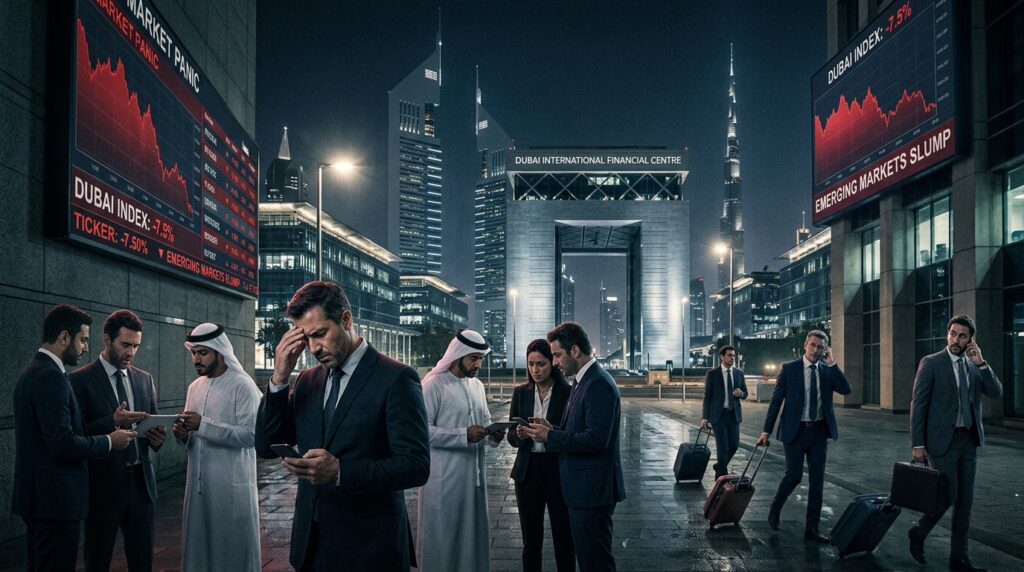
Investors place money in Dubai because they believe the system is stable and predictable. Tourists arrive because they see it as safe. Multinational firms operate there because they trust the infrastructure and regional access. Dubai’s most valuable resource is not oil. It is confidence.
And confidence can disappear faster than physical infrastructure.
Aviation: Strategic Strengths and Weaknesses
The UAE transformed aviation into a geopolitical power. Its airlines connected Europe, Asia, Africa, and the Middle East through one of the world’s most efficient transit systems. But this model depends heavily on regional air access.
If airspace restrictions increase or geopolitical tensions rise:
- Fuel costs rise
- Flight times increase
- Transit efficiency declines
- Passengers shift elsewhere
For a country built on movement, restricted movement becomes a strategic threat.
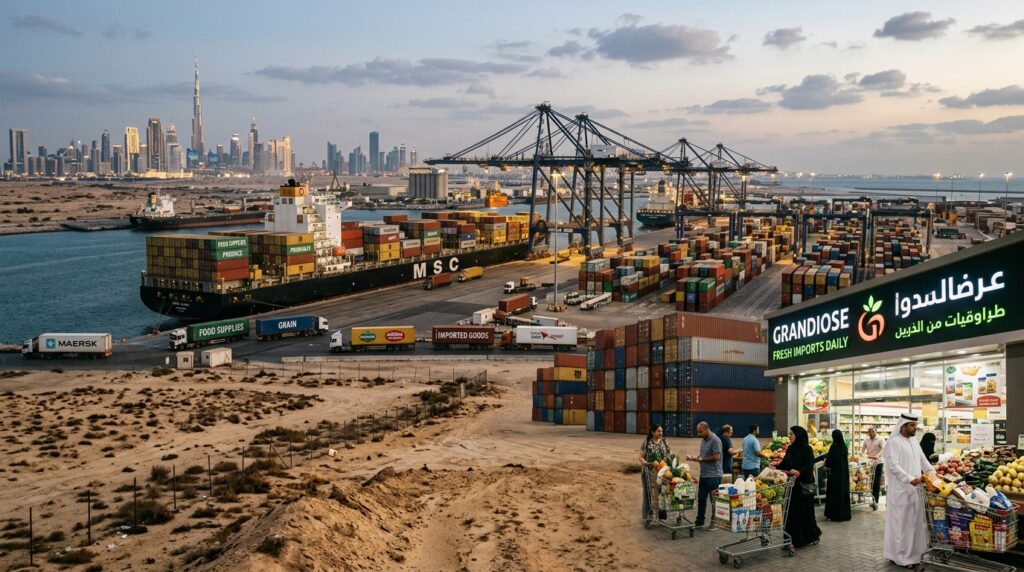
Food Security: The Silent Vulnerability
Because of desert geography, water scarcity, and limited agricultural land, the UAE depends heavily on imported food. This means national stability remains closely connected to uninterrupted logistics and trade routes. In normal times, globalisation solves this problem efficiently.
During major crises, however, supply chains themselves can become vulnerable.
UAE Facing the Limits of Geography: The Population Challenge
A large portion of the UAE workforce is expatriate.
Much of the country’s:
- Construction sector
- Engineering capacity
- Aviation expertise
- Logistics system
- Service economy
depends on imported labour and foreign professionals.
This allowed rapid modernisation at extraordinary speed. But it also created a structural risk: In prolonged instability, the very people who built the system can leave it.
The Illusion of Infinite Wealth
The UAE is enormously wealthy. But wealth and long-term crisis resilience are not identical concepts.
Much of the country’s wealth exists in:
- Long-term investments
- Infrastructure
- Real estate
- Global holdings
- Sovereign wealth funds
During geopolitical stress, the key question becomes:
Not how rich a country appears on paper, but how long it can preserve confidence and stability.
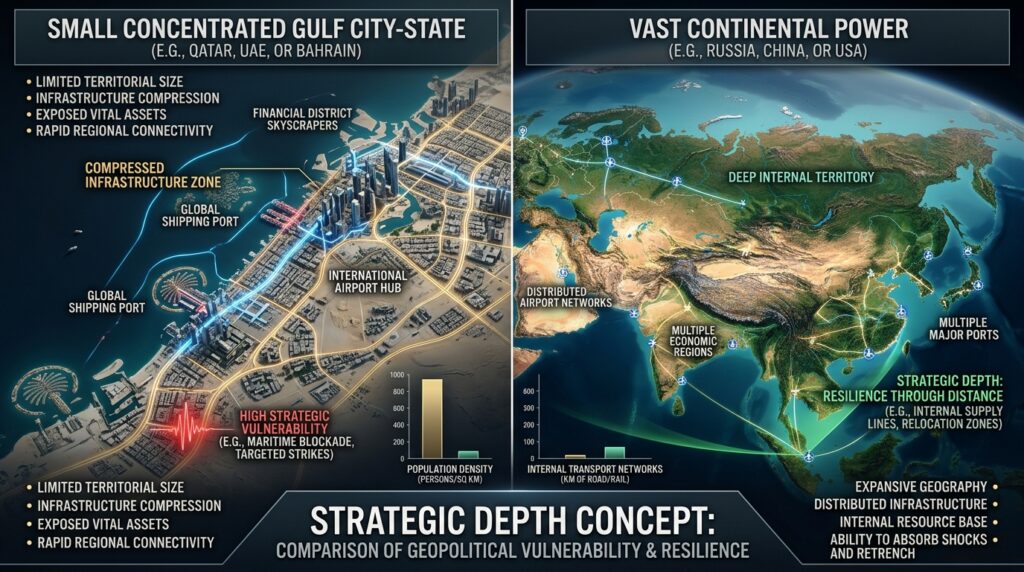
Strategic Depth: The Missing Shield
Strategic depth includes:
- Population scale
- Territorial space
- Agricultural capacity
- Dispersed infrastructure
- Shock absorption capability
The UAE’s infrastructure remains highly concentrated within a compressed geography. This creates exceptional efficiency during peace but potential vulnerability during prolonged instability.
Can the UAE Model Survive Until 2035?
The answer is complex. If regional stability continues and diversification succeeds, the UAE could evolve into one of the world’s most successful middle powers.
But if:
- Regional conflicts intensify
- Air or maritime disruptions increase
- Investor confidence weakens
The same globalisation that fueled its rise could expose its fragility.
Conclusion: Wealth Cannot Buy Geography
The UAE achieved something extraordinary. In just a few decades, it transformed desert settlements into one of the world’s most recognisable economic brands. Its rise deserves recognition.
But history repeatedly shows that:
- Wealth alone does not guarantee permanence
- Infrastructure alone does not create resilience
- Globalisation alone does not eliminate geography
You can build the tallest towers in the world.
You can buy advanced weapons systems.
You can accumulate immense financial power.
But you cannot fully buy:
- Geography
- Demographic depth
- Strategic insulation
- Permanent geopolitical stability
And that may become one of the defining questions shaping the UAE’s future.
Frequently Asked Questions
Why did the UAE become successful so quickly?
It combined oil wealth with aviation, logistics, trade, tourism, and global openness.
What is the UAE’s biggest strength?
Global connectivity, investor confidence, and economic diversification.
What is the UAE’s biggest vulnerability?
Dependence on external labour, trade routes, and regional stability.
Why is Dubai called a confidence economy?
Its success depends heavily on investor trust, tourism, and uninterrupted global business activity.
Is the UAE vulnerable to geopolitical instability?
Like all highly globalised economies, regional instability can affect trade, aviation, finance, and investor confidence.
Can the UAE remain powerful until 2035?
Yes, but long-term sustainability will depend on resilience, diversification, and regional stability.
Purpose of the Article
This article provides a balanced and research-driven examination of the UAE’s rise, strengths, structural vulnerabilities, and geopolitical realities in a way that remains accessible to general readers while maintaining analytical depth.
Editorial Perspective
The UAE represents one of the most ambitious state-building experiments of the modern era. Its rise from scattered desert emirates to a global economic hub is remarkable. Yet the same forces that accelerated its success, globalisation, openness, and dependence on constant connectivity, may also define the limits of its long-term resilience in an increasingly unstable world.