Saudi Arabia’s East-West Pipeline Crisis: When the Oil Bypass Becomes a Target
Saudi Arabia’s East-West Pipeline Crisis: Saudi Arabia built an escape route from the Strait of Hormuz. Now that escape route has itself become a battlefield.
The East-West Pipeline was designed to keep Saudi oil flowing when Hormuz becomes dangerous. But with the Strait severely disrupted, Houthi forces advancing across Yemen, an alleged drone attack from Iraq shutting the pipeline, and diplomatic channels faltering, Saudi Arabia is facing something far more complicated than a single infrastructure attack.
Its alternative energy corridor is being squeezed from several directions at once.
For the world, the danger is equally serious. A conflict that begins with drones and missiles in the Middle East can quickly become higher fuel prices, rising transport costs, renewed inflation and pressure on economies thousands of miles away.
What Is the East-West Pipeline?
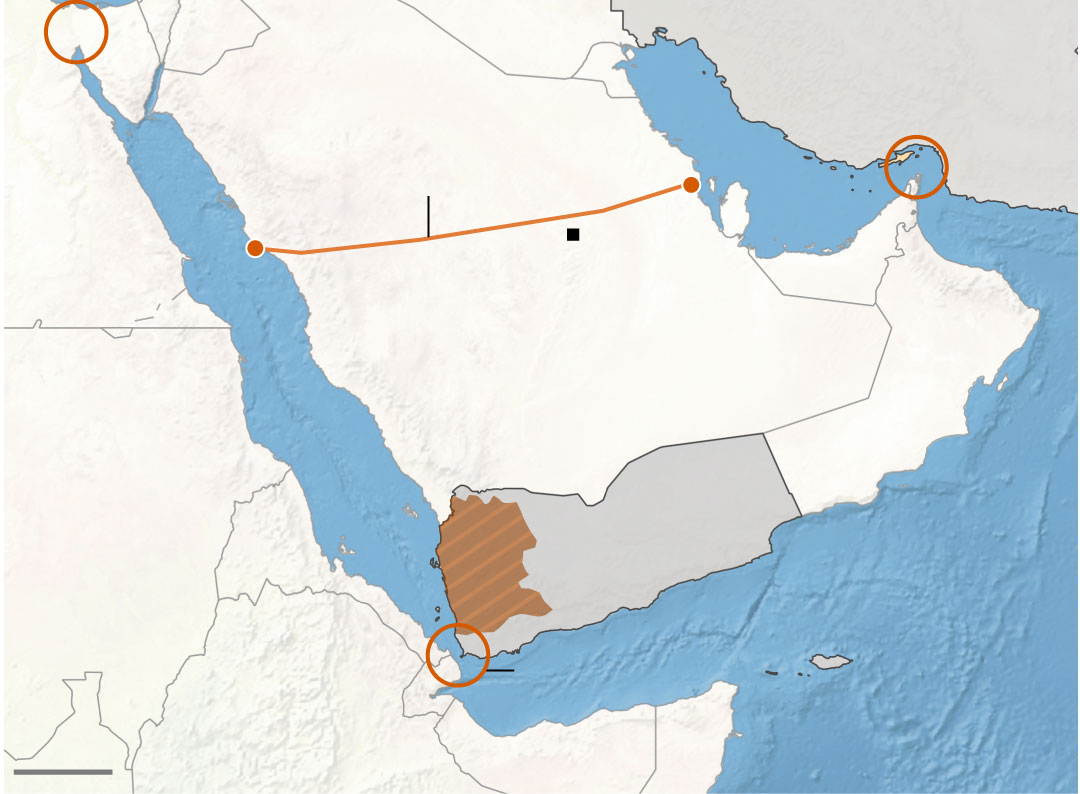
Saudi Arabia’s East-West Pipeline, also known as Petroline, stretches roughly 1,200 kilometres from the Kingdom’s major oil-producing region in the east to Yanbu on the Red Sea.
It was developed during the Iran-Iraq War in the 1980s precisely because Saudi Arabia understood the strategic danger of depending entirely on the Persian Gulf and the Strait of Hormuz.
Graphic: Javier Zarracina and Jiachuan Wu/ NBC News
Its logic is simple:
Oil produced in eastern Saudi Arabia can travel westward by pipeline and reach tankers at Yanbu without passing through Hormuz.
That makes the pipeline more than an oil pipeline. It is a strategic insurance policy for Saudi Arabia and, indirectly, for global energy markets.
During the present crisis, roughly 4 million barrels per day had been associated with flows toward Yanbu, making the route particularly important as Hormuz became increasingly difficult to use. Current reporting indicates that the damaged pipeline could remain largely out of service for three to five weeks. That is a very long time in an energy crisis.
Saudis yet to provide details about damage from drone attack to key east-west pipeline to Red Sea that could affect 4% of global oil supply
Saudi Arabia will run out of oil stocks for export if it doesn’t restart a drone-damaged major pipeline to the Red Sea within days, leading to the loss of up to 4% of global supply, Saudi oil buyers and traders said.
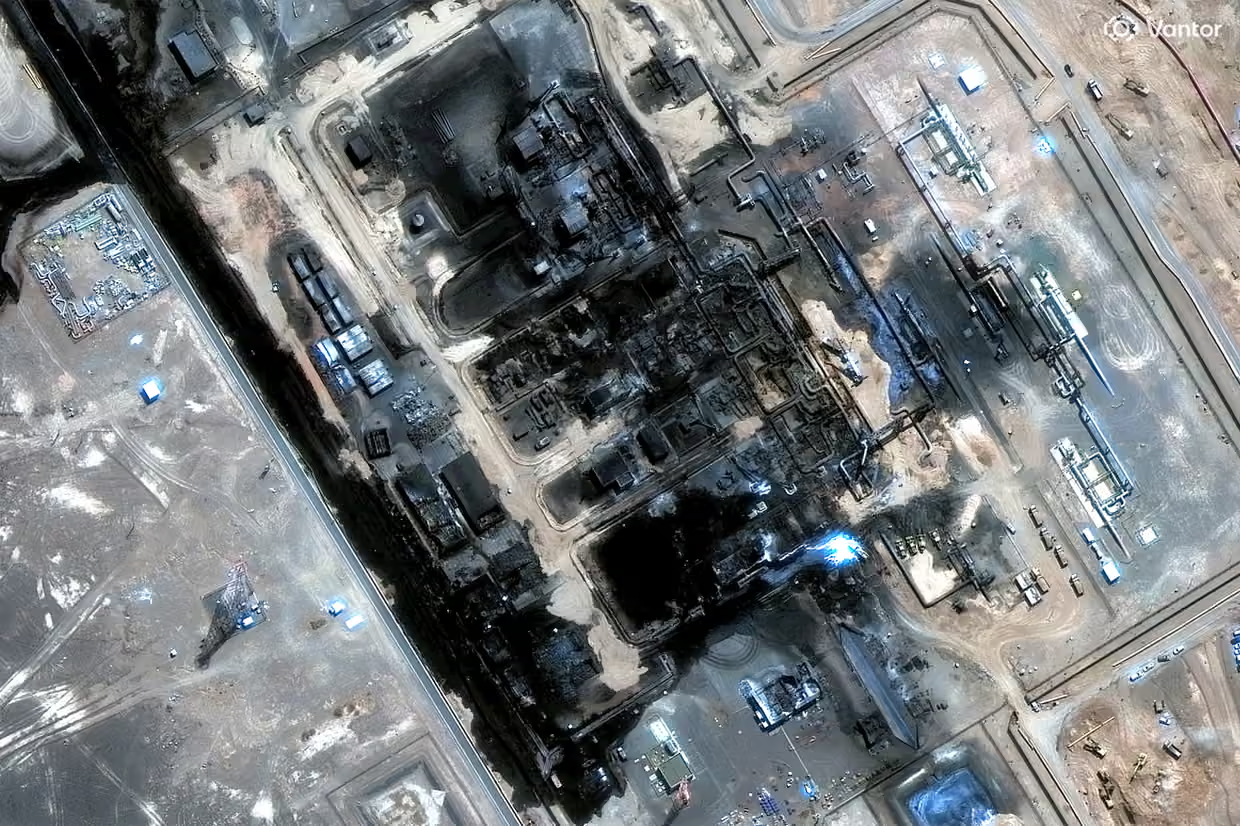
Satellite photos released on Sunday night appeared to show a pumping station on the key 1,200km (745-mile) Saudi east-west pipeline charred and badly damaged, after drone attacks on Friday.
A further decline in oil flow from Saudi Arabia, the world largest oil exporter, will worsen the global supply crunch, which has already pushed global fuel prices to record highs and spurred inflation around the world.
The news comes as Yemen’s Iran-aligned Houthi forces have launched attacks on targets in Saudi Arabia and captured the strategic island of Perim in the Bab al-Mandab strait, expanding their control of the narrow waterway.
On Sunday, the international oil benchmark, Brent crude, rose more than 3.4% to $108 per barrel, a level not seen since May.
Since the drone attacks forced the shutdown of the pipeline, Riyadh has yet to provide full details about the extent of the damage or how long the route will stay offline. The Saudis blamed the attack on drones launched by militants in Iraq.
Why the Timing Is So Dangerous
The pipeline became critical because the Strait of Hormuz was already under extraordinary pressure. The Strait normally carries around one-fifth of global petroleum liquids consumption. Saudi Arabia and the United Arab Emirates have pipeline alternatives, but their combined bypass capacity is only a fraction of normal Hormuz flows. The strategic sequence is therefore becoming increasingly dangerous:
Hormuz becomes difficult to use → Saudi Arabia relies more heavily on its East-West Pipeline → the pipeline is attacked → Yanbu becomes critically important → Houthi forces advance toward the Red Sea and Bab el-Mandeb → another export route comes under pressure.
The problem is no longer simply about protecting one pipeline. It is about whether Saudi Arabia can keep an entire alternative energy corridor functioning.
The September Drone Attack on the Pipeline
Saudi Arabia reported that several drones struck the East-West Pipeline and associated pumping infrastructure in the Riyadh and Medina regions. Saudi officials said the drones originated from Iraq.
Iraq subsequently investigated the incident, traced the suspected launch area to Maysan province near the Iranian border and seized equipment believed to have been used in launching the drones. Baghdad also dismissed a local military commander as part of its response. Saudi Arabia has so far refrained from direct retaliation, allowing Iraq to investigate and act.
Satellite imagery has since revealed the extent of fire and damage around the pipeline infrastructure. The significance is enormous. The attack did not merely damage an oil facility. It struck one of Saudi Arabia’s principal alternatives to Hormuz at precisely the moment when that alternative was most valuable.
The Iraqi Investigation Could Become a Major Test
The Iraqi investigation now has a significance extending well beyond the immediate attack. If Baghdad can establish who launched the drones, where the equipment came from and who financed, supplied or directed the operation, it could either strengthen or weaken competing claims about Iranian involvement.
Iraq has publicly condemned the use of its territory for attacks against neighbouring states and has taken steps against those suspected of involvement.
At the same time, Iraqi militia groups have denied responsibility.
This leaves a crucial question unanswered:
Was the pipeline attack a centrally directed operation, an action by an Iran-aligned militia network, a Houthi-linked operation, or an autonomous attack by an armed group operating within the broader Iran-aligned ecosystem?
Those possibilities should not be treated as interchangeable. The distinction matters enormously for any Saudi decision about retaliation.
Iran’s Response: Denial, Counter-Narrative and a Request for Investigation
Tehran has categorically rejected allegations that it was responsible for the Saudi pipeline attack. Iranian Foreign Ministry spokesman Esmaeil Baghaei has denied Iranian involvement and rejected attempts to link Tehran to the attack. Iran has also denied interfering in Yemen, saying that the Houthis are independent actors who make decisions according to their own interests. That is Tehran’s formal position.
Iran is effectively making two arguments:
First, Iran did not order or conduct the Saudi pipeline attack.
Second, the Houthis should not be portrayed as Iranian-controlled forces acting on direct orders from Tehran.
This distinction is central to Iran’s diplomatic strategy. If the pipeline attack is established as a direct Iranian operation, Saudi Arabia and its allies would have a much stronger case for treating the incident as Iranian aggression. If it is instead attributed to an Iraqi militia or another independent armed actor, the legal and political calculation becomes considerably more complicated.
Iran’s Request to Be Part of the Investigation
There is another unusual development.
Iran has sought to participate in the Iraqi investigation into the attack.
On the surface, this could be presented as an attempt by Tehran to demonstrate confidence in its denial.
But it also places Iran in an unusual position:
Iran is being accused of involvement → Iran denies responsibility → Iran seeks a role in the investigation that could help determine responsibility.
That does not prove Iranian involvement. But the outcome of the investigation could become one of the most politically consequential pieces of evidence in the entire crisis.
The Ground War: The Crisis Is No Longer Only About Drones and Missiles
The most important development that can easily be missed in the headlines is the ground war in Yemen. The Houthi movement is no longer merely threatening Saudi Arabia through missiles, drones and maritime attacks. Houthi forces have made significant territorial gains inside Yemen, particularly along the Red Sea coast and toward the Bab el-Mandeb region. The fighting has spread across several fronts, including areas around Taiz, al-Bayda and al-Jawf.
Saudi-backed Yemeni government forces have launched counteroffensives, while Saudi Arabia has provided air support. The objective is not simply to defend a city. It is to prevent the Houthis from consolidating a strategic corridor stretching toward the Red Sea’s most important maritime chokepoints.
The Western Front: Red Sea and Bab el-Mandeb
The western battlefield is strategically the most important for global trade. Houthi forces have advanced along sections of Yemen’s Red Sea coast and captured strategically important territory and islands. Their growing presence around Bab el-Mandeb gives them greater leverage over one of the world’s major maritime gateways.
Recent reporting indicates that Houthi forces have captured the Greater and Lesser Hanish islands and made gains around other strategically important areas. Bab el-Mandeb connects the Red Sea with the Gulf of Aden and ultimately the Indian Ocean.
For Saudi Arabia, this creates an uncomfortable geographical reality. The Kingdom may successfully defend its oil fields and pipeline pumping stations, yet its alternative Red Sea export route can still be threatened if the maritime environment around the southern Red Sea becomes hostile.
The Central and Northern Yemeni Fronts
The fighting is not confined to the coastline. Saudi-backed Yemeni forces have been fighting on multiple inland fronts, including Taiz, al-Bayda and al-Jawf. Al-Jawf is particularly important because it borders Saudi Arabia and provides strategic approaches toward the Houthi heartland in the north. Al-Bayda is strategically important because of its central position and its links between several Yemeni fronts.
Taiz remains significant because control of the province affects movement between western and central Yemen and access toward the Red Sea. The battlefield therefore resembles a series of connected pressure points rather than one conventional front line. Recent reporting indicates that tens of thousands of civilians have been displaced as the fighting intensified.
Is Saudi Arabia Being Invaded?
This requires careful wording.
There is no reliable evidence of a large-scale Houthi ground invasion of Saudi Arabia itself.
What is happening is different but still extremely serious. Saudi territory has been subjected to Houthi missile and drone attacks, including attacks directed toward military and strategic targets. At the same time, ground fighting is taking place inside Yemen close to Saudi Arabia’s southern security environment. In other words, Saudi Arabia is not facing a conventional army crossing its southern border in force.
It is facing a combination of:
- A rapidly changing ground war inside Yemen
- Houthi missile and drone attacks
- Threats to southern Saudi military and infrastructure sites
- Houthi expansion toward Bab el-Mandeb
- Maritime pressure in the Red Sea
- A separate drone attack on its oil infrastructure from Iraqi territory
That is a much more complicated security problem than a conventional invasion.
A Strategic Pressure Ring Is Emerging
Calling the situation a literal military encirclement would be inaccurate. But strategically, Saudi Arabia is facing pressure from several directions.
From the east, the Strait of Hormuz remains severely disrupted.
From the north and northeast, the pipeline attack has demonstrated the vulnerability of critical infrastructure to attacks originating from Iraqi territory.
From the south, the Houthi movement is expanding its military pressure and conducting attacks against Saudi territory.
From the west, the Red Sea and Bab el-Mandeb are becoming increasingly dangerous for shipping and energy exports.
And in the middle sits Saudi Arabia’s enormous network of oil fields, pipelines, pumping stations, refineries, ports and other critical infrastructure.
This is the strategic nightmare of modern asymmetric warfare. An opponent does not necessarily have to defeat Saudi Arabia’s conventional military. It may only need to create enough simultaneous problems that protecting everything becomes extraordinarily expensive and difficult.
Are the Houthi and Iraqi Fronts Connected?
This is one of the most important unanswered questions. There are growing reports and intelligence assessments suggesting that Iran-aligned armed groups in Iraq and the Houthis in Yemen may have overlapping capabilities, relationships or operational cooperation. But that does not establish that every attack is centrally ordered by Tehran.
The distinction is important.
A regional network can produce coordinated strategic pressure without every individual attack being planned from one command centre. If Iraqi militias can threaten Saudi oil infrastructure while Houthi forces simultaneously threaten Saudi territory and Red Sea shipping, the combined effect may be far greater than either threat alone.
That is why investigators will be looking not only for the immediate drone operators, but also for evidence concerning financing, weapons supply, technical assistance, communications and cross-border coordination.
Saudi Arabia’s Air Defence Is Facing a Different Kind of War
Saudi Arabia possesses sophisticated air-defence capabilities, including Patriot and THAAD systems, fighter aircraft, radars and other surveillance assets. But advanced equipment does not eliminate the problem of saturation.
A low-cost drone can force the defender to launch an interceptor worth millions of dollars.
A large number of relatively inexpensive drones can therefore create an economic and logistical problem even when most of them are successfully intercepted. The question is not simply:
Can Saudi Arabia intercept the next missile?
The larger question is:
Can Saudi Arabia continue intercepting large numbers of missiles and drones over weeks and months without exhausting expensive interceptors, radar capacity, personnel and maintenance resources?
That is a very different military calculation.
Israel’s Emerging Role: Intelligence Cooperation, Not Proven Responsibility
Israel has not been credibly identified as the perpetrator of the Saudi pipeline attack. No reliable evidence currently establishes Israeli involvement in planning or carrying out that strike. That distinction is essential.
However, Israel is increasingly becoming part of the security equation surrounding the crisis. Recent reporting indicates that Israel and Saudi Arabia have discussed intelligence assistance concerning the Houthi threat, reportedly through U.S. Central Command. This would be strategically significant because Saudi Arabia and Israel still do not have formal diplomatic relations.
The common threat posed by Iran-aligned forces may nevertheless be pushing the two countries toward greater practical security cooperation. Israel has also previously taken military action against Houthi targets. But these facts should not be transformed into an unsupported claim that Israel was behind the Saudi pipeline attack.
The more defensible conclusion is different:
The expanding Houthi threat may be quietly creating a Saudi-Israeli intelligence relationship even without formal diplomatic normalisation.
That could become one of the most consequential secondary developments of the present crisis.
What Is Iran Really Saying About Yemen?
Iran’s position deserves special attention because it directly challenges the narrative coming from Saudi Arabia and its allies. On September 14, Iranian Foreign Ministry spokesman Esmaeil Baghaei said Iran does not interfere in Yemeni affairs and described the Houthis as independent actors. Tehran has also argued that Yemen’s crisis has deep historical and political roots rather than being a simple Iranian-directed campaign against Saudi Arabia. This is a clear counter-narrative.
Tehran wants the world to see:
Yemeni conflict first, Iranian involvement second.
Saudi Arabia and its allies increasingly see the problem differently:
Iranian regional influence first, Yemeni armed movement second.
The truth may ultimately prove more complicated than either narrative. Iran clearly has a long-standing relationship with the Houthi movement. But establishing the exact degree of Iranian operational control over each current attack requires evidence rather than assumption. That distinction is especially important when discussing the pipeline attack.
Iran and the Failed Hormuz Diplomacy
Iran’s latest statements also reveal how quickly diplomacy has deteriorated. A meeting involving Iran and Gulf states in Oman was intended to discuss the management and possible reopening of commercial traffic through the Strait of Hormuz.
Iran confirmed on September 14 that the meeting had been postponed and said Saudi Arabia had requested the postponement. Tehran also argued that linking the decision to the Yemen crisis was a false pretext. Oman, meanwhile, said the meeting was postponed in the interests of consensus. The timing could hardly be worse.
The Strait is under pressure. Saudi Arabia’s alternative pipeline is damaged. The Houthis are advancing toward Bab el-Mandeb. Saudi Arabia and Yemen are fighting. And the diplomatic meeting intended to address Hormuz has been postponed.
Diplomacy is therefore falling behind the battlefield.
Are There Any Ceasefire or De-Escalation Efforts?
There are diplomatic channels, but no durable ceasefire currently appears to be holding across the two main fronts.
On the Yemen-Saudi front, the relative calm that followed the 2022 Saudi-Houthi truce has effectively broken down. Saudi-backed Yemeni forces are now engaged in active ground fighting while Houthi attacks against Saudi targets have resumed. Pakistan is also attempting to use its diplomatic position with Iran to encourage restraint and prevent further escalation.
The important conclusion is therefore simple:
There are diplomatic channels, but there is no functioning ceasefire architecture capable of stopping the present escalation.
That leaves the battlefield setting the pace.
The Oil Shock Is Already Moving Beyond Saudi Arabia
The East-West Pipeline normally gives Saudi Arabia a way to reduce its dependence on Hormuz. With that route damaged, the Kingdom has fewer options. Saudi oil production had already fallen sharply. Current reporting indicates that Saudi output declined to around 6.2 million barrels per day in August, while crude exports also fell substantially. The pipeline shutdown therefore arrives at a particularly sensitive moment.
If repairs take several weeks, Saudi Arabia must manage production, storage and export flows much more carefully. That does not mean the world suddenly loses every barrel of Saudi oil. But it does mean the margin of safety becomes much smaller. And oil markets are driven not only by actual shortages but by expectations of future shortages.
That is why Brent crude moved above $108 and subsequently above $109 per barrel as the pipeline disruption and Houthi advances intensified.
Yanbu Has Become a Critical Pressure Point
Yanbu was supposed to be Saudi Arabia’s insurance policy against Hormuz. Now it may become the most important remaining outlet for Saudi oil. That creates a second vulnerability. Even if the pipeline is repaired, Saudi Arabia still has to protect:
- The pipeline itself
- Pumping stations
- Yanbu storage facilities
- Loading terminals
- Tankers approaching the Red Sea
- Maritime routes through the Red Sea
- The Bab el-Mandeb gateway
This demonstrates why the present crisis cannot be understood simply as an oil-pipeline problem. It is an energy corridor security problem.
Why Asia Is Particularly Vulnerable
The consequences will not fall equally across the world.
Asian economies are especially exposed because the overwhelming majority of crude and condensate moving through Hormuz traditionally goes toward Asia.
China, India, Japan and South Korea together account for a very large share of those flows. That means an extended disruption could affect:
China’s manufacturing costs → India’s fuel bill → Japan and South Korea’s energy security → Asian inflation → global shipping and production costs.
Europe and North America would not be insulated. Higher crude prices eventually feed into aviation fuel, diesel, transport, petrochemicals, manufacturing and food distribution. The modern global economy is effectively connected by a long chain that begins with a tanker leaving the Gulf. Break one link and the consequences travel surprisingly far.
The Human Cost: Yemen Is Again Moving Toward Full-Scale War
Behind the oil charts and military maps is an increasingly serious humanitarian crisis. The renewed ground fighting has displaced tens of thousands of Yemenis in a short period, while hundreds have reportedly been killed or wounded during the latest escalation. The danger is that a conflict that had become relatively quieter after years of war is now moving back toward a broader civil war.
The longer the ground war continues, the harder it becomes to separate military objectives from humanitarian consequences. And the more difficult any eventual political settlement becomes.
The Makkah Defence Agreement Changes the Strategic Equation
Against this background, Saudi Arabia, Pakistan and Türkiye signed the Makkah Joint Defence Agreement on August 7, 2026. The agreement states that an armed attack against one member will be treated as an attack against all three. That does not automatically create a NATO-style integrated military command. But its political significance is substantial.
Saudi Arabia now has a formal defence relationship involving:
- Saudi Arabia’s financial and strategic weight
- Türkiye’s NATO membership and military capability
- Pakistan’s large conventional military and nuclear deterrent
The agreement was signed before the latest escalation reached its current level. That makes the present crisis an early and important test of what collective deterrence actually means in practice.
Britain’s Role
The United Kingdom has also strengthened defence cooperation with Saudi Arabia. British Prime Minister Andy Burnham discussed the Iranian and Houthi attacks with Crown Prince Mohammed bin Salman and supported stronger defence collaboration. Britain also appointed Air Chief Marshal Sir Harv Smyth as Defence Envoy to Saudi Arabia. The British role is important because Saudi Arabia needs more than aircraft and missiles.
It needs intelligence, training, planning, logistics, surveillance and long-term defence-industrial support.
The United States Faces a Difficult Choice
Washington remains central to Saudi security calculations, but the current conflict presents the United States with a difficult choice.
Direct American military intervention against the Houthis could widen the conflict.
Limited support, however, leaves Saudi Arabia carrying more of the burden itself.
This is especially sensitive because Washington is already dealing with the wider confrontation involving Iran and the Strait of Hormuz.
The more fronts the United States becomes directly involved in, the greater the risk of regional escalation. The less it becomes involved, the more pressure falls on Saudi Arabia and its regional defence relationships.
The Worst-Case Scenario
The most dangerous scenario is not one spectacular attack. It is a prolonged sequence of smaller attacks that reinforce one another.
Imagine the chain:
Hormuz remains restricted → Saudi oil is redirected toward alternative routes → the East-West Pipeline remains damaged → Houthi forces consolidate territory near Bab el-Mandeb → Red Sea shipping becomes more dangerous → Saudi oil exports face additional restrictions → global inventories tighten → oil prices rise further.
That is how a regional security crisis becomes a global energy crisis. The world does not need every Saudi oil facility to be destroyed. It only needs enough export capacity to become uncertain.
Three Possible Paths Ahead
1. Rapid De-Escalation
Iraq successfully identifies and restrains the groups responsible for the pipeline attack, Saudi Arabia avoids retaliation, diplomatic channels with Iran reopen, and pressure is placed on the Houthis to halt attacks. This would be the best outcome for global energy markets.
2. Managed Conflict
The pipeline is repaired within several weeks, Saudi air defences contain Houthi attacks, the Yemeni battlefield stabilises without a decisive breakthrough, and Gulf states eventually return to negotiations with Iran. Oil prices could remain elevated, but the crisis would become manageable.
3. Regional Energy War
The worst outcome would involve continued Houthi territorial expansion, sustained attacks on Saudi infrastructure, prolonged closure or disruption of Hormuz, further attacks from Iraqi territory and direct retaliation by Saudi Arabia or its allies. At that point, the issue would no longer be merely a Yemen conflict or a Saudi security problem. It would become a global energy emergency.
The Bigger Lesson
The East-West Pipeline was created to make Saudi Arabia less vulnerable to Hormuz. Yet the present crisis demonstrates a harsh reality of modern strategic competition:
A bypass does not eliminate vulnerability. It changes the location of vulnerability.
A pipeline can bypass a maritime chokepoint, but it cannot bypass geography.
It still has pumping stations.
It still crosses enormous distances.
It still requires ports.
It still depends on maritime security.
And it can still be targeted by relatively inexpensive weapons.
The same lesson applies to the Red Sea.
Closing one route does not make another route automatically safe.
What the World Should Watch Next
The next few weeks will be particularly important.
The most significant indicators will be:
- Whether the East-West Pipeline is repaired within the projected timeframe
- Whether Saudi Arabia can maintain exports through Yanbu
- Whether Houthi forces continue advancing toward Bab el-Mandeb
- Whether Saudi-backed Yemeni forces can reverse those gains
- Whether Houthi attacks on Saudi territory intensify
- Whether Iraq can credibly prevent its territory from being used for attacks
- Whether Saudi Arabia continues exercising restraint toward Iraq
- Whether the Iraqi investigation identifies the actual operators and their sponsors
- Whether Iran cooperates meaningfully with that investigation
- Whether Gulf-Iran diplomacy resumes
- Whether Pakistan can use its diplomatic position to reduce escalation
- Whether Saudi-Israeli intelligence cooperation expands
- Whether the Makkah defence pact becomes an active deterrence mechanism
- Whether global oil inventories can absorb prolonged disruption
These indicators will tell us whether the current crisis remains a severe regional emergency or develops into something much larger.
Frequently Asked Questions
1. What is the East-West Pipeline?
It is a roughly 1,200-kilometre Saudi oil pipeline linking the country’s eastern oil-producing region with Yanbu on the Red Sea. It was built partly to reduce dependence on the Strait of Hormuz.
2. How much oil does the pipeline carry?
Its strategic capacity is several million barrels per day. During the current crisis, around 4 million barrels per day had been associated with flows toward Yanbu, making its disruption significant for Saudi exports and global markets.
3. Has Saudi Arabia been invaded by the Houthis?
There is no reliable evidence of a large-scale Houthi ground invasion of Saudi Arabia. The major ground fighting is occurring inside Yemen, while Saudi territory is facing missile and drone attacks.
4. Is Iran responsible for the Saudi pipeline attack?
Iran has categorically denied involvement. Saudi Arabia says the drones originated from Iraqi territory, while Iraq is investigating the launch site and suspected perpetrators. The exact chain of responsibility remains unresolved.
5. Is there currently a ceasefire?
No durable ceasefire is currently holding across the main fronts. The earlier Saudi-Houthi de-escalation has broken down, while Gulf-Iran talks concerning Hormuz have also been postponed amid the Yemen escalation.
6. Why does this matter to ordinary people outside the Middle East?
Because oil is embedded in almost everything modern economies consume and transport. A prolonged disruption can raise petrol and diesel prices, shipping costs, airline expenses, manufacturing costs and ultimately consumer prices across the world.
Editorial Perspective
This crisis deserves attention beyond the daily question of who launched the latest missile or drone. The deeper story is the simultaneous vulnerability of several supposedly separate systems: oil production, pipelines, maritime chokepoints, air defence, regional alliances and diplomatic channels.
Saudi Arabia is not facing one war.
It is facing a network of interconnected security challenges.
Iran denies directing the attacks.
Iraq is investigating who used its territory.
The Houthis are expanding on the ground while denying that they simply take orders from Tehran.
Israel is reportedly moving closer to Saudi Arabia through intelligence cooperation.
The United States is trying to balance support with the danger of widening the war.
Pakistan and Türkiye have a new defence commitment with Saudi Arabia.
And diplomacy is struggling to keep pace with military developments.
That is what makes this crisis different.
The danger is not necessarily one mastermind controlling every battlefield. The greater danger may be a regional security network in which several armed actors can create simultaneous pressure on Saudi Arabia from different directions.
The East-West Pipeline was supposed to make Saudi Arabia less vulnerable to Hormuz.
Instead, the present crisis demonstrates that every alternative route has its own vulnerability.
A pipeline can bypass a maritime chokepoint, but it cannot bypass geography.
A Red Sea port can bypass Hormuz, but it cannot bypass the security of Bab el-Mandeb.
Air defence can intercept missiles, but it cannot make a vast kingdom immune to saturation.
Diplomacy can prevent escalation, but only if the guns give diplomacy enough time to work.
And that may be the most important question now:
Can diplomacy catch up before Saudi Arabia’s remaining energy corridors become the next battlefield?
For the world economy, the answer could determine not only the future of Saudi oil exports, but the price of energy everywhere.
Purpose of This Article
This article examines the strategic significance of Saudi Arabia’s East-West Pipeline crisis, the expanding ground war in Yemen, Houthi advances toward the Red Sea and Bab el-Mandeb, the Iraqi-origin drone threat, Iran’s response and denials, Israel’s emerging intelligence role, Saudi air-defence challenges, fragile ceasefire and diplomatic efforts, and the potential consequences for global oil supplies and energy security.
Author
Maj Hamid Mahmood (Retired) MA Political Science, LLB, PGD (HRM) holds an MA in Political Science, LLB, and PGD (HRM). His military background, academic training in political science, and legal education provide a multidisciplinary perspective for examining international conflicts, security affairs, political developments, and the human consequences of war.
Editorial Note
This article distinguishes between confirmed developments, official statements, allegations and battlefield reports that cannot always be independently verified during an active conflict. Military positions, casualty figures and attribution assessments can change rapidly. Readers should therefore treat real-time battlefield claims with appropriate caution.