
Who Controls Our Seeds, Water, Farms and Food? Pakistan’s Food Sovereignty Crisis
Who Controls Our Seeds, Water, Farms and Food: Pakistan’s Food Sovereignty Crisis. A nation can lose part of its sovereignty without losing a single square mile of territory. It can happen when a country becomes dependent on others for the things it needs every day: food, water, energy, medicine, technology, and knowledge. Pakistan is now facing an uncomfortable question.
https://mrpo.pk/water-power-and-survival/
Are we becoming increasingly dependent on external systems for the very food that sustains us?
The Next Strategic Battle May Not Be About Land
The question has acquired fresh significance after Prime Minister Shehbaz Sharif met Bill Gates on the sidelines of the United Nations General Assembly in September 2026. According to Pakistan’s official account, the two sides discussed expanding cooperation in agriculture, including improved seeds, livestock genetics, biotechnology, climate resilience, research and emerging agricultural technologies.
That meeting does not prove that anyone is attempting to take control of Pakistan’s food supply. Nor is there evidence that Bill Gates or any single corporation controls Pakistan’s agriculture. But the meeting provides a legitimate opportunity to ask a much larger question:
Who should control the foundations of Pakistan’s food system, and how much dependence on external companies, technologies and markets is economically and strategically safe?
This is not merely a debate about hybrid seeds. It is about seeds, water, fertilizer, pesticides, agricultural research, credit, land, technology, storage, markets, imports, processing and the bargaining power of the farmer. And that makes Pakistan’s agricultural future a national-security issue.
Cotton collapse and corporate grip
The government’s portrayal of the Seed (Amendment) Act, 2024 as a benign reform to modernise Pakistan’s seed sector conceals a deeper project of neo-colonisation. Beneath the language of efficiency and innovation lies a systematic transfer of control over seeds from farmers and public institutions to monopoly capital.
This legislation did not emerge from democratic deliberation or public demand; it was passed quietly, with little parliamentary debate, no consultation with farmers, and minimal media scrutiny. Such silence is not accidental. It reflects a governance model dictated by colonial powers.
This trajectory did not begin in 2024. The Seed (Amendment) Act of 2015 laid the groundwork for privileging private companies over public research institutions and farmer-led seed systems over a decade ago. It systematically excluded farmer-saved and locally-bred varieties. Closely aligned with the World Trade Organisation and Trade-Related Aspects of Intellectual Property Rights regimes, these laws reframe seeds not as a shared heritage but as proprietary commodities. They marginalise and criminalise age-old practices of saving and exchanging seeds that farmers across South Asia have relied upon for centuries to ensure resilience, biodiversity, and food security.
Agriculture Is Not Just Another Sector
Pakistan remains an agricultural economy in a very fundamental sense.
According to the Pakistan Economic Survey 2025-26, agriculture grew 2.89 percent during FY2025-26 and accounted for 23.44 percent of GDP. Livestock alone contributed 62.45 percent of agricultural value added and 14.64 percent of GDP. Wheat production reached 29.61 million tonnes, sugarcane 89.45 million tonnes, rice 9.99 million tonnes, cotton 7.05 million bales and maize 8.79 million tonnes.
These numbers explain why agriculture cannot be treated simply as a rural business. It determines food prices, rural employment, exports, industrial raw materials, livestock production, household incomes and ultimately the country’s ability to feed its population. Agriculture also connects Pakistan to some of its most strategic vulnerabilities. A farmer cannot produce food simply because he owns land. He needs:
seed + water + fertilizer + pesticides + machinery + electricity or fuel + credit + knowledge + storage + transport + a functioning market.
If a farmer becomes dependent on external suppliers at several of these points simultaneously, land ownership alone does not guarantee economic independence. That is the real food-sovereignty question.
Pakistan’s Farms Are Getting Smaller
Pakistan’s agricultural structure makes the issue even more complicated. The 2024 Agricultural Census recorded approximately 11.1 million farms operating over 59.3 million acres, with an average farm size of about 5.3 acres and an average cultivated area of about 4.8 acres. The average farm size has fallen substantially from about 6.4 acres in 2010. This matters enormously.
A large commercial farm may be able to absorb a failed crop, purchase machinery, experiment with new varieties or negotiate better prices. A farmer cultivating a few acres cannot easily absorb a bad harvest.
For a small farmer, a poor crop can mean:
less income,
another loan,
higher interest,
less ability to buy inputs next season,
and eventually the sale or leasing of land.
Therefore, when we discuss agricultural modernization, the crucial question should not be merely:
Does the new technology increase yield?
It should also be:
Does it increase the farmer’s net income and resilience?
A technology that produces 20 percent more grain but increases the farmer’s financial risk by 30 percent cannot automatically be described as progress.
The Seed Question
Seeds sit at the beginning of the agricultural chain. That makes them strategically important.
Pakistan’s Economic Survey 2025-26 estimates total seed requirements for the listed major crops at about 2.06 million tonnes, while reported availability during July-March FY2026 was approximately 768,000 tonnes. That represents only about 37 percent of the stated requirement. Private sources accounted for about 654,000 tonnes, compared with roughly 48,000 tonnes from public sources and 66,000 tonnes imported.
That is a striking structural weakness. It does not mean that Pakistan imports 63 percent of its seed requirement. It means that the reported availability of seed covered only around 37 percent of the estimated requirement during the period covered by the survey. The distinction matters.
The bigger problem is that the private sector supplies the overwhelming majority of the formally reported available seed. That creates an obvious policy question:
Is Pakistan building a strong domestic commercial seed industry, or is it becoming dependent on private suppliers without developing sufficient public research and farmer-level seed systems?
The answer requires crop-by-crop investigation.
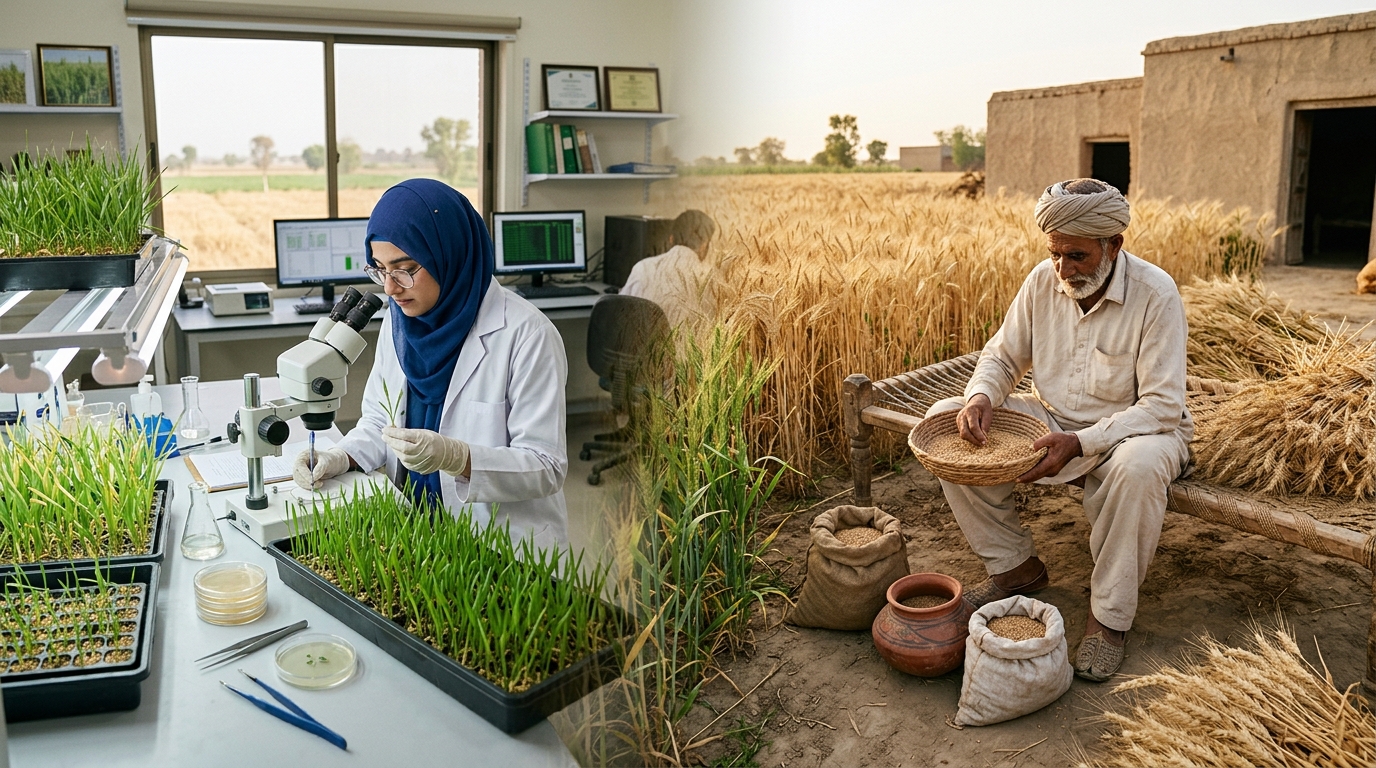
But “Improved Seed” Does Not Mean the Same Thing as “Corporate Control”
This is where the popular argument needs careful correction.
Not every improved variety is a hybrid.
Not every hybrid is genetically modified.
Not every improved seed is patented.
And not every farmer using improved seed loses the ability to save seed.
These distinctions are critical.
Some crops and varieties can be saved and replanted successfully. F1 hybrid seed, however, generally does not reproduce the same genetic combination in the next generation. Farmers who want the same hybrid characteristics therefore normally purchase fresh seed. That creates a genuine commercial dependency for particular crops. But it would be scientifically inaccurate to say:
“Modern seeds cannot reproduce.”
The correct statement is much narrower:
Some hybrid seeds do not breed true in the next generation, making commercial replacement seed necessary if farmers want the same hybrid characteristics.
That difference may appear technical. It is actually central to the entire debate.
Pakistan’s Own Seed Policy Recognizes Both Sides of the Problem
Pakistan’s Draft National Seed Policy 2024 is particularly revealing.
It supports the development of new and improved varieties and the protection of plant breeders’ rights. At the same time, it explicitly proposes protecting farmers’ rights to save, use, exchange, share and sell farm-saved produce of varieties, subject to restrictions on commercial branding. It also proposes recognition and compensation for farmers and communities that contribute to the conservation and development of genetic resources. That is a much more sophisticated position than the simple choice between:
Modern seeds versus traditional seeds.
A sensible national system can support innovation while protecting farmers’ traditional rights and genetic diversity. Pakistan should therefore ask a more useful question:
Can we modernize agriculture without eliminating the farmer’s ability to maintain a degree of seed independence?
The answer should be yes.
The Private Seed Market Deserves Scrutiny
Pakistan’s government itself acknowledges serious problems in the seed market. In 2025, the Ministry of National Food Security and Research reported action against hundreds of companies accused of distributing uncertified or fake seed and emphasized the need for stronger regulation and locally developed varieties. This is important because the real threat to farmers may not always come from multinational corporations. It can also come from:
counterfeit seed,
poor certification,
weak enforcement,
false yield claims,
information asymmetry,
smuggling,
and farmers purchasing products without reliable information about genetic quality. A farmer who pays for expensive “improved seed” and receives inferior or counterfeit material may lose an entire season. That is not technological progress. It is exploitation.
So What About Bill Gates?
The original argument connects Pakistan’s agricultural future with Bill Gates. There is a real connection, but the evidence needs to be described accurately.
Pakistan’s government says the September 2026 meeting between Prime Minister Shehbaz Sharif and Bill Gates included discussion of possible collaboration on improved seeds, livestock genetics and emerging agricultural technologies, alongside biotechnology, climate resilience and agricultural research.
That establishes a documented governmental interest in cooperation. It does not establish a plan by Bill Gates to control Pakistan’s agriculture. Nor does it establish that Pakistan has agreed to surrender control of its seed system. Those are separate claims. The proper investigative question is therefore not:
“Is Bill Gates taking over Pakistani agriculture?”
It is:
“If Pakistan partners with international foundations, corporations and technology providers in agriculture, what safeguards will ensure that intellectual property, genetic resources, farmer rights and national food security remain protected?”
That is a question Parliament, regulators, researchers and farmers should be able to answer.
Technology Is Not the Enemy
There is another danger in this debate. Rejecting useful technology simply because it comes from abroad would be as shortsighted as surrendering strategic control to foreign suppliers.
Pakistan needs better seeds.
It needs better livestock genetics.
It needs drought-resistant crops.
It needs heat-resistant varieties.
It needs disease-resistant cotton.
It needs water-efficient rice.
It needs better soil science.
It needs biotechnology.
It needs agricultural data.
It needs precision irrigation.
It needs mechanization.
It needs better storage.
It needs agricultural research.
The real issue is ownership, governance and bargaining power.
A country can import technology without surrendering sovereignty. China, India, Brazil and many other countries have used international technology while simultaneously building domestic research capacity. Pakistan should do the same. The objective should not be technological isolation.
It should be a technological capability.
The Indian Farmer Suicide Story
This is where the original argument requires the greatest correction.
There is no serious basis for saying that “millions of Indian farmers committed suicide because of improved seeds and pesticides.” India has experienced a severe and prolonged farmer-suicide crisis. But the causes are complex.
Indian government data have documented thousands of suicides among people involved in farming and agricultural activities. Official data have also separately recorded suicides associated with bankruptcy or indebtedness, although the government has cautioned that the data do not establish a simple one-to-one causal relationship between agricultural occupation and a particular economic cause.
Academic research has repeatedly identified indebtedness as one of the strongest recurring factors associated with farmer suicides.
A systematic review of the Indian literature concluded that socioeconomic factors, particularly indebtedness, were major factors. It also identified crop failure, inadequate irrigation, cash-crop dependence, non-institutional credit and broader agrarian distress. The review specifically concluded that Bt cotton was unlikely to be an important factor by itself.
Another study found significant relationships between farmer-suicide rates and the prevalence of marginal farmers, cash-crop cultivation and indebtedness. This gives us a much more meaningful explanation. The danger was not simply:
“Farmer buys corporate seed → farmer commits suicide.”
The more complicated chain could be:
small farm + expensive inputs + crop failure + volatile prices + inadequate irrigation + expensive credit + accumulated debt + weak institutional support = severe financial distress.
Seeds can be part of that equation. They cannot automatically be declared the cause.
Could Commercial Seeds Still Contribute to the Problem?
Yes. That possibility deserves investigation. Some research into India’s agricultural crisis has documented concerns about increased costs associated with commercial seeds, fertilizers, pesticides, irrigation and other inputs, particularly among small cotton farmers. One review notes that the relationship between seed monopolization and farmer suicide remains debated, while also finding evidence linking economic pressures associated with Bt cultivation to farmer distress.
This is an important distinction. A seed may be technically superior and economically disastrous if:
The farmer pays too much,
The expected yield does not materialize,
Water is inadequate,
The crop price collapses,
Or the farmer has borrowed at an unsustainable interest rate.
Therefore, the proper economic test is not:
“Did the seed increase yield?”
It is:
“Did the technology improve the farmer’s risk-adjusted net income?”
That is the number Pakistan should be measuring.
Pesticides Add Another Dimension
There is also a separate issue involving pesticides. India has experienced extensive pesticide-related poisoning and suicide, and research has examined the availability of agricultural pesticides as a factor because they provide easy access to highly lethal poisons in rural communities. This should not be confused with proving that pesticide companies caused farmer suicides.
The evidence supports a different conclusion:
Agricultural chemical systems can create both economic and public-health risks that require regulation.
Pakistan should pay attention to that lesson.
The Real Indian Lesson Is Debt
The strongest lesson from India’s experience may therefore not be about one particular seed company. It is about debt.
When a small farmer borrows to purchase:
seed,
fertilizer,
pesticides,
diesel,
irrigation,
machinery,
and labor,
The entire crop becomes a financial bet.
If the crop succeeds, the farmer may repay the loan.
If the crop fails, the farmer does not simply lose the harvest.
He loses the ability to finance the next harvest.
That creates a dangerous cycle.
And this is precisely where Pakistan should be looking.
Pakistan’s Agricultural Credit Is Expanding
Pakistan’s agricultural credit system is already enormous. The State Bank of Pakistan reported that agricultural lending institutions disbursed Rs2.577 trillion during FY2025, an increase of 16.3 percent from the previous year. Outstanding agricultural loans reached Rs 995.3 billion by June 2025, while the number of outstanding agricultural borrowers reached about 2.9 million.
Credit is not inherently bad. In fact, affordable agricultural credit can transform a small farmer’s productivity. The danger appears when credit finances increasingly expensive inputs without adequate protection against crop failure and price collapse. The crucial question, therefore, becomes:
How much of Pakistan’s agricultural borrowing finances productive investment, and how much merely finances the recurring cost of survival?
That deserves a separate national study.
Fertilizer Creates Another Dependency
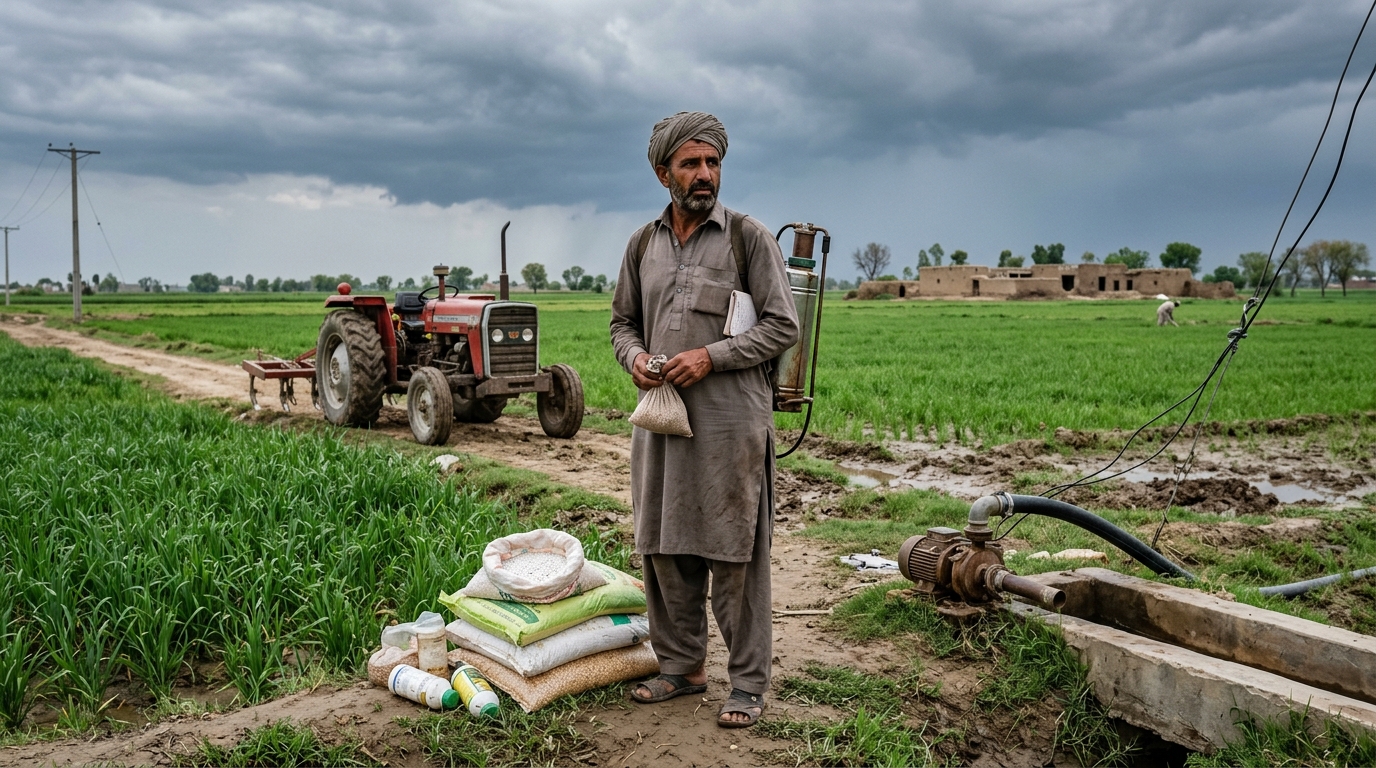
Seeds are only one input. Pakistan’s fertilizer consumption has remained in the millions of tonnes annually. The Pakistan Economic Survey records total fertilizer offtake of approximately 4.35 million tonnes in FY2025, while imports of fertilizer and insecticides remain significant. This exposes another uncomfortable reality.
Even if Pakistan completely controlled its seed system, it would not automatically control its food system.
Farmers still need fertilizer.
They need pesticides.
They need fuel.
They need electricity.
They need machinery.
They need irrigation.
They need finance.
They need markets.
The real agricultural dependency is therefore not a single chain.
It is a network.
Water May Be More Important Than Seeds
Pakistan’s food-security debate frequently focuses on seed companies while giving insufficient attention to water. That is a mistake. Agriculture is fundamentally dependent on the Indus Basin irrigation system, groundwater and increasingly unpredictable weather.
FAO has recently initiated a water-budgeting and agricultural-water-productivity study in Punjab using satellite-based technology to examine crop-water productivity, irrigation efficiency and groundwater sustainability. The project is explicitly linked to food security and climate resilience in the Indus Basin. This should be a national priority.
A drought-resistant seed cannot compensate indefinitely for depleted groundwater.
A high-yield variety cannot produce its potential without appropriate water.
And a farmer cannot repay a loan from a crop that never receives the water it needs.
Therefore:
Pakistan’s food sovereignty is inseparable from water sovereignty.
Climate Change Is Changing the Equation
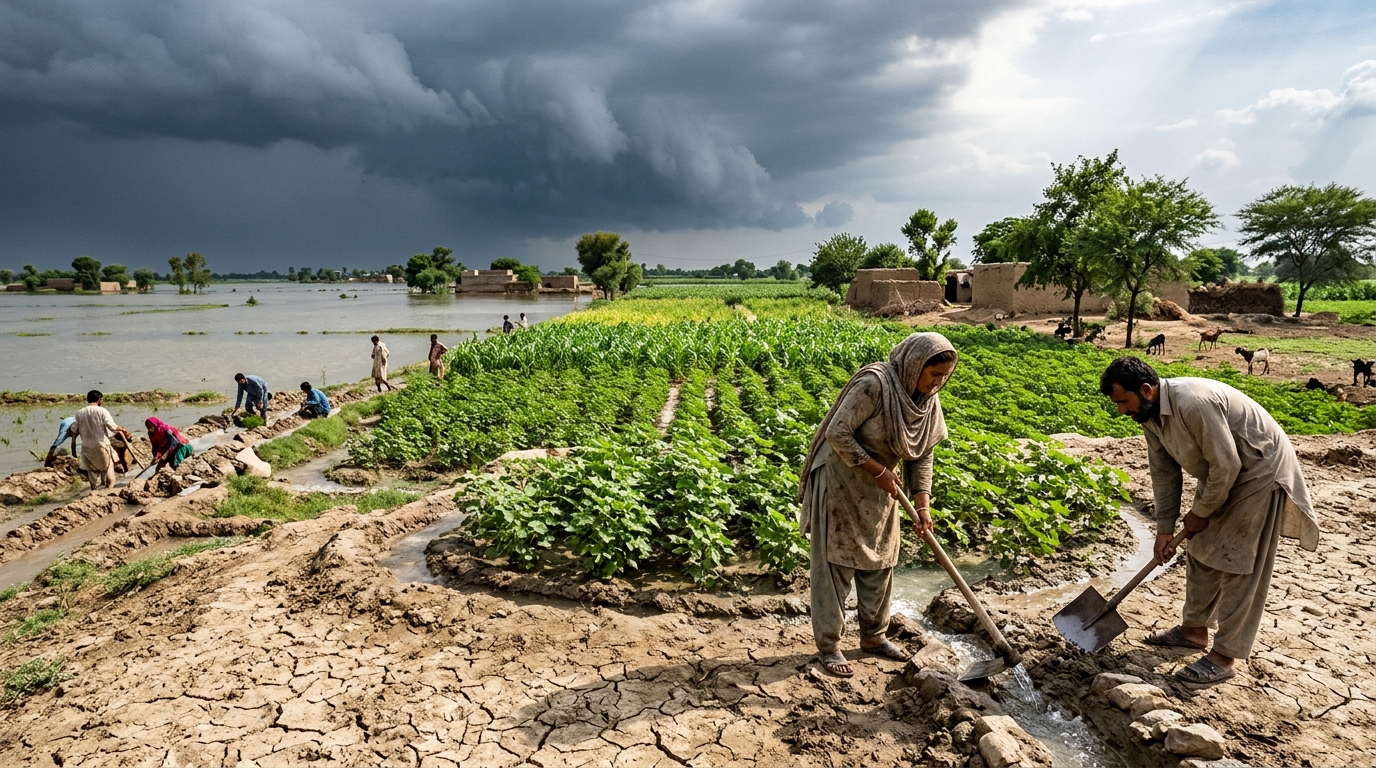
The Pakistani farmer is also confronting a changing climate. Heatwaves, floods, droughts, irregular rainfall, water stress and extreme weather can turn an apparently profitable crop into a financial disaster. This makes climate-resilient agricultural technology important. But it creates another sovereignty question:
Who owns the technology that will make Pakistani agriculture climate-resilient?
Who develops the varieties?
Who owns the patents?
Who stores the genetic resources?
Who controls the agricultural data?
Who determines which technologies farmers receive?
Who pays for them?
And what happens if an international supplier withdraws?
These are not conspiracy questions.
They are normal questions of national policy.
The Genetic Wealth of Pakistan
Pakistan’s traditional agricultural varieties are not merely relics of the past. They represent genetic diversity. A traditional variety may contain characteristics that become valuable in the future:
drought tolerance,
heat tolerance,
salinity tolerance,
disease resistance,
nutritional characteristics,
or adaptation to particular soils.
Once genetic diversity disappears, it may be impossible to recreate it.
That is why seed banks, public agricultural research and farmer-maintained genetic resources are strategic assets. Pakistan’s own proposed Seed Policy recognizes this principle by addressing farmers’ contributions to plant genetic resources and proposing a National Gene Fund. That policy direction deserves far more public attention.
The Bigger Question: Who Captures the Value?
There is another dimension of food sovereignty that receives remarkably little attention.
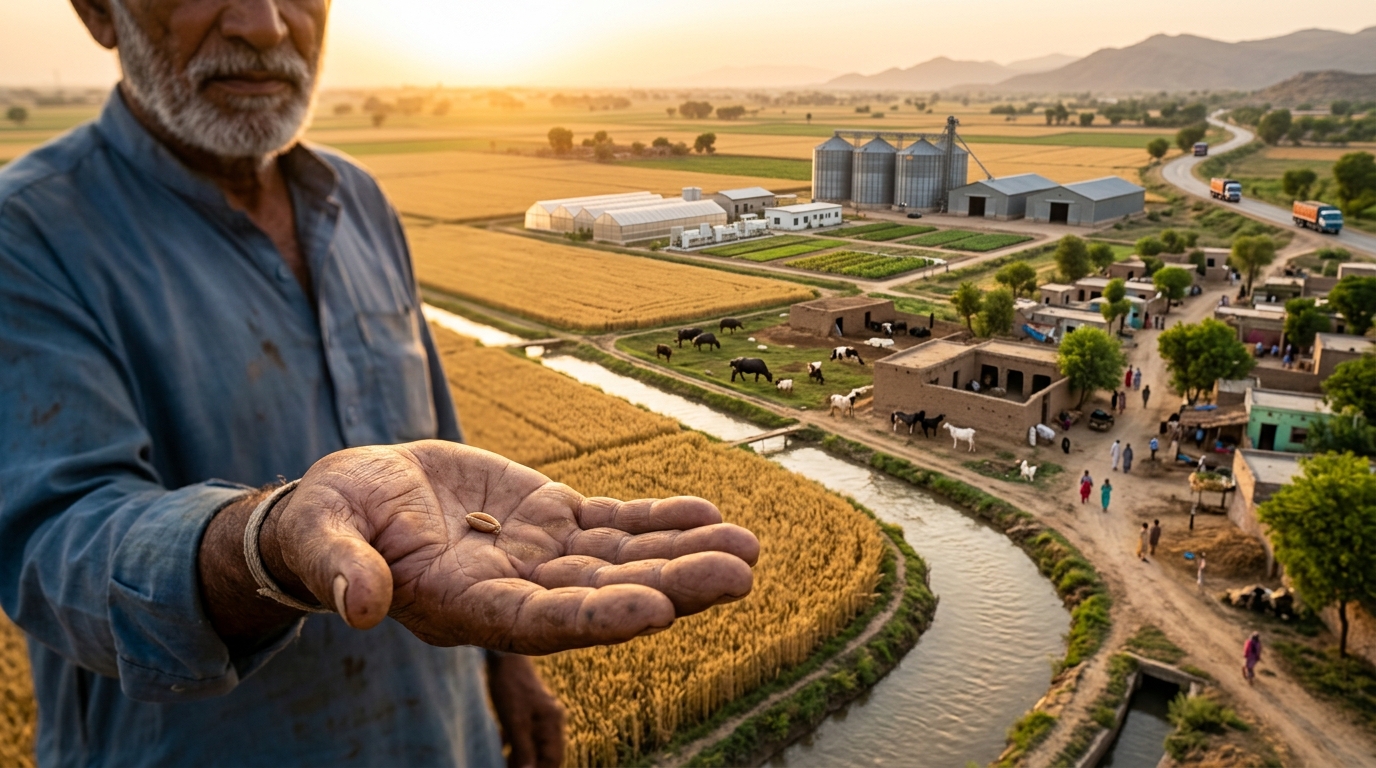
Who earns the money generated by agriculture?
Consider cotton.
A farmer grows cotton.
Then it goes through:
ginning,
spinning,
weaving,
dyeing,
garment manufacturing,
branding,
retailing.
The farmer receives the first payment.
The largest economic value may be created much later.
The same applies to:
wheat → flour → bread,
milk → processed dairy,
mango → juice or packaged fruit,
tomato → processed food,
sugarcane → refined sugar and industrial products,
rice → branded export.
This raises a fundamental question:
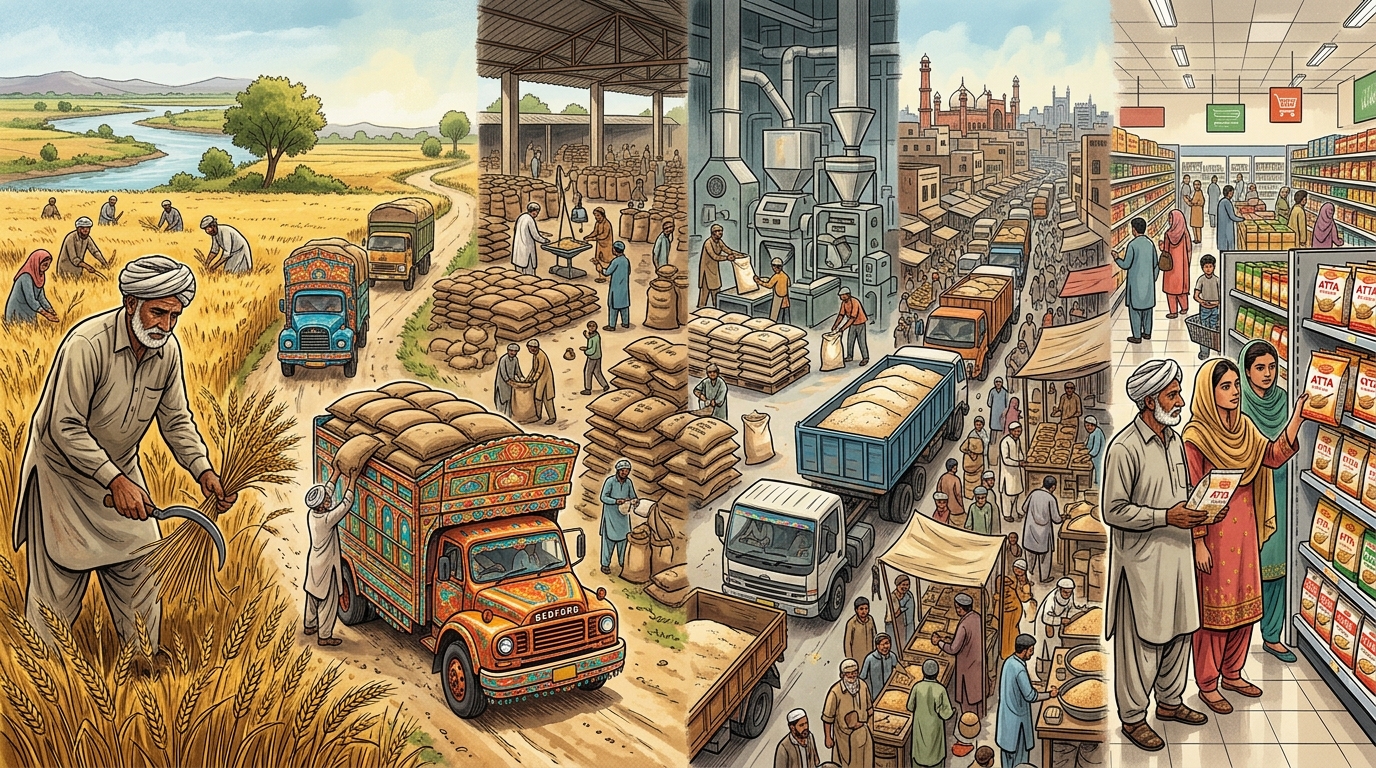
Why should the farmer remain the weakest participant in a value chain that begins with his land, labor and risk?
Agricultural sovereignty, therefore, requires more than seed ownership. It requires farmers’ bargaining power.
Storage Is a Hidden Agricultural Weapon
A farmer who cannot store his crop is often forced to sell when everyone else is selling.
That is when prices can be weakest.
A farmer with access to:
modern storage,
cold chains,
warehouses,
warehouse receipts,
crop insurance,
transparent commodity markets,
and reliable price information
has considerably greater bargaining power.
This is why food security should not end at the farm gate. The country needs to protect food from the farm to the consumer.
Pakistan’s Food Import Paradox
Another warning sign is that Pakistan can be an agricultural country and still remain dependent on imports for important food commodities and agricultural inputs. Pakistan has historically relied heavily on imported edible oil, pulses, tea and other commodities. The country’s food-import bill has at times exceeded food exports by a considerable margin. That produces a paradox.
A country can have millions of farmers and tens of millions of acres under agriculture while still importing important components of its food basket. This suggests that the problem is not simply insufficient agricultural land. It is also:
What we grow, how we grow it, how efficiently we use water, how much we lose after harvest, how we process it, and how the market rewards farmers.
The Crops We Grow Matter
Food sovereignty does not necessarily mean producing everything domestically. Complete self-sufficiency is economically unrealistic for many countries. The sensible objective is strategic food resilience. Pakistan should identify commodities where excessive external dependence creates genuine national risk. These may include:
edible oils,
pulses,
seeds,
fertilizer inputs,
agricultural chemicals,
critical machinery,
and certain food commodities.
The question should be:
Which dependencies are economically efficient, and which are strategically dangerous?
There is a difference. Importing something because another country can produce it more efficiently is normal international trade. Being unable to feed the population because a foreign supplier stops providing a critical agricultural input is a strategic vulnerability.
Public Agricultural Research Has Become a National Security Requirement
If Pakistan wants genuine agricultural sovereignty, it cannot simply tell farmers to “use better seeds.” It must invest in the institutions that create those seeds. Pakistan needs world-class agricultural research capable of producing:
climate-resilient crops,
water-efficient varieties,
disease-resistant crops,
better livestock genetics,
locally adapted hybrids,
soil-management technologies,
precision irrigation,
biological pest control,
agricultural biotechnology,
and post-harvest technologies.
The public sector must not necessarily produce everything. But it must possess enough scientific capacity to understand, evaluate, regulate and improve what the private sector produces. Otherwise, the country becomes a consumer rather than a creator of agricultural technology.
The Danger of Corporate Concentration
Corporate participation in agriculture is not automatically harmful.
Private companies can bring:
research investment,
technology,
distribution,
quality control,
capital,
and access to international markets.
The danger emerges when competition becomes weak. If a small number of companies control critical inputs, farmers may have little bargaining power. That can create problems involving:
pricing,
licensing,
intellectual property,
technology fees,
contract farming,
data ownership,
and access to genetic material.
The answer is not to eliminate private companies. The answer is strong competition law, transparent regulation and public research capacity.
What Pakistan Should Learn From India
The lesson from India should therefore not be:
“Never use improved seeds.”
Nor should it be:
“Foreign agricultural companies are responsible for farmer suicides.”
The more defensible lesson is:
Never build an agricultural system in which small farmers carry the majority of production risk while having little control over input prices, credit, water, technology, or the price they receive for their produce.
That is the structural danger.
Seeds can be part of the problem.
So can fertilizer.
So can pesticides.
So can debt.
So can drought.
So can market manipulation.
So can poor government policy.
So can crop failure.
So can weak rural infrastructure.
The tragedy begins when all of these vulnerabilities converge on the same small farmer.
Food Sovereignty Does Not Mean Isolation
There is an important distinction between food sovereignty and agricultural isolationism.
Pakistan does not need to reject foreign science.
It does not need to reject international investment.
It does not need to reject improved seeds.
It does not need to reject biotechnology.
It does not need to reject cooperation with the Gates Foundation or any other international organization.
It needs to negotiate from a position of knowledge and institutional strength. A sovereign agricultural policy should be able to say:
We welcome technology, but we will not surrender our genetic resources.
We welcome investment, but farmers’ rights will be protected.
We welcome improved varieties, but public research will continue.
We welcome foreign companies, but competition will be enforced.
We welcome biotechnology, but biosafety and transparency will remain mandatory.
We welcome agricultural finance, but farmers will not be trapped in unsustainable debt.
That is sovereignty.
The Pakistan Model Should Be Different
Pakistan needs an agricultural model based on five principles.
1. Seed security
Build strong domestic seed research and production while preserving farmers’ seed rights and genetic diversity.
2. Water security
Measure water productivity crop by crop, modernize irrigation, protect groundwater and shift toward crops that provide greater economic and nutritional value per unit of water.
3. Farmer financial security
Expand affordable institutional credit, crop insurance and risk-management tools while preventing predatory lending.
4. Market security
Give farmers access to storage, transparent pricing, digital market information and competitive buyers.
5. Scientific sovereignty
Develop Pakistan’s own capacity in agricultural genetics, biotechnology, soil science, climate science, data and mechanization. These five pillars would do more for food sovereignty than simply banning foreign seed companies.
The Most Important Question for Pakistan
The debate should therefore move beyond:
“Should Pakistani farmers use improved seeds?”
That is too narrow. The real question is:
Can Pakistan modernize its agriculture without becoming structurally dependent on external corporations for the technologies, genetic resources, inputs and knowledge required to feed itself?
The answer depends on what Pakistan does now. If we strengthen public research, regulate private companies, protect farmers’ rights, conserve genetic diversity, modernize irrigation, expand affordable credit, improve markets and develop domestic agricultural technology, international cooperation can become an asset. If we neglect all of those things, dependence can deepen regardless of whether the supplier is American, Chinese, European, Indian, or Pakistani. That is the uncomfortable truth.
The Greatest Threat May Not Be a Foreign Company
The easiest explanation is to blame an external corporation.
The harder explanation is to examine our own institutions.
A country becomes vulnerable when:
Its research institutions are weak,
Its seed regulation is ineffective,
Its farmers cannot access affordable credit,
Its water is poorly managed,
Its storage system is inadequate,
Its markets are distorted,
Its agricultural data are weak,
Its extension services fail,
And its political leadership thinks in terms of the next harvest rather than the next generation. Foreign companies can exploit weaknesses. But they do not create every weakness. Sometimes the greatest threat to sovereignty is not the foreign company.
It is the domestic failure to build the capacity to negotiate with that company on equal terms.
The Way Forward
Pakistan should establish a national agricultural sovereignty framework covering at least the next 20 years. The framework should publicly disclose:
Who owns and develops major seed varieties,
Which varieties are imported,
Which are locally developed,
Who owns their intellectual property,
How much do farmers spend on seed per acre,
How much they spend on fertilizer and pesticides,
How much credit they require,
How much interest they pay,
How much water each major crop consumes,
What percentage of the final consumer price reaches farmers,
How much food is lost after harvest, and which agricultural commodities create strategic import vulnerability?. Without such information, food sovereignty remains a slogan.With it, Pakistan could build a genuine evidence-based agricultural strategy.
Conclusion: The Seed Is Only the Beginning
The original warning that “control of seed means control of food” contains an important idea, but it is too simple to explain the modern agricultural system. Food sovereignty is much larger.
It is about the farmer’s ability to access seed, water, knowledge, finance, technology and markets without becoming trapped by any single supplier.
It is about preserving genetic diversity while embracing scientific progress.
It is about allowing private companies to innovate without allowing market concentration to eliminate competition.
It is about international cooperation without surrendering national interests.
And above all, it is about ensuring that the person taking the greatest risk in agriculture, the farmer, receives a fair share of the value created by his land and labor. Pakistan should not fear improved seeds.
It should fear dependency without safeguards.
It should not fear foreign technology.
It should fear the disappearance of domestic scientific capacity.
It should not reject international cooperation.
It should ensure that cooperation never becomes surrender.
And it should not romanticize the past. The farmer of yesterday may have saved his own seed, but he also faced lower productivity, weaker technology, poorer infrastructure and greater exposure to natural disasters. The goal is not to return to yesterday.
The goal is to build a future in which Pakistan can use the best science in the world while retaining the capacity to feed itself, protect its farmers and make its own strategic decisions. Because the real measure of food sovereignty is not whether every seed is produced inside Pakistan.
It is whether
Pakistan can still decide what it grows, how it grows it, who benefits from it, and how securely it can feed its people when the world becomes less predictable.
Purpose of This Investigation
This article examines Pakistan’s agricultural sovereignty through the interconnected issues of seed security, farmer indebtedness, agricultural inputs, water, climate change, genetic resources, corporate participation, food imports and agricultural research. It also examines the frequently repeated claim that commercial seeds and agricultural corporations caused India’s farmer-suicide crisis and separates documented evidence from oversimplified or unsupported explanations.
Key Takeaway
Pakistan’s agricultural vulnerability cannot be reduced to foreign seed companies. The real issue is whether the country possesses enough domestic scientific, regulatory, financial and institutional capacity to ensure that modernization strengthens the farmer rather than making him permanently dependent on external suppliers.
Frequently Asked Questions
Does Pakistan depend on imported seeds?
Pakistan imports some seeds, but imports are only one component of the seed system. The Pakistan Economic Survey 2025-26 reported total seed availability of about 768,000 tonnes against an estimated requirement of about 2.06 million tonnes for the crops covered during July-March FY2026. Most reported available seed came from private sources, while imported seed accounted for a much smaller share.
Are all improved seeds hybrid seeds?
No. “Improved seed” is a broad term. Improved varieties can be hybrid or non-hybrid. Hybrid seed may require replacement if farmers want the same hybrid characteristics in the next generation, but it is incorrect to say that all improved seeds are incapable of being replanted.
Did improved seeds cause India’s farmer suicides?
There is no evidence supporting such a simple causal explanation. Indian farmer suicides have been associated in research with indebtedness, crop failure, irrigation problems, cash-crop exposure, input costs, market conditions and other socioeconomic factors. Research specifically examining Bt cotton has produced a more complicated picture, with some studies finding economic links while others conclude that Bt cotton itself was unlikely to be a major independent cause.
Does Pakistan need foreign agricultural technology?
Pakistan can benefit substantially from international technology, research and investment. The strategic issue is not whether foreign technology should be used, but whether Pakistan retains sufficient domestic research, regulatory and bargaining capacity to protect farmer and national interests.
Is Bill Gates taking control of Pakistan’s agricultural system?
The available official evidence does not establish such a claim. Pakistan’s government has confirmed that Prime Minister Shehbaz Sharif and Bill Gates discussed possible cooperation involving improved seeds, livestock genetics and agricultural technologies in September 2026. That establishes cooperation discussions, not control of Pakistan’s agricultural system.
What is the biggest threat to Pakistan’s food security?
There is no single threat. Pakistan faces an interconnected set of risks involving water scarcity, climate change, low productivity, fragmented farms, input costs, credit, weak regulation, seed quality, post-harvest losses, market structures and dependence on imports for selected commodities and inputs.
What would genuine food sovereignty look like?
It would mean Pakistan possesses the domestic scientific and institutional capacity to maintain genetic resources, develop agricultural technology, regulate markets, protect farmers’ rights, manage water, finance agricultural production and maintain strategic food reserves while still participating in international trade and scientific cooperation.
Final Perspective
A country’s food system is too important to be governed by slogans.
“Foreign companies are taking over agriculture” is a slogan.
“So-called modern seeds will save everything” is also a slogan.
Neither is sufficient.
Pakistan needs something much harder:
evidence, transparency, strong institutions, independent research and a farmer who has bargaining power.
That is where genuine agricultural sovereignty begins.