
TRIPS: The Bargain That Can Become a Trap
How Developing Societies Can Protect Their Knowledge, Sovereignty and Policy Space Without Rejecting Technology, Investment or Innovation.
The Trips
There is a recurring pattern in the modern economic history of developing societies. Something that has been part of a community’s life for generations is first described as inefficient, backward or commercially underdeveloped. Then comes a new system, accompanied by attractive promises: greater productivity, modern technology, foreign investment, better markets, intellectual-property protection and access to the global economy.
The old system gradually loses legitimacy. The new system arrives carrying the language of progress.
Only later does the society sometimes discover that it has not merely acquired a new technology or market. It has also surrendered part of its control.
This is the question that deserves to be asked about TRIPS—the Agreement on Trade-Related Aspects of Intellectual Property Rights.
For many ordinary readers, TRIPS will be an unfamiliar term. It is an international agreement administered through the World Trade Organization (WTO) that establishes minimum standards for protecting intellectual property among WTO members. It came into force in 1995 as part of the agreements establishing the WTO.
But why should an ordinary Pakistani care about an international agreement dealing with patents and intellectual property?
Because intellectual-property rules are not confined to lawyers’ offices. They can affect what farmers plant, who controls seeds, how medicines are priced, whether traditional knowledge can be commercially appropriated, how domestic industries compete, and how much policy freedom governments retain when dealing with powerful international businesses.
Intellectual property includes several forms of legally protected creation or commercial identity. Patents can provide exclusive rights over qualifying inventions. Copyright protects literary, artistic and other creative works. Trademarks protect distinctive names and brands. Geographical indications can associate products with particular places and qualities.
There is a legitimate case for such protection. Research is expensive. Inventors need incentives. Companies may be reluctant to invest billions in developing a new medicine or technology if competitors can immediately copy the result.
The controversy, however, begins with a different question:
Who designed the rules, who possesses the capacity to exploit them, and who bears the cost when the interests of the owner of intellectual property collide with those of the ordinary user?
That question matters particularly to Pakistan and the wider Subcontinent.
These societies possess enormous stores of agricultural knowledge, biological resources, traditional medicines, indigenous practices and locally adapted systems. Yet they often lack the institutions, research capacity, documentation, capital and negotiating strength required to protect and develop these assets on equal terms.
The central argument of this article is therefore not that every patent is wrong, every investor is predatory or every modern technology is harmful. Such a position would be neither accurate nor useful.
The argument is more serious:
TRIPS emerged from an international economic order in which the technological and commercial power of advanced economies was vastly greater than that of most developing countries. Its rules can therefore operate very differently for those who own technology and those who must buy it.
That asymmetry deserves scrutiny.
And if developing countries are the intended beneficiaries of global trade and technological progress, they must learn to participate in the system without allowing participation to become permanent dependence.
The Problem Is Bigger Than a Patent
TRIPS is often presented as a technical legal arrangement under which countries agree to minimum standards for protecting intellectual property.
But law does not operate in a vacuum.
A patent may belong to a company possessing laboratories, lawyers, international distribution networks and billions of dollars in capital. The person affected by that patent may be a farmer, patient, small manufacturer, inventor or village community possessing little more than inherited knowledge and limited financial resources.
There may be formal equality before the law.
There is not necessarily equality of power.
This is where the controversy begins.
Critics of TRIPS have long argued that the agreement institutionalised intellectual-property standards that reflected the interests and capacities of technologically advanced economies more strongly than those of poorer countries. The original research identifies the resulting imbalance as one in which the costs for developing countries can be immediate while promised benefits such as innovation, development and technology transfer may be uncertain or delayed.
The point should not be dismissed simply because intellectual property itself has legitimate purposes.
A system can have a legitimate purpose and still produce unequal consequences.
The deeper problem becomes visible when intellectual property intersects with things that developing societies have historically regarded as collective resources: seeds, agricultural practices, medicinal knowledge, biological resources and traditional techniques.
The question then changes from:
Who invented this?
to:
Who has the power to define, document, patent, commercialise and ultimately control it?
From Seed Sovereignty to Seed Dependence
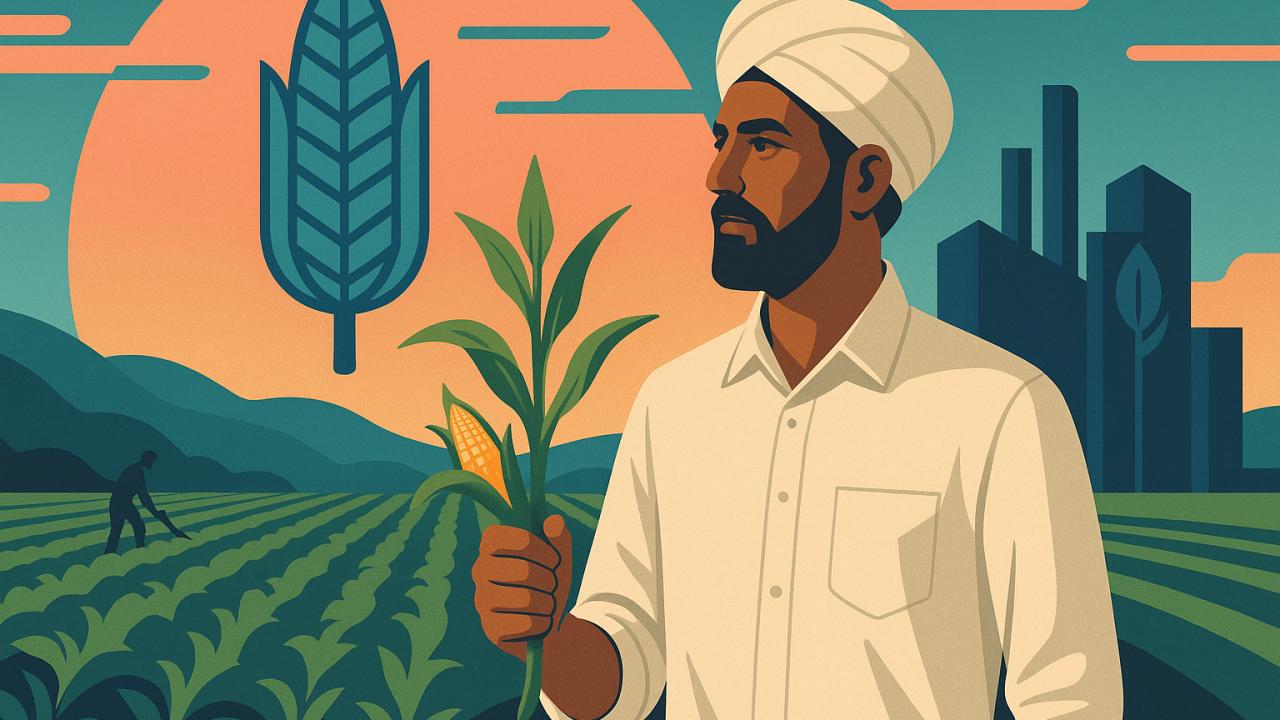
For generations, farmers across the Subcontinent saved seed from one harvest, exchanged it with neighbours, adapted varieties to local soil and climate and gradually improved them through selection.
It was not a perfect system.
Traditional agriculture had—and still has—serious weaknesses in productivity, disease resistance, mechanisation, storage, water efficiency and market access.
But it possessed one important characteristic:
the farmer retained substantial control over the basic reproductive resource of agriculture—the seed.
Modern seed science can deliver extraordinary benefits. Improved varieties can increase yields, resist pests and diseases, tolerate environmental stresses and improve quality.
The answer is therefore not to reject modern seed technology.
The danger lies in assuming that the arrival of a scientifically improved product automatically justifies dismantling the entire traditional system surrounding it.
That is where developing countries need much greater sophistication.
TRIPS Article 27.3(b) requires protection for plant varieties, but it allows countries to adopt protection through patents, an effective sui generis system—a specially designed national system—or a combination of approaches.
That policy space is important.
Pakistan therefore does not necessarily have to copy the intellectual-property architecture of an advanced industrial economy. It can seek a system that rewards genuine agricultural innovation while also protecting farmers, biodiversity, local varieties and food security.
The right question is not:
Traditional seeds or modern seeds?
It is:
How can modern science improve our seed system without destroying the farmer’s sovereignty over it?
That is the question that should guide policy.
The danger is greatest when improved technology becomes part of a larger commercial package in which the farmer becomes permanently dependent on purchased seed, associated inputs and external technical systems.
The issue is not whether such products are useful.
The issue is whether the farmer still has choice.
Pakistan and the Subcontinent: The Warning We Must Understand
India provides some useful illustrations, but this is not fundamentally an India-versus-Pakistan issue.
It is a Subcontinental issue.
Pakistan possesses its own enormous agricultural and biological heritage: indigenous crop varieties, livestock practices, medicinal plants, food traditions, water-management knowledge and farming practices adapted to local ecological conditions.
Much of this knowledge exists informally.
That is both its strength and its vulnerability.
A community may know for centuries that a particular plant has medicinal properties. Farmers may possess locally adapted seed varieties. Villages may maintain agricultural techniques that outsiders later find commercially valuable.
But if that knowledge is neither documented nor scientifically investigated nor appropriately protected, another institution can undertake the research, produce the documentation, obtain intellectual-property protection where legally possible and build a commercial enterprise around it.
The community may possess the knowledge.
Another party may possess the legal and commercial instrument.
That is the asymmetry.
The famous controversies involving neem, turmeric and basmati in India are useful because they demonstrate how traditional knowledge and biological resources can enter the international intellectual-property system in ways that create disputes over novelty, ownership and commercial rights.
The lesson for Pakistan should not be that India is the victim and Pakistan should merely watch.
The lesson should be:
If we do not document, research and protect what we already possess, someone else may be better positioned to define its commercial value.
This is not an argument against international science.
It is an argument for becoming scientifically capable ourselves.
Biopiracy: When Knowledge Becomes Someone Else’s Property
The term biopiracy is used by critics to describe the appropriation or commercial exploitation of biological resources and traditional knowledge without adequate recognition, consent or benefit-sharing.
The concept deserves attention because the developing world has accumulated knowledge in forms very different from the laboratory notebooks and patent documents recognised by modern intellectual-property systems.
A village healer may possess knowledge transmitted orally.
A farmer may know which seed survives a particular soil condition.
A community may know how a plant is processed for medicinal use.
A traditional practitioner may understand combinations of plants that have never been formally documented.
Modern science may subsequently investigate the same knowledge and identify commercially useful compounds or processes.
The problem is not scientific investigation.
The problem arises when the knowledge moves from community heritage into commercial ownership while the original custodians disappear from the economic equation.
This is why Pakistan needs national and community-level documentation systems.
Traditional knowledge should not remain undocumented simply because it is traditional.
It should be recorded, studied, scientifically tested where appropriate and legally protected where possible.
The objective should be to transform traditional knowledge from an exposed resource into a recognised national and community asset.
The Pharmaceutical Dimension
The problem becomes even more sensitive when intellectual property concerns medicines.
TRIPS established international standards for patent protection, including in pharmaceuticals, while also preserving important legal flexibilities. The 2001 Doha Declaration on the TRIPS Agreement and Public Health reaffirmed the right of WTO members to use TRIPS flexibilities to protect public health.
The underlying tension is straightforward.
A patent can provide an incentive for costly research and development.
But exclusive rights can also restrict competition during the period of protection and contribute to higher prices.
For a luxury product, this may be an ordinary commercial dispute.
For a life-saving medicine, it can become a question of public policy and human welfare.
The appropriate question is therefore not whether pharmaceutical patents are inherently good or bad.
It is:
Where should the balance lie between rewarding innovation and protecting people’s access to essential treatment?
Developing countries must understand and use the legal space available to them.
Compulsory licensing, for example, can under defined circumstances allow use of a patented invention without the patent holder’s consent, subject to applicable legal requirements and compensation.
Parallel importation can, depending on national rules, allow legitimately marketed products to be imported from another market.
These are not acts of intellectual-property anarchy.
They are part of the policy space built into the international system.
The real weakness may therefore be less in the existence of legal options than in whether governments possess the legal expertise, institutional confidence, political courage and domestic industrial capacity to use them.
The Technology-Transfer Promise
One of the most persuasive arguments made for international intellectual-property protection is that it will encourage innovation and facilitate technology transfer to developing countries.
TRIPS itself recognises technology transfer as an objective. Article 66.2 specifically requires developed-country members to provide incentives to enterprises and institutions in their territories to promote technology transfer to least-developed countries.
But there is a fundamental distinction that developing countries must learn to make:
technology consumption is not technological development.
A country may import a machine without learning how to design one.
It may purchase patented seed without developing its own breeding capacity.
It may import medicines without developing the research ecosystem capable of discovering the next generation of medicines.
It may attract a foreign technology company without acquiring meaningful domestic technological capability.
It may celebrate billions of dollars of foreign investment while remaining dependent on foreign technology for decades.
That is not necessarily development.
It may simply be technology consumption financed by dependence.
Pakistan must therefore judge foreign investment not merely by how much capital enters the country, but by what capabilities remain behind after the investor has earned a return.
Does local research capacity increase?
Are Pakistani engineers trained?
Are local suppliers developed?
Are domestic laboratories strengthened?
Is manufacturing transferred?
Are patents licensed locally?
Are universities connected to industry?
Can Pakistani enterprises eventually improve, adapt and create the technology?
These questions matter far more than the headline figure of foreign investment.
Why Do We Keep Falling for the Same Bait?
This may be the most uncomfortable question in the entire debate.
Why do developing countries repeatedly accept arrangements whose immediate benefits are attractive while their long-term costs remain hidden?
Part of the answer lies outside us.
But part lies within us.
Governments negotiate under pressure. They want investment. Industries want immediate access to technology. Farmers want higher yields. Patients want medicines. Universities want funding. Policymakers want visible achievements.
The investor, however, may be thinking in decades.
We often negotiate the transaction.
The stronger party negotiates the system.
That difference is decisive.
A developing country may receive a factory but lose technological independence.
It may receive a seed but lose seed sovereignty.
It may receive a patent-protected medicine but lose affordable alternatives.
It may receive investment but create no domestic research capacity.
It may receive a foreign technology platform while becoming permanently dependent upon it.
This is why the problem cannot be blamed entirely on outsiders.
A weak negotiating system creates opportunities for stronger interests to occupy the space left vacant by domestic policy.
If Pakistan possesses traditional knowledge but does not document it, that is partly our failure.
If farmers remain dependent on external inputs because domestic agricultural research is weak, that is partly our failure.
If domestic pharmaceutical research remains inadequate, that is partly our failure.
If international agreements are accepted without serious parliamentary, scientific, economic and public-interest scrutiny, that is an institutional failure.
The answer, therefore, is not merely to denounce foreign investors.
We must repair ourselves.
Do Not Throw Away the Old System—Improve It
This is perhaps the most important principle emerging from the entire debate.
There is a dangerous tendency to divide the world into two camps:
traditional versus modern.
That is a false choice.
A farmer can combine centuries-old ecological knowledge with satellite-based weather information.
A traditional seed can be scientifically characterised, improved, stored and developed.
A medicinal plant can undergo modern pharmacological research without stripping the community of its historical relationship with that knowledge.
Traditional irrigation practices can be combined with modern water-management technology.
Traditional architecture can be strengthened through modern materials and engineering.
Local food systems can benefit from modern processing and cold-chain technology without destroying their identity.
The objective should therefore be:
modernism without dispossession.
Modernisation without dispossession.
Pakistan should not allow investors—or indeed its own policymakers—to define progress simply as replacing indigenous systems with commercially controlled alternatives.
Instead, the country needs a sustained programme of Traditional Systems Improvement.
Document what exists.
Test what works.
Discard what does not.
Improve what can be improved.
Protect what is valuable.
Research what is promising.
Commercialise where appropriate.
And ensure that the original communities receive recognition and a fair share of the resulting benefits.
That would transform tradition from a museum exhibit into a platform for innovation.
New Technology Should Serve the User
This principle should become the test for every major technological intervention.
Who is the technology ultimately serving?
If new agricultural technology increases farmer productivity, reduces risk and gives farmers more choices, it deserves encouragement.
If it merely replaces one dependency with another, its structure deserves scrutiny.
If pharmaceutical research produces affordable and accessible treatment, society benefits.
If innovation creates a monopoly that makes essential treatment inaccessible, the public interest must be considered.
If foreign investment creates local capability, skilled employment, research and manufacturing, it can strengthen the country.
If it merely extracts resources, captures markets and repatriates profits while leaving domestic capability unchanged, the arrangement deserves much closer examination.
The issue is therefore not investment versus no investment.
It is:
investment on whose terms and for whose lasting benefit?
Likewise, the issue is not innovation versus tradition.
It is:
innovation that builds upon society’s accumulated knowledge rather than innovation that makes that knowledge disposable.
What Pakistan Should Do
Pakistan does not need an anti-technology policy.
It needs a pro-capability policy.
- Use TRIPS Flexibilities
Pakistan should make full and informed use of legitimate TRIPS flexibilities, particularly where public health, food security and agricultural interests require them.
The existence of flexibility is meaningless if governments lack the expertise or confidence to use it.
- Develop Home-Grown Protection Systems
Pakistan should develop carefully designed national systems for plant varieties and traditional knowledge rather than mechanically copying foreign intellectual-property models.
Article 27.3(b) provides important policy space in the treatment of plant varieties.
The objective should be to protect innovation without unnecessarily destroying farmers’ rights and biodiversity.
- Create a National Traditional Knowledge Programme
Traditional knowledge should be systematically documented in cooperation with communities, universities, research institutions and relevant government departments.
Documentation can help establish prior art—evidence that knowledge already existed—making it more difficult for someone else to present inherited knowledge as a wholly new invention.
But documentation should not become another mechanism for extracting knowledge from communities.
Communities must participate in deciding what is documented, how it is used and how benefits are shared.
- Rebuild Domestic Research Capacity
Agricultural universities, pharmaceutical research institutions, laboratories and public research organisations require sustained investment.
Pakistan cannot protect its technological sovereignty while remaining scientifically dependent.
The strategic objective should be:
technology buyer → technology adapter → technology developer → technology creator.
- Make Foreign Investment Build Capability
Foreign investment should be evaluated not merely by capital inflow.
Investment agreements involving agriculture, biotechnology, pharmaceuticals, strategic resources and major technologies should ask:
- What local capability will be created?
- What skills will be transferred?
- What research will take place locally?
- What manufacturing will be localised?
- What domestic suppliers will be developed?
- What will remain after the investor has recovered its investment?
- Scrutinise TRIPS-Plus Obligations
TRIPS-Plus refers to intellectual-property commitments that go beyond the minimum requirements established by TRIPS.
Not every TRIPS-Plus provision is necessarily harmful.
But developing countries should never accept such provisions automatically.
Every additional restriction should be tested against national interests, especially medicine affordability, agricultural sovereignty, domestic industry and future policy space.
- Build Coalitions with Other Developing Countries
Pakistan should cooperate with other developing countries in international trade and intellectual-property negotiations.
A country negotiating alone against much larger economic interests is vulnerable.
Collective bargaining can provide greater negotiating weight and allow developing countries to defend policy space more effectively.
The Real Choice Before Us
The choice before Pakistan and other developing societies is not between isolation and globalisation.
Nor is it between tradition and technology.
It is between:
passive integration and intelligent integration.
A country that rejects modern knowledge will fall behind.
But a country that accepts every new technology, investment proposal and intellectual-property arrangement without examining ownership, dependency, affordability and long-term national capability may also fall behind—while becoming increasingly dependent on others.
The sensible path lies between these extremes.
Use foreign capital—but make it build domestic capacity.
Use foreign technology—but learn how it works.
Use patented products—but develop alternatives.
Improve traditional agriculture—but do not destroy its knowledge base.
Adopt modern seeds—but maintain genetic diversity and farmer choice.
Protect inventors—but do not allow essential public interests to disappear beneath permanent commercial exclusivity.
Welcome research—but make its benefits reach the user.
And above all:
Do not abandon a functioning indigenous system merely because someone has attached a lucrative financial proposition to its replacement.
The central lesson of TRIPS is therefore larger than intellectual property.
It is about power.
It is about who defines progress.
It is about who owns knowledge.
It is about who bears the cost of innovation.
And it is about whether developing countries enter the global economy as partners, customers or dependants.
TRIPS need not be treated as an instrument that developing countries can simply abolish. Nor should it be treated as an unquestionable covenant whose consequences must simply be endured.
It should be treated as a framework within which developing countries must learn to defend their policy space, exploit legitimate flexibilities, cooperate with one another and build their own capabilities.
The greatest danger is not that the outside world will modernise us.
The greatest danger is that we will allow modernisation to occur without strengthening ourselves.
The answer is therefore neither blind rejection nor blind acceptance.
It is:
organised self-interest, institutional competence and technological self-reliance.
The world will continue to offer attractive bargains.
Pakistan’s task is to learn how to distinguish between the bargains that develop Pakistan—and those that merely develop the people selling them.
Reader’s Guide: Terms and Abbreviations
TRIPS — Trade-Related Aspects of Intellectual Property Rights: The WTO agreement establishing minimum international standards for intellectual-property protection.
WTO — World Trade Organization: The international organisation governing the multilateral trading system.
IP / IPR — Intellectual Property / Intellectual Property Rights: Legal rights protecting inventions, creative works, brands, designs and other forms of intellectual creation.
Patent: A legal right that can give an inventor exclusive control over a qualifying invention for a specified period, subject to applicable law.
Copyright: Legal protection for qualifying literary, artistic and other creative works.
Trademark: A protected name, symbol or sign identifying goods or services.
Geographical Indication: A designation identifying a product as originating from a particular geographical area where a given quality, reputation or characteristic is linked to that origin.
Sui generis: Latin for “of its own kind”; in this context, a specially designed national system for protecting plant varieties.
UPOV — International Union for the Protection of New Varieties of Plants: An international framework for plant-variety protection. Countries should assess its implications carefully rather than adopting any model mechanically.
Biopiracy: A term used by critics to describe the appropriation or commercial exploitation of biological resources or traditional knowledge without adequate recognition, consent or benefit-sharing.
TRIPS-Plus: Intellectual-property obligations that go beyond the minimum standards established by TRIPS.
Compulsory Licensing: A legal mechanism under which, subject to defined conditions, a government can authorise use of a patented invention without the patent holder’s consent, with applicable safeguards and compensation.
Parallel Importation: Importation of a legitimately marketed product from another country or market, subject to the applicable national rules concerning exhaustion of intellectual-property rights.
Article 27.3(b): The TRIPS provision dealing with protection of plant varieties. It provides countries with policy choices involving patents, an effective sui generis system, or a combination.
Article 66.2: A TRIPS provision concerning incentives by developed-country members for technology transfer to least-developed countries.
Prior Art: Existing evidence showing that an invention or knowledge was already publicly known or used. Establishing prior art can be important in challenging claims of novelty.
Final Word
The argument of this article is not that every patent is exploitative, every investor is predatory or every modern technology is harmful.
The argument is narrower—and more important:
A developing society must never confuse technological modernisation with surrender of control.
Its traditional systems should be improved rather than casually destroyed.
Its knowledge should be documented rather than left exposed.
Its science should be strengthened rather than permanently outsourced.
Modern technology should be appropriated and adapted rather than merely purchased.
Foreign investment should build domestic capability rather than permanent dependency.
And international agreements should be judged not merely by the attractiveness of their promises, but by their actual consequences for the farmer, the patient, the worker, the inventor, the community—and ultimately the nation.