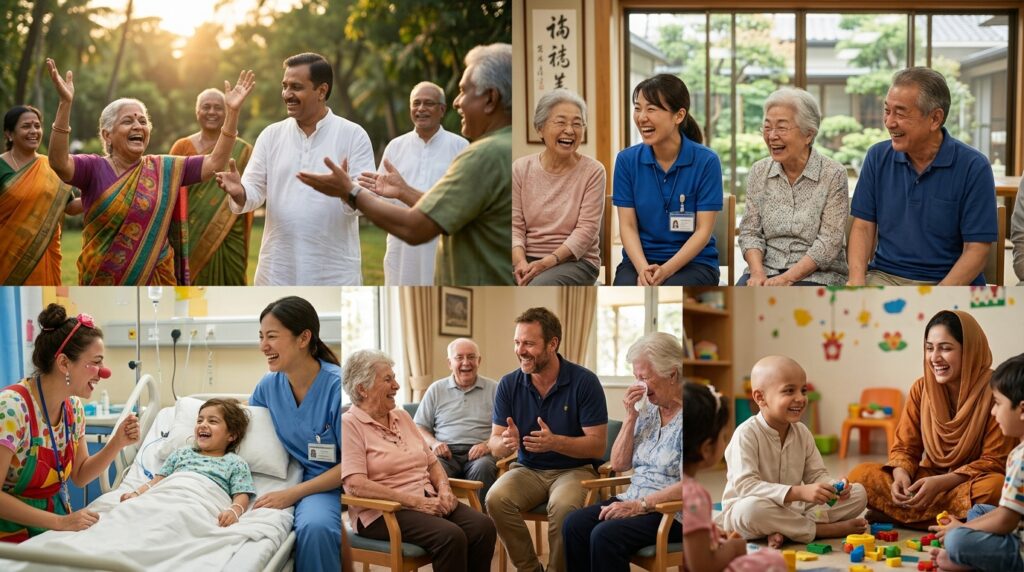
Laughter Therapy and Smile Medicine: Can a Smile Really Help Heal the Body?
Laughter therapy and smile medicine. Imagine being told you have cancer.
Your mind races.
How serious is it?
Will the treatment hurt?
What will happen to my family?
Will I survive?
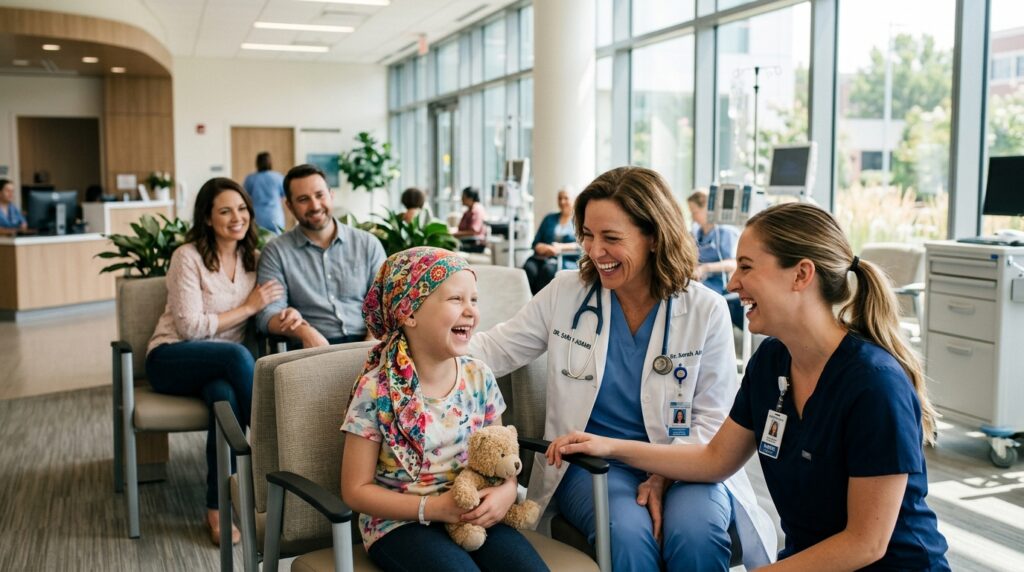
Then, somewhere inside the hospital, a child starts laughing.
For a few seconds, cancer is not the loudest thing in the room.
That moment may sound small.
But modern medicine is beginning to ask a surprisingly serious question:
Laughter Therapy and Smile Medicine: Can a Smile Really Help Heal the Body?
Can laughter, humour, play and human connection become part of better cancer care?
The answer is not that laughter cures cancer. It doesn’t.
But something more interesting is happening.
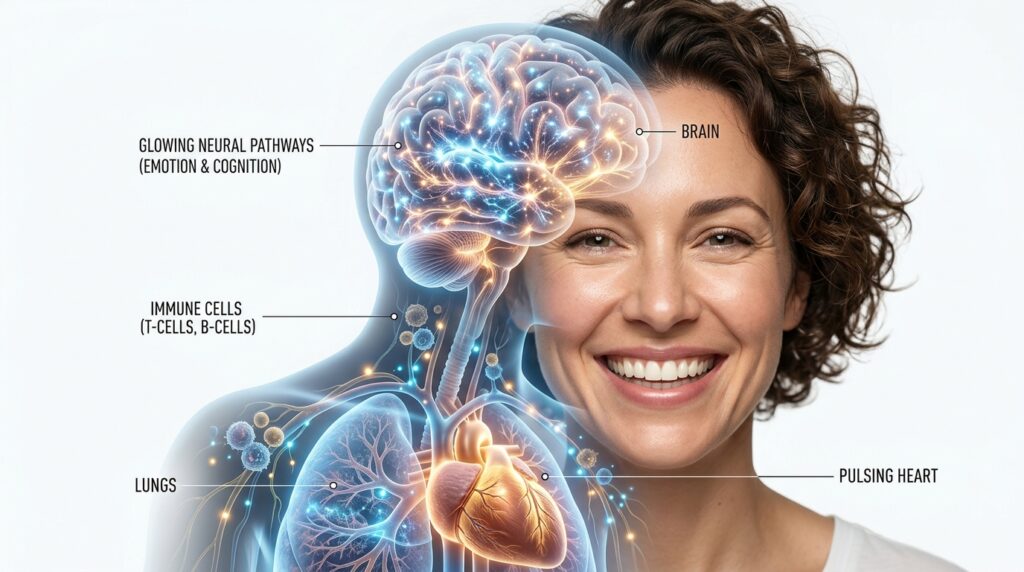
Researchers are finding that laughter-based interventions may help people cope with some of the anxiety, stress, pain and emotional burden that come with cancer and its treatment.
And this is no longer based only on the old advice to “keep smiling.”
There is now a growing body of clinical research behind the idea.
The Funny Thing About Medicine: Sometimes the Best Medicine Is Not a Medicine
Hospitals are usually places of serious faces.
Doctors concentrate.
Nurses hurry.
Machines beep.
Families whisper.
And patients wait.
Cancer hospitals can be even more emotionally intense.
So what happens when laughter enters that environment?
Something changes.
The illness does not disappear.
The chemotherapy does not suddenly become harmless.
A tumor does not laugh itself away.
But the patient may experience the hospital differently.
That distinction is crucial.
Laughter therapy is not cancer treatment. It is potentially supportive cancer care.
And that may be where its real value lies.
“Laughter doesn’t make cancer disappear. Sometimes it simply makes the person facing cancer feel less alone.”
That is not a medical claim. It is a useful way of understanding what researchers are investigating.
Laughter therapy is not cancer treatment. It is potentially supportive cancer care.
The 2026 Cancer Research That Changed the Conversation
The evidence has recently become more interesting.
A systematic review published online in June 2026 examined 16 randomised controlled trials involving 1,127 cancer patients.
The researchers found that laughter therapy probably produces an important reduction in anxiety.
The analysis also suggested possible reductions in pain and stress.
But there was an important limitation: laughter therapy did not clearly improve overall quality of life, and some outcomes had low-certainty evidence. (PubMed)
That is an important scientific reality.
The correct headline is not:
“Laughter cures cancer.”
It is:
“Laughter-based interventions may help cancer patients cope with some psychological and physical symptoms.”
That is both less sensational and much more credible.
A 2025 systematic review and meta-analysis reached a similar conclusion. Across nine randomised trials, laughter therapy was associated with improvements in stress, anxiety, depression, pain and fatigue, although the authors emphasised that it should be considered an adjunct rather than a replacement for standard cancer care. (PubMed)
Another meta-analysis of eight randomised trials involving 543 people with cancer found that laughter therapy combined with routine nursing was associated with reductions in stress, depression and anxiety. (PubMed)
In other words:
The laughter is not treating the tumour. It may be helping the human being living with the tumour.
A Child With Cancer Does Not Stop Being a Child
This is where the subject becomes deeply human.
Cancer can turn a child’s world into a schedule of blood tests, injections, scans, medicines and hospital rooms.
But children still want to play.
They still want to laugh.
They still want to be silly.
They still want to forget, even briefly, that they are patients.
This is one reason pediatric cancer care has become an important area for play, humour, recreation and psychological support.
And it brings us to Pakistan.
Shaukat Khanum: When a Cancer Hospital Makes Room for Laughter
Pakistan offers a particularly meaningful real-world example.
At Shaukat Khanum Memorial Cancer Hospital and Research Centres, cancer care extends beyond chemotherapy, radiation, surgery and medical procedures.
The hospital officially lists Clinical Psychology, Clinical Nutrition, Physiotherapy and Play Therapy among its ancillary health services in Lahore. Its pediatric oncology service emphasises not only medical care but also nurturing and support for children and their families. (Shaukat Khanum Hospital)
This is an important distinction:
Shaukat Khanum does not officially describe this as “laughter medicine” or claim to operate a formal laughter-yoga cancer treatment program.
Instead, it uses play therapy, psychological support, recreation and child-friendly activities.
But the philosophy overlaps with an important principle behind laughter therapy:
Reduce fear. Create connection. Give the patient something joyful to experience. Help the person remain a person—not merely a diagnosis.
The 2026 Shaukat Khanum Carnival: A Cancer Hospital Filled With Laughter
Perhaps no better example exists than what happened in Lahore in January 2026.
Ahead of World Cancer Day, Shaukat Khanum organised a children’s carnival for pediatric cancer patients and survivors.
The event included:
Rides
A puppet show
A magic show
Interactive games
Entertainment
Laughter
Children interacting with doctors and nurses
For a few hours, the hospital environment became something completely different.
The children were not simply patients waiting for the next procedure.
They were children at a carnival.
The hospital described the event as a way to provide an escape from treatment routines and create moments of joy and normalcy. (Shaukat Khanum Hospital)
That may sound like entertainment.
But psychologically, it can be much more than that.
“A hospital bed tells a child, ‘You are sick.’ A game can remind the child, ‘You are still you.’”
Again, this is an editorial observation, not a quotation from the hospital.
And perhaps that is the most powerful lesson from the Shaukat Khanum example.
Why This Matters Globally
A cancer patient does not experience cancer only through biology.
Cancer can bring:
Fear
Uncertainty
Loneliness
Sleep problems
Anxiety
Depression
Pain
Treatment fatigue
Financial stress
Family stress
Loss of normal routines
Modern oncology increasingly recognises the importance of psychosocial care alongside medical treatment.
That means the future of cancer care may not be:
Drug + radiation + surgery.
It may increasingly look like:
Medical treatment + pain control + psychological care + rehabilitation + social connection + meaningful activity + human dignity.
Laughter can fit into that larger picture.
Medical_clown_entertaining_child_
What Shaukat Khanum Teaches the World
The Shaukat Khanum model offers an important lesson for hospitals everywhere:
You do not necessarily need expensive technology to create a better emotional environment.
Sometimes the tools are surprisingly ordinary:
A puppet.
A game.
A magic trick.
A conversation.
A smile.
A family member.
A doctor willing to play.
A nurse willing to laugh.
These things do not replace oncology.
They complement it.
And that distinction is essential.
Could Pakistan Develop Formal Laughter Therapy in Cancer Hospitals?
The evidence now makes this an interesting possibility.
Pakistan already has a powerful foundation in institutions such as Shaukat Khanum: clinical psychology, play therapy, pediatric oncology and patient-centred supportive care. (Shaukat Khanum Hospital)
The next step could be carefully designed research.
For example, Pakistani cancer hospitals could conduct controlled studies comparing standard supportive care with programs involving:
Appropriate jokes, cartoons, storytelling and comedy selected according to age, culture and patient preference.
Medical clowning
Professionally trained performers working within clinical protocols, particularly in pediatric oncology.
Play therapy
Games and creative activities adapted to children’s age and medical condition.
Games and creative activities adapted to children’s age and medical condition.
Family laughter sessions
Activities that allow parents and children to share moments of normality.
Digital laughter therapy
Short videos, games and guided laughter sessions for patients who cannot attend group activities.
The research should measure outcomes scientifically:
Anxiety
Depression
Stress
Pain
Fatigue
Sleep
Heart rate
Treatment-related distress
Quality of life
Patient satisfaction
This would turn a beautiful idea into measurable evidence.
But Should We Call It “Smile Medicine”?
Perhaps, but carefully.
“Smile medicine” is an attractive phrase.
It is memorable.
It is human.
It is also not a recognised medical specialty.
For serious health writing, terms such as humour therapy, laughter therapy, play therapy, psychosocial oncology and supportive care are more scientifically precise.
“Smile medicine” works best as a public-friendly expression for the larger concept.
Think of it as the headline.
Not the diagnosis.
The Difference Between Making Someone Laugh and Making Someone Feel Better
This distinction is easy to miss.
A comedian can make you laugh for ten minutes.
A therapist may help you feel safer for months.
A clown can distract a child from a needle.
A psychologist can help a family cope with a devastating diagnosis.
A funny video can lift your mood.
A supportive community can prevent loneliness.
So laughter should not be treated as a magic button.
Its potential value may come from several things happening at once:
Humour + attention + distraction + movement + breathing + social connection + positive emotion.
That combination may be more important than laughter itself.
The Cancer Patient Who Laughs Is Not Necessarily “Positive”
There is another dangerous misunderstanding.
We should never tell cancer patients:
“You must stay positive.”
That sounds encouraging.
But it can become cruel.
A patient is allowed to be frightened.
Allowed to cry.
Allowed to be angry.
Allowed to have a terrible day.
Allowed to say, “I don’t feel like laughing today.”
Real supportive care does not force happiness.
It creates opportunities for joy when the patient wants it.
That is a much healthier idea.
“You don’t have to laugh through cancer. But if cancer gives you a reason to cry, you deserve a place where laughter is still allowed.”
A Real-Life Scene That Explains the Whole Idea
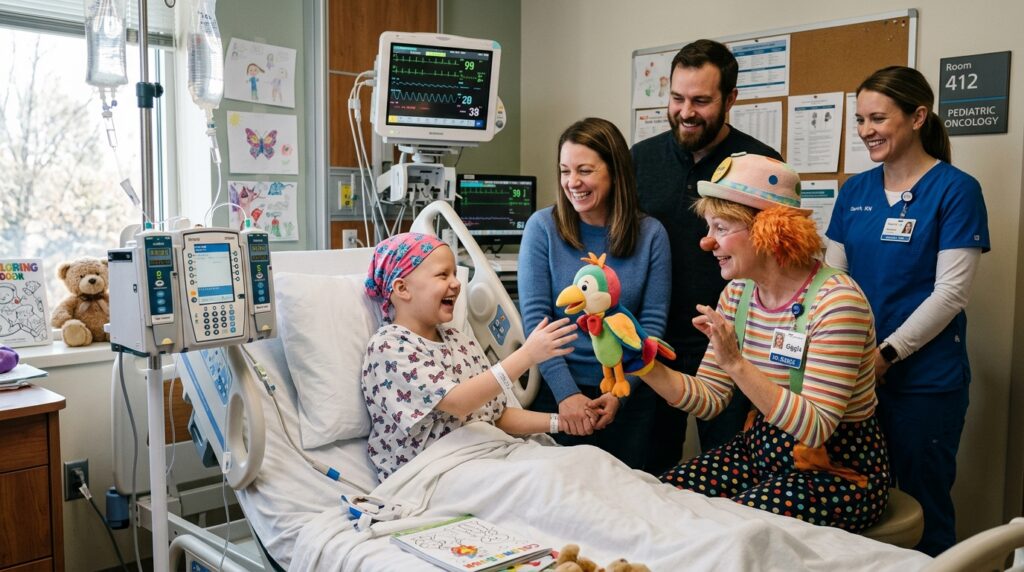
Picture a young patient sitting in a hospital room.
There is an IV line beside the bed.
A parent is trying not to look frightened.
The child knows something serious is happening.
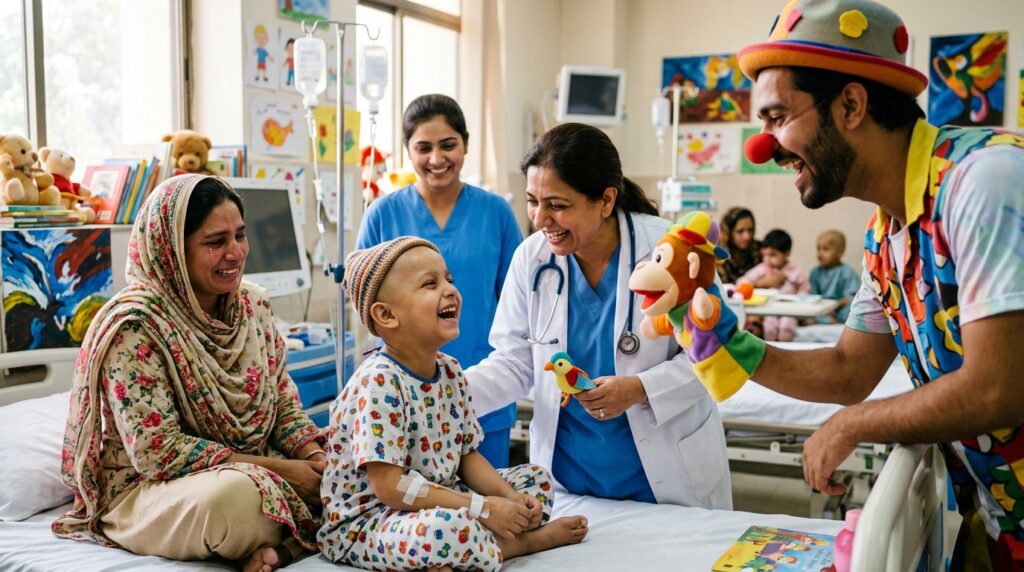
Then a performer walks in carrying a ridiculous hat.
The child looks suspicious.
The performer puts the hat on backward.
Nothing.
Then the performer tries a silly voice.
The child smiles.
The parent smiles.
The nurse smiles.
Then the child laughs.
For perhaps 20 seconds, nobody is thinking about the next blood test.
Nothing medically miraculous has happened.
But something human has happened.
The illness has temporarily lost control of the room.
That may be one of the most meaningful ways to understand supportive laughter therapy.
Laughter Is Not Always the Goal
This is a surprisingly important point.
Sometimes the therapeutic goal is not laughter.
It is connection.
A child who does not laugh but becomes less frightened has benefited.
An elderly patient who smiles but does not laugh may still feel connected.
A patient who watches a comedy video and simply relaxes may still benefit.
A family that shares a funny memory may feel less isolated.
So the real target should not be:
“Make the patient laugh.”
It should be:
“Help the patient experience less distress and more human connection.”
Laughter is one possible pathway.
The Future: From “Laughter Therapy” to Whole-Person Cancer Care
The latest cancer research points toward an increasingly sophisticated understanding of supportive interventions.
A 2026 meta-analysis of creative arts therapies covering 67 randomised trials and 6,259 cancer patients found improvements in anxiety, depression and quality of life across various creative approaches, although the certainty of evidence was low to very low. Most interventions were music-based. (PubMed)
This is important because laughter therapy does not exist in isolation.
It belongs to a wider family of supportive approaches:
Music therapy
Art therapy
Play therapy
Humor therapy
Narrative interventions
Guided imagery
Mindfulness
Psychotherapy
Social support
A 2026 review of narrative interventions also found promising effects on quality of life, self-efficacy and several psychological outcomes among cancer patients, although evidence quality varied by outcome. (PubMed)
The future may therefore be less about finding one magical therapy and more about building a personalized supportive-care package around each patient.
The Global Lesson From Pakistan
Shaukat Khanum’s example is especially valuable because it demonstrates that this philosophy is not limited to wealthy Western healthcare systems.
A cancer hospital in Pakistan can make room for:
medicine and magic shows.
chemotherapy and children’s games.
oncology and laughter.
technology and human warmth.
That is not a contradiction.
It may actually be what good healthcare should look like.
“The machine can measure the tumor. The human being still needs someone to remember the smile.”
“The machine can measure the tumor. The human being still needs someone to remember the smile.”
So, Can Laughter Help Cancer Patients?
The evidence now supports a careful yes.
Laughter therapy does not kill cancer cells.
It does not replace chemotherapy, radiation, surgery, immunotherapy or other evidence-based cancer treatments.
But randomised research increasingly suggests that it may help some patients with anxiety, stress, pain, depression and fatigue, particularly as a complementary intervention. (PubMed)
And Shaukat Khanum offers a compelling real-world Pakistani example of the broader principle: cancer care can include play, psychological support, recreation and moments of joy, especially for children. (Shaukat Khanum Hospital)
Perhaps the most honest conclusion is also the simplest:
Laughter may not treat the cancer.
But it may help treat some of what cancer does to a person’s life.
And sometimes, that matters enormously.
Frequently Asked Questions
Can laughter cure cancer?
No. There is no reliable evidence that laughter therapy destroys cancer cells or replaces cancer treatment. Its potential role is supportive, helping with symptoms such as anxiety, stress, pain and emotional distress.
Is laughter therapy scientifically supported for cancer patients?
Yes, increasingly. A 2026 systematic review of 16 randomised trials involving 1,127 cancer patients found that laughter therapy probably reduces anxiety and may reduce pain and stress. However, evidence for some outcomes remains uncertain. (PubMed)
Does Shaukat Khanum officially use laughter therapy?
Shaukat Khanum officially lists play therapy and clinical psychology among its ancillary services in Lahore. It has also organised recreational events for pediatric cancer patients involving games, puppet shows, magic shows and laughter. However, the hospital’s official material does not establish a formal program called “laughter therapy” or “smile medicine.” (Shaukat Khanum Hospital)
Why is laughter useful for children with cancer?
Children can experience intense fear during cancer treatment. Play, humor and entertainment may provide distraction, reduce distress and restore a sense of normal childhood.
Can laughter replace psychological therapy?
No. Laughter can be a complementary activity. Serious anxiety, depression, trauma or emotional distress should be assessed and treated by qualified professionals.
Is “smile medicine” an official medical field?
No. It is a popular expression rather than a standardised medical specialty. More precise terms include humour therapy, laughter therapy, play therapy and psychosocial oncology.
Could hospitals in developing countries use laughter therapy?
Potentially, yes. Many laughter- and play-based interventions are relatively inexpensive and can be adapted to local culture. But hospitals should use trained personnel, patient consent and appropriate clinical protocols rather than simply telling sick people to “laugh more.”
The Final Prescription
Perhaps the most beautiful thing about laughter therapy is that it asks medicine to remember something obvious.
Patients are not tumours.
They are not scans.
They are not blood reports.
They are people.
People who sometimes need medicine.
People who sometimes need surgery.
People who sometimes need a psychologist.
And sometimes, they need somebody to walk into a frightening room and make it feel human again.
A laugh is not chemotherapy.
A smile is not surgery.
A joke is not a cure.
But a moment of joy can still be medicine for the journey.
And perhaps the future of healthcare will not be about choosing between science and humanity.
Perhaps it will finally understand that patients deserve both.
1. The Shaukat Khanum section. ” The hospital’s own website confirms play therapy and clinical psychology, while its January 2026 carnival provides a vivid, recent example. (Shaukat Khanum Hospital)
2. Does laughter actually help cancer patients? The answer is promising, especially for anxiety, but not miraculous. (PubMed)
3. “A hospital bed tells a child, ‘You are sick.’ A game can remind the child, ‘You are still you.’”
“Laughter Therapy and Smile Medicine: Can Happiness Really Help Cancer Patients?”
The strongest global story here is not “laughter cures cancer.” It is much more powerful: modern oncology is learning that treating the disease and caring for the person are not the same thing, and both matter.