Me Indispensable Syndrome: When the Need to Be Irreplaceable Becomes an Organizational Risk
Me Indispensable Syndrome The most dangerous person in an organization is not necessarily the least competent, the most corrupt, or the most openly authoritarian. Sometimes, the greatest risk comes from a highly capable individual who sincerely believes that nothing can function properly without them.
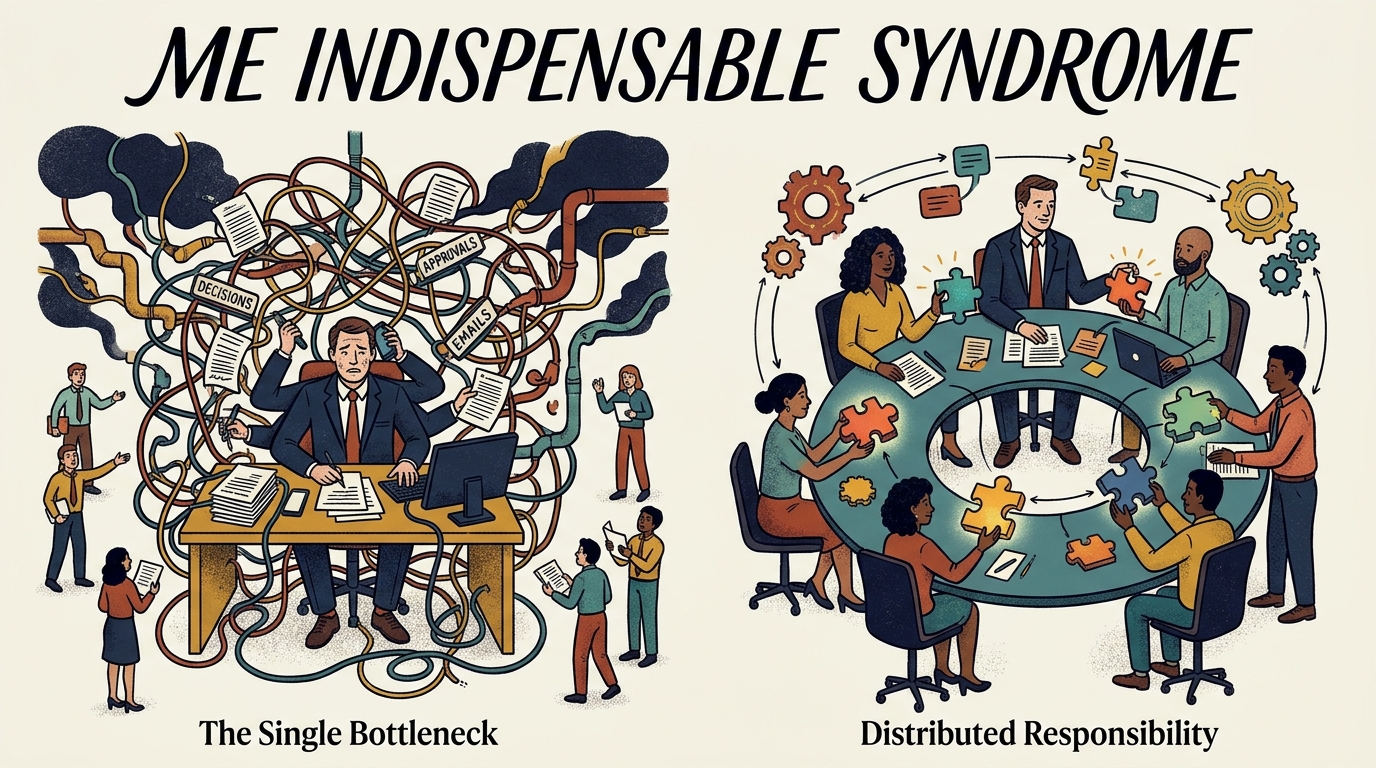
They know every detail, control critical decisions, retain important information, and insist on personally supervising tasks that others could perform. Their presence appears essential, their workload seems overwhelming, and their departure is portrayed as a potential disaster. Yet beneath this apparent dedication may lie a serious organizational weakness: a system that has become dependent on one person’s knowledge, authority, and willingness to remain indispensable.
This is the central paradox of Me Indispensable Syndrome: the more a person tries to make an organization dependent on them, the less capable that organization may become of functioning independently.
The individual may see themselves as the guardian of quality, the ultimate problem-solver, or the only person who truly understands the institution. Colleagues may initially appreciate their expertise. Senior management may reward their apparent commitment. Over time, however, decision-making becomes concentrated, colleagues lose opportunities to develop, information stops flowing freely, and succession planning is neglected.
Eventually, the organization may discover that what appeared to be an exceptional strength was also a hidden vulnerability.
True leadership builds the capacity of others to succeed. The need to remain indispensable can prevent that capacity from developing.
This article examines the psychology behind this behaviour, what scientific research can and cannot tell us about it, how it affects organizations and relationships, and what individuals and institutions can do to prevent it.
What Is “Me Indispensable Syndrome”?
“Me Indispensable Syndrome” is a descriptive term for a pattern of behaviour in which a person develops an excessive need to be perceived as essential, irreplaceable, or uniquely capable of keeping a system functioning.
Such a person may believe that their personal involvement is necessary for almost every important decision. They may struggle to delegate, discourage independent thinking, retain information, or feel threatened when colleagues become equally capable.
The defining feature is not competence itself. It is the perceived need to preserve one’s importance by maintaining other people’s dependence.
An important scientific distinction: “Me Indispensable Syndrome” is not a formally recognized psychiatric diagnosis. It is a useful conceptual label for examining behaviours associated with knowledge hiding, psychological ownership, excessive control, insecure status, and difficulties with delegation. The research discussed in this article investigates these related phenomena; it does not establish a separate clinical syndrome under this name.
The difference between being indispensable and trying to appear indispensable
| Genuine professional value | Indispensability-seeking behaviour |
|---|---|
| Shares knowledge so others can perform effectively | Keeps knowledge concentrated in their own hands |
| Develops capable colleagues | Feels threatened by capable colleagues |
| Delegates authority with appropriate safeguards | Delegates tasks but retains every meaningful decision |
| Welcomes scrutiny and alternative ideas | Treats disagreement as a challenge to personal authority |
| Build systems that survive their absence | Creates arrangements that depend on their constant presence |
| Takes pride in collective achievement | Needs personal recognition for the organization’s success |
A highly skilled surgeon, engineer, administrator, teacher, or military officer may be exceptionally valuable without displaying this pattern. Expertise becomes an organizational concern when it is deliberately converted into dependency or when a person refuses reasonable measures to transfer essential knowledge.
The goal is not to make every individual interchangeable. It is to ensure that critical responsibilities can continue safely and effectively when someone is unavailable.
The Psychology Behind the Need to Be Indispensable
To understand this behaviour, we must look beyond outward conduct and consider the possible psychological forces that sustain it. The same behaviour can arise from different motives, and no single explanation applies to everyone.
1. Self-worth becomes dependent on being needed
Some individuals derive a substantial part of their identity from solving problems, receiving praise, and being the person everyone consults.
Their internal equation may gradually become:
If people need me, I matter. If they can manage without me, I may no longer matter.
This belief can make ordinary professional development feel like a personal threat. When a junior colleague learns a difficult skill, the individual may experience not satisfaction but anxiety about losing status.
Workplace motivation research offers a useful framework here. Self-determination theory examines three basic psychological needs: competence, autonomy, and relatedness. Healthy workplaces support all three, whereas environments that undermine autonomy or create controlling relationships can impair motivation and well-being. This theory helps explain the importance some people attach to recognition and control, but it does not establish that every person seeking recognition has an underlying insecurity.
2. Fear of losing status or authority
In a competitive organization, knowledge can provide influence. A person who alone understands a complex procedure, maintains a crucial relationship, or knows how to resolve recurring problems may gain considerable bargaining power.
Sharing that knowledge can appear to reduce their advantage.
This is one reason why knowledge hiding deserves attention. A systematic review of organizational research describes it as the intentional concealment of knowledge requested by another person. A 2025 meta-analysis examining 267 independent samples from 248 studies found meaningful relationships between knowledge hiding, leadership, personality-related factors, and both psychological and performance-related outcomes. These findings support the importance of the problem while leaving room for differences across workplaces and circumstances.
-
The individual retains knowledge.
-
Colleagues remain dependent on that individual.
-
Management repeatedly seeks their assistance.
-
Their perceived importance increases.
-
They become even less willing to share control.
What began as expertise can gradually become a mechanism for preserving authority.
3. The illusion of control
Some people genuinely believe that personal supervision is the best protection against mistakes.
They may insist on reviewing every document, approving every minor decision, or personally handling tasks that others are qualified to complete.
Initially, this can improve consistency, especially in inexperienced teams or high-risk settings. The problem emerges when supervision becomes permanent and disproportionate to actual risk.
The person starts confusing my involvement with quality assurance.
In reality, quality depends on appropriate standards, training, verification, accountability, and sound processes—not necessarily on one particular individual checking everything.
4. Perfectionism and fear of mistakes
A perfectionistic person may find delegation difficult because another person’s work is unlikely to match their preferred method or standard immediately.
Instead of investing time in training and feedback, they may take the task back and complete it themselves.
This creates a damaging loop:
-
A task is delegated.
-
The colleague makes a correctable mistake or uses a different method.
-
The senior person intervenes and reclaims the work.
-
The colleague loses an opportunity to learn.
-
The senior person concludes that delegation does not work.
The apparent evidence for the individual’s indispensability is partly produced by their own behaviour.
High standards are valuable. Refusing to let others learn, however, can turn those standards into a barrier to organizational development.
5. Fear of being replaced
Promotion, succession, and professional competition can create legitimate uncertainty. But when a person’s identity depends heavily on occupying a unique position, developing a successor may feel like training someone to replace them.
They may withhold opportunities, exclude promising colleagues from important discussions, or provide incomplete instructions.
Not every reluctance to train a successor is evidence of insecurity. Sometimes the organization has created a genuine threat by rewarding individual performance while offering little protection or recognition for knowledge transfer. Effective solutions must address these structural incentives as well as individual choices.
6. The need for recognition
Organizations frequently reward the visible problem-solver more readily than the person who prevents problems from occurring.
The employee who repeatedly rescues a failing process may receive praise, while the employee who redesigns that process so failures rarely happen may receive little attention.
This can unintentionally encourage crisis dependence.
A healthier reward system recognizes not only individual output but also mentoring, process improvement, succession readiness, team capability, and the successful transfer of expertise.
How “Me Indispensable Syndrome” Develops
Stage 1: Expertise
A person acquires valuable knowledge and solves difficult problems.
Others begin relying heavily on that person’s experience and judgment.
Knowledge, approvals, or decisions become concentrated in one individual.
Delegation weakens, colleagues lose autonomy, and the individual becomes a bottleneck.
Absence, departure, overload, or a critical mistake can disrupt essential operations.
This is an illustrative model, not a scientifically validated sequence that every person or organization follows. Its value lies in showing how a useful strength can become a vulnerability when the surrounding system rewards dependence rather than shared capability.
The Organizational Consequences
The greatest danger is not necessarily that the individual will perform poorly. It is that the organization may perform well only under conditions that cannot be sustained.
1. A single point of failure
When critical knowledge, access, relationships, or decisions rest with one person, their absence can interrupt essential work.
Consider an administrator who alone knows how to reconcile a complicated financial system. If the administrator becomes ill or leaves unexpectedly, routine operations may stall—not because the organization lacks qualified staff, but because it failed to distribute the knowledge required to function.
In risk management, this is a form of key-person dependency. It is a system-design problem as much as an individual behaviour problem.
2. Weak succession planning
A manager who discourages capable successors may appear successful for years while leaving the institution unprepared for transition.
When that manager retires, resigns, becomes incapacitated, or moves to another role, the organization discovers that authority was transferred without the knowledge needed to exercise it—or that no meaningful transfer occurred at all.
Succession planning should therefore be treated as a continuing operational responsibility, not an administrative exercise undertaken shortly before retirement.
3. Suppression of initiative and innovation
Employees who must seek permission for every meaningful decision eventually stop exercising judgment.
Some become passive because initiative is discouraged. Others stop proposing improvements because they expect their ideas to be rejected or appropriated. Talented employees may leave for environments where they can contribute more fully.
Research on psychological safety—the shared belief that a team is safe for interpersonal risk-taking—has linked such safety with learning behaviour and team performance. A workplace where disagreement, questions, and reasonable mistakes are punished makes it harder for colleagues to learn and challenge ineffective practices.
4. Bottlenecks and declining efficiency
If every important decision must pass through one individual, the organization has created a queue around that person.
Even a hardworking and intelligent employee has finite time and attention. As demands increase, approvals slow, minor issues escalate unnecessarily, and urgent matters compete with routine tasks.
The supposed indispensable person may then become overwhelmed, while colleagues remain underused.
This is not efficient specialization. It is a failure to distribute work and decision-making appropriately.
5. Information silos and internal competition
When knowledge becomes a source of personal power, colleagues may begin competing to control information rather than collaborating to solve problems.
The consequences can include duplicated work, avoidable mistakes, mistrust, weak coordination, and a reluctance to help colleagues.
A systematic review of knowledge-hiding research shows individual and organizational factors that can contribute to the behaviour and emphasizes the importance of changing the conditions that reinforce it. The remedy is therefore broader than simply telling employees to share more information.
6. Ethical and governance risks
Concentrated authority can weaken oversight when the same individual controls information, execution, and approval.
In a poorly governed organization, this can make errors harder to detect and questionable decisions harder to challenge. It can also create opportunities for conflicts of interest, favoritism, or concealment.
These outcomes are not inevitable, and indispensability-seeking behaviour is not proof of misconduct. Nevertheless, sound governance requires independent checks precisely because competence and good intentions cannot eliminate human error or conflicts of interest.
7. Burnout and organizational fragility
The individual can also become a victim of the system they helped create.
If every difficult issue returns to them, their workload expands, interruptions multiply, and time for strategic thinking disappears. Colleagues may become increasingly frustrated, while the individual feels both indispensable and unappreciated.
The organization becomes fragile because the individual is overloaded, and the individual becomes overloaded because the organization is fragile.
Real-World Illustrations: How the Pattern Appears
The following are hypothetical examples based on recognizable organizational situations, not claims about particular people or institutions.

A manager insists that all correspondence, purchases, and routine approvals pass through their desk. They argue that this protects quality. When they take leave, work accumulates because nobody knows which decisions they are authorized to make.
Underlying issue: excessive centralization and insufficient delegation.

An experienced technician alone understands how to maintain a specialized machine. Instead of documenting procedures and mentoring colleagues, they keep resolving every fault personally. The arrangement appears convenient until the technician is unavailable and production stops.
Underlying issue: concentrated technical knowledge and inadequate continuity planning.

A senior leader appoints a deputy but withholds important information and reverses delegated decisions. The deputy has responsibility on paper but little authority in practice.
Underlying issue: a gap between formal delegation and genuine decision-making power.

A business founder approves every expenditure, manages every supplier relationship, and personally handles customer complaints. The business grows, but its operating capacity does not grow with it.
Underlying issue: the failure to evolve from individual execution to system-building leadership.
These situations may arise from different motives—pride, fear, habit, inadequate training, genuine operational complexity, or poorly designed incentives. Effective diagnosis requires examining behaviour and systems rather than automatically assigning a psychological label.
How to Recognize the Warning Signs
One isolated behaviour does not establish a pattern. The more useful question is whether several behaviours recur over time and consistently make the organization more dependent on one person.
Use the following checklist as a practical self-assessment or management discussion tool.
Indispensability self-assessment
Select the statements that describe a recurring pattern, not an occasional incident.
0 of 8 warning signs selected
No statements selected. Consider how your work would continue if you were unavailable. This is an educational reflection tool, not a validated psychological test or diagnosis.
Reset assessment
Practical Solutions: How to Break the Cycle
The objective is not to diminish expertise or make experienced professionals feel expendable. It is to preserve their contribution while reducing unnecessary dependency.
1. Redefine success as building capability
The first change is conceptual.
Instead of asking, “How much depends on me?” ask, “How much can my team accomplish because of what I have taught them?”
A professional who solves a problem deserves recognition. A professional who develops a reliable method, trains others, and prevents the problem from recurring may create even greater long-term value.
This is particularly important for leaders. Their performance should be assessed not only by what they personally deliver but also by the capability, independence, and resilience of the people and systems they leave behind.
2. Delegate authority, not just workload
Delegation is ineffective when a manager assigns responsibility but retains every meaningful decision.
Good delegation specifies:
-
The expected result and the relevant quality standards.
-
The decisions the colleague may make independently.
-
The budget, legal, safety, or operational limits that apply.
-
When consultation or escalation is required.
-
How outcomes will be reviewed.
A colleague cannot develop sound judgment if every independent decision is later reversed merely because it differs from the manager’s personal preference.
Appropriate controls remain essential, especially in safety-critical, financial, medical, or regulated work. The aim is proportionate oversight rather than unrestricted autonomy.
3. Make knowledge transfer part of the job
Critical knowledge should not exist exclusively in someone’s memory.
Organizations can reduce dependency through:
-
Standard operating procedures and practical checklists.
-
Secure, accessible repositories for essential documents.
-
Documented decision histories and recurring problem solutions.
-
Cross-training and job rotation, where appropriate.
-
Mentoring and supervised practice.
-
Regular verification that documented procedures actually work.
Documentation alone is insufficient if it is outdated, inaccessible, or too vague to be useful. Knowledge transfer should be tested by asking a trained colleague to perform the task without continuous intervention from the original expert.
4. Establish a backup for critical responsibilities
For every essential function, management should ask:
-
Who is the primary responsible person?
-
Who can take over when that person is unavailable?
-
What access, training, and authority does the backup require?
-
What would happen if both the primary person and the backup were unavailable?
-
How frequently is the continuity arrangement tested?
Not every task requires two fully interchangeable experts. The depth of backup should reflect the consequences of failure, the time needed to recover, and the cost of maintaining alternative capability.
5. Build psychological safety and accountability together
Employees must be able to ask questions, identify weaknesses, and challenge decisions without unreasonable fear of humiliation or retaliation.
At the same time, psychological safety does not mean freedom from standards or accountability. It means that people can raise legitimate concerns and learn from mistakes while remaining responsible for their conduct.
Research on team learning supports the importance of an environment where interpersonal risks can be taken constructively. Managers should invite alternative views, respond thoughtfully to mistakes, and distinguish honest learning errors from negligence or deliberate misconduct.
6. Change the incentives that reward dependency
If organizations promote people solely because they personally rescue difficult situations, they may inadvertently reward the very dependency they need to eliminate.
Performance reviews should also consider:
-
The development of capable successors.
-
Quality and completeness of knowledge transfer.
-
The ability of teams to operate without constant intervention.
-
Improvements in processes and internal controls.
-
Collaboration across departments.
-
Retention and development of talented employees.
A manager who creates a team capable of functioning independently should not be viewed as less valuable simply because fewer routine matters now require their attention.
7. Introduce succession planning before it becomes urgent
Succession planning is not limited to chief executives or senior government officials. It applies wherever a person’s departure could seriously disrupt an important function.
A practical approach is to identify critical roles, map their essential knowledge, assess backup readiness, and conduct periodic handover exercises.
Where the consequences of disruption are serious, continuity planning should be incorporated into routine risk management rather than left to personal goodwill.
8. Give the individual a constructive path forward
Not everyone who resists delegation is trying to preserve power. Some have been rewarded for years for doing everything themselves; others have never received training in coaching or team development.
A constructive response includes candid feedback, leadership development, realistic workloads, and recognition for mentoring.
The individual should be encouraged to move from being the person who personally resolves every problem to the person who builds a system capable of resolving problems reliably.
If behaviour remains deliberately obstructive despite clear expectations and support, formal performance management may be necessary.
A Practical 30-Day Action Plan
Days 1–7
Identify the dependencies
List critical tasks, approvals, relationships, passwords or access arrangements, and specialist knowledge that rely on one person. Record the consequences if that person becomes unavailable.
Days 8–14
Select and train backups
Choose suitable colleagues, document essential procedures, arrange supervised practice, and establish clear decision-making limits.
Days 15–21
Test independent performance
Allow trained colleagues to handle agreed responsibilities without unnecessary intervention. Review results, identify gaps, and correct weaknesses.
Days 22–30
Measure resilience
Review which tasks can now be completed independently, which still depend on one person, and what additional training or safeguards are needed. Assign owners and review dates for remaining risks.
This is a starting framework, not a universal implementation timetable. Complex or safety-critical operations may need a longer, formally supervised transition.
The Leadership Test: What Happens When You Leave?
One of the simplest ways to examine organizational resilience is to ask what happens when a key person is absent for a reasonable period.
Can the team continue routine work? Can urgent decisions be made by authorized colleagues? Are essential records available? Do people know when to escalate an issue? Can customers, patients, citizens, or other stakeholders still receive the required service?
The answers reveal more than a job description or performance appraisal can.
If routine work stops, management should investigate whether the cause is an unavoidable specialist requirement, inadequate resources, insufficient training, excessive centralization, or deliberate withholding of knowledge.
The goal is not to prove that a particular individual is unnecessary. It is to discover whether the organization has made sensible arrangements for continuity.
A mature leader should be able to take leave without creating a crisis, trust trained colleagues with meaningful responsibilities, and return to find that the organization has continued to function.
Beyond the Workplace: Relationships and Everyday Life
The same pattern can appear outside formal organizations, although its causes and consequences may differ.
In a family, one person may insist on handling every financial decision, household arrangement, or important conversation. Their stated motive may be care and responsibility, yet the result can be that other family members lose opportunities to develop confidence and independence.
In friendships, a person may feel threatened when a friend builds other relationships or becomes less dependent on their advice.
In community organizations, a long-serving officeholder may resist new volunteers, retain control over records, or discourage changes that would allow the group to operate without them.
These examples should not be treated as evidence of a clinical disorder. They illustrate a broader interpersonal question: Does helping others increase their capacity to act, or does it quietly increase their dependence on the helper?
Healthy support makes room for mutual respect, shared responsibility, and independent judgment. Genuine care does not require permanent dependence.
How to Deal With Someone Who Needs to Be Indispensable
If you work with someone who repeatedly centralizes decisions or withholds knowledge, direct confrontation over their motives may be less effective than addressing observable behaviour.
-
Focus on outcomes: Explain the delays, risks, or duplicated work caused by unnecessary approval requirements.
-
Clarify authority: Agree on which decisions colleagues can make independently and which require escalation.
-
Document essential processes: Make continuity a normal organizational requirement rather than a personal criticism.
-
Recognize legitimate expertise: Invite the person to mentor others and acknowledge their contribution to building team capability.
-
Use proportionate safeguards: Where critical responsibilities are concentrated, introduce appropriate review, access controls, and backup arrangements.
-
Escalate persistent obstruction: If a person deliberately undermines continuity or refuses reasonable duties, address the conduct through established management or governance procedures.
Where you have limited formal authority, begin with the risks and practical improvements you can influence. If the matter involves financial integrity, patient safety, legal compliance, or other serious risks, use the appropriate reporting and oversight channels.
What Organizations Should Measure Instead
A useful way to change the culture is to distinguish individual dependence from institutional capability.
| Measure | What it reveals |
|---|---|
| Backup coverage for critical tasks | Whether essential functions can continue during the absence |
| Successful handover exercises | Whether knowledge transfer works in practice |
| Decision turnaround time | Whether approvals are unnecessarily concentrated |
| Training and succession readiness | Whether colleagues can assume greater responsibility |
| Process compliance and error rates | Whether quality is maintained without excessive personal supervision |
| Staff development and retention | Whether the workplace helps people grow and contribute |
| Recovery time after disruption | How quickly essential operations can resume |
These indicators should be interpreted together. For example, fewer approvals may indicate better delegation, but only if quality, compliance, and safety remain satisfactory.
The objective is not simply to reduce dependence on individuals. It is to build an organization that combines expertise with reliable processes, distributed capability, and appropriate accountability.
Frequently Asked Questions (FAQs)
1. What is Me Indispensable Syndrome?
It is a descriptive term for a pattern in which a person feels a strong need to remain essential, irreplaceable, or uniquely important. It may involve excessive control, reluctance to delegate, withholding knowledge, or discouraging others from developing independent capabilities. It is not a formal psychiatric diagnosis.
2. What causes a person to behave as though they are indispensable?
Possible contributing factors include fear of losing status, dependence on external recognition, perfectionism, a need for control, workplace competition, and organizational incentives that reward individual heroics over collective performance. Different people may display similar behaviour for different reasons.
3. Is being indispensable always a bad thing?
No. Specialized expertise and experienced professionals can be essential to successful operations. The problem arises when an organization depends unnecessarily on one individual because knowledge, authority, or decision-making has not been transferred appropriately.
4. How does this behaviour affect organizational performance?
It can create bottlenecks, discourage initiative, slow decisions, weaken succession planning, increase knowledge loss, and leave critical functions vulnerable when a key employee becomes unavailable. Research on knowledge hiding supports concerns about its relationships with workplace and performance outcomes.
5. How can managers prevent Me Indispensable Syndrome?
Managers can establish clear delegation boundaries, document critical procedures, develop backups, encourage constructive disagreement, and reward mentoring and knowledge transfer. They should also examine whether organizational incentives unintentionally encourage employees to retain control or conceal information.
6. How can someone overcome the need to be indispensable?
Begin by examining whether your sense of professional value depends too heavily on being needed. Practise delegating meaningful decisions, share knowledge, accept that competent colleagues may use different methods, and measure success by the capabilities you help others develop. Seek constructive feedback if the pattern repeatedly affects your relationships or work.
Conclusion: Your Real Legacy Is What Continues Without You
Me Indispensable Syndrome exposes a fundamental misunderstanding about professional worth and leadership: being constantly needed is not the same as being genuinely effective.
A person may spend years building authority, controlling information, solving every problem, and ensuring that others must seek their approval. They may become the busiest individual in the organization and the person whose absence creates the greatest disruption. Yet these outcomes do not necessarily demonstrate exceptional leadership. They may instead reveal that the organization has failed to develop sufficient independent capability.
Scientific research into knowledge hiding, workplace motivation, and team learning offers a strong basis for examining these risks. It also reminds us to avoid simplistic judgments: behaviour can reflect personal motives, workplace incentives, inadequate systems, or a combination of all three.
The solution is not to diminish experienced people or deny the value of specialized knowledge. It is to ensure that expertise strengthens the organization rather than becoming a permanent source of dependence.
A good professional solves problems. A capable leader develops people who can solve them. A wise leader builds systems that continue to work when they are no longer present.
The ultimate test of leadership is not how much an organization needs you today, but how well it can continue to succeed tomorrow without depending on you for everything.
Disclaimer
This article is for educational and informational purposes. “Me Indispensable Syndrome” is a descriptive concept, not a recognized psychiatric diagnosis. The psychological explanations discussed are possibilities, not diagnoses of any individual.
References and Scientific Reading
The following peer-reviewed research and scholarly reviews provide the scientific foundation for the article. They examine related, established concepts rather than validating “Me Indispensable Syndrome” as a distinct clinical condition.
1. Shen, Y., Lythreatis, S., Singh, S. K., & Cooke, F. L. (2025).
A meta-analysis of knowledge hiding behavior in organizations: Antecedents, consequences, and boundary conditions.
Journal of Business Research, 186, Article 114963.
Why do employees hide their knowledge and what are the consequences? A systematic literature review.
Journal of Business Research, 135, 195–213.
Knowledge Hiding: Current Research Status and Future Research Directions.
Frontiers in Psychology, 12, 748237.
Self-Determination Theory in Work Organizations: The State of a Science.
Annual Review of Organizational Psychology and Organizational Behavior, 4, 19–43.
Psychological Safety and Learning Behavior in Work Teams.
Administrative Science Quarterly, 44(2), 350–383.
Psychological ownership: A review and research agenda.
Journal of Organizational Behavior, 38, 163–183.
Knowledge hiding and social exchange theory: A systematic review and meta-analysis.
Frontiers in Psychology, 15, 1516815.