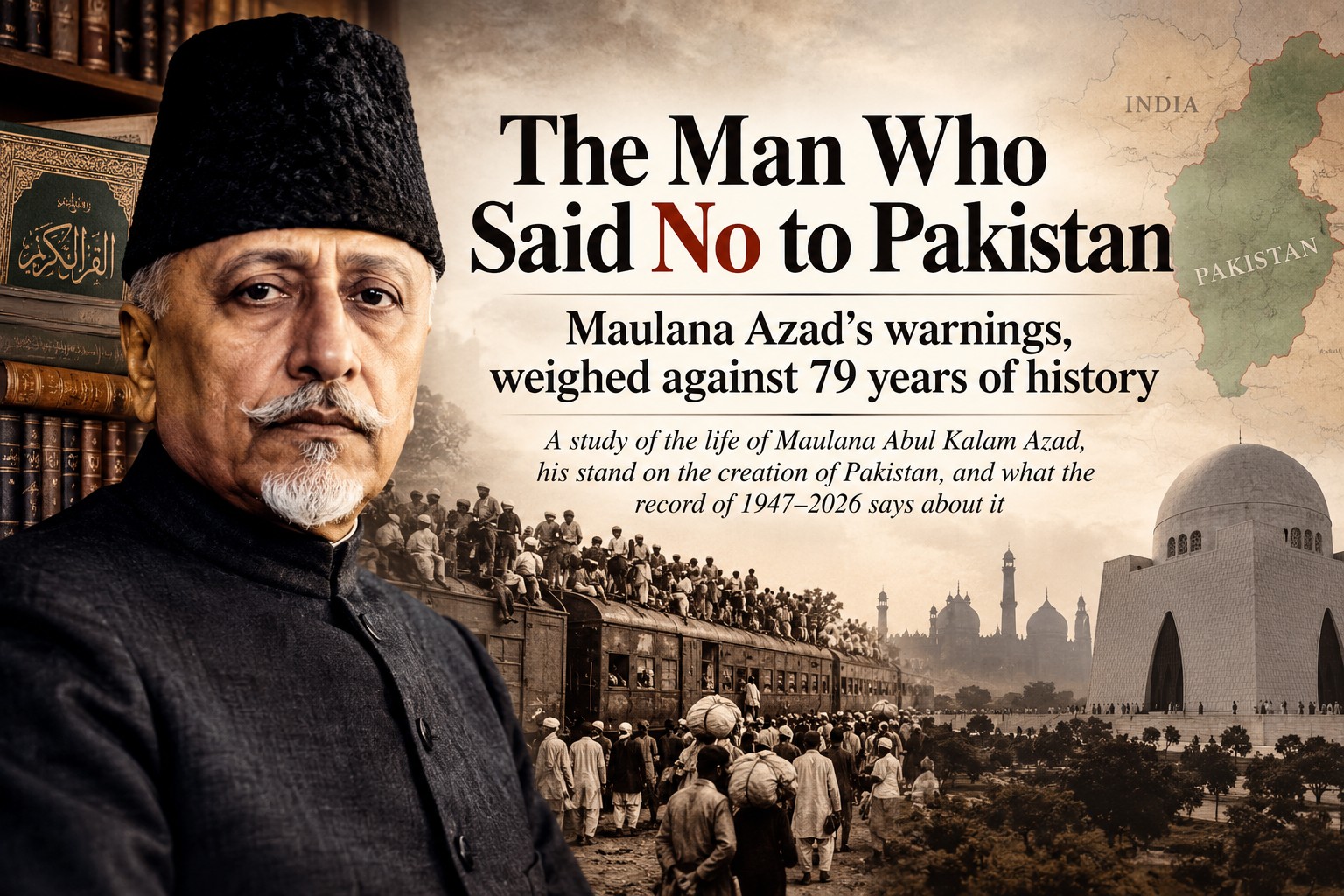

The Man Who Said No to Pakistan
Maulana Azad’s warnings, weighed against 79 years of history
A study of the life of Maulana Abul Kalam Azad, his stand on the creation of Pakistan, and what the record of 1947–2026 says about it
In 1946, with the British preparing to leave, one of the most learned Muslims in India stood in the way of a Muslim homeland. He was no Hindu nationalist, no British loyalist, and no stranger to the faith. He was a scholar who had written a commentary on the Quran, a journalist who had gone to prison for the Khilafat cause, and the elected president of the Indian National Congress. His name was Maulana Abul Kalam Azad, and his position was simple to state and very hard to live with: Pakistan, he believed, would be a mistake for the very people it claimed to rescue.
Seventy-nine years after Pakistan came into being, it is tempting to treat Azad either as a prophet or as a footnote. Both are lazy readings. Those who call him a prophet usually lean on an interview whose authenticity is disputed. Those who dismiss him usually forget that a large part of his case was about how partition would happen and what it would cost, not only about whether Muslims deserved safeguards, which he conceded they did.
This article tries to do three things. It follows Azad’s life closely enough to understand where his convictions came from. It sets out his position on Pakistan using the sources that can be checked, and flags those that cannot. And it tests his claims, one at a time, against the history of Pakistan and the country as it stands in October 2026. Where he was right, I say so. Where he was wrong, or where the story is more complicated than his admirers admit, I say that too.
Part I: The making of a rebel scholar
Mecca, Calcutta and a restless mind
Abul Kalam Ghulam Muhiyuddin was born on 11 November 1888 in Mecca. His father, Maulana Khairuddin, was an Indian Islamic scholar settled in Arabia, and his mother was Arab. His forefathers had originally come to India from Herat. The family returned to Calcutta when he was a child, and he grew up inside a traditional religious education: Arabic, Persian, the Quran, hadith, fiqh and logic, taught largely at home by his father and other scholars.
But the boy was restless inside that world. He read widely and in secret, and by his teens he had absorbed the reformist and pan-Islamic ideas of Jamaluddin Afghani and the modernist thinking associated with Sir Syed. He travelled to Iraq, Egypt, Syria and Turkey, where he met revolutionaries and exiles. He later adopted the pen name Azad, meaning “free”, which turned out to be less a pose than a programme.
He was a precocious writer. By the age of eleven he was producing a poetry journal in Calcutta, and by about twelve he was editing a weekly. In a province where Hindu and Muslim intellectuals mixed closely, his early political education came partly from Bengali revolutionaries, a contact that shaped his belief that Muslims should not stand outside India’s freedom struggle.
Al-Hilal and the first collision with the Raj
In 1912 Azad launched the Urdu weekly Al-Hilal (The Crescent) from Calcutta. It was electric. It attacked British policy, urged Muslims to take part in the national movement rather than rely on British favour, and preached that loyalty to Islam and loyalty to a free India did not conflict. It also shocked conservatives, because it openly criticised the habit of many Muslim leaders of cultivating the colonial government.
The government responded as colonial governments do. Al-Hilal was banned under the Press Act in 1914. Azad started a successor paper, Al-Balagh, which also pushed nationalist and communal-unity themes, and that too was suppressed. He was expelled from Bengal and interned at Ranchi, where he remained until the beginning of 1920. These years gave him a prison-trained patience that his admirers and critics both noticed for decades.
Spiritually, this was also the period of his Quranic scholarship. His Tarjuman al-Quran became one of the most respected Urdu works of Quranic interpretation of the twentieth century, and it is the right place to look if one wants to understand why he refused to treat religion as a mere territorial claim.
Khilafat, Gandhi and the turn to Congress
After his release, Azad joined the Khilafat Movement, which defended the Ottoman sultan’s position as caliph, and became president of the All-India Khilafat Committee. The movement brought him into close partnership with Mahatma Gandhi, and for a time Hindu and Muslim politics in India ran together in a way that would never be repeated.
The Khilafat movement collapsed in the early 1920s, partly because Turkey itself abolished the caliphate. Many Muslim leaders drifted away from the Congress. Azad did the opposite. He drew closer to the Congress, became an enthusiast of Gandhian non-violent civil disobedience, and in 1923, at thirty-five, became the youngest person ever to be elected Congress president. In 1924 he presided over a Unity Conference in Delhi, trying to hold together the Swarajists and the Khilafat leaders. The pattern was already set: when Muslim politics turned inward, Azad turned the other way.
He stayed with the Congress through its major campaigns, including the Salt March period of 1930 and the Dharasana satyagraha. In 1936 at Lucknow he backed Jawaharlal Nehru for the presidency, and in 1938 he tried to mediate between Gandhi and the faction around Subhas Bose.
Ramgarh 1940 and the war years
Azad returned as Congress president in 1940 and held the office until 1946, an unusually long tenure explained largely by the fact that the party’s leadership spent much of the Second World War in jail. His presidential address at Ramgarh in March 1940 is the clearest statement of his political philosophy. (It was delivered in the same month as the Muslim League’s Lahore Resolution, which is the context in which it must be read.)
Addressing a largely non-Muslim audience, he said: “I am a Musalman and am proud of that fact.” He then went on to say he was equally proud of being an Indian, a part of the unity of Indian nationality, and that Hindus, Muslims and Christians together had become one nation, united and not to be divided by artificial schemes. For Azad this was history, not slogan: centuries of shared life had produced a composite culture in language, food, dress, architecture, music and manners that no political project could cleanly separate.
When the Quit India movement began in 1942, Azad and the rest of the Congress leadership were arrested and held in Ahmednagar Fort for roughly three years. It was there that he wrote letters later collected as Ghubar-e-Khatir, among the finest prose works in Urdu.
After 1947
After independence Azad served as India’s first Minister of Education until his death on 22 February 1958. He championed free primary education, supported technical and higher education, and was associated with the founding of the University Grants Commission and the first Indian Institute of Technology, as well as national academies for literature and the arts. India observes his birthday, 11 November, as National Education Day, and he was awarded the Bharat Ratna posthumously in 1992. He is buried near the Jama Masjid in Delhi.
His memoir, India Wins Freedom, was dictated to Humayun Kabir and published in 1959. Azad had directed that about thirty pages remain sealed for thirty years after his death. Those pages, released in the late 1980s, contained his sharpest judgments of Nehru and Patel and are central to the argument below.
Part II: Azad’s case against Pakistan
It helps to separate what Azad actually argued into five strands.
1. The religious argument
Azad was an alim, and he took the religious objection seriously. He did not accept that Islam required, or even favoured, dividing territory to settle populations by faith. Muslims, in his view, had lived in India for a thousand years and had shaped its culture; Islam had spread in India through preaching, Sufi lodges and interaction, not through withdrawal. To redefine Indian Muslims as a separate nation was, he felt, to throw away the very inheritance that had made their faith influential. The Ramgarh address says as much: he spoke of Islam’s long history in India as a precious inheritance he was unwilling to surrender.
He also saw a danger in turning faith into a political bloc. A religion run through a party machine, he suspected, would be reduced to a slogan and a vote.
2. The nationalist argument
The second strand was historical. Azad believed Indians had already become one nation in a practical sense: shared geography, shared history, a shared struggle against colonial rule, and a deeply mixed culture. The two-nation theory, as he saw it, took real differences of religion and inflated them into a difference of nationhood. His response to Jinnah’s claim that Hindus and Muslims could never form a common nationality was that they already largely had.
3. The practical argument: who would be left behind?
This is the strand that has aged best. Azad argued that Pakistan would not help the Muslims who lived in the provinces where they were a minority, such as the United Provinces, Bihar and Bombay, the very heartland of the Muslim League’s intellectual leadership. These Muslims would end up as a smaller, weaker minority in a Hindu-majority India, with their leaders’ attention and political weight relocated to a distant state. He believed Muslims were stronger as a quarter of a united India than as a divided people split among separate countries.
This is what his critics, including many in Pakistan, find hardest to answer, because it is true in outline. The Muslims of what became India did not gain a state; they lost a bargaining position.
4. The strategic and structural argument
In India Wins Freedom, written after partition, Azad argued that a Pakistan with its two wings separated by about a thousand miles of Indian territory would struggle to hold together. He believed that differences of language, culture and economic interest between East Bengal and the western provinces would not be bridged by shared religion alone, and that the dominant western wing would be tempted to treat the east as a junior partner. He also worried about the political culture a new state might inherit, and about foreign powers looking for a foothold in a divided region.
It is important to be precise here. These arguments are in his published memoir, written with hindsight after partition. They are not documented in 1946 in his own hand, a point to which I return below.
5. The alternative: the Cabinet Mission Plan
Azad was not merely against something; he was for something. In 1946 the British Cabinet Mission proposed a loose three-tier federation for India: a weak centre controlling only defence, foreign affairs and communications, with provinces grouped into sections, including a Muslim-majority north-west and north-east, enjoying wide autonomy. Pakistan as a fully sovereign state was rejected by the Mission, but Muslim-majority areas gained substantial self-rule.
Azad, as Congress president, helped steer the Congress Working Committee to accept the plan. The Muslim League also accepted it. For a few weeks it looked as if India might escape partition.
Then, in July 1946, Azad was succeeded as Congress president by Nehru. At a press conference on 10 July (some accounts give 9 July), Nehru indicated that the Congress would be free to change the plan once the Constituent Assembly met. Jinnah took this as proof that the Congress would not honour the arrangement, withdrew the League’s acceptance, and called for “Direct Action” on 16 August 1946. Calcutta erupted into some of the worst communal violence of the era. The road to partition shortened rapidly after that.
In India Wins Freedom, Azad judged Nehru’s statement a grave political error and said he tried to get him to correct it without success. He also later regretted his own decision to step aside and back Nehru as his successor. Azad’s blame is not reserved for Jinnah alone; he faults Congress leadership, including Nehru and Patel, for the failure. In the sealed pages the criticism of both men is direct.
The historian Ayesha Jalal and others have argued from this record that Jinnah’s real aim in 1946 was a workable power-sharing federation, not a sovereign state, and that the Cabinet Mission Plan was the closest he came to getting it. Others dispute this reading and point out that Jinnah wrote privately that the plan could eventually lead to a fully sovereign Pakistan. The debate is unresolved, and a fair reader should hold both versions in view.
A caution about a famous interview
Any discussion of Azad and Pakistan will meet an interview published in Lahore. Journalist Shorish Kashmiri claimed to have interviewed Azad in April 1946 for the magazine Chattan. In it Azad is supposed to have predicted that East Pakistan would break away, that religious conflict and incompetent leadership would plague Pakistan, that military rule would follow, and that foreign debt and great-power interference would trouble the new state. The interview has been widely circulated in Indian media and was translated by the former Indian minister Arif Mohammad Khan, who said he found the original book after a long search.
It is a fascinating document, and it should be handled carefully. The interview appeared, as far as anyone has shown, only in Kashmiri’s own 1972 book, which was published by a Lahore press that no longer exists. It is not in Azad’s collected writings or in the centenary volumes. Critics, including the Pakistani writer Yasser Latif Hamdani, point out that it uses the term “East Pakistan” at a time when that name was not in use and that several of its predictions read like hindsight. Kashmiri himself was a controversial figure, an Ahrar activist, who wrote the book more than a quarter-century later.
So I do not rely on the interview as evidence of what Azad said in 1946. The claims worth testing are the ones documented in his Ramgarh address, his memoir and his other public statements. Where the interview agrees with those, it adds colour. Where it goes beyond them, it deserves scepticism.
The other side: what the Muslim League believed
A fair account must give Jinnah’s side a proper hearing, because Azad’s critics had real arguments.
The League’s strongest card was the fear of permanent minority status. In a parliamentary India based on one person, one vote, a Hindu majority would rule at the centre indefinitely. The experience of the Congress ministries after the 1937 provincial elections left many Muslims feeling excluded, and the Congress refusal to share power in the United Provinces with the League is often cited as a turning point. Azad himself later conceded in his memoir that Congress handling of the League in this period was a mistake that gave Jinnah new life.
The League also argued that Azad’s secular nationalism, however noble, had not delivered guarantees to Muslims on the ground, and that a “Congress showboy”, as Jinnah reportedly dismissed him, could not speak for the Muslim masses, a point the 1945–46 elections seemed to confirm when the League swept most Muslim seats. This is a serious democratic argument. Whatever Azad’s learning, most Muslim voters in 1946 chose the League.
Finally, there was the psychological argument. For many Muslims, the dream of Pakistan was not only about politics. It was about dignity, a place where Muslims would not be a minority in someone else’s state. It would be a mistake to treat that hope as mere manipulation. Millions believed in it and many sacrificed everything for it.
Azad’s reply was that these fears were real but the remedy was wrong, and that a constitutional settlement could have addressed them. That is where the Cabinet Mission Plan comes in.
Part III: The verdict of history, claim by claim
Claim 1: East and West Pakistan would not hold together
Verdict: borne out, but the cause was politics more than geography.
The sequence is well known. In 1948 the new state’s leadership insisted that Urdu alone would be the national language, though most Pakistanis lived in the Bengali-speaking east. The language movement followed, with protests and deaths in 1952. The Constitution came late, in 1956, and was set aside by martial law in 1958. In the first national election in 1970, the Awami League won an absolute majority in the National Assembly, winning nearly every seat in the east. The result was not honoured. A military crackdown began in March 1971, a war with India followed, and Bangladesh emerged in December.
Azad’s structural warning was therefore vindicated in its outcome. A shared faith did not override language, economic grievance and exclusion from power. But historians would stress that the breakup was not predestined by distance. It was caused by decisions: denying a majority its mandate, and answering political demands with force. A more democratic Pakistan might have survived longer. That qualification matters, because it means the lesson is about governance, not just about geography.
Claim 2: A state built on religious identity would be torn by religious conflict
Verdict: largely borne out, with an important nuance.
The Objectives Resolution of 1949 tied the new state’s constitutional identity to Islam. The Munir Report of 1954, produced after anti-Ahmadi riots in Punjab, recorded that the leading ulema could not agree on a single definition of a Muslim, which is a striking illustration of the problem Azad, himself an alim, had pointed to. The 1974 constitutional amendment declared Ahmadis non-Muslim. Under General Zia in the 1980s, Islamisation was pursued as state policy, and blasphemy provisions were expanded. Sectarian militias, attacks on minorities, and vigilante violence over blasphemy accusations followed. In 2011 the governor of Punjab, Salmaan Taseer, was assassinated by his own guard after he criticised the blasphemy laws.
The nuance is that Pakistan’s founder did not envisage this. In his address of 11 August 1947, Jinnah said citizens would be free to worship in any place and that religion would have nothing to do with the business of the state. So the later trajectory was not a simple unfolding of the founding idea; it was a series of political choices, many of them made by rulers seeking legitimacy. Azad’s warning was that once religion becomes the basis of a state’s identity, it becomes the currency of every power struggle. The record supports that.
Claim 3: A new state would struggle with governance and slide towards military control
Verdict: broadly borne out; this is where hindsight bias is greatest.
Pakistan has been under direct military rule for more than three decades of its 79 years (under Ayub Khan, Yahya Khan, Zia-ul-Haq and Pervez Musharraf), and for much of the remainder the army has been an influential political actor. Prime ministers have repeatedly been removed before completing their terms. It was only in 2013 that one elected government handed over to another after finishing a full term.
But one should be careful not to claim that Azad predicted this precisely. His memoir expresses concern about the political and social structure of the new state, but a detailed forecast of coups comes mainly from the contested 1946 interview. Pakistan has also made institutional progress, including the 2010 constitutional amendment that devolved powers to the provinces, an assertive judiciary and a vigorous media. Weak institutions have been persistent, but not immovable.
Claim 4: Pakistan would not help the Muslims who remained in India, and Muslims would be stronger together
Verdict: substantially borne out, though Azad’s confidence in the alternative was also tested.
Partition displaced perhaps fifteen million people and killed on the order of a million, though estimates vary widely. Muslims in India, now one of the world’s largest Muslim communities, did not gain from the creation of a state elsewhere. The Sachar Committee, appointed by the Indian government, reported in 2006 that Muslims lagged behind on education, employment and representation. In Azad’s terms, the community lost bargaining power without gaining a homeland.
But the claim that Pakistan “has not benefited Muslims in any manner”, attributed to Azad in the contested interview, is overstated. Pakistan gave tens of millions of Muslims in its territories a state, a bureaucracy, a nuclear-armed defence, and a political voice they might not have had as minorities in a united India. Whether the same could have been won inside a federal India is exactly the Cabinet Mission counterfactual. Azad’s hope, meanwhile, that a secular India would protect its minorities has been tested by communal violence in the decades after independence and by contemporary debates over citizenship and majoritarian politics. Admirers of Azad who use him only against Pakistan should be prepared to apply his standard to India as well.
Claim 5: The Cabinet Mission Plan could have saved a united India
Verdict: unknowable, and honest historians disagree.
The plan was fragile. Gandhi had reservations about the grouping of provinces, leaders from Assam objected to being grouped with Bengal, and Jinnah privately saw the plan as a stepping stone. A weak centre might have been unworkable. Yet the reading that Nehru’s July 1946 press conference closed the last door is shared not only by Azad but by Jalal, by Indian historians, and by many Pakistani commentators. At the very least, the episode shows that partition was not inevitable in the spring of 1946, a point both Indian and Pakistani nationalist narratives tend to understate.
Where Azad’s case was weaker
It would be dishonest to ignore the limits of his position. He underestimated how deep and genuine Muslim anxiety about majority rule had become, and how much the 1946 elections reflected it. He was a participant in the events he narrates, and India Wins Freedom is shaped by his own regrets and grievances. His belief that a composite nationalism could absorb all differences owed more to hope than to the political reality of 1946. And Pakistan, for all its troubles, has endured for nearly eight decades, home to roughly 240 million people. Predictions of its imminent collapse, which circulate whenever it is in crisis, have been wrong repeatedly. Azad’s warnings were about the cost of partition, not a promise of failure.
Part IV: Pakistan in October 2026
The past week has illustrated how live these questions remain. On 11 October, President Asif Ali Zardari declared a state of emergency in Khyber Pakhtunkhwa, effectively suspending the provincial government run by Imran Khan’s Pakistan Tehreek-e-Insaf. The federal cabinet accused the provincial administration of “disengagement” from the fight against terrorism, while the interior minister said slow decision-making had allowed militants to gain ground. PTI called the move a “disguised coup” and says the province holds the only genuine mandate after the February 2024 elections, which it alleges were rigged. A PTI lawmaker said the provincial chief minister had been arrested. The emergency followed a protest march demanding the release of Khan, who has been in jail since August 2023 and whom polls have shown to be the country’s most popular politician. Governor’s rule, with an advisory council, is planned initially for six months.
The security picture is equally troubling. Early 2026 brought serious attacks in Balochistan and Khyber Pakhtunkhwa and a suicide bombing in Islamabad, and Pakistan’s defence minister spoke of “open war” with Afghanistan in February, a conflict that remains unresolved. On the economy, the IMF has described short-term stability but weak growth, a heavy debt load around 70 per cent of GDP, and limited relief for households, while the World Bank has estimated that close to 45 per cent of Pakistanis live in poverty. The finance minister is currently pushing a privatisation drive aimed at raising more than a billion dollars.
How should one read this against Azad? Honestly, in three ways.
First, the patterns he feared are present. A contested relationship between the centre and a province, repeated reliance on emergency tools, military and security institutions at the centre of politics, and militancy rooted partly in religious ideology are all familiar themes. They match his core claim that a state built around a single identity struggles to manage its diversity.
Second, the picture is not one of simple collapse. Pakistan has parliament, courts, a loud press, active provinces and a young population. The state has remained intact through repeated crises, and talks between government and opposition are continuing even as tensions rise. Azad’s argument is better read as a diagnosis of structural weaknesses than as a countdown to disintegration.
Third, it would be a mistake to turn this into a point-scoring exercise. India has its own serious problems, including the disputes over minority rights noted above, and it also has its own history of political crises. The honest question is not whose country is doing better but whether either state has delivered the equal citizenship that both Azad and Jinnah, in different words, said they wanted.
Conclusion: an argument worth having
Azad’s life was a long argument that identity in South Asia is layered, that faith and nationhood are not the same thing, and that politics driven by fear tends to cost more than it saves. History has given his argument a mixed but weighty verdict. On the fate of the Muslims who stayed in India, on the fragility of a state held together by religion alone, and on the missed chance of 1946, the record leans his way. On the strength of the League’s popular appeal, on Pakistan’s survival, and on the safety of minorities in a majority-run India, the record is less kind to his hopes.
Pakistanis do not need to agree with him to learn from him. His strongest points, such as federal power-sharing, pluralism, and the danger of turning faith into a weapon of state, are not Indian arguments. They are arguments that Pakistan’s own best voices, including its founder on 11 August 1947, have also made. The tragedy of the subcontinent is that both visions, the composite nation Azad imagined and the safe homeland Jinnah promised, are still unfinished business.
Notes on sources and method
This article draws on biographical entries (Wikipedia, Britannica, India’s Constituent Assembly archive), the text and excerpts of Azad’s 1940 Ramgarh address (as reproduced from the Congress presidential addresses volume), Azad’s memoir India Wins Freedom as discussed in Dawn, The Daily Star and other commentary, Ayesha Jalal’s argument as summarised in Law and Other Things, the Shorish Kashmiri interview as published by Sabrang and New Age Islam alongside Yasser Latif Hamdani’s critique, and recent reporting by Al Jazeera, AP, Reuters, Dawn, Business Recorder, the IMF-related coverage in Dawn and Express Tribune, and others. Events of October 2026 are developing quickly and are described as reported at the time of writing. Casualty and displacement figures for 1947 are estimates, and dates of some speeches (such as Azad’s Jama Masjid address, variously placed in 1947 and 1948) are disputed. Historical interpretations of the Cabinet Mission episode remain contested, and I have tried to represent both main views.