
Table of Contents
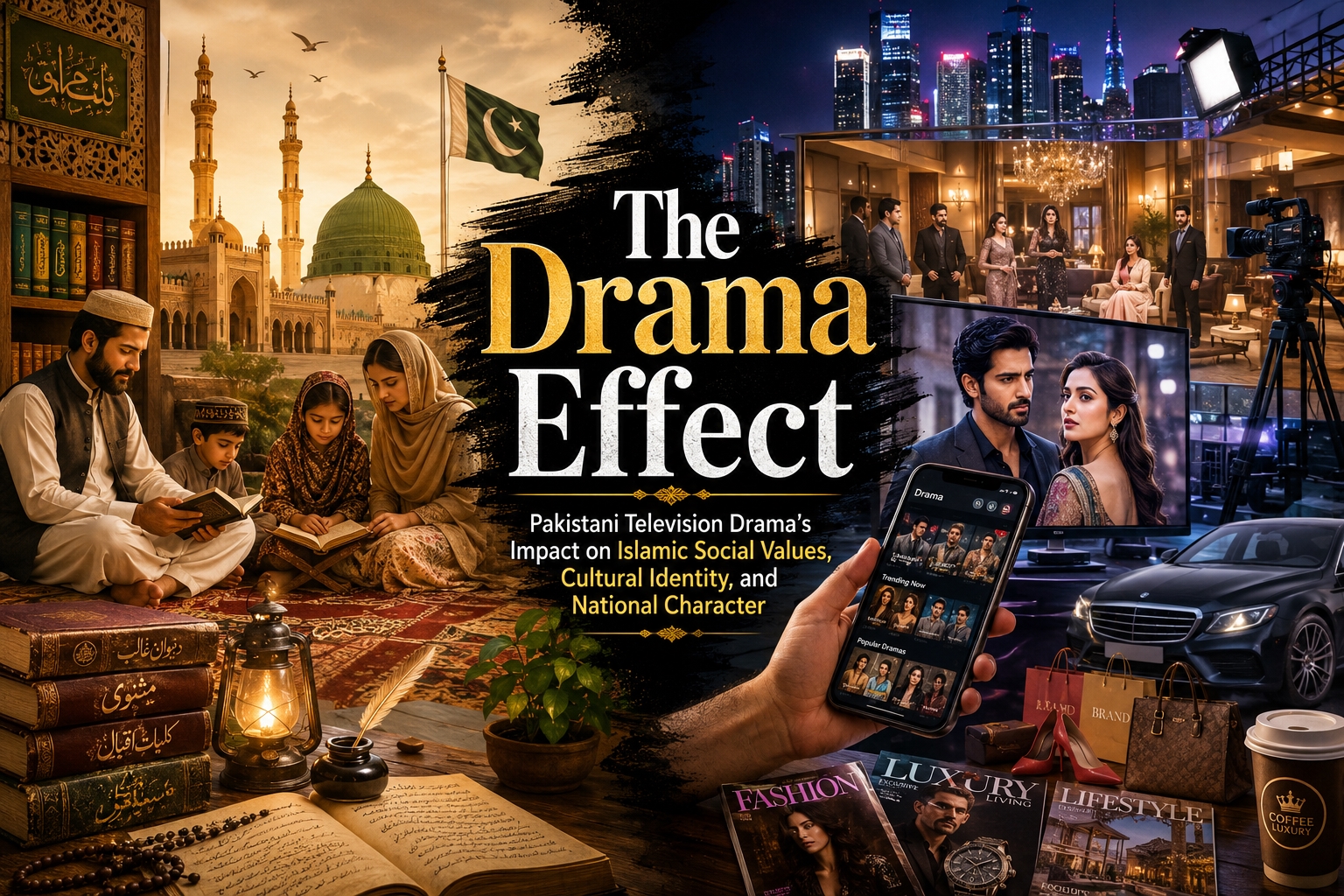
ToggleTHE DRAMA EFFECT: PAKISTANI TELEVISION DRAMA’S IMPACT ON ISLAMIC SOCIAL VALUES, CULTURAL IDENTITY, AND NATIONAL CHARACTER
A Comprehensive Multi-Dimensional Research Paper with Policy Recommendations
Abstract
This research paper presents a comprehensive examination of the impact of Pakistani television drama on Islamic social values, cultural identity, family structure, psychological wellbeing, and national character. Drawing upon media theory, Islamic intellectual frameworks, psychological analysis, sociological studies, economic structures, regulatory assessment, and comparative international models, the study argues that the contemporary Pakistani drama industry has evolved into one of the most influential agents of cultural transformation in Pakistan.
The research identifies that the transformation of the media landscape after the liberalization of electronic media in 2002 shifted television drama from a public-interest educational model toward a commercially driven entertainment system closely tied to multinational advertising structures and urban secular elite cultural production. As a result, television dramas increasingly normalize luxury consumerism, weaken Islamic modesty norms, privatize religion, erode family cohesion, diminish parental authority, reshape linguistic identity, and cultivate secular social attitudes under the guise of entertainment.
The paper demonstrates that these effects are not isolated or accidental, but emerge systematically through identifiable psychological mechanisms including cultivation effects, parasocial attachment, social comparison, moral disengagement, and identity displacement. The research further argues that the regulatory response has remained structurally inadequate due to institutional weaknesses within Pakistan’s media governance framework.
In response, the study proposes a multi-tier reform agenda involving government institutions, PEMRA, producers, advertisers, educational institutions, scholars, civil society, and families. Rather than advocating censorship alone, the research presents a constructive alternative vision: the development of a globally competitive Islamic cultural media industry capable of producing commercially successful entertainment rooted in Pakistan’s Islamic civilizational identity.
The study concludes that Pakistani television drama has become a decisive battlefield in the struggle over Pakistan’s cultural future, and that meaningful reform now represents not merely a media issue, but a civilizational necessity.
Introduction
Television drama occupies a uniquely influential position in Pakistani society. In a country where television remains one of the most widely consumed forms of entertainment, dramas shape perceptions of family life, morality, gender interaction, social aspiration, language, class identity, and even religion itself. Unlike formal educational systems, drama influences audiences not through direct instruction but through repeated emotional immersion, normalization, and symbolic representation. The cumulative impact of this process becomes especially significant in societies where television viewership spans generations and cuts across class divisions.
For decades, Pakistan Television (PTV) represented a model of cultural broadcasting rooted in literary sophistication, social ethics, and Islamic values. The dramas of that era reflected ordinary Pakistani life, respected family structures, preserved linguistic dignity, and often reinforced moral consciousness. However, following the liberalization of electronic media under PEMRA in 2002, Pakistan witnessed the rapid expansion of privately owned television channels operating primarily under commercial advertising models. This transformation fundamentally altered the incentives governing content production.
The new media environment increasingly rewarded sensationalism, consumer aspiration, glamour aesthetics, and emotionally provocative narratives. Luxury lifestyles became normalized. Religion was progressively marginalized or reduced to symbolic decoration. Gender interaction patterns shifted toward imported secular norms. Marriage and family conflicts became central entertainment formulas. Urdu linguistic identity weakened under English-dominant aspirational coding. At the same time, multinational FMCG (Fast-Moving Consumer Goods) advertisers emerged as the dominant economic force shaping content priorities.
This study investigates the consequences of these transformations through a multi-dimensional framework combining media theory, Islamic social thought, psychological research, economic analysis, and policy evaluation. The research seeks to answer several foundational questions:
- How do Pakistani dramas shape social values and cultural identity?
- What psychological mechanisms enable television drama to influence behavior and beliefs?
- How does commercial structure affect narrative production?
- To what extent do dramas conflict with Islamic social principles?
- Why has regulation remained ineffective?
- What reforms are necessary to protect Pakistan’s cultural and Islamic identity while sustaining creative freedom and commercial viability?
The study argues that Pakistani television drama now functions as a powerful instrument of cultural conditioning whose long-term consequences extend beyond entertainment into the moral, psychological, and civilizational fabric of society itself.
Theoretical Framework
Cultivation Theory and Television Reality Construction
The primary theoretical foundation of this research is Cultivation Theory, developed by George Gerbner. Cultivation Theory proposes that prolonged exposure to television gradually shapes viewers’ perceptions of reality according to the symbolic world repeatedly presented on screen. Heavy viewers begin to internalize television representations as social norms regardless of whether those representations reflect actual social conditions.
This framework is particularly relevant in Pakistan, where television dramas command enormous daily audiences. Repeated exposure to luxury lifestyles, normalized gender mixing, conflict-centered marriages, and secularized social behavior gradually cultivates new standards of aspiration and acceptability. Television thus becomes not merely entertainment but an informal institution of socialization competing directly with religion, family, and traditional culture.
Social Learning Theory and Parasocial Modeling
Albert Bandura’s Social Learning Theory further explains how audiences imitate behaviors observed in admired characters. Human beings learn not only through direct experience but also through observational modeling. Television characters become behavioral templates, especially when they are portrayed attractively, emotionally sympathetically, or socially successful.
Pakistani dramas intensify this effect through parasocial attachment, whereby viewers develop emotionally intimate one-sided relationships with fictional characters. These relationships create emotional trust and identification, enabling viewers to absorb values and attitudes unconsciously. Youth audiences are particularly vulnerable because identity formation remains psychologically incomplete during adolescence and early adulthood.
Agenda Setting and Narrative Prioritization
Agenda Setting Theory explains how media influences public consciousness by determining which issues receive attention and symbolic importance. Pakistani dramas consistently prioritize themes such as romance, class aspiration, marital conflict, consumerism, and personal autonomy. Through repetition, these themes become central components of social imagination while religious scholarship, intellectual pursuit, community service, and Islamic ethical struggle become increasingly marginalized.
Cognitive Dissonance and Value Reconciliation
Leon Festinger’s theory of Cognitive Dissonance explains how individuals experience psychological discomfort when their beliefs conflict with observed social norms. Pakistani audiences raised with Islamic teachings encounter drama narratives that normalize behaviors contradicting those teachings. Over time, many viewers resolve this tension not by abandoning religion entirely but by weakening religious practice, reinterpreting moral boundaries, or compartmentalizing Islam into purely personal spirituality.
This process gradually erodes Islamic values through normalization rather than direct ideological confrontation.
The Islamic Framework of Analysis
Maqasid al-Shariah
The Maqasid al-Shariah — the objectives of Islamic law — provide a comprehensive evaluative framework. These objectives include the protection of religion, intellect, lineage, life, and property. Television content that weakens faith, distorts moral reasoning, destabilizes family structures, or cultivates corruption directly conflicts with these objectives.
Amr bil Maroof wa Nahi Anil Munkar
The Quranic obligation to command good and forbid evil establishes collective responsibility toward public morality. Media cannot be treated as morally neutral when it shapes societal behavior at population scale. Producers, regulators, scholars, educators, and audiences all share responsibility for confronting harmful cultural influences.
Hifz al-Aql and Intellectual Protection
Islam places extraordinary emphasis on protecting human intellect from corruption. Just as intoxicants are prohibited because they impair judgment, media systems that systematically distort moral perception and normalize false values threaten intellectual integrity at societal scale.
Ghazw-e-Fikri and Cultural Penetration
The concept of ideological warfare through cultural influence provides an important lens for understanding how secular values spread indirectly through entertainment media. The study argues that Pakistani dramas often transmit Western secular assumptions through localized cultural packaging, making them more psychologically effective than openly foreign media.
Sadd adh-Dhara’i
The Islamic principle of blocking pathways to harm recognizes that moral collapse often occurs gradually through normalization and desensitization. Pakistani dramas frequently operate through incremental escalation rather than direct transgression, making this principle especially relevant.
Historical Transformation of Pakistani Drama
Pakistan Television originally emerged as a state institution tasked with combining education, national development, and moral refinement through entertainment. Early dramas reflected literary quality, social realism, and Islamic cultural coherence. Writers such as Ashfaq Ahmed, Bano Qudsia, and others produced narratives that explored human complexity while maintaining ethical grounding.
The post-2002 media liberalization transformed this structure. Private channels increasingly relied upon advertising-driven revenue models dominated by multinational FMCG corporations. Ratings competition intensified. Production timelines shortened. Glamour aesthetics expanded. Consumer aspiration became central to visual storytelling.
This transition gradually replaced the educational-cultural model with a market-driven entertainment system optimized for advertising effectiveness and urban elite consumption patterns.
The Dimensions of Cultural and Social Harm
Luxury Glorification and Consumerist Aspiration
One of the most consistent features of contemporary Pakistani drama is the normalization of elite lifestyles disconnected from the lived reality of most Pakistanis. Expensive homes, designer fashion, luxury vehicles, extravagant weddings, and upper-class aesthetics dominate visual storytelling regardless of narrative morality.
Even when wealthy characters are verbally criticized, visual presentation often glorifies their lifestyles through lighting, cinematography, music, and emotional framing. This creates what the research identifies as the “Dialogue-Visual Gap,” in which narrative dialogue condemns immoral behavior while visual symbolism celebrates it.
The psychological consequences include chronic social comparison, aspiration distortion, dissatisfaction, resentment, and corruption vulnerability among viewers excluded from such lifestyles by structural inequality.
Psychological Mechanisms of Influence
The study identifies multiple psychological pathways through which drama affects audiences:
- Parasocial bonding with fictional characters
- Social comparison and self-worth distortion
- Moral disengagement and normalization of unethical conduct
- Identity displacement through aspirational imitation
- Cognitive dissonance resolution against Islamic norms
- Corruption rationalization through luxury aspiration
- Materialism-induced mental stress
- Weakening of spiritual protective practices
These mechanisms operate cumulatively and continuously, producing gradual shifts in perception and behavior over time.
Gender Interaction and Parda Erosion
Pakistani dramas increasingly construct a symbolic binary between modesty and empowerment. Women adhering to traditional Islamic modesty are frequently portrayed as weak, oppressed, naïve, or socially backward, while unveiled and socially liberal women are portrayed as sophisticated, independent, and successful.
The research identifies a progressive normalization structure:
- Casual workplace interaction
- Friendship normalization
- Emotional dependency
- Physical proximity
- Romantic transgression
Each stage incrementally reduces audience sensitivity to Islamic gender boundaries.
Commercial advertising structures reinforce this process because beauty and fashion advertisers depend upon highly visible female presentation for product marketing.
Cultural Imperialism and Elite Mediation
The research argues that Pakistani drama functions as a form of hybrid cultural imperialism. Western secular values are transmitted not directly through foreign programming alone but through local elites culturally aligned with Westernized lifestyles and assumptions.
Because these values are embedded within Pakistani language, settings, and characters, they bypass many defensive reactions audiences might otherwise have toward overtly foreign media.
This process gradually redefines concepts of success, progress, freedom, sophistication, and modernity in secular rather than Islamic terms.
Language and Civilizational Identity
Urdu serves not merely as a national language but as a carrier of Islamic intellectual and literary heritage in South Asia. Contemporary dramas increasingly elevate English-dominant speech as aspirational while associating pure Urdu with backwardness or lower social status.
This linguistic hierarchy contributes to cultural alienation from classical Islamic literature, poetry, scholarship, and indigenous intellectual traditions.
Religious Representation and Symbolic Reduction
The study identifies several recurring patterns in religious portrayal:
- Religion as decorative symbolism
- Religious characters portrayed as hypocritical or oppressive
- Islam confined to emotional crisis resolution
- Mockery or caricaturing of visibly religious individuals
- Secular characters portrayed as morally superior
Such portrayals contribute to the privatization of religion and weaken Islam’s perceived relevance to social and institutional life.
Marriage, Family, and Social Stability
Marriage and family structures receive extensive negative framing within contemporary dramas. Common narrative formulas include:
- Dysfunctional marriages
- Manipulative in-laws
- Constant domestic conflict
- Extramarital temptation
- Divorce as liberation
Repeated exposure to such narratives shapes audience expectations regarding marriage and family life. Extended family systems are increasingly depicted as oppressive rather than supportive social institutions.
Parental Authority and Intergenerational Breakdown
The erosion of parental authority represents one of the study’s most significant concerns. Dramas frequently portray parental obedience as weakness and rebellion as sophistication. Respectful behavior is often associated with rurality or lack of education, while confrontation and autonomy are coded as modernity.
This directly weakens intergenerational transmission of Islamic values because families remain the primary institution through which moral and religious identity is reproduced.
Mental Health and Social Frustration
The research links television-driven materialism with rising social frustration, anxiety, inadequacy, and hopelessness. Exposure to unattainable luxury lifestyles intensifies feelings of deprivation within economically unequal societies.
At the same time, drama culture weakens spiritual practices such as salah, dhikr, qana‘at, and religious reflection that traditionally function as psychological stabilizers within Islamic civilization.
Regulatory Failure and Institutional Weakness
The study concludes that Pakistan’s regulatory framework has failed structurally rather than incidentally.
PEMRA possesses extensive legal authority yet suffers from:
- Political dependence
- Reactive enforcement
- Minimal financial penalties
- Lack of pre-screening systems
- Weak Islamic operational standards
- Digital platform gaps
- Insufficient research-based monitoring
Comparative analysis demonstrates that Muslim-majority countries such as Turkey and Malaysia employ more proactive and structured regulatory systems integrating preventive review mechanisms and cultural policy frameworks.
The Reform Framework
The research proposes a comprehensive reform agenda involving seven interdependent levels.
Government and Parliament
- Ensure regulatory independence
- Introduce meaningful penalties
- Regulate OTT (Over-The-Top) platforms
- Prevent ownership monopolization
- Establish national cultural policy structures
PEMRA Reform
- Create content review systems
- Operationalize Islamic values guidelines
- Develop annual public values reporting
- Introduce quality certification incentives
Media Industry
- Develop ethical production standards
- Integrate scholars and psychologists into production consultation
- Reform wealth portrayal norms
- Invest in authentic cultural storytelling
Advertisers
- Introduce ethical sponsorship frameworks
- Reduce dependency on hyper-consumerist marketing logic
- Support socially responsible entertainment
Educational Institutions
- Implement Islamic media literacy curricula
- Train teachers and parents
- Develop critical viewing skills among youth
Civil Society and Scholars
- Establish independent monitoring organizations
- Revive public ethical discourse
- Fulfill obligations of moral guidance
Families
- Introduce structured viewing discipline
- Encourage alternative educational content
- Strengthen Islamic identity within the home
- Develop active parental media engagement
The Positive Alternative: The Pakistan Wave
The research emphasizes that reform should not remain merely defensive. Pakistan possesses the demographic, linguistic, spiritual, literary, and historical resources necessary to become a global leader in Islamic entertainment media.
Key assets include:
- A global Muslim audience exceeding 1.8 billion
- Hundreds of millions of Urdu speakers
- A large diaspora audience
- Rich Islamic civilizational heritage
- Strong storytelling traditions
- Proven audience demand for meaningful Islamic content
The success of Turkish Islamic historical dramas and spiritually grounded Pakistani productions demonstrates that commercially successful entertainment rooted in Islamic values is entirely achievable.
The proposed “Pakistan Wave” envisions a globally influential cultural industry producing high-quality dramas that preserve Islamic ethics while competing successfully in international entertainment markets.
Conclusion
This research demonstrates that Pakistani television drama has evolved into one of the most powerful instruments shaping social consciousness in Pakistan. Through continuous exposure, emotional immersion, symbolic repetition, and aspirational modeling, drama influences perceptions of morality, family, religion, language, gender, and identity at national scale.
The study argues that the current media ecosystem systematically privileges consumerism, secularization, and cultural imitation over Islamic ethics, social stability, and indigenous civilizational confidence. These outcomes emerge not merely from individual moral choices but from structural economic incentives, regulatory failures, and elite cultural production patterns.
At the same time, the research rejects simplistic censorship narratives. The solution lies not in suppressing creativity but in reconstructing the moral and institutional architecture within which creativity operates. Pakistan possesses the intellectual, spiritual, cultural, and artistic resources necessary to build a media system that is commercially vibrant while remaining faithful to its Islamic identity.
The struggle over television drama is therefore not merely a debate about entertainment. It is a struggle over the future moral imagination of Pakistani society itself.
The evidence presented throughout this study indicates that the issue can no longer be treated as marginal or symbolic. Television drama now functions as a central arena in which the cultural future of Pakistan is being shaped daily inside millions of homes.
The ultimate question confronting Pakistan is therefore civilizational in nature:
Will the nation continue permitting its dominant entertainment system to erode the Islamic and cultural foundations upon which it was established, or will it consciously rebuild a media culture capable of strengthening faith, family, dignity, psychological wellbeing, and national identity for future generations?
The answer to that question will shape not only the future of Pakistani media, but the future of Pakistan itself.