
Our Intellectual Slavery and Its Causes: How the Muslim World Lost Intellectual Leadership
The Dichotomy of Sovereignty and Subjugation
Sovereignty, dominance, and supremacy manifest in two distinct forms: intellectual and moral dominance, and political and material dominance. The first form—intellectual dominance—occurs when a nation advances so profoundly in its intellectual faculties that other nations embrace its ideologies, allowing its imaginations, convictions, and paradigms to govern their minds. Mentalities are cast into its mould; its civilization becomes the standard, its knowledge is recognized as absolute truth, and whatever it invalidates is universally deemed false.
The second form—political dominance—occurs when a nation becomes so materially powerful that other nations can no longer sustain their political autonomy against it, enabling the dominant power to seize control of their economic resources and govern their state structures. Correspondingly, subjugation and defeat are also divided into two categories: intellectual slavery and political slavery, both of which are mirror reflections of the characteristics of dominance described above.
While these two forms of dominance can exist independently, the immutable law of nature dictates that the nation prioritizing intellect, reason, original research, and discovery is blessed with material advancement alongside intellectual progress. Conversely, the nation that abdicates the field of critical thinking and contemplation falls victim to material degradation alongside intellectual decay. Because dominance is the fruit of strength and subjugation is the consequence of weakness, intellectually and materially impoverished nations become increasingly predisposed to slavery. Eventually, robust nations take absolute command over both their bodies and their minds.
The Present State of the Muslim World
Today, Muslims are entangled in this dual form of slavery. In some regions, both forms are completely entrenched; in others, political subjugation is less pronounced while intellectual slavery is rampant. Unfortunately, there is currently no Muslim population that is genuinely free in both the political and intellectual sense. Even where they possess political independence and self-governance, they remain shackled by mental servitude. Their educational institutions, administrative offices, marketplaces, social gatherings, homes, and even their physical appearances silently bear witness to the hegemony of Western civilization, Western thought, and Western sciences.
They think with the Western brain, see through Western eyes, and walk the paths laid out by the West—frequently without even realizing it. They are governed by the absolute premise that truth is only what the West validates, and falsehood is only what the West rejects. Their benchmarks for truth, sincerity, civilization, morality, humanity, and refinement are entirely those dictated by Western paradigms. They measure their faith, ideologies, traditions, and manners against this external yardstick. If a concept aligns with this standard, they accept it with pride. If it falls short, they reject it consciously or subconsciously. Some discard it openly, while others suffer internal anguish, attempting to distort and stretch Islamic principles to fit Western configurations. If this is the condition of politically independent Muslim nations, one can scarcely imagine the depths of mental slavery found among those directly subjugated by Western powers.
| The Spectrum of Subjugation | |
| Intellectual Subservience | Political Subjugation |
| Adopting Western paradigms as the universal metric | Loss of state autonomy and economic control |
The Root Cause: The Abdication of Research
What is the cause of this pervasive mental slavery? While a comprehensive analysis would require an entire volume, it can be summarized briefly. Intellectual ascendancy is fundamentally anchored in independent thought (Ijtihad) and empirical research. The nation that leads the way in exploration becomes the guide and leader of humanity, and its ideologies naturally conquer the world. Conversely, the nation that lags behind is reduced to a mere imitator, its ideas stripped of the vitality required to command human minds. The overwhelming torrent of a dynamic, researching nation’s concepts simply sweeps away stagnant dogmas.
As long as Muslims remained pioneers in the realms of research and Ijtihad, the world followed their lead. Islamic thought reigned supreme over human consciousness. The criteria for beauty, success, virtue, vice, truth, and error established by Islam were universally accepted metrics. However, when original thinkers and researchers ceased to emerge among Muslims—when they abandoned contemplation, inquiry, and the pursuit of knowledge—they effectively resigned from the leadership of mankind.
Simultaneously, Western nations stepped into this vacuum. They harnessed their faculties of reason, unravelled the mysteries of the universe, and unearthed the hidden treasures of nature. The inevitable consequence unfolded: Western nations assumed the mantle of global leadership, and Muslims were forced to bow before their authority, just as the world had once bowed before the authority of Islam.
For four to five centuries, Muslims slept comfortably on the laurels of their ancestors while the Western nations laboured relentlessly. Then, the deluge of Western power arose, sweeping across the globe within a single century. Rubbing their eyes as they awoke from deep slumber, Muslims found a Christian Europe armed with both the pen and the sword, ruling the world with dual execution. A small minority attempted physical resistance, but they possessed neither the intellectual sharpness of the pen nor the material sharpness of the sword, leading to consecutive defeats. As for the vast majority of the community, they followed the timeless psychological habit of the weak: they elevated the ideas, theories, and principles arriving from the West—backed as they were by military might, rational discourse, scientific validation, and seductive aesthetic appeal—to the status of absolute truth. Legacy religious convictions, moral frameworks, and cultural laws, which had survived merely on hollow traditionalism, were completely washed away by this powerful current. Subconsciously, the foundational assumption settled deep within their hearts: whatever originates from the West is inherently true, and is the absolute metric of correctness.
The Unique Conflict of Islamic Civilization
When Western civilization collided with other cultures, some of those cultures lacked a distinct civilizational identity. Others possessed a heritage, but it was not resilient enough to preserve its distinct characteristics against an aggressive alternative. Some held foundational principles that were not radically distinct from the incoming Western ideas. These societies quickly absorbed the hues of Western civilization without enduring a severe internal crisis.
However, the case of Muslims is fundamentally different. They possess an independent, comprehensive, and complete civilization governed by an absolute code that encompasses all spheres of ideological and practical life. The foundational principles of Western civilization stand in a clear, structural opposition to this Islamic framework. Consequently, these two civilizations clash at every step, and their confrontation exerts a destructive influence on every department of a Muslim’s devotional and practical life.
The Historical Genesis of Western Materialism
The philosophy and science that nurtured Western civilization have drifted toward atheism, secularism, irreligion, and raw materialism for the past five to six centuries. Its historical inception was marked by an immediate war with religion. In fact, it is accurate to state that this civilization was forged by the rebellion of human reason against ecclesiastical authority.
In truth, observing the universe, investigating its mysteries, discovering its natural laws, reflecting upon its phenomena, and deducing logical conclusions through empirical observation are not inherently antithetical to religion. However, by a tragic historical accident during the European Renaissance, the nascent intellectual movement collided with a Christian clergy that had anchored its theological dogmas to ancient Greek philosophy. The Church firmly believed that if modern scientific discovery and intellectual inquiry fractured these archaic Greek foundations, the entire edifice of religion would crumble into dust.
Driven by this erroneous assumption, the Church vehemently opposed the new intellectual awakening, utilizing raw force to suppress it. Tribunals of the Inquisition were established, inflicting horrific and savage punishments upon the torchbearers of free thought. Yet, because this movement was the product of a genuine intellectual awakening, it thrived under persecution rather than suffocating. Ultimately, the torrent of free thought completely dismantled ecclesiastical authority.
| Historical Era | Dominant Philosophical Trend | Status of the Divine Concept |
| 17th Century | Transitional Rationalism & Mechanics | Coexistence; God as the ultimate mechanical cause. |
| 18th Century | Skepticism, Empiricism & Deism | God reduced to a “Constitutional Monarch” or denied outright. |
| 19th Century | Absolute Materialism & Evolutionism | Complete erasure of the supernatural; human as a machine. |
Initially, the conflict was strictly between the pioneers of free thought and the clergy. However, because the clergy fought under the banner of faith, the struggle rapidly transformed into a war between Christianity and free thought. Eventually, religion itself—regardless of its form—was cast as the adversary. To think scientifically became synonymous with thinking anti-religiously.
European intellectuals deemed it an absolute necessity to resolve the riddles of the cosmos without assuming the existence of God or any supernatural entity, branding any framework that recognized the Divine as inherently unscientific. Thus, a profound prejudice against God, the soul, and spirituality became deeply embedded within modern philosophy—a prejudice born not out of cold logic or empirical negation, but out of raw historical trauma and emotional reactive hostility. They did not reject God because his non-existence was proven by rational demonstration; they recoiled from Him because He was the deity claimed by their historic oppressors. The immense intellectual and scientific achievements of the subsequent five centuries were built entirely upon this emotionally charged, non-rational foundation.
The Philosophical Trajectory: From Descartes to Darwin
Though Western philosophy and science began their journey moving directly away from God, they initially maintained a superficial compromise between naturalism and theism due to their surrounding religious environment. However, as the journey progressed, naturalism completely eclipsed theism. Ultimately, the concept of God and everything transcending the physical world vanished entirely from their worldview, terminating in the conclusion that nothing is real save for matter and motion. Science became synonymous with naturalism, and modern intellectuals established a dogma of their own: whatever cannot be measured, weighed, or empirically verified simply does not exist.
The history of Western philosophy vividly illustrates this trajectory:
René Descartes (d. 1650): Regarded as the father of modern Western philosophy, Descartes was a staunch believer in God and affirmed the independent existence of the soul alongside matter. Yet, he simultaneously pioneered the mechanical explanation of natural phenomena, inadvertently laying the groundwork for absolute materialism.
Thomas Hobbes (d. 1679): Advancing a step further, Hobbes openly attacked the supernatural, arguing that the entire universe and everything within it could be explained through mechanical laws. While he retained a nominal belief in God as an intellectual necessity to satisfy the law of cause and effect, he stripped the Divine of any active interference in the material world.
Baruch Spinoza (d. 1677): The great champion of 17th-century rationalism, Spinoza obliterated the distinction between matter, spirit, and God. By merging God and the universe into a singular pantheistic whole, he denied the absolute free will and sovereignty of the Divine.
Leibniz (d. 1716) & John Locke (d. 1704): Though both affirmed the existence of God, their epistemological and philosophical trajectories leaned heavily toward naturalism.
This 17th-century compromise, where theism and naturalism walked hand-in-hand, extended to the scientific pioneers as well. Copernicus, Kepler, Galileo, and Newton were not atheists. However, in their quest to decipher the mechanics of the cosmos, they intentionally set aside divine agency to isolate the physical forces and mathematical laws operating the system. This methodological exclusion of the divine perspective was the very seed of atheism and naturalism that would later bloom from the tree of free thought, though the 17th-century thinkers were entirely oblivious to it.
By the 18th century, it became undeniably clear that any intellectual framework that systematically ignores the Divine while exploring the cosmos will inevitably terminate in raw materialism and atheism. This era witnessed the rise of fiercely secular and materialist thinkers like John Toland, David Hartley, Joseph Priestley, Julien Offray de La Mettrie, Pierre Jean Georges Cabanis, Denis Diderot, Voltaire, Montesquieu, and Jean-Jacques Rousseau. They either denied the existence of God outright or reduced Him to a mere “Constitutional Monarch” who, after setting the cosmic machine in motion, retired into perpetual isolation, retaining no active role in its governance.
David Hume provided massive reinforcement to this secular drift through his strict empiricism and scepticism, insisting that empirical experience is the sole metric for validating any truth. Bishop Berkeley fought desperately against this rising tide of materialism, but his efforts were swept away. Georg Wilhelm Friedrich Hegel attempted to champion idealism over materialism, but the worship of abstract, intangible ideas could not compete with the allure of solid matter. Immanuel Kant attempted a final, desperate reconciliation: he argued that while the existence of God, the immortality of the soul, and free will are beyond the scope of speculative human reason, practical wisdom mandates that we must believe in them for the preservation of morality. This compromise failed miserably. Once human intellect had categorized God as a mere figment of imagination or a powerless, redundant entity, fearing Him or seeking His pleasure purely for moral utility became a deeply irrational act.
By the 19th century, materialism reached its zenith. Thinkers like Karl Vogt, Ludwig Büchner, Heinrich Czolbe, Auguste Comte, and Jacob Moleschott declared the existence of anything beyond matter and its physical properties to be an absolute fallacy. John Stuart Mill championed empiricism in philosophy and utilitarianism in ethics. Herbert Spencer advanced a comprehensive system of philosophical evolution, asserting that the universe, life, and consciousness emerged entirely spontaneously. Massive breakthroughs in biology, zoology, geology, physiology, and the abundance of material wealth solidified a stubborn conviction in human hearts: the universe is self-caused and self-sustained, operating under unyielding physical laws without any supernatural intervention.
Within this framework, life is not a divine spark; it is merely a property that matter assumes when it reaches a highly complex state of organization. Thought, consciousness, emotion, and intellect are reduced to mere chemical properties of highly evolved matter. Humans and animals are viewed as choice-less biological machines governed entirely by physical laws. The breakdown of this mechanical system—the expenditure of its energy—is death, which means absolute annihilation. Once the machine breaks, its properties vanish, leaving no possibility of a resurrection or a day of accountability.
Charles Darwin’s theory of evolution played the most pivotal role in transforming this naturalism and materialism into a systematic, globally accepted scientific dogma. His seminal work, The Origin of Species (1859), revolutionized the scientific world. Using a methodology that perfectly satisfied the 19th-century secular mind, Darwin stamped the seal of scientific validation upon the claim that the business of the cosmos can run entirely without a Creator. He argued that the evolution of life from the lowest organisms to the highest stages is the result of a gradual, unguided natural process entirely devoid of intellect, wisdom, or purpose. Within this paradigm, humanity was not shaped by a Wise Craftsman; rather, the same primitive biological organism that once crawled as a worm transformed, over eons of natural selection and the brutal survival of the fittest, into a conscious, rational human being.
The Irreconcilable Divergence
This is the philosophy and science that begot modern Western civilization. Within this framework, there is no room for the fear of an All-Knowing God, no value given to prophetic revelation, no conception of an afterlife, no accountability for worldly conduct, and no human destiny higher than biological survival. It is an explicitly material civilization. Its entire structure is completely devoid of the concepts of God consciousness, righteousness, absolute truth, integrity, modesty, and spiritual purity upon which Islamic civilization is built.
Its foundational worldviews are the exact antithesis of Islam. Its path moves in the diametrically opposite direction of the path chosen by Islam. The very foundations upon which Islam builds human character and collective society are the principles this civilization seeks to uproot. Conversely, the foundations upon which Western civilization erects its social order cannot sustain the edifice of Islam for a single moment.
Islam and Western civilization are two ships traveling in directly opposite directions. Whoever boards one must inevitably abandon the other. Anyone attempting to ride both simultaneously will be torn asunder.
By a profound historical misfortune, the century in which this materialistic, atheistic civilization reached its peak was the exact century in which the entire Muslim world—from Morocco to the Far East—was subjugated by the political might of Western powers. Muslims were assaulted by the Western sword and the Western pen simultaneously. Minds already terrified and paralyzed by political defeat found it impossible to resist the intellectual prestige and philosophical awe of Western science.
The situation was particularly catastrophic for those Muslim populations living under direct colonial rule. To secure their economic survival, they were forced to acquire Western education. Because this education was pursued not for pure intellectual enrichment, but out of a deeply subjugated mind-set before Western masters, the new generations of Muslims absorbed these secular theories with complete passivity. Their minds were cast into Western moulds, and Western culture saturated their hearts. They lacked the critical academic faculty required to separate empirical truth from ideological error. They lost the capacity for independent, original thought.
As a direct consequence, the very foundations of Islamic civilization have been destabilized. The mental framework required to comprehend reality through an Islamic paradigm has been warped. Minds trained to think exclusively through Western epistemological categories find it structurally impossible to accommodate the foundational principles of Islam. When the foundational principles cannot be digested, it is hardly surprising that endless doubts and scepticism arise regarding the secondary practices and laws of faith.
While the vast majority of Muslims still retain an emotional faith in Islam and desire to remain Muslims, their intellectual leadership is drifting away. Western secular thought completely dominates the global atmosphere, altering the cognitive angles of vision so profoundly that looking at the world through a distinct Islamic lens has become immensely difficult.
The Call for an Islamic Renaissance
This existential crisis will never be resolved until original, independent thinkers arise within the Muslim world. Islam stands in desperate need of an intellectual Renaissance (Nash’at-e-Jadeedah). The intellectual capital of classical Muslim scholars, while historic, cannot fully resolve the unique dilemmas of the modern era. The world has advanced rapidly, and it is impossible to forcefully drag humanity back to the intellectual milestones of six centuries ago. Leadership in the arena of human thought can only be claimed by those who drive the world forward, not those who attempt to push it backward.
Therefore, if Islam is to reclaim global leadership, there is only one viable path: Muslims must produce original thinkers and researchers who possess the intellectual depth to dismantle the philosophical and scientific foundations upon which Western civilization rests. Grounded in the Quranic methodology of observing nature and pursuing truth, they must construct an entirely new system of philosophy. They must erect a new framework of natural science based on divine premises, shattering the secular monopoly on knowledge. This alternative intellectual edifice must be built with such rigorous sophistication that it captures global consciousness, replacing the destructive materialism of the West with the life-giving, righteous civilization of Islam.
The Metaphor of the Train
To fully assimilate this call to action, consider this concluding metaphor:
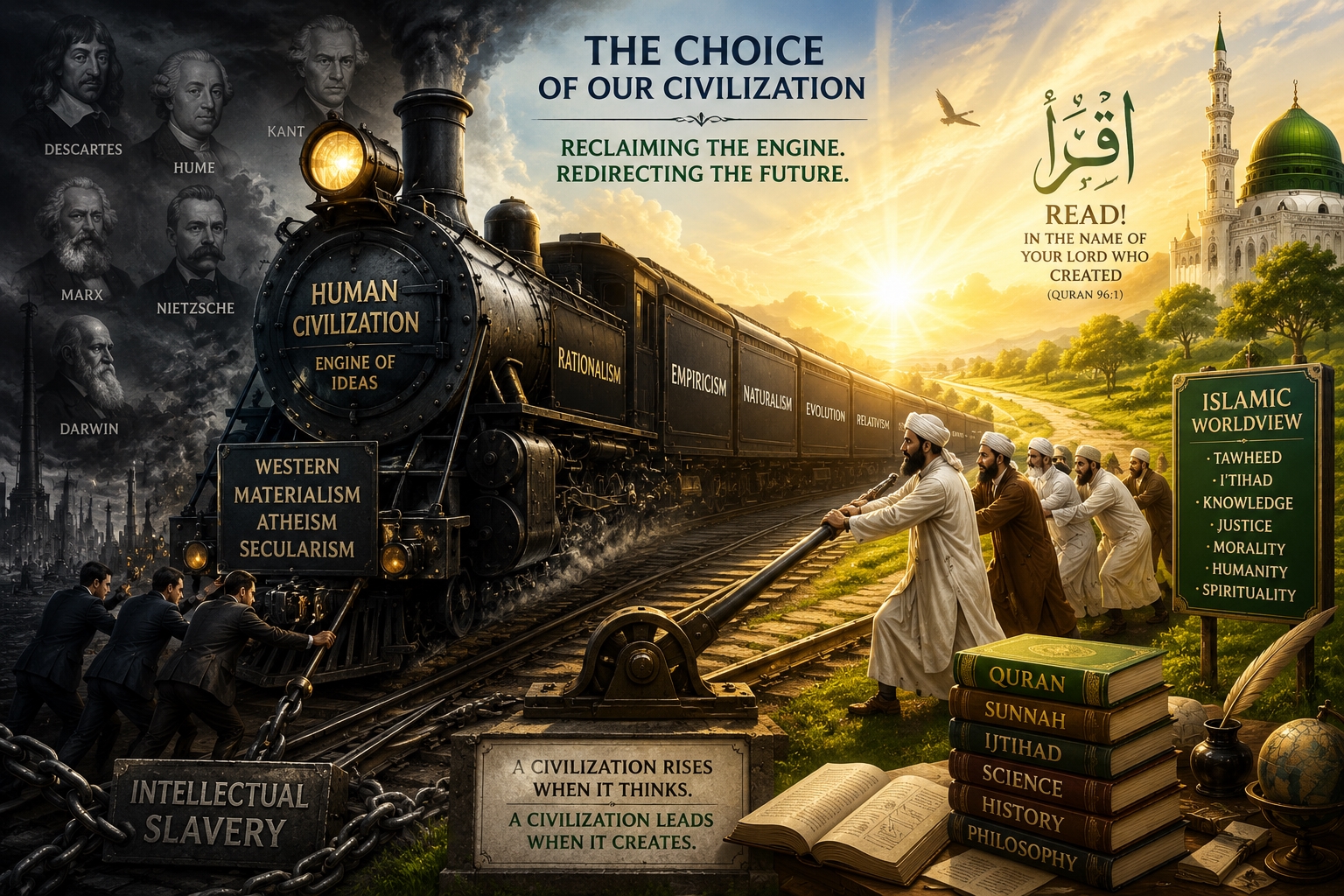
Imagine human civilization as a massive train, driven forward by the powerful engine of intellectual research and original thought. Thinkers and researchers are the drivers of this engine. The train must travel in whatever direction the drivers steer it, and the passengers trapped inside are forced to go along, regardless of their personal desires.
| Intellectual Engine | Passenger Carriages |
| Driven by secular philosophers pulling toward materialism | Humanity trapped, adjusting
seats but moving down same track |
If a passenger inside the carriage objects to the destination, the most he can do is turn his seat around to face backward or sit sideways. Yet, merely altering his sitting posture does not alter the direction of his travel; he is still hurtling toward the exact same destination as the train.
The only way to change the destination is to climb onto the engine, seize control of the steering mechanism, and redirect its path. Currently, the individuals controlling the intellectual engine of humanity are completely estranged from God and devoid of Islamic insight. Consequently, the train of human civilization is hurtling at breakneck speed toward atheism and self-destructive materialism. Every passenger, willingly or reluctantly, is being carried further away from the divine destination. To alter this trajectory, courageous, God conscious thinkers must arise, exert the necessary intellectual effort, and wrest control of the engine from secular hands. Until this intellectual seizure occurs, the train will not alter its course, and despite all our complaints, anger, and superficial emotional protests, humanity will continue to race down the path dictated by its secular drivers.