
Makkah Defence Pact: Can Pakistan, Saudi Arabia and Türkiye Build a Muslim NATO?
Makkah Defence Pact: What happens when three powerful Muslim countries decide that an attack on one should be treated as an attack on all?
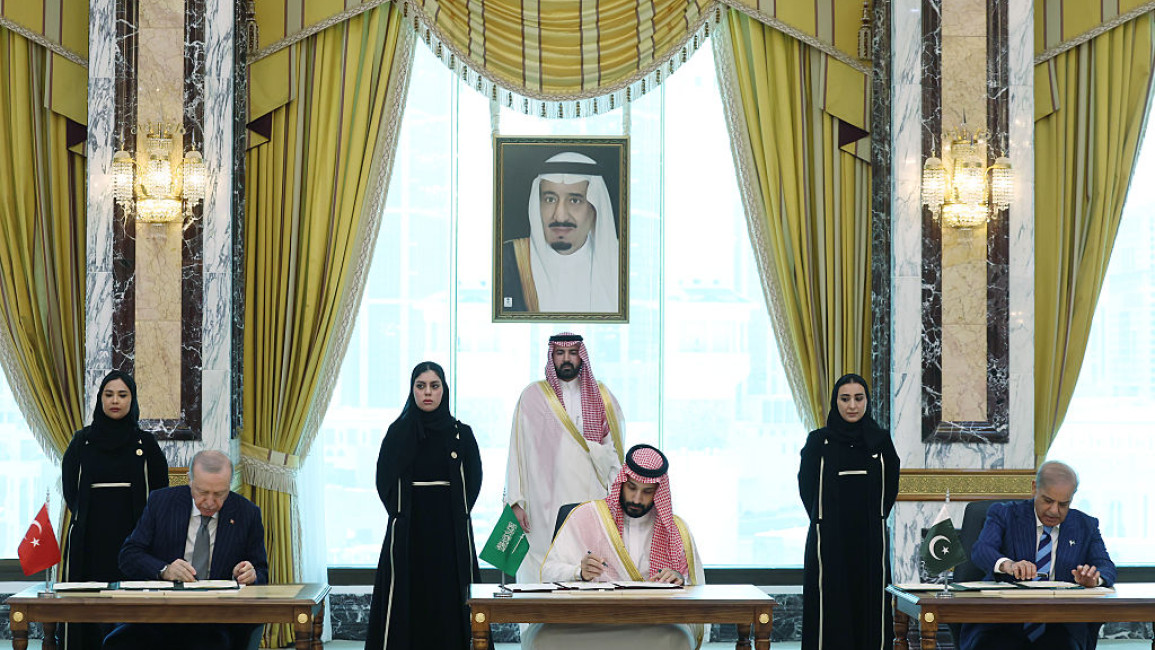
![Makkah Defence Pact:Leaders of Turkey, Pakistan, and Saudi Arabia sign a mutual defence pact. [Getty]](https://mrpo.pk/wp-content/uploads/2026/08/2288615744-1024x576.jpeg)
The answer is far more complicated than the dramatic phrase “Muslim NATO” suggests.
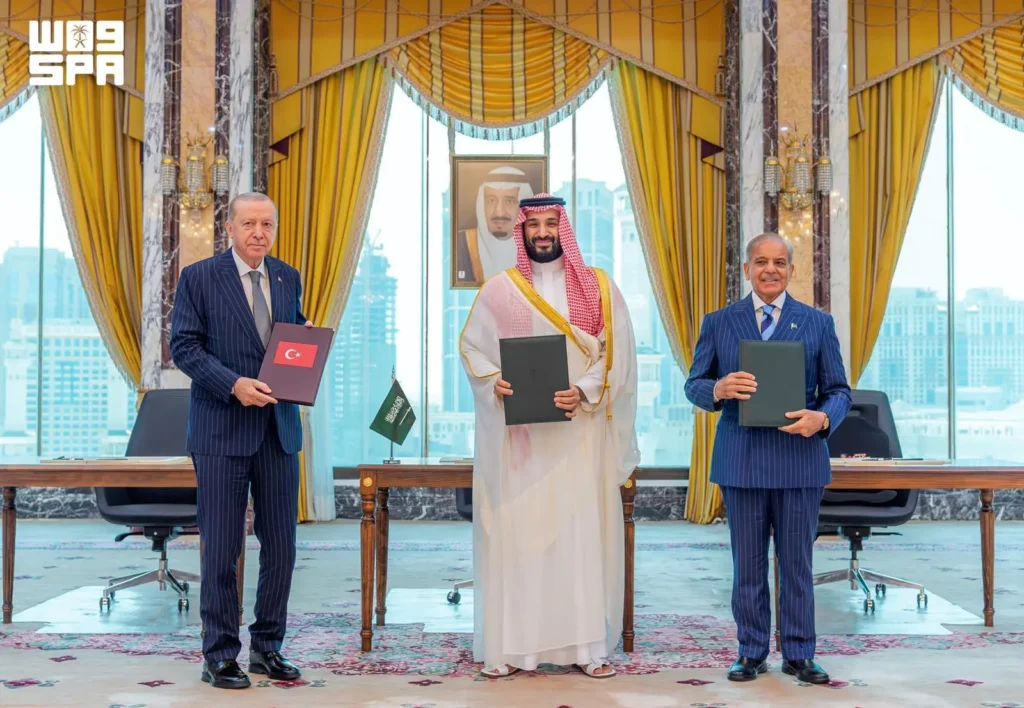
On August 7, 2026, Pakistan, Saudi Arabia and Türkiye signed the Makkah Joint Defence Agreement in Makkah. The agreement commits the three countries to strengthen collective deterrence and states that an armed attack against one member will be considered an attack against all. Pakistani and Turkish officials have compared this principle to NATO’s Article 5, although the practical machinery for implementing the commitment is still being developed. (Saudi Press Agency)
The pact is also explicitly described by the three governments as defensive rather than directed against a particular country. Yet the real significance of Makkah goes beyond the text of the agreement. It raises a much larger question.
Can a deeply divided Muslim world finally convert enormous economic, demographic and military potential into coordinated strategic power?
That is the question this article examines.
https://mrpo.pk/the-price-of-friendship/
What Exactly Did Pakistan, Saudi Arabia and Türkiye Sign?
The Makkah Joint Defence Agreement is a trilateral collective defence arrangement between Pakistan, Saudi Arabia and Türkiye. Its central principle is straightforward.
An armed attack against one member is to be regarded as an attack against all three.
The agreement is intended to strengthen collective deterrence, deepen defence cooperation and provide a mechanism for consultation and coordination when the security of a member is threatened. The countries have also stressed that the pact does not replace their existing bilateral or multilateral defence arrangements. (Saudi Press Agency)
This last point is important. Türkiye remains a NATO member. Pakistan maintains its own defence relationships, including longstanding cooperation with China and Saudi Arabia. Saudi Arabia maintains extensive security relationships with the United States and other partners.
Makkah therefore creates another layer of security cooperation rather than replacing the existing architecture. That is why describing it simply as an “Islamic NATO” can be misleading. It may eventually become something larger. But it has not become that yet.
Why Was the Agreement Signed in Makkah?
The location was clearly symbolic.
Makkah is Islam’s holiest city and a place of enormous emotional significance to Muslims worldwide. But symbolism alone does not explain the timing. The regional security environment has changed dramatically.
The Middle East has experienced repeated missile and drone attacks, instability around the Red Sea, continuing conflict involving Iranian-backed groups, uncertainty over American security commitments and renewed concern among Gulf states about whether traditional security arrangements are sufficient.
Reuters reported on August 12 that Saudi Arabia is increasingly pursuing regional defence arrangements as part of a broader effort to strengthen deterrence and reduce vulnerability amid a deteriorating security environment. (Reuters)
The pact therefore represents both political symbolism and strategic calculation. The symbolism is Islamic solidarity. The calculation is deterrence.
The Agreement Did Not Appear From Nowhere
One of the most important points often missed in public discussion is that the Makkah pact did not suddenly create Pakistan-Saudi military cooperation. The relationship is much older. Pakistan and Saudi Arabia have maintained close defence ties for decades. Pakistani personnel have served in Saudi Arabia. Saudi military personnel have received training in Pakistan.
The two countries have conducted military exercises and maintained extensive defence contacts. That relationship was formalised further on September 17, 2025, when Pakistan and Saudi Arabia signed the Strategic Mutual Defence Agreement in Riyadh.
The official Pakistani statement said the agreement was intended to strengthen joint deterrence and that aggression against either country would be considered aggression against both. (Ministry of Foreign Affairs)
That agreement remains important.
Indeed, Pakistan’s Foreign Office stated in April 2026 that its defence agreements with Saudi Arabia were operational. (Ministry of Foreign Affairs)
The 2026 Makkah agreement therefore should not be viewed as replacing the 2025 Pakistan-Saudi arrangement.
It builds a wider trilateral structure around an already existing bilateral defence relationship.
What Does Türkiye Add?
Türkiye changes the equation considerably.
Pakistan brings extensive military experience, a large standing military and nuclear deterrence.
Saudi Arabia brings enormous financial resources, strategic geography, energy importance and sophisticated Western-supplied military systems.
Türkiye adds something different.
It brings a large conventional military, a major defence industry, significant drone and missile capabilities, naval strength and decades of experience operating within NATO structures.
The combined capabilities are therefore complementary rather than identical.
As Al Jazeera’s assessment noted, the three countries bring together a major oil exporter, NATO’s second largest army and the world’s only Muslim-majority nuclear-armed state. (Al Jazeera)
That combination gives the pact considerable strategic weight. But military inventories do not automatically create military power. The real question is whether the three countries can integrate their capabilities. That will require joint planning, communications, intelligence sharing, exercises, logistics, air defence coordination and agreed crisis procedures.
Until those mechanisms exist, the pact’s deterrent value is partly political rather than fully operational.
Is This Really NATO’s Article 5?
There is an important similarity.
NATO’s Article 5 establishes the principle that an armed attack against one member is considered an attack against all.
Türkiye’s Foreign Minister Hakan Fidan has described the Makkah arrangement as technically comparable to NATO’s collective defence principle. (Reuters)
But similarity of wording does not mean equivalence of institutions.
NATO has:
A permanent integrated military command structure.
Decades of joint operational experience.
Standing headquarters.
Integrated air and missile defence systems.
Common planning procedures.
Interoperability standards.
Large permanent exercises.
Established military logistics.
A huge combined defence budget.
Makkah has none of this at NATO’s scale.
So the intellectually honest description is:
Makkah has adopted a NATO-like collective defence principle, but it is not yet a Muslim NATO.
Whether it becomes something resembling one will depend entirely on what happens after the signing ceremony.
The 2025 Pakistan Saudi Defence Pact Still Matters
The Makkah agreement should also be understood as the expansion of the 2025 Strategic Mutual Defence Agreement between Pakistan and Saudi Arabia.
That bilateral agreement committed both sides to joint deterrence and treated aggression against either country as aggression against both. (Ministry of Foreign Affairs)
The significance is substantial.
For Saudi Arabia, Pakistan represents a major military partner with extensive operational experience and a nuclear deterrent.
For Pakistan, Saudi Arabia represents a strategically vital partner with enormous economic resources, energy importance and geographical significance.
The 2026 agreement adds Türkiye to that equation.
The result is no longer simply a Gulf South Asia security relationship.
It begins to connect South Asia, the Arabian Peninsula and the Eastern Mediterranean.
And Then There Is General Raheel Sharif
This brings us to another frequently misunderstood part of the story.
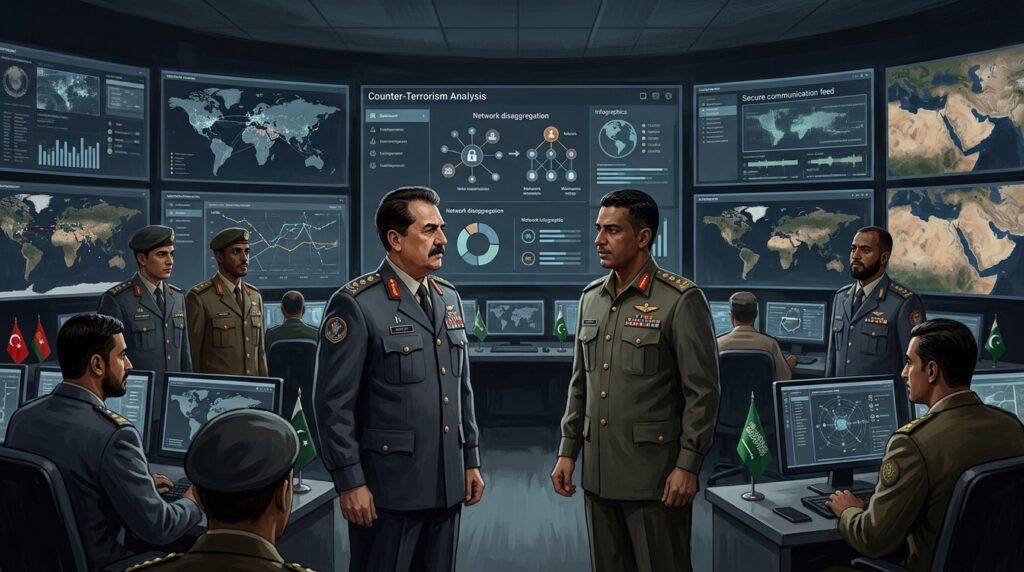
Pakistan’s former army chief General Raheel Sharif has been the military commander of the Islamic Military Counter Terrorism Coalition, or IMCTC, since 2017.
The official IMCTC website identifies him as commander of the coalition representing 43 countries. (imctc.org)
His appointment has often been interpreted as evidence that Pakistan already commands a Muslim multinational army based in Saudi Arabia. That interpretation is incorrect.
General Raheel Sharif commands the IMCTC institution, not a standing Muslim army deployed under a unified battlefield command.
That distinction matters enormously.
Nearly a Decade of IMCTC: What Has It Actually Achieved?
The Islamic Military Counter Terrorism Coalition was announced in December 2015 and developed into a Riyadh-based multinational counterterrorism framework. Nearly 11 years later, its record deserves a sober assessment.
Its greatest achievement has been institutional rather than battlefield-based.
The coalition has created a permanent framework involving dozens of Muslim countries.
It has organised training programmes.
It has developed counterterrorism expertise.
It has worked on counterterrorism financing and money laundering.
It has supported training and capacity building in member countries.
It has conducted programmes addressing extremism, terrorism financing, intelligence and strategic communication.
For example, IMCTC conducted counterterrorism financing and money laundering training in Kenya in 2025 and launched further counterterrorism legal training in the Comoros in 2026. (imctc.org)
Its own publications also emphasise intelligence as a central component of counterterrorism cooperation. (imctc.org)
This is real institutional work.
But there is an equally important truth.
IMCTC has not publicly demonstrated itself as a unified multinational combat force.
It has not conducted a NATO-style collective military campaign against ISIS.
It has not deployed a permanent multinational army to fight Al Qaeda.
It has not independently launched a major multinational air campaign.
It has not demonstrated an Article 5-style battlefield response.
General Raheel Sharif himself has emphasised that IMCTC was created to counter terrorism rather than to confront a particular country or sect. (Arab News)
Therefore, IMCTC should not be presented as a failed Muslim NATO. It was designed for a different purpose.
Its strength is coordination, training, institutional capacity and counterterrorism cooperation.
Its weakness is the absence of a demonstrated unified combat capability. And that distinction may explain why the Makkah agreement is so important.

IMCTC and Makkah Are Not the Same Thing
This may be the most important distinction in the entire story.
IMCTC asks:
How can Muslim countries cooperate against terrorist organisations?
Makkah asks:
What happens if one member state is attacked?
The first is counterterrorism cooperation.
The second is collective defence.
They can therefore coexist.
In fact, they could eventually complement one another.
IMCTC could provide a broad counterterrorism network.
Makkah could provide a smaller core of collective military deterrence.
That creates the possibility of a layered Muslim security architecture rather than one enormous organisation attempting to do everything.
The Gaza Question Cannot Be Avoided
And now we reach the uncomfortable question.
If Muslim countries have repeatedly struggled to act collectively over Gaza, why should anyone believe that a new defence pact will succeed where previous institutions have failed?
The Gaza war exposed a painful contradiction.
Muslim governments have issued repeated condemnations of Israeli military actions and supported Palestinian rights.
But they have not adopted a single common strategy.
Some Muslim countries maintain diplomatic relations with Israel.
Some maintain economic relations.
Others have suspended or restricted those relations.
Türkiye, for example, announced a suspension of trade with Israel in 2024.
Saudi Arabia has not established diplomatic relations with Israel and continues to condition normalisation on a credible path toward Palestinian statehood.
Pakistan does not recognise Israel.
Egypt and Jordan maintain diplomatic relations with Israel.
The UAE and Bahrain established relations under the Abraham Accords.
These differences demonstrate the problem.
Muslim identity does not automatically produce identical national interests.
The International Court of Justice has also issued provisional measures in the South Africa Israel genocide case, including measures concerning prevention of acts under the Genocide Convention and humanitarian assistance. The case itself remains a legal proceeding rather than a final judgment establishing that genocide has been committed. (International Court of Justice)
That legal distinction matters. So does another distinction. It is not accurate to say that all Muslim governments were indifferent to Gaza.
In August 2026, Saudi Arabia, Egypt, Türkiye, Pakistan, Qatar, Jordan, the UAE and Indonesia were among regional states issuing a joint statement condemning Israeli military actions in Gaza and expressing concern over civilian deaths and attacks on civilian infrastructure. (Reuters)
The deeper criticism is therefore more difficult and more meaningful:
Why has condemnation so often failed to become coordinated strategic leverage?
That is the real Gaza lesson.
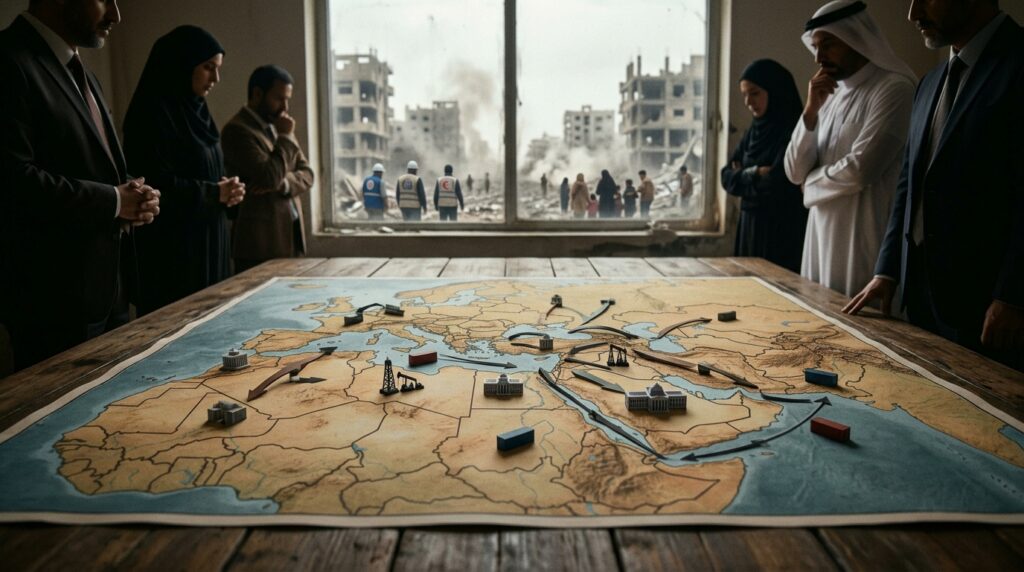
Solidarity Is Not the Same as Strategy
A government can express solidarity.
It can issue a statement.
It can vote at the United Nations.
It can demand a ceasefire.
It can send humanitarian aid.
But strategic power operates at another level.
There are several stages.
Moral solidarity
We condemn injustice.
Diplomatic solidarity
We coordinate our diplomatic position.
Economic solidarity
We are willing to impose economic costs.
Strategic solidarity
We accept national costs to defend a shared strategic interest.
Military solidarity
We are prepared to commit military capability under agreed conditions. The Muslim world has demonstrated varying degrees of the first four. The fifth remains extraordinarily difficult. That is precisely why the Makkah agreement deserves scrutiny.
A Muslim NATO Cannot Be Built on Emotion Alone
The Muslim world possesses extraordinary potential collective power.
More than 50 Muslim-majority countries.
A population approaching two billion.
Major energy reserves.
Critical maritime chokepoints.
Large armed forces.
Several advanced defence industries.
The world’s only Muslim nuclear-armed state.
Major financial centres.
Huge geographic depth.
Yet potential is not power. Power exists only when capabilities can be coordinated and deployed according to a common strategy. That requires something much harder than shared religion.
It requires institutional trust.
Why Muslim Countries Remain Divided
The divisions are not simply religious.
They are geopolitical.
Saudi Arabia and Iran have historically competed for regional influence.
Türkiye has its own strategic ambitions.
Pakistan’s primary security concerns include South Asia and India.
Egypt’s priorities centre heavily on the Arab world, the Nile, Libya, Sudan, Gaza and the Red Sea.
Indonesia focuses strongly on Southeast Asia.
The Gulf states have different threat perceptions even among themselves.
Some countries depend heavily on the United States.
Others maintain close relations with China.
Some cooperate with Russia.
Some maintain relations with Israel.
Others do not.
Therefore, asking whether Muslim countries can unite requires another question:
Unite against whom?
If that question cannot be answered collectively, a common military strategy becomes extremely difficult.
So What Makes Makkah Different?
The answer may lie in its modest beginning. Instead of attempting to unite dozens of countries immediately, the agreement starts with three.
Pakistan.
Saudi Arabia.
Türkiye.
That may actually be its greatest strength.
A small group can make decisions faster.
Military forces can become interoperable more easily.
Joint exercises are easier to organise.
Intelligence cooperation can be deeper.
Defence production can be coordinated.
Crisis procedures can be developed.
And trust can be built before expansion.
This suggests a different model.
Not a giant Muslim NATO from day one.
A core security partnership that could gradually expand.
The Three Founders Bring Different Strengths
Saudi Arabia brings enormous financial resources, strategic geography, energy importance and sophisticated military procurement.
Pakistan brings a large, experienced military, substantial conventional capabilities and nuclear deterrence.
Türkiye brings one of the region’s largest militaries, a powerful indigenous defence industry, drones, missiles, naval capabilities and NATO interoperability.
The combination is strategically interesting precisely because the capabilities are complementary.
Saudi Arabia can finance.
Türkiye can design and manufacture.
Pakistan can contribute manpower, operational experience and strategic deterrence.
That creates possibilities far beyond traditional military exercises.
Defence Industry Could Become the Real Game Changer
This may ultimately be more important than the treaty itself. A sustainable security architecture requires an industrial base.
Türkiye has emerged as a major defence producer.
Pakistan possesses growing aerospace, missile, naval and defence manufacturing capabilities.
Saudi Arabia is investing heavily in localising defence production under its broader economic transformation strategy.
Together, the three countries could potentially develop:
Joint drone programmes.
Missile defence systems.
Unmanned naval platforms.
Electronic warfare capabilities.
Satellite and intelligence systems.
Air defence networks.
Aerospace manufacturing.
Cybersecurity capabilities.
The strategic objective would then shift from simply buying weapons to building weapons together. That would make the alliance much more resilient.
The Maritime Dimension
Geography gives the pact another important advantage.
Saudi Arabia borders the Red Sea and Persian Gulf. Pakistan sits on the Arabian Sea. Türkiye controls access between the Black Sea and Mediterranean through the Turkish Straits. Together, these countries occupy a remarkable strategic arc.
That creates potential cooperation in:
Maritime surveillance.
Anti-piracy operations.
Protection of shipping.
Red Sea security.
Air and missile defence.
Energy infrastructure protection.
Undersea surveillance.
The importance of this is growing because attacks and instability around the Red Sea have demonstrated how quickly regional conflicts can affect global trade.
Saudi Arabia is already working on broader maritime cooperation with regional countries. Reuters reported on August 12 that fourteen regional countries had joined a developing maritime coalition aimed at securing Red Sea shipping. (Reuters) Makkah could eventually provide another framework for this kind of cooperation.
Who Could Join Next?
Türkiye has indicated that the agreement could eventually expand. But expansion is not automatic. And that distinction is crucial. A larger alliance is not necessarily a stronger alliance.
The most obvious potential addition is Egypt.
Egypt is particularly important because it already participates in a four-country consultation format with Pakistan, Saudi Arabia and Türkiye. Pakistan’s Foreign Office currently identifies the R4 grouping as Egypt, Pakistan, Saudi Arabia and Türkiye. (Ministry of Foreign Affairs)
Egypt would bring:
A large military.
Control of the Suez Canal.
Red Sea access.
Mediterranean access.
Major Arab diplomatic influence.
Geographical proximity to Gaza.
And substantial counterterrorism experience.
If Egypt joined, the strategic geography would change dramatically. The alliance would stretch from South Asia to the Arabian Peninsula and across the Red Sea into North Africa and the Mediterranean.
But Egypt has so far not joined.
Reuters reported that Egypt is being considered as a potential future member, while other reporting indicates that Cairo has been cautious about accepting the obligations of a formal defence pact. (Reuters) That caution is understandable.
Membership would affect Egypt’s relationships with Israel, the United States, the UAE and other regional partners.
The UAE Could Be Another Important Candidate
The United Arab Emirates possesses sophisticated military capabilities, advanced air defence systems, substantial financial resources and major maritime infrastructure. Its participation would strengthen the Gulf dimension of the alliance.
But Saudi Arabia and the UAE have not always shared identical strategic interests.
Their differences over Yemen and broader regional policies demonstrate that economic partnership does not guarantee identical security calculations. Therefore, the UAE is a plausible candidate, but not necessarily an easy one.
Qatar Offers Different Advantages
Qatar’s military is smaller, but its strategic value is much larger than its size suggests. It possesses major financial resources, important diplomatic relationships and strategically valuable infrastructure. It could contribute significantly to intelligence, diplomacy, logistics and regional mediation.
But its deep security relationship with the United States would make formal accession politically sensitive.
Jordan Could Add Counterterrorism Expertise
Jordan is another potentially useful partner. Its military and intelligence services have considerable counterterrorism experience. Its geography is also extremely important. Jordan sits close to Israel, Syria, Iraq and Saudi Arabia.
But precisely because of that location, joining a new collective defence structure would have serious implications for its existing relationships.
Indonesia and Malaysia Would Give the Alliance Asian Reach
Indonesia is the world’s largest Muslim-majority country. It has a large population, substantial armed forces and a strategically important maritime position.
Malaysia adds another important Southeast Asian dimension.
But both countries traditionally emphasise strategic autonomy and regional cooperation through ASEAN. They may therefore prefer defence cooperation and exercises over binding collective defence obligations. Their eventual involvement is possible. Immediate membership is less certain.
Azerbaijan Is an Interesting Special Case
Azerbaijan deserves attention because of its exceptionally close relationship with Türkiye and growing defence cooperation with Pakistan. Its participation would also demonstrate that the alliance is not built around a simplistic Sunni versus Shia framework. Azerbaijan is Shia majority but secular in its constitutional system. That could actually reinforce the argument that Makkah is intended as a state security framework rather than a sectarian alliance.
What About Iran?
Iran is the obvious country people will ask about. It is a major Muslim country with substantial military capabilities and enormous strategic importance. But Iranian membership is highly unlikely under current conditions.
Saudi Arabia and Iran have a long history of strategic competition. The Makkah founders have also emphasised that the agreement is defensive and not directed against Iran or another specific country. (Reuters)
Ironically, that leaves open a much more interesting possibility.
A successful Makkah framework might eventually contribute to a broader regional security system in which Iran is not necessarily a member but becomes part of a negotiated security balance. That would be far more ambitious than creating another anti-Iran bloc.
Expansion Could Actually Become a Weakness
This is where history offers a warning. If Makkah immediately expands from three countries to twenty or thirty, it could acquire political legitimacy while losing operational coherence.
Every additional member brings another:
Threat perception.
Foreign policy.
Military doctrine.
Budget.
Political system.
Alliance network.
National interest.
And veto point.
The result could reproduce the very problem that has weakened wider Muslim institutions for decades.
Everyone agrees in principle.
Nobody agrees on what to do.
That is why the most effective model may be a core and network structure.
A small group of militarily capable core members.
A wider circle of cooperating states.
Different levels of participation.
Joint exercises.
Intelligence sharing.
Defence production.
Maritime security.
Counterterrorism.
Diplomatic coordination.
This would be far more realistic than attempting to construct a 50-country military alliance overnight.
Could Makkah Become the Military Core and IMCTC the Wider Network?
This is perhaps the most intriguing possibility.
Imagine a layered structure.
IMCTC
Broad Muslim counterterrorism cooperation involving dozens of countries.
Makkah Defence Pact
A smaller collective defence core.
Pakistan Saudi strategic relationship
A bilateral deterrence pillar.
Türkiye Pakistan defence cooperation
A technology and industrial pillar.
Saudi Türkiye defence cooperation
A financial and industrial pillar.
Joint defence production
A long-term capability pillar.
Maritime cooperation
A Red Sea and Arabian Sea security pillar.
Diplomatic coordination
A political pillar.
This would not be NATO copied into the Muslim world.
It would be something different.
A multi-layered Muslim security architecture.
The Gaza Test
This brings us back to Gaza.
And perhaps this is where the entire debate becomes uncomfortable.
If Muslim governments cannot agree on how to respond collectively to one of the most devastating conflicts involving Palestinians in modern history, why should anyone expect them to fight together?
The answer is that collective defence is not necessarily the same as collective intervention.
NATO does not automatically fight every war involving people who share its members’ values.
Its treaty commitments concern its members.
Likewise, Makkah is fundamentally a state defence agreement.
An Israeli attack on Gaza would not automatically trigger the pact.
An armed attack on Saudi Arabia, Pakistan or Türkiye would be a different matter.
That distinction is essential.
Makkah is not a treaty promising that the three countries will militarily intervene in every conflict involving Muslims.
It is a mechanism for protecting the signatories.
That may sound less grand than the idea of a Muslim army.
But strategically, it makes the pact much more realistic.
The Real Meaning of Muslim Unity
Perhaps the biggest lesson from Gaza is not that Muslim countries lack power. It is that they lack coordinated power.
There is a difference.
The Muslim world has money.
It has soldiers.
It has technology.
It has energy.
It has geography.
It has markets.
It has diplomatic weight.
It has population.
It has strategic resources.
What it has lacked is an institution capable of consistently converting those assets into common action. That is the gap Makkah is potentially trying to fill.
What Would Make Makkah a Real Alliance?
The next five years will tell us much more than the signing ceremony.
A serious collective defence architecture would need to establish:
Permanent strategic consultations.
Joint military exercises.
Integrated communications.
Intelligence sharing.
Common threat assessments.
Air and missile defence cooperation.
Maritime security arrangements.
Joint procurement.
Defence industrial partnerships.
Crisis response procedures.
Clear rules for activating collective defence.
And eventually, some form of permanent military planning structure.
Without these things, the pact will remain primarily political.
With them, it could become strategically consequential.
The Nuclear Question
Another subject will inevitably dominate discussion.
Pakistan is a nuclear-armed state.
Saudi Arabia has repeatedly expressed interest in developing advanced nuclear capabilities for peaceful purposes, while its leaders have also made statements about the possibility of pursuing nuclear weapons if regional circumstances require it.
But the Makkah agreement itself does not publicly establish a nuclear sharing arrangement.
That distinction is essential.
Pakistan’s nuclear weapons remain under Pakistani control.
There is no publicly announced NATO-style nuclear sharing mechanism under Makkah.
Nevertheless, Pakistan’s nuclear deterrent inevitably affects the strategic calculation surrounding the pact.
That creates what analysts may call a nuclear shadow over the agreement.
It is strategically significant even without any formal nuclear commitment.
What Makkah Does Not Yet Have
For all its promise, the agreement has serious limitations.
There is no evidence yet of a permanent integrated Makkah military command comparable to NATO.
There is no publicly established common defence budget.
There is no announced standing multinational army.
There is no automatic military intervention mechanism with publicly detailed operational rules.
There is no evidence that the three countries have adopted a single threat assessment.
There is no guarantee that political differences will disappear during a crisis.
And there is no guarantee that the pact will expand successfully.
These are not minor details.
They will determine whether Makkah becomes history or merely another diplomatic milestone.
The Most Important Question: Who Is the Enemy?
This question may ultimately determine everything.
If the alliance defines itself against a particular country, it risks becoming another regional bloc.
If it defines itself against terrorism alone, it duplicates much of IMCTC’s existing purpose.
If it defines itself as a general collective defence mechanism, it has greater strategic flexibility.
That is why the founders’ insistence that the pact is defensive and not directed against a specific state is important. (AP News)
The strongest version of Makkah would not need a permanent enemy.
Its message would be simpler:
Attack us, and the cost will be higher than attacking any one of us individually.
That is deterrence. And deterrence is ultimately what military alliances are designed to achieve.
Could Makkah Change the Balance of Power?
Potentially.
But not overnight.
The agreement immediately changes perceptions.
It signals that Saudi Arabia is willing to diversify its security partnerships.
It gives Pakistan a formal strategic role in a wider regional security architecture.
It gives Türkiye a new security relationship with two strategically important Muslim countries.
It creates the possibility of defence industrial cooperation.
It may encourage other Muslim countries to reconsider their own security arrangements.
And it sends a message beyond the region.
The Muslim world is no longer necessarily willing to depend on one external security provider.
That may prove to be the pact’s most consequential geopolitical message.
But There Is a Risk of Overpromising
The phrase “Muslim NATO” is attractive.
It is also dangerous.
It creates expectations that the agreement cannot yet meet.
NATO took decades to develop.
Its institutions are deeply integrated.
Its members have fought together.
Its military command structures have been tested repeatedly.
Makkah is at the beginning.
The better question is therefore not:
“Is this already a Muslim NATO?”
The better question is:
“Could this become the nucleus of a new Muslim security architecture?”
The answer is:
Yes, potentially.
But only if the three countries turn political commitment into institutional capability.
The Road Ahead
The most credible development path would probably be gradual.
First, establish permanent consultation mechanisms.
Then develop joint exercises.
Then integrate communications and intelligence.
Then expand defence industrial cooperation.
Then develop maritime and air defence arrangements.
Then establish clearer crisis response procedures.
Only after these mechanisms work should membership expand significantly.
Egypt would be the logical first major addition because of its strategic geography, military weight and existing consultation with the three founders.
The UAE, Qatar and Jordan could follow under the right political circumstances.
Indonesia and Malaysia could provide Asian and maritime depth.
Azerbaijan could bring another strategically important Türkiye-linked partner.
Other states could participate through specific cooperation arrangements without immediately becoming full treaty members.
That would create something more flexible than NATO. And perhaps more suited to the political realities of the Muslim world.
The Final Verdict
The Makkah Joint Defence Agreement is neither meaningless symbolism nor a fully formed Muslim NATO. It is something in between.
It is a serious strategic experiment.
Its importance lies not simply in the military strength of Pakistan, Saudi Arabia and Türkiye.
Its importance lies in whether those three countries can demonstrate something the wider Muslim world has struggled to achieve for generations:
The ability to convert shared interests into permanent institutions and permanent institutions into credible power.
IMCTC has already demonstrated that dozens of Muslim countries can sit around the same institutional table.
Its record shows meaningful work in training, counterterrorism financing, legal capacity, intelligence awareness and institutional cooperation. But it has not demonstrated itself as a unified battlefield force. (imctc.org)
The Makkah pact attempts something different.
It starts smaller.
It focuses on collective defence.
And it places three militarily significant countries at its core.
That may be its greatest advantage.
But Gaza has left the Muslim world with an uncomfortable question that no treaty can escape.
Can solidarity become strategy?
The answer will not be found in speeches.
It will be found in joint exercises.
In shared intelligence.
In defence factories.
In interoperable weapons.
In crisis rooms.
In the willingness to bear costs for one another. And ultimately, in what happens when the first serious test arrives. Perhaps the most important lesson is this:
A community can share a faith, a history and a grievance without becoming a strategic power. Strategic power begins when countries are willing to coordinate what they possess and accept the responsibilities that come with it.
That is the real promise of Makkah. And it is also its greatest test.
Frequently Asked Questions
1. What is the Makkah Joint Defence Agreement?
The Makkah Joint Defence Agreement was signed by Pakistan, Saudi Arabia and Türkiye on August 7, 2026. It establishes a collective defence principle under which an armed attack against one member is treated as an attack against all three. The agreement is intended to strengthen deterrence and defence cooperation and is described by the participating governments as defensive rather than directed against a specific country. (Saudi Press Agency)
2. Is the Makkah pact a Muslim NATO?
Not yet. It has a collective defence principle comparable in concept to NATO’s Article 5, but it does not yet possess NATO’s integrated command system, standing forces, common military infrastructure or decades of operational experience. It is better described as a potential foundation for a broader Muslim security architecture. (Reuters)
3. What is the status of the 2025 Pakistan-Saudi defence agreement?
The September 17, 2025 Strategic Mutual Defence Agreement between Pakistan and Saudi Arabia remains operational. It states that aggression against either country would be considered aggression against both and was designed to strengthen joint deterrence and defence cooperation. The 2026 Makkah pact expands this strategic framework by bringing Türkiye into a trilateral arrangement. (Ministry of Foreign Affairs)
4. What has General Raheel Sharif’s Islamic Military Counter Terrorism Coalition achieved?
General Raheel Sharif has served as IMCTC’s military commander since 2017. The coalition has developed a broad institutional framework involving 43 countries and has conducted training and capacity building in areas including counterterrorism, terrorism financing, money laundering, legal cooperation and strategic counterterrorism knowledge. However, there is no public record of IMCTC conducting a major independent unified combat operation comparable to NATO military campaigns. (imctc.org)
5. Which country is most likely to join the Makkah defence pact next?
Egypt appears to be the most plausible early candidate. Türkiye has identified Egypt as a possible future participant, and Egypt already participates in a four-country consultation mechanism involving Egypt, Pakistan, Saudi Arabia and Türkiye. However, Cairo has not yet joined the defence pact, and its strategic relationships mean that accession cannot be assumed. (Reuters)
6. Could the Makkah pact eventually become a wider Muslim security alliance?
Yes, but expansion alone would not guarantee success. A more credible model would probably combine a small military core with a wider network of countries cooperating in intelligence, counterterrorism, defence production, maritime security and diplomacy. If the founding three develop effective joint institutions first, countries such as Egypt, the UAE, Qatar, Jordan, Indonesia, Malaysia and Azerbaijan could potentially participate at different levels. The ultimate test will be whether the alliance develops operational capability rather than simply increasing its membership.
References and Further Reading
- Pakistan Ministry of Foreign Affairs, Makkah Al Mukarramah Summit for Joint Defence and official statements concerning the August 2026 agreement. Pakistan Ministry of Foreign Affairs
- Saudi Press Agency, joint statement on the Makkah Joint Defence Agreement. Saudi Press Agency
- Pakistan Ministry of Foreign Affairs, Joint Statement on the September 17, 2025 Strategic Mutual Defense Agreement with Saudi Arabia. Official Pakistan Foreign Ministry statement
- Islamic Military Counter Terrorism Coalition, official information on its structure, commander and activities. IMCTC official website
- Reuters, analysis of the Pakistan, Saudi Arabia and Türkiye defence pact and Saudi Arabia’s evolving regional security strategy. Reuters analysis of the Makkah defence pact
- Reuters, Saudi Arabia’s broader effort to develop defensive alliances and maritime security cooperation. Reuters regional security analysis, August 12, 2026
- Al Jazeera, analysis of the combined military capabilities of Pakistan, Saudi Arabia and Türkiye. Al Jazeera analysis
- International Court of Justice, provisional measures in the South Africa v. Israel case concerning the Genocide Convention. International Court of Justice case materials
Primary SEO keyword: Makkah Joint Defence Agreement
Suggested secondary keywords: Muslim NATO, Pakistan Saudi Arabia Türkiye defence pact, Makkah defence pact 2026, Pakistan Saudi defence agreement, General Raheel Sharif IMCTC, Islamic Military Counter Terrorism Coalition, Muslim military alliance, collective defence, Saudi Pakistan Türkiye alliance, future Muslim security alliance