Israel Zionism and the Green Party Revolt: Historical Promises, Palestinian Dispossession and the West’s Crisis of Credibility

Israel Zionism and the Green Party Revolt. A century of diplomatic promises helped create a homeland for one people while leaving another people’s national aspirations unresolved. Today, the consequences are shaking Western politics, exposing the limits of international law, and raising uncomfortable questions about the conduct of Muslim-majority governments.
The Palestinian question is not simply a dispute between Israelis and Palestinians. It is also a test of historical responsibility, equal rights, political courage, and the credibility of a world that claims to uphold a rules-based international order.
Author: Maj Hamid Mahmood (Retired), MA Political Science, LLB, PGD (HRM). His military background, political science and legal education inform analysis of international conflicts, security affairs, political developments and the human consequences of war.
https://mrpo.pk/why-america-supports-israel/
Polanski banned from Israel after party’s motion declaring ‘Zionism is racism’
Israel’s foreign ministry says it has banned Green Party leader Zack Polanski from entering the country, after party members adopted a motion declaring Zionism a form of racism.
Israel’s foreign ministry described the motion as a “clear antisemitic text” and beyond “the boundaries of legitimate political debate”.
Polanski did not take part in the vote on Sunday. The motion, which has divided senior party figures, defines Zionism as an ideology supporting “an ethnonationalist Jewish state” and backs a “single democratic Palestinian state in all of historic Palestine”.
It has been criticised by some Jewish groups, who called the motion an “attack on the Jewish community”.
“Zionism is anti-racism, creating a refuge for Jews in their ancient homeland after millennia of persecution outside it,” the Board of Deputies of British Jews and the Jewish Leadership Council said in a statement.
“Branding most British Jews and Jewish institutions ‘racist’ stokes anti-Jewish hatred after a year in which British Jews have been murdered attending their synagogue, stabbed in the streets, and seen their community buildings firebombed.”
Israel’s foreign ministry said the motion was “a stain on the history of the United Kingdom”.
The party’s joint deputy leaders have been at odds over the subject, with Mothin Ali backing the move, and Rachel Millward describing the wording as “problematic”.
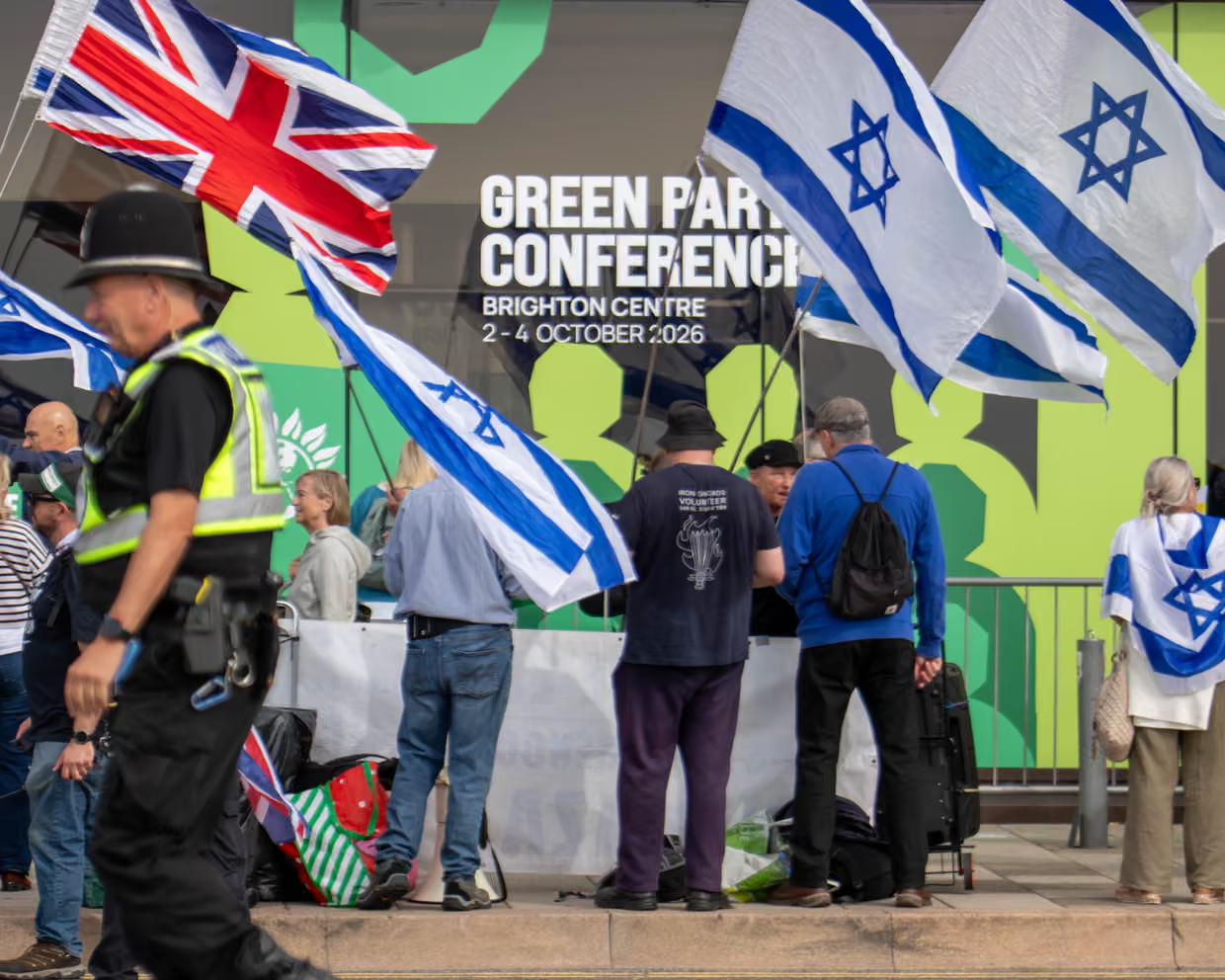
But members endorsed the policy motion, which was put forward by a group of activists at the party’s conference in Brighton, by 1,022 votes to 813.
1. The Green Party Revolt: Why Zionism Has Become a Political Flashpoint
On 4 October 2026, the Green Party of England and Wales adopted a controversial motion declaring Zionism a form of racism and supporting a single democratic state across historic Palestine. The motion passed by 1,022 votes to 813 at the party’s conference.
It also reaffirmed support for Palestinian liberation, the right of return for Palestinian refugees, the Boycott, Divestment and Sanctions movement, and a full arms embargo against Israel. The proposal triggered a fierce debate over Jewish self-determination, Palestinian rights, antisemitism, and the future of the Israeli state.
Party leader Zack Polanski, who is Jewish, did not vote on the motion. He subsequently said he agreed with it in substance but would not have voted for it in its adopted form. The dispute has exposed significant divisions within the party, including concerns voiced by senior Green figures about antisemitism, internal decision-making, and the party’s direction.
The controversy is not merely about terminology. It concerns whether a political movement can oppose the structures and consequences of Zionism without denying Jewish people equal rights or treating Jewish national identity as uniquely illegitimate.
The party’s official announcement and subsequent reporting document the motion and the internal dispute. See the Green Party’s announcement and The Guardian’s coverage of the vote.

What Is Zionism?
Zionism emerged in the late nineteenth century as a movement supporting Jewish national self-determination, particularly through the establishment of a homeland in the historic land of Israel. It developed amid European antisemitism, persecution, and the failure of many societies to protect Jewish communities.
For many Jews, Zionism represents historical connection, cultural identity, collective security, and the right to live free from persecution.
For many Palestinians, however, the political implementation of Zionism has been inseparable from displacement, dispossession, military occupation, settlement expansion, and unequal control over land.
These perspectives cannot be understood honestly by pretending that history does not exist.
Zionism has never been a single, uniform political doctrine. Its supporters have held different views about borders, religion, democracy, Palestinian rights, and the relationship between Jewish identity and state power. Some have supported territorial compromise and Palestinian statehood; others have supported permanent Israeli control over the occupied territories.
The same distinction is necessary when discussing anti-Zionism. Opposition to a political ideology or to a state’s constitutional arrangements is not automatically hatred of a people. But political language can become discriminatory when it assigns collective guilt to Jews, uses antisemitic stereotypes, denies Jews rights granted to others, or treats Jewish identity itself as evidence of wrongdoing. A serious debate must examine policies and their consequences rather than rely on labels alone.
Is Anti-Zionism Necessarily Antisemitism?
No. The two concepts overlap in some political rhetoric, but they are not identical.
A person can oppose occupation, settlements, ethnic discrimination, forced displacement, or the idea that any state should privilege one ethnic or religious group at the expense of others without hating Jewish people.
Equally, someone can invoke anti-Zionism while expressing hostility toward Jews as Jews. The label does not automatically make the underlying language or conduct free from antisemitism.
The same principle applies to criticism of Israel. Criticizing its government, military actions, laws, or constitutional structure is not inherently antisemitic. Yet criticism can cross that line when it holds Jewish people collectively responsible for Israel’s conduct or relies on prejudicial assumptions about Jewish power and loyalty.
The reverse danger also deserves attention. Accusing every critic of Israel of antisemitism can suppress legitimate discussion of Palestinian rights and make genuine discrimination harder to identify.
The appropriate test is consistent: What exactly is being criticized? Is the criticism based on evidence? Does it apply standards consistently? Does it deny equal rights to any group?
The Green Party motion attempts to draw a distinction between Zionism and Jewish identity. Its critics claim that defining Zionism categorically as racism fails to acknowledge the diversity of Jewish experience and risks marginalizing Jewish members who understand Zionism as a central part of their identity.
Those concerns deserve serious consideration. So does the Palestinian experience that has made opposition to Zionism compelling to many people. Neither concern should be dismissed by a slogan.
The Debate Over One State or Two
The Green Party’s support for a single democratic state throughout historic Palestine raises a fundamental question: What political arrangement can deliver equal rights, security, freedom, and self-determination to both peoples?
A single state could, in principle, guarantee equal citizenship regardless of religion or ethnicity. But that would require enforceable constitutional protections, equal political participation, security for both communities, and safeguards against domination by any ethnic or religious majority.
It would also require confronting profound disagreements about national identity, immigration, refugee return, property claims, and the historical meaning of the conflict.
A two-state settlement would preserve separate Israeli and Palestinian national institutions. However, it would require viable Palestinian territory, meaningful sovereignty, a solution to the refugee question, an agreed arrangement for Jerusalem, and security guarantees for both sides.
Decades of settlement expansion, territorial fragmentation, and failed negotiations have weakened confidence in the two-state formula. Yet declaring it obsolete does not automatically make a single-state alternative practical or just.
Any proposed solution must answer a basic question: Will Palestinians and Israelis enjoy equal human rights, political agency, and physical security? A change of national flags without those guarantees would not resolve the underlying injustice.
2. Britain’s Historical Responsibility: The Promises That Shaped Palestine
The modern conflict cannot be understood without examining the decisions made by Britain and other European powers during the First World War and its aftermath.
The central problem was not simply that diplomats made conflicting promises. It was that the future of a populated territory was discussed and negotiated by imperial powers while the political aspirations of its inhabitants received unequal recognition.
The McMahon–Hussein Correspondence
During 1915 and 1916, Britain exchanged letters with Sharif Hussein bin Ali of Mecca. Britain sought Arab support against the Ottoman Empire and discussed the possibility of Arab independence after the war.
The territorial scope of the correspondence remains disputed. Arab representatives understood the exchange as supporting a broad area of future Arab independence, while British interpretations excluded or qualified certain territories, including areas whose status was contested.
It would be inaccurate to claim that Britain unambiguously promised Hussein an independent Palestine in the precise form later demanded by Palestinian nationalists. Nevertheless, the correspondence helped create expectations of postwar Arab independence. Those expectations collided with other British and Allied commitments.
The historical relevance lies in the larger contradiction: Britain encouraged Arab cooperation while reserving considerable freedom to shape the region according to its own strategic interests.
The Sykes–Picot Agreement
In 1916, Britain and France negotiated the secret Sykes–Picot Agreement, which proposed dividing much of the Ottoman Arab territories into zones of direct and indirect influence. The agreement reflected imperial priorities, including control of strategic routes, regional influence, and access to important territories.
Its proposed arrangements did not neatly match the expectations of Arab independence created during the wartime correspondence. They also demonstrated how European powers intended to shape the postwar region before its inhabitants could determine their political future.
Sykes–Picot is sometimes presented as the sole cause of the modern Middle East’s problems. That oversimplifies history. Local political movements, later wars, regional rivalries, authoritarian governments, and subsequent foreign interventions also shaped the region.
Yet the agreement remains a powerful symbol of a recurring pattern: external powers treating the political future of other peoples as a matter to be settled among themselves.
The Balfour Declaration: Whose National Aspirations Counted?
On 2 November 1917, British Foreign Secretary Arthur James Balfour issued a declaration supporting the establishment in Palestine of a national home for the Jewish people. The declaration also stated that nothing should be done to prejudice the civil and religious rights of existing non-Jewish communities in Palestine, or the rights and political status enjoyed by Jews in other countries.
The wording matters.
The declaration recognized a Jewish national aspiration, but it did not explicitly recognize the Palestinian Arab majority as a people entitled to national self-determination. Its protection for the existing non-Jewish population referred to civil and religious rights rather than equivalent national and political rights.
This asymmetry became one of the central historical grievances surrounding the declaration.
Jewish communities had legitimate reasons to seek safety and self-determination after centuries of persecution, including pogroms and, later, the Holocaust. But those historical realities did not eliminate the rights of Palestinians who already lived in the territory.
The ethical failure was not the recognition of Jewish suffering. It was the absence of an equally clear framework protecting the national and political rights of Palestine’s Arab population.
The British Mandate and Its Unresolved Contradictions
After the First World War, Britain administered Palestine under a League of Nations Mandate. The Mandate incorporated support for a Jewish national home and included provisions relating to Jewish immigration and settlement, while also referring to safeguarding the civil and religious rights of all inhabitants. The administration faced competing national movements and growing tensions over immigration, land, political representation, and control of the territory.
British policy shifted at different moments. Restrictions, commissions, proposals for partition, and security operations failed to produce an accepted political settlement. Palestinian Arab opposition to British rule and Zionist political objectives grew, while Jewish immigration increased, particularly as European persecution intensified.
The 1936–1939 Arab revolt and the British response deepened the conflict. By the end of the Second World War, Britain faced mounting violence, competing political demands, and international pressure. Britain eventually referred the Palestine question to the United Nations.
The Mandate ended in 1948, but the political arrangements it had helped create left behind no mutually accepted settlement guaranteeing both peoples’ national rights and security. Britain cannot reasonably be held solely responsible for every subsequent decision or tragedy. Palestinian and Israeli leaders, neighboring states, and later international actors made consequential choices of their own.
But Britain’s historical responsibility remains substantial because its imperial policies helped establish the political framework within which the conflict developed.
3. The United States: Recognition, Strategic Support and the Crisis of Credibility
Britain helped shape the early diplomatic framework. The United States became increasingly influential in determining Israel’s international position, regional security environment, and access to military and diplomatic support.
American policy has changed across administrations. It has included humanitarian assistance, diplomacy, support for Israel’s security, aid to Palestinians, and endorsement of a negotiated two-state settlement. Yet the gap between declared objectives and practical pressure has remained a central source of criticism.
The 1947 Partition Plan
In November 1947, the United Nations General Assembly adopted Resolution 181, recommending the partition of Mandatory Palestine into separate Jewish and Arab states, with a special international arrangement proposed for Jerusalem. The resolution was a recommendation, not a binding territorial settlement that was implemented as designed.
Jewish political leadership accepted partition as a basis for establishing a state, although views differed within the Zionist movement. Palestinian Arab leaders and Arab states rejected the plan, arguing that it allocated territory unjustly and denied the Arab population’s right to determine the future of its own country.
The rejection cannot be separated from the unequal circumstances in which the proposal emerged, the demographic and land questions at its core, or the conflicting national aspirations of the two communities. Nor does that rejection erase the fact that Jewish leaders had legitimate concerns about security and self-determination.
The plan was never implemented as intended. Civil war, the end of British rule, Israel’s declaration of independence, and the intervention of neighboring Arab armies transformed the situation into a regional war. The result was not the peaceful establishment of two states. It was the creation of Israel without an accompanying Palestinian Arab state.
The Nakba and the Palestinian Refugee Question
During the 1948 war, approximately 700,000 Palestinians fled or were expelled from their homes. The mass displacement is known to Palestinians as the Nakba, or catastrophe.
The circumstances varied from place to place. They included direct expulsions, flight from fighting, fear of violence, the collapse of communities, and the destruction or depopulation of villages. Historical research does not support reducing the entire event to a single cause.
Most Palestinian refugees were not permitted to return to their homes. Many villages were destroyed or repopulated, and Palestinian families became refugees in the West Bank, Gaza, neighboring Arab countries, and farther afield. The refugee question remains unresolved across generations.
It concerns more than compensation or the right to return. It also involves family identity, property, historical memory, legal claims, citizenship, and the circumstances under which any settlement could be implemented fairly.
Israel’s establishment provided a national home for Jews after centuries of persecution and the Holocaust. But the creation of that state also involved the mass displacement of another population. Admitting both realities is not a contradiction. It is a requirement for honest history.
American Support and the Double-Standard Debate
The United States recognized Israel in 1948 and gradually developed a close strategic relationship with it. American support has included military assistance, intelligence cooperation, diplomatic backing, and efforts to negotiate regional agreements. Washington has also supported a two-state solution and repeatedly stated that Palestinians deserve a political future of their own.
Criticism arises when these stated principles appear to have limited influence over American decisions. Continued military support, diplomatic protection, or weak consequences for policies condemned by international institutions can undermine confidence in the universality of American commitments.
Supporters of the US-Israel relationship point to Israel’s security threats, attacks on civilians, regional armed groups, and the historical need to protect Jewish communities. These are legitimate considerations. They do not, however, make every Israeli policy lawful or remove the obligation to protect Palestinian civilians.
A credible policy must distinguish between Israel’s right to protect its population and the legality of the means used to do so.
The United States has substantial influence, but influence is not the same as control. Israeli governments retain agency and responsibility for their decisions. Palestinian leaders and armed groups also remain responsible for their own actions.
The question is whether Washington applies meaningful, consistent standards when the conduct of a close ally conflicts with its stated commitments to human rights and international law.
4. The 1967 War and the Continuing Occupation
The June 1967 war transformed the conflict. Israel captured the West Bank, including East Jerusalem, and the Gaza Strip, as well as other territories in the region. The West Bank and East Jerusalem remain central to Palestinian national aspirations. Gaza’s political and humanitarian circumstances have changed repeatedly, but the territory remains part of the occupied Palestinian territory considered by the International Court of Justice.
The war also created a long-term political reality in which Israel exercised control over territories whose Palestinian inhabitants lacked an independent sovereign state.
Settlement Expansion and Palestinian Self-Determination
Israeli settlements have expanded across the West Bank, including East Jerusalem. Their growth, associated infrastructure, restrictions on movement, land disputes, and fragmentation of Palestinian communities have made the establishment of a viable and contiguous Palestinian state increasingly difficult.
Successive Israeli governments have differed in policy and rhetoric, but settlement expansion and the entrenchment of Israeli control have remained central obstacles to a negotiated settlement. Israel has often justified security measures by citing attacks, armed groups, and the need to protect its citizens. Israelis have real security concerns, and attacks on Israeli civilians are unacceptable.
Yet security cannot be used as a blank cheque for permanent territorial control, settlement expansion, or the denial of another people’s right to self-determination.
Palestinians also face security threats, including settler violence, military operations, restrictions, displacement, and the loss of homes and livelihoods. Their security cannot be treated as less important because they live under occupation or lack a state of their own.
What International Law Says
International law distinguishes between the legal status of territory, the obligations of an occupying power, the protection of civilians, and the rights of peoples to self-determination.
United Nations Security Council Resolution 242, adopted after the 1967 war, established principles for a just and lasting peace, including the withdrawal of Israeli armed forces from territories occupied in the conflict and the termination of belligerency, alongside respect for the sovereignty and security of every state in the region.
The settlement question is addressed by the Fourth Geneva Convention and subsequent United Nations resolutions. The prevailing international legal position is that Israeli settlements in the occupied Palestinian territory violate international law. Israel disputes aspects of this interpretation and advances legal and historical arguments of its own, but those arguments have not displaced the prevailing international position.
A major development came on 19 July 2024, when the International Court of Justice issued an advisory opinion on the legal consequences of Israel’s policies and practices in the occupied Palestinian territory, including East Jerusalem.
The Court concluded that Israel’s continued presence in the occupied Palestinian territory was unlawful and that Israel was under an obligation to bring that presence to an end as rapidly as possible. It also addressed settlement policies, annexation, discrimination, and the obstruction of Palestinian self-determination.
An advisory opinion is not a criminal conviction, nor is it a judgment in a contentious case between two states. Nevertheless, it is a major pronouncement by the United Nations’ principal judicial organ and carries substantial legal and political significance.
The Court’s findings make it difficult to defend the status quo as an acceptable permanent arrangement. They also place responsibilities on other states concerning their dealings with the situation created by unlawful policies.
The full text and summary are available through the International Court of Justice.
5. The Two-State Solution: A Diplomatic Promise Without a State
For decades, the two-state solution has been the preferred international framework for resolving the conflict. Its basic concept is straightforward: Israel and an independent Palestinian state would exist side by side, with agreed borders, security arrangements, and a negotiated resolution of the outstanding issues. In practice, the process has repeatedly failed.
Negotiations have stalled over borders, settlements, Jerusalem, refugees, security, recognition, and the distribution of political authority. Palestinian political divisions have weakened unified representation. Israeli domestic politics have also shifted, and settlement expansion has changed realities on the ground.
The result is a growing credibility gap between diplomatic declarations and the conditions required for Palestinian sovereignty.
Why the Framework Is Under Pressure
A state cannot be meaningfully independent if it lacks effective control over its territory, borders, resources, and political decisions. A viable Palestinian state would need territorial continuity or workable connections between its areas, economic opportunity, freedom of movement, and the ability to govern without permanent external domination. It would also need legitimate institutions accountable to Palestinians themselves.
Israel, meanwhile, would need credible security guarantees, protection for its civilians, and confidence that a future Palestinian state would not become a platform for attacks.
Neither population can reasonably be asked to abandon its legitimate security and national aspirations. But security arrangements cannot be designed to preserve one side’s permanent supremacy. The two-state solution therefore remains a possible framework, not a self-executing answer. It requires practical conditions that have been steadily eroded.
Could One Democratic State Offer an Alternative?
Advocates of one state argue that equal citizenship across the entire territory could replace the unequal national and legal arrangements that sustain the conflict.
In principle, a genuinely democratic state could protect Jews, Muslims, Christians, and people of other backgrounds through equal citizenship, constitutional safeguards, independent courts, and shared political institutions.
But a single state would also have to address profound disagreements over national self-determination, refugee return, property, security, immigration, and the future of existing Israeli and Palestinian institutions.
A state that merely replaced one group’s domination with another’s would not provide a just solution. Nor would a nominally democratic system be sufficient if one community feared political elimination or physical insecurity.
The key issue is not whether a one-state or two-state model sounds more morally attractive in the abstract. It is whether a proposed arrangement can secure equal rights and durable political consent for both peoples. Any credible plan must be judged by its protections, institutions, and likely consequences, not by its slogan.
6. The Muslim World: Solidarity in Words, Paralysis in Practice
Western powers bear significant historical and political responsibility. But a fair investigation must also examine the record of Arab and other Muslim-majority governments.
Palestinians have deep cultural, religious, and historical ties with the wider Muslim world. Public support for their rights is widespread across Muslim societies, although views differ on strategy, political leadership, and the future of the conflict. Yet the actions of governments have often fallen short of their declarations.
Arab and Muslim-majority states are not a single political bloc. They differ in their alliances, economies, security concerns, domestic politics, and relations with Israel. Some have provided humanitarian assistance, hosted refugees, supported Palestinian diplomacy, or mediated negotiations. Others have prioritized bilateral relations, internal security, or regional competition.
These differences help explain the limits of collective action. They do not remove the responsibility to assess what governments could reasonably have done but failed to do.
Arab Rivalries and the Limits of Collective Leadership
The Arab world has experienced repeated divisions over regional leadership, political ideology, security partnerships, and relations with major powers.
The rivalry between governments, the competition for influence, and disagreements over armed movements have frequently obstructed common strategies. In some cases, Palestinian factions themselves have become entangled in regional competition. The result is a recurring pattern: strong public declarations are followed by limited implementation.
Governments may condemn Israeli actions while maintaining strategic, commercial, diplomatic, or security relationships. Others may support one Palestinian faction while weakening efforts to establish unified political representation. The issue is not that every government must adopt an identical policy. It is that decades of fragmentation have prevented the creation of a sustained, coordinated strategy capable of delivering meaningful political results.
Egypt and Jordan: Peace Agreements Without a Palestinian Settlement
Egypt signed a peace treaty with Israel in 1979, and Jordan signed one in 1994. Both agreements ended formal states of war and established important security and diplomatic arrangements. Their governments have reasons to preserve those treaties. War could impose severe economic, military, and humanitarian costs on their populations. Both countries also face domestic and regional security pressures.
However, neither treaty resolved the Palestinian national question.
Egypt’s role is particularly important because of its border with Gaza and its influence over access through the Rafah crossing. The border has been a critical route for humanitarian aid and the movement of people, although its operation has depended on changing security arrangements, political decisions, and conditions on the ground.
Egypt has mediated negotiations and supported ceasefire efforts. It has also maintained strict controls on its border and resisted proposals that would permanently transfer responsibility for Gaza’s population to Egyptian territory.
These policies must be assessed in context. Egypt has legitimate concerns about forced displacement, national security, and the possibility that a mass transfer of Palestinians could become permanent. At the same time, border restrictions and diplomatic choices have direct humanitarian consequences and deserve scrutiny.
Jordan faces its own constraints. It hosts a large Palestinian-origin population, shares a border with the West Bank, and has long warned against displacement and unilateral changes to the status of Jerusalem’s holy sites.
Its peace treaty with Israel provides diplomatic pathways and security arrangements. Yet Jordan has not been able to secure an end to the occupation or the establishment of an independent Palestinian state. The treaties should not be judged solely by whether they prevent war. Their broader political record must also be considered against the continuing absence of a just settlement.
The Abraham Accords: Normalisation Without Palestinian Statehood
In 2020, the United Arab Emirates and Bahrain established formal relations with Israel under the Abraham Accords. Morocco subsequently normalised relations with Israel. Sudan announced a normalisation process, but implementation became complicated by political instability and conflict.
Supporters argued that normalisation could create economic opportunities, improve regional cooperation, and open new diplomatic means. The agreements also reflected changing regional calculations, including security concerns and relations with the United States.
Several critics argued that normalisation reduced Israel’s incentive to make concessions to Palestinians by allowing regional relations to improve without a settlement of the core conflict.
Both arguments deserve examination. Diplomatic engagement can provide leverage and reduce hostility. But if normalisation proceeds without measurable progress on Palestinian rights, it risks weakening the connection between regional cooperation and a just political settlement.
The central question is not whether Arab states should communicate with Israel. It is what conditions, commitments, and outcomes those relationships should pursue. Diplomatic relations can be used to advance Palestinian rights, or they can become a substitute for pursuing them. The results depend on how governments use their influence.
The OIC and Arab League: Declarations Without Implementation
The Organisation of Islamic Cooperation and the Arab League have repeatedly issued statements supporting Palestinian rights, opposing occupation, and calling for international action. Such statements can establish diplomatic positions and help maintain international attention. But neither organisation possesses the political unity or enforcement machinery required to turn every declaration into coordinated policy.
Member states have different relationships with Israel and different levels of dependence on external powers. They also disagree over the use of sanctions, diplomatic pressure, security cooperation, and the role of armed Palestinian factions. The problem is not the existence of diplomatic statements. It is the absence of a consistent mechanism for translating agreed principles into measurable outcomes.
A credible collective strategy would define common objectives, assign responsibilities, establish deadlines, publish progress reports, and explain why commitments have or have not been fulfilled. Without such mechanisms, declarations can become a substitute for action rather than a means of organizing it.
When Palestinians Become Victims of Regional Politics
The history of Palestinian relations with Arab governments includes episodes that complicate any simple narrative of permanent solidarity.
In 1970–1971, Jordan’s conflict with the Palestine Liberation Organization led to violent confrontations and the expulsion of PLO forces from Jordan. The episode, commonly known as Black September, reflected a struggle over armed authority, state sovereignty, and political control.
During the 1990–1991 Gulf crisis and its aftermath, Kuwait expelled or pressured large numbers of Palestinians to leave, amid political tensions following the PLO leadership’s position during Iraq’s invasion of Kuwait. The precise numbers and circumstances varied, but the consequences for affected families were severe.
These episodes do not excuse Israeli policies or reduce Israel’s responsibility for its own conduct. They demonstrate that Palestinian suffering has also been shaped by regional power struggles and the decisions of governments that publicly claimed to support Palestinian aspirations.
Historical criticism must remain specific. It should not turn into collective blame against Arabs, Muslims, or ordinary citizens who had little control over state policy.
The lesson is that Palestinians must not be treated as instruments of regional diplomacy, bargaining chips in security disputes, or expendable members of a wider political cause. Their rights should not depend on whether they serve another government’s strategic interests.
Why Governments Have Failed to Do More
Several factors help explain the gap between public rhetoric and practical action.
First, dependence on powerful allies. Some governments rely on American security assistance, arms supplies, investment, or diplomatic support. They may fear that strong measures against Israel could damage those relationships.
Second, domestic vulnerability. Governments facing economic pressures, political opposition, or internal security challenges may prioritize regime stability over a sustained regional campaign.
Third, regional competition. Rivalries over leadership, influence, and relations with Iran, Israel, Turkey, and major powers often obstruct coordinated policy.
Fourth, economic exposure. Trade, investment, energy arrangements, technology partnerships, and financial links can make governments reluctant to impose meaningful costs.
Fifth, weak accountability. When leaders can issue declarations without explaining the results, citizens have limited means to distinguish genuine strategy from political theatre. These factors are explanations, not automatic justifications.
Governments do not have unlimited freedom of action. Nor can every state be expected to use identical tools. But constraints should lead to realistic strategies, not indefinite inaction.
From Symbolic Solidarity to Measurable Action
A practical approach would focus on actions that are lawful, coordinated, and capable of producing verifiable results.
- Coordinate diplomacy. Arab and Muslim-majority governments could establish common benchmarks for Palestinian sovereignty, protection of civilians, humanitarian access, and opposition to forced displacement.
- Use diplomatic leverage. States with relations with Israel could link selected forms of cooperation to measurable progress, while keeping channels open for negotiations.
- Protect humanitarian access. Governments should coordinate aid, medical evacuations, reconstruction support, and the delivery of essential supplies through lawful and workable arrangements.
- Support legal responsibility. States should cooperate with international courts and investigations, respect applicable legal obligations, and avoid shielding any party from scrutiny.
- Strengthen Palestinian political legitimacy. Support should encourage accountable Palestinian institutions, credible representation, political renewal, and the protection of civilians.
- Publish results. Governments and regional organisations should report what they have committed to, what they have implemented, and what obstacles remain.
Such measures would not instantly end the conflict. But they would replace vague promises with standards against which performance could be judged.
The test of solidarity is not how forcefully leaders condemn injustice at a summit. It is whether their policies make the lives, rights, and political future of Palestinians more secure.
7. International Law: One Standard for Everyone
International law cannot function as a menu from which governments select only the principles that suit their allies. Its core standards include the prohibition on acquiring territory by force, the protection of civilians, the right of peoples to self-determination, and the obligation to comply with applicable international humanitarian law.
These standards apply regardless of religion, ethnicity, nationality, or political affiliation.
Israel has the right to protect its population from attacks. That right does not erase the rights of Palestinians or legal restrictions on the use of force, treatment of civilians, detention, settlement, and territorial control.
Palestinians have the right to self-determination and protection under international law. That right does not justify deliberate attacks on civilians, hostage-taking, or other unlawful conduct by Palestinian armed groups.
The conduct of one party does not cancel the legal obligations of another.
The International Court of Justice’s 2024 advisory opinion addressed the unlawfulness of Israel’s continued presence in the occupied Palestinian territory. Other international proceedings and legal assessments concern different questions, including the conduct of hostilities and allegations of specific international crimes. Those questions must be distinguished carefully rather than collapsed into one verdict.
Legal findings should be described accurately, and allegations should not be presented as final criminal convictions where no such judgment has been issued.
The same care is necessary when discussing individual responsibility. A government’s political failure may deserve severe moral criticism, but criminal liability requires evidence and due process.
International law is meaningful only if it is applied consistently, interpreted carefully, and supported by practical measures that help bring violations to an end.
8. Western Double Standards and Muslim Political Failure: Two Sides of the Credibility Crisis
The credibility crisis has two related but distinct dimensions.
The first concerns Western governments that have promoted human rights, democratic values, and the rules-based international order while maintaining close relationships with Israel despite serious disputes over occupation, settlements, civilian protection, and Palestinian self-determination.
Western governments are not identical. Their policies differ, and some have provided humanitarian aid, recognized Palestinian statehood, supported legal proceedings, or criticized Israeli government actions.
Nevertheless, when political support, arms transfers, or diplomatic protection appear inconsistent with stated legal and human rights principles, the gap damages public trust.
The second dimension concerns Arab and Muslim-majority governments that invoke Palestinian solidarity but have often failed to establish a coherent, sustained, and accountable strategy.
Some have used diplomacy and humanitarian assistance. Others have normalised relations with Israel without securing meaningful progress on Palestinian statehood. Collective institutions have frequently lacked the unity needed to implement their declarations.
These failures are not equivalent in every respect. Western powers and regional governments possess different levels of influence, historical responsibilities, and practical capacity. Their actions must be evaluated according to the obligations and leverage each actually possesses. But the underlying principle is the same: public declarations of support for justice must be tested against policy.
Western governments cannot credibly defend a rules-based order while treating legal principles as optional when a strategic partner is involved. Muslim-majority governments cannot claim that Palestine is a central cause while repeatedly allowing regional competition and domestic political calculations to displace effective action.
Nor should responsibility be transferred from one group to another. Criticizing Muslim governments does not absolve Israel or Western powers. Criticizing Western double standards does not absolve Arab governments or Palestinian leaders of their own responsibilities.
The point is not to distribute blame equally. It is to identify the decisions, institutions, and incentives that perpetuate injustice and to demand change from those capable of influencing them.
9. Can Historical Injustice Be Corrected Without Creating New Injustice?
The conflict poses a difficult moral question: Can a political settlement correct the dispossession and insecurity experienced by Palestinians while preserving the safety, dignity, and legitimate rights of Jewish people?
It must.
Justice cannot mean that one population’s historical suffering is recognized while another’s is dismissed. The Holocaust and centuries of antisemitism help explain the urgency of Jewish self-determination. They do not justify denying Palestinian national rights.
Likewise, the Nakba, Gaza genocide, and the continuing experience of occupation help explain Palestinian demands for freedom, return, and equality. They do not justify hatred of Jews or deliberate attacks on civilians.
Historical responsibility is not inherited as personal guilt by every person born into a national, religious, or ethnic community. It is reflected in the institutions, policies, and consequences that societies choose to preserve, remedy, or ignore.
A fair settlement would need to address several connected issues.
Refugees and displacement: Palestinian refugee claims require a negotiated and rights-based framework that considers return, compensation, restitution where possible, resettlement where freely chosen, and the circumstances of affected families. The details would require agreement and practical safeguards.
Equal citizenship and political rights: Any future arrangement must protect individuals from discrimination and ensure meaningful political participation. Neither Jewish nor Palestinian identity should be used to justify permanent exclusion or domination.
Security: Israelis and Palestinians both need protection from violence. Credible security arrangements should be reciprocal, accountable, and consistent with international law.
Jerusalem and holy sites: The city holds deep significance for Jews, Muslims, and Christians. Its future requires arrangements that protect religious access, civic equality, and the political rights of the people who live there.
Historical recognition: Reconciliation cannot be built on denial. A durable settlement would benefit from honest acknowledgement of displacement, violence, persecution, and the decisions that made the conflict more difficult to resolve. None of these questions has an easy solution. But complexity is not a reason to preserve an unjust status quo indefinitely.
The essential distinction is between correcting historical injustice and creating a new system of exclusion. A settlement that fails either test will remain unstable.
10. What Must Change? From Political Declarations to Practical Accountability
A credible way forward requires more than another conference, resolution, or diplomatic photograph.
Britain and Other Western Governments
Britain should acknowledge its historical role with precision, including the conflicting wartime commitments, the Balfour Declaration, and the Mandate’s failure to establish an accepted political framework protecting the rights of both communities.
Historical acknowledgement should be accompanied by consistent contemporary policy. That means applying arms-export rules and human rights standards impartially, supporting lawful humanitarian access, opposing settlement expansion, and using diplomatic influence to advance a viable political settlement.
The United States and other influential governments should ensure that strategic partnerships do not exempt any party from applicable legal obligations.
This is not a demand to abandon Israel’s security. It is a demand to recognize that Palestinian security, freedom, and self-determination matter too.
Arab and Muslim-Majority Governments
Regional governments should move beyond symbolic statements and establish a coordinated plan with clear objectives, responsibilities, and public reporting. They should use diplomatic relationships to seek measurable improvements in Palestinian rights, coordinate humanitarian assistance, oppose forced displacement, support legitimate Palestinian representation, and cooperate with lawful international accountability processes.
Where sanctions or economic measures are considered, governments should assess their legality, likely effectiveness, humanitarian consequences, and ability to achieve specific goals. The purpose should be to influence policies and protect people, not to substitute gestures for results.
Palestinian Leadership
Palestinian leaders also bear responsibilities. Political division has weakened representation and complicated negotiations. Institutions require accountability, credible elections where feasible, transparent public administration, and a clear commitment to protecting civilians. No leadership can secure durable self-determination by treating criticism as disloyalty or allowing the interests of factions to replace the interests of the population.
International support should strengthen Palestinian agency rather than make Palestinians dependent on rival external patrons.
Israeli Leadership
Israeli governments must address the legal and political consequences of occupation, settlement expansion, displacement, and restrictions that obstruct Palestinian self-determination. Protecting Israeli civilians is a legitimate responsibility. It must be pursued through lawful means and alongside recognition that Palestinians possess rights that cannot be indefinitely suspended.
A settlement based on permanent domination would not provide a credible foundation for lasting peace.
International Institutions and Civil Society
The United Nations, international courts, humanitarian organisations, journalists, scholars, and civil society groups all have roles to play. Their work should be evidence-based, independent, and open to scrutiny. They should document violations, challenge misinformation, protect humanitarian workers, and resist efforts to turn legal or historical debate into hostility toward entire communities.
Public debate must also make room for difficult questions. The Green Party controversy demonstrates how a legitimate concern about Palestinian dispossession can become entangled in disputes over language, Jewish identity, and political belonging.
The answer is neither to silence criticism of Israel nor to excuse antisemitism in the name of Palestinian rights. It is to defend both principles with equal seriousness.
Conclusion: Palestine Needs Justice, Not Another Promise
The Palestinian question is the unfinished consequence of a century of conflicting commitments, war, displacement, occupation, failed diplomacy, and political choices made by powerful states and regional governments.
Britain helped shape the historical framework. The United States became a major force in Israel’s international position. Israeli governments have made decisions that entrenched occupation and obstructed Palestinian self-determination. Palestinian leaders and armed groups have also made choices for which they bear responsibility. Arab and Muslim-majority governments have often failed to turn solidarity into a coherent, effective strategy.
These responsibilities differ in scale and character. They should not be confused or used to excuse one another.
The Green Party revolt is part of this wider crisis. It reflects deep frustration with the failure of existing diplomacy and the continuing suffering of Palestinians. It also reveals the risks of reducing a complex national conflict to a sweeping label that many Jews understand as denying an essential part of their identity.
A credible politics of justice must be more precise than that. It must confront occupation without dehumanizing Israelis, protect Jewish communities without silencing Palestinians, and demand accountability from governments regardless of their alliances.
The choice is not between Palestinian freedom and Jewish safety. A just settlement must protect both.
Nor is the choice between Western hypocrisy and Muslim political failure. Both deserve scrutiny, and neither can serve as an excuse for the other.
The real measure of progress is practical: fewer civilians harmed, less displacement, genuine humanitarian access, equal protection under the law, accountable leadership, and a political arrangement that allows Palestinians and Israelis to live with freedom and security.
Palestinians do not need another declaration that disappears after a summit. Israelis do not need a future built on permanent conflict. The wider world does not need another demonstration that international law applies only when politically convenient.
It needs the courage to apply the same principles to friends and adversaries alike. Justice delayed has already cost generations their homes, security, and hope. Justice denied will continue to cost the next generation as well.
References and Further Reading
- Green Party of England and Wales. “Green Party adopts anti-Zionist policy.” 4 October 2026.
https://greenparty.org.uk/2026/10/04/green-party-adopts-anti-zionist-policy/ - The Guardian. “Green party votes to adopt policy that equates Zionism with racism.” 4 October 2026.
https://www.theguardian.com/politics/2026/oct/04/green-party-votes-adopt-policy-zionism-racism - Reuters. “Britain’s Green Party votes to class Zionism as a form of racism.” October 2026.
https://www.reuters.com/world/uk/britains-green-party-votes-class-zionism-form-racism-2026-10-04/ - The Guardian. “Greens must avoid ‘capture by extremists and racists’, says party MP.” 10 October 2026.
https://www.theguardian.com/politics/2026/oct/10/greens-must-avoid-capture-by-extremists-and-racists-ellie-chowns-zionism-racism - International Court of Justice. “Legal Consequences arising from the Policies and Practices of Israel in the Occupied Palestinian Territory, including East Jerusalem.” Advisory Opinion, 19 July 2024.
https://www.icj-cij.org/case/186 - United Nations Security Council. Resolution 242, 22 November 1967.
https://undocs.org/S/RES/242(1967) - United Nations General Assembly. Resolution 181 (II), “Future Government of Palestine,” 29 November 1947.
https://undocs.org/A/RES/181(II) - United Nations General Assembly. Resolution 194 (III), 11 December 1948, including provisions concerning refugees.
https://undocs.org/A/RES/194(III) - United Nations. The Balfour Declaration, 2 November 1917.
https://www.un.org/unispal/document/auto-insert-206581/ - United Nations Office for the Coordination of Humanitarian Affairs (OCHA). Occupied Palestinian Territory reporting and humanitarian updates.
https://www.ochaopt.org/ - United Nations Relief and Works Agency for Palestine Refugees in the Near East (UNRWA). Background and information on Palestine refugees.
https://www.unrwa.org/palestine-refugees - International Committee of the Red Cross (ICRC). International humanitarian law and the occupied Palestinian territory.
https://www.icrc.org/ - League of Nations. Mandate for Palestine, approved 24 July 1922.
- United Nations. Charter of the United Nations, including the principles of sovereign equality and self-determination.
https://www.un.org/en/about-us/un-charter