
Human Legislation versus Divine Revelation
A Historical Study
The American Experiment with Prohibition
Human Legislation versus Divine Revelation. In early December 1933, the formal repeal of the Prohibition Law was announced in the United States, allowing the citizens of the New World to step back across the boundary from “dry” to “wet” territory. The ascension of Mr. Roosevelt to the presidency of the United States was the first clear indicator of this victory of “wet” over “dry”.
Following this, in April 1933, a legislative act first legalized beer with a 3.2% alcohol content. Within a few months, the Eighteenth Amendment to the US Constitution—which prohibited the manufacture, sale, import, export, and transportation of intoxicating liquors within the United States—was entirely repealed.
https://mrpo.pk/attention-habit-inner-presence-ibadah-framework/
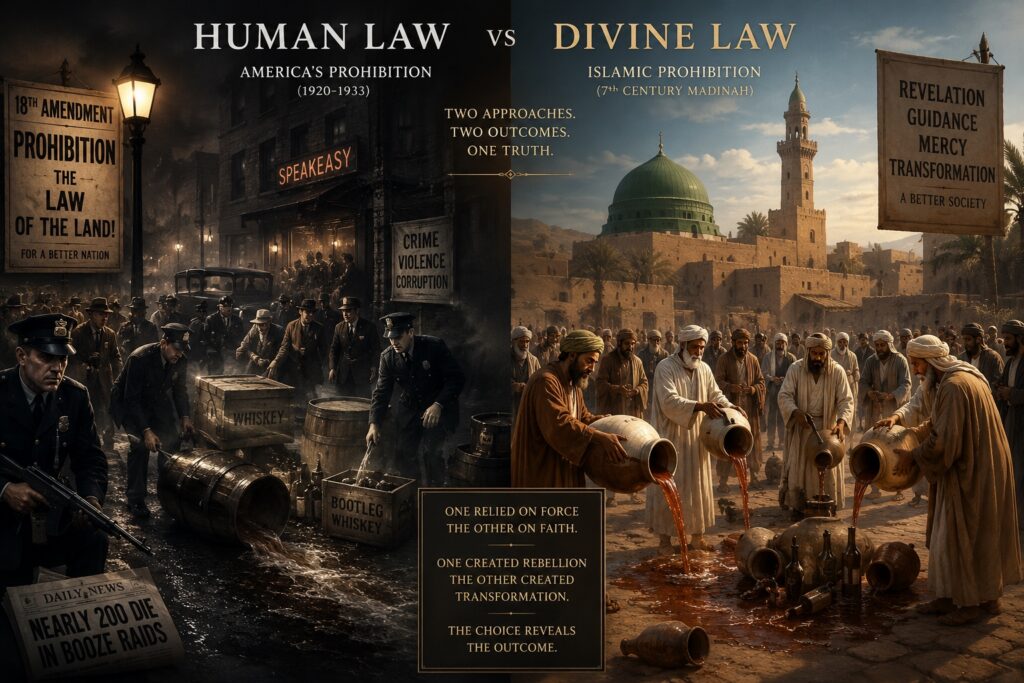
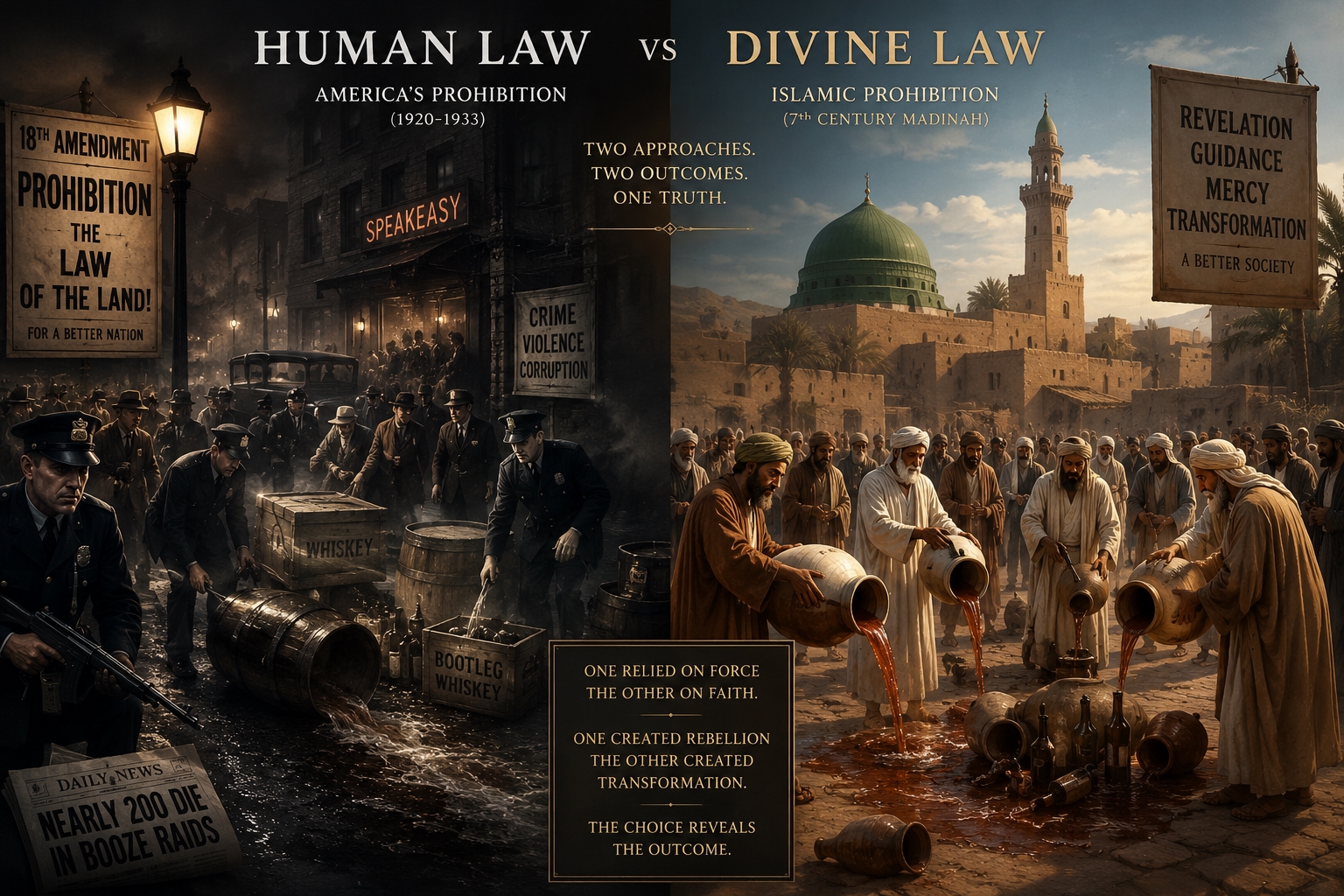
This was the greatest historical experiment in reforming morality and society through the power of secular law. Prior to the Eighteenth Amendment, the Anti-Saloon League spent years educating the American public on the harms of alcohol through journals, pamphlets, lectures, illustrations, magic lanterns, cinema, and various other media. Wealth was poured out like water; it is estimated that from the inception of the movement until 1925, over 65 million dollars were spent on propaganda and public outreach. The literature published against alcohol comprised approximately 9 billion pages.
Furthermore, the financial burden borne by the American nation over those fourteen years to enforce the Prohibition Law is reported to total 450 million pounds. Statistics published by the US Department of Justice covering the period from January 1920 to October 1933 reveal that 200 people lost their lives in connection with the enforcement of this law. Additionally, 534,335 individuals were imprisoned, fines totaling 16 million pounds were imposed, and property valued at 404 million pounds was confiscated.
Divine Rights and Human Rights
The eminent political theorist Harvey Mansfield once wrote that the “religious question” is the crucial one for the modern age, because it concerns the ultimate repository of authority and control. Is it human or is it divine?
“All pre-modern regimes,” said Mansfield, “are more or less based on divine right, on appeal to a principle that says men do not control themselves, that they are controlled by a higher power.”
The modern project, by contrast, is centrally concerned with liberation from that higher power:
“For if men cannot act effectively on their own, they will have to return to divine right, notwithstanding the objections that philosophers might propose. Liberation leads to reform. Liberation is not merely skeptical or negative; it is positive and progressive.”
One of the ways that modernity has answered this challenge is by appropriating “religion” and transforming it from a duty that one owes a creator to a duty that one owes to oneself. In law, one sees this transformation clearly in the standard that is conventionally applied by American courts to requests for religious exemptions from general laws, in which sincerity, individual commitment, or personal conviction are alone sufficient to bring a claim (though they are not sufficient to prevail).
The Failure of Secular Legislation
These staggering losses in life and property were endured solely to educate this highly civilized twentieth-century nation—whose intellect was deemed to be at its zenith—about the spiritual, moral, physical, and financial harms of alcohol, the “mother of all evils”. Yet, years of continuous effort before and after the enactment of the law, backed by the full might of the state, failed against the American public’s resolve to drink. The greatest moral crusade in modern secular history proved entirely futile.
This failure and subsequent repeal did not occur because the harms of alcohol had suddenly transformed into benefits, or because new scientific discoveries had invalidated previous findings. On the contrary, today it is recognized more clearly than ever through extensive data that prostitution, adultery, sodomy, theft, gambling, and murder are closely linked to alcohol consumption. It remains a primary factor in the moral, physical, and economic ruin of Western nations.
Despite this, the US government was forced to rescind its law and make the prohibited permissible because the vast majority of the American public refused to abandon alcohol. The very public whose votes had criminalized it fourteen years prior now demanded its legalization.
As far as we know, no prominent proponent of alcohol ever denied its destructive effects, nor did opponents of Prohibition present any list of virtues that could outweigh its vices. When the Eighteenth Amendment was introduced in Congress with public backing, the balance between “dry” and “wet” had been thoroughly weighed. It was precisely in view of these harms that Congress proposed the amendment, forty-six states ratified it, and the House of Representatives and the Senate passed the Prohibition Act. This was done with the consent of the American nation, and as long as the matter remained confined to paper and rhetoric, the public happily supported it.
However, the moment prohibition transitioned into practical implementation, the temperament of the nation shifted. After spending their first night away from alcohol, this highly civilized, educated, rational, and progressive nation reacted with collective desperation. In a frenzy of defiance, they engaged in behaviours that made it seem as though they were willing to destroy themselves for the sake of the bottle.
The closure of legitimate barrooms triggered the rise of millions of illicit speakeasies and “blind pigs” across the country. Evading the law, citizens devised ingenious methods to manufacture, buy, sell, and consume alcohol. Sharing the location or specific password of an illicit speakeasy with a friend or relative was viewed as an act of great kindness. Previously, the government could regulate licensed establishments, monitoring the quality of liquor and the demographics of patrons. Now, these illicit dens operated entirely outside state oversight.
Their numbers far exceeded the licensed saloons of the pre-Prohibition era. They distributed low-quality, toxic liquors that were immensely damaging to health. The influx of young boys and girls into these hidden establishments increased dramatically, causing deep alarm among American social thinkers.
The price of alcohol skyrocketed, transforming bootlegging into a highly lucrative enterprise that drew in hundreds of thousands of operators. Alongside secret bars, a vast network of mobile bootleggers emerged. These individuals actively sold alcohol and cultivated new clienteles in schools, offices, hotels, recreational centres, and private homes. Conservative estimates indicate that the number of bootleggers in America during Prohibition was ten times higher than before the law was enacted.
The trade spread from urban centres deep into the countryside, with illicit distilleries appearing in villages nationwide. Prior to Prohibition, America had only 400 licensed distilleries. Within seven years of the ban, 79,427 manufacturing operations and 93,831 stills were seized. Even so, the volume of the trade did not diminish. A former Prohibition Commissioner remarked:
“We were only able to seize approximately one-tenth of the total operating breweries and stills.”
The overall consumption of liquor increased significantly. Estimates suggest that during the Prohibition era, American citizens consumed approximately 200 million gallons of alcohol annually—a figure substantially higher than pre-Prohibition levels.
The quality of this heavily consumed alcohol was exceptionally poor and hazardous. Medical experts noted at the time:
“It is more accurate to call this substance poison rather than wine. Upon ingestion, its toxic effects strike the stomach and brain immediately, severely impacting the nervous system for days. Its intoxication does not induce light-heartedness; rather, it drives human temperament toward agitation, violence, and criminality.”
This widespread consumption of toxic alcohol severely impacted public health. In New York City alone, records show that in 1918 (prior to Prohibition), the number of people dynamic enough to be hospitalized due to alcohol poisoning was 3,741, with 252 fatalities. By 1926, the number of hospitalized individuals rose to 11,000, and annual deaths reached 7,500. The number of individuals who indirectly perished or suffered permanent disability due to alcohol remains unquantifiable.
Crime rates, particularly juvenile delinquency, experienced unprecedented growth. American judges remarked that the nation’s history offered no parallel to the sheer volume of children arrested under the influence of alcohol. Investigations into the surge of juvenile crime confirmed that from 1920 onward, youth drinking and disorder increased year after year, with some cities reporting a 200% increase within an eight-year period. In 1933, Colonel Moos, Director of the National Crime Council, stated that one out of every three Americans was engaged in criminal activity, and the homicide rate had risen by 350%.
In summary, the fourteen-year experiment with Prohibition yielded the following outcomes:
- Respect for the law evaporated, and systemic lawbreaking infected every tier of society.
- The primary objective of the law failed completely; once banned, alcohol was consumed in greater quantities than when it was legal.
- The government suffered massive enforcement costs, while citizens spent vast sums through illicit channels, undermining the nation’s economic stability.
- The social and moral fruits of the legislation consisted of widespread disease, compromised public health, rising mortality rates, systemic moral decay, and an unprecedented surge in crime—especially among the younger generation.
These outcomes occurred in a nation widely considered to be among the most educated and enlightened of the twentieth century, whose citizens possessed an acute understanding of personal self-interest. It occurred after millions of dollars were spent distributing billions of educational materials to ensure the public fully grasped the dangers of consumption. It occurred despite the fact that a large majority of the population initially supported the rationale for the ban, and the law itself was enacted through democratic processes.
Finally, it occurred under a powerful government that spent fourteen years utilizing its state machinery to eradicate the liquor trade. As long as these consequences remained unseen, the majority of the government and the citizenry agreed on the ban, and alcohol was made illegal. But once it became evident that the public would not comply, and that forced deprivation produced worse social outcomes than legality, the same government and majority agreed to make alcohol legal once again.
The Islamic Transformation of Arabia
Now, consider the state of a country which, over thirteen hundred years ago, was regarded as one of the darkest regions of the ancient world. Its inhabitants lacked formal education, science, and structured civilization. Literacy was exceedingly rare—perhaps one in ten thousand—and even those who could read possessed basic knowledge compared to modern standards. Modern administrative institutions and infrastructure were completely absent. The state structure was rudimentary and had been established for only a few years.
Furthermore, the inhabitants were profoundly attached to alcohol. The Arabic language contains approximately 250 names for wine, a linguistic phenomenon unmatched in other languages that underscores their deep cultural relationship with it. Their classical poetry further demonstrates that wine was woven into the fabric of their daily existence and viewed as an essential element of life.
Under these historical conditions, the issue of alcohol was raised, and the Messenger of Allah was asked regarding its status in religious law. In response, he recited the divine decree:
“They ask you concerning wine and gambling. Say: ‘In them is great sin, and some benefit for men; but the sin in them is greater than their benefit.’” (Al-Baqarah: 219)
This initial revelation was not an outright legal ban, but rather an objective statement regarding the nature of alcohol, clarifying that while it contained both good and bad, its harmful aspects heavily outweighed its benefits. The effect of this moral education was immediate: a segment of the community abandoned consumption altogether. However, the majority maintained their habits. Later, a specific directive was sought because some individuals would approach prayer while intoxicated and commit errors in recitation. The Messenger of Allah then delivered the subsequent command from his Lord:
“O you who have believed, do not approach prayer while you are intoxicated until you know what you are saying.” (An-Nisa: 43)
Upon receiving this command, the people restricted their drinking habits to specific windows of time. Consumption typically occurred between the dawn (Fajr) and noon (Zuhr) prayers, or after the night (Isha) prayer, ensuring that intoxication would not interfere with their performance of mandatory worship.
Yet, the fundamental social harms of alcohol persisted. Intoxicated individuals still caused civil disturbances and instances of violent conflict. Consequently, a definitive and absolute ruling was requested. The final decree was then revealed:
“O you who have believed, indeed, intemperance, gambling, stone altars, and divining arrows are but defilement from the work of Satan, so avoid it that you may be successful. Satan only wants to cause between you animosity and hatred through wine and gambling and to avert you from the remembrance of Allah and from prayer. So will you not desist? And obey Allah and obey the Messenger and beware. And if you turn away—then know that upon Our Messenger is only clear notification.” (Al-Ma’idah: 90-92)
The moment this decree was issued, those who had long romanticized and championed wine turned away from it instantly. As the announcement echoed through Medina, storage vessels were shattered, and wine flowed through the streets. In one gathering, ten or eleven companions were heavily intoxicated when the voice of the Prophet’s town crier reached them. Despite their deep inebriation, their profound reverence for the divine command caused them to stop mid-drink and smash their jars.
Another account details an individual who was actively drinking; with the cup raised to his lips, he heard the verse of prohibition recited. He immediately pulled the cup away, refusing to let another drop pass his lips. Following this, any rare infraction was met with immediate communal accountability—initially involving physical reprimand with shoes, sticks, and hands, followed by a formal penalty of forty lashes, which was later elevated to eighty lashes.
As a result, the consumption of alcohol was entirely eradicated from Arabia. Wherever Islam spread, it transformed societies into self-regulated, temperate populations. Even today, though the political and spiritual influence of Islam has weakened globally, millions of Muslims remain entirely abstinent without requiring state surveillance or dedicated enforcement agencies. If a census were conducted today across the globe to measure the percentage of total abstainers, the Muslim community would still emerge as the most temperate. Even among those Muslims who do fall into drinking, they continue to recognize it as a sin, harbouring internal remorse and frequently seeking repentance.
Comparative Analysis & Universal Principles
In the realm of reason and philosophy, final judgments rest upon empirical observation and verified outcomes. This evidence cannot be refuted. We are presented with two distinct experiments: the modern American experiment and the classical Islamic experiment. The contrast between them is glaring, and it is our collective duty to analyse this divergence to extract universal principles of governance and morality.
When we analyse the root causes of this immense disparity, we uncover three fundamental principles that govern not only temperance laws, but the entirety of jurisprudence and ethics.
Fundamental principles governing jurisprudence and ethics
Shifting Opinions vs. Immutable Foundations
The first principle lies in the fundamental structural divergence between secular human law and Divine legislation. Secular laws rely entirely upon human opinion, forcing them to constantly defer to the changing desires of either the public or elite legislative bodies across both general and specific statutes. Human opinion is constantly subject to shifting emotional states, external factors, and evolving intellectual frameworks that are not always correct.
As these opinions fluctuate, the metrics for good and evil, right and wrong, permissible and impermissible inevitably shift as well, forcing the law to adapt accordingly. Consequently, society is left without a permanent, stable, or unchanging standard of morality and civilization. Human volatility dictates the law, and legal volatility dictates human life.
This dynamic resembles a novice driver who fumbles with the steering wheel. The vehicle’s path becomes erratic and unstable, unable to maintain a clear path. As it swerves wildly, it directly impacts the passengers; at times they are right on the path, at times off it, occasionally plunging into ditches, crashing into walls, or enduring severe physical jolts.
In contrast, the foundational frameworks and a vast majority of the specific applications of Islamic law are permanently anchored by Allah and His Messenger. Human opinion has no authority to alter these constants. Where human intellect is permitted to operate, it does so strictly through legal derivation (Istinbat)—extrapolating from fixed universal principles to address new situations, ensuring all secondary derivations align perfectly with core divine legal philosophy.
This divine methodology ensures that society possesses a permanent, immutable standard of morality and civilization. There is no room for systemic volatility within these ethical and civil laws; what was prohibited yesterday cannot be declared permissible today, only to be banned again tomorrow. What is decreed prohibited remains prohibited for eternity, and what is declared permissible remains so until the end of time. We have handed the steering wheel of our collective vehicle over to a flawless, omniscient guide, and we rest assured that it will remain on a straight path.
“Allah keeps firm those who believe, with the firm word, in worldly life and in the Hereafter. And Allah sends astray the wrongdoers.” (Ibrahim: 27)
The Fallacy of Popular Consent in Ethical Reform
The second insight highlights a structural limitation faced by secular authorities. To construct societal regulations and implement moral or civil reforms, secular frameworks must first convince the public to accept the reform on a case-by-case basis before taking legislative action. Every clause of their law depends entirely upon public satisfaction for its enforcement. If a structural or regulatory law is enacted against the prevailing desires of the public, it must inevitably be repealed after causing immense social and systemic disruption.
This reality is evidenced not merely by the American experiment, but by the collective history of secular legal systems. It demonstrates that human-made legal structures are inherently unsuited for the fundamental moral and social reform of a population, as the validation, enforcement, or repeal of the law depends entirely on the consent of the very individuals requiring reform.
Islam addresses this fundamental obstacle through a different approach, offering the only viable solution to this legislative paradox. Before addressing specific social, structural, or legal regulations, and prior to demanding obedience to scriptural statutes, Islam first invites the individual to accept a foundational covenant: belief in Allah, His Messenger, and His Book. Accepting this initial step rests entirely upon personal choice.
However, once an individual willingly enters into this covenant of faith, the question of personal likes or dislikes regarding individual laws is superseded. From that point forward, whatever command the Messenger delivers from Allah and whatever statute the Divine Book ordains becomes naturally binding upon them. Once this primary psychological foundation is established, the entire body of divine legislation is embraced systematically, without requiring separate public campaigns for each individual law.
This explains why an objective that America could not achieve despite spending billions of dollars, deploying massive state machinery, and conducting unprecedented public campaigns was achieved seamlessly across the Islamic world through a single divine proclamation.
The Necessity of Faith over Pure Intellect
The third lesson demonstrates that no matter how deeply a human society is enriched by science and art, and no matter how high it ascends in intellectual capacity, it can never escape the grip of primal desires if it lacks submission to divine law and the power of faith. The pull of the lower self (nafs) remains so powerful that if an individual or society is naturally inclined toward a vice, they will refuse to abandon it even if its harms are demonstrated to be brighter than the sunlight.
They will ignore the consensus of medical science, disregard empirical statistics, and look past clear historical evidence. This reality proves that cultivating a genuine moral conscience (dameer) and instilling the internal strength required to master one’s base impulses is entirely beyond the scope of secular science and independent human intellect. This internal transformation can only be achieved through the transformative power of faith (Iman).
Conclusion
The above research offers a profound lesson for contemporary legal, social, and psychological frameworks. Through a precise historical contrast, the text demonstrates that outer legal coercion by a secular state is structurally incapable of mastering human desire. Secular law is reactive and mutable, shifting with the tides of popular culture, which ultimately leads to systemic moral instability.
Conversely, Divine Law operates by first transforming the inner locus of control through faith (Iman), establishing an unyielding metaphysical covenant. Once the individual willingly submits to the ultimate sovereignty of the Divine Creator, compliance with specific moral and civil regulations follows as a natural extension of spiritual devotion rather than state-enforced fear. For long-term societal stability and genuine ethical reform, human intellect must be anchored by the unchanging benchmarks of Divine Revelation.