China Brahmaputra Dam Crisis: India-Pakistan Water Wars
This guide helps you understand the water politics in South Asia. It shows how dams affect countries, why neighbours argue, and what can be done for fair solutions. Perfect for students, families, and anyone who wants clear facts.
China Brahmaputra Dam Crisis: India-Pakistan Water Wars
China Brahmaputra Dam Crisis: Rivers do not respect borders. The Brahmaputra and Indus rivers flow through China, India, Pakistan, and Bangladesh. Today, big dams on these rivers are creating tension between neighbours. This article explains everything in simple words.
China Brahmaputra Dam Crisis: India-Pakistan Water Wars
Purpose of This Article
This guide helps you understand the politics of water in South Asia. It shows how dams affect countries, why neighbours argue, and what can be done for fair solutions. Perfect for students, families, and anyone who wants clear facts.
Water wars
Indian violations of the Indus Waters Treaty have raised existential concerns for Pakistan’s economic stability and the food security of more than 250 million people.
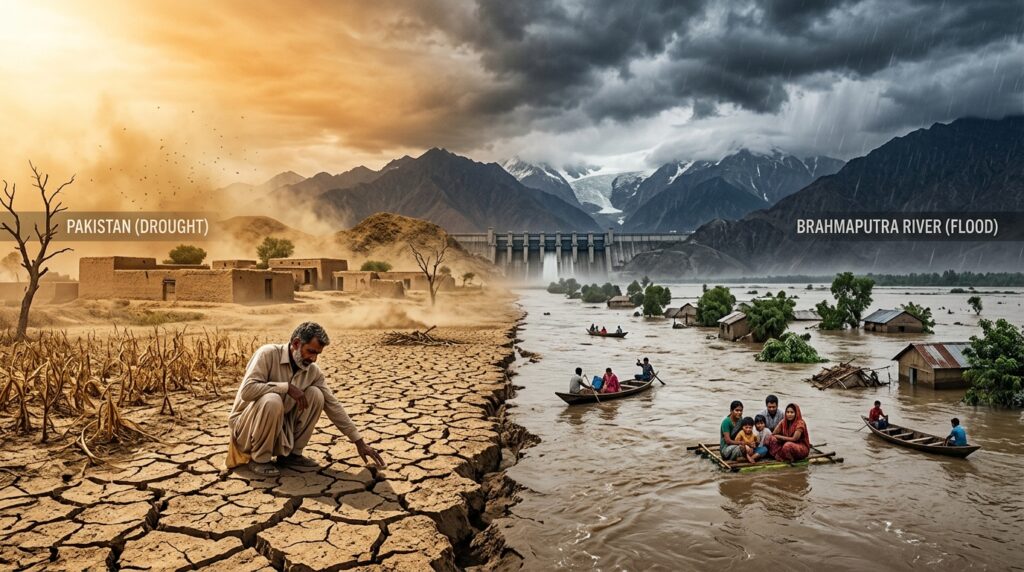
India is pursuing a three-pronged water-denial strategy: using tunnels, diversions and large dams to control the flow of shared rivers to Pakistan. This could cause or aggravate drought-like conditions as well as raise the risk of floods.
Among the most recent developments raising concern in Pakistan is the plan to divert a portion of Chenab waters through the proposed Chenab-Beas Link Tunnel.
Talking to The News on Sunday, Pakistan’s former ambassador to India, Abdul Basit, says, “In a significant and potentially dangerous new development, India has reportedly sought tenders for the 113-kilometre Chenab-Beas Link Tunnel to divert water from the River Chenab to the River Beas. This will take away up to 1.9 million acre-feet of Chenab water.”
This will seriously impact water availability in Pakistan and is a stark violation of the Indus Waters Treaty. “While the Indus Waters Treaty allows India limited non-consumptive use of the western rivers for hydroelectric projects, it does not permit the storage or transfer of water to deprive Pakistan of its rightful share,” Basit says.
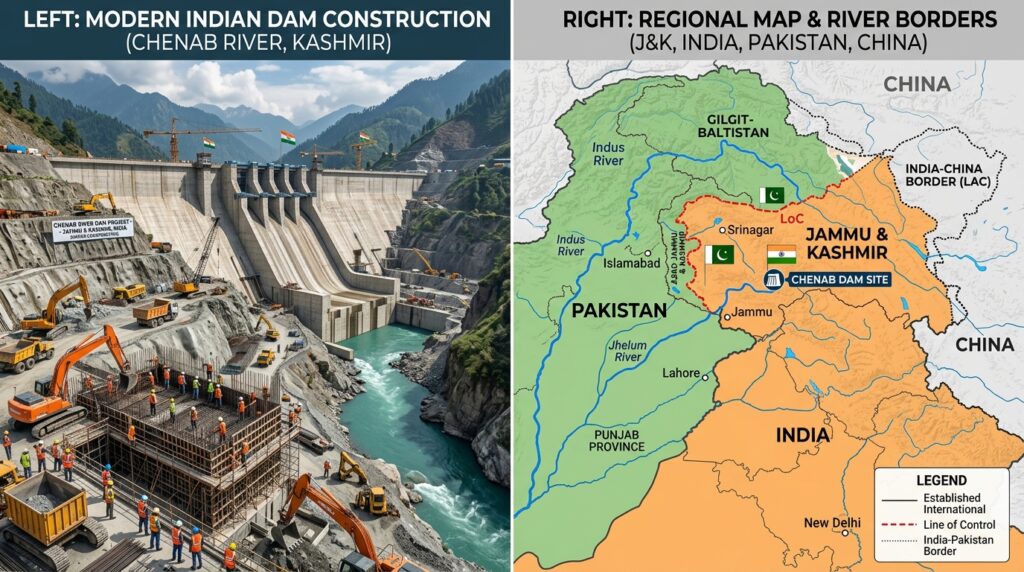
Fast-tracking of construction on the controversial projects has followed India’s unilateral announcement last year to ‘suspend’ the treaty. India is fast-tracking at least four major hydro projects in the upper reaches of the Chenab: Pakal Dul (1,000 MW), Kiru (624 MW), Kwar (540 MW) and Ratle (850 MW). It also plans to raise the height of the Kishanganga Dam and to build the Sawalkote Hydropower Project and expand the Ranbir Canal.
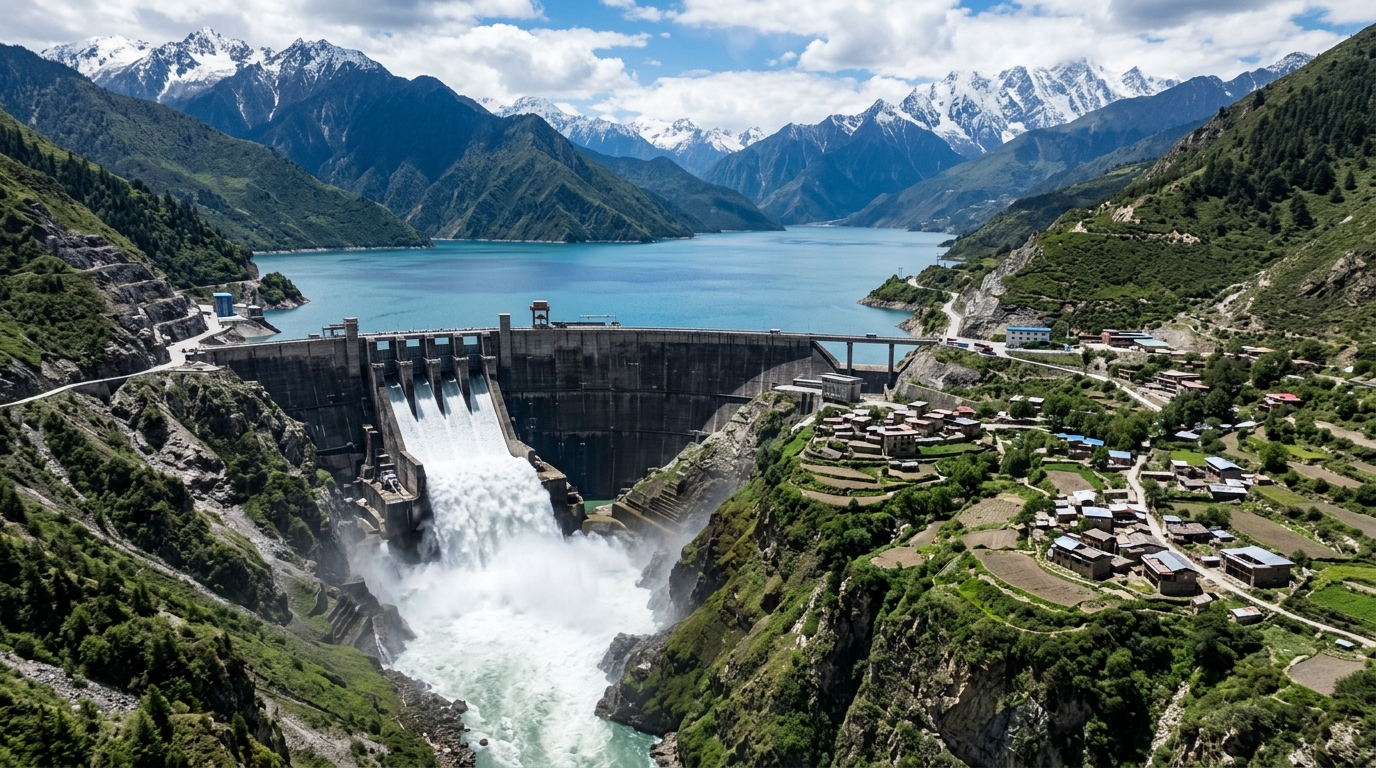
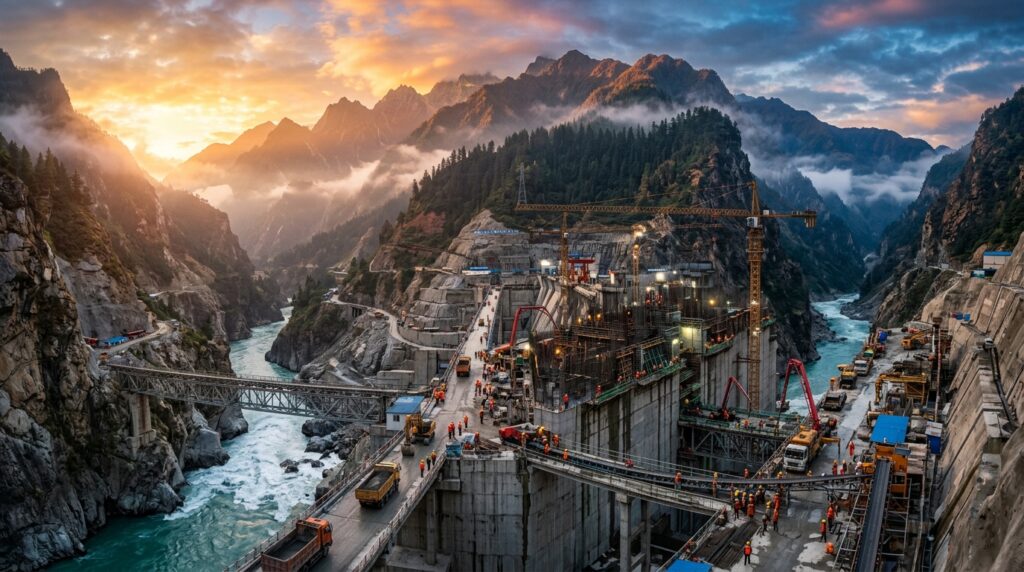
China is building the world’s largest hydropower dam in Tibet on the Yarlung Tsangpo River (called the Brahmaputra in India). The project is called the Medog Hydropower Station.
Power capacity: 60,000 MW (three times bigger than Three Gorges Dam)
Cost: Over $137 billion
Construction started: 2025
Expected completion: Around 2033
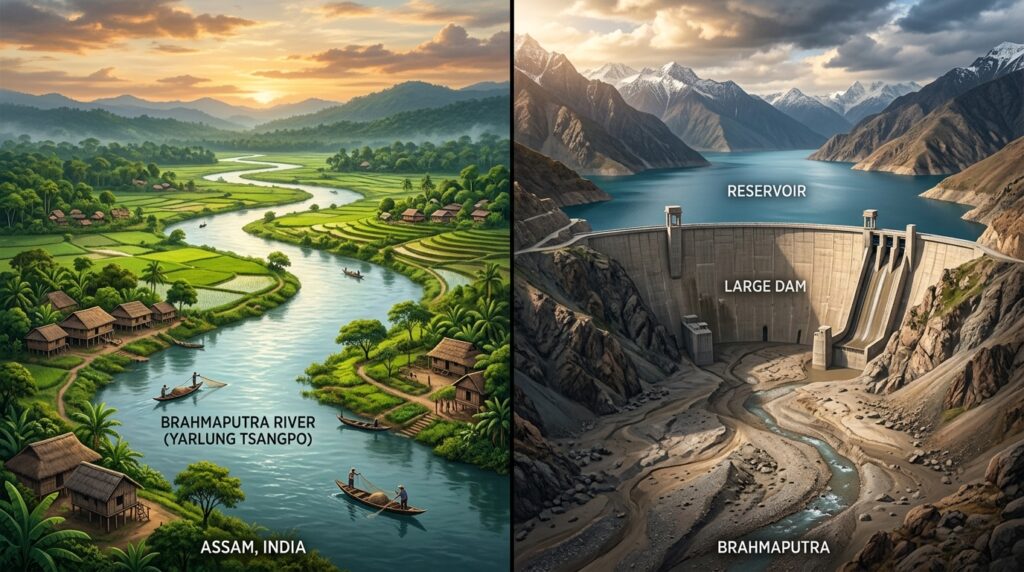
The river flows from China into India and Bangladesh, so downstream countries are worried.
China’s Massive Medog Dam on the Brahmaputra
Why India Is Worried About the Chinese Dam
India fears that China can control the flow of water. Sudden releases could cause floods, while holding water could create dry seasons.
“This is not just about electricity it is about controlling the future of rivers that feed entire nations.” — Regional water expert
India calls it a possible “water bomb“. In response, India is building its own dam on the Siang River for storage and flood control.
India’s Dual Stance: Criticising China but Building Its Own Dams
Linking China’s Medog Dam (Brahmaputra) with India’s Hydropower Projects in Jammu & Kashmir on Indus-System Rivers Flowing to Pakistan provides a clear picture of asymmetric hydro-politics and tit-for-tat strategies across South Asia.
The IWT (brokered by the World Bank) divides the six rivers of the Indus basin:
Eastern Rivers (Ravi, Beas, Sutlej): Primarily allocated to India for consumptive use.
Western Rivers (Indus, Jhelum, Chenab): Allocated mainly to Pakistan, with India allowed limited non-consumptive uses, run-of-the-river (RoR) hydropower projects (minimal storage), irrigation, and domestic needs under strict design criteria (e.g., no large reservoirs that could enable significant control or diversion).
Pakistan has routinely objected to almost every major Indian project on the western rivers (e.g., Baglihar on Chenab, Kishanganga on Jhelum/Kishanganga-Neelum, Ratle on Chenab, Tulbul/Wullar on Jhelum). Objections cite alleged violations of storage limits, impacts on downstream flows/power projects in Pakistan (e.g., Neelum-Jhelum), and “intent” to control water. Disputes go to the Permanent Indus Commission, Neutral Experts, or Court of Arbitration.
India maintains projects comply with IWT allowances for RoR hydro (essential for J&K’s energy needs and strategic infrastructure). Pakistan views them as existential threats to its agriculture (Indus basin irrigates much of its farmland) and uses objections/delays as leverage.
Recent Escalation (2025–2026 Context)
Following the April 2025 Pahalgam terror attack (blamed on Pakistan-linked militants, without substantial evidance/proofs), India suspended/held the IWT “in abeyance” until Pakistan credibly ends cross-border terrorism support. This is unprecedented and rejected by Pakistan and arbitration bodies. India has accelerated projects like Sawalkote (Chenab), revived Tulbul, and advanced others. Pakistan warns of water crises and potential “war” triggers.
Parallels & Linkages to China’s Medog Dam on Brahmaputra
Both cases highlight upstream-downstream power dynamics and the weaponisation (or perceived weaponisation) of water amid territorial/security disputes:
Strategic Asymmetry & Leverage:
China (upper riparian on Brahmaputra) builds the massive Medog dam (~60 GW) near the border with minimal transparency or binding treaty obligations to India/Bangladesh. India worries about flow control as a “water bomb” during border crises.
India (upper riparian on Indus western rivers) advances dams in J&K (e.g., on Chenab/Jhelum) despite IWT constraints and Pakistani objections. With the treaty in abeyance, India gains more flexibility, mirroring China’s unilateralism. Pakistan fears deliberate flow manipulation or data withholding.
Security Linkage:
Medog ties to India-China border tensions (Arunachal/LAC).
Indian J&K projects link to India-Pakistan Kashmir dispute and terrorism. India explicitly frames post-2025 dam acceleration as retaliation/response to attacks, similar to how water issues flare during standoffs (e.g., past data withholding by China).
Treaty/Mechanism Erosion:
No comprehensive Brahmaputra treaty → China acts freely; India pushes countermeasures (e.g., Siang Upper).
IWT exists but is now suspended by India → Pakistan’s objections lose procedural force in India’s view, accelerating projects. Both erode trust in international/bilateral mechanisms (World Bank arbitration, expert-level talks).
Dam Race & Countermeasures:
India responds to Medog with its own Brahmaputra/Siang storage projects.
Pakistan historically counters Indian dams with its own (or objections/internationalization); now faces a stronger Indian push. This creates parallel “dam races” in contested basins, prioritising strategic control over pure energy/ecology.
Broader Regional Pattern:
China-India (Brahmaputra): Upstream hegemony vs. downstream vulnerability.
India-Pakistan (Indus): Similar dynamic, but with a (now strained) treaty. Pakistan, as lower riparian here, echoes India’s concerns vis-à-vis China.
Hypocrisy/Realpolitik: India criticises Chinese opacity on Brahmaputra while asserting rights on Indus; Pakistan objects to Indian dams while benefiting from Chinese projects elsewhere (e.g., CPEC).
Logical Analysis: These are interconnected examples of hydro-diplomacy as a proxy for territorial/security rivalries. The IWT has prevented outright water wars for decades but is under severe stress. Suspension gives India short-term leverage (data control, project acceleration) but risks escalation, flood/drought mismanagement, and long-term instability for Pakistan’s agriculture.
Similarly, Medog amplifies India’s vulnerabilities downstream. Without renewed dialogue (e.g., IWT revival with modifications, Brahmaputra basin talks), climate change + population pressures will intensify conflicts. All parties benefit from transparency, joint monitoring, and separating water from terrorism/border issues, but geopolitics makes this difficult.
This linkage shows a dangerous regional trend: weaker institutions → more unilateral infrastructure → heightened risks for millions dependent on these rivers.
India’s Dual Stance: Criticising China but Building Its Own Dams
India strongly criticises China’s Medog dam for lack of transparency, possible flow control, and risks to downstream areas. It calls for better data sharing and worries about “water weaponisation.”
At the same time, India builds dams on rivers flowing to Pakistan (like on the Chenab and Jhelum). Pakistan raises similar objections: reduced flows, impact on its projects, and lack of consultation. India says its projects follow treaty rules (or are necessary after suspension), just as China claims its dam is for clean energy.
India’s Dams in Kashmir and the Indus Waters Treaty with Pakistan
The Indus Waters Treaty (1960) divides rivers between India and Pakistan. Pakistan gets most water from western rivers (Indus, Jhelum, Chenab), but India can build run-of-river hydropower projects with limits.
Pakistan objects to almost every Indian dam on these rivers, saying they affect downstream flow. Projects like Kishanganga, Ratle, and others faced long disputes.
After a 2025 terror attack, India suspended the treaty. It is now building or accelerating dams in Jammu & Kashmir more freely. This mirrors how China builds upstream without strong checks on India.
Both sides use dams for strategy as well as power and water. It shows how water becomes a tool in bigger conflicts.
India’s Dual Stance: Criticising China but Building Its Own Dams
Why This Looks Like a Double Standard:
When China builds upstream, India highlights risks to its farmers and security.
When India builds upstream from Pakistan, it downplays similar risks and focuses on its own needs for power and strategy in Kashmir.
Both countries act as stronger upstream players in different rivers. Pakistan, often downstream, objects in both cases but has less power to stop projects.
This shows how countries change their arguments depending on whether they are upstream or downstream. It makes trust harder and hurts chances for fair regional water agreements.
“Water does not respect borders, but politics often does.” South Asian analyst
India’s Dual Stance: Criticising China but Building Its Own Dams
Why Pakistan Builds Dams Slowly Despite Water and Energy Crises
Pakistan’s slower pace on large dam construction, despite acute water shortages, energy crises, and climate vulnerabilities, stems from a mix of structural, political, economic, and institutional challenges, often described by critics as policy lethargy bordering on negligence. Pakistan has significant untapped hydropower potential (estimates 40–60 GW in the Indus Basin, with only ~10–12% developed), yet storage capacity remains critically low (~15–30 days vs. recommended 1,000+ days for similar climates), leading to floods, droughts, and power shortfalls.
Major Ongoing Projects & Delays
Pakistan is building some dams, but progress is slow:
Diamer-Bhasha Dam (Indus River): ~4,500 MW, 6–8 MAF storage. Multiple delays; now targeted ~2028–2029. Cost overruns, funding issues.
Dasu Hydropower (Indus): 4,320 MW (phased). Stage 1 (~2,160 MW) progressing with World Bank support, targeted ~2027.
Mohmand Dam and others (e.g., Kurram Tangi, Nai Gaj): Incremental progress, but overall storage addition lags.
These could add significant capacity, but timelines slip repeatedly.
Why the Apparent Lethargy?
Several interconnected reasons explain the slower pace compared to India’s or China’s more aggressive upstream development:
Funding & Economic Constraints:
Mega-dams are capital-intensive (Diamer-Bhasha ~$14B+ with escalations). Pakistan faces chronic fiscal crises, high debt, IMF dependencies, and circular debt in the power sector. International lenders (World Bank, ADB) have hesitated due to disputed territories (e.g., Gilgit-Baltistan for Bhasha), environmental concerns, and repayment risks. Domestic fundraising (e.g., public appeals) has been insufficient.
Political & Governance Issues:
Politicisation: Historical controversies (e.g., Kalabagh Dam) divided provinces (Punjab vs. Sindh/KP over water sharing, fears of “theft”). Ethnic/regional politics stall consensus.
Policy Inconsistency: Frequent government changes disrupt continuity. Weak project management, delayed PC-Is (planning documents), and bureaucratic inefficiencies cause cost escalations and delays.
Elite Capture & Political Economy: Powerful agricultural lobbies (water-intensive crops) resist efficiency reforms or new storage that might challenge status quo allocations. Focus remains on short-term fixes over long-gestation infrastructure.
Institutional & Capacity Challenges:
WAPDA (Water and Power Development Authority) executes projects, but faces coordination issues, resettlement problems (Diamer-Bhasha involves significant displacement), and security concerns in remote areas.
Climate variability already strains existing reservoirs (silting reduces capacity). Transboundary tensions with India (IWT disputes/suspension) complicate planning, though Pakistan’s internal delays predate recent escalations.
Compared to China (state-driven, massive capital) or India (larger economy, strategic push in J&K), Pakistan’s smaller fiscal space and reliance on donors slow momentum.
Is This Criminal Negligence?
Yes, many analysts and domestic critics argue it borders on negligence given the consequences:
Water Crisis: Per capita availability has plummeted; shortages hit agriculture (backbone of economy), causing food insecurity and economic losses.
Energy Crisis: Chronic loadshedding, industrial closures, high circular debt. Hydropower is cheap/clean baseload; underdevelopment forces expensive thermal imports.
Climate Vulnerability: More frequent floods/droughts (e.g., 2022 floods) highlight storage needs. Delays waste floodwater to the sea while dry seasons suffer.
Critics (including opposition, experts, judiciary in past) call it a failure of governance, prioritising short-term politics over national security (water/energy as existential). However, it’s not purely “criminal” inaction: Pakistan has advanced some projects and smaller initiatives. The issue is systemic inefficiency rather than total neglect.
Counterpoint: Building large dams isn’t risk-free (displacement, ecology, seismic risks in the Himalayas, as seen in Chinese projects). Pakistan also pursues efficiency (canal lining, metering) and alternatives (solar/wind), but these don’t replace storage for seasonal regulation.
Comparison & Broader Context
China (Medog): Unilateral, state-funded mega-projects despite risks.
India (J&K dams): Accelerated post-IWT suspension for strategic/energy reasons.
Pakistan: Reactive, constrained by domestic divisions and economics, making it vulnerable in the regional hydro-politics triangle.
Path Forward: Prioritising Diamer-Bhasha/Dasu with better governance, public-private models, and provincial consensus could help. Broader reforms (irrigation efficiency, crop patterns, integrated basin management) are equally critical. Lethargy exacerbates crises that climate change and population growth will worsen. Urgent acceleration, with accountability, is needed for water/energy security.
Imran Khan Government Push (2018–2022)
During Imran Khan’s government (2018–2022), there was a notable push for mega-dam projects as part of addressing water and energy security. Key initiatives included starting construction on major dams, launching public fundraising (with Supreme Court support), and setting ambitious timelines. Here is a reproduction of the main projects, announced completion targets from that era, and the current situation as of mid-2026.
1. Diamer-Bhasha Dam (Indus River, Gilgit-Baltistan/KP)
Key Push: Groundbreaking/launch by PM Imran Khan in July 2020 (after preparatory work). Contract awarded earlier; public donations and green bonds mobilised funding.
Announced Completion: 2028 (with power generation aspects aligned to this timeline). It was presented as a multi-purpose project for water storage (6.4–8.1 MAF) and 4,500 MW hydropower.
Today’s Situation (2026): Preliminary construction ongoing; river diversion system completed. RCC placement and foundation work advanced in 2025–2026. Timeline still targets 2028 (some reports mention July 2028 for full completion or power units). Delays and cost escalations noted, but work is in full swing under subsequent governments. Not yet complete.
2. Mohmand Dam (Swat River, Khyber Pakhtunkhwa)
Key Push: Construction inaugurated by PM Imran Khan in May 2019. Emphasised as a priority for irrigation and power.
Announced Completion: 2025 (initial targets around 2025–2026 for key phases).
Today’s Situation (2026): Significant progress; first power unit expected in late 2024 or 2025 per some updates, with full operations targeted soon after. It is one of the more advanced projects among the mega-dams, though exact full completion may have slipped slightly. Contributing to storage and energy goals.
3. Dasu Hydropower Project (Indus River, Kohistan)
Key Push: Progress accelerated during the PTI era with focus on upstream hydropower. Resolutions for pending issues highlighted in briefings to PM Khan.
Announced/Targeted Completion: Stage 1 (2,160 MW) aimed for 2027 (or earlier phases in 2020s announcements).
Today’s Situation (2026): Stage 1 under construction with World Bank support. Targeted to start electricity generation around December 2027. Steady progress reported, creating jobs. Phase 2 planned later.
Other Initiatives & Broader Context
The government announced plans for 10 new dams overall and emphasised a “decade of dams” for water/energy security.
Focus on northern hydropower potential to counter shortages. Public campaigns and Supreme Court involvement helped mobilise resources.
Overall Assessment (2026): Many timelines set during 2018–2022 have faced delays due to funding, terrain challenges, resettlement, and political transitions. However, the foundational work (contracts, land acquisition, initial construction) laid during that period enabled current progress. Projects like Diamer-Bhasha and Dasu remain on extended but active tracks toward late 2020s completion. Mohmand is relatively advanced. Subsequent governments (Shehbaz Sharif, etc.) continued and, in some cases, tried to expedite them, but systemic issues (costs, management) persist. These dams are critical for Pakistan’s storage (currently very low) and hydropower mix.
The push under Imran Khan marked a shift from decades of stagnation on mega-projects post-Tarbela/Mangla, though full realisation depends on sustained execution beyond any single regime.
The Bigger Picture: Climate Change and the Need for Cooperation
Climate change brings more floods, droughts, and uncertain river flows. Dams can help, but without trust, they create new problems.
All countries should focus on:
Better data sharing
Joint environmental studies
Improving water efficiency
Keeping politics out of basic survival needs
Conclusion
Big dams on shared rivers bring hope for clean power and water storage, but they also create risks and arguments. China’s Medog project, India’s dams in Kashmir, and Pakistan’s challenges show the same story from different sides. Fair agreements and smarter planning can turn these rivers into sources of peace and progress instead of conflict.
What Should Happen Next?
Countries need better cooperation:
Share data openly.
Build dams carefully with environmental checks.
Focus on efficiency (better irrigation, less waste) along with new storage.
Separate water issues from politics and borders.
Climate change does not wait. Faster, smarter dam building, plus regional talks, can help India, Pakistan, China, and Bangladesh secure water and clean power for the future.
Fair agreements and smarter planning can turn these rivers into sources of peace and progress instead of conflict.
Frequently Asked Questions (FAQs)
1. What is the Medog Dam and why does India worry?
It is China’s giant dam near the border. India fears it could control or disrupt water for millions downstream.
2. Is the Indus Waters Treaty still active?
India suspended it in 2025. Pakistan wants it restored. Disputes continue.
3. Is Pakistan neglecting its dam projects?
Not completely, but financial and political problems cause big delays during a time of shortage.
4. What did Imran Khan’s government achieve on dams?
It launched major projects and set clear completion targets that are still being followed today.
5. Who benefits most from these dams?
Upstream countries (China and India on different rivers) have more control. Downstream countries feel more vulnerable.
6. Can the countries solve these water problems together?
Yes. Better treaties, honest data sharing, and joint climate plans can help everyone in South Asia.
References & Sources
WAPDA official updates on Diamer-Bhasha, Dasu, and Mohmand dams
Reports from Dawn, The Diplomat, NDTV, and BBC (2025–2026)
World Bank and regional studies on Indus and Brahmaputra basins
This article explains complex issues in simple language so that students, families, and general readers can understand the real stakes behind the headlines.