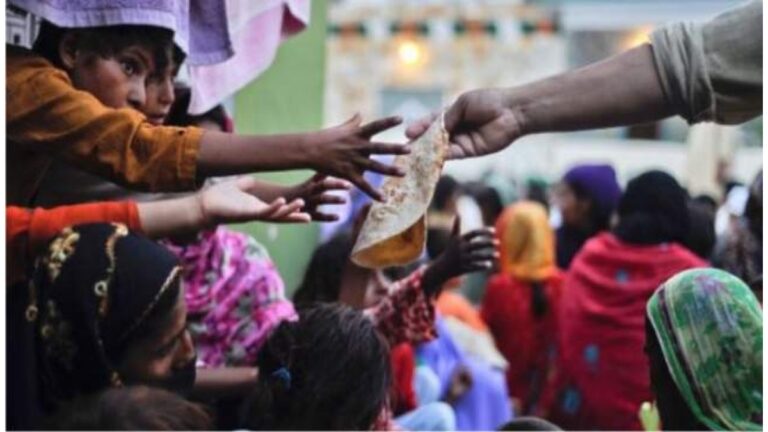
India Reduced Poverty Dramatically. Why Pakistan Still Struggling?
India Reduced Poverty Dramatically: A comparative investigation into two neighbouring economies, their divergent development trajectories, and the historical and structural factors shaping their economic futures.
https://mrpo.pk/who-controls-our-seeds-water-farms-and-food/
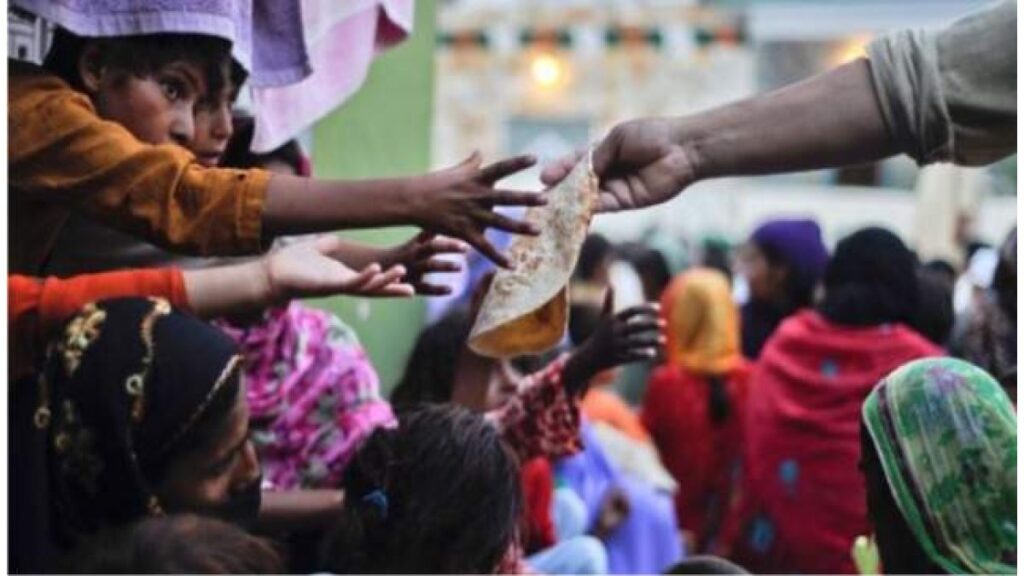
Introduction: Two Neighbours, Two Different Economic Realities
Nearly eight decades after independence in 1947, India and Pakistan present two markedly different economic realities.
India has developed into one of the world’s largest economies and achieved a substantial reduction in measured poverty. Pakistan, despite its agricultural resources, strategic location, established industries and entrepreneurial population, continues to struggle with economic instability and declining household welfare.
The difference is not simply the size of their economies. It is also about how effectively each country has converted its resources, population, institutions and economic opportunities into improvements in living standards.
The contrast deserves serious attention, particularly because both countries inherited many similar developmental challenges at independence: widespread poverty, limited industrial capacity, inadequate infrastructure, low literacy, agricultural dependence and the difficult task of building functioning national institutions.
Their subsequent journeys, however, were not identical.
India’s economic transformation gathered momentum through several phases, particularly following the economic reforms introduced in 1991. Pakistan also experienced periods of economic growth and development, but struggled to sustain progress and build a sufficiently diversified, productive economy.
The World Bank’s October 2025 Poverty and Equity Brief provides an important measure of India’s progress. Between 2011–12 and 2022–23, the proportion of Indians living below the international lower-middle-income poverty line of $4.20 per person per day, measured in 2021 purchasing power parity terms, declined from 57.7% to 23.9%.
Extreme poverty, measured against the $3 daily international poverty line, also declined from 27.1% to 5.3%.
These figures represent a substantial improvement in household consumption, although they do not mean that India has eliminated poverty, unemployment or economic insecurity.
Pakistan’s more recent experience has been considerably less encouraging. According to the World Bank’s October 2026 Poverty and Equity Brief, its national poverty rate increased from 22% in 2018–19 to 29% in 2024–25, affecting approximately 70 million people.
The two countries’ headline poverty figures use different measures and reporting periods, so they should not be directly compared as though they represent identical statistical conditions. Nevertheless, the direction of their respective trends raises important questions about economic performance and the distribution of its benefits.
Why has India made such substantial progress in reducing measured poverty while Pakistan has experienced a reversal?
What explains their different economic trajectories? And what can Pakistan realistically learn from its neighbour without attempting to copy an entirely different economic and political system?
To understand the difference, we must examine the historical development of both economies, their economic structures and the factors that have shaped their regional competitiveness.
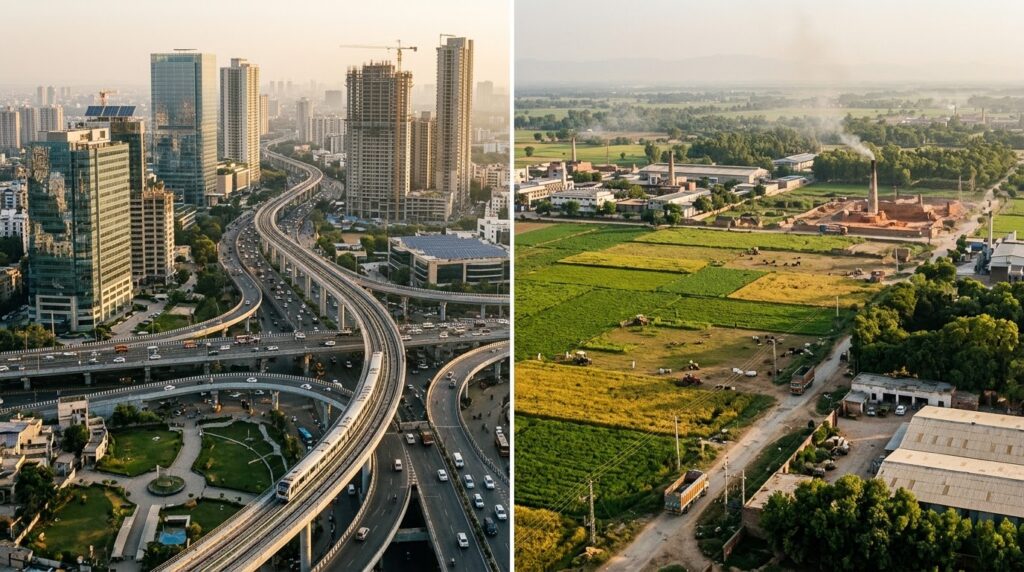
1. The Historical Divide: Different Economic Choices, Different Outcomes
India and Pakistan did not begin their independent journeys with identical resources, geographical circumstances or institutional arrangements.
Partition disrupted established commercial networks, divided agricultural and industrial regions, displaced millions of people and created enormous administrative and security challenges.
Both countries subsequently had to develop national institutions, expand education, establish industries and provide basic services to largely impoverished populations.
However, their economic policies gradually followed different paths.
India initially adopted a state-led development model, with extensive government involvement in industrial planning, investment and resource allocation. Private businesses operated within a heavily regulated environment.
The system helped establish important industrial and scientific capabilities, but also created bureaucratic restrictions and inefficiencies.
By 1991, India faced a serious balance-of-payments crisis. Its foreign exchange reserves had fallen to critically low levels, forcing the government to undertake significant economic reforms.
The reforms introduced that year included industrial deregulation, trade liberalisation, changes to investment rules and greater openness to foreign capital.
These measures did not instantly transform the country. Nor did every subsequent policy succeed. But they marked an important change in India’s approach to economic development.
Over time, private investment, international trade, services, technology and domestic consumption became increasingly important drivers of economic expansion.
Pakistan’s development history was different.
The country experienced periods of relatively strong economic growth, industrial expansion and agricultural development. Its early industrialisation, major irrigation infrastructure and later export-oriented manufacturing created important economic foundations.
However, successive governments pursued different economic priorities, and the country struggled to establish a sufficiently consistent long-term development strategy.
Political changes, regional conflicts, external economic shocks and changing policy directions all affected the investment environment.
Pakistan’s economic progress also depended heavily on periods of external financial assistance and foreign exchange availability. This created vulnerabilities when export earnings and domestic productive capacity failed to keep pace with economic requirements.
It would be simplistic to attribute India’s progress solely to its 1991 reforms or Pakistan’s difficulties solely to political instability.
Both countries experienced political upheavals, policy failures and external shocks.
The important difference is that India gradually developed a larger and more diversified economic base, while Pakistan struggled to sustain comparable diversification and productivity growth.
2. Economic Scale: What the Numbers Actually Tell Us
The difference in economic size is striking.
According to the World Bank’s 2025 data, India’s nominal GDP reached approximately $3.96 trillion, compared with approximately $407 billion for Pakistan.
India’s economy was therefore almost ten times larger in current US dollar terms.
However, total GDP alone does not establish how prosperous ordinary citizens are.
Population size must also be considered.
The World Bank’s 2025 figures show the following comparison:
| Economic indicator, 2025 | India | Pakistan |
|---|---|---|
| Total GDP | $3.96 trillion | $407.31 billion |
| GDP per capita | $2,702.50 | $1,595.90 |
| Annual GDP growth | 7.6% | 3.7% |
| Population | Approximately 1.46 billion | Approximately 255 million |
Source: World Bank, World Development Indicators. GDP figures are nominal, not adjusted for purchasing power differences.
The difference in GDP per capita is considerably smaller than the difference in total economic size, but remains significant.
India’s GDP per capita was approximately 1.7 times Pakistan’s in 2025.
Even this figure requires careful interpretation. GDP per capita represents average economic output per person, not the income actually received by every individual or the distribution of household wealth.
Nevertheless, a larger and more diversified economy can offer important advantages.
It can support a broader domestic market, attract investment across different industries, finance research, develop infrastructure and absorb economic shocks more effectively.
India’s large population also creates enormous demand for housing, transportation, consumer products, telecommunications, financial services and healthcare.
Businesses can expand within the domestic market before attempting to compete internationally.
Pakistan has a substantial domestic market too, but its smaller economic base and weaker productivity limit the opportunities available to many businesses.
There is another useful regional comparison.
Bangladesh’s nominal GDP reached approximately $456 billion in 2025, exceeding Pakistan’s approximately $407 billion. Its GDP per capita was also higher.
This does not mean Bangladesh has resolved its economic challenges. It demonstrates, however, that Pakistan’s development difficulties cannot be explained by population size or geographical circumstances alone.
Economic structure, productivity, investment and the ability to sustain development matter considerably.
3. Poverty Reduction: India’s Progress and Pakistan’s Reversal
Poverty provides perhaps the clearest starting point for understanding the different economic experiences.
India’s reduction in measured poverty between 2011–12 and 2022–23 was substantial.
According to the World Bank’s October 2025 assessment:
- Poverty at the $4.20 international lower-middle-income threshold declined from 57.7% to 23.9%.
- Extreme poverty at the $3 threshold declined from 27.1% to 5.3%.
- Rural poverty at the $4.20 threshold fell from 64.9% to 27.7%.
- Urban poverty at the same threshold declined from 39.7% to 14.3%.
The improvement extended beyond major metropolitan areas.
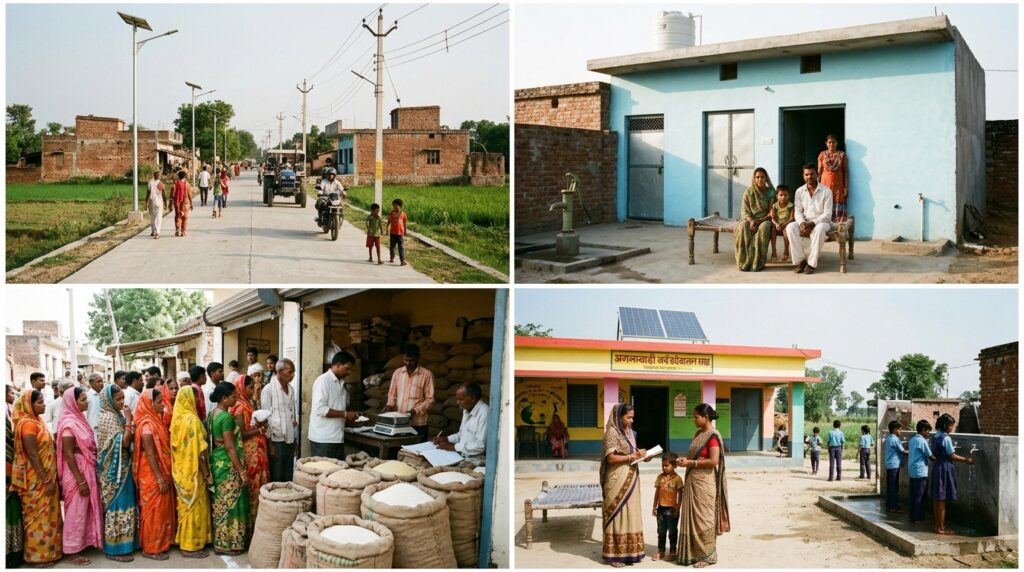
Several factors contributed to the reduction, including rising household consumption, employment growth, social transfers, subsidised food distribution and improved access to essential services.
India’s food distribution programmes have helped protect vulnerable households against food insecurity. These interventions are particularly important for families whose earnings remain low or irregular.
The expansion of infrastructure and basic services has also contributed to improvements in living conditions.
However, poverty reduction should not be confused with the elimination of economic hardship.
India continues to face informal employment, substantial regional disparities, unequal access to quality education and healthcare, and significant differences in income and opportunity.
The World Bank’s assessment also highlights continuing wage disparities and the uneven distribution of economic benefits.
Pakistan’s experience provides a contrasting picture.
Its national poverty rate declined considerably during the early 2000s and reached approximately 21.9% in 2018–19.
However, progress subsequently stalled and reversed.
The World Bank’s October 2026 assessment places national poverty at 29% in 2024–25, compared with 22% in 2018–19.
Importantly, the deterioration was not simply a consequence of slow economic growth.
The World Bank identifies weak employment generation, high inflation, declining real wages and a worsening distribution of consumption as important contributing factors.
More than half of the increase in poverty reflected a deterioration in how household consumption was distributed.
This is an important distinction.
An economy may continue producing goods and services while many households become less able to afford basic necessities.
For ordinary families, economic development is not an abstract statistical achievement. It means being able to purchase food, educate children, obtain medical treatment and maintain a reasonable standard of living.
The two countries’ experiences demonstrate why poverty reduction must remain a central measure of development rather than being treated as a secondary consequence of economic growth.
4. Productive Capacity: Why Economic Diversification Matters
A country’s economic strength depends not simply on how much it produces, but also on what it produces, how efficiently it produces it and whether those products can compete in international markets.
India has developed a relatively diversified economy.
Its major economic strengths include:
- Information technology and business services.
- Pharmaceutical manufacturing.
- Automobile and engineering industries.
- Chemicals and industrial machinery.
- Electronics and telecommunications.
- Financial and professional services.
- Agriculture and food-related industries.
The services sector has become particularly important.
Indian technology companies provide software development, business-process services, engineering support and other professional services to international clients.
These activities generate export earnings while creating employment for skilled workers.
India’s pharmaceutical industry has also established an important international position, particularly in generic medicines and pharmaceutical manufacturing.
Manufacturing remains an important part of India’s development strategy.
Government initiatives, including production-linked incentive programmes, have attempted to attract investment, increase domestic production and strengthen industrial supply chains.
Their success varies across sectors, and announced investment should not automatically be treated as completed productive capacity.
Nevertheless, India has developed a broader industrial and services base than Pakistan.
Pakistan also has established competitive businesses.
Its textiles, surgical instruments, sports goods, agricultural products and information technology services demonstrate that the country possesses entrepreneurial and technical capabilities.
The problem is not an absence of business talent.
The challenge is converting these capabilities into sustained industrial expansion, higher productivity, diversified exports and greater international competitiveness.
This distinction is important because the next instalment of our investigation will examine the financial pressures facing Pakistan, while the third will investigate industrial and productive decline in considerably greater detail.
For the present comparison, the central observation is that India’s economic diversification has given it a wider range of income-generating activities and export opportunities.
Pakistan has yet to develop comparable breadth.
5. Infrastructure, Agriculture and Technology: Different Levels of Opportunity
Infrastructure is another important factor separating economic potential from actual economic performance.
India has invested heavily in highways, expressways, railways, airports, ports, electricity generation and digital connectivity.
These investments have helped improve transportation, connect markets and support commercial activity.
The expansion has not been uniform. Some regions still experience inadequate infrastructure, congestion, unreliable services and serious environmental pressures.
Nevertheless, improved connectivity has supported the development of larger domestic markets and industrial centres.
Pakistan also possesses significant infrastructure.
The Indus Basin irrigation system, major ports, highways, motorways and existing electricity installations provide an important foundation for economic activity.
Its geographical position offers access to South Asian, Central Asian, Middle Eastern and international markets.
However, possessing infrastructure is not the same as using it efficiently.
Electricity affordability, reliability, transmission capacity, transportation costs and the condition of commercial logistics all influence the competitiveness of businesses.
India faces energy-security challenges of its own, including substantial fossil-fuel dependence and growing energy demand.
Neither country has completely resolved its infrastructure and energy difficulties.
The relevant comparison is how effectively infrastructure investment is translated into productive economic activity.
Agriculture remains another major area of opportunity.
Both countries have large agricultural populations, extensive cultivation areas and important food-producing regions.
India has developed substantial agricultural production, food procurement, storage and distribution systems.
Pakistan possesses the Indus River irrigation network and produces wheat, rice, cotton, sugarcane, fruits, vegetables and livestock products.
Yet agricultural production alone does not determine the economic value generated by a farming sector.
Storage, refrigeration, processing, packaging, transportation and access to international markets all influence the final value of agricultural output.
Pakistan has opportunities to increase the value of its agricultural production through better processing, reduced post-harvest losses and more efficient water management.
India has also struggled with fragmented landholdings, inadequate farm incomes, water stress and climate vulnerability.
The lesson is not that one country has solved agricultural development.
It is that both need to move beyond measuring success solely by crop production and to examine the value generated throughout the agricultural supply chain.
Technology presents a further contrast.
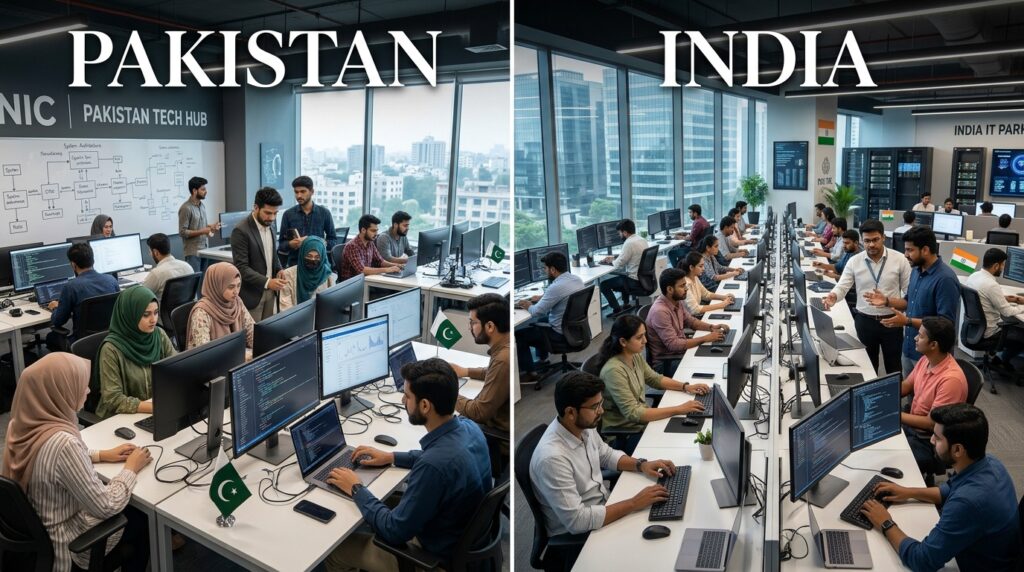
India’s IT industry has developed through decades of technical education, private investment, international business relationships and specialised technology clusters.
Its digital public infrastructure, including Aadhaar identification and the Unified Payments Interface, has also expanded access to digital services and payments.
These systems have attracted international attention, although concerns about privacy, cybersecurity, exclusion and implementation remain.
Pakistan has made progress in software services, telecommunications, mobile banking, digital payments and freelance work.
Its young population offers considerable potential.
The challenge is to provide a reliable environment in which technology businesses can grow, receive international payments, access markets and employ skilled professionals.
The broader lesson is that technology becomes an economic advantage when it improves productivity, expands access and generates sustainable commercial opportunities.
6. Political and Institutional Continuity: Why Long-Term Development Matters
Economic development requires decisions whose results may take years or even decades to become visible.
A highway, industrial facility, research institution, university or energy project cannot always deliver its full economic benefits within the tenure of a single government.
India has experienced intense political competition, changes of government, regional disagreements and substantial policy controversies.
Nevertheless, important elements of its economic transformation have continued across successive administrations.
Infrastructure expansion, digital systems, economic liberalisation and the development of private-sector industries have benefited from a degree of continuity.
This does not mean every Indian policy has been consistent or successful.
It means that certain broad economic priorities have survived political transitions.
Pakistan has faced greater difficulties in maintaining a predictable long-term development direction.
Changes in government have frequently led to changes in economic priorities, investment incentives, taxation arrangements, and administrative approaches.
Political instability and institutional disagreements have contributed to uncertainty.
Businesses planning long-term investments need predictable rules. They must be able to estimate future costs, assess regulatory requirements and judge whether government policies will remain reasonably stable.
When the business environment becomes unpredictable, investors may delay expansion or choose activities requiring shorter planning periods.
However, policy continuity alone is not enough.
A government can maintain an economically damaging policy for decades just as easily as it can maintain a successful one.
What matters is continuity of sound policies, supported by accountable institutions, reliable administration and the capacity to correct mistakes.
Pakistan’s challenge is to establish a broadly agreed national development direction that does not change fundamentally with every political transition.
7. The Regional Lesson: Economic Potential Must Become Public Progress
The comparison between India and Pakistan is not an argument about which country is inherently more capable.
Both possess significant human resources, agricultural potential, entrepreneurial communities and geographical advantages.
Both have experienced economic difficulties, political disputes, inequality and uneven development.
India’s achievements deserve recognition, but its problems should not be overlooked.
Its economy continues to face informal employment, unequal access to quality public services, regional disparities, environmental pressures and the challenge of creating sufficiently productive jobs for its enormous workforce.
The World Bank itself has emphasised that India must sustain substantial investment and improve employment opportunities if it hopes to achieve its ambition of becoming a high-income economy by 2047.
Pakistan’s difficulties, meanwhile, should not obscure the country’s genuine strengths.
Its agricultural base, established export industries, strategic location, natural resources, educated professionals and expanding digital sector offer opportunities for development.
But potential is not the same as achievement.
The important question is why these resources have not consistently produced higher productivity, stronger exports, more employment and improved household incomes.
This is where the comparison becomes particularly useful.
India’s experience demonstrates the value of economic diversification, sustained investment, expanding productive sectors and combining growth with social interventions.
Pakistan needs to understand these developments in the context of its own economic circumstances rather than simply adopting another country’s policies.
There is no single Indian formula that Pakistan can copy.
The two countries have different institutional arrangements, market structures, population characteristics and economic constraints.
But the evidence does show that development requires more than natural resources, geographical advantages or periodic economic expansion.
It requires the capacity to convert these advantages into sustained improvements in people’s lives.
Conclusion: The Real Measure of Economic Success
India’s reduction in measured poverty represents a substantial development achievement.
It has expanded its economic scale, developed globally competitive services, strengthened parts of its manufacturing base and improved access to essential services.
It has not eliminated poverty or resolved its inequalities, but its progress deserves serious examination.
Pakistan, meanwhile, has struggled to sustain earlier poverty reduction and build an economy capable of generating sufficiently broad-based improvements in household welfare.
The comparison points to important differences in economic diversification, productivity, infrastructure, institutional continuity and the ability to translate growth into better living standards.
However, this is only the beginning of a much larger investigation.
Economic scale does not explain why Pakistan repeatedly experiences financial instability. Industrial comparisons alone do not explain why productive investment remains constrained. Nor can poverty statistics reveal the full relationship between public policy, institutional incentives and the distribution of economic opportunity.
These questions require separate and deeper investigations.
The next instalments of this series will examine Pakistan’s national debt and recurring financial instability, the decline in productive capacity, the employment and migration challenges facing its younger population, and the institutional interests influencing economic decision-making.
Ultimately, the purpose is not to establish that Pakistan should become another India.
It is to understand why two neighbouring countries, beginning with many comparable developmental challenges, have followed such different economic trajectories.
A nation’s economic success should not be judged merely by the size of its economy, the value of its infrastructure or the wealth accumulated by a section of its population. It should be judged by whether ordinary citizens can live with dignity, find meaningful work, educate their children and look towards the future with reasonable confidence.
Pakistan still has the resources and human potential to achieve that objective. The question is whether it can build the institutions, policies and productive foundations necessary to turn that potential into reality.
Frequently Asked Questions
1. How much has India reduced poverty?
According to the World Bank’s October 2025 Poverty and Equity Brief, India’s poverty rate at the $4.20 international lower-middle-income poverty line declined from 57.7% in 2011–12 to 23.9% in 2022–23. Extreme poverty, measured at $3 per day, fell from 27.1% to 5.3%.
2. Is poverty increasing in Pakistan?
Yes. The World Bank’s October 2026 Poverty and Equity Brief reported that Pakistan’s national poverty rate increased from 22% in 2018–19 to 29% in 2024–25, affecting approximately 70 million people.
3. Why is India’s economy much larger than Pakistan’s?
India benefits from a larger population and domestic market, a more diversified services sector, substantial manufacturing capabilities, infrastructure investment and stronger integration into international markets. Its economic reforms since 1991 also played an important role.
4. Has India eliminated poverty and unemployment?
No. Despite substantial poverty reduction, India continues to face informal employment, wage disparities, regional inequalities, underemployment and unequal access to quality healthcare and education.
5. Can Pakistan follow India’s development model?
Pakistan can learn from India’s experience in economic liberalisation, infrastructure, technology, manufacturing and poverty reduction. However, its policies must reflect its own economic structure, institutional circumstances and development priorities.
6. What is the central lesson Pakistan can learn from India?
Economic potential must be converted into productive investment, diversified employment, competitive industries and measurable improvements in household welfare. Economic growth alone is not enough.
References and Further Reading
- World Bank: India Poverty and Equity Brief, October 2025.Poverty reduction, household consumption, employment and inequality.https://documents1.worldbank.org/curated/en/099722104222534584/pdf/IDU-25f34333-d3a3-44ae-8268-86830e3bc5a5.pdf
- World Bank: Pakistan Poverty and Equity Brief, October 2026.National poverty trends, household welfare and distribution of consumption.https://documents.worldbank.org/en/publication/documents-reports/documentdetail/099255104222573036
- World Bank: India Country Overview.Economic development, infrastructure, services and poverty reduction.https://www.worldbank.org/ext/en/country/india
- World Bank: World Development Indicators, India and Pakistan.GDP, GDP per capita, economic growth and other comparative indicators.https://data.worldbank.org/?locations=IN-PK
- World Bank: June 2025 Update to Global Poverty Lines.Explanation of revised international poverty thresholds and purchasing power parity.https://www.worldbank.org/en/news/factsheet/2025/06/05/june-2025-update-to-global-poverty-lines
- World Bank: India, Trends in Poverty from 2011–12 to 2022–23.Methodology and household consumption survey data.https://documents.worldbank.org/en/publication/documents-reports/documentdetail/099060325033540333
- World Bank: Pakistan Development Update, October 2025.Historical poverty trends and the limitations of Pakistan’s consumption-driven growth model.https://www.worldbank.org/en/brief/2025/10/29/q-as-on-pakistan-development-update-staying-the-course-for-growth-and-jobs-october-2025
- World Bank: India’s 1991 Economic Reforms and Industrial Policy.Background on economic liberalisation and industrial development.https://documents1.worldbank.org/curated/en/101321549556073308/pdf/WPS8731.pdf
Author
Maj Hamid Mahmood (Retired) holds an MA in Political Science, an LLB, and a Postgraduate Diploma in Human Resource Management (PGD-HRM). His academic and professional background supports his research-based writing on politics, law, governance, public policy, and global affairs.
Editorial Note
This is Article 1 of a six-part investigative series examining Pakistan’s economic challenges, their historical and structural causes, their consequences for ordinary citizens and the possibilities for economic transformation.
Next instalment: Pakistan’s National Debt and Financial Instability: Why Does the Country Keep Returning to the IMF?