
The US Hormuz Trap: The Blockade Risks Dual Chokepoint Oil Shock
The US Hormuz Trap: The Blockade Risks Dual Chokepoint Oil Shock. Less than 24 hours after the US Navy enforced a naval blockade on Iranian ports, oil prices have surged past $100–103 per barrel before partially easing on talk of resumed negotiations. Saudi Arabia is urgently pressing Washington to lift the blockade amid fears of Houthi retaliation at Bab al-Mandeb.
This investigative analysis examines the mechanics, risks, and global implications of the escalating crisis.
https://mrpo.pk/the-architecture-of-attrition/
Purpose of the Article
This research-driven piece provides a factual, evidence-based overview of the US naval blockade on Iran (effective April 13, 2026), Iran’s response options, exposed US vulnerabilities, and the looming threat of a dual-chokepoint disruption involving Bab al-Mandeb. It aims to help readers understand the high-stakes geopolitical and economic consequences in real time.
Executive Summary
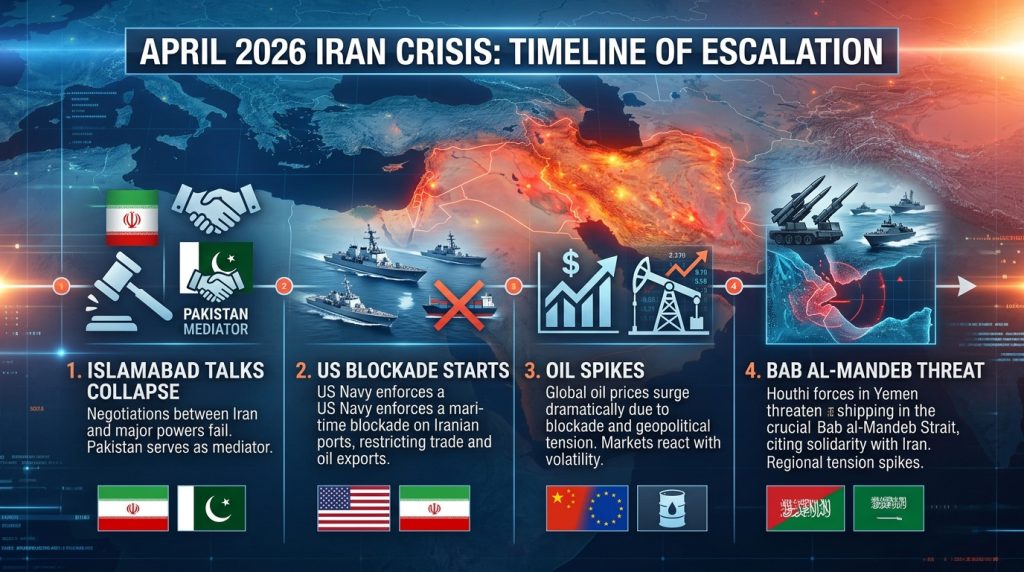
The US naval blockade of all maritime traffic to and from Iranian ports began at 10 a.m. ET on April 13, 2026, following the collapse of peace talks in Islamabad, Pakistan. CENTCOM states the operation targets Iranian ports while allowing transit to non-Iranian destinations through the Strait of Hormuz.
Brent crude spiked more than 7% to over $102–103 per barrel initially, with reports of tankers diverting and Saudi lobbying for de-escalation. Iran has labelled the move “piracy,” while senior advisers have threatened horizontal escalation via Houthis at the Bab al-Mandeb Strait, the “Gate of Tears.”
This is a calculated economic coercion strategy that risks triggering a broader global energy shock by disrupting 20–25% of efficient oil and trade routes.
Strategic Chokepoint Control in Maritime Energy Networks
Energy security frameworks traditionally evaluate supply chains through infrastructure vulnerability assessments rather than immediate crisis response mechanisms. The global petroleum distribution system relies on narrow maritime passages where single-point failures can cascade across international markets within hours. A potential US blockade on the Strait of Hormuz would represent one of the most significant disruptions to these critical networks, affecting global oil price movements and supply chains.
These chokepoints represent structural weaknesses in energy architecture that extend far beyond regional political dynamics. Understanding how naval control affects commodity flows requires examining the intersection of military capability, international law, and market psychology. When major powers project force near critical shipping lanes, the resulting disruption patterns reveal underlying dependencies that peacetime analysis often overlooks.
Background: Anatomy of the Blockade
President Trump ordered the blockade after weekend talks failed to persuade Iran to fully reopen the Strait of Hormuz. At least 13–15 US warships, supported by carrier strike groups, are enforcing interdiction, boarding, and diversion of vessels bound for Iranian ports in the Persian Gulf, Gulf of Oman, and Arabian Sea approaches.
Early developments include tanker reversals and Chinese-linked vessels testing the waters. The operation aims to cut Iran’s oil export revenue (previously ~1.5–2 million barrels per day) without a full-scale invasion.
The US Hormuz Trap: Key Trigger
The blockade followed Iranian restrictions on Hormuz traffic and the breakdown of US-Iran negotiations hosted by Pakistan.
Iran’s Four Strategic Options
Iran has shown remarkable resilience through the 8-year Iran-Iraq War, the June 2025 US-Israel conflict, and the ongoing war since February 28, 2026. The blockade tests whether rapid economic pressure can overcome this endurance.
- Conventional Military Challenge
Direct use of anti-ship missiles, drones, or fast boats against US enforcement vessels (lower probability due to US naval superiority).
- Asymmetric/Proxy Escalation (Highest Risk Path)
Activating Houthis to disrupt shipping at Bab al-Mandeb. Iranian advisers, including Ali Akbar Velayati, have explicitly warned that the “Resistance Front” views Bab al-Mandeb the same as Hormuz.
- Diplomatic Leverage
Seeking political cover from China and Russia, plus renewed mediation through Pakistan.
- Economic Resilience and Outlasting
Shadow fleet smuggling, strategic reserves, and barter deals with allies to weather the pressure.
“If the situation gets out of control, Iran’s allies will also close the Bab el-Mandeb Strait.” Senior Iranian adviser.
Trump Administration’s Anticipated Coercion via Naval Blockade: Rationale vs. Iran’s Proven Resilience (April 14, 2026)
The Trump administration’s decision to enforce a naval blockade on all maritime traffic to/from Iranian ports (effective 10 a.m. ET, April 13, 2026) is explicitly framed as targeted economic coercion, not full-scale war to force Iran back to the negotiating table on U.S. terms (nuclear concessions, full reopening of the Strait of Hormuz, and revised peace deal). President Trump and senior officials argue the blockade will succeed where broader military campaigns have not, by immediately strangling Iran’s oil revenue lifeline.
This view persists despite Iran’s documented resilience across three conflicts: the 8-year Iran-Iraq War (1980–1988, with U.S./European backing of Iraq), the June 2025 joint U.S.-Israel war, and the ongoing war that began February 28, 2026 (Operation Epic Fury phase).
Trump Administration’s Core Logic: Why this blockade is expected to “Budge” Iran
administration statements and supporting analyses emphasize that the blockade is qualitatively different from past prolonged wars:1. Direct & Immediate Strike on Economic Lifeline
Iran’s oil exports (1.5–2.1 million barrels/day pre-blockade, generating $139 million daily) account for >50% of exports and nearly all government hard-currency revenue. Over 90% flow through Kharg Island (Persian Gulf terminal). The blockade severs this within days no viable short-term alternatives exist for large tankers. Analysts aligned with the strategy (e.g., Brookings’ Robin Brooks) describe it as “imploding Iran’s economy” faster than sanctions alone ever could, triggering currency devaluation, hyperinflation, and food/fuel shortages within weeks.
2. Post-War Weakening + Sanctions Fatigue
Prior U.S.-Israeli strikes (Feb–April 2026) damaged infrastructure, missile production, and military logistics. Combined with years of sanctions, Iran’s economy was already contracting (projected 10% shrinkage in 2026). The blockade exploits this vulnerability: unlike the 1980s war (where Iran adapted via human-wave tactics and domestic production) or 2025 (shorter, less economically targeted), this is calibrated economic pressure while Iran’s conventional navy is “obliterated” and its shadow fleet is now interceptable.
3. Flip the Script” on Leverage
Iran had been charging tolls” and restricting Hormuz traffic (20% of global oil). The U.S. blockade denies Iran revenue while preserving transit for non-Iranian ports, turning Iran’s own chokepoint tactic against it. Trump has stated Iran “wants to work a deal” post-announcement, signaling early psychological pressure. The goal is a short, decisive squeeze to avoid prolonged engagement.
4. U.S. Naval Superiority Enables Low-Risk Enforcement
With 15+ warships (including carrier strike groups), mine-clearing assets, and rules of engagement allowing interdiction/diversion, the U.S. can sustain the operation without ground invasion. Officials view it as “coercion at sea” precise, reversible, and politically preferable ahead of 2026 midterms.
Trump’s public posture (Truth Social, White House remarks) frames this as maximum pressure 2.0: Iran’s “desperation” will grow as oil money dries up, forcing concessions without repeating the “quagmire” of earlier phases.
Contrast with Iran’s Historical Resilience Why Skeptics Doubt It Will Work
- Iran has repeatedly demonstrated endurance:
1980–1988 Iran-Iraq War: Survived 8 years of attrition, chemical attacks, and Western-backed Iraq through asymmetric tactics, domestic mobilization, and smuggling.
June 2025 U.S.-Israel conflict: Absorbed strikes yet maintained missile/drone capabilities and proxy networks.
Feb 28–April 2026 war: Despite infrastructure hits, Iran adapted via proxies (Houthis), shadow fleet exports, barter deals with China/Russia, and “out-crazy” horizontal escalation.Experts (including former U.S. officials like Wendy Sherman) argue Iran “can outlast” another blockade through smuggling, reserves, overland routes, and asymmetric retaliation (Bab al-Mandeb disruption, cyber, mines). Regime consolidation under pressure is a proven pattern; bending now would signal weakness.
Research-Based Possibilities: Why the Administration Believes It Differs This Time
Speed of Pain: Past wars allowed gradual adaptation; this blockade hits revenue in days, not years.
Allied/Neutral Pressure: China (Iran’s top buyer) and Gulf states are already signaling impatience; Pakistan-mediated talks provide an off-ramp.
Internal Calculus: Tehran’s post-war economic damage (105%+ food inflation, 140% bread price surge) may lower the “outlasting” threshold.
Political Timing: Trump seeks quick leverage before midterms; a prolonged stalemate risks domestic backlash.Most Probable Outcome (per analysts): Short-term Iranian economic pain forces renewed talks (possibly via Pakistan), but full concessions remain uncertain if proxies escalate or China provides lifelines. Failure risks a “staring contest” where global oil prices stay elevated ($100+/barrel).
Implications
US: Gains negotiating leverage and Hormuz control but faces higher domestic fuel prices, midterm political costs, and stretched naval resources.
Europe: Energy inflation and supply risks accelerate strategic autonomy push.
World: Sustained oil shock (2M bpd off-market) raises recession fears; multipolar tensions grow if China/Russia deepen ties with Iran.
Most Affected Countries:Pakistan: Mediator prestige but acute import shock, rupee pressure, CPEC delays.
China/India: Higher costs, industrial slowdowns; China gains long-term leverage.
Gulf States (Saudi/UAE): Fear Houthi retaliation on alternatives; actively lobbying for de-escalation.Events remain fluid , watch IRGC responses, oil-market data, and any fresh diplomatic signals in the next 48–72 hours. The blockade tests whether economic speed can overcome Iran’s historic staying power.
US Vulnerabilities Exposed
The conflict has highlighted several structural challenges for the United States:
- Political Leadership: The decision-making process has been characterised as highly centralised and reactive. Trump announced the blockade via Truth Social shortly after the Islamabad talks failed, bypassing broader inter-agency or allied consultation in the public narrative. Critics note that warnings from senior officials (including Joint Chiefs of Staff members) about escalation risks were reportedly downplayed.
- This has fueled perceptions of a high-stakes gamble that prioritises short-term leverage over sustained strategic consensus, especially as the blockade is described by experts as a “major, open-ended military endeavour” with unpredictable escalation potential.
- Intelligence Shortfalls: US intelligence assessments significantly underestimated Iran’s pre-war capabilities and resilience. Pre-conflict estimates (e.g., from 2022–2025) undercounted Iran’s ballistic missile arsenal by more than 1,000 systems, with range and precision figures off by as much as 50%. Post-strike damage assessments have also been revised downward; only about one-third of the arsenal was confirmed destroyed despite claims of broader success.
- Underground facilities and rapid production rates (50+ missiles per month) were not fully anticipated. Analysts describe this as a broader “intelligence failure” where accurate warnings about a potential quagmire were available but disregarded in favour of optimistic assumptions, leading to a more protracted conflict than initially projected.
- Military Strain and Fatigue: Command Changes, Morale, and Extended Fatigue. The war has imposed significant operational strain on U.S. forces. Multiple carrier strike groups, Marine Expeditionary Units, and additional warships have been surged into the region, including extensions of service for ageing assets like the USS Nimitz (originally slated for decommissioning). The Hormuz blockade itself is viewed as a high-risk “kill box” environment vulnerable to Iranian anti-ship missiles, drones, mines, and fast boats.
- Pentagon figures from the earlier combat phase (Operation Epic Fury) report 13 U.S. troops killed and 346 wounded.
- Command-level debates have surfaced publicly (e.g., warnings from senior generals against certain regime-change elements), and sustained deployments risk fatigue across the Navy and Air Force, with experts warning that prolonged blockade enforcement could limit readiness for other global contingencies. Morale impacts are not quantified in open sources but are implied by the strain of open-ended operations in a confined, contested waterway.
Eroding European Alliances: European NATO allies have largely distanced themselves from direct military support. Key nations (including Germany, France, Spain, Italy, and the UK) have restricted U.S. use of airspace, bases, and overflight rights for offensive operations; some have explicitly refused to participate in the Hormuz effort during active hostilities. Trump has publicly criticised NATO as a “paper tiger” and accused allies of cowardice, while European leaders emphasise that the conflict is not a NATO obligation and prioritise diplomacy or post-ceasefire stabilisation roles (e.g., a UK-led coalition for future Hormuz security). - This has exposed fractures in transatlantic trust, with Europe providing only limited logistical or defensive support while focusing on mitigating economic fallout at home.
- Economic Blowback: Rising domestic fuel prices are feeding into inflation concerns.
The blockade has already driven immediate oil price spikes (Brent crude up 4–8% to ~$99–104+/barrel in early trading), exacerbating global energy volatility and raising U.S. consumer fuel costs. Longer-term risks include broader supply disruptions (20% of global oil trade via Hormuz) and inflation pressures. The administration’s strategy relies on Iran feeling the economic pain first, but sustained high energy prices are feeding back into U.S. domestic costs, complicating the narrative of a low-risk pressure campaign.
- 2026 Midterm Election Pressure: GOP strategists worry about voter backlash from sustained high energy costs.Impact on 2026 Mid-Term Elections. With November 2026 midterms approaching, Republican leaders and strategists privately worry that the war, particularly if the blockade prolongs high gas prices and economic uncertainty, will damage GOP prospects in the House and Senate. Pre-existing forecasts already anticipated difficult races; the conflict is now cited internally as a factor that “almost cements” losses, with voters’ economic outlook cited as a dominant concern.
-
Public analyses describe the war as an added burden that puts more Republican seats at risk, especially if no swift resolution emerges. Democrats are positioned to highlight the costs without ownership of the decisions.
The US Hormuz Trap: Global and Regional Ripple Effects
The blockade and potential escalation carry wide-reaching consequences:
- US: Short-term negotiating leverage but higher consumer costs and stretched naval resources.
- Europe: Energy inflation and supply risks via the Red Sea–Suez corridor.
- World Economy: Recession fears from sustained oil price volatility and shipping disruptions.
- Pakistan: Diplomatic mediator role alongside acute fuel import shocks, rupee pressure, and impacts on CPEC projects.
- China and India: Higher import bills for energy; China gains long-term strategic leverage.
- Gulf States (Saudi Arabia, UAE): Severe risk if Bab al-Mandeb is disrupted, as Saudi Arabia has rerouted exports to Yanbu on the Red Sea.
The Bab al-Mandeb Threat: Iran’s Houthi “Trump Card” and Dual-Chokepoint Risks
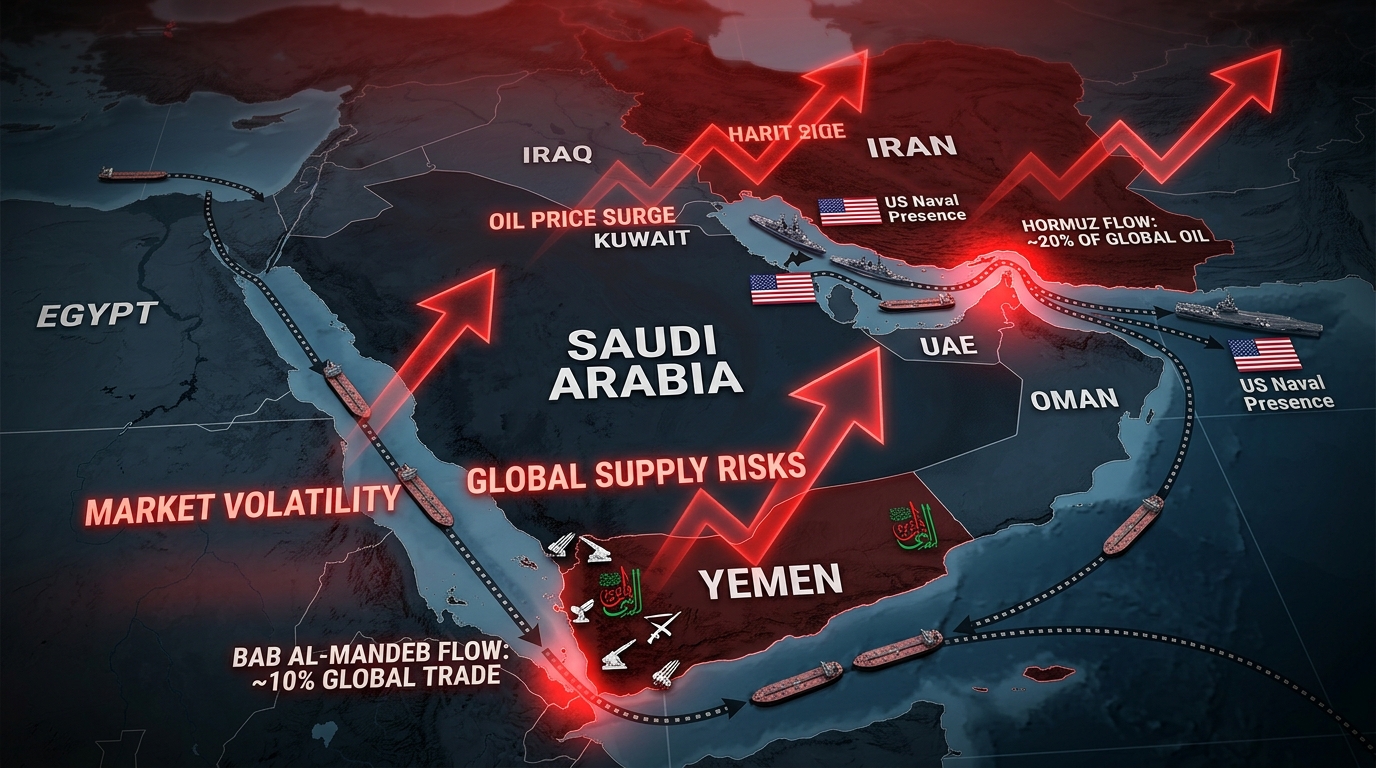
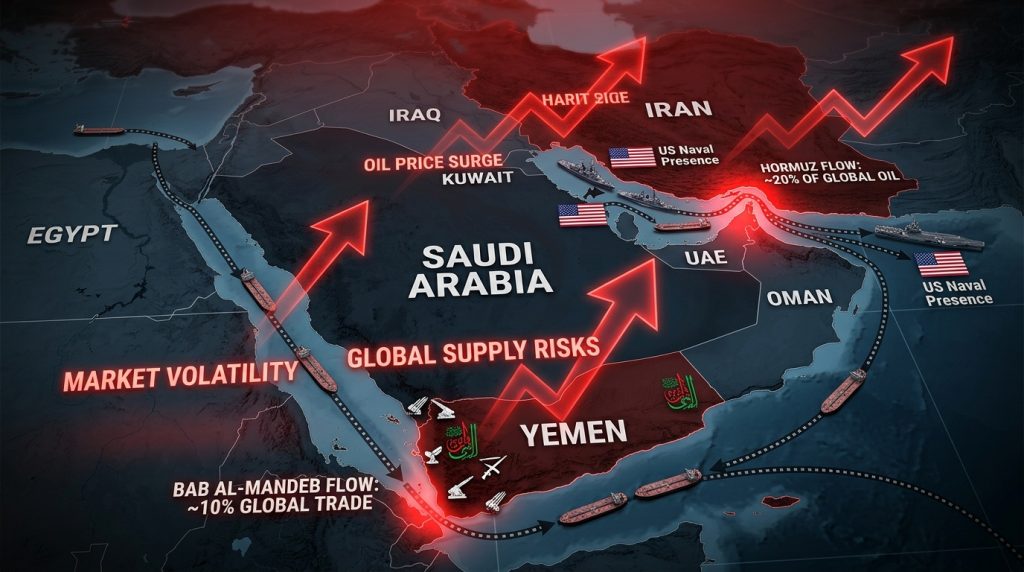
The Bab al-Mandeb Strait (“Gate of Tears”) connects the Gulf of Aden to the Red Sea and handles ~10–15% of global seaborne oil and trade. Houthis, who control Yemen’s western coastline, have previously demonstrated their ability to halve traffic through drone, missile, and small-boat attacks.
Possibility of Houthis Closing/Disrupting the Bab al-Mandeb Strait (as of April 14, 2026)
The Bab al-Mandeb Strait (also spelt Bab el-Mandeb or “Gate of Tears”) is the narrow chokepoint (18–32 km wide at its narrowest) connecting the Gulf of Aden to the Red Sea. It is a vital artery for ~12–15% of global maritime trade by value and ~10% of seaborne oil/petroleum products. Saudi Arabia has increasingly relied on it as an alternative export route (via Yanbu port on the Red Sea) after Iranian actions restricted the Strait of Hormuz.
Current Status (April 14, 2026): The strait remains open but high-risk. Commercial shipping continues, though at reduced volumes and with elevated insurance premiums and rerouting by some vessels (e.g., US carrier strike groups like the USS George H.W. Bush are sailing around Africa to avoid the Red Sea). No full-scale Houthi attacks on commercial shipping have been reported in the last 48 hours, but the threat level has escalated sharply since the US naval blockade of Iranian ports began on April 13.
Possibility of Closure/Disruption: A literal full naval blockade (permanent physical closure) by the Houthis is low probability, as they lack the conventional surface fleet or minesweeping denial capability for sustained control. However, an effective disruption (making passage commercially unviable through sustained asymmetric attacks) is medium-to-high probability and rising rapidly in direct response to the US Hormuz blockade.
Why feasible: The Houthis already demonstrated this playbook in 2023–2025 (Gaza war era), launching 100+ drone/missile/small-boat attacks that halved traffic through the strait (from 9.3 million bpd pre-crisis to ~4.1–4.2 million bpd). They control Yemen’s western coastline overlooking the strait and have Iranian-supplied weapons (anti-ship missiles, drones, naval mines). Senior Houthi officials and Iranian advisers (including Ali Akbar Velayati and IRGC-linked sources) have explicitly called Bab al-Mandeb a “Yemeni option” and “trump card” to retaliate against US/Israeli escalation or the Hormuz blockade.
Timing trigger: Iran is actively pressing the Houthis to escalate now that the US blockade is in force. Arab officials (including Saudi) confirm Iran is signalling the group to resume attacks on shipping or impose “tolls.” Analysts (WSJ, Al Jazeera, Fox News) describe it as Iran’s most credible asymmetric counter to the blockade.
Current signals: Houthis have resumed missile strikes on Israel (March 28 onward) and issued fresh warnings. They have not yet launched shipping attacks in the last week, but restraint appears tactical; the threat itself is leverage. A full activation could occur within days if Iran feels economic pain from the blockade.
Most likely scenario (next 7–14 days): Sporadic or targeted attacks on US/Israeli-linked vessels or Gulf oil tankers, creating a de facto “insurance blockade” rather than total shutdown. This mirrors their successful 2023–2024 campaign.
Impacts if the Houthis Disrupt or Effectively Close Bab al-Mandeb
Gulf Countries (Saudi Arabia, UAE, and others)
Severe and immediate: Saudi Arabia diverted the majority of its crude exports to the Red Sea (Yanbu) after Hormuz disruptions began in late February 2026. A Bab al-Mandeb shutdown would strand ~7 million bpd of Saudi output, forcing ultra-long Cape of Good Hope reroutes (adding 3,500–6,000 nautical miles and 2–3 weeks). This is exactly why Saudi Arabia is urgently pressing the US to lift the Hormuz blockade.
UAE and other Gulf exporters: Similar export/import hits; higher risk of direct Houthi strikes on energy infrastructure (as occurred previously).
Broader effects: Revenue collapse, budget strain, and accelerated diplomatic push for de-escalation. Gulf states have secured temporary Houthi assurances not to target them directly but view the situation as “fluid.”
The World (and compounded by the Hormuz crisis)
Energy markets: Dual-chokepoint crisis (Hormuz + Bab al-Mandeb) could remove 20–25% of global oil/gas supply from efficient routes. Oil prices, already up 4–8% since the Hormuz blockade, could surge toward $120–140+/barrel. Bloomberg Economics and other analysts warn of the “sum of all fears” scenario.
Shipping and trade: 12–15% of global maritime traffic affected. Rerouting around Africa spikes freight rates 20–30%+, insurance premiums, and transit times → global supply-chain delays, higher consumer prices, and inflation.
Europe: Heavy reliance on Gulf oil/LNG via Red Sea–Suez route → acute energy shortages, higher heating/transport costs, and slower growth.
Asia (China, India, South Korea, Japan): Longer routes increase import bills; industrial slowdowns.
Global economy: Heightened recession risks, especially if prolonged. The 2023–2024 Houthi campaign already proved this model works; a repeat on top of Hormuz would amplify the shock.
US, Europe, and Broader Geopolitical Implications
US: Naval resources stretched across two theatres; higher operational costs and domestic fuel-price pain ahead of midterms.
Europe: Accelerates strategic autonomy push and criticism of US policy.
Most affected third countries: Pakistan and India face compounded fuel-import shocks (already strained by Hormuz effects); China gains leverage but suffers energy security hits.
Bottom line (research outlook): The Houthis have both the capability and stated intent to disrupt Bab al-Mandeb as Iran’s preferred “horizontal escalation” tool. Full closure is unlikely, but effective disruption is a very real near-term risk that Saudi Arabia is treating as an existential economic threat. This is why Gulf pressure on Washington is intensifying within hours of the Hormuz blockade taking effect.
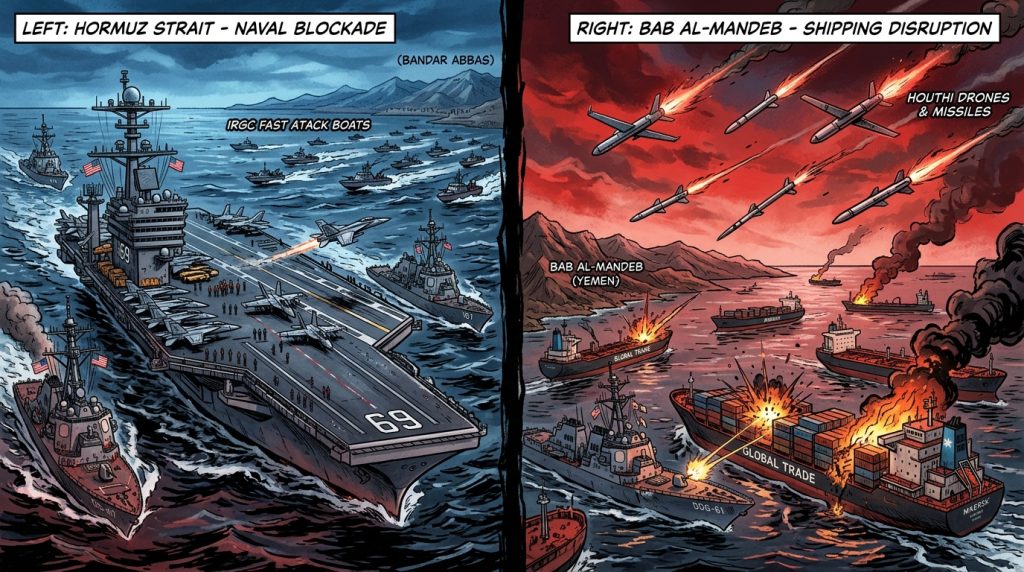
The US Hormuz Trap: The Bab al-Mandeb Threat: Iran’s Houthi “Trump Card” and Dual-Chokepoint Risks
Can economic pressure overcome Iran’s proven resilience, or will a second chokepoint turn a calculated gamble into a broader crisis?
Future Scenarios and Outlook
Optimistic Scenario
Quick Iranian concessions via renewed Pakistan-mediated talks lead to partial lifting of the blockade.
Base Case
Prolonged asymmetric and diplomatic standoff with sustained elevated energy prices.
Pessimistic Scenario
Houthi activation at Bab al-Mandeb, combined with great-power involvement, escalates into a wider crisis.
Pakistan’s role as a neutral mediator remains one of the most viable off-ramps. Events are fast-moving — monitor shipping trackers, oil markets, and official statements in the coming days.
Conclusion
The Hormuz blockade represents a high-stakes gamble by the US to coerce Iran through economic pressure. However, the real danger lies in the potential for a dual-chokepoint crisis involving Bab al-Mandeb. In today’s multipolar world, disruptions at these narrow straits could reshape global energy security, alliances, and economic stability for years ahead.
Frequently Asked Questions (FAQs)
What is the US naval blockade of Iran?
It targets all vessels entering or exiting Iranian ports and coastal areas while permitting transit through the Strait of Hormuz to non-Iranian ports. Enforcement began on April 13, 2026.
Why is Bab al-Mandeb now a major concern?
Houthis could disrupt the strait as retaliation, threatening Saudi Arabia’s Red Sea export route and compounding the Hormuz crisis into a dual-chokepoint shock.
How high could oil prices rise?
Prices have already exceeded $100–103 per barrel; analysts warn of $120–140+ in a full dual-chokepoint scenario.
Will Europe or NATO support the blockade?
Most European allies have distanced themselves, restricting use of bases and overflights for offensive operations.
How does this affect Pakistan?
Pakistan gains diplomatic visibility as a mediator but faces severe fuel import costs, inflation, and potential delays to CPEC-related projects.
Is the US blockade legal under international law?
The US describes it as a lawful belligerent measure during conflict; Iran calls it “piracy” and a violation of the ceasefire. The legal debate continues internationally.
References
- Wall Street Journal: Saudi Arabia Pressing U.S. to Drop Hormuz Blockade (April 2026)
- Al Jazeera and Reuters: Oil Price Surge and Iran Blockade Coverage
- CENTCOM Statements and Notices to Mariners (April 13–14, 2026)
- Fox News and Think-tank Analyses on Houthi/Bab al-Mandeb Threats
- Live Market Data from Bloomberg, Guardian, and CNBC (April 14, 2026)
This article is for informational purposes and reflects developments as of April 14, 2026. Geopolitical situations evolve rapidly.