
The Friendship Crisis: Why the World Is Growing Lonelier and How We Can Rebuild Human Connection
When Connection Is Everywhere, but Friends Are Not

The Global Friendship Crisis: Why the World Is Growing Lonelier. We live in the most connected age in human history, yet millions of people quietly feel alone.
Our phones buzz nonstop. Our calendars are full. Our contact lists stretch endlessly.
And still, many of us pause at a simple question:
“Who would I really call if everything fell apart?”
For a growing number of people, the honest answer is: no one.
This is not a personal failure. It is a global pattern.
Welcome to the global friendship crisis, a slow, silent erosion of one of humanity’s most essential bonds.
A World With Fewer Close Friends
Research discussed in leading academic and business publications reveals a troubling trend:
- The number of adults reporting no close friends has risen sharply over the past few decades
- Those with large circles of close friends have declined significantly
- Urban societies report more social contact but less emotional closeness
- Solo activities like eating alone are becoming increasingly common
Even institutions of higher learning have taken notice. Universities are now offering formal courses on friendship, something previous generations never imagined needing.
This is not just a social shift.
It is a cultural turning point.
Why Friendship Is Declining

The Global Friendship Crisis is not that simple. Friendship did not disappear overnight. It was slowly pushed aside.
Time Became Scarcer Than Money
Long work hours, constant availability, and chronic exhaustion leave little room for unstructured human connection. Friendship requires time with no immediate payoff, and modern life rarely rewards that.
Digital Substitutes Replaced Presence
Messages replaced meetings. Reactions replaced listening. Visibility replaced intimacy.
Technology made connection easy, but depth optional.
Independence Became an Ideal
Many societies began celebrating emotional self-sufficiency. Needing people was reframed as weakness. Friendship quietly lost its status.
Life Became More Mobile
Education, careers, and migration repeatedly uprooted people. Friendships struggle to survive constant resets without deliberate care.
Friendship Was Never Taught
We teach careers. We teach relationships. We rarely teach how to maintain friendships until we realise we no longer have them.
The Hidden Health Cost of Loneliness

Loneliness is not just an emotion. It is a health risk.
Extensive research shows that chronic loneliness:
- Increases the risk of heart disease
- Accelerates cognitive decline and dementia
- Raises rates of depression and anxiety
- Is associated with earlier mortality
Some studies suggest its impact on the body rivals that of heavy smoking.
The human nervous system is not built for isolation.
We are social by design.
What Decades of Research Say About Happiness
One of the longest-running studies on human well-being, the Harvard Study on Adult Development, reaches a strikingly simple conclusion:
Close relationships are the strongest predictor of long-term happiness and health.
Not income.
Not status.
Not achievements.
People who feel connected tend to live longer, cope better, and experience less suffering.
You can rebuild a career.
You can regain wealth.
But losing meaningful relationships leaves a deeper wound.
Is This Happening Everywhere?
The Global Friendship Crisis is not simple is global, but not uniform.
Some cultures still protect friendship through social rituals, shared time, and emotional openness. Community-oriented societies, café cultures, and multi-generational living arrangements help preserve bonds.
Yet even these places are changing. Urbanisation and screen-based lifestyles are slowly reshaping how people relate.
No society is immune, only buffered.
The friendship recession is a decline in the number of friends people have in Canada and the United States. The decline first began in the late 20th century. This phenomenon is theorized to have a wide range of impacts on mental and physical health.[1]
Statistics
USA
Surveys show that the number of close friends people have on average has decreased. Those who state they have 10+ close friends, excluding family members, was 33% in 1990, but has now decreased to 13% in 2021.[2]
Canada
Canadian seniors can often feel more lonely than the general population. Ageism, the community environment and dementia can put them more at risk.[3]
Impacts
Social isolation significantly increases a person’s risk of premature death from all causes, a risk that may rival that of smoking, obesity, and physical inactivity. It also creates a higher likelihood of becoming depressed or anxious, or committing suicide.[4] One study in Germany showed that having several friends is correlated with fewer worries about the economy and higher life satisfaction.[5]
Those without friends are more likely to feel lonely. Chronic loneliness is linked to poorer sleep and increases the odds of cardiovascular disease as much as smoking 15 cigarettes per day would. This may be because people who are chronically lonely develop long-term “fight-or-flight” stress signaling, which negatively affects immune system functioning, leading to less immunity and more inflammation.[6]
Finally, in a study evaluating 99 countries, it was found that those who prioritize friendships tend to be happier, especially if they are women, older people, less educated or people of an individualistic culture. Friendships becoming less prioritized in North America may mean that the friendship recession is causing a decrease in happiness for the average citizen.[7][8]
Does Age or Gender Matter?
Yes. The crisis looks different across life stages.
Children
Highly structured lives and reduced free play limit natural friendship-building. Social skills still develop, but with less depth.
Adults
Career pressure, family responsibilities, and time scarcity hit this group hardest. Many adults know many people, but feel close to none.
Seniors
Retirement, loss of partners, and physical isolation make older adults especially vulnerable. For them, friendship is often a lifeline.
Men and Women
Men’s friendships are often activity-based and fade when routines change. Women’s friendships tend to be emotionally resilient, but stretched thin by caregiving and emotional labour.
How to Rebuild Friendships at Any Age
Friendship is not lost; it is neglected. And neglected things can be revived.
Redefine Friendship
Adult friendship is not constant contact. It is a dependable presence.
Schedule It
If friendship never reaches the calendar, it rarely reaches real life.
Reach Out First
Most people are lonelier than they admit. Someone has to send the first message.
Choose Consistency Over Intensity
Small, regular moments matter more than rare grand gestures.
Allow Honest Moments
Friendship deepens when politeness gives way to sincerity.
The Men’s Loneliness Gap
Men experience disproportionately high loneliness, especially in midlife and later years. Cultural expectations around emotional restraint leave many without support when routines collapse.
This is not a personal flaw; it is a social blind spot.
Normalising emotional openness saves lives.
Friendship in the Age of Social Media
Technology is not the enemy, but it is a poor substitute.
What strengthens friendship:
- Staying in touch across distance
- Reconnecting intentionally
What weakens it:
- Replacing conversations with reactions
- Measuring closeness by visibility
Connection should support relationships, not replace them.
Why Workplaces Feel So Lonely
Modern workplaces prioritise efficiency over humanity. Remote work, competition, and professional boundaries have stripped away casual bonding.
Yet adults spend most of their waking hours at work.
When friendship disappears, loneliness multiplies.
The Larger Cost of Losing Friendship
This crisis affects more than individual well-being.
It impacts:
- Mental health systems
- Elder care
- Parenting outcomes
- Social trust
- Community resilience
Disconnected societies fracture more easily.
Friendship is not soft.
It is structural.
Final Reflection: Choosing Connection on Purpose
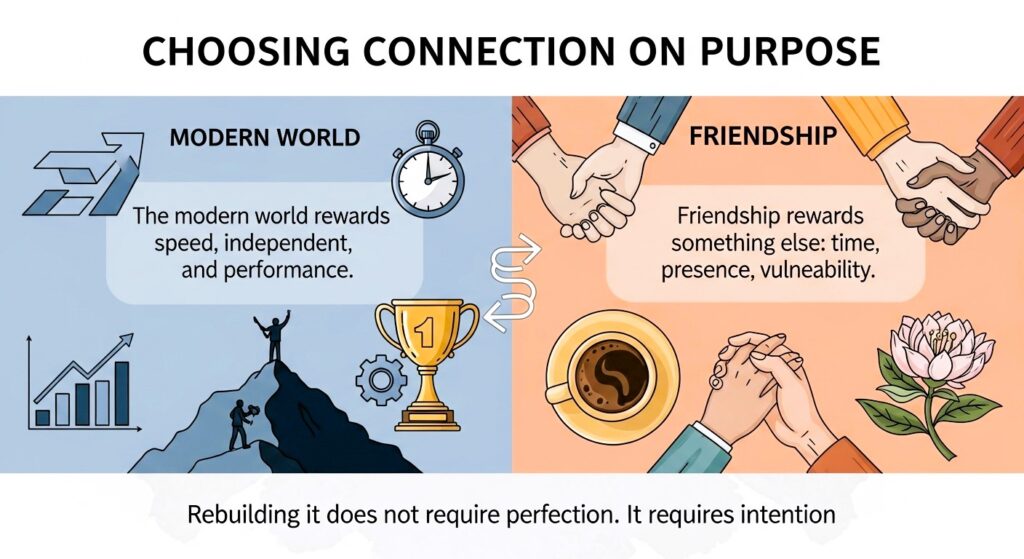
The modern world rewards speed, independence, and performance.
Friendship rewards something else:
time, presence, vulnerability.
Rebuilding it does not require perfection.
It requires intention.
When we choose people over convenience, depth over display, and presence over productivity, life becomes not just less lonely, but more human.
Because in the end, success fades, roles change, and time moves on.
But a true friend remains one of the rare things that makes life worth holding onto.
Frequently Asked Questions
1. Is the decline of friendship a real global issue?
Yes. Research across continents shows declining close relationships and rising loneliness.
2. Can loneliness truly affect physical health?
Yes. It is linked to heart disease, cognitive decline, depression, and early mortality.
3. Are younger generations more affected?
Adults in working age groups show the sharpest decline, though all ages are impacted.
4. Do men experience loneliness differently from women?
Yes. Men often lack emotionally expressive friendships, especially later in life.
5. Can friendships really be rebuilt after long gaps?
Yes. Many friendships resume with honesty and minimal explanation.
6. Is a digital connection always harmful to friendship?
No, but it should support real relationships, not replace them.
References
- Harvard Study on Adult Development (1938–present)
- Harvard Business Review: Research on social isolation and workplace relationships
- Stanford University: Programs on social connection and well-being
- World Health Organisation: Social determinants of health
- U.S. Surgeon General’s Advisory on Loneliness and Social Isolation