SpaceX Rocket Crashes Into the Moon: What Happened, Why It Matters, and What It Means for the Future of Space Exploration
SpaceX Rocket Crashes Into the Moon. An accidental collision. A cloud of lunar dust. A new crater on the Moon. Is this merely another chapter in space exploration, or a warning that humanity’s expanding presence beyond Earth needs new rules?
https://mrpo.pk/words-that-define-leadership/

For decades, the Moon has symbolized humanity’s greatest ambitions in space. Once visited only by government-led missions, it is now becoming the destination of commercial companies, private investors, and international partnerships. As nations race to establish a permanent presence on the lunar surface, every mission carries not only scientific promise but also new responsibilities.
On August 5, 2026, one such responsibility came sharply into focus when the upper stage of a SpaceX Falcon 9 rocket slammed into the Moon at nearly 9,000 kilometers (5,600 miles) per hour. The impact was not planned. It was the result of a rocket stage that had completed its mission months earlier but continued drifting through cislunar space until gravity eventually pulled it into a collision course with Earth’s natural satellite.
The event immediately drew worldwide attention. While there was never any danger to people on Earth, scientists viewed the impact as a rare opportunity to study the Moon’s surface. At the same time, the incident reignited an important debate about the growing challenge of managing space debris beyond Earth’s orbit. Was this simply an unavoidable accident, or does it highlight the need for stricter rules as humanity returns to the Moon?The answer is more complex than many headlines suggest.
This article explores what really happened, why the collision occurred, what scientists hope to learn from it, and why this incident could influence the future of lunar exploration for years to come.
South Korea space agency shares Moon images after SpaceX rocket debris crash
South Korea’s space agency has released images that show the Moon after part of a SpaceX rocket crashed into its surface on Wednesday.
The Korean AeroSpace Administration (KASA) said lunar orbiter Danubri captured images after the impact, which it shared alongside photos of what the Moon’s surface looked like before the crash.
Rocket debris struck the Moon at around 06:35 GMT on Wednesday, according to the South Korean space agency.
SpaceX has said the impact was not intentional.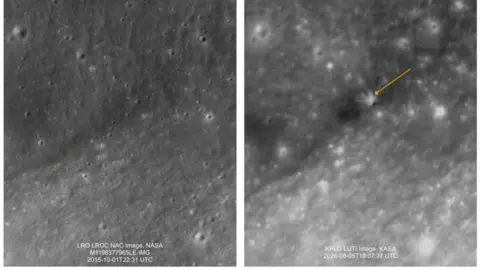
The Incident at a Glance
Before exploring the science behind the collision, here are the essential facts.
| Fact | Details |
|---|---|
| Date of impact | August 5, 2026 |
| Spacecraft | SpaceX Falcon 9 upper stage |
| Mission launch | January 2025 |
| Impact speed | Approximately 8,700–9,000 km/h (5,400–5,600 mph) |
| Impact location | Near Einstein Crater on the Moon’s far western hemisphere |
| Nature of impact | Accidental and uncontrolled |
| Estimated crater size | Approximately 20–30 meters (66–98 feet) |
| Risk to Earth | None |
| Scientific value | High |
Unlike many previous lunar impacts that were deliberately planned for scientific research, this collision happened unintentionally after the rocket stage had completed its original mission. Ironically, what began as an accident has now become one of the most valuable real-world experiments available to planetary scientists.
What Exactly Happened?
At first glance, the story sounds dramatic. “A SpaceX rocket crashed into the Moon.” However, the reality is both more fascinating and more nuanced.
The Falcon 9 rocket itself did not suddenly lose control during launch, nor did it fail while carrying astronauts or satellites. In fact, the launch was considered a success. The object that eventually struck the Moon was the upper stage of the Falcon 9 rocket.
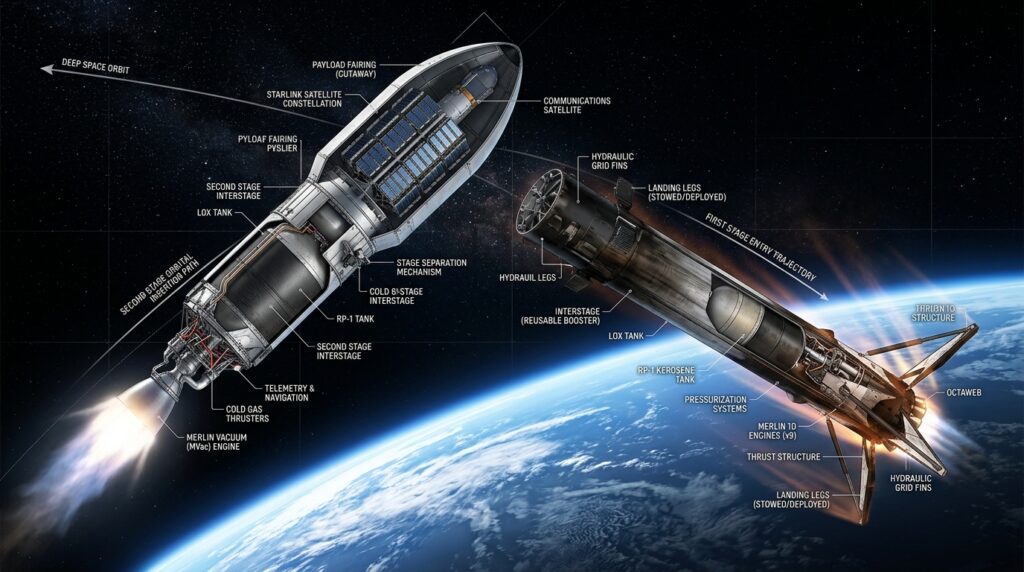
Modern rockets operate in stages. After lifting a spacecraft out of Earth’s atmosphere, different sections separate once their fuel is exhausted. The Falcon 9’s first stage is designed to return safely to Earth, where it lands vertically and can be reused on future missions. This revolutionary approach has dramatically reduced launch costs and transformed commercial spaceflight.
The second stage, however, performs a different job. It carries satellites or spacecraft into their intended orbit or onto deep-space trajectories. Once its work is complete, it usually has little fuel remaining and is often left in space.
In this case, after successfully delivering its payload during a mission launched in January 2025, the upper stage continued drifting through cislunar space. With no propulsion system available to change its course, it gradually became an uncontrolled object influenced only by gravity.
For months, astronomers tracked its changing orbit. Eventually, calculations showed that the combined gravitational pull of the Earth, Moon, and Sun would steer the rocket stage directly toward the lunar surface. Those predictions proved correct.
On August 5, 2026, the four-ton object struck the Moon at extraordinary speed, releasing enormous kinetic energy and ejecting a cloud of lunar dust and rock high above the impact site. Although the collision lasted only a fraction of a second, scientists expect to study its effects for months or even years.
Understanding the Falcon 9 Rocket
To appreciate why this event matters, it helps to understand how the Falcon 9 works. Developed by SpaceX, Falcon 9 has become one of the world’s most successful launch vehicles. Since its first flight in 2010, it has carried satellites, cargo, scientific instruments, and astronauts into space while establishing new standards for reliability and reusability.
Its greatest innovation lies in its reusable first stage. Instead of falling into the ocean after launch like traditional rockets, Falcon 9’s booster performs a controlled return and lands either on a drone ship at sea or at a designated landing site on Earth. This breakthrough has dramatically lowered the cost of accessing space. The rocket consists of two primary stages:
First Stage
The first stage provides the enormous thrust needed to escape Earth’s lower atmosphere. After completing its job, it separates from the rocket, flips around in mid-air, reignites its engines, and returns for landing. This stage was not involved in the Moon impact.
Second Stage
The upper stage continues the journey into orbit or deep space. Unlike the reusable booster, it generally remains in space after completing its mission. Depending on the mission profile, it may re-enter Earth’s atmosphere and burn up, be sent into a disposal orbit, or continue traveling through space if there is insufficient fuel for controlled disposal. The rocket stage that hit the Moon belonged to this category. Its original mission had already ended successfully.
The collision occurred many months later because the inactive stage gradually wandered into the Moon’s path under the influence of celestial gravity. That distinction is important because it means the impact was not caused by a launch malfunction but by the long-term behavior of an abandoned spacecraft component.
From Mission Success to Lunar Collision
One of the most intriguing aspects of this story is that everything initially went according to plan. The launch achieved its objectives.
The payload reached its intended trajectory.
Mission controllers completed their assigned tasks.
Yet, more than a year later, the mission unexpectedly returned to global headlines.
How did that happen? The answer lies in orbital mechanics.
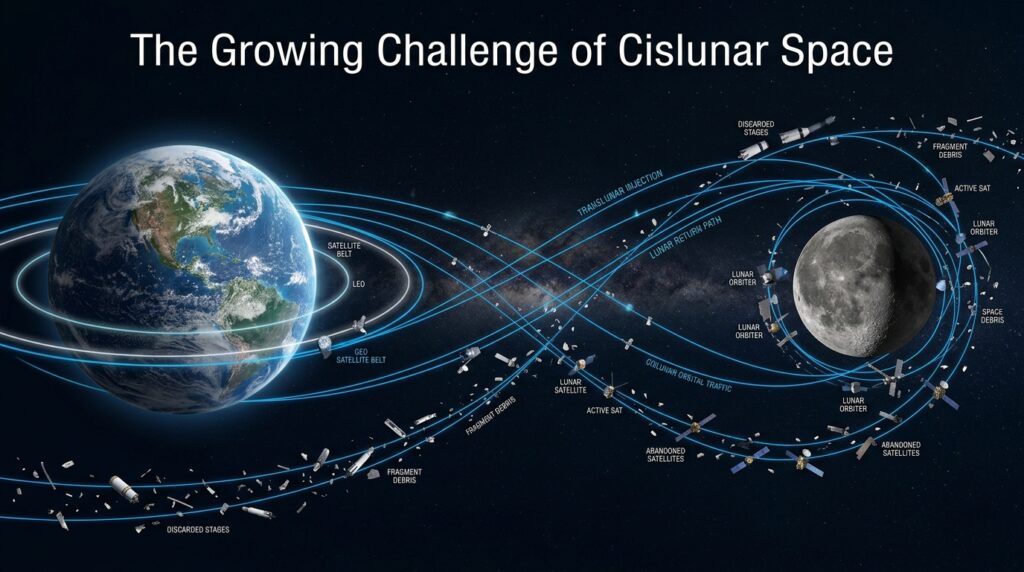
Unlike objects in low Earth orbit, spacecraft traveling toward the Moon enter a region where the gravitational influence of multiple celestial bodies constantly competes. Tiny differences in speed, direction, or altitude can gradually alter an object’s path over weeks or months. Scientists refer to this region as cislunar space, the vast area extending between Earth and the Moon.
As lunar exploration accelerates, cislunar space is becoming increasingly busy with government spacecraft, commercial missions, scientific probes, and, occasionally, abandoned rocket stages. The Falcon 9 upper stage became one such object.
With no remaining fuel to perform corrective maneuvers, it slowly drifted through this complex gravitational environment until an impact with the Moon became unavoidable. The event serves as a reminder that in space, a mission does not always end when the payload is delivered. Sometimes, its final chapter is written months, or even years, later.
Why Did This Story Capture Global Attention?
Every year, thousands of natural meteoroids strike the Moon without attracting headlines. So why did this particular impact make international news? The answer is simple. This was not a random space rock.
It was a human-made object built using advanced engineering, launched by one of the world’s most influential aerospace companies, and ultimately driven into the Moon by the laws of celestial mechanics. The collision represents something larger than a single accident.
It symbolizes humanity’s transition into a new era of space exploration, where governments are no longer the only players. Private companies are now launching hundreds of missions, developing reusable rockets, planning lunar landers, and even envisioning permanent settlements beyond Earth.
As activity in space increases, so does the responsibility to manage it safely. That is why scientists, policymakers, and space agencies around the world are paying close attention. The Moon has always been a destination. Now, it is also becoming a shared workplace. And with that transformation comes an entirely new set of scientific, technical, and legal challenges.
The Moment of Impact: A Collision Measured in Milliseconds
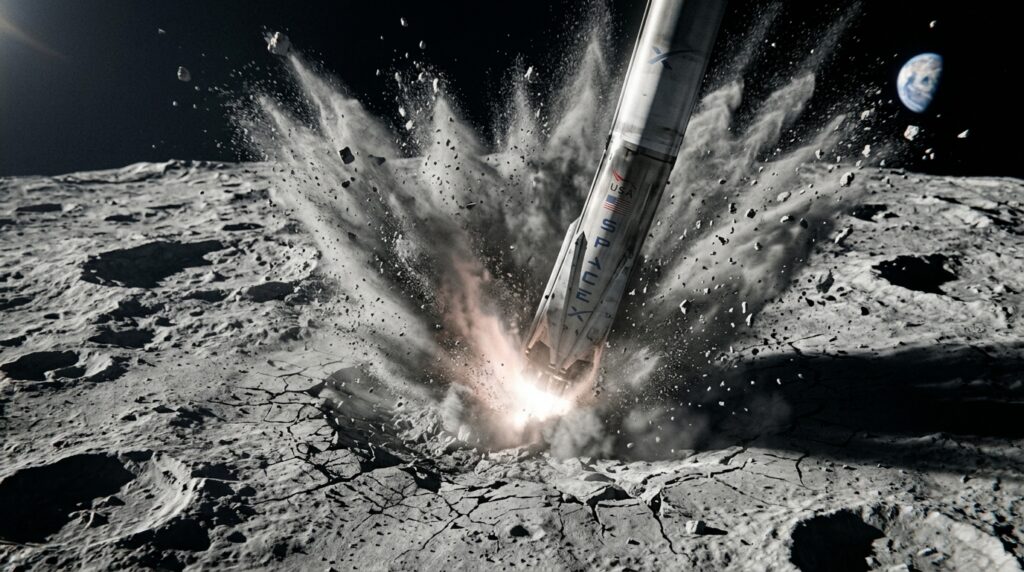
Imagine standing on the Moon and watching the night sky. There would be no atmosphere, no clouds, and no sound. Then, without warning, a four-ton metal object traveling nearly 9,000 kilometers (5,600 miles) per hour would strike the lunar surface. The impact itself would last only a fraction of a second.
Yet, in that instant, an enormous amount of kinetic energy would be released, pulverizing rock, vaporizing parts of the rocket stage, and blasting a cloud of dust and debris high above the impact site. Unlike explosions on Earth, there was no fireball.
The Moon has virtually no atmosphere and no oxygen to support combustion. Instead, the collision produced what scientists call a hypervelocity impact. At such extreme speeds, the energy released is sufficient to fracture solid rock, melt minerals, and even vaporize some materials upon impact. Although the event was brief, the crater it created could remain visible for millions of years.
Where Did the Rocket Hit?
The Falcon 9 upper stage struck near Einstein Crater, a large impact basin located on the Moon’s western limb, close to the boundary between the Moon’s near side and far side. This region is of particular interest to planetary scientists because it contains ancient geological formations that have remained largely unchanged for billions of years.
Unlike Earth, where wind, rain, rivers, vegetation, and plate tectonics constantly reshape the landscape, the Moon preserves its geological history with remarkable clarity. Every new impact becomes another page in that history.
Scientists estimate that the collision excavated a fresh crater approximately 20 to 30 meters (66 to 98 feet) across, exposing material that had been buried beneath the lunar surface. Fresh craters are especially valuable because they reveal rocks and minerals that have not been exposed to the harsh environment of space for millions of years.

Why Scientists Are Excited About This “Accidental Experiment”
At first glance, a rocket crashing into the Moon may sound like bad news. For planetary scientists, however, it represents an unexpected research opportunity. Creating an artificial impact allows researchers to observe processes that are otherwise impossible to study under controlled conditions.
Questions scientists hope to answer include:
- How does lunar dust behave after a high-speed impact?
- How far does debris travel in the Moon’s weak gravity?
- What minerals lie beneath the weathered surface?
- How deep is the layer of loose lunar soil, known as regolith?
- How do impacts shape the Moon over billions of years?
Every answer improves our understanding of the Moon and helps engineers design safer missions for future astronauts. In many ways, nature has provided scientists with a full-scale laboratory experiment.
NASA and International Observatories Begin Their Investigation
Long before the impact occurred, astronomers had calculated the rocket stage’s trajectory with remarkable accuracy. As the predicted collision approached, observatories around the world prepared to monitor the event. Although no telescope captured a dramatic video of the exact moment of impact, several observatories recorded important scientific data immediately afterward. Researchers detected evidence of a dust plume rising above the impact site.
Spectroscopic observations also identified signatures of elements such as sodium, believed to have originated from lunar soil, and lithium, likely released from the rocket itself. These observations help scientists distinguish between lunar material and spacecraft debris, allowing them to study both the Moon’s composition and the behavior of impact-generated dust.
The investigation is only beginning. Orbiting spacecraft will continue photographing the impact site over the coming months, comparing before-and-after images to measure the crater’s size, depth, and surrounding ejecta pattern.
What Is Lunar Regolith, and Why Does It Matter?
One of the most important objectives is studying the Moon’s regolith. Regolith is not ordinary soil. It is a layer of crushed rock, shattered minerals, and microscopic glass particles created by billions of years of meteorite impacts. Because the Moon lacks an atmosphere, these particles remain sharp and abrasive rather than becoming rounded by wind or water.
Apollo astronauts quickly discovered that lunar dust clung stubbornly to spacesuits, scratched equipment, and even caused irritation when brought inside their spacecraft. Future Artemis astronauts are expected to face the same challenge. By observing how fresh impacts disturb the regolith, scientists can better understand:
- How deep the loose surface layer extends.
- How dust behaves during spacecraft landings.
- How future lunar habitats can be protected.
- How mining equipment might operate on the Moon.
These findings are directly relevant to long-term human exploration.

Can the Impact Change the Moon?
This question has appeared repeatedly on social media. The simple answer is no. Despite the dramatic headlines, the Moon is an incredibly massive celestial body with a mass of approximately 73.5 quintillion kilograms. A four-ton rocket stage is insignificant in comparison.
The impact did not alter the Moon’s orbit.
It did not affect Earth’s tides.
It did not change the Moon’s rotation.
It posed no danger to people on Earth.
To put the event into perspective, the Moon is struck by countless natural meteoroids every year. Some of these impacts release far more energy than the Falcon 9 upper stage. What makes this collision unusual is not its power but its origin. Instead of being caused by a natural object from space, it resulted from human activity. That distinction transforms an ordinary impact into an important milestone in the history of space exploration.
How Powerful Was the Collision?
Although the rocket stage weighed only about four metric tons, its enormous speed made the impact surprisingly energetic. In physics, the destructive power of a moving object depends not only on its mass but also on its velocity. Because kinetic energy increases with the square of the speed, even a modest increase in velocity dramatically increases the energy released upon impact.
At nearly 9,000 kilometers per hour, the Falcon 9 upper stage carried enough kinetic energy to excavate a substantial crater and hurl tons of lunar material into space. Scientists often compare hypervelocity impacts to natural meteorite strikes rather than conventional explosions. The impact was not powerful enough to threaten the Moon itself, but it was more than sufficient to provide valuable scientific data.
A Rare Opportunity to Witness Fresh Lunar Geology
Most lunar craters visible today are ancient. Many formed hundreds of millions or even billions of years ago. Over time, their edges softened under constant bombardment by tiny micrometeorites. Fresh craters are much rarer. A newly formed crater exposes pristine material that has remained hidden beneath the surface for immense periods of time. By studying this fresh excavation, researchers hope to answer long-standing questions about:
- The composition of the lunar crust.
- The thickness of the regolith.
- The distribution of minerals beneath the surface.
- The mechanics of crater formation.
- The evolution of the Moon over geological time.
Every image collected by orbiting spacecraft adds another piece to this scientific puzzle.
Why This Matters Beyond the Moon
At first glance, an abandoned rocket striking an airless world may seem like an isolated event. In reality, it raises questions that extend far beyond lunar science. Human activity in cislunar space is increasing rapidly. NASA’s Artemis program aims to return astronauts to the Moon. China is developing plans for a permanent International Lunar Research Station.
Private companies are preparing commercial lunar landers, cargo missions, communication satellites, and eventually resource extraction projects. As traffic increases, so does the importance of responsible space operations. The accidental impact of the Falcon 9 upper stage serves as a reminder that every mission has consequences long after its primary objectives have been achieved. Today, the event is a scientific opportunity.
Tomorrow, similar incidents could influence the safety of lunar bases, scientific instruments, and future astronauts.
The Moon Has Been Hit Before. So Why Is This Different?
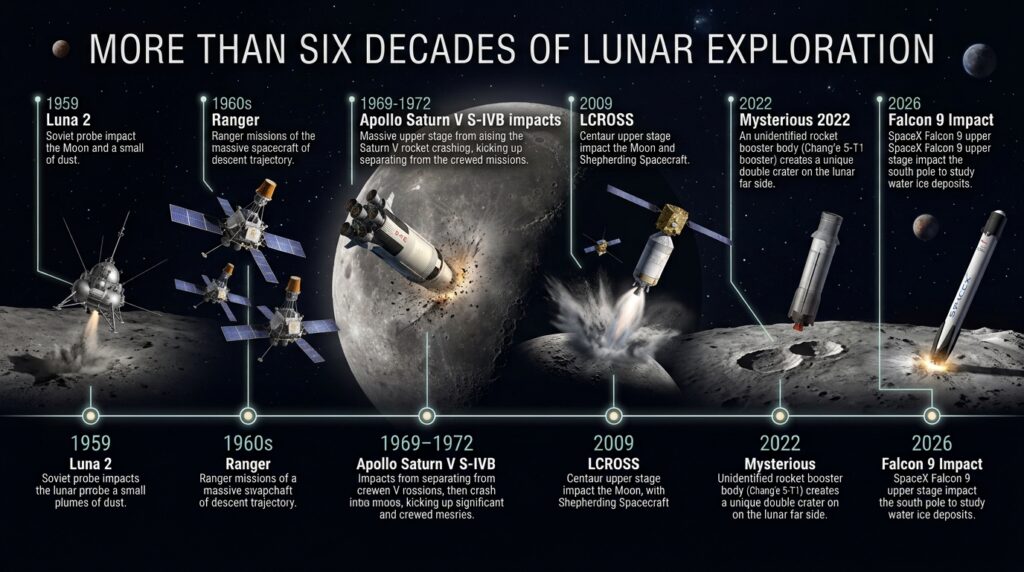
At first glance, the 2026 SpaceX impact may seem unprecedented. In reality, humans have been deliberately and accidentally crashing objects into the Moon for more than six decades. What makes this event significant is not that a rocket hit the Moon. It is when it happened. Humanity is entering a new era of lunar exploration.
Unlike the Cold War space race, today’s Moon missions involve governments, private companies, universities, and international partnerships. Dozens of spacecraft are expected to travel between Earth and the Moon over the next decade.
That changes everything. An isolated impact that once attracted little attention now raises broader questions about responsibility, sustainability, and the future of space governance.
A Brief History of Human-Made Impacts on the Moon
Understanding the 2026 incident requires looking back at the history of lunar exploration.
1959: Luna 2 Makes History
On September 13, 1959, the Soviet Union’s Luna 2 became the first human-made object to reach another celestial body. The spacecraft intentionally crashed into the Moon after completing its mission. Although primitive by today’s standards, Luna 2 marked one of humanity’s greatest technological achievements. For the first time, people had successfully reached another world.
The Ranger Missions
During the early 1960s, NASA launched a series of Ranger spacecraft. Unlike modern lunar landers, these probes were designed to photograph the Moon during their final minutes before intentionally crashing into its surface. The missions returned thousands of close-up images that transformed scientists’ understanding of lunar geology and helped identify safe landing sites for the Apollo astronauts.
Apollo’s Scientific Moonquakes
Perhaps surprisingly, NASA intentionally crashed several Saturn V S-IVB rocket stages into the Moon during the Apollo program.
Why?
Apollo astronauts had deployed highly sensitive seismometers on the lunar surface. By creating controlled impacts, scientists could measure how seismic waves traveled through the Moon’s interior. These experiments revealed something unexpected.
The Moon “rang like a bell.”
Unlike Earth, whose active interior quickly dampens seismic vibrations, the Moon continued vibrating for extended periods because of its dry, fractured internal structure. Those experiments remain among the most important studies ever conducted on lunar geology.
LCROSS: Searching for Water
In 2009, NASA launched the Lunar Crater Observation and Sensing Satellite (LCROSS). Instead of avoiding the Moon, mission planners intentionally directed a spent rocket stage into a permanently shadowed crater near the lunar south pole. Minutes later, the LCROSS spacecraft flew through the resulting debris cloud, analyzing its composition before also impacting the surface. The mission produced one of the most significant discoveries in modern lunar science.
It confirmed the presence of water ice trapped inside permanently shadowed lunar craters. That discovery transformed future exploration plans because water can potentially provide drinking supplies, breathable oxygen, and even rocket fuel for future astronauts.
The Mystery Impact of 2022
Another uncontrolled impact occurred in March 2022. Initially, astronomers believed the object was an old SpaceX Falcon 9 upper stage. Later investigations suggested it was more likely part of China’s Chang’e 5-T1 mission, although the object’s identity remained debated.
When NASA’s Lunar Reconnaissance Orbiter photographed the site months later, scientists found something remarkable. Instead of creating a single crater, the object had produced two overlapping craters. This unusual double crater suggested that the rocket stage had an uneven mass distribution, possibly because heavy equipment was mounted at both ends. The discovery demonstrated that even accidental impacts can reveal new insights into impact physics.
What Makes the 2026 Impact Unique?
Unlike earlier events, the 2026 collision occurred during an unprecedented expansion of lunar activity. Today’s Moon is no longer visited occasionally. It is becoming increasingly crowded. Several countries are preparing new missions, including:
- The United States through NASA’s Artemis program.
- China with its long-term lunar exploration strategy.
- India following the success of Chandrayaan missions.
- Japan through advanced robotic exploration.
- Europe through international partnerships.
- Commercial companies developing lunar landers and cargo services.
Each mission increases traffic in the space between Earth and the Moon. Consequently, the need for careful coordination has never been greater.
The New Frontier: Cislunar Space
Most people are familiar with satellites orbiting Earth. Far fewer have heard of cislunar space. This vast region extends from Earth’s orbit to the Moon and is rapidly becoming one of the busiest frontiers in space exploration. Unlike low Earth orbit, where satellites follow relatively predictable paths, cislunar space is governed by the combined gravitational forces of Earth, the Moon, and the Sun.
Navigation is far more complex. Small changes in velocity can produce dramatically different trajectories over time. That is precisely what happened to the Falcon 9 upper stage. After completing its mission, the inactive rocket slowly drifted through this intricate gravitational environment until it eventually intersected the Moon’s orbit. As future lunar missions increase, tracking every object in cislunar space will become far more challenging.
Is Space Debris Becoming a Lunar Problem?
For decades, discussions about space debris focused almost entirely on Earth orbit. Thousands of inactive satellites, abandoned rocket stages, and fragments now circle the planet, posing collision risks to operational spacecraft. However, scientists are increasingly warning that a similar problem could eventually develop around the Moon. Although cislunar space is vastly larger than Earth orbit, traffic is expected to increase dramatically during the coming decades.
Future sources of debris may include:
- Spent rocket stages.
- Defunct lunar satellites.
- Failed landers.
- Mission hardware.
- Fragments from accidental collisions.
If left unmanaged, these objects could complicate future navigation and increase risks for robotic and crewed missions.
The SpaceX impact has therefore become part of a much larger conversation about responsible exploration beyond Earth.
Who Is Responsible for Objects Left in Space?
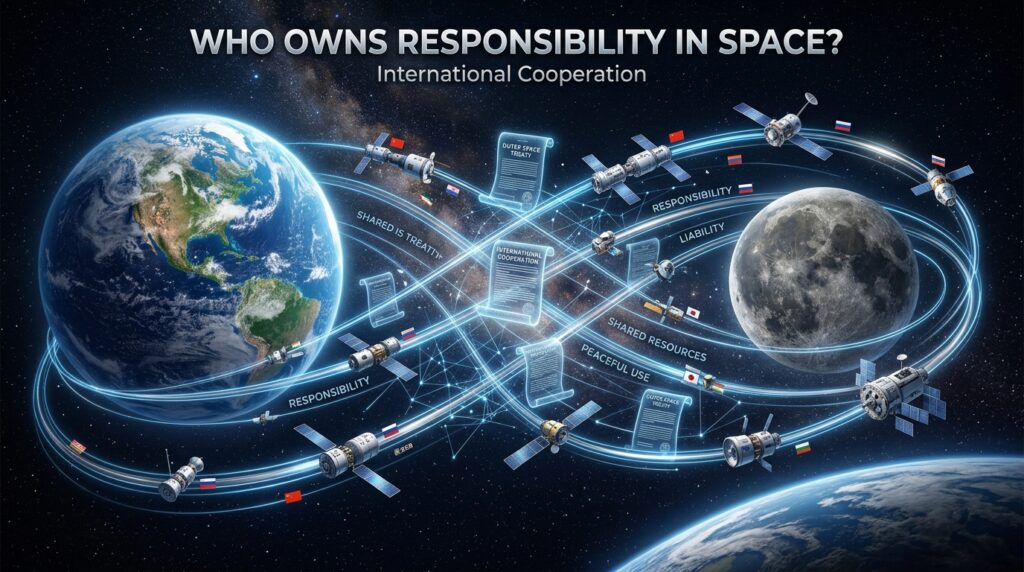
This question has no simple answer. Under the 1967 Outer Space Treaty, countries remain internationally responsible for space activities conducted by both government agencies and private companies operating under their jurisdiction. In other words, although SpaceX is a private company, the United States retains international responsibility for its licensed space activities. However, existing treaties were written long before commercial lunar exploration became a reality.
They say relatively little about abandoned spacecraft operating far beyond Earth orbit. As more companies begin sending missions to the Moon, experts believe international regulations will need significant updates. Questions now being debated include:
- Should every mission include a mandatory disposal plan?
- Who pays if abandoned hardware damages another country’s spacecraft?
- Should traffic management systems exist for cislunar space?
- Can companies be required to remove space debris?
These issues are becoming increasingly urgent.
Are We Polluting the Moon?
Another debate is emerging among scientists and ethicists. Should humanity treat the Moon as a pristine scientific environment? Unlike Earth, the Moon has preserved billions of years of geological history with extraordinary clarity. Every artificial object left behind alters that environment, even if only slightly.
Today, the Moon contains:
- Apollo landing equipment.
- Soviet spacecraft.
- Chinese landers.
- Scientific instruments.
- Crash sites from multiple missions.
- Reflectors still used for laser ranging.
- Tracks left by astronauts more than fifty years ago.
The addition of another impact site may seem insignificant. Yet, as lunar activity expands, the cumulative effects deserve careful consideration. Many scientists argue that sustainable exploration should become a guiding principle before permanent human settlements begin.
Preparing for Humanity’s Return to the Moon
The accidental Falcon 9 impact arrives at a pivotal moment. NASA plans to return astronauts to the lunar surface through the Artemis program.
China aims to establish an International Lunar Research Station.
Private companies envision mining lunar resources, delivering cargo, constructing habitats, and supporting scientific research.
The Moon is no longer viewed simply as a destination.
It is increasingly seen as humanity’s first stepping stone toward Mars and the broader Solar System. That transformation makes every lesson learned today more valuable for tomorrow. The collision may not have damaged the Moon in any meaningful way. However, it has highlighted a critical reality.
As our presence beyond Earth grows, so too must our commitment to responsible exploration, international cooperation, and long-term stewardship of space.
Could This Incident Damage Elon Musk’s or SpaceX’s Reputation?
Whenever a SpaceX mission makes headlines, Elon Musk inevitably becomes part of the story. As the company’s founder and public face, he is closely associated with both its achievements and its setbacks. This raises an important question.
Could the Moon impact damage Musk’s reputation or affect SpaceX financially?
Based on the evidence available so far, the answer is probably not in any significant way.
The reason is straightforward. The Falcon 9 mission itself was a success. The rocket launched as planned, delivered its payload to the intended trajectory, and fulfilled its primary objectives. The object that later struck the Moon was an inactive upper stage that had already completed its mission months earlier.
Within the aerospace community, this is viewed as an orbital disposal and space traffic management issue, not as a launch failure or engineering breakdown. SpaceX continues to maintain one of the strongest reliability records in commercial spaceflight, with hundreds of successful Falcon 9 launches, reusable boosters, crewed missions to the International Space Station, and key roles in NASA’s Artemis lunar program. However, the incident may still influence future discussions in several important ways.
Greater Regulatory Scrutiny
As commercial activity expands beyond Earth orbit, regulators may consider stricter requirements for end-of-mission disposal plans. Future missions could face additional obligations, including:
- Controlled disposal of upper stages where technically feasible.
- Improved long-term tracking of inactive spacecraft.
- Better coordination between national space agencies.
- International standards for operations in cislunar space.
These discussions would affect not only SpaceX but every company planning lunar missions.
Financial Impact
At present, there is no indication that the incident has caused measurable financial losses for SpaceX.
The impact:
- Did not destroy an operational spacecraft.
- Did not result in injuries or loss of life.
- Did not interrupt commercial launch services.
- Did not jeopardize existing NASA contracts.
- Did not affect Falcon 9’s overall reliability record.
Unless future investigations reveal negligence or repeated similar incidents, financial analysts generally view this event as having limited commercial consequences.
What Does This Mean for the Future of Space Exploration?
The Moon is rapidly becoming humanity’s next major destination. NASA’s Artemis program aims to establish a sustainable human presence on the lunar surface.
China is developing plans for the International Lunar Research Station.
India, Japan, Europe, and several private companies are also preparing ambitious lunar missions.
Within the next decade, the number of spacecraft operating between Earth and the Moon is expected to increase dramatically.
That growth brings exciting opportunities. It also introduces new responsibilities. The accidental SpaceX impact serves as a reminder that exploration does not end when a spacecraft completes its mission. Every object launched into space remains part of the broader space environment and must eventually be managed responsibly. Future success will depend not only on technological innovation but also on international cooperation, effective regulation, and sustainable exploration practices.
Frequently Asked Questions
Did the Falcon 9 rocket fail?
No. The launch successfully completed its intended mission. The object that impacted the Moon was the upper stage of the rocket after it had finished its job.
Did the impact change the Moon’s orbit?
No. The Moon is far too massive for a four-ton rocket stage to alter its orbit or affect Earth’s tides.
Could people on Earth see the impact?
No. The impact was too small and occurred too far away to be visible with the naked eye.
Was anyone in danger?
No. The collision posed no threat to people on Earth, astronauts, or operational spacecraft.
Can astronauts visit the impact site?
Potentially, yes. If future missions operate near the region, the crater could become a scientifically valuable site for geological investigation.
Will similar incidents happen again?
Possibly. As more missions travel beyond Earth orbit, the likelihood of abandoned spacecraft following unpredictable trajectories will increase unless improved disposal methods become standard practice.
Key Takeaways
- The Falcon 9 upper stage accidentally impacted the Moon after completing a successful mission.
- The collision occurred because the inactive rocket stage gradually drifted into a lunar impact trajectory under the influence of gravity.
- Scientists view the event as a valuable opportunity to study fresh lunar geology and impact physics.
- The Moon itself suffered no meaningful damage, as natural impacts occur regularly.
- The incident highlights the growing importance of managing space debris beyond Earth orbit.
- It is unlikely to significantly affect Elon Musk’s reputation or SpaceX’s commercial position.
- The broader legacy of the event may be its influence on future international policies governing lunar exploration.
Final Thoughts
The story of the Falcon 9 upper stage crashing into the Moon is not one of failure but of transition. It marks the moment when humanity’s expanding presence beyond Earth began raising new questions that previous generations never had to answer.
Who is responsible for abandoned spacecraft in deep space?
How should nations and private companies share an increasingly busy cislunar environment?
Can exploration remain sustainable as more missions head toward the Moon?
These questions will shape the next chapter of space exploration.
History is unlikely to remember this event simply as “the day a SpaceX rocket hit the Moon.”
Instead, it may be remembered as one of the first incidents that prompted the international community to rethink how humanity explores, protects, and manages the space beyond our planet. As the Moon once again becomes the gateway to deeper exploration of the Solar System, every mission will carry not only scientific ambition but also a shared responsibility to ensure that the next giant leap is also a sustainable one.
References
The following sources provide authoritative information and additional reading on the incident and related topics:
- NASA – Lunar Reconnaissance Orbiter (LRO) Mission
https://www.nasa.gov/lro - NASA Artemis Program
https://www.nasa.gov/artemis - SpaceX – Falcon 9 Launch Vehicle
https://www.spacex.com/vehicles/falcon-9/ - Reuters – Coverage of the Falcon 9 Upper Stage Lunar Impact (August 2026).
- European Space Agency (ESA) – Space Debris and Space Safety
https://www.esa.int/Safety_Security/Space_Debris - NASA Orbital Debris Program Office
https://orbitaldebris.jsc.nasa.gov/ - Lunar Reconnaissance Orbiter Camera (LROC)
https://www.lroc.asu.edu/ - The Planetary Society – Lunar Exploration Resources
https://www.planetary.org/ - Outer Space Treaty (United Nations Office for Outer Space Affairs)
https://www.unoosa.org/ - Robinson, M. S., et al. Lunar Reconnaissance Orbiter Mission and Scientific Results.
- Colaprete, A., et al. (2010). Detection of Water in the LCROSS Ejecta Plume. Science, Vol. 330.
- National Academies of Sciences. Planetary Science and Astrobiology Decadal Survey.
- ESA Space Environment Report (latest edition).
- NASA Apollo Seismic Experiment Archives.
- Peer-reviewed publications on hypervelocity impacts, lunar regolith, and cislunar space traffic management.