
The Sovereignty of the Collective Soul
Dismantling the Fallacy of Absolute Individualism through Divine Law and Logical Reciprocity
Introduction
The Sovereignty of the Collective Soul: Modern society is increasingly shaped by a powerful declaration: “It’s my life.”
This phrase symbolises personal freedom, autonomy, and independence from external moral constraints. However, when examined in the context of shared human existence, this idea reveals a deep structural contradiction.
https://mrpo.pk/the-pedagogy-of-estrangement/
What Soul Sovereignty Truly Means
At its core, Soul Sovereignty is complete self-governance over your life—and how you live, lead, and create.
It’s the freedom, authority, and autonomy to make choices in alignment with your values, your truth, and what feels deeply right for you.
It means no longer being unconsciously shaped by external pressure, fear, expectation, conditioning, ancestral patterns, or subconscious limitations.
Instead, you live from self-trust, clear boundaries, personal responsibility, and inner alignment.
You recognise that your power comes from within—not from anything or anyone outside of you.
It is a return to authenticity.
A return to your Soul Truth.
A return to living life on your own terms.
Human beings do not live in isolation. They share streets, workplaces, markets, transport systems, and digital spaces. In such environments, individual expression is never purely private—it becomes part of a shared sensory reality.
The central question of this study is therefore:
How can individual freedom exist without becoming a source of sensory and psychological burden for others?
This article argues that true freedom is not absolute expression, but responsible coexistence in shared sensory space, a principle deeply aligned with Divine guidance and rational ethics.
The Shared Sensory Environment
Human life is not only physical—it is sensory. Every moment in public space involves continuous exposure to:
- Visual stimuli
- Sounds and voices
- Behavioural expressions of others
Unlike conscious choice, sensory reception is automatic and involuntary. The human brain processes external stimuli without permission.
This creates a hidden reality:
Every individual in public space is simultaneously an “expressor” and an “involuntary receiver.”
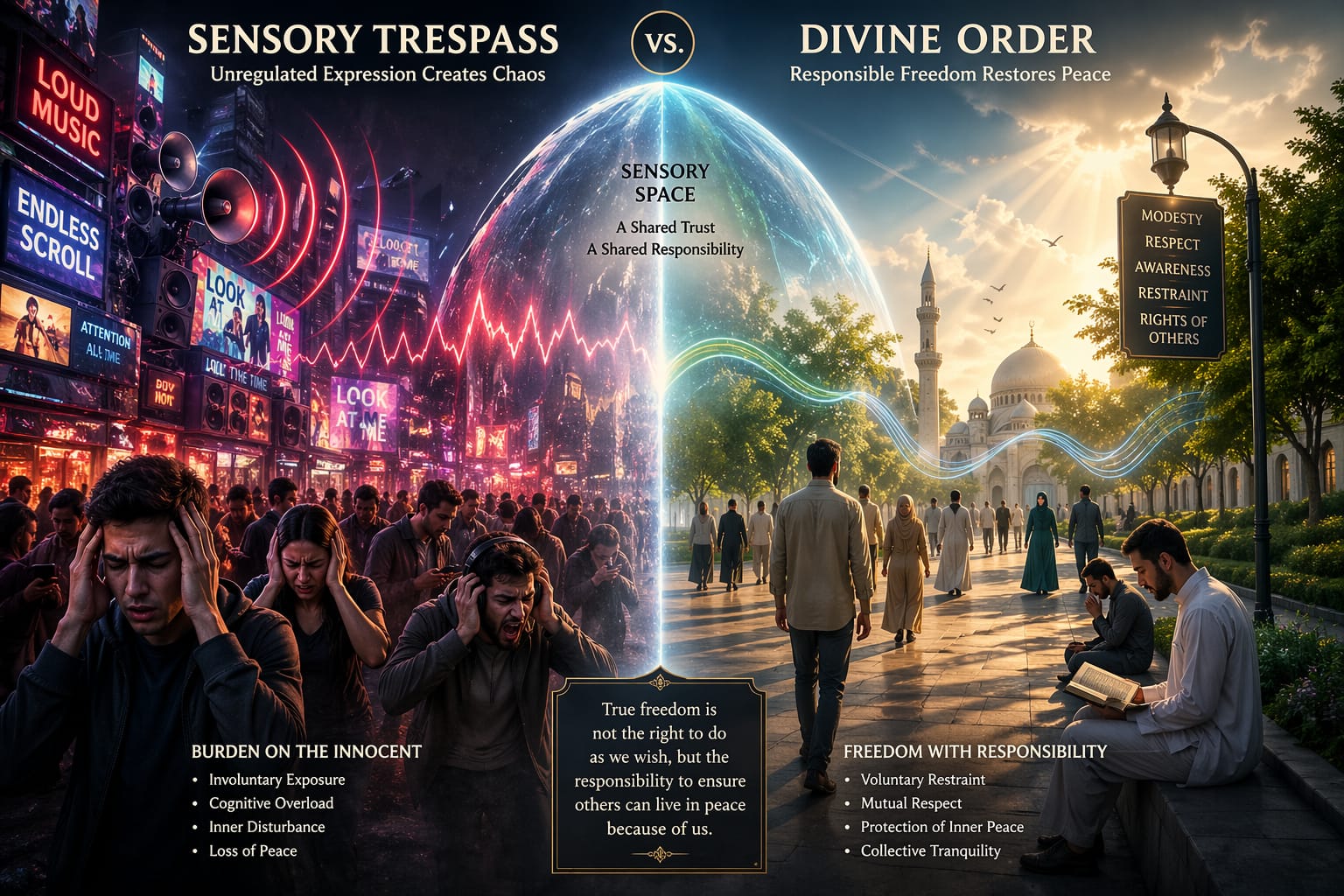
Just as societies regulate air pollution because all people must breathe the same air, there is a parallel need to recognize sensory pollution—the overload of unnecessary visual and auditory stimuli in shared environments.
Sensory Trespass: A New Ethical Concept
This study introduces the concept of Sensory Trespass, defined as:
The involuntary imposition of sensory stimuli on others in shared spaces creates cognitive, emotional, or spiritual burden.
Sensory trespass occurs when three conditions are met:
- Involuntary Exposure
The observer cannot avoid the stimulus without effort.
- Cognitive Demand
Ignoring the stimulus requires mental effort and attention control.
- Inner Disruption
The stimulus disturbs focus, emotional balance, or inner calm.
When all three are present, personal expression becomes a social violation of shared sensory space.
The Hidden Cost of “Ignoring”
Modern culture often advises:
- “Just ignore it”
- “Lower your gaze”
- “Mind your own business”
However, ignoring is not passive—it is cognitively expensive.
It requires:
- Attention suppression
- Emotional regulation
- Continuous mental filtering
This means the burden of maintaining peace is shifted unfairly onto the observer, rather than the generator of the stimulus.
A just society cannot rely on constant mental compensation by the innocent party.
Philosophical Limitations of Modern Liberty
Modern liberal philosophy, notably influenced by John Stuart Mill, argues that individual freedom should only be limited to prevent harm to others.
However, “harm” is often narrowly defined as:
- Physical injury
- Financial damage
- Direct coercion
This study expands the definition of harm to include:
Cognitive overload, emotional disturbance, and sensory intrusion in shared environments.
Without this expansion, liberty becomes one-sided—protecting expression while ignoring its impact on others.
Why Absolute Individualism Fails in Society
Absolute individual freedom works only in isolation. In shared environments, it produces conflict because:
- Every expression competes for attention
- Sensory space becomes overcrowded
- Mental peace becomes fragmented
A society based purely on “my freedom” inevitably leads to collective discomfort.
Therefore, freedom must be balanced with reciprocity and restraint.
Divine Guidance and Sensory Ethics
Religious principles provide a structured solution to this problem.
- Modesty (Haya)
Modesty is not merely a personal virtue—it is the protection of others from unnecessary sensory burden.
- Rights of Others (Haqooq-ul-Ibad)
Human responsibility extends beyond physical rights to include the emotional and psychological well-being of others.
- Spiritual Environment
Practices such as Wudu and Dhikr cultivate inner calm, which requires a stable and non-aggressive external environment.
Thus, religion does not restrict freedom—it organises it to preserve collective peace.
Qualifying Sensory Trespass
An action becomes sensory trespass when:
- Exposure is unavoidable
- Ignoring requires cognitive effort
- Inner balance is disturbed
This provides a practical framework for evaluating behaviour in public spaces.
Responsibility lies with the source of the stimulus, not the receiver.
Responsibility-Based Social Contract
A stable society must move from:
“What am I free to do?”
to
“What effect does my presence have on others?”
This creates a new ethical model based on:
- Shared sensory responsibility
- Mutual restraint in public behavior
- Awareness of cognitive impact
- Respect for inner peace of others
Public space becomes a field of coexistence, not competition for attention.
Spiritual Environmentalism
Just as environmental ethics protects air and water, human societies must also protect the spiritual and sensory environment.
Sensory overload leads to:
- Mental fatigue
- Reduced focus
- Emotional instability
- Loss of inner peace
Therefore, ethical responsibility includes protection of:
- Visual space
- Auditory space
- Behavioral impact on others
Conclusion: Submission as True Freedom
The modern understanding of freedom as unrestricted expression is incomplete. In shared environments, such freedom inevitably leads to sensory conflict and psychological burden.
The alternative is a responsibility-based model of coexistence, where individual expression is guided by awareness of its impact on others.
True freedom is therefore not unlimited expression, but:
The ability to exist in public space without harming the sensory and spiritual peace of others.
In this sense, submission to Divine guidance is not a limitation—it is the highest form of social intelligence and collective freedom.
Final Reflection
A society that ignores sensory responsibility will always struggle with conflict, distraction, and inner unrest. A society that embraces it will move toward:
- Calmness in public life
- Respect in interaction
- Clarity of attention
- Spiritual balance
The future of social harmony lies not in expanding personal freedom without limits, but in refining it through ethical responsibility and Divine alignment.