
Skin Signs of Health Problems
Skin Signs of Health Problems: Your skin, hair, scalp, and nails can sometimes reveal changes happening inside your body. Learn which visible signs deserve attention and when to seek medical advice.
https://mrpo.pk/still-tired-after-sleeping/

Your Skin May Be Telling You Something
You look into the mirror.
Something seems different.
Perhaps your skin has become unusually dry.
Maybe you are losing more hair than usual.
Perhaps the skin around your neck has become darker.
Or you have noticed a strange change in one of your nails.
Your first thought is probably:
“It is nothing serious.”
And sometimes it isn’t.
But sometimes the body’s first visible clue appears on the outside.
The skin, hair, scalp, and nails are not just cosmetic features. They can reflect changes involving circulation, hormones, nutrition, immunity, inflammation, infections, medications, and other aspects of health. Dermatologists sometimes recognise clues to internal disease by examining these visible structures. (American Academy of Dermatology)
But there is an important rule to remember:
A visible change is a clue, not a diagnosis.
A person with hair loss does not automatically have a vitamin deficiency.
A person with itchy skin does not automatically have liver disease.
A dark neck does not automatically mean diabetes.
The smart approach is neither panic nor dismissal.
Notice. Observe. Understand. Investigate when necessary.
Why Can Internal Health Problems Appear on the Skin?
Your skin is your body’s largest organ. It is constantly interacting with the outside world while also responding to what is happening inside. Changes in circulation, immune activity, hormones, nutrition, inflammation, and metabolism can sometimes affect the appearance or behaviour of skin, hair, and nails.
That is why a dermatologist may sometimes notice something that another person has overlooked.
The American Academy of Dermatology notes that skin, hair, and nail findings can sometimes provide clues to conditions affecting other parts of the body. (American Academy of Dermatology)
But there is a catch.
The same visible symptom can have many different causes.
Dry skin may simply mean dry weather.
Hair loss may be hereditary.
Brittle nails may result from ageing or repeated exposure to water.
A rash may be a straightforward skin condition.
So the question is not:
“What disease does this symptom mean?”
The better question is:
“What are the possible explanations, and does this particular change need attention?”
Pale Skin: Could Your Body Be Running Low on Oxygen-Carrying Capacity?
Everyone’s natural skin tone is different. So a person should not confuse their normal complexion with unusual paleness.
But a noticeable change toward unusual paleness can sometimes be associated with anaemia, reduced blood flow, certain nutritional deficiencies, chronic illness, or other conditions. (MedlinePlus)
Iron-deficiency anaemia can cause tiredness, weakness, headaches, dizziness, pale skin, brittle nails, shortness of breath, and sometimes hair loss. (MedlinePlus)
A real-life example
Imagine a woman who has been feeling unusually tired for several months. She blames work. Then she notices that her face looks paler than usual. She also notices increased hair shedding and brittle nails.
One symptom alone might mean very little.
Together, however, they are worth discussing with a healthcare professional.
Especially if she also has heavy menstrual bleeding.
The lesson is not:
“Pale skin means iron deficiency.”
The lesson is:
“A combination of persistent symptoms deserves investigation.”
Yellow Skin or Yellow Eyes: Don’t Ignore the Difference
Yellowish skin can have several explanations. But true yellowing of the skin and especially the whites of the eyes can be a sign of jaundice. Jaundice occurs when bilirubin builds up in the body.
Possible causes include liver disease, blockage of bile flow, certain infections, blood disorders, medications, and other conditions. (MedlinePlus)
Other possible signs include:
- Yellowing of the eyes: The whites of the eyes become noticeably yellow.
- Dark urine: Urine may become unusually dark.
- Pale stools: Stools may become unusually light or clay-colored.
- Itching: Generalised itching can occur.
- Fatigue: The underlying condition may cause tiredness.
There is also an important distinction. A yellow or orange skin tone does not automatically mean jaundice.
For example, consuming large amounts of foods rich in beta-carotene can sometimes make the skin look yellow-orange without causing yellowing of the whites of the eyes. (MedlinePlus)
So look at the whole picture.
Skin colour alone does not provide a diagnosis.
But new yellowing of the skin or eyes deserves medical attention.
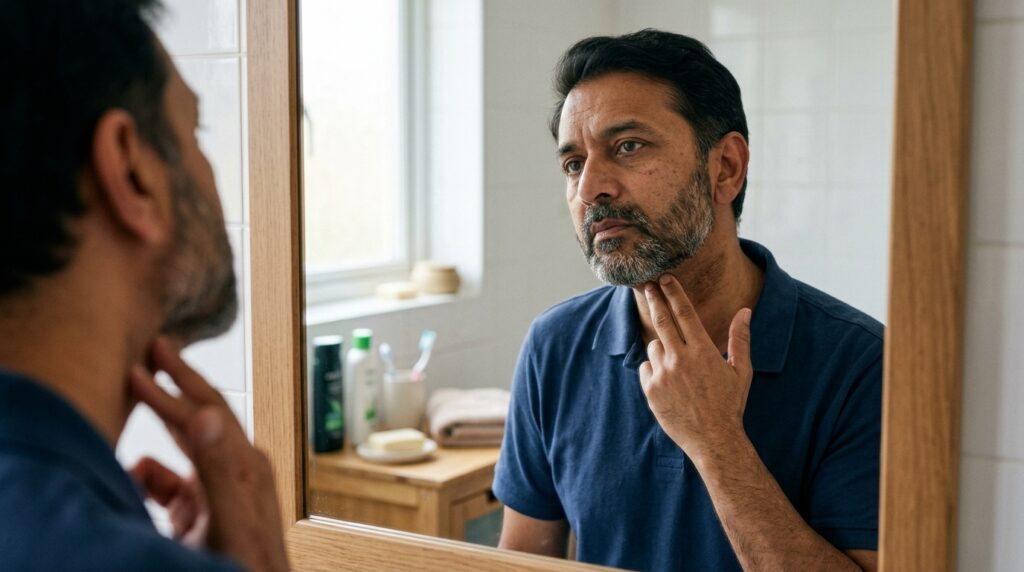
Dark Skin Around the Neck: More Than a Cosmetic Problem?
Have you ever seen a darker, thicker, almost velvety area around the neck? Some people assume it is dirt. They scrub harder. The darkness remains. This can sometimes be a condition called acanthosis nigricans. It commonly appears in body folds such as the neck, armpits, and groin.
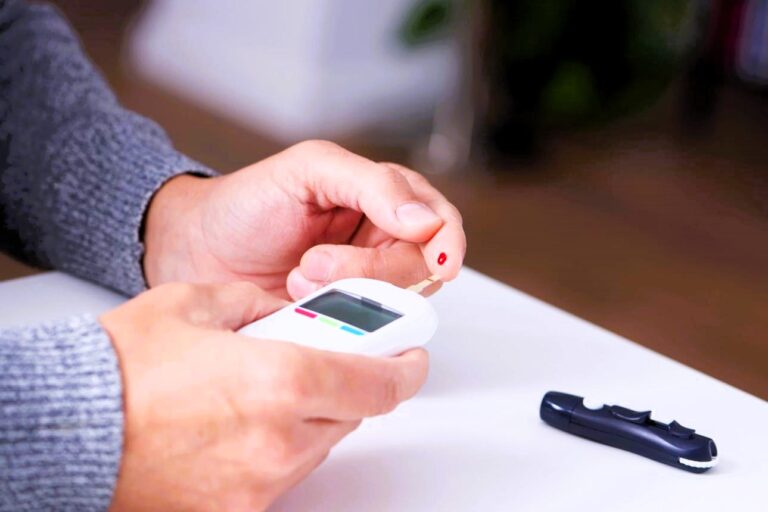
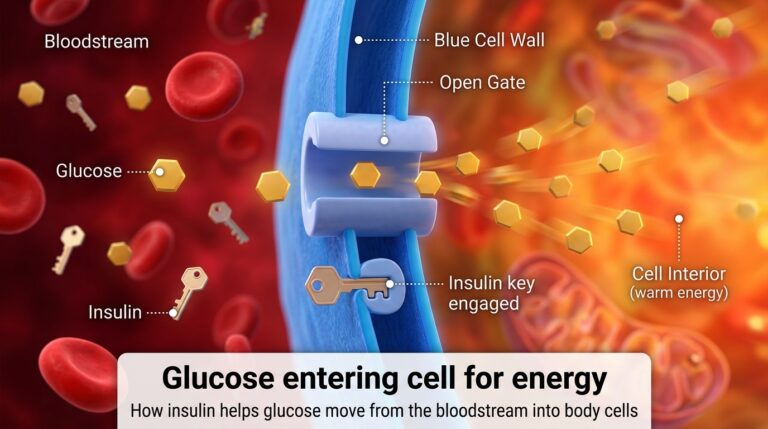
It can be associated with insulin resistance and may occur with prediabetes or type 2 diabetes. (CDC)
It is particularly important because the skin change may appear before a person realises that blood sugar regulation is becoming a problem.
A real-life example
A 42-year-old man notices that the skin around his neck has become darker. He assumes he needs a better soap. His wife notices that the skin also feels slightly thicker. He has gained weight over the past few years and has become less physically active. The skin itself cannot tell him that he has diabetes. But the change may be a reason to discuss blood sugar and metabolic health with his doctor. This is exactly the kind of clue worth noticing.
Persistent Itching: When Should You Look Deeper?
Everyone gets itchy skin.
Dry weather can do it.
Mosquitoes can do it.
Allergies can do it.
A new soap can do it.
Eczema can do it.
So itching alone is rarely a diagnosis.
But persistent, severe, unexplained itching deserves attention.
Skin disorders such as eczema can cause chronic itching and dryness. But some people experience itching in association with underlying diseases or other systemic problems. (American Academy of Dermatology)
Possible explanations can include:
- Dry skin: Particularly common with ageing and dry weather.
- Eczema: A common inflammatory skin condition.
- Allergies: Reactions to foods, medicines, products, or environmental triggers.
- Infections: Some bacterial, fungal, or parasitic infections can cause itching.
- Medication effects: Certain medicines can trigger itching or rashes.
- Liver problems: Some liver conditions can cause generalised itching.
- Kidney problems: Certain kidney disorders can also be associated with itching.
- Thyroid disorders: Hormonal changes can affect the skin.
The important question is whether the itching is persistent, severe, unexplained, or accompanied by other symptoms.
Extremely Dry Skin: Usually Simple, Sometimes Significant
Dry skin is extremely common.
Cold weather.
Hot showers.
Harsh soaps.
Low humidity.
Frequent washing.
Aging.
All can contribute.
So don’t turn every dry elbow into a medical mystery. But persistent severe dryness can sometimes occur with conditions such as eczema or thyroid disorders.
The American Academy of Dermatology also notes that dry skin can have several ordinary explanations, while in some people skin symptoms may provide clues to underlying disease. (American Academy of Dermatology)
A useful first step is simple:
Use a gentle cleanser.
Avoid excessively hot showers.
Moisturise regularly.
Then observe.
If the problem remains severe or is accompanied by other symptoms, seek medical advice.
Unexplained Bruising: When a Bruise Is More Than a Bruise
Most bruises have an explanation.
You bumped into a table.
You hit your leg against a chair.
You simply forgot.
But what if bruises suddenly begin appearing everywhere?
Or become much larger than expected?
Or appear without any obvious injury?
Possible contributors can include medications, ageing, nutritional problems, platelet abnormalities, clotting disorders, liver disease, and other conditions.
Some medicines, especially blood-thinning medicines, can make bruising easier. That does not mean you should stop them. If bruising changes noticeably after starting or changing a medicine, speak with the prescribing healthcare professional.
A real-life example
An older woman notices that her arms are covered with bruises. She assumes she has become careless. Her daughter notices that some bruises appeared without any remembered injury. Instead of searching the internet for a frightening diagnosis, they make a list of her medicines and arrange a medical review. That is the sensible response.
Investigate the change. Don’t invent the diagnosis.
Tiny Red or Purple Spots Under the Skin
Small red, purple, or brownish spots can have many causes. Some are harmless. Others can represent bleeding beneath the skin. Pinpoint spots that appear suddenly and spread should not simply be ignored, particularly when accompanied by fever, weakness, bleeding elsewhere, or feeling seriously unwell. This is another situation where appearance alone cannot provide the answer.
A healthcare professional may need to examine the skin and consider the person’s medications, medical history, and other symptoms.
Wounds That Refuse to Heal
This is one skin change that deserves particular attention. A small cut should normally begin healing. If a wound repeatedly remains open, becomes increasingly painful, swollen, red, or produces discharge, something may be interfering with healing. Diabetes is an important possibility.
People with diabetes can have nerve damage and reduced blood flow, making foot wounds harder to notice and harder to heal. (CDC)
The Centres for Disease Control and Prevention specifically lists slow-healing cuts, sores, or wounds among possible signs associated with type 2 diabetes. (CDC)
A real-life example
A man notices a tiny wound on his foot. It doesn’t hurt much. So he ignores it. Two weeks later, it still has not healed.
This is particularly important if he has diabetes, reduced sensation in his feet, poor circulation, or other risk factors. The wound may look small. The underlying problem may not be.
A wound that refuses to heal is worth taking seriously.
What Your Hair May Be Telling You
Hair is not just a beauty feature. It has a growth cycle. Hair naturally sheds.
The American Academy of Dermatology notes that losing roughly 50 to 100 hairs a day can be normal, while noticeable thinning, bald patches, a receding hairline, or significantly increased shedding can indicate hair loss. (American Academy of Dermatology)
The causes are numerous. Some are completely unrelated to internal disease. Others can reflect changes in the body.
Sudden Hair Shedding After Illness or Stress
Have you ever noticed large amounts of hair in the shower several months after a difficult period? You may have experienced:
- A serious illness: Particularly one involving fever.
- Major surgery: Physical stress can affect the hair cycle.
- Significant emotional stress: Severe stress can trigger increased shedding.
- Major weight loss: Rapid nutritional or metabolic changes can affect hair.
- Childbirth: Increased shedding can occur in the months after giving birth.
- Certain medicines: Some medications can cause hair loss.
The American Academy of Dermatology lists childbirth, major surgery, high fever, severe infection, stress, and certain diseases among possible causes of increased hair shedding. (American Academy of Dermatology)
A real-life example
A woman notices that several months after giving birth, much more hair is coming out when she brushes it. She becomes frightened. She starts buying every hair supplement she sees. But increased shedding after childbirth can occur as part of a temporary change in the hair cycle. That does not mean every case should be ignored.
It means the timing and pattern matter.

Gradual Hair Thinning Is Not Always a Disease
Hair thinning can be hereditary. It can also occur with ageing. Both men and women can experience hereditary hair loss. In women, a widening part or reduced fullness of the ponytail may be an early sign.
In men, a receding hairline or gradual thinning on the crown is common. (American Academy of Dermatology)
Other causes include:
- Thyroid disorders: These can affect hair growth.
- Autoimmune conditions: Some cause patchy hair loss.
- Nutritional problems: Certain deficiencies may contribute.
- Medications: Some medicines can cause shedding.
- Scalp disease: Inflammation or infection can affect follicles.
- Hair practices: Tight hairstyles and excessive chemical or physical treatment can damage hair.
The mistake is assuming:
“Hair loss means I need vitamins.”
Maybe. Maybe not. The cause needs to be identified first.
Sudden Bald Patches Need Attention
A round or oval smooth bald patch that appears suddenly is different from gradual thinning. One possible cause is alopecia areata, an autoimmune condition that can cause sudden patchy hair loss.
It can affect the scalp, beard, eyebrows, eyelashes, or other hair-bearing areas. (American Academy of Dermatology)
Other conditions can also cause patchy hair loss.
For example, scalp infections may produce scaling, inflammation, tenderness, or discharge along with hair loss. (American Academy of Dermatology)
So if hair disappears in patches rather than gradually thinning, professional assessment is sensible.
Your Scalp Can Also Provide Clues
A healthy scalp can still produce dandruff. Dandruff is common. But persistent scalp inflammation, severe itching, scaling, sores, tenderness, or hair loss may point toward a specific scalp condition.
Possible causes include:
- Dandruff: Often mild but sometimes persistent.
- Eczema: Can cause inflammation and itching.
- Psoriasis: Can produce thick, scaly patches.
- Fungal infection: May cause scaling and hair loss.
- Allergic reactions: Hair products can sometimes irritate the scalp.
- Other inflammatory conditions: These may require medical treatment.
The American Academy of Dermatology notes that scalp conditions can accompany hair loss and that certain infections can produce scaly bald areas. (American Academy of Dermatology)
Don’t Forget Your Nails
Your fingernails and toenails are often overlooked. Yet nail colour, shape, texture, and growth can sometimes provide useful clues. A nail change may be completely harmless. It may result from injury, ageing, repeated exposure to water, cosmetics, or normal variation. But some changes deserve professional attention.
Brittle Nails
Brittle nails are common. They can occur with ageing and repeated exposure to water or chemicals. But they can also occur with certain medical conditions.
Iron-deficiency anaemia, for example, can be associated with brittle nails. (MedlinePlus)
The important point is that brittle nails alone do not prove anaemia.
Look for the broader pattern. Are you also unusually tired? Are you pale? Are you experiencing dizziness or shortness of breath? Do you have heavy menstrual bleeding? These additional clues make medical evaluation more worthwhile.
Spoon-Shaped Nails
Imagine a fingernail that becomes unusually thin and curves inward, almost like a small spoon. This is called koilonychia.
It can be associated with iron-deficiency anaemia, although it is not exclusive to that condition. (MedlinePlus)
This is a perfect example of why visible symptoms should be treated as clues.
A nail cannot tell you:
“You are iron deficient.”
It can tell you:
“Something about my growth pattern has changed.”
That is when investigation becomes useful.
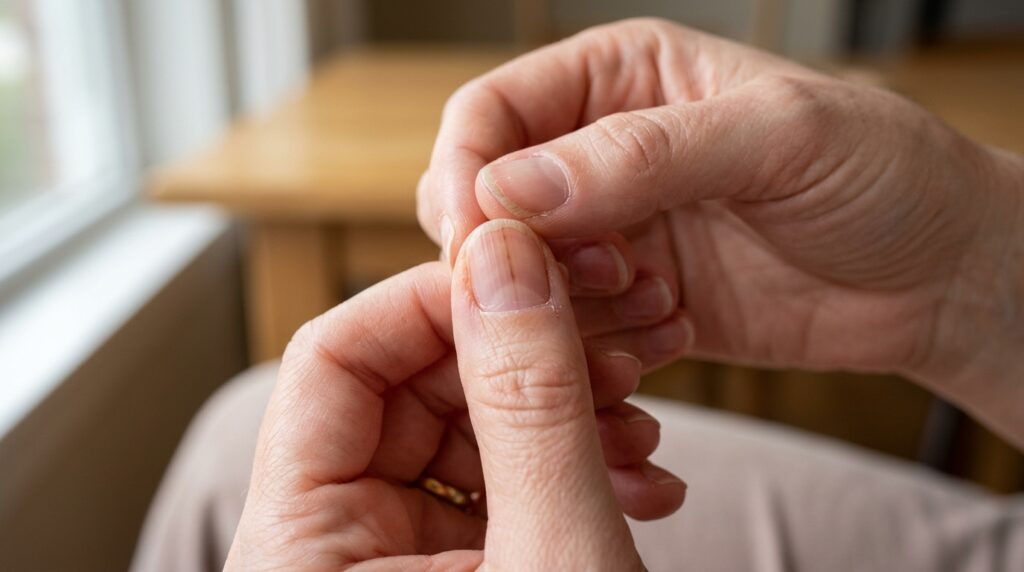
A New Dark Streak Under One Nail
This is one nail change that should not be casually dismissed. A new or changing dark streak under a fingernail or toenail can have harmless causes. But it can also be a sign of melanoma beneath the nail.
The American Academy of Dermatology recommends having a new or changing dark streak examined by a dermatologist. (American Academy of Dermatology)
This does not mean every dark nail streak is cancer.
It means this particular change is important enough to have professionally assessed.
Early evaluation is far better than months of guessing.
Yellow, Blue, White, or Unusual Nail Colour
Nails can change colour for many reasons. Some are external. Some are related to infection. Others may be associated with underlying health conditions.
For example, blue nails can sometimes indicate inadequate oxygenation, while pale nails can occur with anaemia. Yellow nails may result from nail infection or other causes. (American Academy of Dermatology)
But nail colour should never be interpreted in isolation. Lighting, nail polish, injury, smoking, and many harmless factors can change appearance.
A changing nail is worth observing. A persistent unexplained change is worth discussing.
When Skin, Hair, and Nails Change Together
This is where the story becomes particularly interesting. Sometimes one visible change means very little. But several changes appearing together can provide a more useful pattern.
Iron deficiency and anaemia
Possible clues can include:
- Pale skin: Especially when the change is noticeable.
- Brittle nails: Nails may become fragile.
- Hair shedding: Increased hair loss can occur.
- Fatigue: Energy may fall noticeably.
- Shortness of breath: Particularly with activity.
Iron-deficiency anaemia can produce several of these symptoms. (MedlinePlus)
But proper testing is required before deciding that iron is the problem.
Thyroid disorders
Thyroid conditions can affect skin, hair, and nails.
Possible changes include:
- Dry skin: Skin may become unusually dry.
- Hair thinning: Hair may become thinner or shed more.
- Brittle hair: Hair may become coarse or fragile.
- Scalp changes: Dryness and dandruff may increase.
- Nail changes: Nails may become brittle or change growth patterns.
The American Academy of Dermatology lists numerous skin, hair, and nail changes that can occur with thyroid disease. (American Academy of Dermatology)
Again, these signs are clues. They are not a substitute for thyroid testing.
Diabetes and blood sugar problems
Diabetes can affect the skin in several ways.
Possible signs include:
- Darkened skin folds: Especially around the neck, armpits, or groin.
- Slow-healing wounds: Particularly on the feet.
- Repeated infections: Skin infections can occur more frequently.
- Dry itchy skin: Poor circulation and other changes can contribute.
- Certain unusual skin changes: Some are associated with prolonged high blood sugar.
The Centres for Disease Control and Prevention specifically identifies dark patches around body folds and slow-healing wounds among possible diabetes-related signs. (CDC)
Hormonal changes
Hormones can influence the skin and hair.
Changes may affect:
- Acne: New or unusually severe acne may sometimes have a hormonal component.
- Hair growth: Increased facial or body hair can have hormonal causes.
- Scalp hair: Hormonal changes can influence shedding and thinning.
- Skin oiliness: Hormonal shifts can alter oil production.
- Pigmentation: Some hormonal states can influence skin colour.
The American Academy of Dermatology notes that new or severe acne in adulthood can sometimes be associated with hormonal abnormalities such as polycystic ovary syndrome. (American Academy of Dermatology)
Men: What Skin and Hair Changes Deserve Attention?
Men often notice hair changes first. A receding hairline. Thinning at the crown. A gradually smaller amount of hair.
These may simply reflect hereditary hair loss. But men should also pay attention to changes that do not fit their usual pattern.
These include:
- Sudden hair loss: Especially in patches.
- New scalp inflammation: Persistent redness, scaling, pain, or discharge.
- Unexplained bruising: Particularly if it appears frequently.
- Slow-healing wounds: Especially on the feet.
- New changing skin growths: Particularly those that bleed, change shape, or refuse to heal.
- Persistent unexplained itching: Especially when widespread.
A real-life example
A middle-aged man notices that his hairline has been slowly receding for several years. That is likely to be different from suddenly losing a round patch of hair in a week. At the same time, he notices a wound on his foot that is taking unusually long to heal. These are two different clues.
One may be hereditary.
The other may deserve medical evaluation.
Patterns matter more than isolated appearances.
Women: What Skin and Hair Changes Deserve Attention?
Women experience several life stages that can produce noticeable changes in skin and hair.
Pregnancy.
Childbirth.
Menopause.
Changes in menstrual bleeding.
Hormonal treatment.
All can influence appearance and energy.
A real-life example
A woman notices significant hair shedding several months after childbirth. She also feels exhausted. The hair shedding may be related to the normal changes in the hair-growth cycle that can occur after pregnancy. But if fatigue is severe or persistent, or if there are other symptoms such as heavy bleeding, dizziness, or shortness of breath, it is worth discussing the full picture with a healthcare professional.
The key lesson:
Do not treat the hair separately from the person.
Sometimes the most useful clue is the combination of symptoms.
Older Adults: Don’t Blame Everything on Age
Skin naturally changes with age. Hair changes too. Nails change. Older skin tends to become thinner and drier. Hair may become finer. Nails may become more brittle. These changes can be normal. But a new and rapidly changing symptom should not automatically be blamed on age.
Pay attention to:
- New or changing skin growths: Especially those that bleed or change appearance.
- Persistent itching: Particularly when unexplained.
- Unexplained bruising: Especially if it suddenly becomes frequent.
- Slow-healing wounds: Particularly on the feet.
- Sudden hair loss: Especially when severe.
- New dark nail streaks: Particularly when changing.
- Yellowing of the skin or eyes: Especially when new.
A real-life example
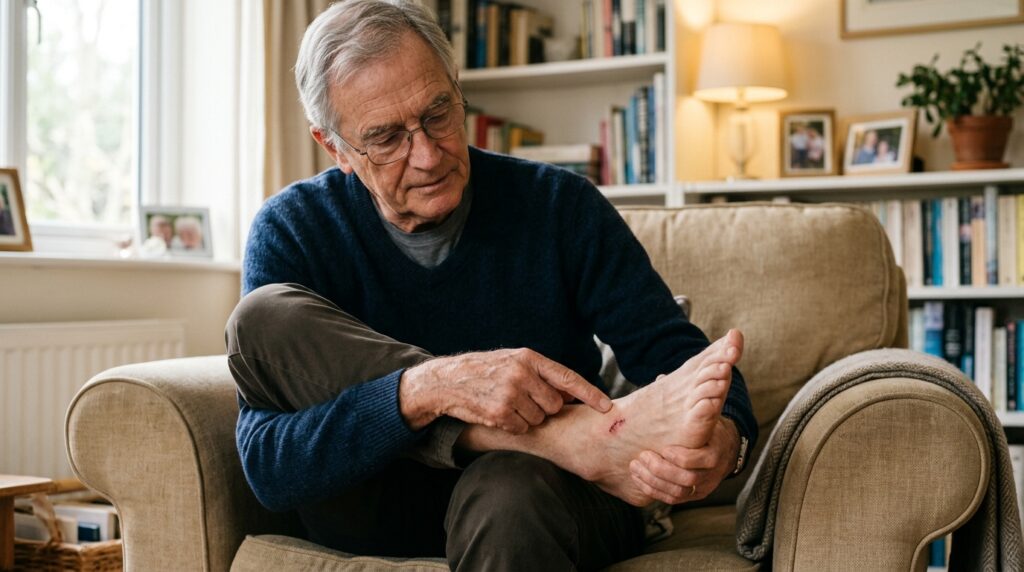
An older man develops a small wound on his foot.
The family says:
“At this age, wounds just take longer to heal.”
That may be partly true. But the wound could also be revealing diabetes, poor circulation, nerve damage, infection, or another problem. Age can change healing. It should not become an excuse for ignoring a wound that is not healing.
What Skin Changes Are Usually Less Concerning?
Not every skin change is a medical warning. Many are ordinary.
They may result from:
- Weather: Cold and dry conditions can dry the skin.
- Sun exposure: Can cause pigmentation and other changes.
- Ageing: Naturally changes skin, hair, and nails.
- Soap: Harsh products can irritate the skin.
- Cosmetics: Some products cause temporary reactions.
- Hair treatments: Chemicals and heat can damage hair.
- Stress: Can affect skin and hair in different ways.
- Temporary illness: Physical stress can temporarily affect hair growth.
The important factors are:
When did it begin?
Is it getting worse?
Is it spreading?
Does it hurt or itch?
Are other symptoms appearing?
Is it responding to ordinary care?
These questions are often more useful than simply staring at the mirror.
Don’t Diagnose Yourself From a Search Result
This is where modern technology can become both helpful and dangerous. You notice a dark patch. You search for it.
Five minutes later, you are convinced you have a rare disease that occurs in one person out of several million. Then you cannot sleep. The internet has not diagnosed you. It has frightened you. A single symptom can have dozens of explanations.
For example:
Hair loss does not automatically mean vitamin deficiency.
Itching does not automatically mean liver disease.
Dark skin around the neck does not automatically mean diabetes.
Brittle nails do not automatically mean anaemia.
A rash does not automatically mean an autoimmune disease.
Use health information to ask better questions. Do not use it to give yourself a diagnosis.
The internet can help you recognize a clue. It cannot replace an examination.
When Should You See a Doctor?
A skin or hair change deserves medical attention when it is:
- New: It has appeared without an obvious explanation.
- Persistent: It does not improve with ordinary care.
- Rapidly changing: It is growing, spreading, or changing quickly.
- Painful: The area becomes increasingly painful.
- Bleeding: A lesion repeatedly bleeds without a clear reason.
- Infected-looking: There is increasing redness, warmth, swelling, pus, or pain.
- Associated with fever: Especially when the rash or skin change is widespread.
- Associated with weight loss: Particularly unexplained weight loss.
- Associated with severe fatigue: Especially when persistent.
- Affecting several body areas: Multiple changes appear together.
- Not responding to treatment: The problem continues despite appropriate basic care.
Some symptoms need urgent assessment. Seek urgent medical attention for serious breathing difficulty with a rash, rapidly spreading severe infection, widespread blistering or skin peeling, severe swelling, or other signs of a medical emergency.

What Should You Tell Your Doctor?
You do not need to become a medical detective. But a little preparation can make your appointment more useful.
Write down:
- When it started: Give the approximate date.
- Where it started: Note the first affected area.
- How it changed: Record whether it spread, grew, darkened, or became painful.
- Other symptoms: Mention fatigue, fever, weight changes, itching, pain, or weakness.
- Recent illness: Include infections, fever, surgery, or major physical stress.
- New medicines: Include prescription and over-the-counter medicines.
- Dietary changes: Mention major changes in eating habits.
- Weight changes: Note significant unexplained changes.
- Stress: Mention major emotional or physical stress.
- Hormonal changes: Relevant menstrual, pregnancy, postpartum, or menopausal changes.
- Family history: Mention similar conditions in close relatives.
- Photographs: If the appearance has changed over time, photographs can help show progression.
A photograph taken three months ago may be more useful than:
“I think it started recently.”
The Skin-to-Health Connection
The following table provides a quick way to think about the subject.
| Visible change | Possible explanations | When to investigate |
|---|---|---|
| Pale skin | Anaemia, reduced blood flow, other conditions | Persistent or accompanied by weakness |
| Yellow skin or eyes | Jaundice and several underlying conditions | New yellowing deserves medical assessment |
| Darkened neck | Insulin resistance and other causes | Persistent or spreading |
| Hair shedding | Stress, illness, hormones, heredity, nutrition | Sudden or excessive shedding |
| Easy bruising | Medicines, ageing, blood or other conditions | New or unexplained bruising |
| Slow-healing wound | Diabetes, circulation problems, infection | Especially important if persistent |
| Persistent itching | Dry skin, eczema, allergy, systemic conditions | Severe or unexplained |
| Brittle nails | Ageing, repeated exposure, nutritional or medical factors | New or persistent changes |
| New dark nail streak | Injury and other causes, including melanoma | New or changing streak should be examined |
| Patchy hair loss | Autoimmune disease, infection, other causes | Sudden or expanding patches |
These associations are possibilities, not diagnoses. The American Academy of Dermatology emphasises that many skin, hair, and nail changes have multiple causes and should be assessed in context. (American Academy of Dermatology)
The Bigger Lesson
Your skin is not a medical laboratory. Your hair cannot tell you exactly what is happening inside your body. Your nails cannot replace a blood test. And a photograph cannot replace a medical examination. But your appearance can sometimes provide an early clue that something has changed. That clue may turn out to be completely harmless. Or it may lead to an important discovery. The smartest response is neither fear nor denial.
It is curiosity.
Notice the change.
Watch what happens.
Look for accompanying symptoms.
And when something is persistent, unusual, rapidly changing, or unexplained, ask a qualified healthcare professional.
Don’t panic when your body changes. Don’t ignore it either.
Sometimes the first sign of an internal problem is not pain. Sometimes it is something you can see in the mirror.
Frequently Asked Questions
Can skin changes be the first sign of a health problem?
Yes. Some diseases and systemic conditions can produce changes in the skin, hair, or nails. However, most individual skin changes have several possible explanations, so a visible symptom should be considered a clue rather than a diagnosis. (American Academy of Dermatology)
What skin changes should never be ignored?
New yellowing of the skin or eyes, rapidly changing skin growths, unexplained widespread bruising, wounds that do not heal, rapidly spreading infections, and severe or unexplained skin changes deserve medical attention. The urgency depends on the appearance and accompanying symptoms.
Can hair loss indicate a health problem?
Yes, but not always. Hereditary hair loss and normal shedding are extremely common. Sudden patchy loss, unusually heavy shedding, or hair loss accompanied by scalp inflammation or other symptoms can have many possible causes and may require professional assessment. (American Academy of Dermatology)
What does dark skin around the neck mean?
A dark, thickened, velvety appearance around the neck can sometimes be acanthosis nigricans, which is associated with insulin resistance and may occur with prediabetes or type 2 diabetes. However, other causes exist, so the appearance alone cannot diagnose diabetes. (CDC)
Can nail changes reveal nutritional deficiencies?
Some nail changes can be associated with nutritional deficiencies. For example, spoon-shaped nails can occur with iron-deficiency anaemia, while anaemia can also be associated with brittle nails. But nail changes have many possible causes, so testing and professional assessment are needed before assuming a deficiency. (MedlinePlus)
When should I see a doctor about a skin or hair change?
Seek medical advice when a change is new, persistent, rapidly worsening, painful, bleeding, associated with fever or unexplained weight loss, accompanied by significant fatigue, or not improving with appropriate basic care. Sudden or severe symptoms may require more urgent evaluation.
References
- American Academy of Dermatology — Skin, hair, and nail signs of overall health. (American Academy of Dermatology)
- American Academy of Dermatology — Hair loss: signs, symptoms, and causes. (American Academy of Dermatology)
- American Academy of Dermatology — Thyroid disease and skin, hair, and nail changes. (American Academy of Dermatology)
- American Academy of Dermatology — Nail changes that should be examined. (American Academy of Dermatology)
- Centers for Disease Control and Prevention — Diabetes and skin changes. (CDC)
- Centers for Disease Control and Prevention — Diabetes symptoms and slow-healing wounds. (CDC)
- Centers for Disease Control and Prevention — Diabetes, nerve damage, wounds, and foot health. (CDC)
- MedlinePlus — Iron-deficiency anemia and associated symptoms. (MedlinePlus)
- MedlinePlus — Jaundice and possible causes. (MedlinePlus)
- MedlinePlus — Nail abnormalities and possible health associations. (MedlinePlus)
Medical Disclaimer
This article is intended for general education and health awareness. Skin, hair, and nail changes can have many causes, and an online article cannot diagnose an individual condition. Persistent, unexplained, worsening, painful, bleeding, or otherwise concerning changes should be evaluated by a qualified healthcare professional.