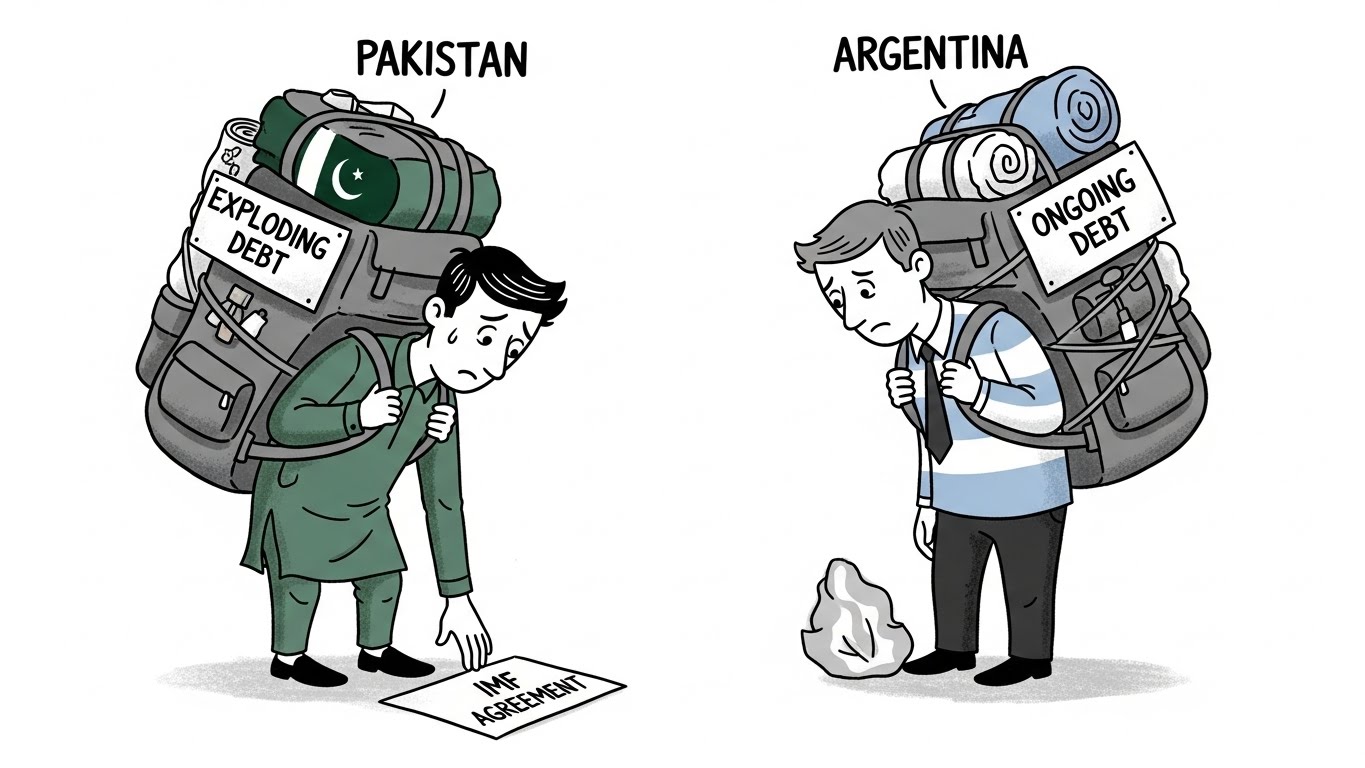

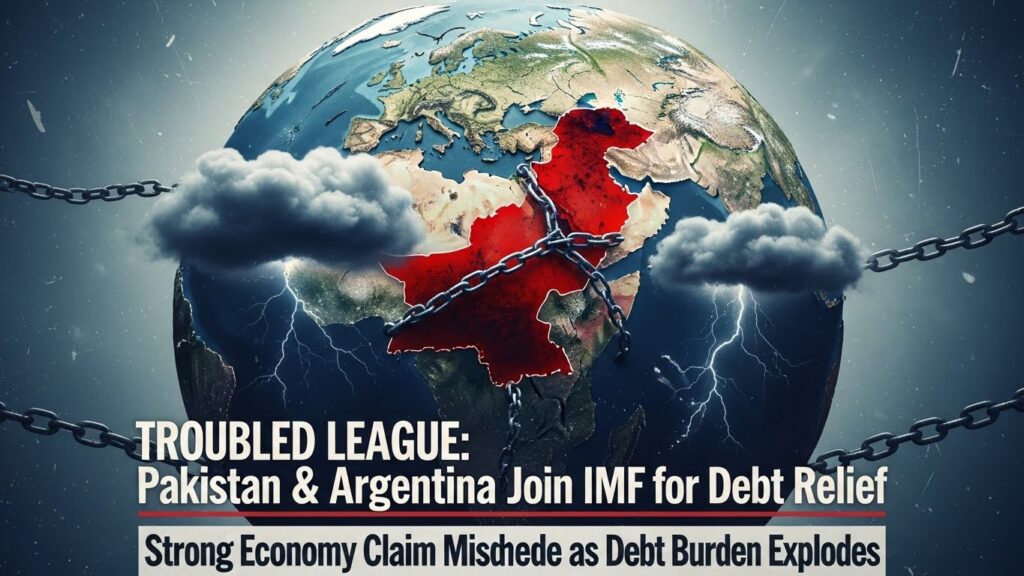
Pakistan Joins IMF in Troubled League with Argentina “Strong Economy” Claim Misleading as Debt Burden Explodes
EP RESEARCH
Independent Economic Analysis:
Pakistan has now joined Argentina in a troubling club of countries with frequent episodes of IMF support, repeatedly seeking help to manage chronic balance-of-payments problems. Pakistan has entered into IMF programs more times than most developing countries, highlighting persistent economic fragility.
In 2024, Pakistan secured a $7 billion Extended Fund Facility (EFF) aimed at stabilising its finances. While disbursements continue into 2025, the IMF has repeatedly stressed that financing alone won’t fix underlying structural issues without deep reforms. (Reuters)
Despite official narratives about strengthening the economy, hard data paint a much more alarming picture of debt accumulation and repayment pressure:
IMF board approves Pakistan review, releases $1.2 billion in funding
How does the program enhance Pakistan’s competitiveness amidst high borrowing costs, energy prices, and taxes weighing on the private sector?
The program enhances Pakistan’s competitiveness by implementing structural reforms that address key economic distortions and improve the business environment. Reforming state-owned enterprises through restructuring and privatization will enhance efficiency and reduce fiscal burdens. The program will foster a level playing field for the private sector, and lower the cost structure of the economy, by removing state-induced distortions including the setting of prices for goods and services, reforming the energy sector, and increasing competition. Measures such as streamlining subsidies, improving the foreign direct investment regime, and deepening financial intermediation aim to attract investment and stimulate economic activity. By scaling up human capital investment and enhancing governance and transparency, the program will strengthen the foundations for productivity gains and competitiveness.
https://www.imf.org/en/countries/pak/faq
Soaring Internal Debt: A Hidden Time Bomb
Pakistan’s internal (domestic) debt has grown dramatically, far outpacing revenue and economic growth. Latest figures show:
- Government debt surged sharply, reaching near record levels. Total public debt hit around Rs78 trillion in mid-2025, driven largely by domestic borrowing to cover fiscal deficits. (Profit by Pakistan Today)
- Internal debt is projected to grow further in FY 2026-27, with IMF estimates suggesting an increase of around Rs4.5 trillion, lifting total domestic obligations to nearly Rs64 trillion. (Business Recorder Urdu)
This rise in domestic debt reflects sustained budgetary shortfalls, where borrowing is used to finance basic government operations rather than productive investment. Heavy domestic borrowing also crowds out private investment, raising future financing costs and reducing economic growth prospects.
Key IMF Governance Findings – Pakistan (2025)
Governance failures are identified as a major constraint on sustainable growth:
| Area | Key Findings | Impact |
|---|---|---|
| Corruption & Elite Capture | Widespread corruption across state institutions; policy and spending are influenced by powerful actors | Undermines fiscal efficiency, discourages investment |
| Fiscal Governance & Transparency | Opaque budgeting, weak oversight of procurement and capital expenditure | Inefficient public spending, weak fiscal discipline |
| Institutional Weaknesses | Fragmented oversight agencies, a politically influenced judiciary, and overlapping regulatory mandates | Slow decision-making, weak enforcement of laws, and higher compliance costs |
| Tax & Market Regulation | Complex, poorly enforced tax system; inconsistent regulation | Reduced revenue collection, higher business uncertainty |
| Economic Impact | Governance deficits erode public trust and economic efficiency | Limits GDP growth, increases cost of borrowing, risks repeated financial crises |
| IMF Recommendations | Digitize procurement, strengthen internal audits, streamline regulators, reform tax systems, and enhance accountability | Potential to boost GDP growth by 5–6.5% if reforms are implemented effectively |
Source: IMF Governance and Corruption Diagnostic Assessment (GCDA), 2025 (IMF)
https://mrpo.pk/pakistan-governance-and-corruption-diagnostic-report/
External Debt Pressures: Heavy Payments Loom in 2026
Pakistan’s external debt burden is also escalating, exposing the country to foreign exchange risks and heavy repayment obligations:
- IMF projections indicate that external debt could reach about $126.7 billion by FY 2025-26, with estimates rising further into 2026-27. (Business Recorder)
- Pakistan must meet large foreign debt servicing payments in FY 26, with estimates suggesting roughly $25.9 billion in principal and interest repayments, including about $22 billion in principal and nearly $4 billion in interest. (Dawn News)
These obligations mean Pakistan must secure substantial foreign financing or rollover existing debt to maintain reserves and avert default risks, a tightrope that makes long-term planning inherently unstable.
Here’s a comprehensive **summary of the key governance‑related findings from the IMF’s Governance and Corruption Diagnostic Assessment (GCDA) with evidence you can include in your article to reinforce the point that governance failures are a core obstacle to sustainable economic growth in Pakistan:
IMF Report: Governance Failures Undermine Sustainable Growth
The International Monetary Fund’s Governance and Corruption Diagnostic Assessment (GCDA) — an official IMF diagnostic released in late 2025 — paints a bleak and detailed picture of governance weaknesses in Pakistan that go far beyond fiscal imbalances. These structural flaws are identified as major constraints on long‑term economic stability and growth: (IMF)
1. Persistent and Systemic Corruption Risks
- The IMF finds corruption to be deeply embedded across key state institutions, weakening the control of public resources and undermining transparency and accountability. (IMF)
- “Elite capture” — where powerful political and economic actors influence policy and public spending for private gain — is highlighted as a central drain on economic potential, costing billions and discouraging legitimate economic activity. (Geo News)
- Recovery figures such as the roughly Rs5.3 trillion recovered from corruption (Jan 2023–Dec 2024) are described as “only a small portion” of the true economic loss from graft, indicating the scale of mismanagement. (Geo News)
2. Weak Fiscal Governance and Transparency
- Budgeting and financial reporting systems are described as opaque and vulnerable to manipulation, with large discrepancies between budget allocations and actual expenditures. (Geo News)
- Public procurement and capital spending — major avenues for public funds — lack effective oversight and clear rules, increasing the risk of misuse and inefficiency. (Geo News)
- Fiscal operations such as cash management and treasury controls are fragmented and lack unified accountability, weakening the state’s fiscal discipline. (Profit by Pakistan Today)
3. Institutional Weaknesses and Regulatory Fragmentation
- Oversight bodies, including anti‑corruption agencies (such as NAB and FIA) are fragmented, inconsistently coordinated, and often lack the authority or independence to enforce accountability effectively. (Profit by Pakistan Today)
- The judiciary is characterised as inefficient, slow, and susceptible to political influence, with long backlogs that erode property rights and contract enforcement — key foundations of investment confidence. (Profit by Pakistan Today)
- Regulatory functions are spread across multiple agencies with overlapping mandates, raising compliance costs and creating opaque business environments. (Geo News)
4. Tax and Market Regulation Challenges
- The report highlights an overly complex and weakly enforced tax system that encourages evasion and lowers revenue collection, compromising the government’s fiscal capacity. (Geo News)
- Market regulation suffers from multiple regulators issuing conflicting rules, high compliance costs, and perceptions of regulatory capture by vested interests, further deterring investment. (Geo News)
5. Economic Impact and Reform Imperatives
- The IMF cautions that governance failures directly reduce public trust, weaken revenue systems, and erode the effectiveness of public expenditure, all while increasing the cost of doing business in Pakistan. (Dunya News)
- The Fund suggests that addressing governance and corruption could unlock significant economic gains — potentially contributing to a 5 %–6.5 % boost in GDP growth over the next five years if reforms are effectively implemented. (Profit by Pakistan Today)
- The report includes a detailed multi‑point reform agenda — from digitizing procurement and rationalising tax systems to strengthening internal audits and parliamentary oversight — but stresses that political will is the crucial factor for any meaningful progress. (IMF)
Why This Matters for Sustainable Growth
The IMF’s governance assessment makes it clear that:
- Economic reforms cannot succeed without addressing deep governance deficits.
- Fiscal and monetary measures alone will not generate sustainable growth if transparency, accountability, and effective public management remain weak.
- Governance quality is fundamentally linked to investor confidence, revenue mobilisation, and efficient public spending.
In short, the IMF report underscores that Pakistan’s economic vulnerabilities are as much political and institutional as they are fiscal or monetary — and without confronting these governance gaps, claims of a “strong economy” are at best incomplete and at worst misleading.
The Real Economy vs. Political Rhetoric
While government leaders, including Prime Minister Shehbaz Sharif, have asserted that the economy is gaining strength, independent economic analysts see this as deeply misleading. Current dynamics suggest the country’s financial health is being propped up by debt accumulation rather than sustainable growth.
Key systemic issues persist:
- Fiscal deficits are forcing reliance on both domestic and foreign borrowing.
- The inefficient tax system is failing to generate stable revenue.
- State-owned enterprises are running losses, adding to fiscal stress.
- Heavy debt servicing obligations are crowding out development spending.
These factors have combined to produce an economy where short-term relief measures—temporary subsidies, stop-gap financing, and recurrent bailouts—mask deep structural weaknesses that are not being addressed.
A Crucial Crossroads: Reform or Recurrence
Pakistan now stands at a critical juncture. Without credible structural reforms in taxation, public spending prioritisation, and debt management, the country will continue to cycle through crises and IMF programs.
Temporary relief measures will not suffice. What is urgently needed is:
- Fiscal discipline, including more efficient and broad-based revenue collection.
- Long-term investment strategies that generate sustainable jobs and exports.
- Debt-management frameworks that reduce dependency on short-term borrowings and stabilise foreign currency reserves.
Failing to act decisively risks Pakistan not just repeating past cycles of economic stress but facing deeper financial instability that could undermine social and political well-being.
EP Research refers to independent economic analysis conducted by the editorial team at MRPO.pk, based on publicly available data, official reports, and reputable international and national sources.