
Islam Comes to Persia: How Iran Became the Heartland of Shia Islam
Islam Comes to Persia. Discover how Islam transformed ancient Persia, why Iran embraced Shia Islam, and how Persian civilisation helped shape Islamic history and the modern Middle East.
https://mrpo.pk/iran-explained-from-ancient-persia-to-modern-geopolitics/
Introduction
History remembers great battles because they redraw borders. Yet the most profound transformations are often those that reshape civilisations rather than simply conquer territories. When Islam entered Persia during the seventh century, the world witnessed one such transformation. It was not merely the end of one empire and the beginning of another. It marked the meeting of two remarkable civilisations whose interaction would influence religion, science, philosophy, literature, governance, and geopolitics for more than thirteen centuries.
Modern Iran cannot be understood without appreciating this defining chapter of its history. The country’s religious identity, intellectual traditions, political institutions, and even its contemporary role in regional affairs all bear the imprint of the centuries-long relationship between Persian civilisation and Islam. To many observers, Iran is viewed primarily through the lens of modern politics or the 1979 Islamic Revolution. Yet long before those events, Persia had already become one of the most influential centres of Islamic civilisation.
This article is the third instalment in our investigative series exploring Iran’s remarkable historical journey. The first article introduced readers to the importance of understanding Iran beyond headlines and contemporary conflicts. The second explored the extraordinary legacy of Ancient Persia, one of humanity’s oldest continuous civilisations. This instalment examines how Islam arrived in Persia, how Persians gradually embraced the new faith, and why Iran eventually became the heartland of Shia Islam.
Understanding this transformation is particularly relevant today. Recent regional conflicts have once again drawn international attention to Iran. Analysts frequently focus on military capabilities, diplomacy, and geopolitical rivalries. However, the resilience, national cohesion, and strategic outlook that many observers associate with modern Iran are deeply rooted in historical experiences spanning more than a millennium. To understand present-day Iran, one must first understand the civilizational journey that shaped it.
“Civilizations survive not because they refuse change, but because they transform change into part of their identity.”
The Evolution of Iran from Sunni to Shia Islam
Iran’s religious landscape has drastically changed over the centuries, evolving from a Sunni stronghold to the centre of Shia Islam. This transformation was driven by key historical events, including the rapid spread of Islam after Prophet Muhammad’s رسول اللہ صلی اللہ علیہ وسلم (peace be upon Him) death, the fall of the Persian Empire, and the rise of the Safavid Dynasty. These shifts not only redefined Iran’s religious identity but also made Persia a crucial contributor to the Islamic Golden Age.
The Rise of Islam and the Conquest of Persia
After the passing of Prophet Muhammad رسول اللہ صلی اللہ علیہ وسلم(peace be upon Him) in 632, the Muslims began expanding rapidly from the Arabian Peninsula. They simultaneously launched attacks on the Roman and Persian Empires, the two greatest powers of the time. While the Roman Empire managed to hold on for another 800 years, the Persian Empire fell much more quickly. A plague had recently devastated Persia, weakening the empire. After just two major battles, the Persian kingdom collapsed, and over the next 50 years, the remaining Persian lands were absorbed into the Muslim Caliphate.
https://www.islamicity.org/102575/the-evolution-of-iran-from-sunni-to-shia-islam/
Persia Before Islam
A Civilisation at the Height of Power
Long before Islam emerged in Arabia, Persia stood among the world’s greatest civilisations. By the beginning of the seventh century, the Sasanian Empire represented one of the two dominant superpowers of the known world, rivalled only by the Byzantine Empire.
Stretching from Mesopotamia to Central Asia, the Sasanian state governed millions of people through an efficient administrative system supported by experienced governors, professional armies, sophisticated taxation, and flourishing trade routes. Persian engineers built canals, bridges, and irrigation systems that sustained prosperous agricultural regions. Merchants carried silk, spices, precious metals, textiles, and knowledge across Asia through commercial networks that connected China, India, Central Asia, and the Mediterranean.
Persian cities became centres of commerce, learning, and culture. Magnificent palaces, temples, libraries, and markets reflected the wealth and sophistication of a civilisation that had inherited centuries of imperial experience from earlier Persian dynasties. Yet beneath this impressive façade, significant challenges had begun to emerge.
Decades of exhausting warfare against Byzantium drained state finances and weakened military strength. Heavy taxation burdened ordinary citizens, while rigid social hierarchies increasingly limited opportunities for the lower classes. Internal political rivalries also reduced the stability that had once distinguished the Persian state.
Although still powerful, the empire entered the seventh century carrying vulnerabilities that would soon become evident.
Zoroastrianism: The Spiritual Foundation of Ancient Persia
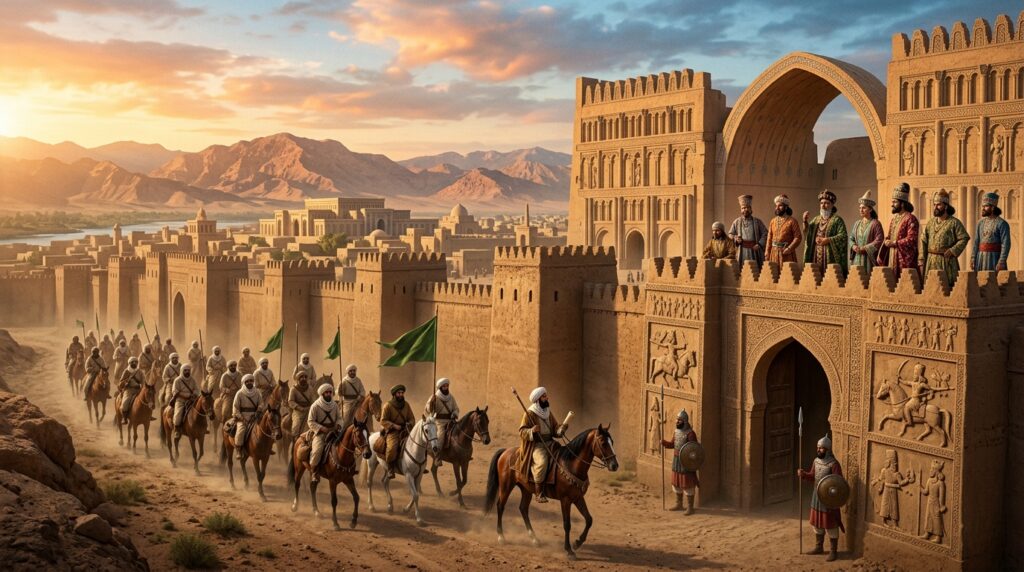
Religion occupied a central place in Persian society long before Islam arrived. The dominant faith was Zoroastrianism, one of the world’s oldest monotheistic traditions. Founded by the prophet Zarathustra, also known as Zoroaster, it centred on devotion to Ahura Mazda, the supreme creator associated with truth, wisdom, and justice.
Unlike many ancient religions, Zoroastrianism emphasised moral responsibility rather than ritual alone. Every individual was encouraged to pursue what became one of history’s most enduring ethical principles:
Good Thoughts. Good Words. Good Deeds.
Fire temples served as places of worship, where sacred flames symbolised purity rather than being objects of worship themselves. Priests preserved religious traditions, advised rulers, and oversaw important ceremonies throughout the empire.
The influence of Zoroastrianism extended far beyond religious practice. Persian concepts of kingship, justice, public administration, and ethical governance were deeply connected to its teachings. Festivals such as Nowruz, celebrating the Persian New Year, reflected ancient traditions that continue to be observed across Iran today despite the country’s Islamic identity.
Understanding this heritage is essential because Islam did not arrive in an empty cultural landscape. Persia already possessed a sophisticated religious philosophy, rich literary traditions, advanced legal institutions, and a strong sense of civilizational identity. These foundations would profoundly influence the way Persians later understood and practised Islam.
The Arrival of Islam
A New Faith Emerges in Arabia
In the early seventh century, a new religious movement emerged in the Arabian Peninsula under the Prophet Muhammad رسول اللہ صلی اللہ علیہ وسلم. Within only a few decades, Islam united many previously divided Arab tribes through a shared spiritual and political vision.
Following the Prophet’s رسول اللہ صلی اللہ علیہ وسلم death in 632 CE, the expanding Muslim community rapidly extended beyond Arabia. Military campaigns reached Syria, Egypt, Iraq, and eventually the borders of the mighty Sasanian Empire.
For the Persian leadership, this new force initially appeared to be another regional challenge. Few anticipated that it would fundamentally reshape the political and religious landscape of the Middle East.
The First Contact Between Islam and Persia
Islam reached Persia first through diplomacy rather than conquest. After the Treaty of Hudaybiyyah in 628 CE, Prophet Muhammad رسول اللہ صلی اللہ علیہ وسلم sent letters to several neighbouring rulers inviting them to embrace Islam peacefully. Among them was Khosrow II (Kisra), the powerful emperor of the Sasanian Empire.
According to early Islamic sources, Khosrow II reacted angrily when he saw that the Prophet’s name, رسول اللہ صلی اللہ علیہ وسلم name appeared before his own in the letter. He reportedly tore the letter apart and ordered the governor of Yemen to send men to arrest Muhammad رسول اللہ صلی اللہ علیہ وسلم.
Before the order could be carried out, news reached Arabia that Khosrow II had been overthrown and killed by his own son, Kavadh II. When the governor’s envoys learned this, they returned without carrying out the emperor’s command.
Although the diplomatic mission did not lead to Persia’s conversion, it marked the first recorded contact between the Islamic community and the Sasanian Empire. Within a few years, events would move from diplomacy to warfare as the rapidly expanding Muslim state encountered its powerful northern neighbour.
The Muslim Conquest of Persia
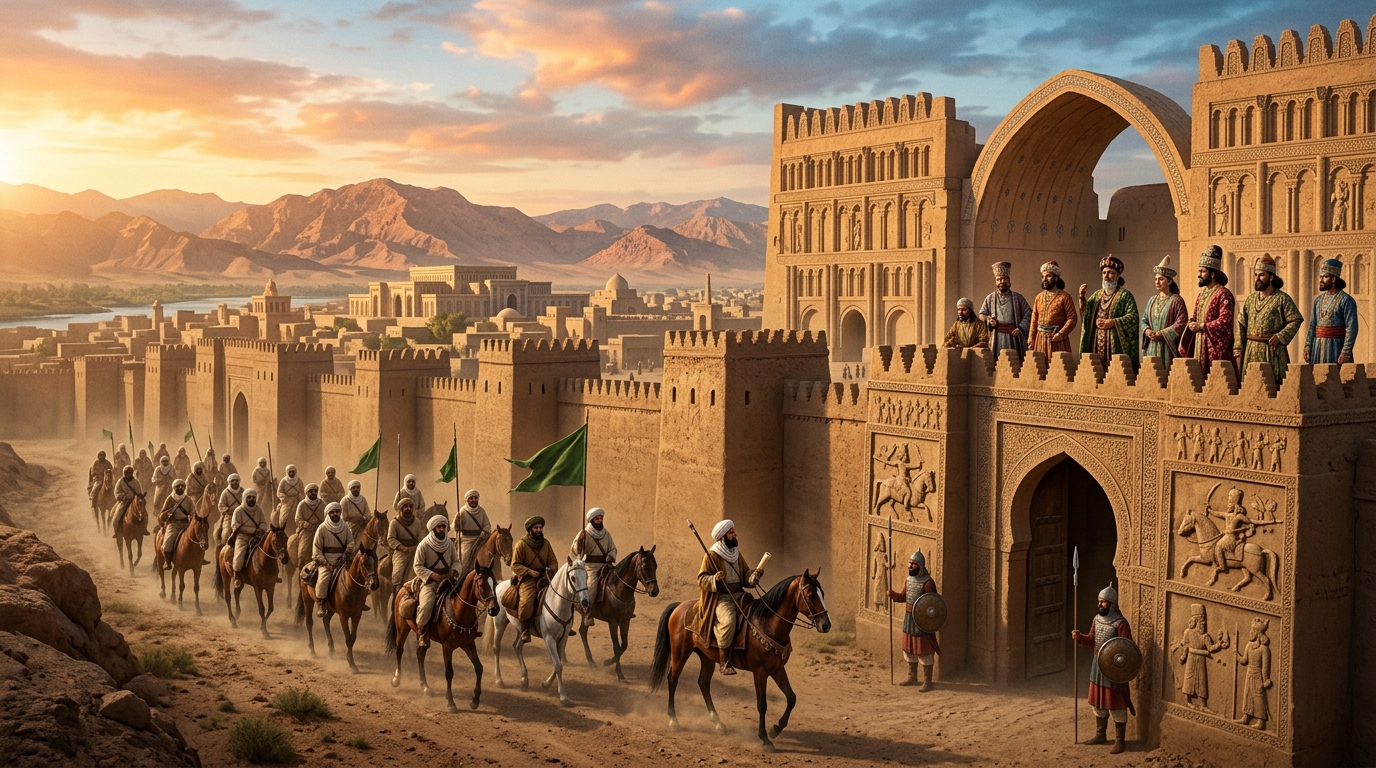
Following the death of Prophet Muhammad ﷺ in 632 CE, the Rashidun Caliphate expanded beyond Arabia under the leadership of the first caliphs. Muslim forces entered Persian territory during the reign of Caliph Umar ibn al-Khattab. Several decisive battles changed the balance of power forever.
The Battle of al-Qadisiyyah in approximately 636 CE resulted in the defeat of a major Sasanian army and opened the road to Ctesiphon. Soon afterwards, Muslim forces captured the imperial capital, bringing enormous wealth and strategic advantages under their control.
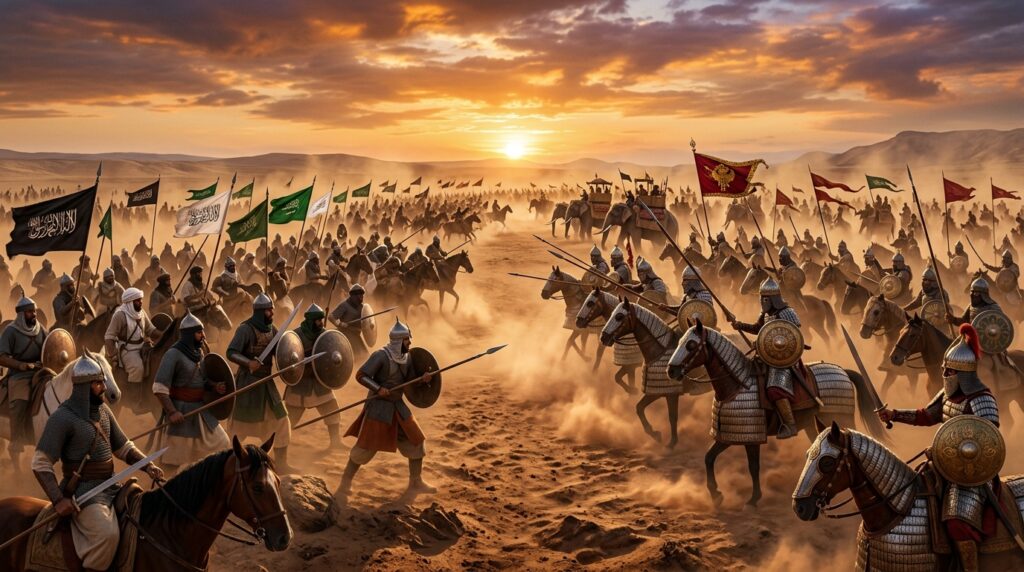
The decisive Battle of Nahavand in 642 CE, sometimes called the “Victory of Victories,” effectively ended organised Sasanian resistance. Although fighting continued in some regions, the empire steadily collapsed.
The last Sasanian ruler, Yazdegerd III, fled eastward before being killed in 651 CE, bringing more than four centuries of Sasanian rule to an end. Yet conquering Persia politically did not mean converting its people overnight. The transformation of Persian society would unfold gradually over the next several centuries.
The Arab Conquest of Persia
The decisive turning point came in 636 CE during the Battle of al-Qadisiyyah. Facing Muslim forces, the Persian army suffered a defeat that opened the road toward the imperial capital of Ctesiphon. The loss represented more than a military setback. It severely weakened the administrative heart of the Sasanian state.
Soon afterwards, Muslim forces entered Ctesiphon, gaining control over one of the richest cities in the region. However, resistance did not end there.
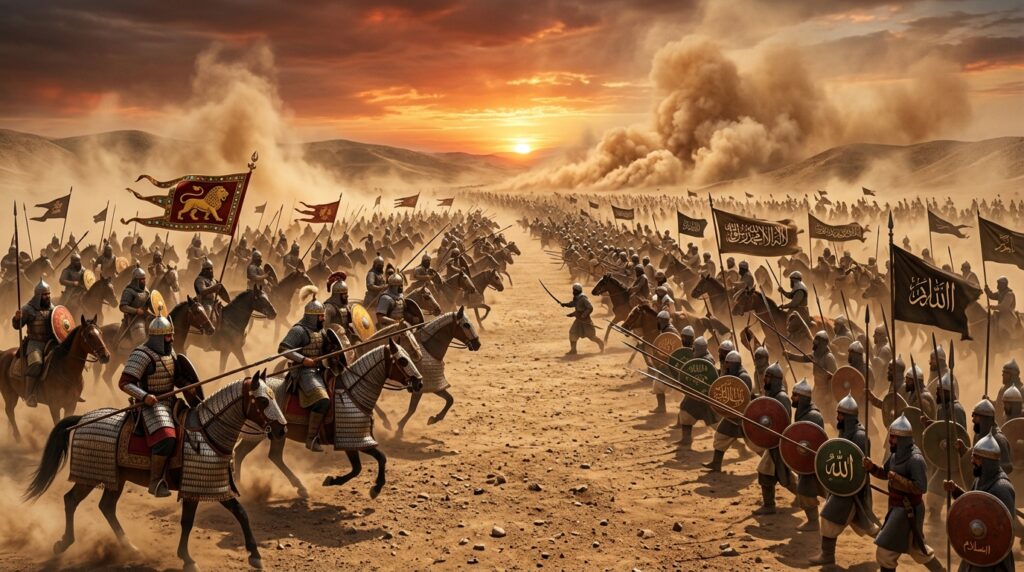
Several years later, the Battle of Nahavand in 642 CE dealt another devastating blow to the remaining Sasanian military. Often described by historians as the “Victory of Victories,” the battle effectively ended organised imperial resistance.
Even after these defeats, local Persian rulers continued resisting in various provinces for years. The political collapse of the empire occurred relatively quickly, but the transformation of Persian society unfolded far more gradually.
Conquest Was Rapid. Conversion Was Gradual.
Popular narratives often portray Persia as converting to Islam immediately after military defeat. Historical evidence presents a far more nuanced picture. For generations after the conquest, many Persians continued following Zoroastrianism. Others adopted Islam gradually through interaction with Muslim administrators, merchants, scholars, and neighbouring communities.
Conversion varied considerably across different regions. Urban centres generally embraced the new religion earlier than remote rural communities. Economic opportunities, social mobility, commercial relationships, and intermarriage all contributed to this gradual process.
Rather than a single dramatic event, the Islamization of Persia unfolded over centuries. This gradual transition allowed many elements of Persian culture to survive and eventually become integrated into the broader Islamic civilisation.
Why Many Persians Accepted Islam
Political and Administrative Change
The arrival of Muslim rule introduced a new administrative system that reorganised governance across Persia. Many local officials retained important roles within the new political order. Persian administrators, already experienced in taxation, record keeping, and provincial management, became valuable contributors to the expanding Islamic state.
Instead of completely dismantling Persian institutions, Muslim rulers frequently adapted existing administrative practices to meet new governmental needs. This continuity reduced disruption and encouraged cooperation between local elites and the new authorities.
Economic Opportunities
Economic considerations also influenced conversion. Muslim merchants participated in growing commercial networks extending from Spain to Central Asia. Participation within this rapidly expanding economic sphere created new opportunities for trade, travel, education, and public service.
Although economic incentives alone cannot explain religious change, they formed one part of a broader environment that encouraged gradual integration into the Islamic world.
Social Mobility
The rigid class structures that had characterised the later Sasanian Empire had created frustration among many segments of society. Islam emphasised the spiritual equality of believers before God, offering an alternative vision that appealed to individuals seeking greater social opportunity.
As Persian converts increasingly participated in public administration, scholarship, commerce, and military service, many found opportunities that had previously been limited by inherited social status.
The Appeal of Islamic Teachings
Religious conviction also played an important role. Islam’s emphasis on monotheism, charity, justice, accountability before God, and moral conduct resonated with many Persians whose own religious traditions already valued ethical responsibility. Rather than viewing Islam as entirely foreign, many Persians recognised familiar moral themes while embracing a new religious framework.
This intellectual and spiritual dialogue helped facilitate one of history’s most significant religious transformations. By the eighth and ninth centuries, Islam had become firmly established across much of Persia. Yet remarkably, Persian civilisation itself had not disappeared. Instead, it was preparing to reshape Islamic civilisation in ways few could have imagined.
Persia Did Not Lose Its Identity
One of history’s greatest misconceptions is that the Arab conquest erased Persian civilisation. In reality, Persia experienced something far more remarkable. While the Sasanian Empire disappeared as a political entity, the Persian language, culture, literature, administrative traditions, and intellectual heritage endured. Rather than being absorbed into Islamic civilisation, Persia became one of its principal architects.
This distinction is crucial for understanding modern Iran.
History offers many examples of civilisations that vanished after conquest. Ancient Assyria, Carthage, and numerous kingdoms of Central Asia gradually faded into history. Persia followed a different path. It adapted without surrendering its cultural soul.
The Persian language continued to flourish despite Arabic becoming the language of religious scholarship and administration during the early Islamic centuries. Over time, New Persian emerged, written in the Arabic script but retaining its own grammar, vocabulary, literary traditions, and unique identity.
This cultural resilience enabled Persia to remain unmistakably Persian while becoming profoundly Islamic.
Persian Literature Became a Guardian of National Identity
The Revival of the Persian Language
By the ninth and tenth centuries, Persian literature experienced an extraordinary revival. Courts across eastern Iran and Central Asia encouraged poets, scholars, and historians to write once again in Persian, preserving centuries of cultural memory. Far from disappearing, Persian became one of the great literary languages of the Islamic world.
Its influence eventually spread across Central Asia, the Indian subcontinent, Anatolia, and beyond, serving as the language of diplomacy, poetry, philosophy, and courtly culture for centuries. The preservation of Persian literature ensured that future generations would remember not only their Islamic faith but also their ancient civilizational heritage.
Ferdowsi and The Shahnameh
No individual contributed more to preserving Persian identity than the celebrated poet Ferdowsi. Around the year 1010, he completed the monumental epic known as Shahnameh, or The Book of Kings. Comprising roughly 50,000 couplets, it recounts the legendary and historical rulers of Persia from mythical beginnings to the Arab conquest.
More than an epic poem, the Shahnameh became a cultural monument. It preserved ancient legends, royal traditions, ethical ideals, and historical memory during a period when many feared that Persia’s pre-Islamic heritage might be forgotten. Importantly, Ferdowsi did not reject Islam. Instead, he demonstrated that Persian civilisation and Islamic faith could coexist without diminishing either.
Even today, the Shahnameh remains a cornerstone of Iranian cultural identity.
Persian Scholars Helped Build Islamic Civilisation
From Conquered Land to Intellectual Powerhouse
If military conquest transformed political authority, Persian scholarship transformed Islamic civilisation itself. Beginning in the eighth century, Persia produced generations of scientists, physicians, philosophers, mathematicians, theologians, astronomers, and poets whose work influenced not only the Muslim world but also medieval Europe.
The Islamic Golden Age cannot be understood without acknowledging the extraordinary contributions of Persian scholars. Many of history’s greatest Muslim intellectuals were born in Persian-speaking regions or educated within Persian scholarly traditions.
Medicine and Scientific Discovery
Perhaps the most famous was Avicenna. His medical encyclopedia, the Canon of Medicine, became one of the most influential medical texts in history. For centuries, universities across Europe and the Middle East used it as a standard reference.
Persian physicians developed sophisticated approaches to diagnosis, pharmacology, surgery, and public health that were far ahead of their time. Their hospitals, libraries, and research institutions became models for later civilisations.
Mathematics and Astronomy
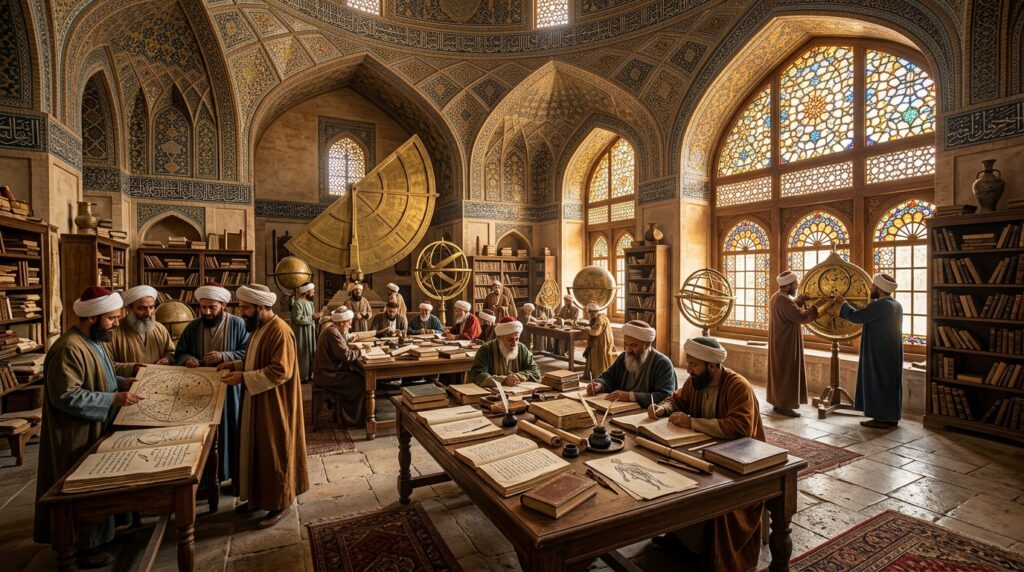
Persian scholars also made lasting contributions to mathematics and astronomy. Omar Khayyam, widely celebrated for his poetry, was equally respected as a mathematician and astronomer. His work on algebra and calendar reform demonstrated remarkable scientific precision.
Meanwhile, Al-Biruni conducted pioneering studies in geography, astronomy, mineralogy, and comparative religion. His measurements of the Earth’s circumference were astonishingly accurate considering the technological limitations of his era. Their research reflected a culture that valued observation, reason, and intellectual inquiry alongside religious scholarship.
Philosophy and Theology
Persian thinkers also shaped Islamic philosophy. Scholars such as Al-Farabi and Al-Ghazali explored profound questions concerning ethics, metaphysics, education, governance, and the relationship between reason and revelation. Their writings influenced Islamic seminaries for centuries and later reached European universities through translations into Latin.
The result was an intellectual exchange that extended far beyond the Middle East, contributing to the preservation and transmission of knowledge that would eventually influence the European Renaissance.
The Islamic Golden Age Was Also a Persian Golden Age
The flourishing of science, literature, philosophy, and medicine between the eighth and thirteenth centuries is often described as the Islamic Golden Age. Yet this remarkable period was equally a Persian renaissance.
Persian cities such as Nishapur, Rayy, Isfahan, Shiraz, and later Tabriz became thriving centres of learning. Libraries housed thousands of manuscripts. Scholars debated astronomy, theology, mathematics, medicine, architecture, and philosophy. Knowledge became one of Persia’s greatest exports.
This intellectual tradition established a national respect for scholarship that remains deeply embedded in Iranian society today. The country’s enduring emphasis on education, scientific research, and technological advancement can be traced, in part, to this long historical legacy.
The Rise of Shia Islam in Iran
A Common Historical Misunderstanding
Many people assume that Iran became a Shia Muslim country immediately after embracing Islam. History tells a different story.
For nearly nine centuries after the Arab conquest, the overwhelming majority of Muslims living in Persia followed Sunni Islam. During this period, Persian scholars made some of the most important contributions to Sunni theology, jurisprudence, philosophy, science, and literature. The transformation into a predominantly Shia nation occurred much later and resulted from political as well as religious developments. Understanding this timeline is essential for understanding modern Iran.
The Safavid Revolution
A Turning Point in Iranian History
In 1501, a young ruler named Shah Ismail I established the Safavid dynasty after conquering Tabriz. His decision would permanently alter the religious landscape of Iran. Shah Ismail declared Twelver Shia Islam the official religion of the state. This was not merely a theological choice. It was also a strategic political decision.
Surrounded by powerful Sunni rivals, particularly the Ottoman Empire to the west and the Uzbeks to the east, the Safavids sought a distinct religious identity that would strengthen internal unity and reinforce political independence. Religion became one of the pillars of nation-building.
Building a Shia State
Establishing Shia Islam as the state religion required far more than issuing a royal decree. The Safavid government invested heavily in religious institutions. Scholars from regions such as Iraq, Lebanon, and Bahrain were invited to teach in Iran. Seminaries were established, mosques expanded, and religious education became increasingly organised.
Gradually, over generations rather than overnight, Shia theology became deeply rooted within Iranian society. By combining political authority with religious institutions, the Safavids created a national identity unlike any other in the Muslim world. The consequences of that decision continue to influence the Middle East more than five centuries later.
Why Shia Islam Took Deep Root
Several factors explain why Shia Islam became firmly established in Iran.
First, sustained state support enabled religious institutions to expand across the country.
Second, Shia narratives emphasising justice, sacrifice, resistance against oppression, and moral leadership resonated with longstanding Persian ethical traditions.
Third, a distinct religious identity differentiated Iran from neighbouring Sunni powers, strengthening national cohesion during periods of geopolitical rivalry.
Over time, Shia Islam became woven into Iran’s educational institutions, legal traditions, literature, religious ceremonies, and public life. It was no longer simply a branch of Islam practised in Iran. It had become one of the defining elements of Iranian civilisation itself.
The Persian Character of Shia Islam
By the sixteenth century, Iran had become the principal centre of Twelver Shia Islam. Yet the version of Shia Islam that developed in Persia reflected the country’s own historical experiences, intellectual traditions, and cultural identity. Rather than separating religion from civilisation, Persian society gradually fused the two.
This fusion gave Iranian Shia Islam several distinctive characteristics.
Education became central to religious life. Seminaries encouraged rigorous study of theology, jurisprudence, philosophy, ethics, and logic. Religious scholars were expected not only to preserve sacred texts but also to interpret them in response to changing circumstances.
Persian literature also enriched religious expression. Poetry, philosophy, and mysticism became powerful vehicles for conveying spiritual ideas. The works of great Persian poets infused religious discourse with themes of justice, love, sacrifice, humility, and devotion.
Architecture reflected the same synthesis. Magnificent mosques, seminaries, shrines, and public squares combined Islamic spirituality with centuries-old Persian artistic traditions. Intricate geometric patterns, turquoise domes, elegant calligraphy, and expansive courtyards created spaces where faith and beauty reinforced one another.
This blending of Persian civilisation with Islamic belief produced a religious culture that was intellectually vibrant and deeply rooted in national identity.
Karbala and the Iranian National Consciousness
A Defining Historical Memory
Few events have influenced Shia Islam more profoundly than the Battle of Karbala.
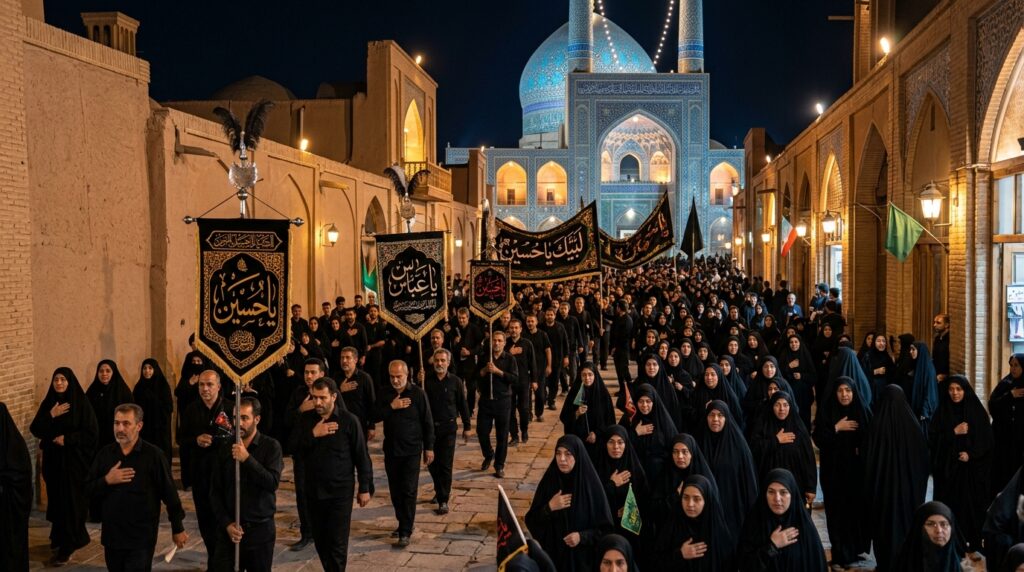
In the year 680 CE, Husayn ibn Ali, the grandson of the Prophet Muhammad رسول اللہ صلی اللہ علیہ وسلم, and a small group of his companions were killed near Karbala after refusing to pledge allegiance to the Umayyad ruler Yazid. Although the battle itself lasted only a short time, its moral significance has endured for more than thirteen centuries.
For Shia Muslims, Karbala symbolises the eternal struggle between justice and oppression, principle and expediency, truth and political power. The memory of Husayn’s sacrifice became far more than a historical event. It evolved into a moral framework through which generations interpreted political authority, ethical responsibility, and resistance to injustice.
Why Karbala Resonated So Deeply in Iran
The ideals associated with Karbala found a particularly receptive audience in Persian society. Ancient Persian traditions had long emphasised righteous leadership, justice, and moral responsibility. These values resonated strongly with the Shia narrative of Imam Husayn’s stand against tyranny.
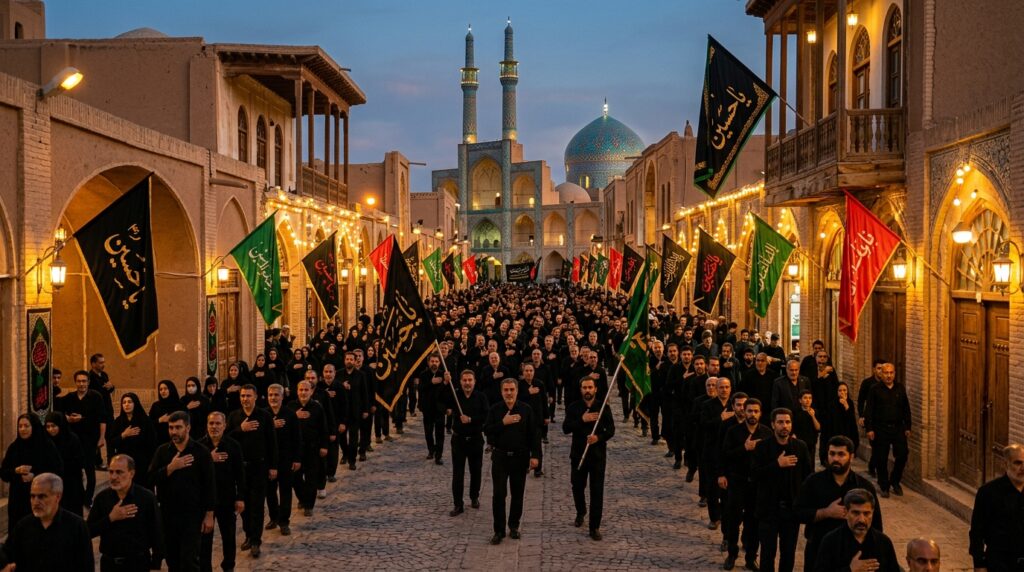
Over the centuries, the remembrance of Karbala became deeply woven into Iranian religious and cultural life. Annual commemorations during Muharram evolved into occasions for spiritual reflection, charitable works, public sermons, historical remembrance, and communal solidarity.
Poetry, literature, theatre, architecture, and visual arts all drew inspiration from Karbala’s enduring message. The influence extended beyond religious rituals.
Throughout Iranian history, reformers, scholars, political leaders, and ordinary citizens frequently invoked Karbala as a reminder that moral principles should not be sacrificed for political convenience.
Whether one agrees with those interpretations or not, there is little doubt that Karbala became one of the most influential moral narratives in Iranian society.
Qom: The Intellectual Heart of Shia Islam
A City of Scholarship
Among Iran’s many historic cities, few hold greater religious significance than Qom. Located south of Tehran, Qom gradually developed into one of the world’s foremost centres of Shia learning.
Its seminaries attract students from across Asia, Africa, Europe, and the Americas who come to study Islamic law, theology, philosophy, Qur’anic interpretation, ethics, and history. Unlike many universities, education in Qom often combines traditional methods of scholarship with intensive debate and independent reasoning.
Students spend years mastering Arabic grammar, logic, jurisprudence, philosophy, and the principles used to derive religious rulings before progressing to advanced levels of study. This educational tradition has helped preserve continuity within Shia scholarship for centuries.

The Role of Religious Scholars
In Twelver Shia Islam, religious scholars occupy an important position within society. Beyond leading prayers, many serve as teachers, jurists, authors, counsellors, and interpreters of religious law. Senior scholars, often recognised for decades of study and scholarship, are respected for their legal opinions and theological expertise.
This long tradition of scholarship has contributed to Iran’s reputation as the intellectual centre of contemporary Shia Islam. It has also given religious institutions considerable influence in shaping public discourse, education, and social values.
Religion and the Road to the 1979 Islamic Revolution
By the twentieth century, religion had become inseparable from Iran’s political and cultural identity. Throughout the nineteenth and twentieth centuries, religious scholars often participated in debates concerning constitutional government, foreign intervention, modernisation, education, and social reform.
These discussions intensified during the rule of the Pahlavi monarchy. Rapid modernisation programmes introduced significant economic and social changes, but also provoked criticism from sections of the religious establishment and parts of Iranian society.
Questions surrounding political authority, cultural identity, economic inequality, and foreign influence increasingly dominated national debate. Against this backdrop, religious leadership assumed an increasingly visible public role.
The culmination of these developments was the 1979 Islamic Revolution, an event that fundamentally transformed Iran’s political system and continues to shape regional politics today. The revolution deserves detailed examination in its own right and will be explored in the next article of this series.
Common Misconceptions About Islam in Iran
Was Iran Always a Shia Country?
No.
For approximately nine centuries after Islam first arrived, most Muslims in Persia followed Sunni Islam. Iran became predominantly Twelver Shia only after the Safavid dynasty adopted it as the state religion in the early sixteenth century.
Did Islam Erase Persian Civilisation?
History suggests the opposite. Persian language, literature, administrative traditions, architecture, scholarship, and artistic achievements survived the Arab conquest and eventually became integral to Islamic civilisation. Rather than disappearing, Persian civilisation evolved within an Islamic framework while preserving its distinctive identity.
Is Iran an Arab Country?
No.
Iran is a Persian-majority nation with its own language, culture, literature, and historical traditions that predate Islam by many centuries. Although Islam originated in Arabia, Iranian national identity remains distinct from Arab identity.
Why Is Religion So Influential in Iran?
Religion has shaped Iranian society for more than thirteen centuries. Its influence extends beyond worship to education, law, philosophy, literature, charitable institutions, ethics, and political thought. Understanding this historical continuity helps explain why religious ideas continue to play an important role in Iranian public life.
Conclusion
The story of Islam in Persia is not simply a narrative of conquest or conversion. It is the story of one of history’s most remarkable civilizational partnerships. When Islam reached Persia, it encountered a society with thousands of years of political experience, intellectual achievement, artistic excellence, and cultural confidence. Rather than erasing that legacy, Islam became intertwined with it.
Persia embraced a new faith while preserving its language, literature, philosophy, architecture, and historical memory. Over the centuries, Persian scholars enriched Islamic civilisation through advances in medicine, mathematics, astronomy, philosophy, theology, and literature. The Safavid transformation later established Iran as the world’s foremost centre of Twelver Shia Islam, giving the country a distinctive religious identity that continues to influence regional and global affairs.
Today, discussions about Iran often focus on contemporary politics, nuclear negotiations, sanctions, or military strategy. While these issues are undoubtedly important, they represent only the latest chapter in a much longer story. Modern Iran cannot be fully understood without recognising how ancient Persian civilisation and Islamic faith gradually merged to create a unique national identity, one rooted in scholarship, resilience, cultural continuity, and religious conviction.
The next article in this series will examine one of the most consequential turning points in modern Middle Eastern history: the 1979 Islamic Revolution, exploring its origins, its leaders, its global consequences, and how it reshaped both Iran and the wider world.
Frequently Asked Questions
1. When did Islam first arrive in Persia?
Islam reached Persia during the seventh century. Following the Battles of al-Qadisiyyah (636 CE) and Nahavand (642 CE), Muslim rule gradually expanded across the Sasanian Empire, while religious conversion occurred progressively over several generations.
2. Why did Iran become predominantly Shia?
Iran became predominantly Twelver Shia after the Safavid dynasty declared it the official state religion in 1501. The change was reinforced over generations through religious education, state institutions, and the development of a distinct national identity.
3. Was Persia always a Shia Muslim country?
No. For nearly nine centuries after the arrival of Islam, Persia was predominantly Sunni. Its transformation into a Shia-majority nation occurred during the Safavid period.
4. How did Persian civilisation influence Islam?
Persian scholars made lasting contributions to medicine, mathematics, astronomy, philosophy, theology, literature, architecture, and governance. Persian language and culture also became central to Islamic civilisation across much of Asia.
5. Why is Karbala so important in Iranian society?
The Battle of Karbala symbolises justice, sacrifice, moral courage, and resistance against oppression. These values became deeply embedded in Iranian religious thought, literature, and national consciousness.
6. Why is Iran called the heartland of Shia Islam?
Iran is home to the world’s largest Shia population and hosts major religious seminaries, especially in Qom. For centuries, it has served as the leading centre of Shia scholarship, theology, and religious education.
References
- The Cambridge History of Iran (Cambridge University Press)
- The Venture of Islam by Marshall G. S. Hodgson
- Iran: A Modern History by Abbas Amanat
- The Shia Revival by Vali Nasr
- The Oxford History of Islam edited by John L. Esposito
- Encyclopaedia Iranica
- The Metropolitan Museum of Art – Islamic Art Collection
- UNESCO World Heritage Centre – Persian Cultural Heritage