
Firaun as Archetype
A Quranic, Historical, and Comparative Study of Legitimized Tyranny
Abstract
Firaun (Pharaoh) is popularly remembered in Muslim consciousness as the archetypal cruel ruler — the man who drowned pursuing Musa (Moses) across the sea. This paper argues that the Quran’s own account is considerably more precise than the popular memory: it does not depict cruelty as a spontaneous outburst of a wicked personality, but as the end-product of a deliberate, staged political process — elite consultation, narrative-building, threat construction, public spectacle, calibrated terror, and only then a culminating absolute claim. Drawing on a systematic survey of every Quranic reference to Firaun, classical and modern tafsir in Arabic, Urdu, and English, and the historical record of pharaonic Egypt, this paper reconstructs a six-stage model of “legitimized tyranny” and tests it against the general pattern of modern authoritarian statecraft. The conclusion is that the Quran’s Firaun narrative functions less as a morality tale about one bad man and more as a diagnostic template — a set of recognizable stages by which power converts itself into cruelty while retaining the appearance, and even the active cooperation, of the ruled.
1. Introduction and Methodology
The premise of this study is one many readers of the Quran notice but rarely formalize: Firaun does not simply command atrocities; he builds a case for them. He consults his chiefs before acting (Al-A’raf 7:109-110), he stages a public contest rather than simply eliminating his rivals (Ta-Ha 20:57-64), he offers a security rationale for wanting Musa killed (Ghafir 40:26), and he escalates his own claims to authority only gradually, culminating — not beginning — in the declaration “I am your lord, most high” (An-Nazi’at 79:24). This sequencing is the subject of this paper.
Method: every ayah referencing Firaun was surveyed across the Mushaf, cross-checked against the order of revelation, and grouped thematically rather than sequentially, since the Quran itself narrates the story non-linearly, returning to different facets of Firaun’s conduct in different surahs for different rhetorical purposes. This thematic material was then read against:
- Classical Arabic tafsir — al-Tabari, Ibn Kathir, al-Qurtubi, and al-Zamakhshari’s al-Kashshaf — for the earliest interpretive layer;
- Urdu tafsir and exegetical literature — Maulana Maududi’s Tafheem-ul-Quran, Tafsir-e-Usmani, and Bayan-ul-Quran — for the South Asian scholarly tradition’s reading of Firaun’s statecraft;
- Modern Arabic and English scholarship explicitly framing the Musa–Firaun narrative as a political paradigm, including recent thematic studies of Rashid Rida’s Tafsir al-Manar and contemporary Arabic political commentary that reads Firaun as a recurring structural type rather than a closed historical case;
- The Egyptological and historical record on New Kingdom pharaonic ideology, to establish what “normal” governance looked like in that culture and what Firaun could draw on, versus what he had to manufacture;
- Comparative political theory on authoritarianism and propaganda (Hannah Arendt’s analysis of totalitarian ideology and terror; the broader literature on legitimation strategies of modern authoritarian states).
A methodological caution is in order. The Quran does not date, name, or provide a continuous chronicle of Firaun; it is a theological and moral narrative, not a chronicle, and this paper treats it as such — extracting the behavioral and structural pattern the text emphasizes, without claiming to reconstruct a positivist history of a named Egyptian king.
2. The Quranic Data: A Thematic Survey
Firaun is referenced well over seventy times across some two dozen surahs, making him the most extensively discussed political figure in the Quran. The material clusters into distinct thematic units:
2.1 The Governing Policy (Al-Qasas 28:4)
The Quran’s single most condensed political statement on Firaun describes him as having exalted himself in the land and divided its people into factions, oppressing one group among them — slaughtering their sons and sparing their women — and states plainly that he was among the corrupters (al-mufsidin). Three elements stand out for a political reading: self-exaltation (istikbar), engineered factionalism (divide-and-rule among the population), and targeted rather than universal violence. Even the infanticide is described as directed at a defined faction, not the population at large — a policy of selective terror, not indiscriminate slaughter.
2.2 The Elite Council (Al-A’raf 7:109-126; Ash-Shu’ara 26:34-51)
Firaun does not act as an isolated despot. Confronted with Musa’s sign, his first move is to consult his mala’ — his chiefs, nobles, and counselors — who advise him on strategy, including summoning trained sorcerers from across the cities. The contest with the sorcerers is itself telling: it is staged as a public spectacle with promised rewards for the winners, functioning as a legitimacy-conferring performance rather than a private judicial or military matter. When the sorcerers instead believe in Musa’s Lord, Firaun’s response — a threat of amputation and crucifixion, and the accusation that they conspired with Musa in advance — is a public, exemplary punishment designed to deter, again performed before an audience rather than executed quietly.
2.3 Threat Construction (Ghafir 40:26-45)
Firaun’s own stated rationale for wanting to kill Musa is explicit: he tells his chiefs to leave him to kill Musa, adding that Musa may otherwise change their religion or spread corruption in the land. This is a textbook securitization move — recasting a moral and religious challenge as a threat to public order and communal religion, the framing every subsequent authoritarian propaganda apparatus has reached for. Notably, the same passage preserves an act of internal dissent: an unnamed believing man from Firaun’s own household argues for restraint and due process, asking how they can kill a man merely for saying his Lord is God, especially when he has brought clear signs. His arguments are overridden, but the Quran’s inclusion of this figure shows that Firaun’s court was not monolithic; dissent existed and had to be managed, not merely assumed absent.
2.4 Persuasion, Mockery, and the Manufacture of Consent (Az-Zukhruf 43:51-54)
In one of the Quran’s sharpest political passages, Firaun addresses his people directly, asking rhetorically whether the kingdom of Egypt and the rivers flowing beneath his palaces are not his, and whether he is not better than Musa — a man he describes as lacking eloquence and, in the classical reading, lacking the outward markers of status such as gold bracelets. The Quran’s own verdict on what follows is unusually direct: he made his people light-minded (istakhaffa qawmahu) and they obeyed him — and the text adds that they were a people who had transgressed (fasiqin). Two things matter here for a political reading. First, obedience is not presented as coerced only; it is described as the product of persuasion aimed at status-anxiety and national pride. Second, the Quran assigns the people themselves a share of moral responsibility for allowing themselves to be persuaded — the tyrant’s method is named, but so is the audience’s complicity.
2.5 State Resources and the Theatre of Technology (Al-Qasas 28:38)
Firaun instructs Haman, his vizier and master-builder, to construct a lofty tower so that he might “see the God of Musa” — a public, resource-intensive act of state theatre that mocks the theological challenge using the regime’s own technical and administrative capacity. The episode illustrates how bureaucratic and engineering resources of the state are marshalled not for governance but for propaganda.
2.6 Economic Co-optation (Al-Qasas 28:76-79; Al-Ankabut 29:39)
The Quran repeatedly names Firaun alongside Haman and Qarun as a triad: political authority, administrative/technical authority, and economic wealth, standing together against Musa’s message. Qarun’s story, though from among the Israelites rather than the Egyptian elite, is placed in the same rhetorical basket, suggesting the Quran is describing a general alliance of power — political, bureaucratic, and financial — that a reform movement must confront, not a single man acting alone.
2.7 Fear as Governance (Yunus 10:83)
The Quran notes that none believed in Musa, except a few among the descendants of his own people, because of fear of Firaun and his chiefs, who could persecute them. This single verse establishes that terror was operative even against those not yet punished — an atmosphere of fear functioning as a governing instrument in its own right, independent of any specific act of violence.
2.8 The Culminating Claim (An-Nazi’at 79:15-26)
Only in the passage describing Firaun’s final transgression does he make his most extreme claim — gathering his people and proclaiming, “I am your lord, most high.” The Quran’s sequencing is deliberate: the verb used implies he assembled and called out to a gathered audience — a rally, in modern terms — and that this culminating self-deification came after, not before, the stages of elite capture, threat framing, persuasion, and terror described elsewhere. Firaun does not begin his rule by claiming godhood; he arrives at it once the machinery of consent has already been built.
3. A Political-Personality Profile of Firaun
Read as a composite, the Quranic material yields a coherent political personality, not merely a moral caricature:
- Istikbar (self-exaltation) — a persistent posture of superiority, expressed through claims about his kingdom’s grandeur and his own status relative to Musa.
- Tughyan (transgression of limits) — repeated Quranic description of Firaun as one who “exceeded all bounds,” applied to his escalating claims over time, not a single act.
- Institutional reliance — consultation with a chief council (mala’) before major decisions, indicating collective elite ownership of policy rather than solitary decree.
- Narrative control — direct, personal rhetorical engagement with “his people,” including staged debate, mockery of the opposition’s social standing, and appeals to national pride.
- Securitization of dissent — recasting a moral-religious challenge as an existential threat to social and religious order.
- Calibrated rather than indiscriminate violence — targeted infanticide against one faction, exemplary punishment of the sorcerers, used for deterrence rather than extermination.
- Economic and technical co-optation — alliance with wealth (Qarun) and engineering/bureaucratic capacity (Haman).
- Gradual self-deification — the boldest claim to absolute status arrives last, after the supporting apparatus is in place.
4. Historical and Cultural Contextualization
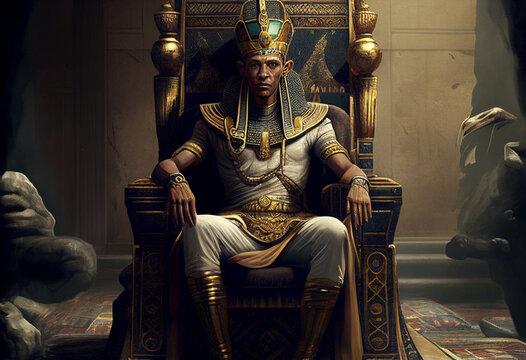
None of this was invented from nothing. New Kingdom Egyptian political theology (the era most historians associate with the Exodus narrative, whether under Ramesses II or a successor) already held the pharaoh to be a living god — commonly identified with Horus in life and Osiris in death, later fused with the cult of Amun-Ra — whose rule was understood as the earthly guarantee of maat, cosmic and social order, against Isfet, chaos. Opposition to the pharaoh was therefore not merely political dissent but, within the prevailing state theology, a threat to cosmic order itself.
This matters for reading the Quran’s Firaun correctly. He is not a lone madman inventing a claim to divinity in a vacuum; he inherits a state religion, priesthood, and bureaucracy already structured to sacralize the office he holds. His achievement, in the Quran’s telling, is to push an inherited system of institutional sacrality to its most extreme personal expression, and to do so through the very tools that system provided him: a compliant priestly-administrative elite (the mala’), a vizier-engineer class (Haman, matching the historical office of overseer of royal works), an economically entangled elite (Qarun), and a labor underclass drawn from Semitic and other foreign populations documented in Egyptian administrative records as forced labor. The Quran’s account and the Egyptological record are, at the structural level, mutually reinforcing: both describe a state in which religious legitimacy, bureaucratic capacity, and economic power were fused around the person of the ruler.
5. A Six-Stage Model of Legitimized Tyranny
Synthesizing the thematic survey above into a sequence, the Quranic Firaun narrative yields a repeatable structural model: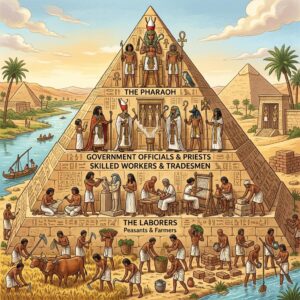
Stage 1 — Inherited Legitimacy: The ruler steps into a pre-existing institutional and theological order that already confers sacred or extraordinary status on the office, so that no persuasion is initially required to secure basic deference.
Stage 2 — Elite Capture: Loyalty of the religious, bureaucratic, technical, and economic elite (the mala’, Haman, Qarun) is secured through patronage, appointment, and shared interest, converting potential centers of independent authority into instruments of the ruler.
Stage 3 — Threat Construction: A reform movement or moral challenge is reframed as a danger to religion, social order, or national identity, providing an ostensibly protective rationale for repression.
Stage 4 — Public Spectacle and Persuasion: Contests, rallies, and staged debates are used to win the active consent of the wider population, often by appeal to national pride and by mocking the social standing of dissenters, rather than by force alone.
Stage 5 — Calibrated Terror: Violence is targeted and exemplary — directed at a defined faction or made visible as a deterrent threat — sufficient to produce a general climate of fear without provoking full-scale revolt.
Stage 6 — Culminating Absolute Claim: Only once the preceding stages have done their work does the ruler make his most extreme claim to authority, arriving at it as a capstone rather than a starting point.
The order matters. A reading that begins and ends at Stage 6 — “Firaun claimed to be god, therefore he was cruel” — misses the Quran’s own diagnosis, which locates the danger earlier, in the ordinary-seeming machinery of Stages 2 through 5.
6. Comparative Analysis: Modern Authoritarian Statecraft
The parallels between this model and documented patterns of twentieth-century authoritarian rule are not merely rhetorical; they have already been drawn independently by contemporary Muslim scholarship. Recent Arabic commentary explicitly describes Firaun as a model of a political and intellectual order built on controlling minds, falsifying facts, and subjugating populations through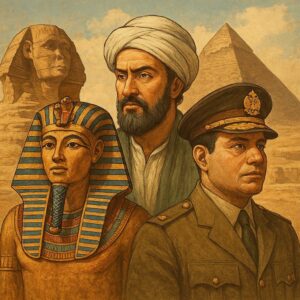 fear, propaganda, and force — a description of a system, not simply a personality. A recent thematic study of Rashid Rida’s Tafsir al-Manar likewise reads the Musa–Firaun narrative as a deliberate Quranic paradigm for critiquing despotic regimes that erode human dignity, positioning Musa’s resistance as a template for opposing absolute power in any era.
Set against Hannah Arendt’s classic analysis of totalitarian rule — which identifies ideology (a total explanatory narrative), terror (calibrated rather than random), and the atomization of independent social and institutional life as the three pillars of totalitarian control — the structural echo of the Quranic model is clear:
- Inherited or manufactured ideology plays the role of Stage 1: twentieth-century totalitarian states did not rely on force alone but on comprehensive worldviews (racial, class-based, or nationalist) that made obedience feel natural rather than coerced, just as pharaonic state theology had already primed Egyptian society to defer to the throne.
- Elite capture (Stage 2) recurs in the co-optation of security services, state media, the judiciary, and crony-economic classes — modern analogues of the mala’, Haman, and Qarun — converting independent institutions into extensions of the ruler’s will.
- Threat construction (Stage 3) reappears wherever internal reformers, minorities, or dissenters are recast as agents of foreign subversion, religious deviation, or national betrayal — the same rhetorical move Firaun makes when he tells his chiefs that Musa threatens to “change your religion or spread corruption in the land.”
- Public spectacle (Stage 4) recurs in staged plebiscites, mass rallies, engineered contests of loyalty, and propaganda apparatuses explicitly designed — as twentieth-century propaganda theorists themselves noted — to shape mass opinion through repetition and appeals to pride rather than argument.
- Calibrated terror (Stage 5) is a documented feature of most durable authoritarian regimes: violence is generally targeted at defined categories (a class, an ethnicity, an opposition faction) and made visible enough to deter the wider population, rather than applied indiscriminately, which would be both costlier and less useful as a deterrent.
- The culminating personality cult (Stage 6) — the ruler as infallible father of the nation, sole guarantor of order, effectively unaccountable — is characteristically a late-stage development in durable authoritarian systems, arrived at once the preceding machinery is in place, exactly as the Quran sequences Firaun’s own escalation.
A further, easily overlooked parallel concerns the role of the ruled themselves. The Quran’s verdict on the Egyptian population — that Firaun “made them light-minded and they obeyed him,” and that they were themselves transgressors — anticipates a point modern scholarship on authoritarianism also makes: that durable tyranny generally requires a measure of active or passive public cooperation, not merely fear, and that this cooperation is itself a moral and political failure worth naming, not only the tyrant’s initiative.
7. Conclusions and Lessons
- Cruelty in the Quranic Firaun narrative is not depicted as spontaneous or purely psychological; it is manufactured through an identifiable, staged institutional process, and the Quran’s own emphasis falls on that process, not merely on the drowning that ends it.
- The most dangerous stages are the early, ordinary-looking ones — elite capture, threat framing, and public persuasion — which attract the least popular resistance precisely because they precede, rather than follow, the visible cruelty they make possible.
- The Quran assigns a share of moral responsibility to the governed, not only the governor, when a population allows itself to be persuaded into complicity — a point with direct contemporary relevance to how societies evaluate their own conduct under authoritarian pressure, rather than only the ruler’s.
- Because the Quran deliberately avoids naming this Firaun or fixing him to a single chronicled reign, classical and modern commentators alike have read him as a recurring type rather than a closed historical case — which is precisely what licenses, and indeed invites, the comparative exercise undertaken in this paper.
- For contemporary application, the model suggests that early warning against authoritarian drift should focus less on waiting for an explicit, culminating claim to absolute or quasi-divine authority, and more on monitoring the earlier, subtler stages: whether independent religious, judicial, media, and economic institutions are being absorbed into a single center of loyalty, and whether reform or dissent is being recast as an existential threat to religion, order, or nation.
This paper has attempted to establish the Quranic, historical, and comparative groundwork for the study group’s broader inquiry. It is offered as a foundation for further thematic sessions — on the believing man of Firaun’s court as a model of principled internal dissent, on the parallel Qarun narrative as a study of economic complicity, and on the comparative treatment of tyranny across the Torah, the Quran, and classical Islamic political theory (siyasah shar’iyyah) — each of which the study group may wish to pursue as a dedicated follow-on paper.
Note on Sources
This paper draws on the Quranic text itself (verse references cited by surah and ayah throughout), classical Arabic tafsir (al-Tabari, Ibn Kathir, al-Qurtubi, al-Zamakhshari), Urdu tafsir literature (Maududi’s Tafheem-ul-Quran, Tafsir-e-Usmani, Bayan-ul-Quran), recent Arabic and English scholarship reading the Musa–Firaun narrative as a political paradigm (including recent thematic work on Rashid Rida’s Tafsir al-Manar and contemporary Arabic commentary on Firaun as a model of authoritarian statecraft), the Egyptological record on New Kingdom pharaonic ideology, and comparative political theory on authoritarianism, most notably Hannah Arendt’s analysis of ideology and terror. In keeping with standard academic practice, quranic wording and third-party scholarship have been paraphrased throughout rather than quoted at length.