
Digital Detox Guide
Digital Detox Guide. You wake up to the sound of your phone alarm. Before your feet touch the floor, you check the weather, reply to a message, browse social media, glance through the latest headlines, and watch a few short videos recommended by an app. You intended to spend two minutes looking at your phone. Instead, nearly half an hour has disappeared before your day has even begun. If this sounds familiar, you are far from alone.

Across the world, millions of people begin and end every day in almost exactly the same way. Smartphones have become alarm clocks, newspapers, entertainment centres, shopping assistants, navigation systems, workplaces, classrooms, cameras, and social gathering places all rolled into one device that rarely leaves our hands.
Technology has undoubtedly improved modern life. It allows grandparents to see grandchildren living thousands of miles away, students to attend online classes, doctors to consult patients remotely, and entrepreneurs to build businesses from their homes. Artificial intelligence now helps people summarise documents, learn new languages, organise schedules, and solve complex problems in seconds.
Yet there is another side to this remarkable digital revolution.
Many people no longer use technology intentionally. Instead, technology quietly dictates how they spend their time, where they focus their attention, and even how they feel about themselves. Endless notifications, autoplay videos, personalised recommendations, breaking news alerts, and infinite scrolling have created an environment where remaining disconnected feels increasingly difficult.
This constant connection comes at a cost. Researchers around the world continue to link excessive digital consumption with increased stress, poorer sleep, reduced concentration, declining productivity, anxiety, loneliness, and weakened personal relationships. Many people describe feeling mentally exhausted despite spending much of their day sitting still.
This growing phenomenon has inspired millions to explore a simple but powerful solution known as a digital detox.
Digital Detox
-
When you consider that the average American’s attention span has plummeted over the past decade from a mere 12 seconds to an even lower eight, shorter than the attention span of a goldfish, you have to wonder what’s driving this trend. Today, we’re barraged by so many media and devices that it can bring on sensory overload.
Here are some startling statistics:
- About 61 per cent admit to being addicted to the internet and their devices.
- A third of people would rather clean their toilets than their email inbox.
- One out of 10 Americans report depression; heavy internet users are 2.5 times more likely to be depressed.
- The average employee checks 40 websites a day, switching activities 37 times an hour, changing tasks every two minutes.
- However, only 2 per cent of people can actually multitask without a decline in performance.
- Roughly 60 per cent of people say a traditional vacation does not relieve their stress.
What Is a Digital Detox?
A digital detox is the deliberate decision to reduce or temporarily disconnect from smartphones, social media, computers, online entertainment, and other digital technologies in order to restore balance, improve mental wellbeing, and regain control over how time and attention are spent.
Contrary to popular belief, a digital detox does not require abandoning technology completely. Modern life depends on digital tools for communication, education, healthcare, banking, transportation, and work. The goal is not to reject technology but to create healthier boundaries that allow people to benefit from innovation without becoming overwhelmed by it.
Think of it in the same way we think about nutrition. Healthy eating does not mean never enjoying dessert. It means developing habits that nourish the body rather than allowing unhealthy choices to dominate every meal. A digital detox follows the same principle by encouraging mindful rather than compulsive technology use.
Why Digital Detox Matters Today
Never before in human history have so many people competed for our attention. Every application on a smartphone has been carefully designed to encourage longer engagement. Notifications appear at precisely the right moment. Videos automatically begin playing before the previous one ends. News feeds refresh endlessly. Shopping platforms recommend products based on previous searches. Artificial intelligence studies user behaviour and continuously predicts what content will keep individuals engaged for just a little longer.
Attention has become one of the world’s most valuable commodities. Technology companies invest billions of dollars each year studying human behaviour because every additional minute spent on a platform increases opportunities for advertising, subscriptions, and online purchases. While these innovations make digital experiences more convenient and personalised, they also make disengaging significantly more difficult.
Real-world example: Imagine searching for a simple pasta recipe before dinner. Within minutes, recommendation algorithms begin suggesting cooking videos, kitchen gadgets, restaurant reviews, celebrity chefs, and food travel documentaries. Forty minutes later, dinner has not started, but your phone has kept you continuously entertained without you consciously deciding to stay online.
This is not necessarily the result of poor self-control. It reflects how modern digital platforms are intentionally designed to capture and retain attention.
The Attention Economy
Economists once described oil as the world’s most valuable resource. Today, many technology experts argue that human attention has become equally valuable. Every notification asking you to check a message, every breaking news alert, every social media update, and every recommended video competes for a limited resource that can never be replaced. Your attention determines how you spend your time, what information shapes your thinking, how productive you become, and ultimately how your life unfolds.
Unlike money, lost attention cannot be earned back. Once an hour disappears into mindless scrolling, it is gone forever. This realisation has encouraged psychologists, educators, employers, and healthcare professionals to rethink the relationship between technology and wellbeing.
Artificial Intelligence Is Changing Everything
The rapid growth of artificial intelligence has fundamentally transformed the digital landscape. AI now powers search engines, social media feeds, online shopping, music streaming, navigation systems, educational platforms, and customer service applications. Every click, search, purchase, pause, and swipe teaches AI systems more about personal preferences. As a result, digital experiences become increasingly personalised, efficient, and engaging.
While these developments create enormous opportunities for education and productivity, they also introduce new challenges. AI can unintentionally reinforce unhealthy habits by continuously recommending similar content, encouraging prolonged screen time, and creating personalised digital environments that become increasingly difficult to leave.
Real-world example: A university student watches one motivational study video while preparing for exams. The recommendation system quickly begins suggesting hundreds of productivity videos, study playlists, motivational speeches, and educational podcasts. Although much of the content is useful, the student spends more time watching advice about studying than actually studying. This illustrates an important principle. Even positive content can become a distraction when consumed without intention.
Digital Overload by the Numbers
Research conducted across multiple countries demonstrates how deeply digital technology has become embedded in everyday life.
- Many adults spend between six and seven hours each day using internet-connected devices outside of work-related activities.
- Average smartphone users unlock their devices dozens of times every day, often without conscious awareness.
- Teenagers frequently spend several hours daily using social media, messaging applications, online games, and streaming platforms.
- Workplace studies show that frequent digital interruptions significantly reduce concentration and increase the time required to complete important tasks.
- Sleep researchers consistently report that late-night screen use contributes to poorer sleep quality and increased daytime fatigue.
Although these numbers vary between countries and age groups, the overall trend remains remarkably consistent. Digital technology occupies a growing share of modern life.

The Purpose of This Guide
This guide combines scientific research, psychology, neuroscience, productivity studies, and practical lifestyle strategies to help readers build a healthier relationship with technology.
Rather than encouraging fear of smartphones or social media, the goal is to develop mindful digital habits that improve focus, reduce stress, strengthen relationships, enhance productivity, and create more space for meaningful experiences beyond the screen.
Whether you are a student struggling to concentrate, a professional overwhelmed by constant notifications, a parent concerned about family screen time, or simply someone seeking greater balance, the principles explored in this guide can help you reclaim one of your most valuable resources.
Your time.
Your attention.
Your peace of mind.
The Science Behind Digital Addiction
Have you ever picked up your phone to check the time and, twenty minutes later, found yourself watching videos you never intended to see? If so, you are not alone. This happens because today’s digital platforms are carefully engineered to capture and retain human attention.
Contrary to popular belief, excessive smartphone use is rarely caused by a lack of willpower. Modern apps combine psychology, neuroscience, behavioural economics, and artificial intelligence to create experiences that encourage repeated engagement. Every swipe, notification, like, and recommendation is designed to make users return again and again.
This does not mean technology companies deliberately want to harm people. Their business models often depend on user engagement, which naturally encourages designs that keep people using their platforms for longer periods.
Understanding how these systems work is the first step toward taking back control.

Your Brain Loves Rewards
The human brain has evolved to seek rewards. Whenever we accomplish something enjoyable, solve a problem, receive praise, or experience something exciting, the brain releases dopamine, a neurotransmitter involved in motivation, learning, and reward.
Dopamine is often described as the brain’s “feel-good” chemical, but scientists explain that its primary role is motivation rather than happiness. It encourages us to repeat behaviours that appear rewarding.
Digital platforms take advantage of this natural process.
Every notification, new follower, message, or entertaining video creates the possibility of a rewarding experience. Because users never know exactly what they will see next, the brain becomes increasingly motivated to continue checking.
Real-world example: Think about opening your email inbox. Most messages are routine, but occasionally you discover exciting news such as a job interview invitation, a message from an old friend, or confirmation of an important purchase. Because rewarding messages appear unpredictably, people often check email far more frequently than necessary.
The same psychological principle operates across social media, online gaming, shopping applications, and short video platforms.
The Infinite Scroll Trap
Many older websites displayed information page by page. Once readers reached the bottom, they naturally stopped. Today’s digital platforms work very differently.
Infinite scrolling continuously loads fresh content without requiring users to make deliberate decisions. Autoplay immediately starts another video before viewers have time to consider stopping. Recommendation systems constantly suggest something new based on previous activity.
These features remove natural stopping points, making it surprisingly easy to spend an hour online when the original intention was only a few minutes.
Real-world example: A father sits down after dinner intending to watch one short football highlight before helping his daughter with homework. One recommended video leads to another, then another. Forty-five minutes later, he realises he has watched interviews, transfer rumours, historical matches, and fan reactions while his daughter has already started her homework alone.
Small moments like these happen every day in millions of households.
Fear of Missing Out
Another powerful psychological force driving excessive screen use is the Fear of Missing Out, commonly known as FOMO.
Humans are naturally social beings. Throughout history, staying connected to family and community improved survival. Modern technology taps into this instinct by creating a constant awareness of what other people are doing.
Social media updates, breaking news alerts, group messages, and trending topics create the impression that something important may happen at any moment. Many people therefore feel uncomfortable disconnecting because they worry they might miss valuable information or social interactions. Ironically, constantly trying to stay connected often increases stress rather than reducing it.
Real-world example: During a family vacation, parents may find themselves repeatedly checking work emails or social media updates instead of enjoying the scenery around them. Although physically present with loved ones, mentally they remain somewhere else entirely.
How Digital Overload Affects Mental Health
Technology itself does not automatically damage mental health. The challenge arises when digital activities begin replacing healthy habits that support emotional wellbeing.
Researchers continue studying the relationship between screen use and mental health. While the evidence is complex, several consistent patterns have emerged. People experiencing excessive digital consumption often report higher levels of stress, anxiety, emotional exhaustion, loneliness, reduced concentration, and poorer sleep quality. Constant exposure to alarming news, online arguments, unrealistic lifestyles, and social comparison can gradually increase emotional fatigue.
Psychologists also distinguish between active and passive digital use. Participating in meaningful conversations, learning new skills, or collaborating with others generally provides greater psychological benefits than endlessly consuming content without interaction.
Comparison Is the Hidden Cost
Social media rarely presents everyday reality. Most people share celebrations rather than disappointments, achievements rather than failures, vacations rather than ordinary weekdays. Over time, repeatedly comparing ordinary life with carefully edited highlights from others can distort personal expectations and reduce life satisfaction.
Real-world example: Emma, a young marketing professional, enjoyed her career until she began spending several hours each evening browsing social media. Gradually, she became convinced that everyone her age was travelling constantly, earning more money, and living happier lives. After reducing her social media use for several weeks, she realised that her anxiety had been fueled more by comparison than by reality.
Many psychologists encourage people to remember that social media usually represents a curated collection of life’s best moments rather than an accurate picture of everyday experience.
Information Overload and Decision Fatigue
Every day, people absorb an extraordinary amount of information through emails, news websites, messaging applications, podcasts, videos, advertisements, and social media posts. The human brain, however, evolved in environments where information arrived gradually rather than continuously.
When the mind processes too much information without sufficient rest, people may experience decision fatigue. Simple choices begin feeling more difficult because mental energy has already been consumed by hundreds of smaller decisions throughout the day.
Real-world example: A manager spends the morning answering emails, reviewing reports, responding to instant messages, attending virtual meetings, and monitoring project updates. By late afternoon, making even routine decisions feels surprisingly exhausting, not because the work is unusually difficult but because the brain has received very few opportunities to recover.
Your Body Feels It Too
Digital overload affects more than mental wellbeing. Long hours spent looking at screens can also influence physical health. Common complaints include tired eyes, headaches, neck pain, shoulder stiffness, poor posture, reduced physical activity, and discomfort in the hands or wrists.
Health professionals increasingly describe a condition known as “text neck,” caused by repeatedly looking downward at smartphones for extended periods. Even a slight forward tilt of the head significantly increases pressure on the neck and upper spine. Extended screen use may also reduce blinking frequency, leading to dry, irritated eyes and blurred vision. Fortunately, these symptoms often improve through regular movement, better posture, and scheduled breaks away from digital devices.
Sleep Is the First Casualty
Few habits affect overall wellbeing more quickly than poor sleep. Blue light emitted by smartphones, tablets, and computers suppresses melatonin, the hormone that prepares the body for sleep. At the same time, exciting online content keeps the brain mentally stimulated long after bedtime. Many people believe they are relaxing by scrolling through social media before sleep. In reality, they may be delaying the body’s natural transition into restorative rest.
Real-world example: Daniel often stayed awake until midnight watching short videos. Although he remained in bed for eight hours, he woke feeling tired every morning. After replacing thirty minutes of evening scrolling with reading a printed book, he noticed meaningful improvements in both sleep quality and morning energy within two weeks.
Simple changes often produce surprisingly significant results.

Relationships Need Undivided Attention
Technology connects people across continents, yet it can quietly distance those sitting in the same room. Meaningful relationships depend upon attention, active listening, eye contact, empathy, and shared experiences. Frequent phone checking interrupts these moments, even when conversations continue.
Researchers have found that simply placing a smartphone on the table during a conversation may reduce the perceived quality of social interaction because both people remain subconsciously aware of possible interruptions.
Real-world example: During dinner, a young boy excitedly begins telling his parents about winning a school science competition. Midway through the story, one parent glances at a notification. The interruption lasts only a few seconds, yet the child quietly stops speaking. Small moments like these shape relationships more than most people realise.
A digital detox is therefore not only about reducing screen time. It is also about becoming fully present with the people who matter most.

Technology and Workplace Productivity
Many professionals believe multitasking makes them more productive. Research increasingly suggests the opposite. Each interruption forces the brain to shift attention from one task to another. This process, known as context switching, consumes mental energy and reduces efficiency. Checking emails every few minutes, responding immediately to every notification, and frequently switching between applications make deep, focused work increasingly difficult.
Real-world example: Two accountants receive the same assignment. One disables notifications and works uninterrupted for ninety minutes. The other checks email, messaging apps, and social media throughout the task. Although both spend the same amount of time at their desks, the first accountant completes the work more quickly and with fewer errors because sustained concentration was never interrupted.
Productivity is not determined only by how many hours people work. It also depends on how well they protect their attention.
Recognising the Warning Signs
Digital overload rarely develops overnight. It usually appears gradually through small daily habits that eventually become automatic.
The encouraging news is that awareness is the first step toward positive change. Once people recognise how technology influences their behaviour, they become far more capable of creating healthier routines that support both productivity and wellbeing.
In the next section, we will explore the most common signs of digital burnout before building a practical, step-by-step digital detox plan that anyone can begin, regardless of age or profession.
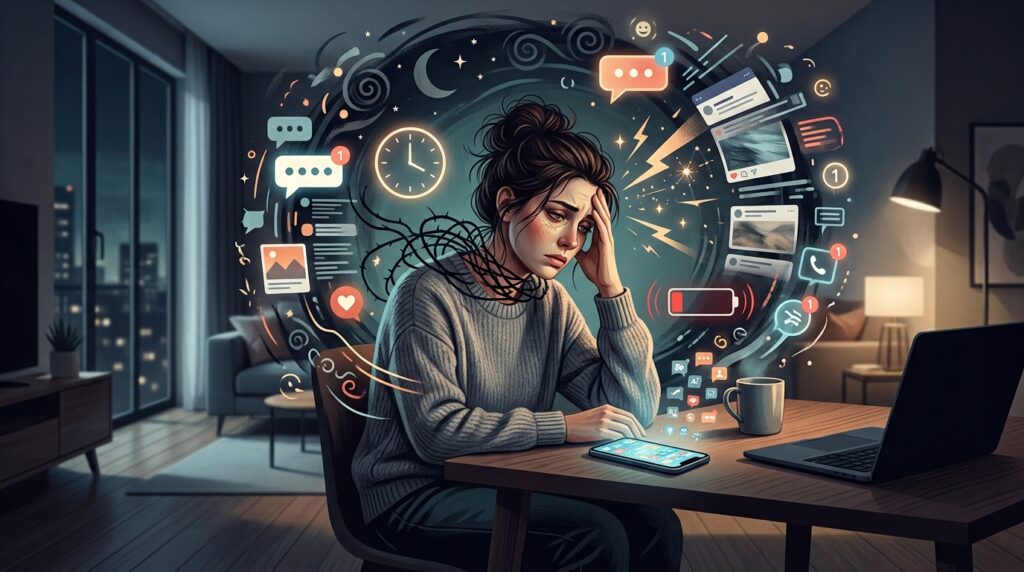
Are You Experiencing Digital Burnout?
Digital burnout rarely happens overnight. It develops gradually through countless small habits that seem harmless on their own. Checking one more notification before bed, replying to emails during dinner, scrolling through social media while waiting in line, or watching “just one more video” all become part of a daily routine until constant connectivity begins to feel normal.
Unlike physical exhaustion, digital burnout is often difficult to recognise because many of its symptoms resemble the pressures of everyday life. People may blame work, family responsibilities, or lack of sleep without realising that excessive digital stimulation is quietly contributing to the problem.
If you regularly feel mentally tired despite spending much of your day sitting still, your brain may simply be receiving more information than it has time to process.
Warning Signs You Need a Digital Detox
Everyone uses technology differently, so there is no universal number of hours that defines unhealthy screen use. Instead, experts encourage paying attention to behavioural patterns.
You may benefit from a digital detox if you recognise several of these signs.
- You check your phone within minutes of waking up.
- You automatically unlock your phone without a specific purpose.
- You struggle to finish books, articles, or lengthy conversations without checking notifications.
- You feel anxious when your phone battery becomes low.
- You continue scrolling long after you intended to stop.
- You regularly sacrifice sleep to stay online.
- You feel distracted during conversations with family or friends.
- You experience difficulty concentrating on work or study.
- You compare your life with people on social media.
- You feel mentally exhausted despite accomplishing very little.
Recognising these habits is not about feeling guilty. It is about understanding where small adjustments can produce meaningful improvements.
A Simple Digital Wellness Self-Assessment
Ask yourself these questions honestly.
- When was the last time I spent an entire hour without checking my phone?
- Can I comfortably leave my phone in another room?
- Do I eat meals without looking at a screen?
- Do I regularly enjoy hobbies that involve no technology?
- Do I feel refreshed after using social media, or emotionally drained?
- Am I controlling my technology, or is it controlling me?
Your answers may reveal habits you have never consciously noticed before.
How to Start Your Digital Detox
One of the biggest mistakes people make is trying to eliminate technology overnight. That approach often leads to frustration because modern life depends on digital communication for work, education, banking, healthcare, and family responsibilities.
A successful digital detox focuses on gradual, sustainable improvements rather than perfection.
Step One: Define Your Purpose
Before changing any habit, understand why you want to change. Perhaps you want better sleep, improved concentration, stronger family relationships, reduced stress, or simply more free time. Writing down one clear reason dramatically increases the likelihood of maintaining new habits.
Real-world example: Michael realised he was spending nearly four hours every evening switching between social media, streaming platforms, and online shopping. His goal was not to eliminate technology but to have enough time to read two books each month. Having a meaningful objective helped him remain motivated.
Step Two: Discover Your Digital Triggers
Every habit begins with a trigger.
Some people reach for their phones when they feel bored. Others scroll through social media during stressful moments. Some check news websites whenever they receive notifications. Spend several days observing when and why you pick up your device.
- Is it boredom?
- Stress?
- Loneliness?
- Habit?
- Avoiding difficult work?
Understanding these triggers makes unhealthy habits much easier to change.
Step Three: Create Technology-Free Spaces
Your environment strongly influences your behaviour. Designate certain places where digital devices are not used.
- The dining table.
- The bedroom.
- The family living room during conversations.
- Outdoor walks.
- Religious or spiritual activities.
These small boundaries create regular opportunities for genuine connection and mental recovery.
Real-world example: One family introduced a simple basket beside the dining table where everyone placed their phones before meals. Initially the children complained, but after several weeks the conversations became noticeably longer and more enjoyable.
Step Four: Replace, Don’t Simply Remove
Removing screen time without replacing it often creates boredom, making old habits quickly return. Instead, intentionally fill that time with rewarding offline activities.
- Reading printed books.
- Walking outdoors.
- Gardening.
- Cooking.
- Learning a musical instrument.
- Photography.
- Painting.
- Volunteering.
- Playing board games.
- Writing a journal.
The goal is not simply spending less time online. The goal is spending more time living.
Reconnect With Nature
One of the most effective ways to reduce digital fatigue is surprisingly simple: spend more time outdoors.
Research has consistently shown that exposure to green spaces can reduce stress, improve mood, lower blood pressure, and restore attention. A walk through a park, sitting beside a lake, hiking in the mountains, or even tending a small garden provides the brain with a type of stimulation that differs greatly from the rapid pace of digital media.
Real-world example: A software developer began taking a thirty-minute walk in a nearby park during lunch instead of eating while checking emails. Within a month, he noticed improved concentration during the afternoon and fewer feelings of mental exhaustion at the end of the workday.

Practice Digital Minimalism
Digital detox is often the beginning of a broader philosophy known as digital minimalism. Digital minimalism encourages people to use technology intentionally rather than automatically. Instead of downloading every new application or joining every social media platform, digital minimalists ask a simple question.
Does this technology genuinely improve my life?
If the answer is no, they choose not to use it. This approach does not reject innovation. Instead, it prioritises quality over quantity and meaningful use over constant consumption.
Managing Artificial Intelligence Wisely
Artificial intelligence has become an invaluable tool for learning, creativity, and productivity. It can summarise lengthy reports, explain difficult concepts, assist with language learning, generate ideas, and automate repetitive tasks. However, healthy technology use also means knowing when not to rely on AI.
Critical thinking develops through solving problems independently. Reading physical books, writing by hand, performing mental calculations, and reflecting quietly without digital assistance continue to strengthen memory, creativity, and reasoning. Think of artificial intelligence as an assistant rather than a replacement for your own judgment.
A Family Digital Detox
Healthy digital habits become much easier when the entire household participates. Children learn more from observing adults than from listening to instructions. Parents who constantly check phones during conversations unintentionally teach the same behaviour.
Families can establish simple agreements such as:
- No phones during meals.
- No devices one hour before bedtime.
- One technology-free evening each week.
- Outdoor activities every weekend.
- Reading together instead of scrolling before bed.
These shared habits strengthen communication while reducing conflict over screen time.

The 30 Day Digital Detox Challenge
Week One: Build Awareness
The first week is about observation rather than restriction.
- Track your daily screen time using your device’s built-in tools.
- Notice which apps consume the most time.
- Write down when and why you usually reach for your phone.
- Turn off nonessential notifications.
- Avoid checking your phone during the first fifteen minutes after waking up.
Many people are surprised to discover that they spend several hours each day on activities they barely remember.
Week Two: Create Healthy Boundaries
Once you understand your habits, begin introducing practical limits.
- Keep phones away from the dining table.
- Create a technology-free bedroom.
- Schedule one uninterrupted hour for focused work or study each day.
- Check email at designated times instead of continuously.
- Replace thirty minutes of evening scrolling with reading or another offline activity.
Week Three: Replace Digital Habits
Reducing screen time becomes much easier when you replace it with meaningful experiences.
- Walk outdoors every day.
- Reconnect with an old hobby.
- Visit a local museum, library, or park.
- Cook a meal with family.
- Meet a friend without checking your phone.
- Write in a journal before bedtime.
Real-world example: A busy accountant replaced thirty minutes of nightly social media scrolling with learning to play the guitar. After several months, he not only reduced his screen time but also discovered a lifelong hobby that brought genuine satisfaction.
Week Four: Build a Sustainable Lifestyle
The final week focuses on creating habits that will continue long after the challenge ends.
- Review your screen time improvements.
- Delete applications you rarely use.
- Unfollow accounts that increase stress instead of adding value.
- Keep technology-free periods in your daily routine.
- Celebrate your progress rather than aiming for perfection.
Creating Healthy Digital Habits That Last
A successful digital detox is not measured by how many hours you avoid technology. Success is measured by whether technology supports your goals instead of distracting you from them. Long-term digital wellbeing depends on small habits practised consistently.
- Begin each morning without immediately checking your phone.
- Finish each evening away from bright screens.
- Protect family meals from digital interruptions.
- Schedule regular outdoor activities.
- Practice deep, uninterrupted work whenever possible.
- Review your screen time every month.
- Continue learning new offline skills.
These habits require little effort individually, yet together they can dramatically improve focus, wellbeing, and quality of life.

What Employers Can Do
Digital wellbeing is not solely a personal responsibility. Employers also influence how people interact with technology. Organisations can reduce digital fatigue by encouraging realistic response times, limiting unnecessary meetings, respecting personal time outside working hours, and promoting periods of uninterrupted work.
Several companies have introduced “no meeting” afternoons, delayed email delivery outside business hours, and wellness initiatives that encourage employees to disconnect after work. These changes have often been associated with improved productivity, higher job satisfaction, and reduced burnout.
Helping Children Build Healthy Digital Habits
Children learn digital behaviour primarily by observing adults. If parents constantly check notifications, children naturally assume that continuous connectivity is normal.
Healthy family habits begin with simple actions.
- Read printed books together.
- Encourage outdoor play every day.
- Delay personal smartphone use during family conversations.
- Teach children how algorithms influence online content.
- Discuss online safety openly rather than relying only on restrictions.
- Use educational technology intentionally instead of as a default form of entertainment.
Families that communicate openly about technology generally experience fewer conflicts over screen time than families relying exclusively on strict rules.
Your Digital Wellness Checklist
Review this checklist every few weeks.
- □ I begin my day without immediately checking social media.
- □ I keep my phone away during meals.
- □ I spend time outdoors most days.
- □ I regularly exercise without digital distractions.
- □ I enjoy hobbies that do not involve screens.
- □ I sleep without my phone beside my bed.
- □ I use artificial intelligence thoughtfully rather than automatically.
- □ I spend quality time with family and friends without checking notifications.
- □ I intentionally choose what I consume online.
- □ Technology supports my life instead of controlling it.
If several boxes remain unchecked, consider making one small improvement this week rather than trying to change everything at once.
Frequently Asked Questions
How long should a digital detox last?
There is no universal answer. Some people benefit from a few hours away from screens each day, while others choose weekend or week-long digital breaks. The most effective approach is one that fits your lifestyle and can be maintained consistently.
Will a digital detox improve mental health?
Many people report reduced stress, improved concentration, better sleep, and stronger relationships after reducing unnecessary screen time. However, a digital detox should complement, not replace, professional support for mental health conditions.
Can I complete a digital detox if my job depends on technology?
Absolutely. The goal is mindful technology use rather than eliminating digital tools. Many professionals benefit from scheduling uninterrupted work sessions, reducing unnecessary notifications, and separating work from personal screen time.
Should I delete all social media accounts?
Not necessarily. Many people use social media to maintain friendships, learn new skills, or grow businesses. The key is intentional use rather than habitual scrolling.
Can children benefit from digital detox?
Yes. Balanced screen use, outdoor play, reading, physical activity, and face-to-face interaction all contribute to healthy emotional, cognitive, and social development.
What is digital minimalism?
Digital minimalism is the practice of using technology only when it genuinely supports your values and goals while eliminating unnecessary digital distractions.
Final Thoughts
Technology has transformed the modern world in extraordinary ways. It has connected families across continents, expanded educational opportunities, improved healthcare, accelerated scientific discovery, and placed the world’s knowledge within reach of almost every smartphone. Yet the greatest moments in life rarely happen on a screen.
A meaningful conversation with a friend. A child laughing in the garden. A quiet sunrise during a morning walk. Reading a book beneath a tree. Sharing a meal without interruptions. Watching birds after the rain. Listening carefully to someone you love. These experiences cannot be replaced by notifications, algorithms, or endless scrolling.
A digital detox is not about rejecting innovation. It is about protecting something even more valuable than technology itself.
Your attention.
Your relationships.
Your health.
Your peace of mind.
Every notification asks for a few seconds of your life. Every unnecessary hour spent scrolling quietly disappears forever. Time is the one resource that cannot be recovered once it is gone. Technology should remain one of humanity’s greatest tools, not its greatest distraction.
Start with one small change today. Put your phone away during dinner. Take a walk without headphones. Read a chapter of a printed book before bed. Call a friend instead of sending another message. Small decisions repeated consistently create lasting transformation. Your digital life does not have to control your real life.
You have the power to choose where your attention goes, and that choice will shape the quality of your days, your relationships, and ultimately your future.
References
- World Health Organization. Guidelines on Physical Activity and Sedentary Behaviour.
- American Psychological Association. Research on Technology, Stress, and Wellbeing.
- American Academy of Pediatrics. Family Media Plan and Digital Media Guidance.
- National Institutes of Health. Screen Time and Health Research.
- Harvard Business Review. Studies on Productivity and Attention Management.
- Cal Newport. Digital Minimalism.
- Common Sense Media. Digital Wellbeing Research.
- Pew Research Center. Internet and Technology Studies.
- Organisation for Economic Co-operation and Development. Digital Society Reports.