
China’s Strategic Educational Decoupling: How China is Re-Engineering the “Brightest Minds” for a Post-Profit World
Ten major reforms shaping China’s education landscape in 2025
The year 2025 marks a pivotal moment for China’s educational reform agenda. It is the first full year of implementing the 2024–2035 Master Plan on Building China into a Leading Country in Education, a long-term blueprint aimed at building a high-quality, equitable, and innovation-driven education system. To translate strategy into action, the MOE rolled out a three-year action plan, supported by a series of targeted reforms.
Rather than sweeping, one-size-fits-all changes, the MOE adopted a “small-entry-point” approach, piloting reforms in focused areas to generate broader, system-wide impact. Over the past year, two rounds of pilots spanning six categories and 41 initiatives have taken root, producing visible results and accelerating progress toward long-term goals.
From curriculum reform and student well-being to university restructuring and vocational education, the following ten reform themes have emerged as defining features of China’s education landscape in 2025.
http://en.moe.gov.cn/news/press_releases/202601/t20260120_1427027.html
The purpose of this article is to pull back the curtain on China’s 180-degree turn in education policy. [cite: 4, 64] We explore why businessmen were evicted from the classroom, how a “Little Soldier” mentality is being cultivated to bridge the gap with the US and Europe, and why the “STEM Funnel” is the new engine of national survival. [cite: 5, 65]
1. The Death of the “Edu-Business”: Why the Classroom is No Longer a Marketplace
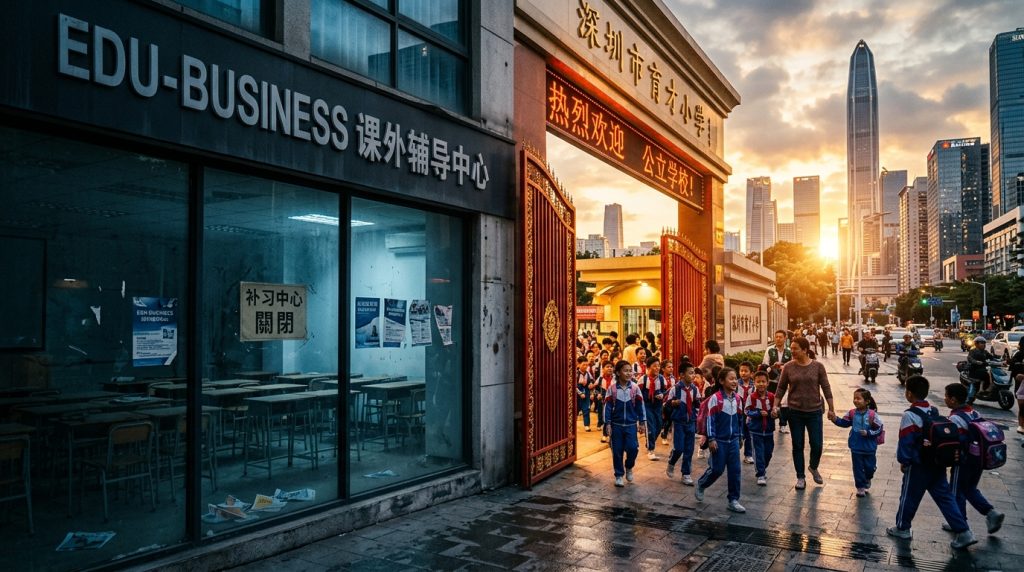
For decades, the “Edu-preneur” was the king of the Chinese middle class. [cite: 6, 66] Private tutoring centres were a $120 billion industry where parents spent their life savings to give their kids an edge. [cite: 7, 67] Then, almost overnight, the government pulled the plug. [cite: 8, 68] The ages of 6 to 15 are now a “sacred zone.” [cite: 8, 68]
China’s leadership realised that when education becomes a business, the wealth gap explodes. [cite: 9, 69] Families with money buy success, while the poor are left behind. [cite: 10, 70] By enforcing a non-profit model for compulsory education, the state has reclaimed the soul of the school system. [cite: 11, 71]
But there’s a deeper, more human reason: the fertility crisis. [cite: 12, 72] The crushing cost of private education was stopping people from having babies. [cite: 12, 73] By removing the “businessman” from the equation, China is trying to make it affordable to be a parent again. [cite: 13, 74]
2. The Clash of Titans: The US Innovation Model vs. The China Model
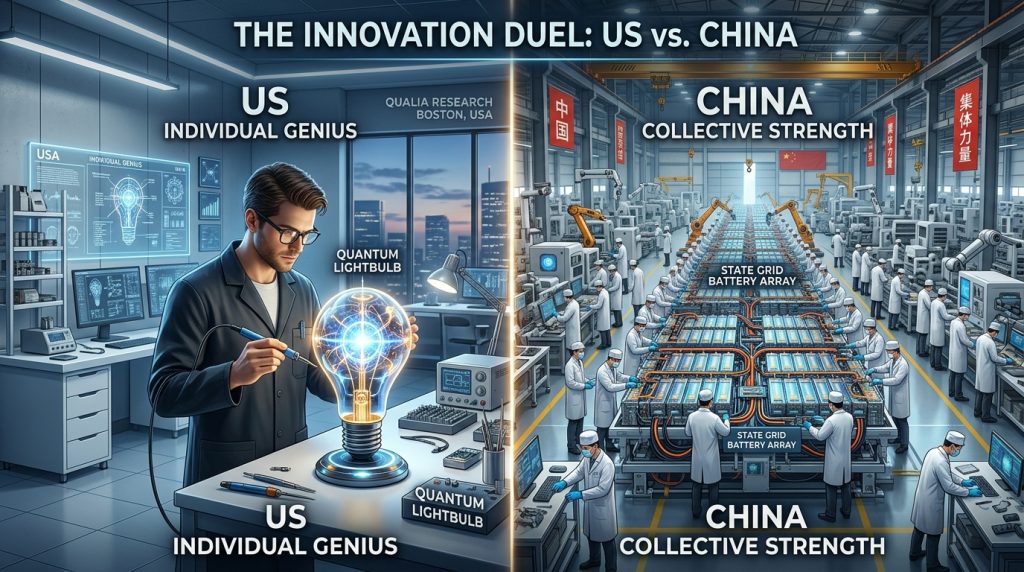
To understand why China is making progress at such a staggering rate, we have to look at the “Innovation Duel” with the West. [cite: 14, 75] It is a battle of two very different spirits. [cite: 15, 76]
| Feature | US Innovation Model | China Innovation Model |
|---|---|---|
| The Core Philosophy | Individual Genius: “I want to change the world.” [cite: 16, 78] | Collective Strength: “We will build the nation.” [cite: 16, 78] |
| The Funding | Private Venture Capital & Markets [cite: 17, 79] | State-Directed Strategic Planning [cite: 17, 79] |
| The Strategy | High Risk: Fail fast, innovate big. [cite: 18, 80] | High Scale: Perfect the process, dominate the market. [cite: 18, 80] |
| Education Focus | Critical Thinking & Liberal Arts [cite: 19, 81] | STEM-Heavy & Applied Engineering [cite: 19, 81] |
While the US still leads in “Pure Science,” China has become the world leader in applied engineering. [cite: 20, 82] They don’t just want to invent the battery; they want to build 80% of the world’s batteries. [cite: 21, 83] As the 15th Five-Year Plan dictates, the goal is total technological self-reliance. [cite: 22, 84]
The Gaokao is China’s highly competitive national college entrance exam. It serves as a critical mechanism in the nation’s educational “funnel,” designed to fast-track the top 1% of talent into specialised research institutes and global research hubs.
Key Characteristics of the Gaokao
Systemic Role: It is the final stage of China’s “6-3-3” education system, which consists of six years of primary school, three years of junior middle school, and three years of senior high school.
Strategic Fast-Tracking: The exam is instrumental in identifying high-level talent to support national goals, such as achieving total technological self-reliance and advancing “New Quality Productive Forces” like AI and quantum computing.
Competition and Pressure: The intensity of the Gaokao drives a deep cultural obsession with “The Edge,” leading some families to seek advantages through “shadow markets” like hiring “Math Nannies” when formal private tutoring is banned.
STEM Focus: It acts as a primary filter for the state-mandated “STEM-first” curriculum, helping China produce more STEM graduates than the US and Europe combined.
3. The STEM Funnel: How China Produces “Bright Minds” at Scale
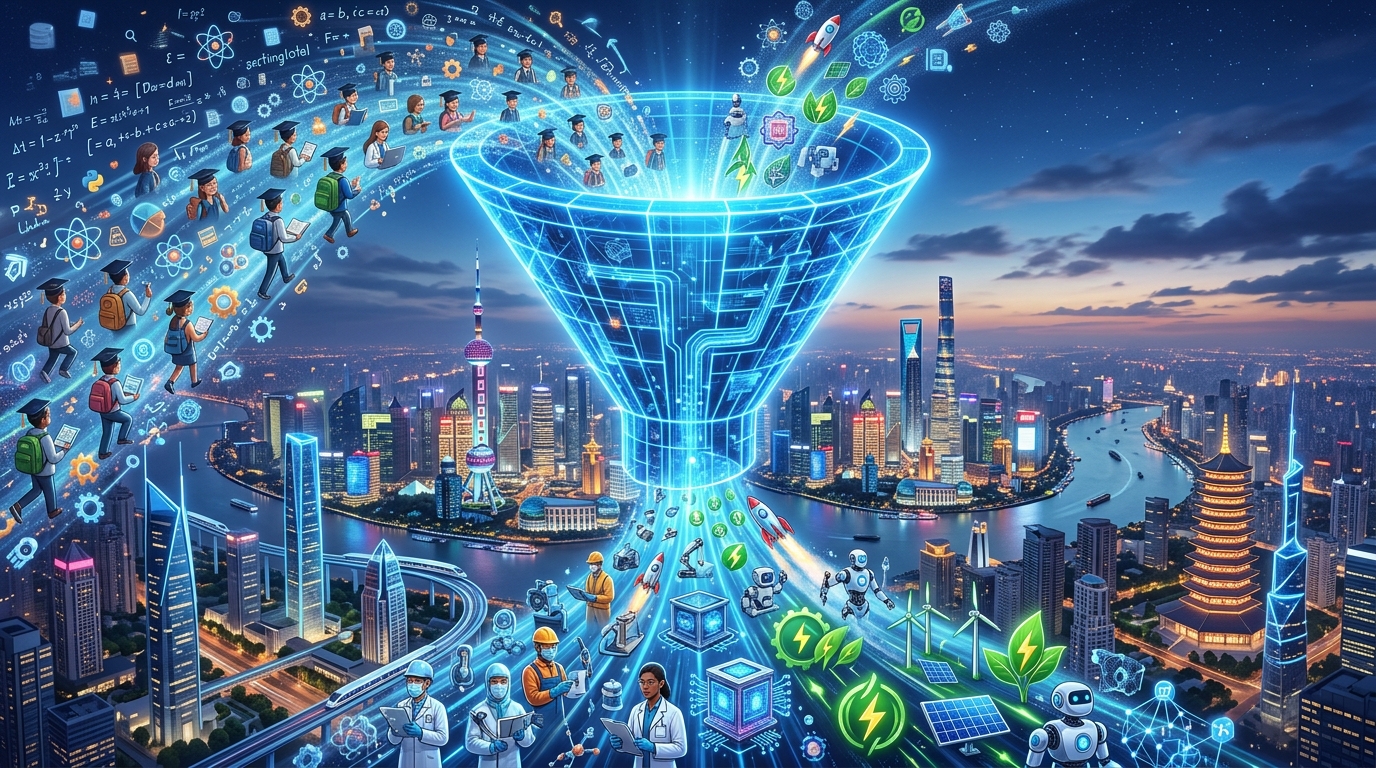
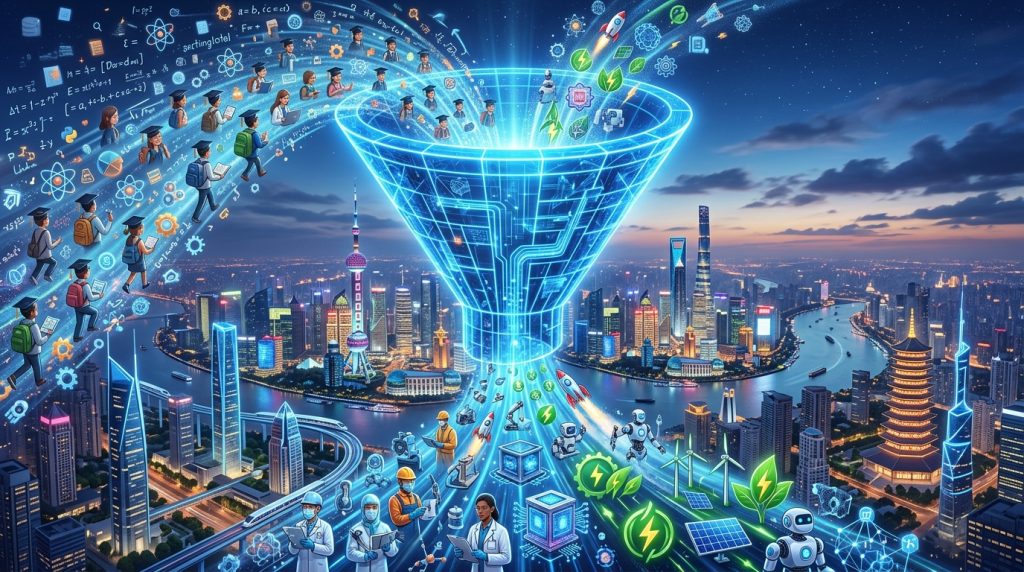
China’s education system is essentially a giant funnel. [cite: 23, 85] With over 290 million students, the sheer volume of talent is overwhelming. [cite: 24, 86] The government is pouring billions into turning local universities into global research hubs through “Double First-Class” initiatives. [cite: 25, 87]
China’s R&D spending is now growing at 7% annually, focusing on “New Quality Productive Forces” like Agentic AI, quantum computing, and green energy. [cite: 26, 88] The result is a nation that produces more STEM graduates than the US and Europe combined. [cite: 27, 89] They aren’t just teaching kids to code; they are teaching them to engineer the infrastructure of 2030. [cite: 28, 90]
4. The “Little Soldiers” Mentality: Re-Engineering the Youth
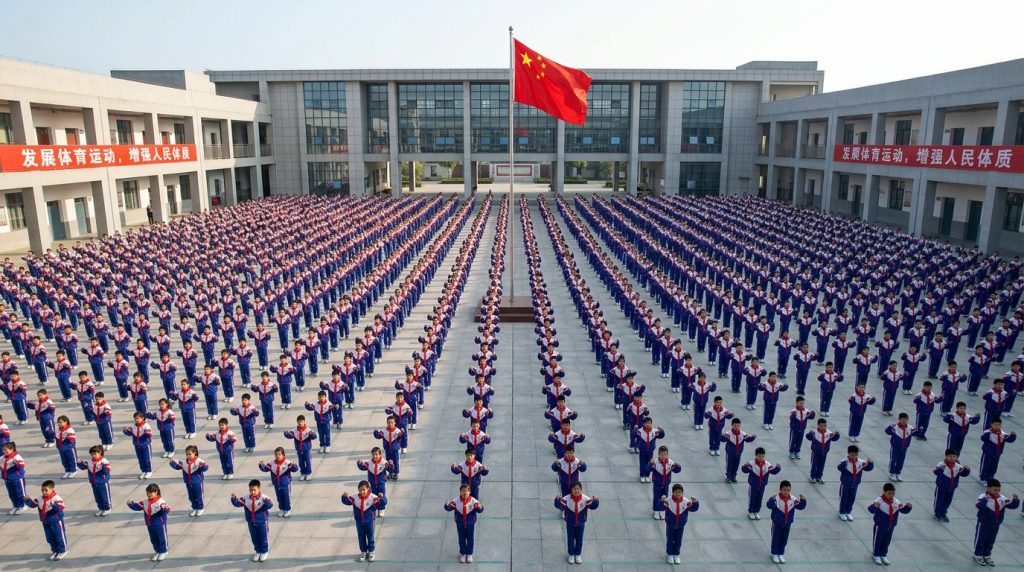
One of the most significant aspects of the Chinese system is the focus on “National Vigour.” [cite: 29, 91] It’s not just about what’s in the head, but what’s in the heart and the body. [cite: 30, 92] Chinese schools use specific techniques to transform individual ego into collective utility. [cite: 31, 93]
Collective Merit Systems
Instead of individual rewards, they use digital merit systems where the whole group wins together. [cite: 32, 94] Students earn “stars” for collective behaviour, creating a squad mentality where kids pressure each other to excel. [cite: 33, 95]
Labor Education
“Labour Education” has returned; kids are taught to cook, clean, and farm to ensure they don’t become “spoiled elites.” [cite: 33, 34, 96] Moving in rhythmic synchronicity during mass callisthenics releases endorphins and reinforces the feeling of being part of a powerful, synchronised machine. [cite: 35, 97]
5. Physical Health as a Grade
In a move to bridge the health gap, Physical Education (PE) is now a core exam subject. [cite: 36, 98] To get into a good high school, you must be physically fit. [cite: 37, 99] This is a direct strike against the “weakness” of modern digital life, ensuring the next generation is as physically resilient as they are mentally sharp. [cite: 38, 100]
The state has identified that “bright minds” are useless if the youth suffer from the 70% myopia rates currently plaguing the nation. [cite: 39, 101]
6. The Investigative Reality: The “Shadow Market” Loopholes
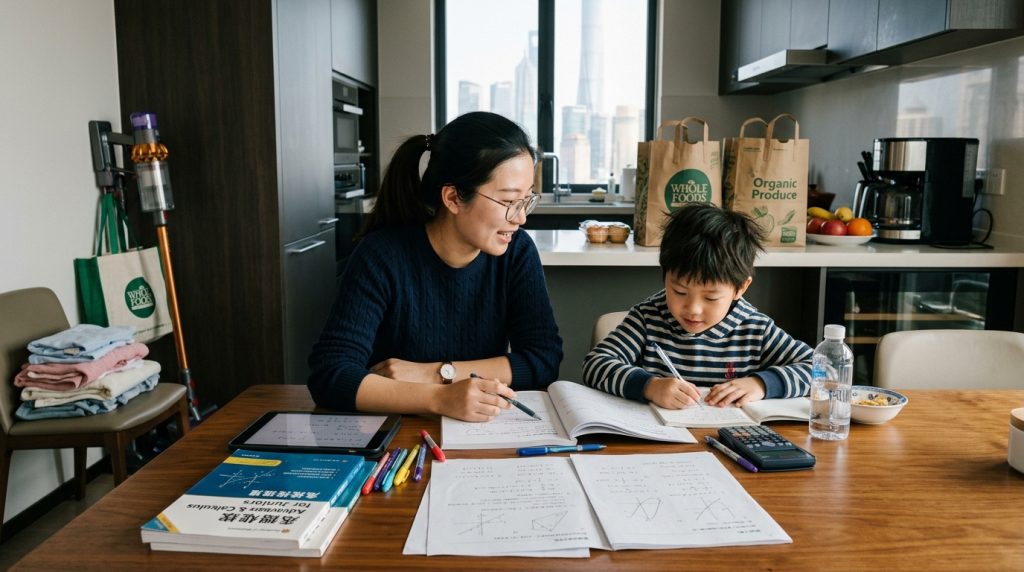
Is it all perfect? Far from it. Human nature always finds a way. [cite: 41, 102] Our investigation shows that while the “businessmen” are gone, a black market has emerged. [cite: 42, 103] Wealthy families are now hiring “Math Nannies” high-level graduates who live in the house under the guise of domestic help but are actually private tutors. [cite: 43, 104]
The pressure hasn’t fully disappeared; it has simply moved underground. [cite: 44, 105] The cultural obsession with “The Edge” is so deep that even the strictest laws can’t fully extinguish the fire of competition. [cite: 45, 106]
Frequently Asked Questions
Q1. Is education in China completely free?
Education is free for the 9 years of compulsory schooling (ages 6–15) in public schools. [cite: 46, 108] However, parents still pay for “indirect costs” like uniforms and meals. [cite: 47, 109] Senior High and University still require tuition. [cite: 47, 110]
Q2. Why did China ban private tutoring?
The “Double Reduction” policy aimed to reduce the financial burden on parents to encourage higher birth rates and to level the playing field between the wealthy and the poor. [cite: 48, 111]
Q3. What is the “6-3-3” system?
It refers to 6 years of Primary school, 3 years of Junior Middle school, and 3 years of Senior High school. [cite: 49, 112]
Q4. How does China produce so many engineers?
Through a state-mandated “STEM-first” curriculum and a highly competitive exam system (Gaokao) that fast-tracks the top 1% of talent into specialised research institutes. [cite: 50, 113]
Q5. What are the “Golden Weeks”?
These are 7-to-9-day-long national holidays designed to boost domestic tourism, often “paid for” by working on weekends through the “Tiaoxiu” system. [cite: 51, 114]
Q6. What is the “Little Soldier” mentality?
It is an educational approach that prioritises collective resilience, discipline, and physical fitness over individualistic expression. [cite: 52, 115]
References and Authoritative Sources
This analysis is built upon the strategic directives of China’s 15th Five-Year Plan (2026–2030) and the Law on the Promotion of Private Education. [cite: 53, 116] Data regarding STEM graduation rates and R&D spending are sourced from the National Bureau of Statistics of China and the Ministry of Education’s 2025 Annual Report. [cite: 54, 117] Insights into the “Double Reduction” impact are based on longitudinal studies from the Chinese Academy of Social Sciences, while global innovation comparisons draw from the World Intellectual Property Organization (WIPO) Global Innovation Index 2026. [cite: 55, 118]