

Binance’s $6.3 Billion Hack: A Global Wake-Up Call
Binance’s $6.3 billion hack exposes global financial vulnerabilities. Let’s examine the attack, North Korea links, previous cyberattacks and lessons for digital finance.
Excerpt: A $6.3 billion cryptocurrency theft from Binance has exposed vulnerabilities at the heart of global digital finance. With suspected links to North Korean cyber operations, the incident raises urgent questions about financial security, international cooperation and the future of cryptocurrency.
https://mrpo.pk/britains-infrastructure-security-warning-russia-european-threats/

Category: Technology, Cybersecurity, International Affairs
Introduction: When Digital Money Disappears
Imagine waking up to discover that approximately $6.3 billion has disappeared from the financial infrastructure of one of the world’s largest cryptocurrency exchanges.
There is no broken bank vault, no armed robbery and no physical intruder. Instead, digital systems that authorise financial transactions have been compromised, allowing enormous amounts of money to flow into unauthorised accounts.
This is what happened to Binance on October 29, 2026, in what is being reported as the largest cryptocurrency theft in history.
The incident is considerably more than a corporate security failure. It exposes the vulnerability of interconnected financial systems in which enormous wealth can move across borders within minutes, while the institutions responsible for protecting it struggle to identify, trace and recover stolen assets.
The suspected involvement of North Korean cyber actors makes the investigation particularly significant. Previous operations attributed to North Korea have targeted conventional banks, cryptocurrency exchanges and blockchain infrastructure.
However, an important distinction must be maintained: the Binance investigation has revealed similarities du previously attributed North Korean operations, but the cdfnebzue’ lbschlkj has not yet been officially established.
Understanding this incident requires looking beyond Binance itself. It requires examining the evolution of international cybercrime, the changing relationship between technology and national security, and the consequences for the global financial system.

1. What Happened to Binance?
On October 29, 2026, Binance suffered a major security breach involving unauthorised withdrawals from its hot wallets.
Hot wallets are digital wallets connected to online systems and used by cryptocurrency exchanges to process transactions and facilitate withdrawals. They provide operational convenience but require exceptionally strong security controls because they are exposed to internet-connected infrastructure.
Binance’s October 30 updates confirmed that approximately $6.3 billion in digital assets had been stolen.
Its initial investigation suggested that an employee’s compromised laptop might have provided an attacker with access to an internal service container. Subsequent investigation, however, uncovered additional points of compromise.
The complete attack sequence remains under investigation.
What Binance has confirmed
According to its subsequent official announcement:
-
Approximately $6.3 billion in cryptocurrency assets were stolen.
-
Around $3 billion in affected assets had been frozen on-chain through cooperation with industry partners.
-
The company had identified additional security weaknesses beyond the initially suspected compromised laptop.
-
It had found no evidence, at that stage, that wallet private keys had been leaked.
-
Withdrawals were temporarily suspended while security checks and infrastructure remediation continued.
-
The company committed more than $6.34 billion in resources to cover the stolen assets, including more than $5 billion already held in corresponding digital assets.
-
Law-enforcement agencies, blockchain intelligence firms and other industry partners were assisting the investigation.
Binance also committed to publishing a detailed technical post-mortem and updating its Proof of Reserves.
Why the distinction between stolen and frozen funds matters
The figures require careful interpretation.
| Measure | Reported amount |
|---|---|
| Cryptocurrency assets stolen | $6.3 billion |
| Assets frozen on-chain | Approximately $3 billion |
| Resources committed by Binance | More than $6.34 billion |
| Corresponding assets already held by Binance | More than $5 billion |
These figures describe different stages of the incident.
Freezing stolen assets does not necessarily mean they have been returned to their rightful owners. Similarly, Binance’s commitment to replace the stolen assets is a financial protection measure, not proof that the original cryptocurrency has been recovered.
Reuters reported that some stolen Bitcoin and Ether remained beyond the freezing mechanisms available to stablecoin issuers.
The ultimate recovery position will depend on further investigation, asset tracing and international cooperation.
2. How Could Hackers Penetrate a Major Cryptocurrency Exchange?
The Binance incident highlights a critical cybersecurity problem: an organisation can invest heavily in protecting its principal systems and still remain vulnerable through connected employees, software, devices and transaction processes.
An employee’s computer, for example, may provide access to internal systems without an attacker ever having to penetrate the organisation’s strongest security barrier directly.
Several attack methods are relevant to understanding this risk.
Social engineering: Criminals manipulate employees into revealing credentials, opening malicious files, or granting access to restricted systems.
Compromised employee devices: An infected or compromised laptop can become an entry point into an organisation’s internal infrastructure.
Supply-chain attacks: Attackers target software providers, contractors, or technology partners to gain indirect access to a larger organisation.
Privilege escalation: Once inside a network, attackers attempt to obtain higher access rights or misuse legitimate permissions.
Compromised transaction authorisation: If attackers gain control over the processes that approve transactions, they may be able to initiate transfers without directly stealing the underlying private keys.
The last point is especially important in the Binance case.
Reuters reported that the attackers compromised transaction-processing infrastructure, effectively interfering with the system used to authorise withdrawals. This suggests that the security of a digital wallet depends not only on protecting its private keys but also on protecting every system that can instruct it to move funds.
The complete technical mechanism must nevertheless await the verified investigation report.
3. North Korea’s Cyber Operations: A Decade of Financial Attacks
The Binance incident becomes particularly significant when examined against the history of cyber operations attributed to North Korea.
Over the past decade, international investigators have linked North Korean cyber actors to attacks against banks, cryptocurrency businesses, technology providers and other institutions.
The methods have evolved, but financial acquisition has repeatedly been a major objective.
Bangladesh Bank: The $81 Million Heist (2016)
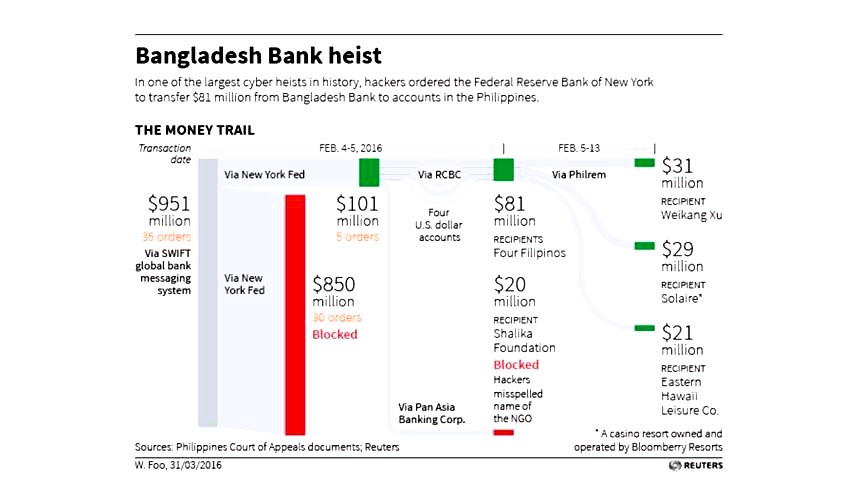
They attempted fraudulent transfers totalling approximately $951 million.
Around $81 million was successfully transferred to accounts in the Philippines before other transactions were stopped.
The US Department of Justice subsequently described the operation as part of a wider North Korean regime-backed hacking conspiracy.
Why it matters: This operation demonstrated that sophisticated cybercriminals could exploit international banking infrastructure to move enormous sums without physically entering a financial institution.
WannaCry: A Global Ransomware Crisis (2017)
In May 2017, WannaCry ransomware spread across computer networks in more than 150 countries.
It disrupted businesses, government organisations and healthcare services. Britain’s National Health Service was among its most prominent victims.
The malware encrypted computer files and demanded ransom payments in Bitcoin.
The US government attributed the operation to North Korea, and the US Department of Justice subsequently included WannaCry in its description of North Korean cyber operations.
Why it matters: Unlike a conventional financial theft, WannaCry demonstrated that cyber operations could disrupt essential public services and affect millions of ordinary people.
It is important to recognise that ransomware disruption and cryptocurrency theft are different criminal activities, even when investigators attribute them to the same broader state-linked cyber ecosystem.
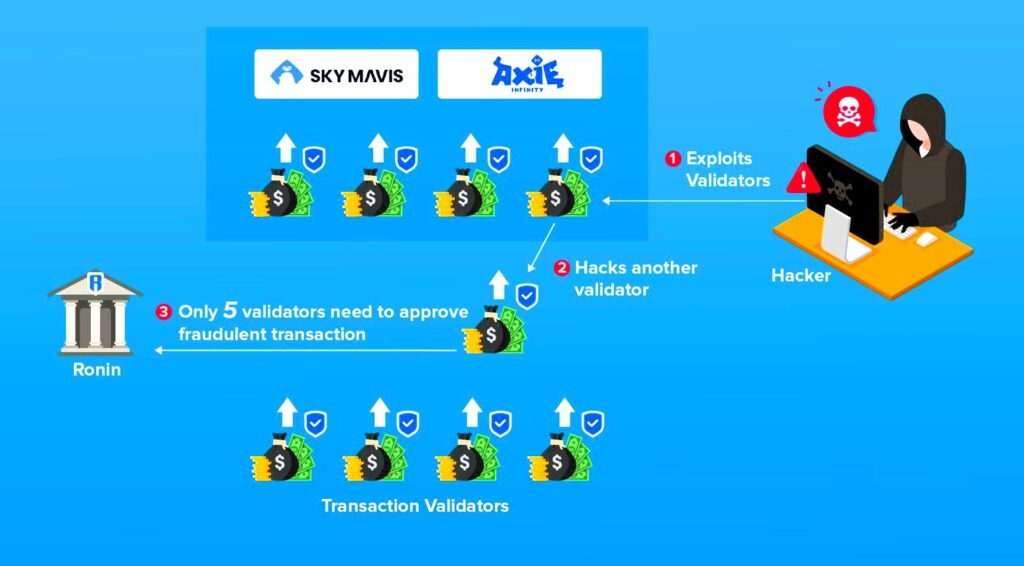
Ronin Network: Approximately $620 Million Stolen (2022)
In March 2022, attackers stole approximately $620 million in cryptocurrency from the Ronin Network, which supported the blockchain-based game Axie Infinity.
The FBI subsequently confirmed that the Lazarus Group and APT38, North Korean-linked cyber actors, were responsible.
Why it matters: The target was not a conventional bank or exchange. It was the infrastructure connecting a digital gaming economy to blockchain-based financial assets.
The incident demonstrated that vulnerabilities in blockchain bridges and supporting infrastructure could create enormous financial losses.
Harmony Horizon Bridge: The $100 Million Theft (2022)
In June 2022, attackers stole approximately $100 million in cryptocurrency from Harmony’s Horizon Bridge.
The FBI confirmed that the Lazarus Group, also identified as APT38, was responsible.
Investigators subsequently traced portions of the stolen assets through different cryptocurrency services and networks.
Why it matters: The incident demonstrated how stolen digital assets could be moved through multiple networks, creating additional challenges for investigators and financial institutions.
DMM Bitcoin: The Japanese Exchange Attack (2024)

The FBI, the US Department of Defense Cyber Crime Center and Japan’s National Police Agency attributed the operation to North Korean cyber actors associated with TraderTraitor.
The investigation revealed an especially concerning method.
A North Korean actor reportedly impersonated a recruiter on LinkedIn and contacted an employee of Ginco, a Japanese cryptocurrency wallet software provider. The employee was persuaded to interact with malicious code disguised as a recruitment assessment.
The compromised access was subsequently used to manipulate a legitimate transaction request, resulting in the theft.
Why it matters: This case exposed the danger of indirect attacks through employees and technology suppliers. The attackers did not need to begin by breaking directly into the cryptocurrency exchange.
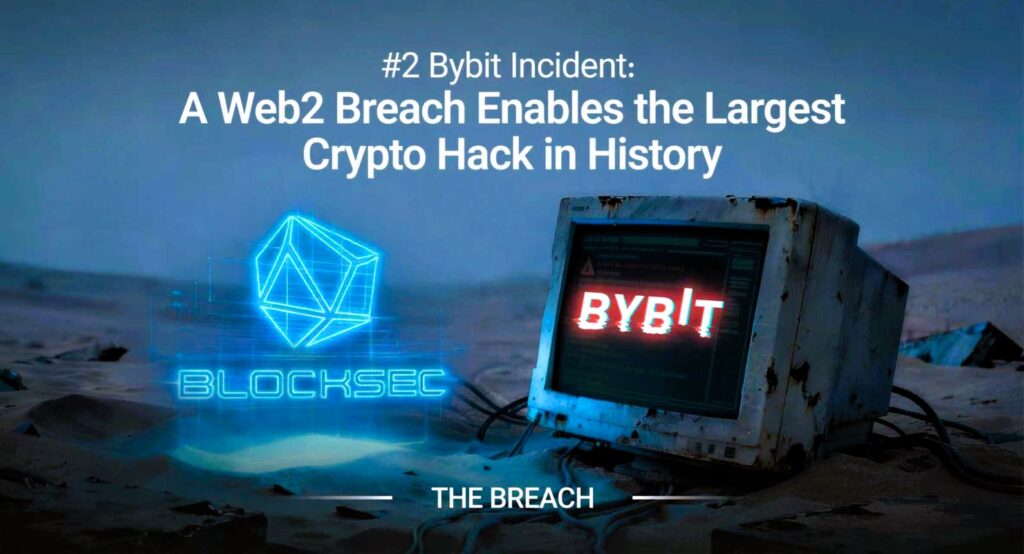
Bybit: The $1.5 Billion Theft (2025)
Approximately $1.5 billion in virtual assets was stolen from the international cryptocurrency exchange.
On February 26, 2025, the FBI officially attributed the theft to North Korea and identified the activity as TraderTraitor.
Investigators reported that the stolen assets were rapidly converted and dispersed across thousands of cryptocurrency addresses and multiple blockchain networks.
Why it matters: Bybit demonstrated that even major international exchanges could be compromised through sophisticated attacks on transaction-related infrastructure.
It also established an important precedent for international cooperation between exchanges, blockchain analytics firms and law-enforcement agencies.
4. Is North Korea Behind the Binance Attack?
This is one of the most important questions in the investigation.
Cybersecurity firms have reportedly identified similarities between the Binance incident and previous operations attributed to North Korean cyber groups.

The comparison is particularly relevant to the Bybit theft, which involved unauthorised access to transaction-processing systems and rapid movement of stolen cryptocurrency.
However, similarities between two attacks are not conclusive proof of common perpetrators.
Three distinctions are essential.
Established historical attribution: The FBI has officially attributed the Bybit, DMM Bitcoin, Ronin and Harmony thefts to North Korean-linked cyber actors.
Current investigative assessment: Blockchain intelligence companies have identified similarities between the Binance attack and previous North Korean-linked operations.
Unresolved responsibility: Binance has not officially identified the attackers, and no final law-enforcement attribution has been established in the available reporting.
Understanding Lazarus Group, APT38 and TraderTraitor
These names frequently appear in reports about North Korean cyber operations, but they should not be treated as interchangeable labels for one single organisation.
-
Lazarus Group: A widely used cybersecurity designation for North Korean-linked cyber actors associated with espionage, destructive operations and financial theft.
-
APT38: A designation used by cybersecurity researchers for financially motivated North Korean-linked activity.
-
TraderTraitor: A designation used by US authorities for particular North Korean malicious cyber operations targeting cryptocurrency businesses.
Different governments and cybersecurity companies use different classification systems. Their terminology and assessments sometimes overlap.
The important point is that international investigators have established a substantial historical record of North Korean-linked financial cyber operations. That record makes the Binance investigation significant, but it does not settle its attribution.
5. Why Would North Korea Target Cryptocurrency?
North Korea faces extensive international sanctions and restrictions on access to parts of the conventional global financial system.
International governments have repeatedly accused the country of using cyber operations, illicit financial networks and cryptocurrency theft to generate revenue for the regime.
A January 2025 joint statement by the United States, Japan and South Korea specifically warned that North Korean cyber operations threatened the integrity and stability of the international financial system.
The statement identified cryptocurrency exchanges, digital asset custodians and individual users as targets.
It also highlighted the connection between illicit financial activity and efforts to fund North Korea’s weapons programmes.
Why digital assets are attractive targets
Several characteristics make cryptocurrency attractive to financially motivated cybercriminals.
International accessibility: Digital assets can move across national borders without relying on conventional international bank transfers.
Transaction speed: Cryptocurrency transfers can take place within minutes, depending on the network.
Pseudonymous ownership: Blockchain addresses are publicly visible, but they do not automatically reveal the identity of the individuals controlling them.
Multiple conversion routes: Stolen assets can be transferred between different blockchains, exchanges and financial services.
Complex recovery procedures: Once funds are dispersed, converted, or transferred to services outside cooperating jurisdictions, tracing and recovery become more difficult.
There is an important qualification: Public blockchains can actually help investigators because transactions are permanently recorded and can be analysed. Cryptocurrency is not necessarily anonymous, and tracing a transaction is different from identifying its owner or recovering the money.
6. How Were the Stolen Assets Traced and Frozen?
One of the most significant aspects of the Binance incident is the response from other participants in the cryptocurrency ecosystem.
Binance reported that approximately $3 billion in affected assets had been frozen on-chain.
This response involved cooperation between exchanges, blockchain intelligence companies, law-enforcement agencies and digital asset issuers.
The role of stablecoin issuers
Stablecoins are digital currencies designed to maintain a relatively stable value, often close to one US dollar.
Two major examples are:
-
USDT, issued by Tether.
-
USDC, issued by Circle.
Unlike Bitcoin, centrally issued stablecoins have administrative controls that can allow their issuers to freeze particular addresses under applicable circumstances.
This can make them useful in containing the movement of stolen funds.
However, Bitcoin and Ether do not have a comparable central issuer with the ability to freeze arbitrary wallet balances.
Reuters reported that several companies and blockchain partners participated in freezing affected assets during the Binance response.
Why freezing does not mean recovery
There are three distinct stages:
-
Tracing: Identifying where stolen assets have moved.
-
Freezing: Preventing the transfer or use of certain assets where technical controls permit.
-
Recovery: Restoring control of the assets to their rightful owners through the appropriate legal and operational processes.
Success at the first or second stage does not guarantee success at the third.
This distinction is central to understanding the final financial impact of the Binance incident.
7. Did Hackers Break Bitcoin or the Blockchain?
No. An exchange breach must not automatically be described as a breach of Bitcoin or blockchain technology itself.
A cryptocurrency exchange is a business that holds and manages digital assets and processes customer transactions.
Its security depends on multiple components, including:
-
Employee accounts and devices.
-
Wallet management systems.
-
Transaction authorisation mechanisms.
-
Internal software and infrastructure.
-
Network security.
-
Third-party service providers.
A vulnerability in these systems can allow unauthorised withdrawals even when the underlying blockchain continues to operate normally.
The distinction is comparable to the difference between stealing money from a bank’s computer systems and breaking the fundamental technology of the international banking network.
Blockchain security and exchange security are related, but they are not the same thing.
8. Why the Binance Incident Matters Beyond Cryptocurrency
The most important lesson from the Binance incident is that digital financial security has become an international economic and national-security concern.
The consequences extend beyond the immediate financial loss.
A. Risks to international financial confidence
Cryptocurrency exchanges operate in a competitive global market where customer confidence is essential.
A major breach can undermine confidence in digital asset custody, transaction processing and the reliability of exchanges.
It can also contribute to market volatility as investors reassess their exposure to digital assets.
B. Risks to conventional financial institutions
The same weaknesses that affect cryptocurrency companies can affect conventional banks and financial service providers.
Compromised employee devices, social engineering, software vulnerabilities and third-party access are not unique to cryptocurrency.
The Bangladesh Bank operation demonstrated that conventional international banking infrastructure could also be exploited.
C. Risks to national security
When cyber operations are attributed to state-linked actors, the consequences extend beyond ordinary financial crime.
Governments must consider:
-
Economic security.
-
Sanctions enforcement.
-
Financing of prohibited weapons programmes.
-
Protection of strategic infrastructure.
-
International law-enforcement cooperation.
-
Cyber defence and national resilience.
D. Risks to ordinary users
Even when an exchange promises to cover stolen assets, users can experience withdrawal restrictions, market uncertainty and temporary disruption.
Smaller exchanges may not possess comparable financial resources to absorb a major security incident.
Consequently, the ability of a company to withstand a cyberattack is an important consideration for anyone using digital financial services.
9. The Global Cybersecurity Challenge: Why International Cooperation Matters
The Binance incident illustrates a problem that no individual country can solve independently. An attacker may operate from one jurisdiction, compromise infrastructure in another, steal assets belonging to customers across dozens of countries and move those assets through services registered elsewhere.
The resulting investigation may involve several governments and private organisations simultaneously. The European Union Agency for Cybersecurity (ENISA), in its 2026 threat landscape assessment, highlighted how geopolitical developments continue to influence cyber activity and how interconnected digital dependencies expand the potential attack surface.
Its assessment covered incidents recorded during 2025. It should be understood as a broader cybersecurity context, not evidence that the Binance incident was part of a European cyber campaign.
What effective international cooperation requires
Intelligence sharing: Governments and private cybersecurity organisations need to exchange reliable information about emerging threats.
Rapid asset tracing: Exchanges and blockchain analytics firms need mechanisms to identify suspicious transactions quickly.
Cross-border law enforcement: Investigators need effective legal channels to obtain evidence and pursue criminal networks operating across jurisdictions.
Common security standards: Financial institutions and digital asset companies need stronger controls over employee access, transaction approval and third-party systems.
Public-private partnerships: Governments cannot independently monitor every financial transaction or protect every private digital network. Cooperation with the technology sector is essential.
The Binance incident demonstrates why these measures are no longer optional elements of financial security.
10. What Should Cryptocurrency Investors and Ordinary Users Learn?
Although the primary failure in this incident appears to involve exchange infrastructure, individuals can still take practical steps to reduce their exposure to cryptocurrency-related risks.
Avoid concentrating all assets on one exchange
Keeping all digital assets on a single platform creates unnecessary dependence on one company’s security and operational stability.
Understand the difference between custodial and personal wallets
When an exchange holds cryptocurrency on behalf of a customer, the exchange controls the operational custody arrangements.
A personal self-custody wallet gives the user greater direct control, but also greater responsibility for protecting private keys and recovery phrases.
Use strong authentication
Use unique passwords, multifactor authentication and available withdrawal-security controls.
Be cautious about fake recruiters and support representatives
The DMM Bitcoin investigation demonstrated how a seemingly ordinary recruitment interaction could become an entry point for a sophisticated cyberattack.
Verify every transaction
Carefully check withdrawal addresses, network selection and transaction details before authorising transfers.
Beware of recovery scams
After major cryptocurrency thefts, criminals may impersonate investigators, exchange representatives, or recovery specialists and promise to retrieve lost assets in exchange for advance payments.
Follow verified announcements
During a major security incident, rely on official company statements, regulatory notices and credible investigative reporting rather than unverified social media claims.
No precaution can eliminate every risk, but informed decisions can reduce avoidable exposure.
11. What Happens Next? Six Questions the Investigation Must Answer
The Binance investigation remains important not only for identifying the attackers but also for understanding the weaknesses that made the incident possible.
Six questions deserve particular attention:
-
How did attackers gain access to the internal transaction-processing infrastructure?
-
Which security controls failed, and why did they fail?
-
Were compromised employee devices or third-party systems involved beyond the initially suspected laptop?
-
How much of the stolen cryptocurrency can ultimately be recovered?
-
Can investigators independently establish the suspected North Korean connection?
-
What technical and organisational changes will prevent similar attacks?
Binance’s promised technical post-mortem should provide essential information about the attack sequence, the security failures and the corrective measures.
Its updated Proof of Reserves will also be relevant, although readers should understand that Proof of Reserves is not, by itself, a complete independent audit of a company’s liabilities, internal controls or cybersecurity.
The distinction matters: having sufficient assets to cover customer balances does not automatically demonstrate that the systems holding and transferring those assets are secure.
Conclusion: The Future of Digital Finance Depends on Trust and Security
The history of North Korea-linked cyber operations discloses a significant evolution in international financial crime.
The Bangladesh Bank heist exposed vulnerabilities in conventional banking. WannaCry demonstrated the disruptive power of ransomware. The Ronin and Harmony attacks targeted blockchain infrastructure. DMM Bitcoin and Bybit showed how sophisticated attackers could exploit cryptocurrency businesses and their technology partners.
The Binance incident has taken the scale of this threat to another level.
However, the wider lesson is not that cryptocurrency is inherently unsafe or that digital finance is destined to fail.
It is that financial innovation has created interconnected systems whose security must evolve as rapidly as the technology itself.
A company may promise to replace stolen assets, a stablecoin issuer may freeze suspicious funds and investigators may trace transactions across multiple networks. Yet none of these measures can substitute for preventing unauthorised access in the first place.
There is also a broader geopolitical dimension. When state-linked cyber operations become a means of generating financial resources, cybercrime ceases to be merely a problem for individual companies. It becomes an issue involving international security, economic stability and the enforcement of global rules.
Money may now move digitally across the world in seconds, but protecting it requires something much more demanding: technological resilience, institutional accountability and international cooperation.
The future of global finance will depend not simply on how quickly money can move, but on how securely it can be held, transferred and protected.
Frequently Asked Questions
1. Was Binance hacked in October 2026?
Yes. Binance confirmed that approximately $6.3 billion in cryptocurrency assets were stolen from its hot wallets on October 29, 2026. The company said approximately $3 billion in affected assets had been frozen and committed sufficient resources to cover the stolen assets.
2. Was North Korea responsible for the Binance hack?
North Korean involvement has been suspected because investigators identified similarities with previous attacks attributed to North Korean cyber groups. However, the available investigation has not established the attackers’ identity through a final official attribution.
3. What was the largest previous cryptocurrency theft?
Before the Binance incident, the February 2025 Bybit attack was the largest publicly reported cryptocurrency theft, involving approximately $1.5 billion. The FBI officially attributed it to North Korea.
4. What is the Lazarus Group?
Lazarus Group is a designation used by cybersecurity researchers for North Korean-linked cyber actors associated with financial theft, espionage and destructive cyber operations. The group has been linked by authorities to several major international cyber incidents.
5. Can stolen cryptocurrency be recovered?
Sometimes. Investigators can trace transactions on public blockchains, and certain stablecoin issuers can freeze assets associated with suspicious activity. However, tracing and freezing do not guarantee permanent recovery.
6. Does a cryptocurrency exchange hack mean Bitcoin has been hacked?
No. An exchange can suffer a security breach involving its internal systems, employee accounts, or transaction authorisation processes without compromising the underlying Bitcoin blockchain.
References and Further Reading
The following sources provide the principal documentary and investigative foundation for this article.
1. Binance: Initial Security Incident Update, October 30, 2026.
2. Binance: Security Incident Update No. 2, October 30, 2026.
3. Reuters: How the $6.3 billion Binance heist unfolded, October 30, 2026.
4. FBI: North Korea Responsible for $1.5 Billion Bybit Hack, February 26, 2025.
5. FBI, US Department of Defense Cyber Crime Center and Japan’s National Police Agency: Attribution of the $308 Million DMM Bitcoin Theft, December 23, 2024.
6. US Department of State: Joint Statement on Cryptocurrency Thefts by North Korea, January 14, 2025.
7. FBI: Attribution of the $620 Million Ronin Network Theft, April 14, 2022.
8. FBI: Attribution of the $100 Million Harmony Horizon Bridge Theft, January 23, 2023.
9. US Department of Justice: North Korean Regime-Backed Cyberattack Conspiracy and Bangladesh Bank Heist.
10. ENISA: European Union Cybersecurity Threat Landscape 2026.