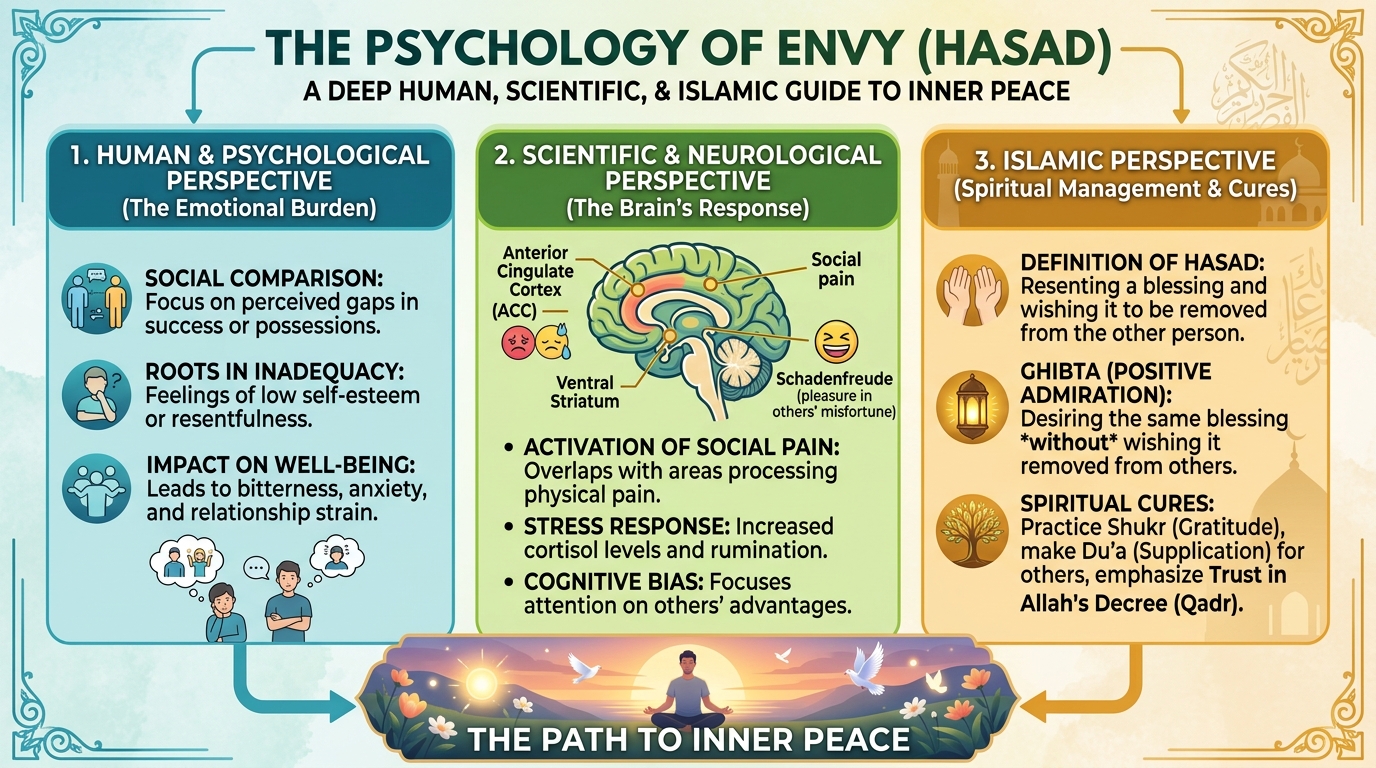

The Psychology of Envy (Hasad): A Deep Human, Scientific, and Islamic Guide to Inner Peace
This is ḥasad (envy). A deeply human emotion, yet powerful enough to influence your thinking, emotions, behaviour, and even your spiritual state if left unchecked.
In today’s globally connected world, from the fast-paced cities of the US to the digital cultures of Europe and beyond, envy has become more intense, more frequent, and more hidden.
This article brings together psychology, real human experience, and Islamic wisdom to help you understand envy, recognise its hidden damage, and transform it into clarity, growth, and inner peace.
Hasad, the Envy: Some Psychological, Spiritual and Social Dimensions
When moral conduct among the individuals gets deteriorated, its bad effects are not confined to them only but extend to others as well. The entire community and the whole society face the consequences of its adverse effects resulting in the degradation of social well-being, solidarity, and tranquility. Moreover, there are some moral vices which give rise to numerous other evils as they are contagious in their nature, i.e., evil has a natural tendency to give rise to other evils.
For example, tale-bearing gives rise to backbiting, slander; miserliness to selfishness, hard-heartedness, unkindness; arrogance to belligerence, despising others, accusing others of imperfections, denial of truth, no appreciation for the good qualities of others, and so on. In the same way, envy gives rise to hatred, enmity, hostility, slander, backbiting, theft, murder, resentment, miserliness, etc.
In this background, the present paper attempts at explaining the nature, essence, and kinds of envy. The harms and evils of this moral vice will also be explored. The ways and methods of curing this moral disease are also taken care of in this paper. A list of habits that should be cultivated and given currency is given at the end of the paper in order to eradicate envy from selves (nufūs) so as to make individual as well as social life happy, prosperous, and peaceful.
The tips and methods used to eradicate moral vices like rancor, hatred, enmity, and evil intentions from the individual and collective human life, will be deliberated upon along with the ways and means to cultivate moral virtues like love, compassion, sympathy, and sincerity to create an atmosphere of peace and cordiality.
https://psychologyandeducation.net/pae/index.php/pae/article/view/5247
What Is Envy (Hasad)?
Envy begins as a natural thought:
I wish I had what they have.
But it becomes harmful when it shifts into something deeper:
Why do they have it… and I don’t?
At this stage, envy is no longer just desire. It becomes emotional discomfort, comparison, and sometimes even silent resentment.
Let’s bring those three triggers down from theory into everyday life… the kind you bump into at work, in family gatherings, or during a late-night scroll.
1. Comparison: “Their life vs my life”
This is the most common spark of envy. Your brain becomes a scoreboard, even when no game is announced.

Real-Life Example
You open Instagram and see a former classmate:
- New car
- Vacation photos
- Happy captions
Meanwhile, you’re:
- Working hard
- Saving money
- Feeling stuck
Nothing in your life actually changed…
But your perception did.
Your mind quietly says:
“They’re ahead of me.”
That single comparison turns neutral reality into emotional discomfort.
What’s really happening?
You’re comparing:
- Your behind-the-scenes struggles
with - Their highlight moments
It’s like judging your entire movie against someone else’s trailer.
2. Perceived Unfairness “Why them, not me?”
This is where envy gets sharper. It’s no longer just a comparison… it starts to feel unjust.
Real-Life Example
At work:
- You put in extra hours
- You meet deadlines
- You stay consistent
But someone else gets promoted.
Your reaction:
“I worked harder. This isn’t fair.”
Even if there are hidden factors (skills, timing, relationships), your mind simplifies it into one conclusion:
“I deserved it more.”

What’s really happening?
Your brain is wired to seek fairness.
But it only sees your effort clearly, not others’.
So it builds a story:
- “They got lucky”
- “System is biased”
- “My effort doesn’t matter”
This fuels frustration… and slowly, envy.
3. Feeling Left Behind “Everyone is moving, except me”
This one cuts deeper. It’s not just about others… It’s about your own timeline.
Real-Life Example
You attend a family event or reunion:
- One cousin is married
- Another is settled abroad
- Someone started a business
And then someone asks you:
“What are you doing these days?”
Suddenly, everything feels heavier.
Internal voice:
“I’m late… I’m behind… I should be further.”
What’s really happening?
You’ve unconsciously accepted a timeline template:
- By this age → career
- By this age → marriage
- By this age → success
When your life doesn’t match that script, envy appears… not just toward others, but toward their timing.
The Hidden Connection Between All Three
These triggers often work together like a chain reaction:
- You compare
- It feels unfair
- You feel left behind
And just like that… envy forms.
A Grounded Reality Check
Let’s flip each one gently:
- Comparison → You don’t see the full story
- Unfairness → You don’t see all variables
- Left behind → There is no universal timeline
Life is less like a race track…
and more like different roads under the same sky.
A Thought
Envy doesn’t mean you’re a bad person.
It means your mind is trying to make sense of where you stand.
The problem is not the feeling…
It’s the interpretation you attach to it.
Shift the interpretation…
and the same moment that created envy can become direction.
Spiritually, it reflects:
- Inner restlessness
- Difficulty accepting life’s distribution
- A weakened sense of contentment (Qana’ah)
Why Envy Feels Stronger Today
The Highlight Reel Effect
In modern global culture, especially through social media, we constantly see:
- Success without struggle
- Happiness without hardship
- Results without process
This creates a distorted comparison:
Your real life vs someone else’s edited life
This is a classic example of cognitive distortion, in which the mind selectively focuses on visible outcomes while ignoring underlying realities.
The Habit of Comparison
Human beings are naturally wired to compare. In the past, it helped with survival. Today, it often creates dissatisfaction.
- Someone’s promotion feels like your delay
- Someone’s lifestyle feels like a lack
- Someone’s success feels like your failure
This aligns with Social Comparison Theory, which explains how people evaluate themselves based on others.
The Scarcity Mindset
A subtle but powerful belief fuels envy:
If they have it, there may be less left for me
This belief turns life into a competition rather than a unique journey.
The Hidden Damage of Envy
Envy is not just a feeling. It has consequences.
- It steals gratitude: you stop noticing your own blessings
- It blocks action: you assume others succeeded due to luck
- It creates bitterness: instead of growth, you develop resentment
- It distorts thinking: you begin to misinterpret reality

The Hidden Damage of Envy
The Islamic Perspective: Envy as a Disease of the Heart
Islam treats envy not merely as an emotion, but as a spiritual illness.
The Qur’an warns:
“And from the evil of the envier when he envies.” (Surah Al-Falaq 113:5)
This shows that envy is something we are actively taught to seek protection from.
Another verse states:
“Or do they envy people for what Allah has given them of His bounty?” (Surah An-Nisa 4:54)
This reframes envy at a deeper level. It is not only about people. It is about how we perceive divine wisdom, fairness, and destiny (Qadr).
The Psychology of Envy (Hasad): Prophetic ﷺ Teachings on Envy
“Beware of envy, for it consumes good deeds like fire consumes wood.” Sunan Abu Dawood
This highlights the spiritual damage envy causes.
However, the Prophet ﷺ also described a positive form:
“There is no envy except in two cases…” Sahih al-Bukhari, Sahih Muslim
- A person who uses wealth for good
- A person who uses knowledge for truth
This is not destructive envy. It is aspiration without resentment (Ghibtah).
Scholarly Insights on Envy
- Envy becomes harmful when it turns into intention or action
- Envy reflects an inner objection to divine wisdom
- Envy corrupts sincerity
- Clarified permissible envy (aspiration)
- Contentment leads to inner peace
Where Psychology and Islam Align
| Psychology | Islam |
|---|---|
| Distorted perception | Lack of contentment (Qana’ah) |
| Comparison | Weak trust in divine plan |
| Insecurity | Unsettled heart |
Different frameworks, same truth: envy begins within.
How to Overcome Envy (Practical Steps)
- Zoom In: See the Full Story
Focus on the effort, struggle, and sacrifices behind success.
- Zoom Out: Turn Envy into Direction
Use envy as a signal of what you truly want.
- Make Dua for Others
This softens the heart and removes resentment.
- Practice Gratitude

How to Overcome Envy (Practical Steps)Gratitude_Shift_Dull_world_colorful
“If you are grateful, I will increase you.” (14:7)
- Accept Your Unique Timeline
Your journey is not meant to mirror others.
- Protect Your Mental Space
Limit exposure to comparison triggers.
Frequently Asked Questions (FAQs)
1. Is envy normal?
Yes, but it becomes harmful when it turns into resentment.
2. Envy vs jealousy?
Envy is wanting what others have. Jealousy is the fear of losing what you have.
3. Can envy be positive?
Yes, when it becomes motivation without wishing harm.
4. Why does social media increase envy?
Because it shows edited, unrealistic versions of life.
5. How can I reduce envy quickly?
Pause, reflect, and practice gratitude.
6. What is the Islamic cure for envy?
Dua, gratitude, trust in Allah, and self-reflection.
Purpose of This Article
This article helps readers understand envy from both psychological and Islamic perspectives, offering practical strategies to transform it into personal growth and inner peace.
Final Reflection
Envy is like standing in your own garden while staring at someone else’s flowers for so long that you forget to water your own.
The solution is not to stop seeing others. It is time to start seeing clearly.
- See the effort behind success
- See your own blessings
- See your unique path
Your life was never meant to look like anyone else’s.
And once you truly understand that, envy begins to fade, and peace quietly takes its place.
https://mrpo.pk/understanding-human-behaviour/
https://mrpo.pk/6-basic-emotions/
References
This article is supported by a combination of psychological research, Qur’anic guidance, Hadith, and classical Islamic scholarship.
Psychology & Behavioral Science
Leon Festinger (1954) – A Theory of Social Comparison Processes
Explains how individuals evaluate themselves by comparing with others.
Aaron T. Beck (1976) – Cognitive Therapy and the Emotional Disorders
Introduces cognitive distortions that shape negative thinking patterns like envy.
Richard H. Smith & Sung Hee Kim (2007) – Comprehending Envy
Research on emotional triggers such as perceived unfairness and comparison.
Robert A. Emmons (2007) – Gratitude Research
Shows how gratitude reduces envy and improves emotional well-being.
Qur’an References
Surah Al-Falaq (113:5)
– Protection from the harm of envy
Surah An-Nisa (4:54)
– Envy and divine distribution of blessings
Surah Ibrahim (14:7)
– Gratitude leads to increase
Hadith References
Sunan Abu Dawood
“Envy consumes good deeds like fire consumes wood.”
Sahih al-Bukhari
&
Sahih Muslim
Permissible envy (ghibtah) in wealth used for good and knowledge acted upon.
Classical Islamic Scholarship
Ibn Kathir – Tafsir al-Qur’an al-Azim
Explanation of envy in Surah Al-Falaq.
Al-Ghazali – Ihya Ulum al-Din
Envy as a disease of the heart.
Ibn Taymiyyah – Majmu’ al-Fatawa (Referenced)
Envy’s effect on sincerity and faith.
Imam Nawawi – Commentary on Sahih Muslim
Clarification of permissible envy (ghibtah).
Ibn al-Qayyim – Madarij al-Salikin
Contentment (Qana’ah) as a cure for envy.
Modern Research & Reports
American Psychological Association – Social Media and Mental Health