

Ramadan Fasting 2026: The Ultimate Guide to Health, Spirituality, and Productivity
Updated February 2026
Ramadan fasting 2026: What if the ultimate longevity hack wasn’t a modern supplement, but a 1,400-year-old tradition? As Ramadan 2026 approaches, science is finally catching up to the benefits of spiritual fasting. From triggering cellular “cleanup” to boosting mental clarity, discover how to use this holy month as a complete metabolic and spiritual reset.
“Everything you need to know about Ramadan 2026: Rules, Exemptions, and Health Benefits.”

1. The Essence of Ramadan 2026
Ramadan is one of the Five Pillars of Islam, requiring Muslims to abstain from food and drink from dawn (Fajr) until sunset (Maghrib). In 2026, the Northern Hemisphere will experience Ramadan in late winter and early spring (starting approximately February 18).
With fasting hours averaging 13–14 hours in the US, UK, and Pakistan, this year offers a “Goldilocks” window—manageable hours that allow for a perfect balance between deep spiritual devotion and a busy professional life.
2. The Science of Fasting: A Global Health Trend
For our readers in the US and EU, “Intermittent Fasting” (IF) is a major health movement. Ramadan is essentially a spiritual version of IF that unlocks powerful biological benefits:
-
-
Autophagy: Around the 12-hour mark, your body begins “cellular spring cleaning,” repairing damaged cells and clearing out toxins.
-
Metabolic Reset: Fasting improves insulin sensitivity, helping to regulate blood sugar and reduce body-wide inflammation.
-
Brain Health: Studies show fasting increases BDNF (Brain-Derived Neurotrophic Factor), which supports cognitive function and keeps you sharp during long workdays.
-
3. The Three Ashras: Your 30-Day Roadmap
To manage your mental exhaustion and energy, view Ramadan in three distinct stages, or “Ashras”:
-
Days 1–10 (Mercy – Rahmah): The Adaptation Phase. Your body is detoxing from caffeine and sugar. Focus on patience and setting your intentions.
-
Days 11–20 (Forgiveness – Maghfirah): The Flow Phase. Your metabolism stabilises. This is the peak time for mental clarity and internal reflection.
-
Days 21–30 (Salvation – Nijat): The Peak Phase. This includes Laylat al-Qadr (The Night of Power). Focus on charity and intense prayer.
4. Thriving in the Western Workplace (9-to-5)
Fasting while working in London, New York, or Berlin requires a specific strategy:
-
Smart Hydration: Don’t just “chug” water at Suhoor. Add a pinch of sea salt or electrolytes to your water to help your cells retain moisture during dry office hours.
-
Deep Work Windows: Schedule your most difficult, focus-heavy tasks for the early morning when your energy is at its highest.
-
Workplace Advocacy: In the US and EU, many employers offer religious accommodations. Don’t hesitate to ask for a shifted schedule (e.g., skipping lunch to leave an hour early).
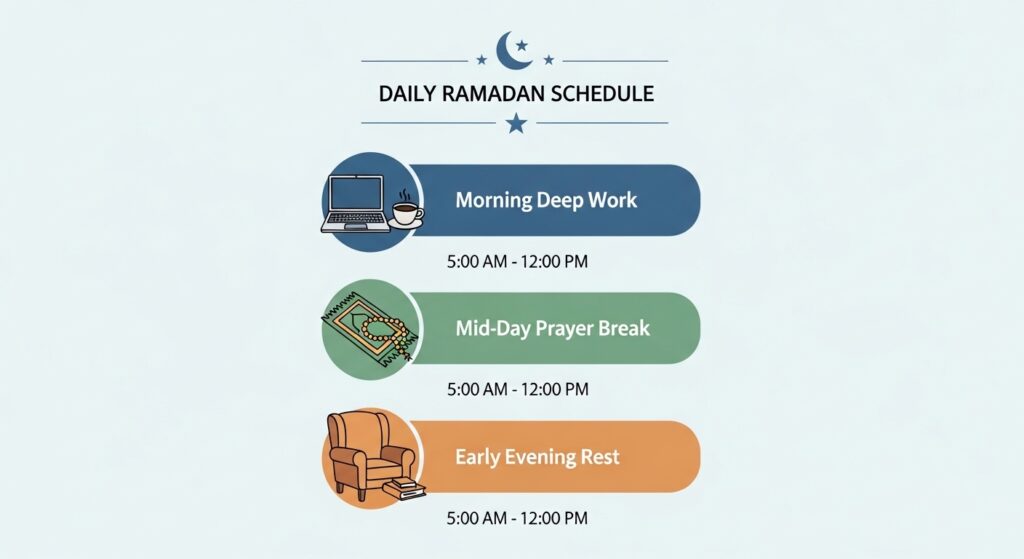
Daily Ramadan Schedule
5. Nutrition for 2026: Suhoor and Iftar
Ditch the heavy, fried foods that cause “Iftar comas.” Focus on slow-release energy:
-
Modern Suhoor: Try overnight oats with Greek yoghurt, chia seeds, and berries. Add half an avocado for healthy fats that keep you full until sunset.
-
Sunnah Iftar: Break your fast with three dates and room-temperature water. Follow this with a “Hydration Salad” (cucumber and greens) and grilled protein like chicken or fish.
Ramadan Mubarak to our global community!
6 . Historical and Religious Context of Ramadan Fasting
- Commemoration: Muslims believe the Quran’s first verses were revealed to Prophet Muhammad (ﷺ) during Ramadan. Fasting honours this momentous event and reaffirms commitment to Islamic teachings.
- Second Pillar of Islam: Fasting is the second pillar of Islam’s Five Pillars, alongside faith, prayer, charity, and pilgrimage. These practices form the core of Muslim life, guiding believers toward a deeper connection with God (Allah).
7. Month of Revelation: Honouring the Quran’s Descent
- Terminology: While Ramadan is associated with the Quran’s revelation, “Descent” isn’t a commonly used term in this context. Muslims often refer to the “first revelation” or “beginning of Quranic revelation.”
8 . From the Quran
- Surah Al-Baqarah, 2:183: “O you who have believed, decreed upon you is fasting as it was decreed upon those before you that you may become righteous.” (This verse establishes the obligation of fasting during Ramadan for all believers.)
9 . From the Ahadith
- Prophet Muhammad (ﷺ) said: “Allah (SWT) says: ‘Every good deed of Adam’s son is for him except fasting; it is for Me and I shall reward for it.’ Verily, the smell of the mouth of a fasting person is better to Allah than the smell of musk.” (Sahih Bukhari) (This Hadith emphasises the special status of fasting and the immense reward promised by Allah (SWT) for those who observe it sincerely.)
- Prophet Muhammad (ﷺ) said: “There are two joys for the fasting person: one at the time of breaking his fast, and the other at the time of meeting his Lord. Allah (SWT) “(Sahih Bukhari) (This Hadith highlights the happiness associated with Ramadan, both in this life and the hereafter.)
- Prophet Muhammad (ﷺ) said: “رمضان (Ramadan) has come to you a blessed month, in which Allah (SWT) covers you with His favour and pours His mercy upon you, and forgives your faults and accepts your repentance, so strive for excellence in the worship of your Lord. Whoever draws near to Allah (SWT) during this month with a single good deed will receive the reward of a wajib (obligatory) deed performed at other times, and whoever performs an obligatory deed will receive the reward of seventy such deeds performed at other times.” (Ibn Majah) (This Hadith motivates Muslims to make the most of Ramadan by increasing their good deeds.)
- Prophet Muhammad (ﷺ) said: “Whoever fasts during Ramadan with faith and seeking reward from Allah, all his previous sins will be forgiven.” (Sahih Bukhari) (Highlights the spiritual significance of Ramadan as a time for forgiveness and renewal.)
10 . Embracing the Spiritual Significance of Ramadan Fasting
Embracing the Spiritual Significance of Ramadan Fasting explores how the act of fasting transcends physical limitations. Here’s a breakdown:
11. Cultivating Taqwa: Deepening God-Consciousness
Ramadan fasting serves as a potent catalyst for cultivating taqwa, an Arabic term often translated as God-consciousness. It signifies a heightened awareness of Allah’s presence in every aspect of life. This section will delve into how Ramadan fosters a deeper sense of taqwa:
- Detachment from Worldly Desires: By abstaining from food and drink, Muslims experience a sense of detachment from material desires. This temporary deprivation allows them to focus on their spiritual connection with Allah, unburdened by worldly preoccupations.
- Mindful Actions and Increased Self-Control: Fasting during Ramadan demands constant awareness of one’s actions. Muslims strive to avoid not just consuming food and drink, but also negative thoughts, gossip, and harmful behaviours. This heightened self-control translates into a more mindful and God-conscious approach to daily life after Ramadan.
- Gratitude and Appreciation: The act of breaking the fast each evening, a joyous occasion called Iftar, serves as a powerful reminder of Allah’s blessings. This daily experience cultivates a profound sense of gratitude and appreciation for the simple joys in life, further strengthening the connection with the Divine.
Gratitude and Appreciations
Through these experiences, Ramadan becomes a training ground for cultivating taqwa. The lessons learned and the spiritual connection established during this holy month translate into a more mindful and God-conscious approach to life throughout the year.
12 . Fostering Empathy: Sharing the Experience of Hunger
Here’s a concise explanation of Fostering Empathy: Sharing the Experience of Hunger:
- Understanding Hunger’s Impact: Fasting allows Muslims to experience hunger firsthand, fostering a deeper understanding of the challenges faced by those who are less fortunate and struggle with food insecurity.
- Heightened Compassion and Generosity: This newfound empathy motivates Muslims to increase acts of charity (zakat) during Ramadan. They become more inclined to donate food and support initiatives that address hunger within their communities.
- Building Bridges and Community Cohesion: By sharing the experience of hunger, Muslims develop a sense of solidarity with those in need. This fosters a more compassionate and supportive community environment.
- Amplifying Gratitude: Appreciating Blessings: Ramadan serves as a powerful catalyst for amplifying gratitude and fostering a deeper appreciation for life’s blessings. Here’s a breakdown of how this occurs:
- Breaking the Fast: A Daily Reminder: The daily ritual of breaking the fast, known as Iftar, is a joyous occasion marked by shared meals with family and community. This act of coming together after a period of abstinence serves as a potent reminder of Allah’s provision and the simple joys of life, such as good health, food, and loved ones.
Through these experiences, Ramadan cultivates a lasting sense of gratitude that extends beyond the holy month. Muslims emerge with a heightened appreciation for life’s blessings and a stronger commitment to sharing their good fortune with others.
13 . A Mind-Body Connection: Sharper Focus and Clarity
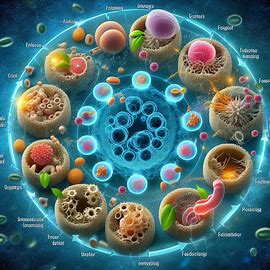
The benefits of Ramadan fasting extend beyond the physical realm, potentially influencing cognitive function and mental clarity. Here’s a glimpse into this mind-body connection:
- Reduced Cognitive Load: By abstaining from food and drink, the body redirects energy away from digestion towards other functions, potentially including cognitive processes. This reduced “digestive burden” may lead to improved focus and sharper mental clarity.
- Enhanced Brain Function: Some studies suggest that fasting may stimulate the production of brain-derived neurotrophic factor (BDNF), a protein crucial for neuronal growth and repair. Increased BDNF levels can potentially enhance memory, learning, and overall cognitive function.
- Improved Mental Discipline: The act of fasting during Ramadan demands a high degree of self-control and discipline. This mental fortitude can translate into improved focus and concentration throughout the day, even during times of temptation or distraction.
It’s important to note that research on the cognitive benefits of Ramadan fasting is still ongoing. However, the potential for enhanced mental clarity and focus adds another layer to the multifaceted experience of this holy month.
Frequently Asked Questions (FAQs) About Ramadan Fasting
Q 1. Do Muslims have to give up everything during Ramadan?
A. While Muslims abstain from food and drink during daylight hours, they can still engage in most daily activities. Smoking, sexual activity, and negative behaviours like gossip or anger are also discouraged during Ramadan.
Q 2. Can I eat with my Muslim friends during Ramadan?
A. It is completely acceptable to eat and drink around your Muslim friends during their fasting hours. However, they may politely decline offers out of respect for their fast. If you’d like to share a meal, consider inviting them to break their fast with you at Iftar, the evening meal.
Q 3. How can I be supportive of my Muslim friends during Ramadan?
A.. Simple gestures of understanding and respect go a long way. Avoid offering them food or drink during fasting hours. You can offer words of encouragement or invite them to Iftar meals after sunset.
Q 4. Is it okay to wish someone a happy Ramadan?
A . Absolutely! Wishing someone a “Ramadan Mubarak” (Blessed Ramadan) is a thoughtful gesture that will be appreciated.
Q 5. Is Ramadan the same as Eid al-Fitr?
A. Ramadan is the month of fasting, while Eid al-Fitr is the celebratory feast that marks the end of Ramadan. It’s a joyous occasion filled with feasting, gift-giving, and family gatherings.
Q 6. Who is exempt from fasting?
Children, the elderly, the sick, travellers, and women who are pregnant or menstruating. You may provide Fidya (feeding the needy) if you cannot fast.
Q 7. Does brushing teeth break the fast?
No, as long as you do not swallow the water or toothpaste.
Q 8. Can I exercise?
Yes! The best time is 30–60 minutes before Iftar (light cardio) or 2 hours after Iftar (strength training).
Final Thoughts: A Month of Character
Ramadan 2026 is an opportunity to prove that you can be spiritually grounded and professionally excellent. By combining ancient wisdom with modern science, you can make this your most transformative year yet.
It goes beyond just abstaining from food and drink, fostering spiritual growth, physical well-being, and a deeper sense of community. The lessons learned and experiences shared during Ramadan can have a lasting impact, enriching lives beyond the holy month itself.
ibtimes.co.in/eid-mubarak-best-quotes-wishes-images-sms-quran-verses-share-eid-al-fitr-798899


Very nice 👍
Thanks