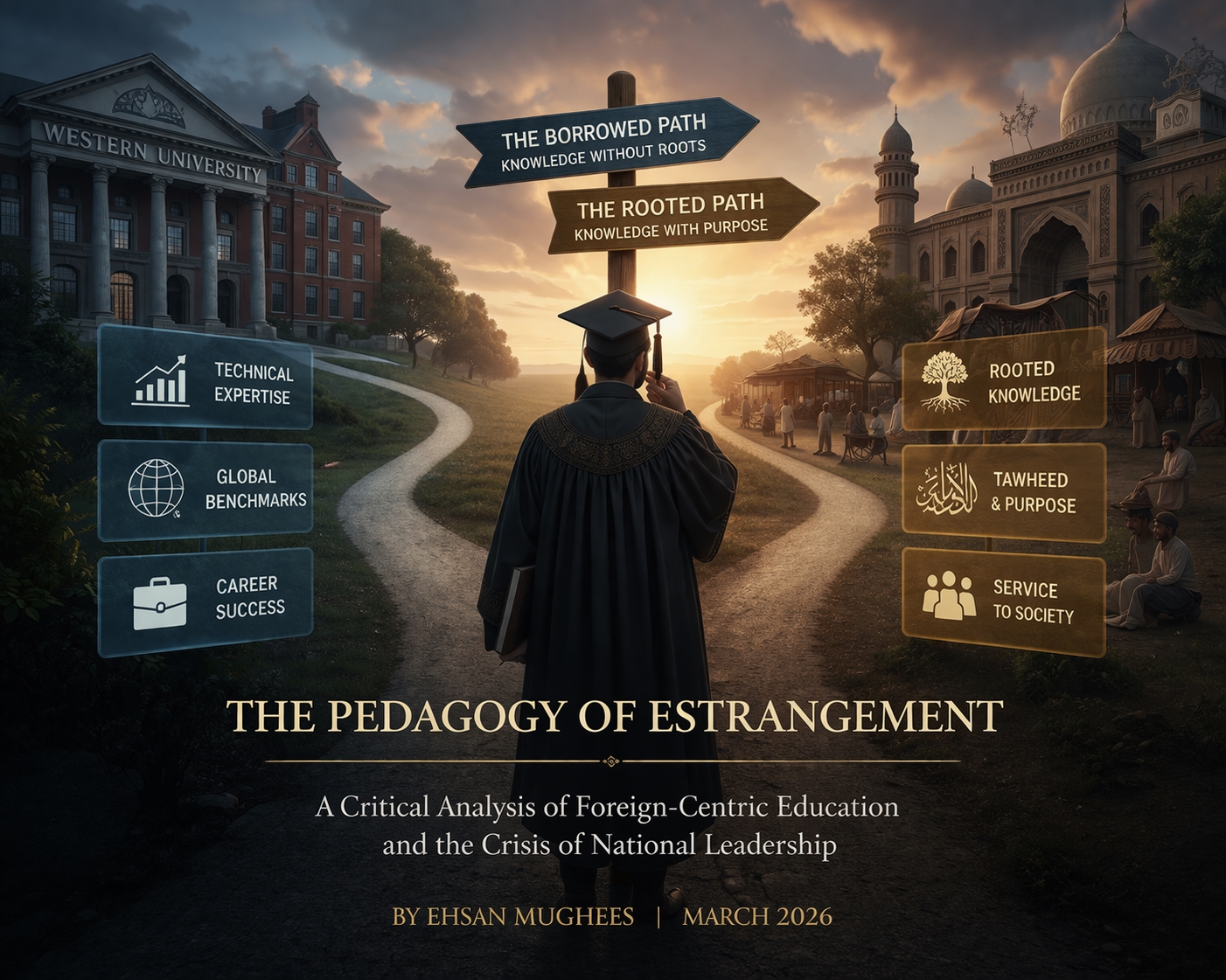

The Pedagogy of Estrangement: A Critical Analysis of Foreign-Centric Education and the Crisis of National Leadership
Author: Ehsan Mughees
Date: March 2026
Theme
In recent years, a noticeable pattern has emerged in many post-colonial societies: foreign-educated individuals, despite their technical competence, often return estranged from the social, cultural, and spiritual realities of their own people. Leadership practices increasingly prioritize external models, global benchmarks, and procedural efficiency over local context, moral purpose, and societal belonging.
This disconnect stems from deeper structural and epistemological issues, including the separation of knowledge from its ethical foundations, the erosion of indigenous educational paradigms rooted in Tarbiyah, and the uncritical adoption of foreign pedagogical frameworks. Despite sustained investment in foreign education, this misalignment has resulted in institutional inefficiencies, policy dissonance, and a gradual weakening of civilizational confidence.
Aim
The aim of this study is to critically examine the phenomenon of foreign-centric education in post-colonial societies, identify its epistemological and structural misalignments, and propose a framework of Rooted Globalism that integrates global knowledge with local realities and moral purpose, thereby fostering leadership that is competent, connected, and socially responsible.
Scope of the Study
This study focuses on the impact of foreign-centric education on leadership formation in post-colonial societies, emphasizing ideological, institutional, and cultural implications. It examines the shift from Tarbiyah to technicality, the secularization of knowledge, and the resulting estrangement between leadership and societal realities.
The analysis is primarily conceptual, drawing on civilizational, philosophical, and Islamic perspectives. It does not provide a quantitative assessment of educational outcomes or statistical evaluation of institutions. The study aims to explore patterns of intellectual and leadership misalignment and offer solutions to realign knowledge with purpose and societal needs.
Abstract
This study explores the phenomenon of foreign-centric education in post-colonial societies, focusing on the growing disconnect between technical competence and societal rootedness among foreign-educated individuals. It argues that the issue is not intellectual deficiency but a deeper problem of epistemological misalignment, where knowledge acquired in isolation from indigenous context and moral purpose results in what may be termed “rootless knowledge.”
Through an analysis of educational transformation, the shift from Tarbiyah to technicality, and the secularization of knowledge, the study demonstrates how this misalignment produces leadership estrangement, policy dissonance, and institutional inefficiencies. It further highlights the resulting erosion of civilizational confidence and societal alignment.
The study proposes a framework of Rooted Globalism as a corrective approach, integrating global knowledge with local realities and a value-driven worldview, ensuring that education serves as a tool of societal connection rather than alienation.
- Introduction — The Paradox of the Borrowed Path
A quiet paradox marks the modern national experience: the more a society invests in educating its brightest minds abroad, the less “at home” many of them appear upon return. Foreign degrees are celebrated as indicators of leadership potential, yet decades of such reliance have failed to produce expected societal transformation.
The problem is not lack of intelligence but misalignment. Education that distances individuals from the lived realities of their own people defeats its fundamental purpose: service. Graduates return fluent in foreign systems but uncertain in applying solutions locally—articulate, confident, and technically skilled, yet subtly alienated from the society they are meant to lead.
- From Tarbiyah to Technicality — The Evolution of the Educational Crisis
Historically, education in Muslim civilization emphasized Tarbiyah—a holistic formation of character intertwined with knowledge. Learning was transformational: scholars were morally anchored, socially embedded, and accountable to the Creator and creation.
Modern post-colonial education has gradually shifted from this mission to mechanical adoption of foreign pedagogies:
- Character → Credential
- Belonging → Benchmarking
- Wisdom → Vocabulary
Students master global policy, economics, and governance languages but lose grounding in their society’s social and cultural texture. This produces displacement: leaders who understand systems abroad better than at home.
III. The Secularization of Knowledge and the Loss of a Unifying Principle
A central cause of estrangement is the separation of knowledge from its ethical and metaphysical roots. In the classical Islamic worldview, Tawheed provided the unifying principle across all knowledge. Science, governance, and social conduct were interlinked within a coherent moral universe.

Modern secular education treats knowledge as value-neutral. Leadership formed in such a system evaluates reform via external performance indicators rather than moral purpose. Policies are judged by global rankings rather than human well-being. This produces leaders without an ethical compass rooted in their civilization, not necessarily immoral ones.
- The HRD Mismatch — Humans as “Resources” vs “Servants”
Contemporary Human Resource Development frameworks, derived largely from corporate models, treat humans as resources—inputs for productivity. By contrast, an indigenous civilizational perspective sees humans as servants of God and society, entrusted with responsibility rather than efficiency.
Foreign-trained technocrats often adopt a managerial mindset, viewing culture as a constraint and tradition as inefficiency. This creates the Validation Trap: local wisdom is dismissed unless externally endorsed. The subtle tragedy is that societies begin to doubt themselves through the eyes of their own educated class.
- The National Cost of Intellectual Alienation
This estrangement produces tangible consequences:
- Policies copied from foreign templates without adaptation
- Educational reforms prioritizing international standards over character
- Bureaucratic culture focused on procedure rather than people
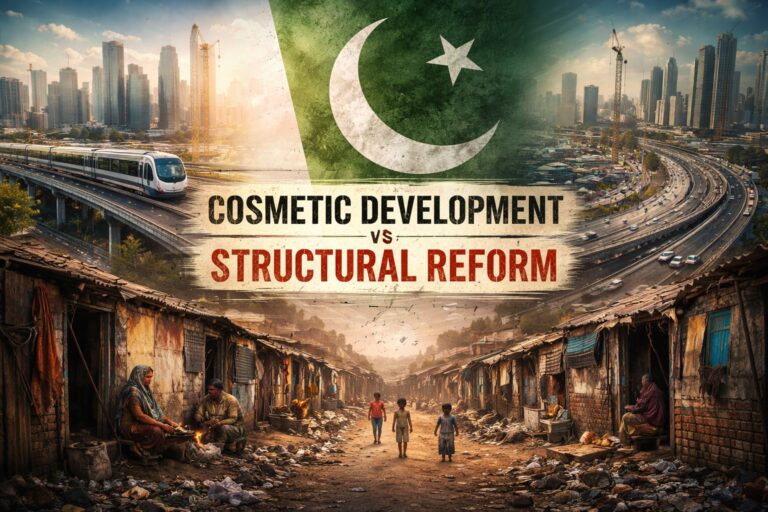
- Development measured by infrastructure rather than human well-being
Result: institutional paralysis—activity without authentic progress. Nations rise not through imitation, but through authentic expression of their own ideological and cultural identity.
- Toward Rooted Globalism — A Corrective Framework
The solution is not rejection of foreign knowledge. Knowledge is universal; the problem is assimilation.
The proposed framework of Rooted Globalism rests on three principles:
- Contextual Translation – Filter external expertise through local socio-cultural and spiritual realities.
- Epistemological Sovereignty – Reclaim confidence to define “best practices” from indigenous successes and wisdom.
- Restoration of Purpose – Education must produce committed servants of society, not disconnected technocrats.
VII. Conclusion — From Rootless Knowledge to Grounded Wisdom
The leadership crisis in post-colonial societies is pedagogical, not merely political or economic. Education that produces competence without belonging, knowledge without rootedness, and reform without moral purpose fosters estrangement rather than empowerment.
The task ahead is to re-anchor education in local realities and moral frameworks, ensuring that foreign knowledge becomes a tool for renewal, not alienation. Until this occurs, societies will continue mistaking motion for progress and imitation for reform.