
National Concept Paper
Developing Inland Water Transport (IWT) as Pakistan’s Strategic Logistics Backbone
1. Executive Summary
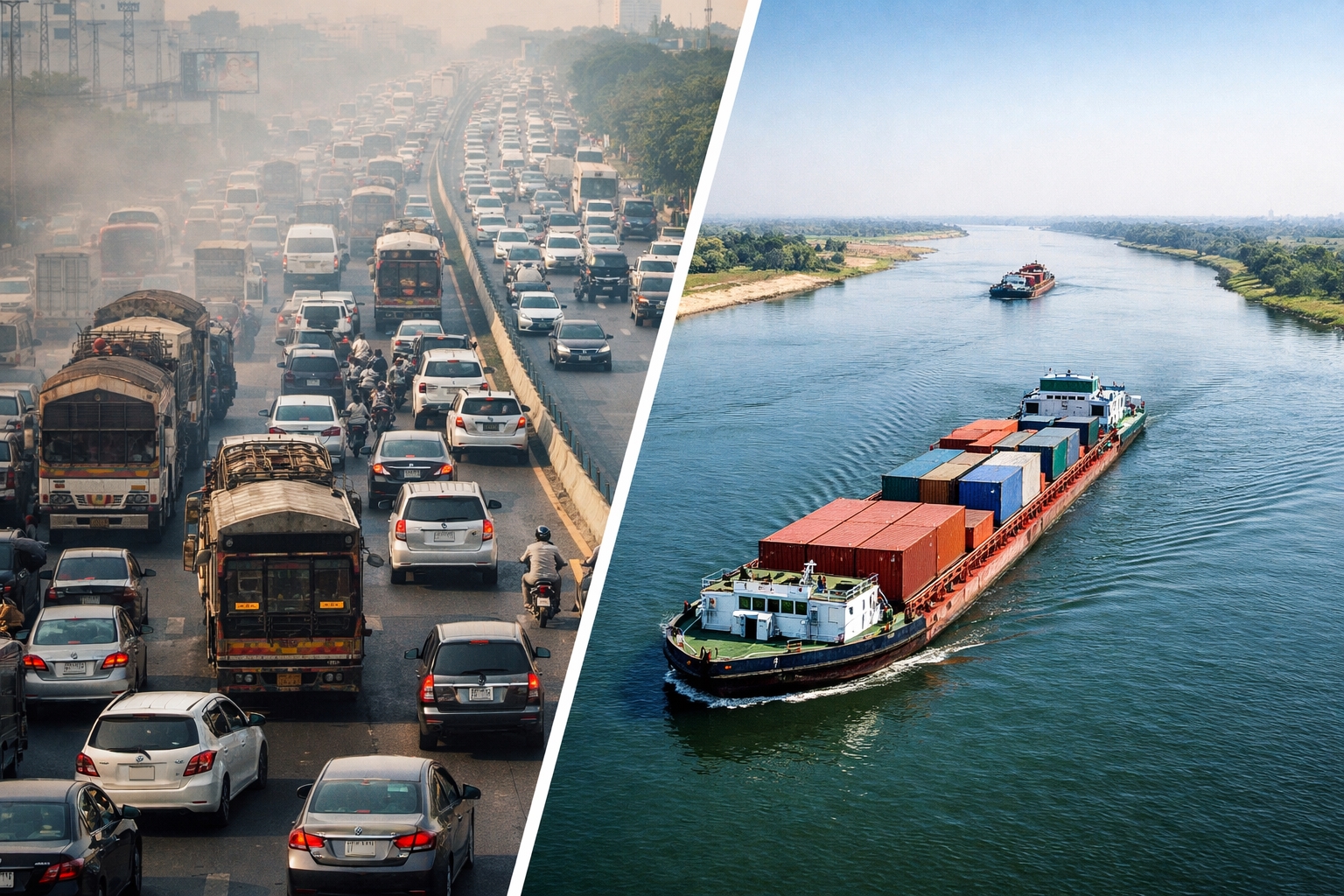
Pakistan’s inland logistics system is overwhelmingly dependent on road transport. While this model may have sufficed in earlier decades, it has now become economically inefficient, environmentally damaging, and strategically unsustainable. Excessive reliance on roads has led to high fuel consumption, accelerated deterioration of highways, chronic congestion, rising accident rates, and persistently high freight costs that undermine national competitiveness.
Rail transport, despite being inherently more suitable for bulk and long-distance freight, remains significantly underutilized. Structural weaknesses, aging infrastructure, governance challenges, and limited capacity expansion have prevented railways from assuming their natural role within the national logistics ecosystem. Air transport, meanwhile, is confined to niche, high-value cargo and cannot serve as a solution for mass inland freight movement.
Against this backdrop, Inland Water Transport (IWT) presents a largely ignored yet strategically vital opportunity. Pakistan possesses one of the world’s most extensive river systems in the form of the Indus and its associated canals, yet inland navigation remains virtually absent from national planning.
This concept paper proposes the development of a National Inland Water Transport System, centered on the Indus River system, as a long-term, cost-effective, and sustainable logistics backbone. It outlines the strategic rationale for IWT, proposes a conceptual and institutional framework, and presents a phased pathway for moving from concept to implementation.
2. Strategic Context and Problem Statement
2.1 Over-Reliance on Road Transport
Pakistan’s freight movement is overwhelmingly road-based, with more than 90 percent of inland cargo transported by trucks. This imbalance has imposed heavy economic and social costs. Logistics expenses are estimated at 18–20 percent of GDP—far higher than in comparable economies—making Pakistani goods less competitive domestically and internationally.
Heavy axle loads have accelerated the degradation of highways and arterial roads, forcing the state into a perpetual and costly cycle of repairs and rehabilitation. Congestion in and around major cities has become routine, while accident rates and environmental pollution continue to rise. In effect, roads are being used far beyond their optimal and intended capacity.
2.2 Limitations of Rail and Air Transport
Railways, though more efficient for bulk freight, have not fulfilled their potential role. Aging tracks, limited rolling stock, operational inefficiencies, and governance challenges have kept rail freight’s share well below what Pakistan’s geography and demand would otherwise justify.
Air cargo, while fast and reliable, is economically viable only for high-value, low-volume goods. It cannot address the country’s growing demand for the movement of bulk commodities, agricultural produce, construction materials, fuel, and containers.
Individually or collectively, road, rail, and air transport—under their current structures—are insufficient to meet Pakistan’s future logistics requirements.
2.3 Untapped Potential of the Indus River System
Running from the northern regions to the Arabian Sea, the Indus River forms a natural north–south axis that aligns closely with Pakistan’s population centers, agricultural heartlands, industrial zones, and ports. Historically, riverine transport played a vital role in regional trade and mobility.
Despite this inherent advantage, the Indus system remains almost entirely absent from modern logistics planning, representing a significant missed opportunity.
3. Why Inland Water Transport (IWT)?
3.1 Economic Efficiency
Globally, inland water transport is the most cost-efficient mode of freight movement when measured in cost per ton-kilometer. It is highly fuel-efficient, less vulnerable to energy price shocks, and benefits from infrastructure with long service life and relatively low maintenance requirements.
For a country facing chronic balance-of-payments pressures and rising fuel import bills, these economic advantages are particularly relevant.
3.2 Strategic and National Benefits
A functional IWT system would significantly reduce pressure on overburdened road and rail networks. By providing an alternative backbone for bulk freight, it would enhance supply chain resilience and reduce systemic vulnerabilities.
IWT is especially suited for transporting agricultural produce, construction materials, fertilizers, fuel, and containers—commodities that form the backbone of Pakistan’s real economy.
3.3 Environmental and Climate Advantages
Inland water transport produces substantially lower carbon emissions compared to road transport. When properly designed, it can also support integrated river management, contribute to sediment control, and complement flood moderation strategies rather than conflict with them.
4. Conceptual Framework for Pakistan’s IWT System
4.1 Core Concept
The proposed system envisions the development of a perennial, navigable inland water transport corridor along the Indus River system through a combination of:
- Controlled navigational stretches of the river
- Engineered navigation channels running parallel to river flows where required
- Integration with existing barrages, canals, ports, and hydraulic infrastructure
This approach emphasizes adaptability rather than rigid, one-size-fits-all engineering.
4.2 Door-to-Door Logistics Integration
Inland Water Transport is not proposed as a standalone replacement for existing modes, but as a core component of an integrated, multimodal logistics system:
- IWT for long-haul, bulk movement
- Rail as a parallel and backup long-distance mode
- Road transport for last-mile connectivity
- Seaports and dry ports as multimodal logistics nodes
5. Institutional and Governance Framework
5.1 National Inland Water Transport Authority (NIWTA)
Successful implementation requires institutional clarity. This paper proposes the establishment of a National Inland Water Transport Authority (NIWTA) as a federal statutory body responsible for planning, regulation, and coordination.
NIWTA would work closely with provincial governments, IRSA, WAPDA, port authorities, and the private sector to ensure alignment between navigation, irrigation, and environmental priorities.
5.2 Legal and Regulatory Reforms
Key reforms would include formal recognition of navigation rights alongside irrigation rights, robust environmental safeguards, and a clear public–private partnership (PPP) framework to attract private investment and expertise.
6. Phased Implementation Strategy
Phase I: Concept Validation and Feasibility
This phase would focus on hydrological and sediment studies, identification of priority corridors, and comprehensive economic and environmental assessments.
Phase II: Pilot Corridor Development
One or two pilot navigation corridors—such as a Punjab–Sindh stretch—would be developed, supported by basic terminals and a modest vessel fleet. Operational performance would be closely monitored and refined.
Phase III: Scaling and Integration
Successful pilots would be expanded to additional river stretches, fully integrated with national logistics and port systems, and increasingly opened to private sector participation.
7. Financial and Economic Model
While initial capital investment will be substantial, operating and maintenance costs are relatively low. Over time, savings from reduced road maintenance, lower fuel imports, and improved logistics efficiency are expected to outweigh initial expenditures.
PPP arrangements and multilateral financing provide viable pathways for funding.
8. Risks and Mitigation
- Seasonal flow variability: Managed through perennial channels and controlled navigation
- Institutional fragmentation: Addressed via a central authority with provincial coordination
- Environmental concerns: Mitigated through strong EIAs and adaptive design
- Political discontinuity: Reduced through legal backing and phased implementation
9. Strategic Outcomes
A national IWT system would lower logistics costs, enhance agricultural and industrial competitiveness, improve infrastructure sustainability, and strengthen Pakistan’s climate resilience.
10. Conclusion
Pakistan stands at a critical logistics crossroads. Continuing with a road-dominated transport model is economically and environmentally unsustainable, while exclusive reliance on rail and air is insufficient to meet future demand.
Inland Water Transport, anchored in the Indus River system, offers a strategic, cost-effective, and nationally aligned solution. With careful planning, institutional reform, and phased implementation, it can evolve into a foundational pillar of Pakistan’s long-term logistics architecture.