
Nuclear War Devastation Explained: What Happens If Nuclear Weapons Are Used? The Reality We Ignore
Nuclear war devastation explained, the reality we ignore, in today’s political climate, references to nuclear weapons are often made casually, sometimes even as displays of strength. Statements by figures like Donald Trump and other global leaders about overwhelming force or total destruction circulate widely.
https://mrpo.pk/us-war-without-declaration/
But what does “wiping out a civilisation” actually mean? Would it end in seconds, or echo across generations?
This article Nuclear war devastation explained, the reality we ignore, breaks down the reality in simple, human terms, because the truth is far more devastating than most people imagine.
The facts: 10 things you should know about nuclear weapons
1️⃣ The consequences of nuclear weapons are catastrophic.
Nuclear weapons are not like other weapons; they are designed to mass murder civilians, wipe out entire cities and cause irreversible harm to the environment. First responders like the Red Cross have warned that they would have no capacity to deal with a nuclear detonation, and if the conflict were to escalate into nuclear war, recent studies show over 5 billion people could die from the famine that follows. There are a lot of resources to learn about the unacceptable harm nuclear weapons cause. You can get started here or by watching this powerful explainer by Kurzgesagt and the Red Cross
2️⃣ There are no safe hands for nuclear weapons; all 9 nuclear armed states put the entire world at risk.
There are 9 nuclear armed states: Russia, United States, China, France, United Kingdom, Pakistan, India, Israel, North Korea (by size of their nuclear arsenals). Between them they have almost 13000 nuclear warheads. While this is a much smaller number than there were during the Cold War, many are more destructive and nuclear armed states are all planning to build new and possibly more usable weapons. The reality is that we will not be safe until all nuclear weapons are completely eliminated for good.
The Only Time Nuclear Weapons Were Used in War
Hiroshima and Nagasaki: When the World Changed Forever
In August 1945, during World War II, the United States dropped two atomic bombs on Japan:
-
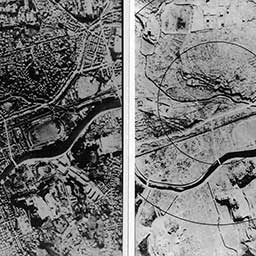
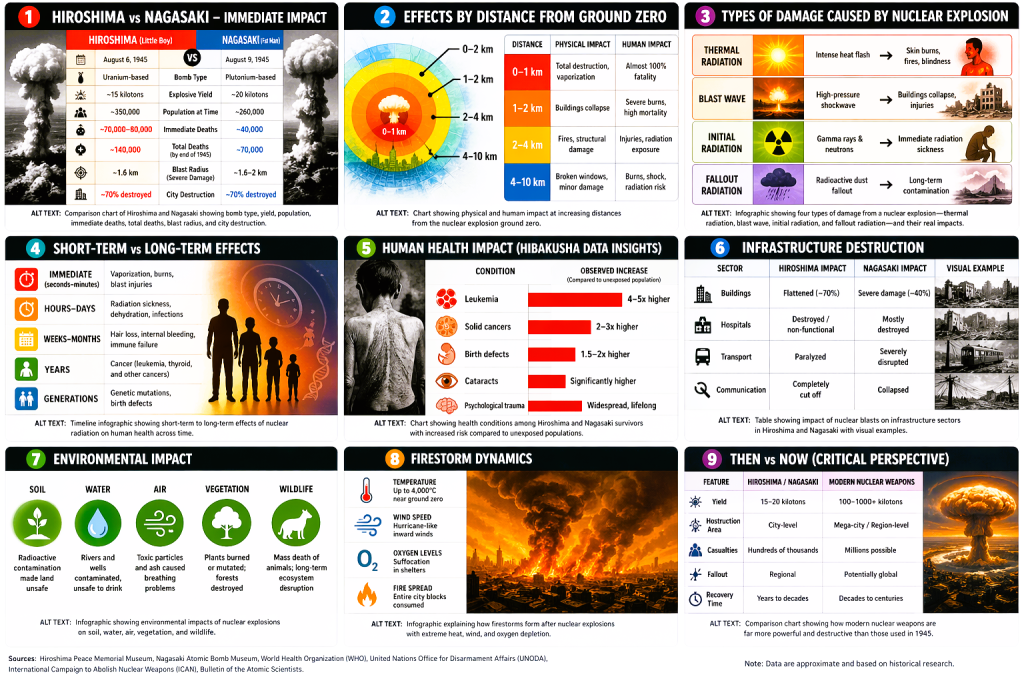
The Only Time Nuclear Weapons Were Used in War. Nagasaki, Japan. Left before and right after Hiroshima (Little Boy) Uranium bomb (~15 kilotons)
- Nagasaki (Fat Man) Plutonium bomb (~20 kilotons)
The immediate result: over 200,000 people dead, many within seconds.
| Category | Hiroshima (Little Boy) | Nagasaki (Fat Man) |
| —————————– | ———————- | —————— |
| Date | August 6, 1945 | August 9, 1945 |
| Bomb Type | Uranium-based | Plutonium-based |
| Explosive Yield | ~15 kilotons | ~20 kilotons |
| Population at Time | ~350,000 | ~260,000 |
| Immediate Deaths | ~70,000–80,000 | ~40,000 |
| Total Deaths (by end of 1945) | ~140,000 | ~70,000 |
| Blast Radius (Severe Damage) | ~1.6 km | ~1.6–2 km |
| City Destruction | ~70% destroyed | ~40% destroyed |
Why Were the Bombs Dropped?
- To force Japan’s surrender quickly
- To avoid prolonged war casualties
- To demonstrate power in a shifting global order
Recent nuclear-related rhetoric linked to President Donald Trump has added fuel to an already volatile cycle of threats and counter-threats, raising the overall level of risk.
Historians debate whether it was necessary or a warning to the Soviet Union.
What Happens in the First Seconds?
- Blinding Flash: Hotter than the sun, causing instant burns and blindness
- Shockwave: Buildings collapse, bodies thrown through the air
- Radiation Burst: Invisible, lethal exposure within seconds
Most victims near ground zero never even hear the explosion.
Short-Term Effects (Hours to Weeks)
- Severe burns and radiation sickness
- Hospitals destroyed, no medical help
- Firestorms are consuming entire cities
- Radioactive fallout contaminating air and water
Long-Term Effects (Years to Generations)
- Massive increase in cancer rates
- Birth defects and genetic mutations
- Psychological trauma among survivors
- Contaminated land unusable for decades
Modern Nuclear Weapons: Far More Powerful
The bombs used in 1945 were small compared to today’s arsenals.
- Hiroshima: 15 kilotons
- Modern weapons: hundreds of kilotons to megatons
- Largest test: Tsar Bomba (50 megatons)
Today, a single weapon can destroy an entire metropolitan region.
Tactical vs Strategic Nuclear Weapons
- Tactical: Smaller, battlefield use
- Strategic: Large-scale destruction of cities and infrastructure
Reality: Once one nuclear weapon is used, escalation becomes extremely difficult to control.
Blast Radius: What Happens Around the Impact
- 0–1 km: Total destruction, no survival
- 1–5 km: Severe damage, high fatalities
- 5–10 km: Injuries and infrastructure collapse
- 10–100+ km: Fallout contamination
Beyond Borders: How Neighbouring Countries Would Suffer
What if your country is never targeted, but still ends up poisoned, starving, and destabilised?
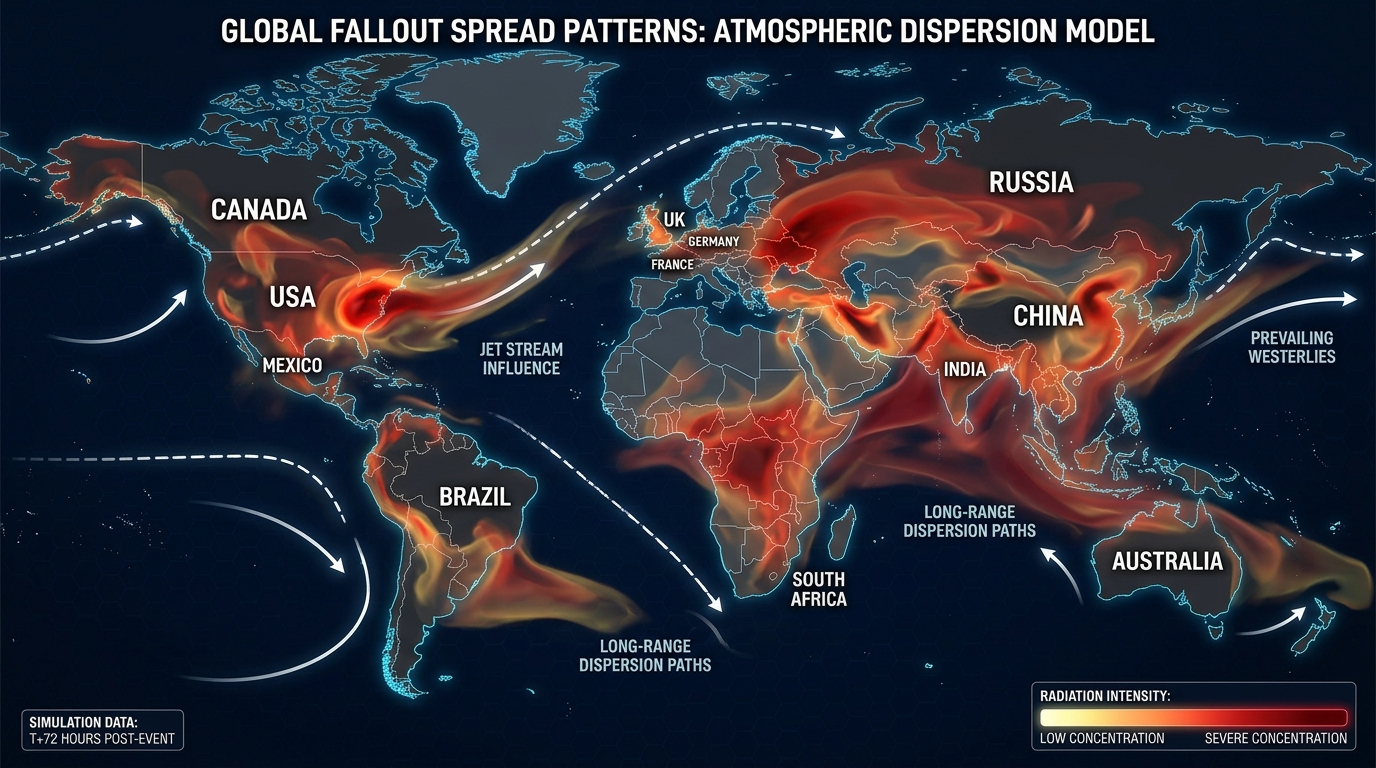
Nuclear weapons don’t recognise borders, politics, or neutrality. The blast may be local, but the consequences spread silently, carried by wind, water, trade, and human movement. In tightly connected regions like South Asia and the Middle East, even a “limited” nuclear exchange can trigger a chain reaction far beyond the battlefield.
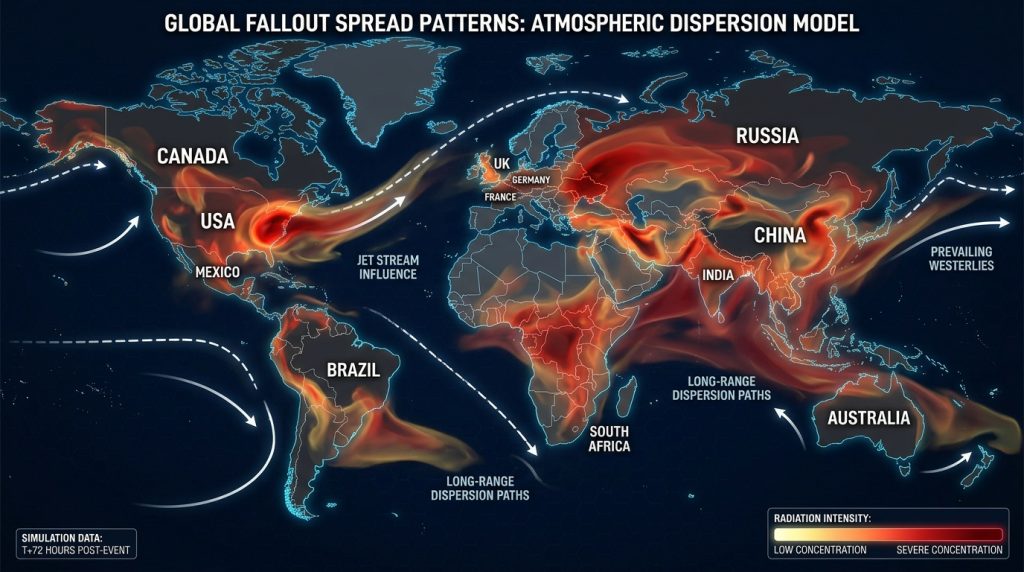
1. Fallout Drift: The Invisible Enemy
After a nuclear explosion, the most dangerous phase isn’t always the blast; it’s what comes after.
Radioactive particles rise into the atmosphere and travel with prevailing winds. Within hours, these particles begin to settle, sometimes hundreds or even thousands of kilometres away.
How it spreads
- High-altitude winds transport fine radioactive dust
- Weather systems carry contamination across borders
- Rain turns fallout into “black rain,” depositing radiation onto land and water
Regional impact example
A detonation near the India-Pakistan border could expose:
- Afghanistan within days
- Western regions of China
- Large parts of Iran
Human reality
People far from the blast zone may:
- Breathe contaminated air
- Drink polluted water
- Eat food grown in radioactive soil
They may never see the explosion, but its effects enter their bodies anyway.
2. Water Systems: Contamination That Flows Across Nations
Water does not stop at borders, and neither does radiation.
Critical river systems at risk
- Indus River
- Ganges River
These rivers sustain hundreds of millions of people.
What happens after fallout
- Radioactive particles settle into rivers and reservoirs
- Contamination travels downstream across multiple countries
- Irrigation systems spread radiation into crops
Consequences
- Drinking water becomes unsafe
- Agricultural land becomes contaminated
- Fisheries collapse
Key question:
How do you contain radiation in a river that feeds entire civilisations?
3. Agriculture Collapse: When Food Becomes Toxic
Food systems are extremely vulnerable to nuclear fallout.
Immediate effects
- Crops absorb radioactive particles from soil and air
- Leaves and grains become unsafe for consumption
Long-term damage
- Soil fertility declines due to contamination
- Radioactive isotopes remain for years (or decades)
- Farming becomes impossible in affected zones
Regional impact
- The fertile plains of Punjab (Pakistan, India), often called the breadbasket of South Asia, could be rendered unusable
- Food shortages ripple into neighbouring countries
Livestock impact
- Animals graze on contaminated grass
- Milk and meat become radioactive
This is not just crop failure, it’s a food system collapse.
4. Oil & Gas Shock: Energy Crisis Without Direct Attack
Even without a direct nuclear strike, energy systems are highly vulnerable.
Regional dependencies
Countries like:
- China
- India
depend heavily on imported energy, much of it from the Gulf.
Chain reaction
- Conflict disrupts transport routes
- Insurance costs for shipping skyrocket
- Ports shut down due to risk
Critical chokepoint
- Strait of Hormuz
Nearly 20% of the world’s oil flows through this narrow passage.
Global consequences
- Oil prices surge within days
- Fuel shortages spread
- Industries slow down or shut down
A regional nuclear conflict can trigger a global energy shock.
5. Gulf Countries: A Silent Secondary Crisis
At first glance, Gulf nations may seem distant from South Asia, but in reality, they are deeply connected.
Countries at risk
- Saudi Arabia
- United Arab Emirates
- Qatar
- Kuwait
- Oman
A. Water Crisis (Desalination Vulnerability)
Unlike many countries, Gulf states depend on desalinated seawater.
What could go wrong
- Radioactive particles enter the sea
- Desalination plants pull in contaminated water
Outcome
- Drinking water becomes unsafe
- Rapid shortages emerge within days
Reality: Wealth cannot buy clean water if the source itself is contaminated.
B. Food Insecurity
Most Gulf countries import food.
Disruptions include
- Collapse of South Asian agriculture
- Shipping delays or blockades
- Global price spikes
Result
- Food shortages
- Panic buying
- Dependency on unstable global supply chains
C. Oil Infrastructure Risks
Key energy facilities, highly concentrated and vulnerable, could face:
- Contamination
- Regional military escalation
- Indirect damage through economic disruption
Even limited disruption could shake global markets.
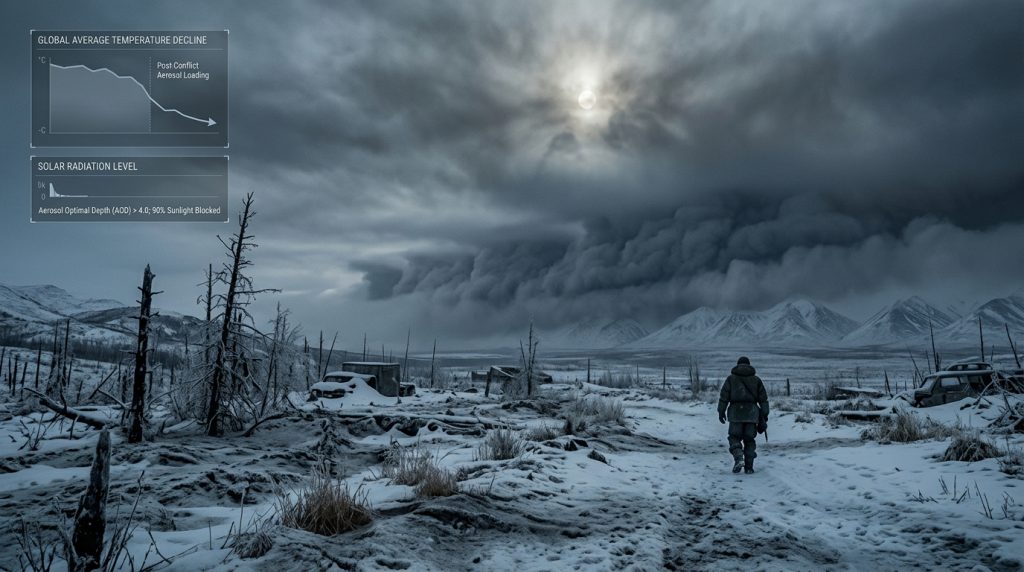
6. Climate Impact: Nuclear Winter Beyond the Battlefield
The effects of nuclear war don’t stop at radiation; they extend into the climate.
What happens
- Massive fires release soot into the atmosphere
- Sunlight is blocked
- Global temperatures drop
Regional consequences
- Disrupted monsoon cycles in South Asia
- Abnormal weather patterns in the Middle East
- Reduced agricultural output globally
This transforms a regional war into a planet-wide crisis.
7. Public Health Crisis Across Borders
Even countries untouched by blasts face a medical emergency.
Exposure pathways
- Air (inhalation of particles)
- Food imports
- Water systems
Health outcomes
- Cancer rates increase
- Birth defects rise
- Long-term genetic damage
System collapse
Healthcare systems, even in stable countries, could be overwhelmed by:
- Refugees
- Chronic illnesses
- Resource shortages
8. Refugee Crisis: Movement on an Unprecedented Scale
Survivors flee contaminated zones in search of safety.
Where do they go?
- Neighbouring countries like Afghanistan and Iran
- Gulf states hosting large South Asian populations
Challenges
- Sudden population surges
- Housing shortages
- Spread of disease
This becomes not just a humanitarian issue, but a regional destabiliser.
9. Economic Shockwaves: Collapse Without Direct Impact
Even countries not physically affected would feel the economic shock.
Immediate effects
- Stock markets plunge
- Trade routes collapse
- Currency instability rises
Long-term consequences
- Recession across Asia and the Middle East
- Reduced remittances impacting millions of families
- Industrial slowdown due to energy shortages
10. Environmental Devastation Beyond Borders
Nature does not recover quickly from nuclear exposure.
Impacts include
- Forest destruction
- River contamination
- Marine ecosystem damage in nearby seas
Long-term reality
- Loss of biodiversity
- Permanent ecological changes
- Collapse of fisheries
Final Reflection: There Are No Bystanders
A nuclear war anywhere in a connected region is not a local event.
It poisons shared rivers, disrupts global food systems, destabilises economies, and alters the climate itself.
Final Question:
If the air you breathe, the water you drink, and the food you eat are all affected, can any country truly remain neutral?
Why People Underestimate Nuclear Risk
- Media normalization
- Political rhetoric
- Lack of awareness of real consequences
The Uncomfortable Truth: Nuclear War Devastation Explained
Nuclear weapons are not just larger bombs. They are civilisation-altering forces.
A single detonation can destroy a city. Multiple detonations can reshape the planet.
If a war poisons your air, water, and food, are you really not part of it?
FAQs
Can a nuclear war be survived?
Some individuals may survive initial blasts, but long-term survival is extremely difficult due to radiation, food shortages, and societal collapse.
How far can radiation travel?
Hundreds to thousands of kilometres, depending on wind and weather patterns.
What is nuclear winter?
A global cooling effect caused by smoke blocking sunlight, leading to crop failure and famine.
Would neighbouring countries be safe?
No. Fallout, economic disruption, and environmental damage cross borders.
How quickly would global effects begin?
Within hours to days, especially in energy markets and regional fallout zones.
Is a “limited nuclear war” possible?
Highly unlikely. Escalation risks make containment extremely difficult.
Purpose of This Article
This article aims to bridge the gap between political rhetoric and scientific reality, helping ordinary people understand the true, far-reaching consequences of nuclear weapons.
Call to Action for World Citizens: Nuclear War Devastation Explained
The future of humanity is not decided only in governments or military rooms; it is shaped by informed citizens everywhere. Nuclear war is preventable, but only if silence is replaced with awareness, and indifference with responsibility.
Stay informed. Question escalation. Support diplomacy over destruction. Hold leaders accountable for choices that affect every life on this planet.
No nation wins in nuclear war; humanity only loses. The responsibility to prevent it belongs to all of us, together.
Disclaimer
This content is for educational and informational purposes only, based on publicly available scientific and historical research.
References:
United Nations Office for Disarmament Affairs (n.d.) Nuclear weapons. Available at: https://disarmament.unoda.org/ (Accessed: 22 April 2026).
United Nations (n.d.) Nuclear weapons overview and humanitarian impact. Available at: https://www.un.org/ (Accessed: 22 April 2026).
International Atomic Energy Agency (n.d.) Radiation protection and nuclear safety. Available at: https://www.iaea.org/ (Accessed: 22 April 2026).
World Health Organization (n.d.) Health consequences of nuclear war. Available at: https://www.who.int/ (Accessed: 22 April 2026).
International Campaign to Abolish Nuclear Weapons (n.d.) Humanitarian impact of nuclear weapons. Available at: https://www.icanw.org/ (Accessed: 22 April 2026).
Physicians for Social Responsibility (n.d.) Nuclear weapons and public health. Available at: https://www.psr.org/ (Accessed: 22 April 2026).
Robock, A. and Toon, O.B. (2022) ‘Nuclear winter revisited: Global food security implications of regional nuclear conflict’, Nature Food. Available at: https://www.nature.com/natfood/ (Accessed: 22 April 2026).
Stockholm International Peace Research Institute (n.d.) Global nuclear arsenals and arms control. Available at: https://www.sipri.org/ (Accessed: 22 April 2026).
International Committee of the Red Cross (n.d.) Nuclear weapons: Humanitarian consequences. Available at: https://www.icrc.org/ (Accessed: 22 April 2026).