
No King in America: The Uprising Against Trump’s Imperial Style Politics
The Tweet That Shook the Republic
No king in America, it began, as many things in the modern political circus do, with a tweet. A meme, entirely satirical, depicting an “airstrike” ordered from the presidential jet against protesters, went viral overnight. No, the skies didn’t roar with missiles. But the idea struck deeper: was the Commander-in-Chief “bombing” dissent, metaphorically, through words, policies, and presidential might? Within hours, the hashtag #NoKing was trending across the United States. The protest wasn’t just against one man; it was against a mindset.
https://mrpo.pk/why-flattery-feels-good-but-does-us-harm/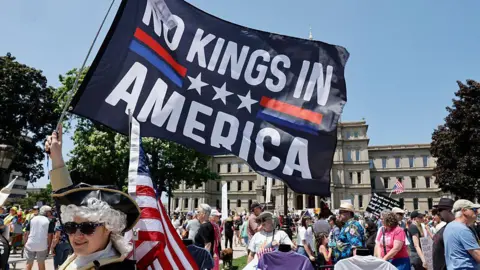
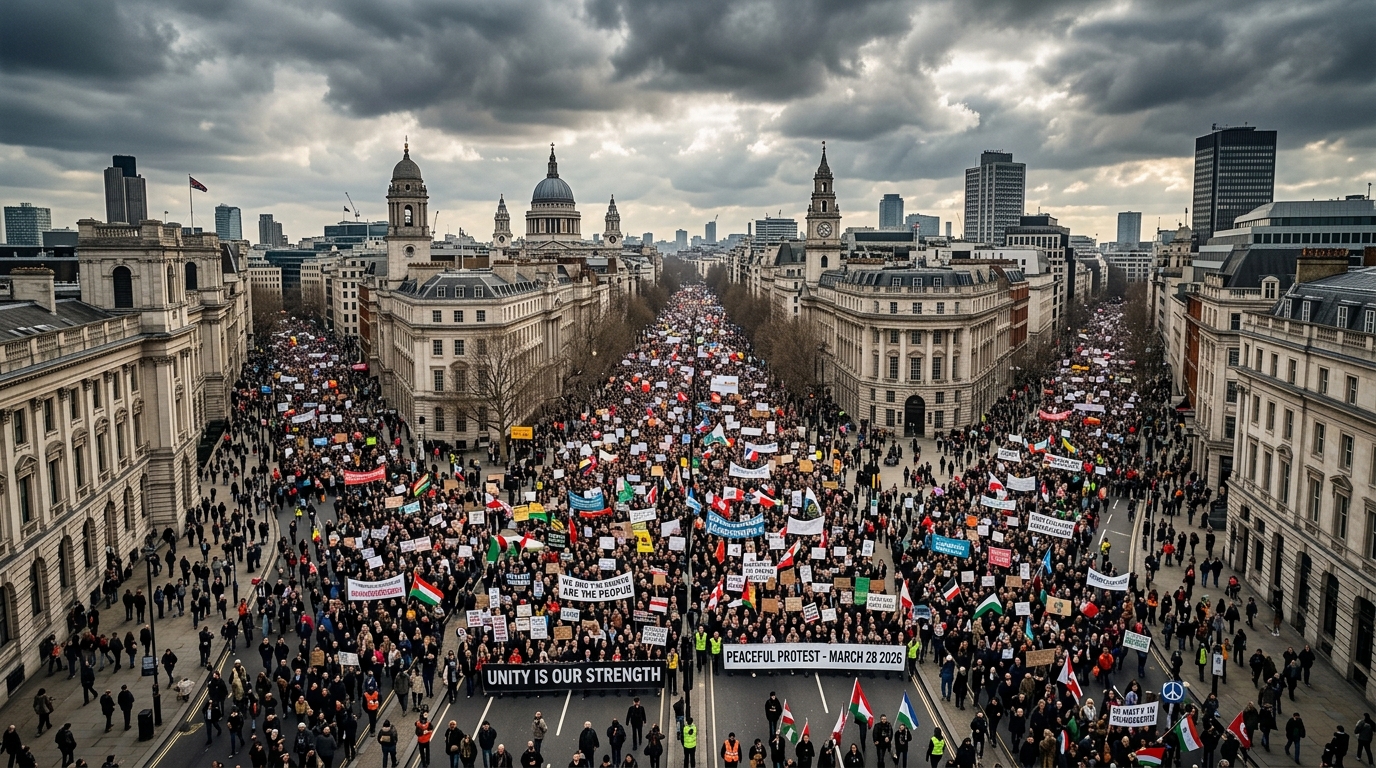
The “No King” protests quickly evolved from online outrage to street action, thousands gathering in Washington, Los Angeles, Chicago, and Austin, chanting a modern echo of 1776: “No crowns, no kings, no cults!” It wasn’t a rebellion against America. It was a rebellion for America, the one promised to be “of the people, by the people, for the people.”
A protest outside the Michigan Capitol in Lansing, Michigan. Image: Courtesy BBC
I. The Spark Beneath the Satire: How the Meme Became a Movement
Political satire has always been America’s unofficial opposition party. The “Airstrike Tweet” wasn’t from the President; it was crafted by activists parodying his bombastic digital style. Within hours, it became symbolic shorthand for how many citizens felt: democracy was under friendly fire. Political cartoonists called it “digital warfare.” Protesters called it “our Boston Tea Party, but with hashtags.
Trump trolls ‘No Kings’ protests with obscene AI video and mulls invoking Insurrection Act
Nearly 7 million people across the country turned out for the second “No Kings” protests against President Donald Trump and his administration, marking the largest single-day demonstration against a sitting president in modern history, organisers said.
After golfing on Saturday, Trump returned to Mar-a-Lago and fired off several Truth Social posts, including an AI-generated video that appeared to show him wearing a crown, flying a jet, and bombing a crowd of protesters with brown liquid.
Millions of demonstrators joined protests in more than 2,500 cities and towns to stand up to what organisers called Trump’s “authoritarian power grabs.” In June, more than 5 million turned out for the first “No Kings” protests.
II. Who’s Leading the Charge? From State Squares to National Stage
Contrary to expectations, the “No King” protests aren’t controlled by a single national leader or political party. Instead, they’re a decentralised coalition, an alliance of civic groups, student organisations, and local advocacy movements such as “Guardians of the Republic,” “21st Century Patriots,” and “The Liberty Collective.” Think less “one face of resistance,” and more “a thousand small torches lighting up the night.”
State-based movements have been especially vocal. In California and New York, protests have leaned progressive, focusing on threats to democracy and civil rights. In Texas and Ohio, libertarian groups have joined in, demanding limits to executive power. This rare cross-ideological unity, conservatives, centrists, and liberals marching under the same banner, has startled analysts. “When both the left and right shout ‘No King,’” said political scientist Dr Maria Lang from Georgetown University, “you know democracy is awake.”
At the national level, loosely coordinated coalitions are emerging. Digital strategy networks like “Democracy Watchdog” have been helping local chapters with messaging, legal coordination, and crowd logistics. But leaders are cautious; they don’t want another “Occupy Wall Street” that fizzles out. Instead, they frame “No King” as an ongoing civic habit, not a weekend protest but a watchtower for democracy.
Despite heavy rain, protesters turned out for the ‘No Kings’ demonstration in Dallas on Saturday. Credit…Desiree Rios for The New York Times
III. The Administration’s Balancing Act: Between Dismissal and Damage Control
The White House’s response has been predictably theatrical. At first, presidential aides brushed off the protests as “noise from the usual suspects.” Then came televised statements insisting that “America respects peaceful expression, even when misled.”
Yet, internal reports suggest growing concern over how quickly satire is turning into symbolism. In the capital, federal security presence has quietly increased, while in states like Oregon and Pennsylvania, local authorities have chosen dialogue over a crackdown. The administration walks a tightrope: appearing strong without seeming monarchic.
A senior official, speaking anonymously to Reuters, remarked: “The President believes in strong leadership. The protesters believe that’s code for kingship. It’s a perception battle we’re losing online.” And indeed, perception, not policy, is where this war is being fought.
IV. A Tale of Two Americas: The King and the Common
The “No King” protests tap into something deeper than partisan politics. It’s about cultural memory. Americans have always defined themselves by what they are not. Not British. Not monarchic. Not subjects. So when citizens feel the presidency shifting from service to sovereignty, the instinctive response is revolt, peaceful, yes, but passionate.
Writers have drawn parallels between Trump’s rally rhetoric and royal decree. Supporters love his “strength.” Critics see it as swagger. Either way, both sides agree on one thing: his personality defines the politics. He is the brand and the banner. But that’s also the problem: when governance feels like fandom, democracy feels like entertainment. And citizens, tired of being an audience, are stepping back on stage.
V. The Global Spectacle: How the World is Watching
From London to Lagos, the “No King” movement has become a global meme, a kind of democratic déjà vu. International media outlets like The Guardian, Le Monde, and Al Jazeera have framed it as “America’s constitutional conscience rediscovering its voice.” Meanwhile, in autocratic capitals, state media mock the protests as “proof of chaos in Western democracy.”
China’s Global Times editorialised that “America lectures the world on freedom yet fears its own citizens marching.” But in democratic Europe, the tone is different, supportive, even admiring. “It’s a sign that democracy still breathes in the streets,” wrote Germany’s Der Spiegel. Social scientists in Canada and Japan are analysing the phenomenon as a case study in civic digital mobilisation.
In a world where strongman politics are rising from Hungary to India, America’s internal protest is being seen as a test of democratic endurance. Does the republic have antibodies left? Can it self-correct before cynicism becomes the new constitution?
VI. Memes, Meaning, and Momentum: Digital Satire as Political Weapon
The viral “Airstrike Tweet” represents more than humour; it’s the new language of rebellion. Where 18th-century revolutionaries used pamphlets, today’s activists use parodies. Each meme, each hashtag, is a small dose of resistance, making the serious digestible, the abstract emotional.
Psychologists at Stanford University studying the protests’ social-media footprint found something striking: humour increases message retention by up to 70%. In short, people remember what makes them laugh, and rethink what makes them uncomfortable. That’s why satirical activism works. It lowers defences while raising questions.
“Comedy is truth wearing a clown nose,” one organiser quipped. And in a way, that’s the genius of “No King.” It’s political philosophy wrapped in punchlines.
VII. The State Response: Cooperation, Crackdowns, and Calculated Calm
State-level reactions vary widely. In liberal states like Washington and Massachusetts, governors have publicly affirmed the right to protest, even joining symbolic marches. In conservative states like Florida and Tennessee, police presence has been stronger, but largely non-confrontational. Authorities are cautious, after all, nobody wants footage of tear gas trending with #NoKing. Optics are the new order.
In the capital, D.C., Mayor Muriel Bowser authorised “freedom corridors” to minimise clashes, turning sections of downtown into safe protest zones. Federal authorities, however, maintain quiet surveillance, monitoring “digital extremism” within the movement, though no evidence yet links “No King” organisers to violence. It remains largely disciplined, its banners hand-painted, not burned.
VIII. The Hidden Truth: Why Flattery Feeds Autocracy
Psychologically, the protests may be less about Trump and more about human nature. Flattery, as history shows, is democracy’s most seductive poison. Power doesn’t demand crowns, it just needs applause. And when leaders begin to believe their own fanbase more than their facts, they drift from representative to ruler.
The “No King” movement, therefore, isn’t simply anti-Trump; it’s anti-hubris. It’s a national therapy session asking: “When did we start worshipping politicians instead of questioning them?” The answer isn’t partisan, it’s human. Every era forgets that democracy is like a muscle: it atrophies without exercise. Protest is the gym.
IX. What Happens Next? From Hashtags to History
Whether “No King” fades or flourishes depends on one question: can satire sustain seriousness? Movements often begin with humour and end with hard work, policy, organisation, and persistence. The founders of “Democracy Watchdog” are already discussing voter education drives, town hall reform networks, and civic literacy workshops. Their motto: “The Republic, Refreshed.”
Political analysts predict the protests could influence turnout in the next election, especially among younger voters who feel ownership of the meme. Meanwhile, party strategists from both sides are recalibrating narratives: Republicans emphasising strength-with-accountability, Democrats amplifying checks-and-balances patriotism.
X. Final Reflections: America’s Eternal Rebellion
The “No King” protests are not just about today’s President; they are about tomorrow’s democracy. America’s DNA carries rebellion. It’s restless by design. Every few decades, it wakes up, looks in the mirror of power, and asks, “Are we still free, or just comfortable?”
That’s what’s happening now. Citizens are reasserting ownership. The satire, the slogans, the street marches, they’re not chaos; they’re calibration. They remind us of the power that it serves, not rules. And perhaps that’s the real headline history will remember, not the meme, not the marches, but the moment America once again told its leaders: No crowns allowed.
Conclusion: A Republic Reborn Through Laughter and Loyalty
As the smoke of satire clears, one truth remains: democracy doesn’t die in darkness, it just occasionally needs to laugh itself awake. “No King” isn’t anarchy; it’s accountability, reimagined through humour. Maybe the republic doesn’t need saving. Maybe it just needed reminding.
As one banner read at the D.C. march: “We fired a king once, we can do it again.”
And the crowd laughed, not in anger, but in confidence. Because laughter, in the end, is freedom’s oldest language.