
Islamabad’s Green Illusion: Debt, Development, and the Silent Erosion of the Margalla Hills
Islamabad’s Green Illusion Pakistan is planting millions of trees, but quietly losing the forests that matter most. At the foothills of Islamabad, a new development push is raising a deeper question: is growth coming at the cost of the country’s ecological survival?
https://mrpo.pk/1-to-save-nature-30-to-destroy-it/
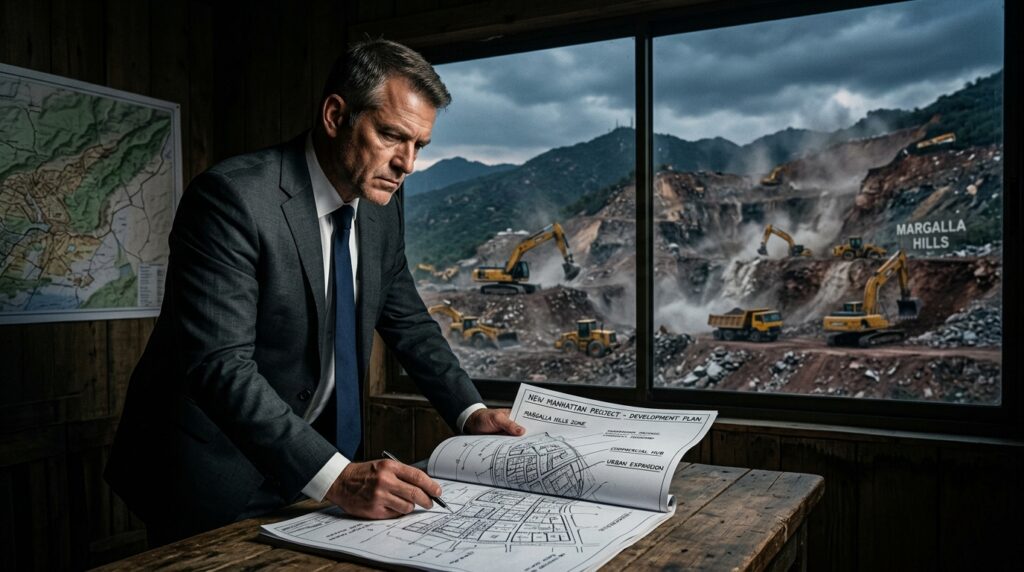
Islamabad’s Green Illusion: A Capital Built on Nature, Now at Risk
The identity of Islamabad has always been inseparable from the Margalla Hills National Park, a rare urban ecological buffer hosting leopards, hundreds of bird species, and critical groundwater recharge zones.
But today, environmental alarms are intensifying.
WWF-Pakistan has issued a stark warning:
Development near the Margalla foothills poses “serious and potentially irreversible risks” to Islamabad’s fragile ecosystem.
At the centre of the controversy lies a proposed 1,000-kanal park and infrastructure project, marketed as urban uplift, but criticised as a gateway to ecological disruption.
From green to gray: the changing face of Islamabad
Data from Global Forest Watch estimates that from 2001 to 2022, Islamabad lost 12 hectares of tree cover, equivalent to a 0.39% decrease in tree cover since 2000, and 4.05 kilotons of CO emissions.
Walking through the corridors of history, Islamabad was established in the 1960s, nestled on the ancient Potohar Plateau in Northern Punjab; a region of extraordinary archaeological significance as one of Asia’s earliest human settlements. The elusive Greek architect Constantinos Apostolou Doxiadis’s comprehensive plan organized Islamabad into eight distinct functional zones. This deliberate arrangement was meant to seamlessly integrate administrative centers, diplomatic enclaves, residential neighborhoods, educational and industrial districts, commercial hubs, and preserved rural and green spaces.
Sadly, the last decade has witnessed the rapid transformation of green spaces into concrete jungles, particularly towards the new airport. The city has expanded up to the mountains of Shah Allah Ditta on one side, while construction continues unchecked along the new and old Murree Road, the Simli Dam area, and Park Road.
Additionally, massive urban sprawl has already taken place along the Islamabad Expressway, and with the construction of a new road, this expansion will accelerate even further.
The Project: Park or Precedent?
Officially framed as a public recreational space, the project is believed to include:
- Landscaped park zones
- Access roads and parking
- Visitor facilities
- Potential commercial extensions
Yet key concerns remain unanswered:
- Where is the full Environmental Impact Assessment (EIA)?
- Has the Pakistan Environmental Protection Agency approved it transparently?
- What role has the Islamabad Wildlife Management Board played?
Experts warn: once development enters a protected buffer zone, containment becomes nearly impossible.
🌳 The Tree-Cutting Shock: Numbers That Don’t Align
While Pakistan promotes large-scale plantation campaigns, recent data from Islamabad tells a different story.
Verified Tree Loss (Recent Cycle)
- 28,000–30,000 mature trees cut across Islamabad
- Areas affected include:
- Fatima Jinnah Park
- Shakarparian
- Park Road / Chak Shahzad corridors
- Margalla-linked infrastructure zones
Official explanations cite the removal of invasive species like paper mulberry.
But environmental observers argue:
- Native trees were also removed
- Clearing was too extensive and too rapid
- Development and housing access roads overlapped with the operation
This raises a troubling question:
Was this environmental management,or pre-development clearing?
Plantation vs Reality: The Credibility Gap
Pakistan’s flagship afforestation effort, the Ten Billion Tree Tsunami, reports:
- 2.2 billion trees planted (2019–2025)
However, deeper analysis reveals:
Key Gaps
- No clear breakdown of post-April 2022 plantation data
- Shift from billion-scale planting → millions-scale campaigns
- Survival rates uncertain (often 40–70%)
Meanwhile:
- Pakistan lost 9,500 hectares of tree cover in 2024 alone
The Contradiction
A country planting billions of trees cannot afford to destroy its oldest ecosystems.
Plantation headlines and on-ground forest realities are moving in opposite directions.
The IMF Angle: Can Pakistan Afford Another Mega Project?
Pakistan is currently navigating:
- High external debt
- IMF-linked fiscal constraints
- Rising subsidy pressures
Yet large-scale projects continue.
To understand the risk, one must look at history.
The Cost of Development: Lessons from Mega Projects
Orange Line Metro Train
- Annual subsidy: Rs7–10 billion
- Estimated cumulative burden: Rs45–60+ billion
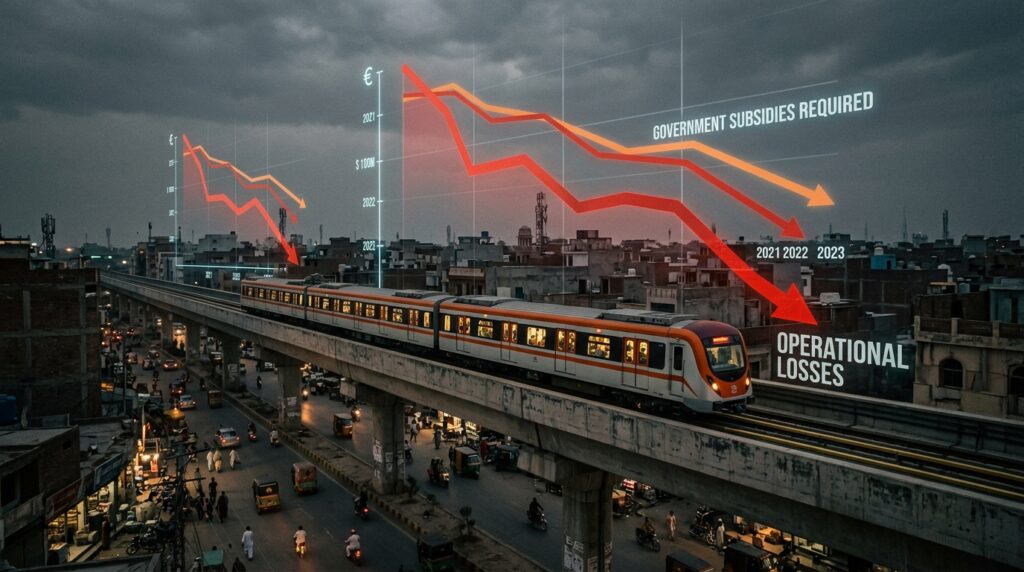
The Cost of “Development”: Lessons from Mega Projects
Independent Power Producers (IPPs)
- Annual capacity payments: ~Rs1.8–2.1 trillion
- Long-term burden: Rs15–20 trillion+
Urban Metro Systems
- Annual losses: ~Rs2.6 billion (Islamabad region)
Combined Annual Burden
👉 Rs1.8–2.1 trillion per year
A Repeating Pattern
Across sectors, a familiar cycle emerges:
- High-visibility launch
- Weak financial modeling
- Long-term subsidies
- Fiscal strain on the state
Global Reality Check: The “Manhattan” Myth
In recent discourse, bold claims have surfaced about building a “Manhattan” in Pakistan. But the real history of Manhattan tells a very different story.
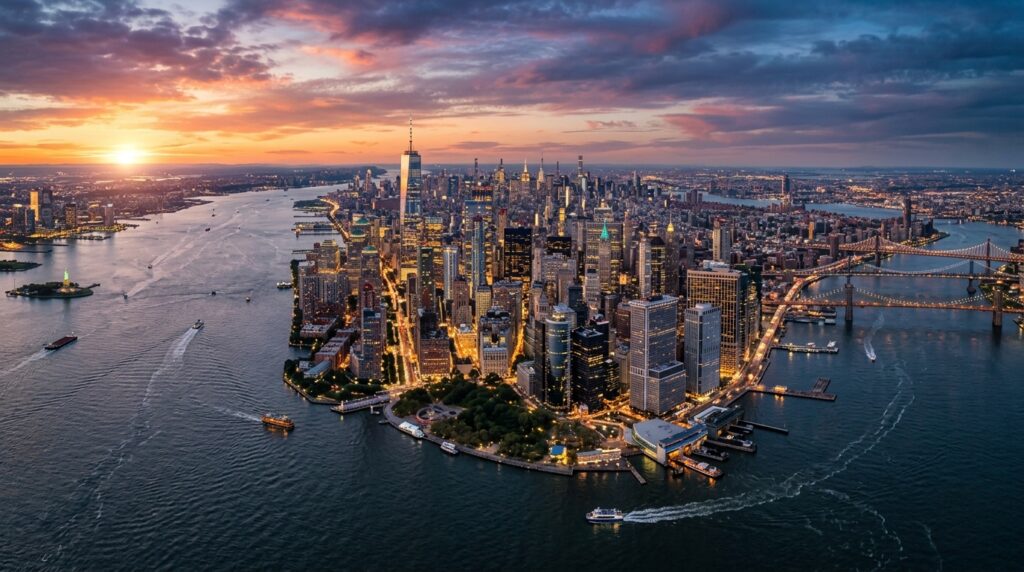
A 400-Year Evolution, not a Project
- Began in 1626 as a Dutch trading outpost under the Dutch West India Company
- Expanded organically through trade, migration, and private enterprise
- Transformed over centuries, not through a single state-led mega project
The Only “Blueprint”: Commissioners’ Plan of 1811
- Introduced Manhattan’s grid system
- Enabled scalable urban growth
But crucially:
It organised expansion; it did not create it from scratch.
Built by Capital, Not Slogans
Landmarks like the Empire State Building and financial dominance around Wall Street were driven by:
- Private investment
- Industrial growth
- Financial markets like the New York Stock Exchange
Governance & Control
- The 1916 Zoning Resolution regulated density and urban form
- Strong institutions ensured long-term planning discipline
The Missing Factor: Water, Manhattan’s Lifeline, Islamabad’s Constraint
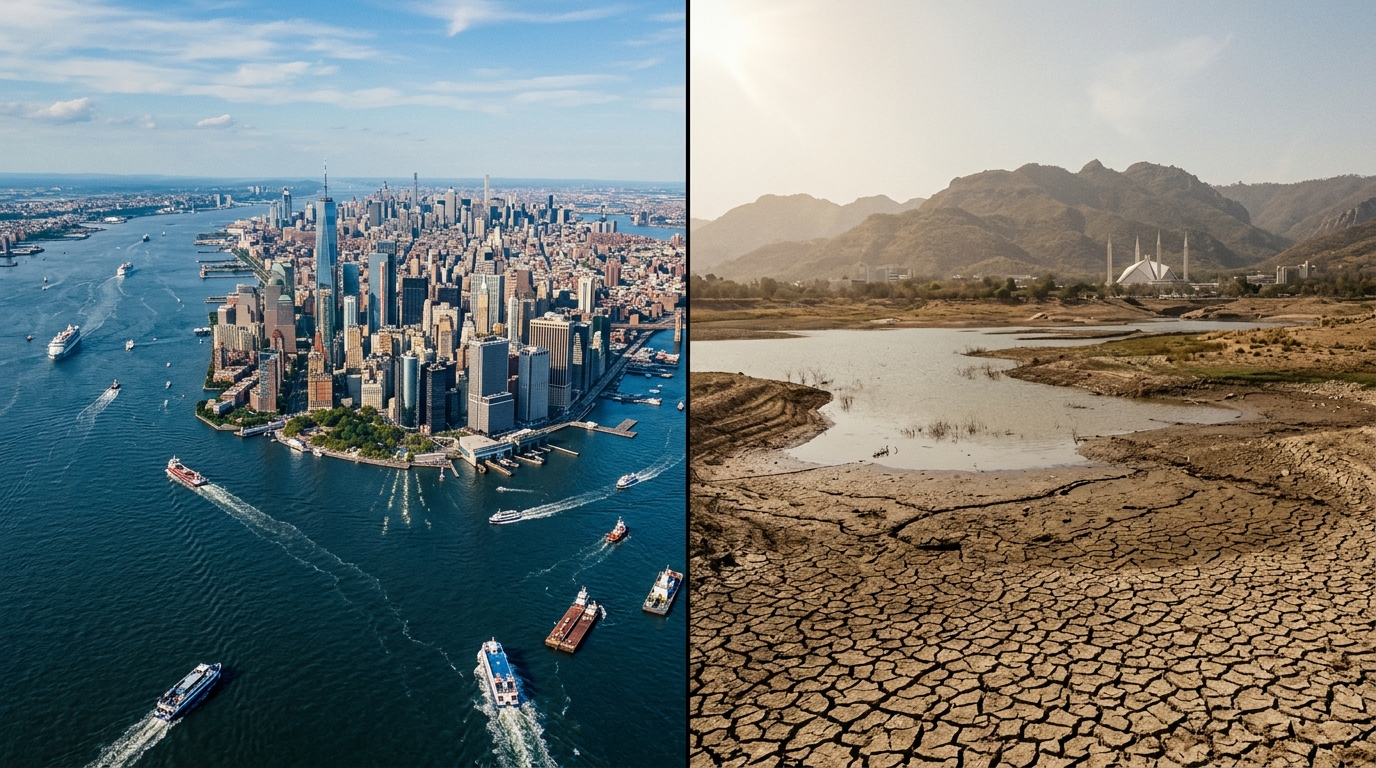
One of the most overlooked differences between Manhattan and Islamabad is not skyline, capital, or planning; it is water access.
Why Manhattan Thrives
Manhattan sits at the convergence of major water bodies:
- Hudson River
- East River
- Atlantic Ocean
This geographic advantage has shaped everything:
- Trade and port economy
- Industrial growth
- Transportation networks
- Climate moderation
- Tourism and real estate value
In simple terms, water created Manhattan’s economy long before skyscrapers defined its skyline.
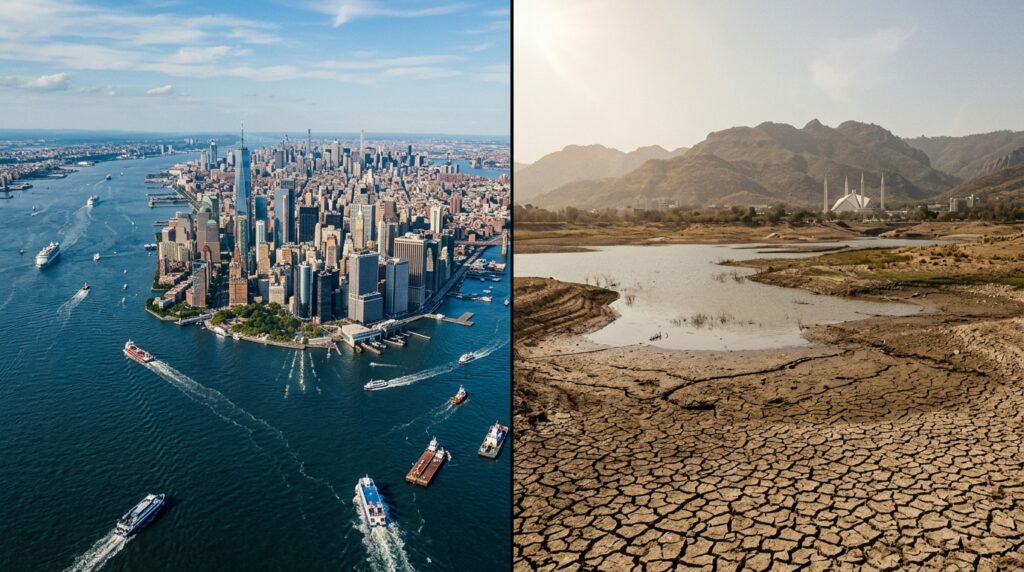
Islamabad’s Structural Limitation: Islamabad’s Green Illusion
In contrast, Islamabad:
- Has no major river flowing through it
- Relies on:
- Simply Dam
- Khanpur Dam
- Groundwater extraction
This makes its growth fundamentally dependent on managed and limited water resources.
The Emerging Crisis
Islamabad is already facing:
- Falling groundwater levels
- Rising demand due to rapid urban expansion
- Climate variability affecting reservoirs
Now add:
- Large-scale construction
- Loss of natural recharge zones, such as the Margalla foothills
The pressure on water systems intensifies significantly.
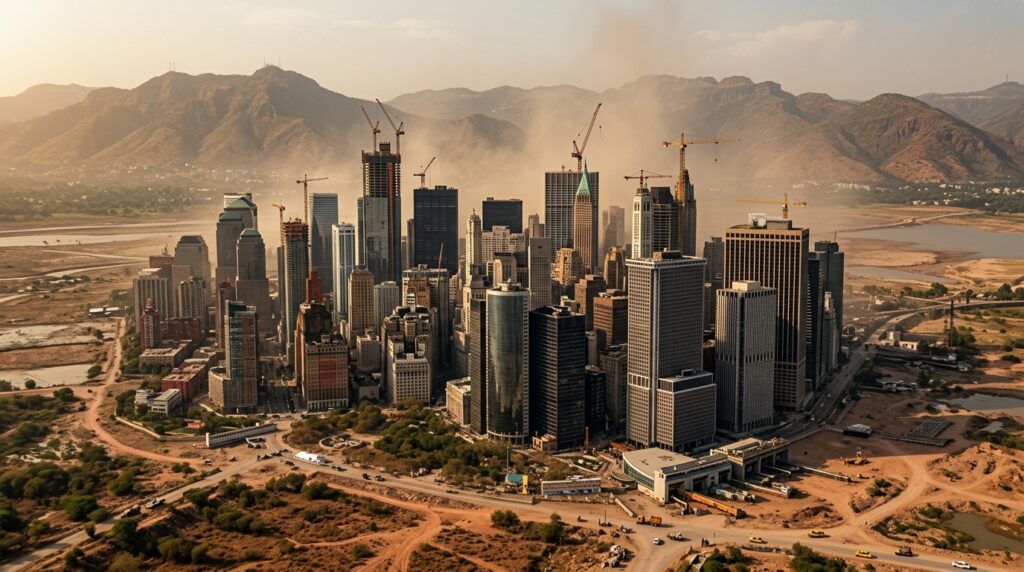
The Strategic Contradiction
You cannot build a “Manhattan-style” dense urban ecosystem without a Manhattan-scale water system.
Unlike Manhattan, Islamabad must engineer, transport, and conserve every drop rather than naturally benefit from it.
Why This Matters for the Margalla Project
The Margalla foothills are not just scenic; they function as:
- Natural groundwater recharge zones
- Soil absorption systems
- Flood regulation buffers
If these are disrupted:
- Groundwater recharge declines
- Surface runoff and flooding increase
- Dependence on already stressed reservoirs grows
Hard Reality
Manhattan grew around water. Islamabad survives despite its limitations on water.
Ignoring this difference turns ambitious urban planning into resource-blind expansion.
Closing Insight
Skyscrapers can be built with money, but cities are sustained by water, and that is the one resource Islamabad cannot afford to gamble with.
Islamabad’s Green Illusion: Manhattan vs Imported Dreams
| Manhattan Reality | “Build Manhattan Here” Narrative |
|---|---|
| 400 years of growth | Few years ambition |
| Economic engine first | Infrastructure first |
| Private capital-driven | State-led expansion |
| Strong governance | Institutional gaps |
| Organic evolution | Artificial replication |
The Critical Insight
“Manhattan was not built by ambition alone, it was built by centuries of capital, institutions, and economic gravity. Replicating its skyline without replicating its foundations is not development,it is illusion.”
For a country under fiscal strain, attempting to replicate its skyline without replicating its foundations risks creating expensive illusions rather than sustainable cities.
Islamabad’s Green Illusion: What’s at Stake for Islamabad
If current trends continue, Islamabad faces:
Environmental Risks
- Loss of biodiversity
- Rising urban heat
- Water scarcity
Economic Risks
- Maintenance-heavy public assets
- No guaranteed revenue stream
Identity Loss
- From “green capital” → to urban sprawl
The Core Question
Before launching another prestige project, Pakistan must ask:
- Where is the transparent feasibility study?
- What is the long-term financial model?
- Who is accountable if it fails, environmentally or economically?
The Deeper Crisis: Policy vs Practice
Pakistan’s environmental narrative today is caught between:
- Global climate leadership messaging
- Local ecological degradation realities
This gap is where credibility erodes.
Conclusion: A Defining Choice
Islamabad was not built just with roads and sectors; it was built around nature.
If the Margalla foothills are compromised:
- The loss will not just be ecological
- It will be economic, climatic, and generational
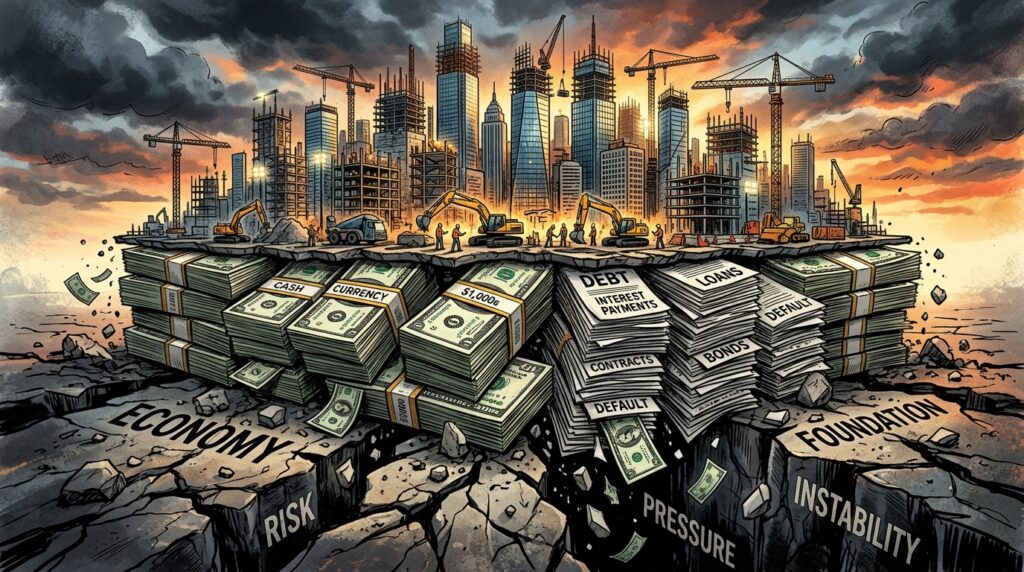
Islamabad’s Green Illusion: Silent Erosion of the Margalla Hills: A Defining Choice
Final Word: Islamabad’s Green Illusion
Pakistan’s challenge is no longer building mega projects.
It is surviving the cost,financial and environmental,of the ones it keeps building.
And this time, the price may not just be paid in rupees…
but in the very landscape that once defined its capital.
🎯 Purpose of the Article
The article Islamabad’s Green Illusion, goes beyond a single project near Margalla Hills National Park; it examines a broader pattern shaping development in Pakistan.
It highlights the rise of “borrowed grandeur”, projects driven by loans and optics rather than sustainable foundations, and questions a model of cosmetic governance that prioritises visibility over long-term planning.
By comparing with cities like Manhattan, the article underscores the absence of a practicable blueprint, weak financial planning, and critical blind spots such as water scarcity and environmental limits.
Ultimately, it calls for real accountability, data-driven decisions, and sustainable development, not ambitious visions that risk becoming costly illusions.
EP Statement
From an editorial standpoint, the concern is not opposition to development itself, but the absence of a clearly enforced environmental blueprint that aligns growth with long-term ecological sustainability. Without that balance, Islamabad risks turning its defining natural asset into a slowly eroding backdrop to unchecked urbanisation.
References & Sources
- WWF-Pakistan — Statements on risks to Margalla foothills and ecological impact
- Pakistan Environmental Protection Agency — EIA requirements under environmental law
- Islamabad Wildlife Management Board — Protection mandate for Margalla Hills ecosystem
- Margalla Hills National Park — Biodiversity and conservation status
- Government data on Ten Billion Tree Tsunami — plantation targets and reported outcomes
- Energy sector analyses on Independent Power Producers (IPPs) — capacity payments and circular debt
- Public finance and transport data on Orange Line Metro Train — operational subsidies
- Urban water supply references: Simly Dam, Khanpur Dam
- Global urban planning context: Manhattan, Commissioners’ Plan of 1811, 1916 Zoning Resolution