AI Chatbots: Can You Trust the Answers?
AI chatbots can produce convincing answers that contain false information. Discover how AI generates responses, why hallucinations happen, how to verify sources, and how to write research-based articles using AI responsibly.

Imagine asking an AI chatbot a simple question about a historical event, a medical condition, or a political leader. Within seconds, you receive a polished answer with dates, statistics, explanations, and references. Everything looks convincing. The language is explicit, the argument sounds logical, and the answer appears complete.
But what if one of the dates is wrong? What if the statistics are invented? What if a scientific study cited in the answer does not exist?
There is a bigger problem. Incorrect information may look just as convincing as correct information.
So, can we trust ChatGPT, Gemini, Claude, and other AI tools? Yes, for many tasks, with appropriate caution. But trust should depend on evidence, not confidence. Understanding how AI makes mistakes, checking its sources, and verifying important claims can help us use these tools without becoming unwitting carriers of misinformation.
The lesson is not that AI is useless or that everything it says is false. The real issue is understanding what AI can do, where it can fail, and how to check its answers before trusting or publishing them.
For students, professionals, journalists, researchers, and website publishers, this distinction matters. A convincing answer is not necessarily a correct answer.
The central question is simple: How can we benefit from AI without allowing its mistakes to become our own?
https://mrpo.pk/ai-has-learned-to-act/
What Is an AI Chatbot, and Why Is Everyone Using One?
An AI chatbot is a computer system designed to understand and respond to questions using natural language. Instead of searching through pages of information yourself, you can ask a question in plain English and get a direct answer.
For example, you might ask:
- Why are food prices increasing?
- What are the possible causes of persistent fatigue?
- How did the Second World War begin?
- What are the advantages and disadvantages of electric vehicles?
- How can I plan a holiday on a limited budget?
The chatbot can produce a structured answer within seconds. You can ask follow-up questions, request simpler explanations, or ask it to compare different viewpoints.
This conversational approach makes AI especially attractive to people who find traditional internet searches time-consuming or confusing.
Why People Prefer AI to Traditional Search Engines
A traditional search engine usually presents links to webpages. The user must open those pages, examine the information, compare sources, and decide which claims are reliable.
An AI chatbot often performs part of that work by generating a summary directly.
This convenience is valuable, but it introduces a hidden risk.
When a search engine displays several sources, users can at least see that different websites exist and compare their claims. When a chatbot combines information into one smooth answer, the original sources may become less visible.
The reader may not know which statements come from reliable research, which depend on outdated information, and which are unsupported.
An AI-generated summary can therefore feel more authoritative than the evidence behind it deserves.
The Difference Between Finding Information and Generating an Answer
This distinction is fundamental.
A search engine primarily helps users locate information from available sources. A language model generates a response based on patterns learned during training and, when available, additional information retrieved through tools such as web search or document retrieval.
Some AI systems combine both approaches.
However, generating an answer and verifying a fact are different activities.
A chatbot may produce a correct answer from its learned information. It may also generate a plausible answer without having reliable evidence for every detail.
That is why readers should not confuse a well-written explanation with a properly researched conclusion.

How Does AI Actually Generate Its Answers?
To understand why AI makes mistakes, we first need to understand how it works.
Large language models, commonly called LLMs, are trained on extensive collections of text and other data. During training, they learn statistical patterns involving words, phrases, concepts, relationships, and different forms of language.
They use these learned patterns to generate responses that fit the question and the surrounding conversation.
The process is more sophisticated than simply copying sentences from a database. Nevertheless, it does not automatically establish whether every generated statement is true.
Step 1: AI Learns Patterns From Training Data
During training, a language model processes large amounts of text. It learns relationships between words and concepts and develops the ability to produce coherent language.
For example, it may learn how historical explanations are structured, how medical terminology is used, and how scientific arguments are presented.
It can then use those learned patterns to answer questions it has not encountered in exactly the same form.
However, the model’s training data can contain incomplete information, conflicting claims, errors, and material that later becomes outdated.
Even when the training data contains a correct fact, the model may fail to reproduce it accurately in a particular response.
Learning patterns from information is not the same as independently verifying every fact.
Step 2: AI Predicts What Comes Next
At the heart of a conventional language model is a process often described as next-token prediction.
A token is a small unit of text. It may represent a complete word, part of a word, or a punctuation mark.
Given the text already supplied, the model estimates which token should come next. It generates a sequence of tokens until it has produced a response.
For example, if someone asks, “What is the capital of France?” the model has learned strong associations between France, its capital, and Paris. It can therefore produce the correct answer.
But consider a much less familiar question:
“What was the exact attendance at a small conference held in a particular town on 14 March 2018?”
The model may not have reliable information about that event. Nevertheless, it may generate a specific number because that number fits the structure of a plausible answer.
The problem is not necessarily that the model deliberately chooses to deceive the user. It is that generating a plausible continuation shall not guarantee factual accuracy.
Step 3: Additional Training Shapes the Response
Modern AI assistants usually undergo additional training and adjustments designed to make their responses more useful, follow instructions, and handle sensitive questions appropriately.
These processes can improve performance, but they do not eliminate every factual error.
Research published by OpenAI in September 2025 examined why language models continue to produce hallucinations. The researchers argued that evaluation methods that reward correct answers without adequately accounting for uncertainty can encourage guessing rather than admitting that an answer is unknown.
This is an important distinction.
A system can become better at answering questions while still struggling to recognize when it lacks enough evidence to answer a particular question accurately.
Step 4: AI May Use External Information
Some AI assistants can search the internet, retrieve information from documents, or use specialized tools to improve their answers.
These capabilities can make responses more current and easier to verify.
For example, an assistant researching a recent government announcement may search for the original announcement rather than relying only on information learned during training.
However, external search is not a guarantee of accuracy.
A chatbot may retrieve an unreliable website, misunderstand a source, overlook an important qualification, or summarize a statement incorrectly.
Even a genuine source can be misinterpreted.
The safest approach is to treat AI as a tool for locating, organizing, and explaining information while checking important claims against the evidence itself.
Why Does AI Make Mistakes Even When It Sounds Certain?
One of the most misleading features of AI is its ability to express incorrect information in polished, confident language.
A person who does not know an answer may hesitate, look uncertain, or admit a lack of knowledge. An AI chatbot can produce a grammatically perfect paragraph even when the underlying information is unreliable.
This creates a dangerous gap between how convincing an answer sounds and how well supported it actually is.
1. AI Can Hallucinate Information
In AI terminology, a hallucination is a response that contains information that is false, fabricated, or unsupported by the available evidence.
For example, a chatbot might invent:
- A scientific study that was never published.
- A quotation that a public figure never made.
- An expert’s qualifications or professional history.
- A court judgment that does not exist.
- A precise statistic without a reliable source.
- A book title or research paper that sounds genuine but cannot be found.
The problem becomes more serious when the invented detail appears inside an otherwise accurate explanation.
Suppose an article correctly explains climate change but includes one fabricated scientific study to support its argument. Readers may trust the entire article because most of it appears credible.
One false reference can undermine an otherwise valuable piece of work.
The US National Institute of Standards and Technology discusses this problem in its Generative AI Risk Management Profile, describing how generative AI systems can confidently produce erroneous information and even fabricate citations or explanations that appear to justify their answers.

2. AI May Not Have the Latest Information
Information changes over time.
Governments announce new policies. Courts issue new judgments. Medical guidelines are updated. Political leaders leave office. Companies release new products. Economic statistics are revised.
A model relying on older information may provide an answer that was once correct but is no longer accurate.
Consider someone asking:
“What is the current interest rate?”
The answer depends on the country, the institution, the type of interest rate, and the date.
A figure that was accurate last year may be misleading today.
For current questions, the writer should establish the relevant date, identify the correct institution, and consult the latest available official information.
3. AI May Fill Gaps With Convincing Details
AI often produces detailed responses because users request explanations, examples, and supporting evidence.
When reliable information is missing, the model may still generate a response that fits the requested format.
Imagine asking for the biography of an obscure researcher. The chatbot may correctly identify the person’s field but invent a university affiliation or publication title.
The resulting biography may look entirely reasonable.
This is especially risky when researching lesser-known people, local events, old documents, minor court cases, and obscure statistics.
The less familiar or less well-documented the subject, the more carefully specific claims should be checked.
4. AI Can Confuse Similar Facts
Two people may have similar names. Two government programs may have similar titles. A historical event may be confused with another event from the same period.
A model might attribute one person’s statement to another or combine details from different studies.
For example, a chatbot could describe a genuine medical study but attach the findings to the wrong research team.
The individual details may sound familiar, yet their combination may be incorrect.
Writers should therefore verify the relationship between facts, not merely check whether each name or term exists.
5. AI Can Agree With a False Assumption
The way a question is phrased can influence the response.
Consider these two questions:
Question A: What evidence exists about the effectiveness of this treatment?
Question B: Why has this treatment been proven to cure the disease?
The second question assumes that the treatment has been proven effective.
A careless response may accept that assumption and construct an explanation around it, even if the evidence does not support the claim.
This problem is sometimes called leading-prompt bias or premise acceptance.
A better question would be:
“Has this treatment been shown to cure the disease? Examine the available evidence, including studies that found no benefit, and distinguish established findings from uncertainty.”
The lesson is simple: never assume that the wording of a question makes its central claim true.
Does AI Lie, or Does It Simply Make Mistakes?
The word “lie” normally implies an intention to deceive. When an AI system produces a false answer, that alone does not establish that it intended to deceive anyone.
A chatbot can generate false information without having human intentions or an accurate understanding of its own uncertainty.
For ordinary users, however, the practical consequences can be similar. They may believe a false claim, make a poor decision, or publish inaccurate information.
It is therefore more useful to distinguish between three situations.
An ordinary error: The AI gives an incorrect date, miscalculates a figure, or confuses two people.
A hallucination: The AI invents a source, quotation, statistic, or other detail that appears genuine but lacks factual support.
A misleading presentation: The AI presents a disputed interpretation as settled fact, omits important context, or expresses more certainty than the evidence warrants.
These categories can overlap.
A chatbot’s confident tone does not establish that it is correct, and a false answer does not by itself prove intentional deception.
For writers, the important question is not whether the system is meant to mislead them. It is whether the claim can be independently supported.
How Can You Check Whether an AI Answer Is True?
There is no single test that can guarantee every AI-generated statement is accurate.
However, a disciplined verification process can substantially reduce the risk of publishing false information.
The following method is useful for students, journalists, website owners, researchers, and ordinary readers.
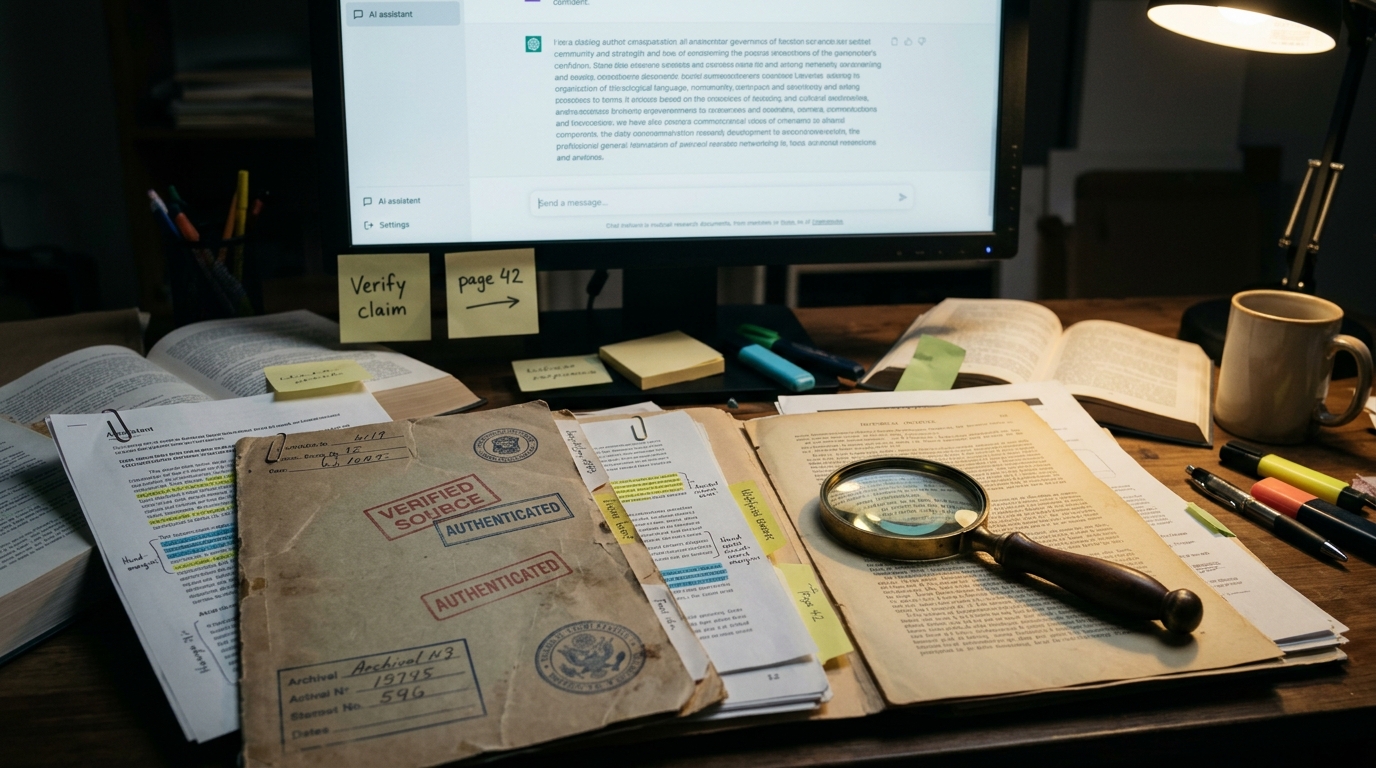
Step 1: Break the Answer Into Individual Claims
Do not attempt to verify an entire article as one large block of text.
Divide it into specific claims that can be checked separately.
Suppose AI generates this sentence:
“According to a 2023 international study, the treatment reduced hospital admissions by 42 percent and was subsequently approved by the national health authority.”
This sentence contains several separate claims:
- An international study was published in 2023.
- The study examined the treatment.
- Hospital admissions fell by 42 percent.
- The result was attributable to the treatment.
- A national health authority subsequently approved it.
Each claim requires evidence.
The study might exist, but the reported percentage is wrong. The percentage might be correct for a small subgroup rather than the entire population. The approval might concern a different use of the treatment.
Checking only the general topic would not uncover these distinctions.
Rule: Verify the individual claims, not just the overall story.
Step 2: Identify the Original Source
Whenever possible, locate the original document or primary source behind a claim.
Depending on the subject, this might be:
- An official government announcement.
- A court judgment or legal document.
- A peer-reviewed research paper.
- A national statistical agency’s dataset.
- A company’s published financial report.
- A speech, interview, or complete transcript.
- An official statement from the relevant organization.
For example, if AI claims that a government increased its defence budget by 15 percent, look for the actual budget documents.
Do not rely solely on a news article repeating the figure, particularly if the original document is available.
The original source can reveal whether the percentage refers to nominal spending, inflation-adjusted spending, an annual budget, or a multiyear proposal.
These distinctions can change the meaning of the claim.
Step 3: Check Whether the Source Actually Exists
AI can generate convincing but nonexistent references.
Suppose a chatbot supplies this citation:
“Smith, J. (2023). Artificial Intelligence and Human Decision-Making. International Journal of Advanced Research, Volume 18, Issue 4.”
The citation looks academic. That does not establish that the article exists.
Search for the exact title in quotation marks. Then search for the author’s name, the journal, and the publication details.
For scientific literature, use recognized scholarly databases, the publisher’s website, or the journal’s official archive.
For medical research, PubMed can help locate biomedical literature, although finding a paper there does not automatically establish that its conclusions are correct.
For legal cases, search the relevant court’s official database or a reliable legal database.
If you cannot locate the reference, do not cite it as genuine.
Ask the chatbot to provide a verifiable publication record or DOI, where applicable. Then independently check those details.
Never treat a reference as authentic merely because AI has formatted it correctly.
Step 4: Compare Independent Sources
A claim becomes more credible when reliable, independent sources support it.
However, ten websites repeating the same original error do not provide ten independent confirmations.
For example, several news websites may publish the same figure from a single press release. Their agreement may reflect a shared source rather than independent verification.
For important claims, look for sources that provide their own evidence or examine the original documents.
A useful approach is to compare:
- The original source.
- A reputable independent report.
- Another authoritative source that can confirm the relevant facts.
If the sources disagree, investigate the reason.
They may be using different dates, definitions, populations, currencies, or measurement methods.
The aim is not simply to count sources. It is to understand the evidence behind them.
Step 5: Check Dates, Numbers, Names, and Units
Specific details deserve special attention because they can be wrong even when the general explanation is correct.
Check:
- Dates and chronological order.
- Names and professional titles.
- Percentages and monetary amounts.
- Currency and measurement units.
- Population sizes and geographical boundaries.
- Study publication dates and sample sizes.
- Whether a policy was proposed, approved, or implemented.
Consider the statement:
“Government spending increased by 20 percent.”
What does that mean?
Did spending rise by 20 percent in nominal terms? Was inflation taken into account? Is the comparison with the previous year or a different baseline? Does it refer to the original budget or actual expenditure?
Without this context, a mathematically correct percentage may still create a misleading impression.
Step 6: Read Beyond the Headline or Abstract
A scientific paper’s abstract provides a summary, not the complete picture.
A news headline may simplify a complicated finding. A government announcement may describe a proposed measure rather than an implemented policy.
Read the relevant sections of the original source.
For scientific studies, check the methods, sample size, limitations, and actual results.
For political statements, distinguish what an official said from what independent evidence establishes.
For legal questions, read the relevant judgment or statutory provision where possible rather than relying only on a summary.
The objective is to understand not only what a source says, but also what it does not establish.
Step 7: Ask AI to Challenge Its Own Answer
You can use AI to help identify weaknesses in an earlier response.
For example, ask:
“Review your previous answer claim by claim. Identify statements that require verification, possible unsupported assumptions, uncertain dates, questionable statistics, and references that may not exist. Do not invent replacement sources. Mark anything you cannot establish as unverified.”
This can be useful for generating a verification checklist.
However, there is an important limitation: asking the same chatbot to check itself is not independent verification.
The chatbot may reproduce the original mistake or generate a new explanation that sounds equally convincing.
Treat the result as a list of issues to investigate, not as proof that the original answer is correct.
Step 8: Record What You Could and Could Not Verify
Before publishing an article, maintain a simple record of important claims.
For example:
| Claim | Source checked | Result | Action |
|---|---|---|---|
| A law was passed in 2024 | Official legislative record | Confirmed | Publish with citation |
| A study found a 35% reduction | Original paper | Percentage refers to a subgroup | Correct the wording |
| An expert published three books | Publisher’s catalogue | Only two confirmed | Remove the third book |
| A policy will begin next month | Official announcement | No implementation date found | Mark as unconfirmed |
| A quotation was made by a minister | Complete speech or transcript | Not located | Remove the quotation |
This simple process makes research more transparent and helps prevent unsupported statements from slipping into the final article.
How to Recognize Warning Signs of AI Hallucinations
You cannot reliably identify every false statement by looking at its wording. Some hallucinations are obvious, while others are extremely difficult to detect without external evidence.
Nevertheless, certain warning signs deserve attention.
Warning Sign 1: Extremely Specific Details Without Evidence
Be cautious when a chatbot provides an exact date, percentage, quotation, or publication title without identifying a verifiable source.
Specificity can make an answer sound authoritative, but it is not evidence of accuracy.
A statement such as “The meeting attracted 17,436 participants” requires stronger support than a general statement that thousands attended.
Warning Sign 2: References You Cannot Find
A missing citation is a serious warning sign, especially in research-based writing.
Check whether the author, title, publisher, publication date, and other identifying details match a real document.
A small formatting error does not necessarily mean a reference is fabricated. However, repeated failure to locate a supposedly published study is a reason not to rely on it.
Warning Sign 3: The Answer Changes When You Ask Again
Ask the same factual question in a neutral way on another occasion.
If the chatbot supplies different dates, names, figures, or explanations, investigate the discrepancy.
However, variation alone does not prove that an answer is false. A model may produce different wording while conveying the same correct information.
The concern is a change in the underlying factual claim.
Warning Sign 4: The Answer Accepts Your Assumptions Without Question
If you ask why a particular person committed a crime, the question assumes that the person committed it.
If you ask why a treatment is effective, the question assumes that it works.
If the premise is unproven, the chatbot should not simply build an explanation around it.
Use neutral questions that ask whether the claim is supported before asking why it happened.
Warning Sign 5: A Complicated Answer Has No Meaningful Evidence
An answer may contain sophisticated terminology, detailed reasoning, and confident conclusions without citing any reliable evidence.
That is not proof that the answer is false. Some established facts do not require extensive citations in ordinary conversation.
However, important claims about medicine, law, finance, science, or public affairs should have an appropriate evidentiary basis.
The more consequential the claim, the less sensible it is to rely on confident wording alone.
Warning Sign 6: A Source Supports Only Part of the Claim
A real report can still be used incorrectly.
Suppose a research paper finds an association between a particular food and a health outcome. An AI-generated article describes the paper as proving that the food causes the condition.
The source exists, but the conclusion goes beyond the evidence.
Always check whether the source supports the exact statement being made, including its strength and limitations.
Can AI Verify Facts by Searching the Internet?
Internet search can improve the quality of AI-generated answers, especially for recent events and information that requires specific documentation.
However, web access does not automatically make an answer accurate.
A chatbot with search capabilities may still:
- Select an unreliable website.
- Misread a report.
- Confuse two similar events.
- Ignore contradictory evidence.
- Quote a source out of context.
- Give a citation that does not support the associated claim.
- Rely on an outdated webpage.
- Overlook an important correction or subsequent development.
The quality of an answer depends on more than whether the chatbot searched the internet. It also depends on the quality of the sources, the accuracy of the interpretation, and the way the evidence is presented.
For example, an AI assistant researching an election may find a news report about preliminary results. If it describes those results as final without checking the official count, the answer can be misleading despite being based on a genuine source.
Similarly, an AI system may locate a real medical study but misunderstand whether the study involved animals, a small group of volunteers, or a large clinical trial.
How to Check AI-Generated Citations
When a chatbot supplies sources, ask four questions:
Does the source exist? Open the original document or official webpage.
Is the source authoritative for this claim? A government statistical agency may be appropriate for official employment figures, while a peer-reviewed paper may be more appropriate for a specific scientific finding.
Does the source support the exact claim? Check the relevant passage, table, or result.
Is the source current enough? Confirm that its publication date and the period covered match the question.
If a citation fails any of these checks, do not use it as unquestioned evidence.
For more important claims, preserve the original source and the specific passage supporting the statement. This makes later corrections easier.
How to Write AI-Assisted Articles Using Verified Facts
This is where AI literacy becomes especially important for bloggers, journalists, researchers, and website publishers.
AI can help organize an article, explain technical subjects, generate questions for further research, compare arguments, and improve readability.
But if an article is intended to inform readers, its factual claims must be supported by evidence rather than by the chatbot’s fluency.
A reliable article-writing process should separate research, verification, analysis, and writing.
Stage 1: Define the Article’s Purpose
Before asking AI to write an article, establish what readers should understand by the end.
For example, an article about rising national debt might aim to explain:
- How government debt is measured.
- Why do governments borrow?
- How interest payments affect public finances.
- What the available figures show.
- Which claims remain disputed?
- What the evidence means for ordinary citizens.
A clear purpose helps prevent the article from becoming a collection of loosely connected claims.
Stage 2: Research the Subject Before Drafting
Ask AI to prepare a research plan rather than immediately producing a finished article.
Identify the main questions, relevant institutions, primary documents, opposing explanations, and statistics that require verification.
For a political or economic article, the source list might include government publications, central bank data, parliamentary records, international organizations, and credible independent reporting.
For a medical article, the research may require clinical guidelines, systematic reviews, peer-reviewed studies, and official public-health guidance.
For a historical article, use primary documents and established historical scholarship where available.
AI can help identify the evidence you need, but each important source must be checked.
Stage 3: Build a Verified Fact Sheet
Before drafting, prepare a table of the article’s most important factual claims.
Record the claim, its source, the publication date, the relevant passage or dataset, and any limitations.
Classify each claim as one of the following:
- Verified: Supported by an appropriate source.
- Partially verified: The source supports only part of the statement or requires narrower wording.
- Disputed: Credible sources disagree about the claim or its interpretation.
- Unverified: Adequate supporting evidence has not been found.
- Opinion or analysis: An interpretation that must be distinguished from established fact.
This classification prevents an unconfirmed statement from quietly becoming a fact simply because it appears in a polished draft.
Stage 4: Write From the Evidence
Once the fact sheet is prepared, use AI to organize and explain the verified material.
Provide the relevant sources or excerpts and instruct the chatbot to remain within the evidence supplied.
For example, if an official report confirms that government spending increased but does not explain why, the article should not present a particular political motive as an established fact.
The article may discuss possible explanations, but it should identify them as interpretations and support them with appropriate evidence.
The same principle applies to scientific studies, economic forecasts, and historical controversies.
Stage 5: Separate Facts From Analysis
Investigative writing often needs to explain what the facts mean.
That is appropriate, provided the distinction remains clear.
Consider three statements:
Fact: An official report recorded a particular increase in government spending.
Analysis: The increase may place additional pressure on public finances if revenue does not rise sufficiently.
Unproven claim: The government increased spending specifically to benefit a particular political group.
The first statement requires evidence from the official report. The second requires sound economic reasoning and relevant context. The third requires evidence supporting the alleged motive.
These statements do not have the same evidentiary status.
A strong article can include facts, analysis, and competing interpretations without presenting all three as equally certain.
Stage 6: Add Citations to the Actual Claims
Do not place a long list of references at the end and assume that it supports everything in the article.
Citations should appear near the claims they support.
A reader should be able to determine which source establishes a figure, confirms a quotation, or documents a policy change.
If a source supports only a limited part of a paragraph, revise the paragraph or provide additional evidence.
Where appropriate, link directly to the original document rather than an unrelated homepage or a secondary summary.
Stage 7: Conduct a Final Fact-Checking Review
After the article is drafted, review every significant factual statement.
Pay particular attention to:
- Figures and percentages.
- Names and job titles.
- Dates and timelines.
- Direct quotations.
- Medical claims.
- Legal requirements.
- Political allegations.
- Scientific conclusions.
- Claims about motives.
- Predictions presented as established facts.
- References and links.
Then check whether the article leaves out information that materially changes the meaning of its claims.
A statement can be technically accurate yet misleading because it omits the relevant comparison, limitation, or context.
Finally, remove any detail that cannot be adequately supported, or revise it to reflect the uncertainty.
A shorter article with verified facts is more useful than a longer article filled with impressive but unreliable details.
The Best Prompt for Writing Factually Reliable AI Articles
The instructions given to an AI chatbot can improve the research process. They cannot guarantee that every statement will be correct, but they can make verification an explicit requirement.
The following reusable prompt is designed for research-based articles.
Copy and adapt this prompt for future projects.
The Verified-Facts Article Prompt
“Act as a careful research assistant and investigative writer. Help me develop an informative article on the subject I provide.
My priority is factual accuracy, not speed, length, or persuasive language.
Follow these rules:
- Research the subject using reliable, relevant, and preferably primary sources. For current developments, check the latest available information and clearly state the relevant dates.
- Do not invent facts, figures, quotations, events, names, expert credentials, scientific studies, legal cases, publication titles, references, or website links.
- Verify every important factual claim against its original source wherever possible. If a source cannot be located or does not support the claim, do not present that claim as established fact.
- For statistics, identify the source, reporting period, units, geographical coverage, and relevant definitions. Do not confuse estimates with confirmed figures or proposed policies with implemented policies.
- Distinguish verified facts from interpretations, opinions, disputed claims, forecasts, and assumptions. Clearly attribute claims to the people or institutions making them.
- Do not accept assumptions in my questions without examining whether the evidence supports them. Identify misleading premises and correct them respectfully.
- Include relevant opposing evidence, limitations, and alternative explanations where they materially affect the subject.
- Provide citations near the claims they support. Give enough bibliographic information to locate the original source, and include working links when available. Never fabricate a citation or claim to have checked a source that you have not actually accessed.
- If information is uncertain, unavailable, disputed, or impossible to verify, say so explicitly. Do not fill gaps with plausible guesses.
- Use clear, simple, natural English suitable for a general international audience. Avoid unnecessary technical language, repetition, exaggerated claims, and sensationalism.
- Before finalizing the article, prepare a fact-checking table identifying important claims, their supporting sources, their verification status, and any necessary corrections.
- Perform a final review of names, dates, figures, quotations, citations, and conclusions. Correct unsupported statements and narrow claims that go beyond the available evidence.
Do not promise that the article is completely accurate unless that conclusion can be justified. Clearly identify anything that remains unverified.
Article topic: [Insert topic]
Target audience: [Insert audience]
Purpose of the article: [Insert purpose]
Preferred structure and length: [Insert requirements]”
This prompt establishes a disciplined workflow. It does not turn the chatbot into an infallible fact-checker. The evidence must still be examined independently.
An Important Improvement: Ask for Research Before Writing
For complex subjects, do not ask the chatbot to research, analyze, and produce the final article in a single step.
Use three separate stages.
First, research: Identify the important questions and locate credible sources.
Second, verify: Check the evidence, compare conflicting accounts, and prepare a verified fact sheet.
Third, write: Develop the article using the verified material, with citations and clear distinctions between facts and analysis.
This approach makes errors easier to detect because the evidence is examined before the article’s narrative takes shape.
It also reduces the risk of allowing an attractive storyline to determine which facts are included.
A Special Warning About Health, Legal, Financial, and Political Information
Not all AI errors carry the same consequences.
A mistaken recommendation for a holiday destination may waste time or money. An incorrect medical recommendation or legal explanation may cause serious harm.
The level of verification should therefore reflect the consequences of getting the answer wrong.
Medical Information
AI can explain medical terminology, summarize general information, and help people prepare questions for their doctors.
However, it can misinterpret symptoms, overlook important medical history, or suggest treatments that are unsuitable for a particular person.
For medical articles, prioritize recognized clinical guidelines, systematic reviews, and reliable public-health sources.
Distinguish between established treatment recommendations, preliminary findings, and experimental approaches.
Do not present a study involving animals or a small group of participants as proof that a treatment is effective for everyone.
Readers should consult qualified healthcare professionals for diagnosis and treatment decisions, especially when symptoms are severe, persistent, or worsening.
Legal Information
Laws differ by jurisdiction and may change over time.
A statement that is correct in one country may be incorrect in another. A court judgment may also apply only to particular circumstances.
For legal articles, consult the relevant legislation, official court judgments, and current government guidance.
Clearly identify the jurisdiction and the date of the information.
Do not present a general AI-generated explanation as a substitute for advice from a qualified legal professional when a person’s rights or obligations are at stake.
Financial Information
Financial claims require careful attention to dates, definitions, and assumptions.
For example, foreign-exchange reserves are not the same thing as a country’s net wealth. Government debt is not the same as annual government spending. A projected investment return is not a guaranteed return.
When writing about national debt, inflation, interest rates, foreign reserves, or investments, identify the original data source and the reporting period.
Use official statistics and financial reports where appropriate. Explain the limitations of the figures instead of presenting a single number without context.
Political and International Affairs
Political and international reporting presents a different challenge: sources may disagree about events, responsibilities, motives, and the significance of particular decisions.
An official statement can establish what a government claims. It does not automatically establish that every part of the claim is true.
For investigative articles, distinguish between:
- What an official document confirms.
- What a government or political leader claims.
- What independent reporting establishes.
- What analysts infer from the available evidence.
- What remains disputed or unknown.
For example, if a government describes an agreement as a diplomatic victory, the article can report that characterization. Whether the agreement achieved its stated objectives requires a separate assessment of its provisions and consequences.
Similarly, an allegation of misconduct should not be presented as an established fact merely because a politician, commentator, or chatbot repeats it.
The purpose of investigative analysis is to examine the evidence, not simply to adopt the most persuasive account.
Can We Ever Guarantee That an AI-Written Article Contains Only True Facts?
No research method can guarantee absolute factual accuracy in every circumstance.
Sources can be wrong. Official records can contain errors. Scientific findings can be revised. Witnesses can provide conflicting accounts. Some events remain impossible to reconstruct with certainty.
Even human experts must sometimes revise their conclusions when new evidence becomes available.
However, this does not mean that all claims are equally uncertain or that fact-checking is pointless.
Some statements can be established with considerable confidence through direct records and independent confirmation. Others remain provisional or disputed.
The responsible approach is to match the strength of a statement to the strength of its evidence.
Replace Absolute Certainty With Evidence-Based Confidence
Consider these examples:
Too strong: “The new policy will reduce unemployment by 20 percent.”
More accurate: “The government estimates that the policy could reduce unemployment by 20 percent, although the outcome will depend on implementation and wider economic conditions.”
The second statement identifies the estimate’s source and acknowledges uncertainty.
Another example:
Too strong: “Scientists have proved that this supplement cures chronic fatigue.”
More accurate: “The available evidence must be examined to determine whether the supplement improves fatigue, which populations have been studied, and whether the findings support its use as a treatment.”
The revised statements may sound less dramatic, but they are more useful because they do not claim more than the evidence establishes.
What to Do When Evidence Is Missing
If a fact cannot be verified, you have several options.
You can omit it, seek a better source, narrow the claim, or explain that the available evidence is insufficient.
For example, if a chatbot attributes a quotation to a public figure but no reliable record can be found, do not publish the quotation simply because it supports your argument.
If a precise statistic cannot be confirmed, consider whether a broader, properly sourced figure would answer the question.
If credible sources disagree, explain the disagreement and identify what each source establishes.
The ability to say “the evidence does not establish this” is an important part of reliable research.
The Human Responsibility Behind AI-Assisted Writing
AI can make research and writing faster, but it does not remove the writer’s responsibility to readers.
When an article is published, readers may rely on its claims to understand a medical condition, evaluate a government policy, make a financial decision, or form an opinion about an important event.
They may never know that an AI chatbot helped produce the article.
That makes verification especially important.
A writer should not publish a claim merely because the AI generated it, because another chatbot agreed with it, or because it sounds consistent with the writer’s existing beliefs.
Nor should an author assume that a well-written article must be a well-researched article.
The final responsibility is to ensure that important claims are supported, quotations are authentic, statistics are accurately represented, and uncertainty is not hidden.
AI is most useful when it helps the writer examine evidence more carefully, not when it replaces the examination of evidence.
Six Practical Rules for Using AI Responsibly
For readers who want a simple system to follow, these six rules provide a useful starting point.
Rule 1: Never Confuse Fluency With Accuracy. A confident answer is not proof of a correct answer.
Rule 2: Verify Important Claims Independently. Use original documents, authoritative sources, and reliable research rather than relying solely on chatbot responses.
Rule 3: Check Every Citation. Confirm that the source exists and supports the exact statement being made.
Rule 4: Question the Premise. Do not allow an AI chatbot to turn an unproven assumption into an established fact.
Rule 5: Separate Facts From Interpretation. Clearly distinguish documented events, attributed claims, expert analysis, and speculation.
Rule 6: Remove or Qualify Unsupported Statements. If adequate evidence cannot be found, omit the claim or explain its uncertainty.
These rules apply whether you are writing a social media post, preparing a university assignment, publishing a news analysis, or developing a comprehensive website article.
Conclusion: Use AI as a Research Assistant, Not an Authority
Artificial intelligence has changed how people find, understand, and communicate information. It can explain difficult subjects, organize large amounts of material, help identify relevant sources, and make complex ideas more accessible.
These are substantial benefits.
But AI-generated information can also contain fabricated references, outdated facts, misleading interpretations, and confident mistakes.
The solution is neither to reject AI completely nor to accept everything it produces.
It is to use AI with a clear understanding of its limitations.
Ask questions carefully. Examine the evidence. Check original sources. Compare independent accounts. Distinguish established facts from claims and interpretations. Correct or remove anything that cannot be adequately supported.
For writers, the most important principle is straightforward:
Let AI help you write the article, but let verifiable evidence determine what the article says.
A reliable writer does not simply ask, “Can AI produce a convincing answer?”
A reliable writer asks, “What evidence supports this answer, and would the conclusion still stand if someone checked every important claim?”
That question is the difference between an article that merely sounds informative and one that genuinely informs its readers.
Frequently Asked Questions
1. How does AI generate answers to questions?
Large language models learn statistical patterns from extensive training data and use those patterns to generate text, generally by predicting one token at a time. Some systems also use web search, document retrieval, or other tools to obtain additional information. Their ability to produce coherent answers does not guarantee that every statement is factually correct.
2. Why does ChatGPT sometimes give false information?
ChatGPT can generate false information because its learned patterns do not provide a perfect record of reality. It may lack relevant information, misinterpret a question, confuse similar facts, rely on outdated knowledge, or generate convincing details that are unsupported. Such errors are commonly called hallucinations.
3. How can I tell whether an AI chatbot is making something up?
There is no reliable visual or linguistic test that identifies every hallucination. Check important claims against original sources, search for cited studies and quotations, verify dates and statistics, and investigate any reference you cannot locate. Treat unexplained inconsistencies as reasons for further checking, not automatic proof of fabrication.
4. Can I trust AI-generated citations and references?
Not without checking them. AI can produce references that look genuine but contain incorrect publication details or refer to nonexistent documents. Open the original source, confirm that the publication exists, and check whether it actually supports the associated claim. Never include a reference in a research article solely because a chatbot supplied it.
5. Can I make ChatGPT write an article containing only true facts?
You can instruct ChatGPT to use reliable sources, verify claims, avoid invented references, distinguish facts from opinions, and admit uncertainty. These instructions can improve the process, but they cannot guarantee perfect accuracy. Important claims must still be checked against independent evidence before publication.
6. What is the safest way to use AI for research and article writing?
Use a three-stage process: research the topic and identify original sources, verify the important claims and prepare a fact sheet, then write the article using the verified material. Cite sources near the claims they support, distinguish evidence from interpretation, and remove or qualify statements that remain unverified. For medical, legal, and financial topics, use authoritative sources and seek qualified professional advice when appropriate.
References and Further Reading
The following sources explain AI hallucinations, factual reliability, and responsible use of generative AI.
- OpenAI: Does ChatGPT Tell the Truth?
An explanation of ChatGPT’s limitations, including incorrect answers, fabricated references, outdated information, and the need to verify important claims.
OpenAI Help Center - OpenAI: Why Language Models Hallucinate.
Research examining why language models generate plausible but false statements and how evaluation methods can encourage guessing instead of acknowledging uncertainty. Published September 2025.
OpenAI Research - National Institute of Standards and Technology: Artificial Intelligence Risk Management Framework, Generative Artificial Intelligence Profile.
A technical resource describing generative AI risks, including confabulation, unreliable outputs, and the potential consequences of users relying on false information.
NIST Generative AI Profile - Anthropic: Claude Is Providing Incorrect or Misleading Responses.
An explanation of why Claude can produce inaccurate information and why users should examine cited sources and avoid relying on a chatbot as their sole source of truth.
Anthropic Help Center - National Institute of Standards and Technology: AI Risks and Trustworthiness.
Background on AI reliability, validity, and the importance of evaluating systems for their intended uses.
NIST AI Risk Management Framework Resources
Purpose of This Article
This article aims to help readers understand how AI chatbots generate answers, why they sometimes produce false or misleading information, and how to verify AI-generated claims before using or publishing them. It promotes responsible AI use, evidence-based research, critical thinking, and greater transparency in digital communication.