
AfD Germany’s Political Earthquake: What the AfD Victory Means for Europe, Ukraine and America
Germany’s Political Earthquake: What the AfD Victory Means for Europe, Ukraine and America. Germany did not simply wake up one morning and become far-right. Something more complicated happened.
https://mrpo.pk/europes-gold-is-moving-is-trust-in-america-fading/
Purpose of the Article
The purpose of this article is to examine the forces behind the Alternative for Germany’s historic breakthrough in Saxony-Anhalt, look beyond the election numbers to the economic, social and geopolitical grievances driving voters, and assess what the result means for Germany, the European Union, Ukraine, Russia and the United States.
Editorial Statement
This is an evidence-based geopolitical analysis, not an endorsement of any political party or ideology. The article distinguishes between legitimate voter concerns and the political movements seeking to exploit them. It also distinguishes between mainstream right-wing conservatism, radical-right populism and far-right extremism, categories that are increasingly blurred in public debate.
How significant are AfD’s historic gains for Germany and the rest of Europe?
“Seismic”, “a socio-political earthquake”, “a watershed moment for Germany”.
This was how political analysts and many media outlets described the stunning victory of the anti-immigration Alternative for Germany (AfD) party in local elections in Germany on Sunday. Is that an exaggeration?
Saxony-Anhalt is one of the smallest of massive Germany’s 16 regions. It boasts a mere 1.7 million out of 59 million eligible voters nationwide.
How significant can its political sentiments be, especially since the AfD narrowly failed to win an outright majority?
The answer: Very significant.
First and foremost, at home in Germany.
The vote may have been regional but it impacts at national level. The AfD landslide piles even more pressure on the already beleaguered centrist coalition government in Berlin. It may prove to be the nail in the political coffin of Germany’s deeply unpopular conservative Chancellor, Friedrich Merz. He had promised to slash the AfD’s popularity.
These political woes will further weaken and distract Germany, the EU’s most powerful player, at a time of continental crisis – as Europe struggles to contain Russian aggression, US President Donald Trump’s tariff tantrums and the economic threat from China.
https://www.bbc.com/news/articles/c986w38r4j5o
The Political Earthquake Is Real. But the Real Story Is Bigger Than the AfD.
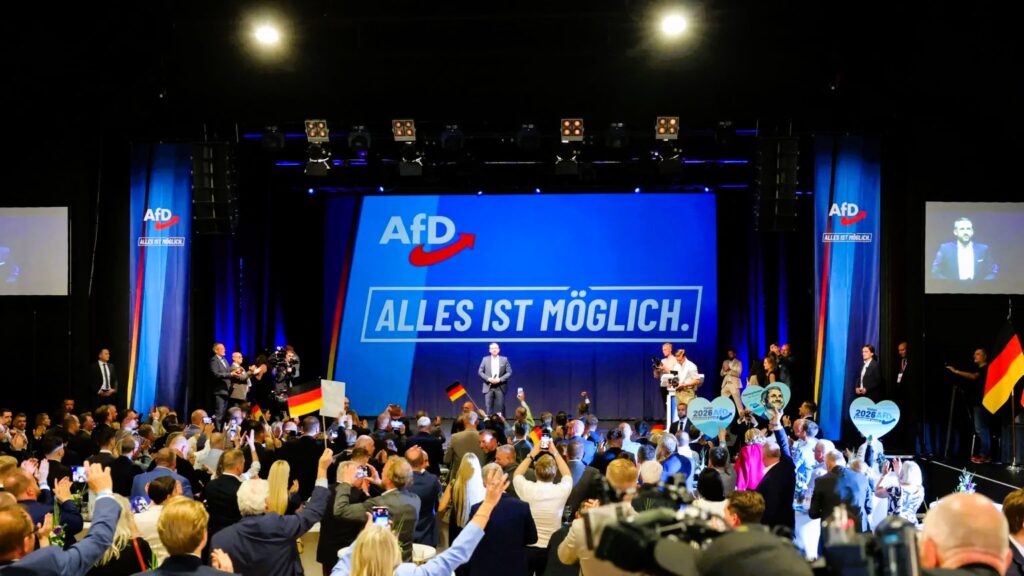
On September 6, 2026, the Alternative for Germany (AfD) won 43.8% of the vote in Saxony-Anhalt, securing 39 of the state parliament’s 83 seats. The Christian Democratic Union (CDU), which had dominated the state for decades, collapsed to 17.2% and 15 seats. The SPD won 9.3%, the Greens 8.9%, Die Linke 8.6%, and the Sahra Wagenknecht Alliance (BSW) 5.3%. The AfD therefore finished three seats short of the 42 required for an outright majority. (The Guardian)
That arithmetic matters.
The AfD won the election.
It did not, however, win the ability to govern alone.
And that distinction is the first place where sensational headlines can mislead.
The more important fact is what happened underneath the numbers.
A party that Germany’s domestic intelligence authority in Saxony-Anhalt has classified as a confirmed right-wing extremist organisation has become the dominant political force in a German state. The classification is based on the authority’s assessment that the state AfD organisation has acted against core principles of Germany’s liberal democratic constitutional order, including human dignity and the democratic principle. (Sachsen-Anhalt)
This is therefore not an ordinary change of government. It is a warning about the changing relationship between voters and Germany’s political establishment. And the warning extends far beyond Germany.
The Numbers Tell Only Half the Story
The election result is striking not merely because the AfD won 43.8%. It is striking because the CDU fell from 37.1% in 2021 to 17.2%. That is a collapse of almost 20 percentage points. Meanwhile, the AfD more than doubled its previous result.
| Party | 2021 | 2026 | 2026 Seats |
|---|---|---|---|
| AfD | 20.8% | 43.8% | 39 |
| CDU | 37.1% | 17.2% | 15 |
| SPD | 8.4% | 9.3% | 8 |
| Greens | 5.9% | 8.9% | 8 |
| Die Linke | 11.0% | 8.6% | 8 |
| BSW | — | 5.3% | 5 |
| FDP | 6.4% | 2.6% | 0 |
The result should therefore not be reduced to a simple story of “the far right getting stronger.” It is also a story of the political centre losing voters.
That distinction is crucial. People do not necessarily vote for a protest party because they have suddenly embraced every part of its ideology. Sometimes they vote because they believe the established parties have stopped listening. That is the more uncomfortable question Germany now faces.
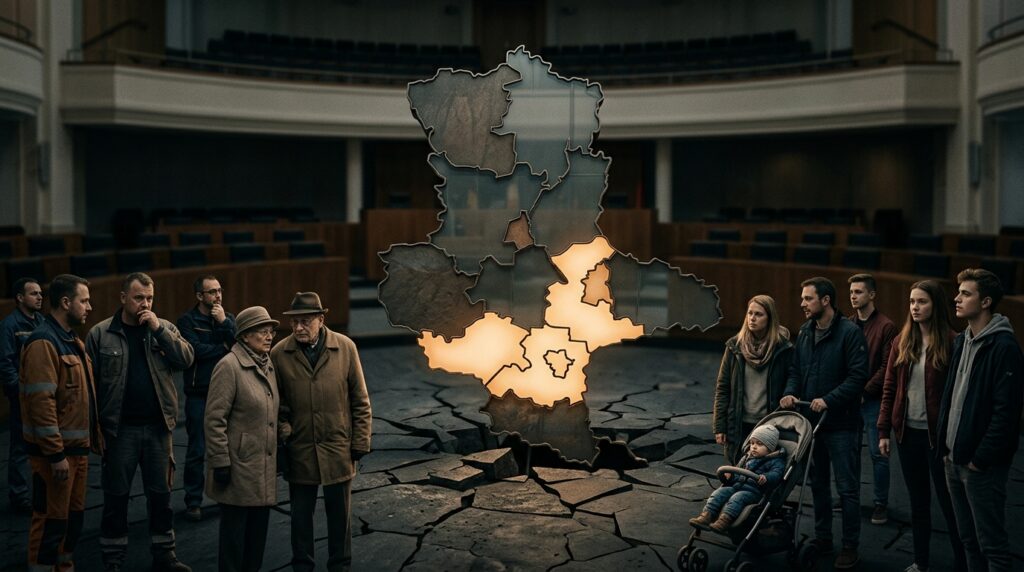
Why Did Voters Turn Toward the AfD?
There was no single cause. The evidence points toward an accumulation of grievances.
Economic insecurity.
Migration.
Social security.
Crime and internal security.
Energy costs.
Distrust of Berlin.
The war in Ukraine.
Fear of cultural change.
And growing frustration with established political parties.
The Konrad Adenauer Foundation’s post-election analysis found an unusually pessimistic mood in Saxony-Anhalt. Only 20% rated the economic situation as good or very good, a fall of 27 percentage points from 2021. Only 28% believed the state was well prepared for the future, compared with 41% five years earlier. Among AfD supporters, concerns about immigration, rising prices and declining living standards were particularly strong. (Konrad Adenauer Stiftung)
That is not merely ideological anger. It is economic anxiety mixed with cultural anxiety. And those two forms of anxiety can reinforce each other.
Germany’s Economic Problem Is More Than a Temporary Recession
Germany’s economic difficulties have become one of the most important political facts in the country.
The European Commission estimates that Germany’s economy grew only 0.2% in 2025 after two years of recession, with growth forecast at 0.6% in 2026 and 0.9% in 2027. The Commission points to high energy costs, weak exports, uncertainty and structural problems in major export-oriented industries. (Economy and Finance)
The German government itself has acknowledged the weakness.
Its 2026 annual economic report projected 1% growth for 2026, while stressing that the recovery would depend heavily on public investment and structural reforms. (Bundesregierung)
For a country accustomed to being Europe’s industrial powerhouse, this is psychologically significant. Germany’s traditional economic model depended on several pillars:
- Cheap and relatively reliable energy.
- Powerful industrial manufacturing.
- Export-driven growth.
- Large global markets.
- Skilled labor.
- Stable supply chains.
- Political stability.
Several of those pillars have been weakened simultaneously.
China has become a stronger industrial competitor.
Global trade has become more fragmented.
American tariff policy has created additional uncertainty.
Energy costs have risen.
Germany’s industrial transition has become expensive.
And Russia’s invasion of Ukraine destroyed the political assumption that deep energy interdependence with Moscow could continue indefinitely. The result is a particularly dangerous political combination:
People are being asked to accept major economic and geopolitical adjustments at precisely the moment when their personal economic confidence is weakening.
That is fertile ground for populism.
The Russian Gas Question
For years, Germany believed that economic interdependence could help stabilise relations with Russia. The logic was simple:
Trade creates dependence. Dependence creates mutual interest. Mutual interest reduces the probability of conflict.
The policy became associated with the phrase Wandel durch Handel—change through trade.
Then came February 2022.
Russia invaded Ukraine.
The European security order changed.
The energy relationship collapsed.
Germany was forced to diversify its energy supplies at enormous political and economic cost.
The argument over Russian energy therefore became much more than an argument over pipelines.
It became an argument over whether Germany had made a strategic mistake.
The AfD has exploited that question aggressively.
Its message is straightforward: Germany should have preserved cheaper energy relationships with Russia rather than accepting prolonged economic pain in the name of geopolitical confrontation.
Critics respond that restoring dependence on Russia would recreate the very strategic vulnerability that Moscow’s invasion exposed.
Both arguments appeal to genuine concerns. The disagreement is over which risk is more dangerous.
Migration: The Nationalities Behind Germany’s Debate
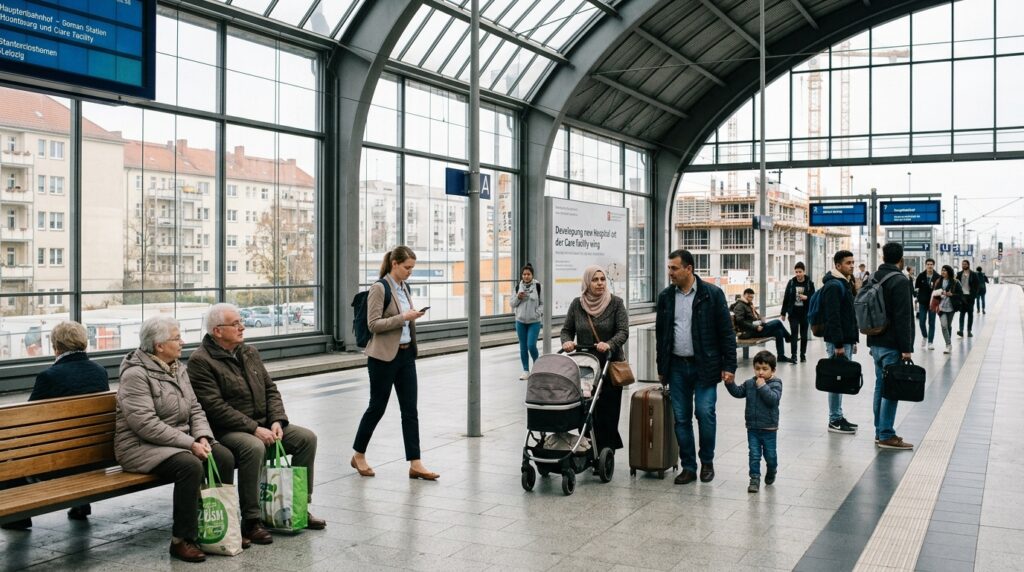
Migration has become one of the most emotionally charged issues in German politics. But the debate is often reduced to a misleading question: Which nationality worries Germans the most? The reality is more complicated.
Germany’s concern is not directed uniformly at one nationality. It is shaped by a combination of the number of arrivals, asylum applications, integration outcomes, pressure on local services, security concerns, and the difficulty of returning people whose asylum claims have been rejected.
Afghans and Syrians have been particularly prominent in Germany’s recent asylum debate. Turks also feature prominently in the statistics, although their story is very different because Germany has had a large Turkish-origin population for generations. Iraqis, Somalis and Eritreans are smaller groups but have also appeared significantly in asylum and integration discussions.
The distinction matters. A person arriving from Afghanistan or Syria is not automatically a security or integration problem. Many have legitimate protection claims, and large numbers have built ordinary lives in Germany. Treating an entire nationality as a problem would be both unfair and analytically weak.
Ukrainians are different
Germany has received a very large Ukrainian population since Russia’s full-scale invasion. But Ukrainians generally entered under a special temporary-protection framework rather than the conventional asylum system.
German statistics show that among people entering Germany for the first time in 2025, Ukrainians were by far the largest nationality in the protection-seeking category: 137,515 people, compared with 38,540 Syrians and 23,110 Afghans. Yet politically, the debate is different.
The questions increasingly concern:
- How long temporary protection should continue.
- Employment.
- Housing.
- Social benefits.
- Integration into schools and the labour market.
- Whether Germany can sustain long-term assistance.
This is important because migration fatigue does not necessarily mean hostility toward refugees. People can sympathise strongly with Ukrainians while simultaneously questioning the cost and duration of government support.
The political issue is really about how Germany manages migration from beginning to end.
Who is allowed to enter? Who qualifies for protection? How quickly are asylum applications decided? Can newcomers learn German and find employment? Can municipalities provide housing, schools and healthcare? And what happens when an asylum application is rejected?
These questions have become increasingly important because Germany faces a demographic contradiction.
The country is ageing and needs additional workers. Immigration can help fill labour shortages and slow the decline of the working-age population. Yet large-scale migration can also put pressure on housing, schools, local government budgets and welfare systems, particularly when arrivals are concentrated in communities that already struggle with limited resources.
That contradiction has created fertile political ground.
For many voters, the concern is not simply “too many foreigners.” It is a broader feeling that the state has lost control of a process that affects everyday life. A crowded housing market, pressure on municipal services, uncertainty about welfare spending or concerns about crime can become connected in the public mind with migration, even when the underlying causes are more complicated.
This is where the AfD has been politically effective.
The party has taken separate anxieties—migration, crime, economic insecurity, cultural change, welfare pressure and distrust of established political parties—and combined them into one powerful narrative: Germany’s political establishment is no longer protecting the interests of ordinary Germans.
That message does not mean every AfD voter is hostile to migrants. Nor does it mean migration alone explains the party’s historic success in Saxony-Anhalt. Economic stagnation, the cost of living, dissatisfaction with established parties, the war in Ukraine and broader concerns about Germany’s direction all played a role.
But migration provides something particularly powerful in politics: a visible issue that voters encounter in their own communities and that can be connected to much larger fears about identity, security and the future.
There is another uncomfortable reality that Germany cannot escape. The country needs immigrants economically while simultaneously struggling to manage the political and social consequences of immigration. Closing the door completely would not solve Germany’s demographic problem. Leaving the system poorly controlled would not solve its political problem either.
The challenge, therefore, is not simply whether Germany should have migration. It is whether Germany can build a system that is humanitarian without being chaotic, open to needed workers without abandoning border control, and firm on rejected asylum claims without abandoning the principles of human dignity and the rule of law.
That is the migration dilemma behind the AfD’s rise, and one of the reasons the issue has become so politically explosive.
Social Security Was Even More Important Than Many Headlines Suggested
One of the most revealing findings from the election was that the AfD’s victory cannot be explained by migration alone.
According to ARD/infratest dimap data, social security was the most important issue for 25% of voters, followed by peace in Europe at 17% and the economy at 15%. For AfD voters specifically, crime and internal security and migration were particularly important. (tagesschau.de)
That matters because it changes the narrative. The election was not simply:
Immigration → AfD.
It was closer to:
Economic insecurity + social insecurity + migration concerns + distrust of government + geopolitical anxiety → AfD opportunity.
That is a much more serious political diagnosis.
Ukraine: When a Foreign War Becomes a Domestic Political Issue
This may be the most consequential part of the story for Europe. The Ukraine war began as a foreign-policy and security crisis. It has gradually become a domestic political issue.
Germany has provided major financial and military assistance to Ukraine. Berlin has also moved toward greater defence spending and stronger NATO commitments. But not everyone sees the policy in the same way.
For some Europeans, supporting Ukraine is a matter of defending the rules of international order.
For others, endless weapons deliveries represent an open-ended commitment to a war with no clear political end. The AfD has exploited the second argument. And in Saxony-Anhalt, it worked.
ARD data showed that 57% of voters supported the AfD position that Germany should stop supplying weapons to Ukraine. Among AfD supporters, the figure was 92%. At the same time, 48% of voters considered Russia a strong security threat to Germany, while 66% of AfD supporters did not. (tagesschau.de)
That is an extraordinary political divide. But it needs to be interpreted carefully.
It does not mean that 43.8% of Saxony-Anhalt voters support Russia.
Nor does it mean every AfD voter wants Ukraine to lose. The more accurate conclusion is that the war has become a vehicle for expressing dissatisfaction with Germany’s foreign-policy direction. That distinction matters.
Ukraine Fatigue: The Accelerant, Not the Original Fuel
The European public has not abandoned Ukraine. That point is essential.
The Spring 2026 Eurobarometer found that 76% of Europeans believed Russia’s invasion of Ukraine was a threat to EU security, while 76% supported continuing to support Ukraine until a just and lasting peace is achieved. Eighty-one per cent supported a common EU defence and security policy. (European Union)
So the simplistic argument that “Europe is tired of Ukraine” is wrong.
The more accurate picture is conditional support.
Europeans can support Ukraine and still question the cost.
They can oppose Russian aggression and still want negotiations.
They can support humanitarian assistance while questioning unlimited military commitments.
They can believe Russia is dangerous while believing the war needs a diplomatic exit. That distinction is increasingly important politically.
Research from Eurofound has also identified signs of war fatigue, particularly among financially insecure Europeans. Support for helping displaced Ukrainians and providing aid remains substantial, but dissatisfaction with government policies has risen among financially vulnerable groups. (Eurofound)
The political danger for Europe’s mainstream parties is therefore not necessarily their support for Ukraine. It is the possibility that they appear unable to explain where the policy ultimately leads. A policy without an identifiable endpoint eventually becomes vulnerable to the accusation of being permanent. And permanent war is politically difficult to sell.
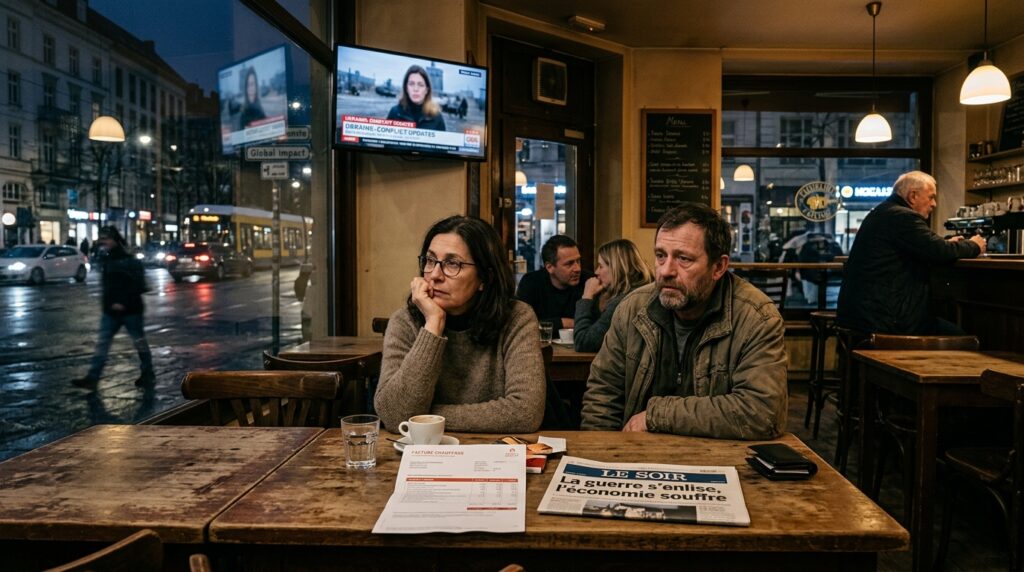
The Real Political Formula
The interaction of these forces can be expressed simply:
Economic stagnation → energy insecurity → rising living costs → migration pressure → declining trust → cultural polarisation → dissatisfaction with established parties → Ukraine and war fatigue → populist opportunity.
This is why Ukraine should be described as an accelerant, not the original fuel. The fuel was already there. The war added oxygen.
The Brandmauer Is Now Under Pressure
Germany’s postwar political system created a powerful taboo against cooperation with extremist parties. It is commonly described as the Brandmauer—the firewall. The basic idea is simple:
Mainstream democratic parties do not form coalitions or formal governing arrangements with the AfD.
The AfD’s 43.8% result has now put that principle under enormous pressure.
The party holds 39 seats.
A majority requires 42.
So it needs only three additional votes.
But arithmetic is not the same thing as political legitimacy.
The CDU, SPD, Greens and Die Linke have rejected coalition cooperation with the AfD. The BSW has also said it currently does not intend to enter a coalition with the AfD, although it is open to cooperation on individual issues and has discussed the possibility of a minority government. (tagesschau.de)
That creates a remarkable situation.
The largest party may find itself unable to govern.
But it can still influence the government.
It can force other parties to respond to its issues.
It can shape the political agenda.
And it can argue that the establishment is preventing voters’ choice from being translated into government.
That is precisely where the firewall becomes politically dangerous.
Does the Firewall Protect Democracy or Strengthen the AfD?
There is no easy answer.
Supporters argue that cooperation would normalise an extremist party and weaken democratic safeguards.
Critics argue that permanently excluding a party with a huge electoral base can make the political system appear arrogant and unresponsive. Both arguments contain a serious point.
If mainstream parties cooperate with the AfD, they risk legitimising positions that Germany’s constitutional system considers dangerous. If they refuse all cooperation indefinitely, the AfD can tell voters:
“They are afraid of you.”
That is powerful political ammunition. The deeper problem is not the firewall itself. It is whether mainstream parties can produce convincing policies without simply copying the AfD. If they cannot, the firewall becomes increasingly difficult to defend politically.
The AfD Is No Longer a Protest Party
This may be the most important transformation. The AfD began as a protest against the euro and Germany’s handling of the European debt crisis.
It evolved.
Migration became central.
National identity became central.
Anti-establishment politics became central.
Then Ukraine, Russia and energy became major themes.
The party now claims competence across almost every major policy field.
ARD’s election-day analysis found that voters increasingly regarded the AfD as competent not only on migration and crime but also on economic policy, energy, employment, education, social justice and even peace. (tagesschau.de)
That is a critical development. A protest party says:
“The others are failing.”
A governing party must eventually say:
“Here is what we will do instead.”
The AfD has now reached the point where voters will increasingly judge it by the second question. That is where electoral success becomes much harder.
What Does “Right-Wing” Actually Mean in Europe?
The terminology itself has become part of the problem.
Not every right-wing party is far-right.
Not every conservative voter is a nationalist.
Not every nationalist is an extremist.
Europe’s political spectrum is better understood as a continuum:
Center-left → Center → Center-right → Right → Radical right → Far-right
Centre-right parties generally operate comfortably within liberal democracy and constitutional government.
Radical-right parties may combine nationalism, strong anti-immigration policies and hostility toward aspects of liberal pluralism.
Far-right politics goes further, often challenging fundamental principles of liberal democracy, pluralism, minority equality or constitutional constraints.
That distinction is particularly important in Germany.
The AfD is commonly described as a far-right party in contemporary reporting, and Germany’s Saxony-Anhalt intelligence authority has specifically classified its state organisation as confirmed right-wing extremist. (Sachsen-Anhalt)
But it would be analytically careless to describe every AfD voter as a far-right extremist.
Voters are not political categories.
They are people.
Some vote because of migration.
Some because of economic insecurity.
Some because of distrust.
Some because of Ukraine.
Some because of cultural identity.
Some because they simply want to punish the government.
A serious investigation must distinguish between the party, its ideology, and its electorate.
Germany Is Not Alone: Europe’s Political Centre Is Under Pressure
The German election is part of a wider European story. But it would be wrong to describe Europe as experiencing one uniform far-right revolution. The political picture is more fragmented.
In France, the Rassemblement National remains one of the continent’s strongest nationalist forces.
In Austria, the FPÖ has transformed the political balance.
In Italy, Giorgia Meloni’s Brothers of Italy leads a right-wing government, although Meloni’s foreign policy is substantially more pragmatic and pro-European than that of the AfD.
In the Netherlands, Geert Wilders’ PVV has reshaped the immigration debate.
In Portugal, Chega has become a major political force.
In Sweden, the Sweden Democrats have influenced mainstream policy even without being the country’s dominant governing party.
In Spain, Vox remains an important nationalist force.
In Romania, Poland, Czechia, Slovakia, Finland, Croatia and elsewhere, nationalist or radical-right movements have become significant political players.
But recent European developments also show setbacks for the radical right in some countries. The trend is therefore not a straight line upward.
It is a struggle.
The political centre is being challenged.
But it has not disappeared.
Italy Shows Why “The European Right” Is Not One Thing
Italy provides an important counterexample to simplistic analysis. Giorgia Meloni came to power through a party rooted in the nationalist right. Yet her government has maintained a broadly pro-NATO and pro-Ukraine position while working within European institutions. At the same time, harder-right forces inside Italy are pushing in a very different direction.
Roberto Vannacci’s newly formed Futuro Nazionale has criticised deeper EU integration and attacked European policies, while Ukraine aid and defence spending have become increasingly controversial issues inside Italy. (Reuters)
This demonstrates something important:
The European right is not a single army marching under one flag.
Some parties want to reform the EU.
Some want to weaken it.
Some want to leave parts of the EU’s policy architecture.
Some support NATO.
Some distrust NATO.
Some support Ukraine.
Others want negotiations or an end to military assistance.
Some want economic protectionism.
Others remain committed to business-friendly policies.
Calling all of them “far-right” may generate headlines. It does not generate good analysis.
And Then There Is America
The United States belongs in this story. Not as another European right-wing country, obviously. But as an external political force, and increasingly as an ideological reference point. Donald Trump’s return to the White House has given nationalist-populist politics enormous global visibility.
The modern American right has moved toward:
- Stronger immigration restrictions.
- National sovereignty.
- Economic protectionism.
- Scepticism toward international institutions.
- Cultural conservatism.
- Opposition to progressive identity politics.
- Greater emphasis on national economic interests.
- A more transactional approach to alliances.
- Greater scepticism toward prolonged foreign wars.
These themes overlap with parts of Europe’s nationalist right. But overlap does not mean identity. The American and European right are better described as political cousins, not identical twins.

MAGA and Europe’s Nationalist Right
Trump has demonstrated that political movements once considered outside the mainstream can move into the centre of national power. That matters psychologically. European nationalist parties can now point across the Atlantic and say:
“It has already happened there.”
The AfD has actively sought relationships with Trump’s political movement, and Trump himself has commented favorably on the AfD’s Saxony-Anhalt breakthrough. On September 8, 2026, Trump attributed the AfD’s success to what he described as Germany’s “horrible” immigration rules. (Reuters)
This is politically significant. But there is a paradox. Trump’s America may encourage European nationalism while simultaneously weakening European confidence in America.
Pew Research’s 2026 survey of 42,151 adults in 36 countries found especially negative European views of Trump. Majorities in all ten European countries surveyed lacked confidence in him to do the right thing in world affairs, while confidence in the United States as a reliable partner had declined in much of Europe. (Pew Research Center)
So Europe faces a strange contradiction:
Parts of Europe’s right feel ideologically closer to Trump’s America, while many Europeans feel less strategically comfortable with America.
That is one of the most important geopolitical developments of the present moment.
Ukraine Creates the Biggest Transatlantic Fault Line
The Ukraine war makes this even more complicated. The traditional postwar security model was relatively straightforward:
America leads → NATO provides the shield → Europe supports the alliance → transatlantic unity holds.
Trump’s second presidency has disrupted that assumption. European governments are now being forced to consider whether they can defend themselves if American commitment becomes more conditional. That creates two possible political reactions.
One is nationalist:
“Europe must take back control of its security, borders and sovereignty.”
The other is integrationist:
“Europe must become more capable because America may no longer guarantee European security in the same way.”
The first strengthens nationalist parties. The second could strengthen the European Union. That is why America’s rightward shift does not automatically produce a European rightward shift. It can produce a European strategic awakening instead.
The United States Is Both a Model and a Warning
For Europe’s right, Trump represents proof that nationalist-populist politics can win.
For Europe’s political establishment, Trump represents a warning about what happens when political polarisation becomes permanent. For European security planners, Trump raises a different question:
Can Europe remain dependent on American military power while simultaneously disagreeing with American political priorities?
That question has no easy answer. And it will become more important if Europe’s nationalist parties continue to gain influence.
The Russia Question Is Back
The European political debate is now divided over a fundamental strategic question:
Is Russia primarily a threat that must be contained, or a power with which Europe must eventually negotiate?
The mainstream security establishment generally emphasises deterrence and the danger of rewarding territorial aggression. Parts of the European radical right argue that prolonged confrontation with Russia damages Europe more than it damages Moscow. The AfD is firmly positioned in the latter camp. That is particularly powerful in parts of eastern Germany, where historical memories of Soviet occupation, economic relationships with Russia and scepticism toward Berlin intersect.
Reuters reporting before the election found that Russia had become a particularly sensitive issue in former East Germany, with some voters viewing Moscow through a different historical and cultural lens than voters in western Germany. (Reuters)
This does not mean eastern Germany is “pro-Russian.” It means the historical experience is different. And history matters in elections.
The Historical Weight of Russia
Europe’s relationship with Russia has never been simple. Imperial Russia fought wars across eastern and northern Europe.
The Soviet Union occupied or dominated large parts of Central and Eastern Europe after the Second World War.
The Cold War divided Germany itself.
NATO was built partly around the possibility of Soviet expansion.
After 1991, however, Europe tried something different.
It attempted to replace military confrontation with economic integration.
Germany became one of the most important examples of that strategy.
Energy flowed from Russia.
German capital and technology flowed east.
Trade created interdependence.
The assumption was that economic interests could restrain geopolitical conflict.
Ukraine destroyed that assumption.
The question now is what replaces it.
Three Futures for Europe
Europe is entering a period in which several different futures remain possible.
Scenario One: Populist Escalation
Mainstream parties refuse to cooperate with radical-right parties but fail to address the economic and social grievances behind their rise.
Economic weakness continues.
Migration remains politically explosive.
Ukraine remains unresolved.
Energy remains expensive.
Voters become more frustrated.
The radical right grows further.
This is the most dangerous scenario for Europe’s political centre because it allows populist parties to campaign permanently as outsiders without ever being tested fully by government.
Scenario Two: Mainstream Adaptation
Traditional parties recognise that voters want stricter migration control, cheaper energy, stronger internal security and a more clearly defined strategy for Ukraine.
They adapt.
They tighten migration policies.
They reform energy policy.
They address industrial competitiveness.
They strengthen local services.
They develop a credible diplomatic strategy alongside military deterrence.
The centre survives by changing.
This is not the same as copying the AfD.
It means addressing the problems that gave the AfD its opening.
Scenario Three: European Strategic Rebuilding
Europe accepts that the post-Cold War security model is finished.
It increases defence capabilities.
It strengthens energy independence.
It diversifies trade.
It reduces strategic dependence on both Russia and, where necessary, the United States.
It maintains support for Ukraine while simultaneously pursuing a credible diplomatic pathway toward a sustainable settlement.
It reforms the EU so that national concerns can be addressed without destroying European cooperation.
This would represent neither surrender to Russia nor permanent dependence on America. It would represent a more self-reliant Europe.
What Would De-Escalation Look Like?
A durable European security architecture cannot be built around permanent confrontation. But peace cannot simply mean freezing the current conflict and hoping nothing happens again. A serious de-escalation framework would require several layers.
First: Reduce the Risk of Direct NATO-Russia Conflict
Military communication channels, airspace rules, maritime safety mechanisms and crisis hotlines should remain functional even when political relations are hostile.
Second: Pursue a Structured Negotiation Process
A ceasefire, if achievable, should be supported by monitoring mechanisms and credible security arrangements. The lesson of previous ceasefires is clear:
A ceasefire without enforcement can become merely a pause before the next war.
Third: Rebuild European Security Architecture
Europe needs a security structure that reduces the probability of another large-scale war.
That means arms control.
Transparency.
Force-posture discussions.
Crisis communication.
Border security.
Energy resilience.
And a realistic understanding of Russia’s security interests without granting Moscow a veto over the sovereignty of neighbouring states.
What the AfD Victory Means for Germany
The first consequence is political. The CDU’s traditional dominance in Saxony-Anhalt has been badly damaged.
The second is psychological.
The AfD can no longer be dismissed as merely a protest party.
The third is national.
Germany’s federal government now has to confront the possibility that the same grievances could reshape future elections.
The fourth is European.
Germany has traditionally been one of the principal anchors of the European political project. A stronger nationalist party in Germany therefore has consequences for EU migration policy, defence, sanctions, Ukraine, energy policy and fiscal debates.
The fifth is geopolitical.
A Germany with a significantly stronger anti-establishment and Russia-sceptical political force could make European consensus more difficult.
What It Does Not Mean
The election does not mean:
- Germany has become an AfD state.
- The AfD can govern alone.
- 43.8% of voters are far-right extremists.
- Germans have rejected democracy.
- Germans have rejected the EU.
- Germans have become pro-Russian.
- Europeans have abandoned Ukraine.
- Europe is uniformly moving to the far right.
- America controls Europe’s political transformation.
Those conclusions go beyond the evidence. The real picture is more complicated. And therefore more important.
The Bigger Crisis Is Trust
Political systems rarely collapse because voters suddenly become radical. They weaken when people stop believing that established institutions can solve ordinary problems.
Can I afford my electricity bill?
Can my children find good jobs?
Will my pension be enough?
Is my neighbourhood safe?
Can my local school cope?
Will my government control the border?
Why is the economy not growing?
How long will the war continue?
Why does the government keep asking for sacrifice?
And perhaps the most dangerous question:
Does anyone in Berlin actually listen to people like me?
Those questions are more politically powerful than ideology alone. The AfD has understood that. The question is whether Germany’s mainstream parties have.
Europe Faces a Choice But Not the Choice Often Presented
The European debate is frequently presented as:
Far right or democracy.
That is too simplistic.
The real choice is closer to:
Can liberal democracy adapt to legitimate public anxiety without surrendering its constitutional principles?
That is the challenge.
If mainstream parties dismiss every concern about migration as xenophobia, they lose voters.
If they dismiss every concern about Ukraine as pro-Russian, they lose voters.
If they dismiss every concern about energy prices as climate denial, they lose voters.
If they dismiss every concern about globalisation as nationalism, they lose voters.
But the opposite is equally dangerous.
If political parties exploit fear of migrants, demonise minorities, weaken constitutional safeguards or undermine democratic institutions, they may win votes while damaging the system those voters depend upon. Democracy requires both responsiveness and restraint.
The German Election Is a Warning, Not a Verdict
The AfD’s 43.8% result is historic.
But history does not end with an election result.
The party now has to demonstrate whether it can convert opposition politics into effective government.
That will be harder.
Running against the establishment is easy.
Running the government is not.
It means budgets.
Hospitals.
Schools.
Infrastructure.
Industrial investment.
Labor shortages.
Energy prices.
EU rules.
Federal relations.
Foreign policy.
And accountability.
The same voters who punish established parties today can punish new governments tomorrow. That is democracy’s great equaliser.
The Global Significance
The real significance of Saxony-Anhalt is not that Germany has suddenly become something it was not. It is that a political model that once lived on the margins is now close enough to power to force every major party to respond. And that model is not confined to Germany.
It exists in different forms across Europe.
It exists in America.
It is being shaped by economic insecurity.
It is being intensified by migration debates.
It is being accelerated by geopolitical conflict.
It is being fueled by distrust.
And it is being amplified by social media, political polarisation and the collapse of old assumptions.
The Western political order is therefore entering a new phase. The question is no longer whether the political right will influence Europe. It already does.
The question is what kind of right will emerge, how far it will move, and whether democratic institutions can absorb the pressure without breaking.
Final Assessment: The Earthquake Was Building Before the Vote
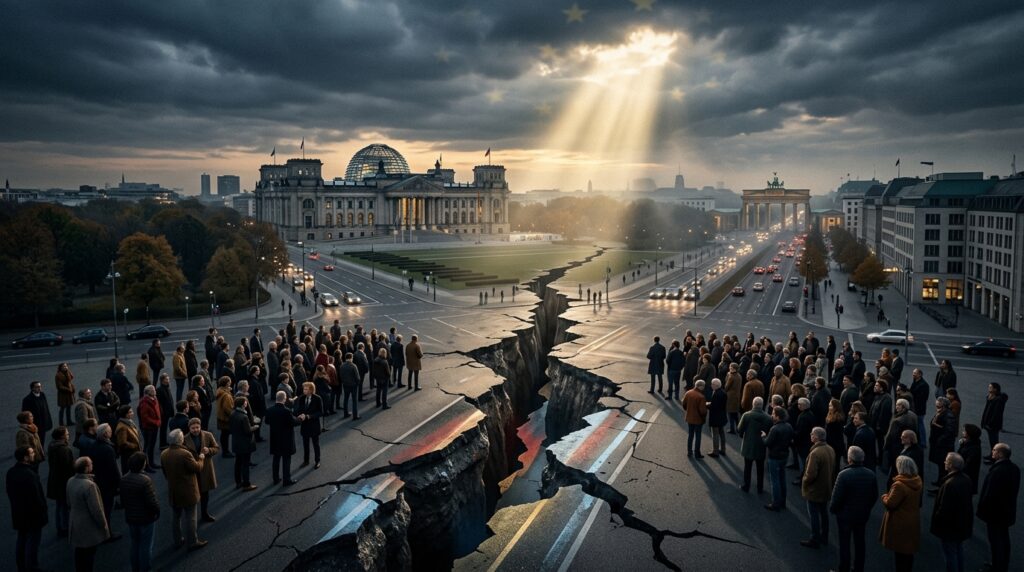
The AfD did not create Germany’s political earthquake. It detected the fault lines.
Economic stagnation created one.
Energy insecurity created another.
Migration created another.
The Ukraine war created another.
Distrust in political institutions created another.
The growing distance between eastern and western Germany created another.
And America’s own political transformation added a transatlantic dimension.
The September 2026 election merely revealed how deep those cracks had become.
That is why the result matters beyond Saxony-Anhalt.
Germany is not simply debating whether to cooperate with the AfD. Europe is debating what happens when millions of citizens believe that the old political consensus no longer represents their fears, priorities or economic reality.
And America is no longer standing outside that debate. Washington is now part of it. The political West is changing from within. The most important question is not whether the centre can stop the right.
It is whether the centre can earn back the trust that the right has learned to convert into votes.
Frequently Asked Questions
1. Why did the AfD win 43.8% in Saxony-Anhalt?
The result reflected several overlapping factors: dissatisfaction with established parties, economic insecurity, migration concerns, internal-security fears, social-security worries, energy costs and disagreement over Germany’s approach to the Ukraine war. Research after the election found particularly strong material and identity-related concerns among AfD voters. (Konrad Adenauer Stiftung)
2. Can the AfD govern Saxony-Anhalt on its own?
No. The AfD won 39 of 83 seats, while 42 are required for an outright majority. Other parties have rejected a formal coalition with it. The BSW has ruled out a coalition for now but remains open to cooperation on individual issues and has discussed the possibility of a minority government. (The Guardian)
3. Is Ukraine support responsible for the rise of the European right?
Not by itself. EU-wide support for Ukraine remains substantial: 76% of Europeans in the Spring 2026 Eurobarometer supported continuing support until a just and lasting peace. But war fatigue and concern about the costs of assistance are increasingly important among some groups, especially financially insecure voters. Ukraine therefore functions more as an accelerant of existing grievances than as the original cause of Europe’s political shift. (European Union)
4. Is every right-wing European party far-right?
No. European right-wing politics covers a wide spectrum from conventional centre-right conservatism to radical-right populism and far-right extremism. Treating all right-wing parties as identical obscures important differences over democracy, immigration, the EU, NATO, Russia and economic policy.
5. How is the United States connected to Europe’s right-wing shift?
America’s nationalist-populist transformation under Donald Trump has provided European nationalist movements with a powerful political example. There are ideological overlaps involving immigration, sovereignty, cultural politics, protectionism and scepticism toward established institutions. But the American and European right are not identical, and European parties have different positions on Ukraine, NATO and the EU. Pew’s 2026 research also shows that many Europeans have become significantly less confident in Trump and less comfortable with the United States as a reliable partner. (Pew Research Center)
6. Does the AfD victory mean Europe is inevitably moving to the far right?
No. The trend is significant but not inevitable or uniform. Radical-right parties are powerful in several European countries, while others have experienced setbacks. Mainstream parties can still respond successfully if they address economic insecurity, migration, public services, security and foreign policy without abandoning democratic safeguards. The European political centre is under pressure—but it is not dead. (AP News)
Author’s Perspective
Major Hamid Mahmood (Retired)
MA Political Science | LLB | PGD (HRM)
The central lesson of the Saxony-Anhalt election is not that Europe has suddenly become extremist. It is that political systems become vulnerable when ordinary citizens lose confidence that established institutions understand their problems. A democratic government does not have to agree with every demand made by its citizens.
But it must listen. Because when citizens feel unheard for too long, someone else eventually offers to speak for them.
References and Research Sources
- European Commission — Economic Forecast for Germany, 2026. Germany’s weak post-recession recovery, energy-cost pressures, export difficulties and structural challenges. European Commission: Economic Forecast for Germany
- German Federal Government — Annual Economic Report 2026. Official assessment of Germany’s economic outlook and structural reform agenda. German Federal Government: Annual Economic Report 2026
- Konrad-Adenauer-Stiftung — Analysis of the Saxony-Anhalt State Election, 2026. Voter attitudes, economic pessimism, identity concerns and electoral behavior. Konrad-Adenauer-Stiftung Election Analysis
- Tagesschau/ARD — Saxony-Anhalt Election Analysis. Election motivations, voter attitudes toward the AfD, migration, Russia and Ukraine. Tagesschau: Election Analysis
- Ministry of the Interior and Sports of Saxony-Anhalt — Constitutional Protection Information. Classification of the AfD state organization as a confirmed right-wing extremist organization. Saxony-Anhalt Interior Ministry: Constitutional Protection
- European Commission — Standard Eurobarometer 105, Spring 2026. European public opinion on Ukraine, EU security, defense and trust in European institutions. Eurobarometer 105: Spring 2026
- Eurofound — Support for Ukraine Still High Among EU Citizens. Evidence concerning continuing support alongside emerging war fatigue and financial insecurity. Eurofound: Support for Ukraine
- Federal Returning Officer — 2025 German Bundestag Election. National electoral context and the AfD’s 20.8% result. Federal Returning Officer: 2025 Bundestag Election Results
- Pew Research Center — European Views of Trump and the United States, 2026. Public confidence in Trump and perceptions of the United States among European populations. Pew Research Center: European Views of Trump and the U.S.
- Associated Press — European Far-Right Political Trends, September 2026. Comparative assessment of gains and setbacks among radical-right parties across Europe. Associated Press: European Far-Right Trends
- Reuters — Saxony-Anhalt Election and Germany’s Political Shift, September 2026. Election results, economic grievances, Ukraine policy and the national implications of the AfD breakthrough. Reuters: AfD Victory and Germany’s Political Shift
- MDR/Tagesschau — BSW and Post-Election Government Formation. Current BSW position on cooperation with the AfD and a possible minority government. Tagesschau: BSW and Government Formation