
Child Online Safety: Protecting Kids in the Age of Mobile Phones and Social Media
Child online safety: Imagine handing a child a playground that never closes, where strangers can walk in anonymously, advertisements can follow them home, and an algorithm quietly learns exactly what keeps them coming back. Now imagine that playground fitting inside a smartphone. That is the digital childhood millions of children are experiencing in 2026.
https://mrpo.pk/digital-detox/
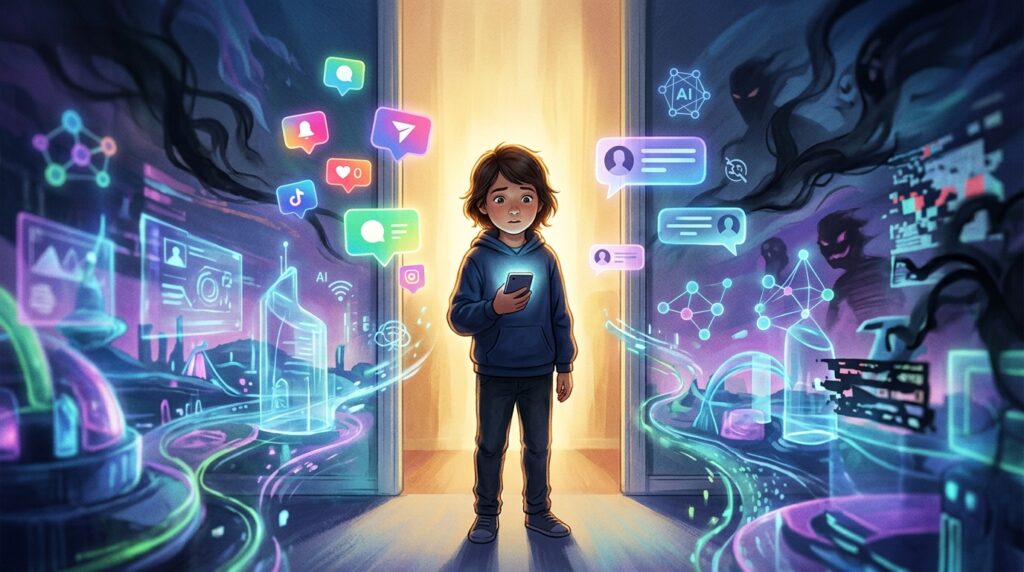
The challenge is no longer simply deciding whether children should use technology. They already do. The real question is far more difficult:
How do we give children the benefits of the digital world without allowing the digital world to consume their childhood?
From Australia’s under-16 social media restrictions to Europe’s privacy-preserving age-verification efforts, from China’s nationwide “Minor Mode” to growing child-safety initiatives in Pakistan, governments are experimenting with new ways to protect young users. But legislation alone cannot raise a digitally healthy child.
A child needs something more powerful than a parental-control button: digital judgment.
Keeping children safe online
Children are spending more time in the digital world than ever before, often without realising it. From smart toys and voice assistants to video games, chatbots and learning apps, artificial intelligence (AI) is becoming part of their everyday lives.
Unseen but powerful, AI systems shape children’s digital interactions and choices, suggesting videos to watch, articles to read, music to play and even people to connect with. But the rise of AI-driven technology brings serious risks, especially as changes in digital platforms outpace the safeguards and regulations needed to protect young users.
Most alarming is the threat of technology-facilitated sexual exploitation and abuse. It has never been easier for perpetrators to contact and extort children. Online perpetrators may be someone a child knows or a stranger. They often attempt to earn the child’s trust (or the trust of a caregiver) before manipulating victims into sharing sexually explicit videos or images. In some cases, sexual abuse is livestreamed: From the confines of their homes, perpetrators can direct the abuse of children far away.
Other forms of abuse, like peer-to-peer violence and cyberbullying, can thrive online. This, along with the rise of online hate and discrimination, contributes to the growing risk of self-harm and suicidal thoughts among children growing up in the digital era.
Purpose of the Article
This article examines how smartphones, social media, algorithms, gaming and emerging AI technologies are reshaping childhood and creating both unprecedented opportunities and serious risks. It explains the latest evidence on children’s digital well-being, explores real-world policy responses in Australia, Europe, China and Pakistan, and examines issues including cyberbullying, grooming, sextortion, privacy, excessive use, algorithmic manipulation and AI companions.
The article’s central purpose is to move the conversation beyond simple screen-time limits toward digital readiness, responsible parenting, safer technology design and digital literacy, helping parents, educators and policymakers prepare children to navigate the digital world safely and intelligently.
Why This Debate Has Changed
A decade ago, the central question was often:
“How much screen time is too much?”
Today, researchers increasingly ask better questions:
- What is the child doing on the screen?
- Is the content educational, social, creative or simply addictive?
- Is the child actively creating or passively scrolling?
- Is social media replacing sleep, exercise, schoolwork or family interaction?
- Is the child being exposed to bullying, sexual exploitation, harmful content or manipulative advertising?
- Does the child understand how algorithms influence what they see?
- Can the child recognise when an online relationship becomes dangerous?
- What happens when artificial intelligence becomes part of that relationship?
This shift matters.
The American Academy of Paediatrics now emphasises a personalised approach rather than a universal screen-time number. Its updated digital-media guidance stresses quality, context, developmental stage, sleep, physical activity and what digital media is crowding out.
The National Academies reached a similarly important conclusion in its major review of social media and adolescent health: the available evidence does not support the claim that social media itself causes population-level changes in adolescent health. Effects vary considerably depending on the individual child, the content, the platform features, and the circumstances of use. In other words:
The screen is not the whole story. The digital environment is.

The Digital Playground Is Already Huge
For today’s teenagers, social media is not an occasional activity. It is part of everyday social life.
Pew Research Centre’s 2025 research found that about nine in ten U.S. teens use YouTube, while majorities use TikTok, Instagram and Snapchat. More than half visit YouTube and TikTok daily, and a significant minority describe using some platforms almost constantly.
Its December 2025 research added another major development: 64% of U.S. teens reported using AI chatbots, with about three in ten saying they use them daily. Roughly one in five teens said they were on TikTok and YouTube almost constantly.
The digital playground is therefore expanding.
It is no longer just:
phone + social media.
It is now:
phone + social media + gaming + influencers + algorithms + livestreams + AI chatbots + synthetic images + personalized advertising.
That changes the safety equation.

The Promise: Technology Can Expand a Child’s World
It would be a mistake to portray technology as the enemy.
Used intelligently, digital tools can open doors that previous generations could barely imagine.
A child in a remote village can watch a university lecture.
A teenager can learn coding without attending a computer academy.
A budding artist can publish digital artwork to an international audience.
A student can explore ancient civilisations through virtual reality.
A young musician can compose, record and distribute music using inexpensive software.
A child who feels isolated in the physical world may find supportive communities online.
The American Psychological Association notes that social media can provide opportunities for social support, companionship and meaningful connection, particularly for young people who experience isolation or adversity offline.
Technology can therefore serve three very different purposes:
Consume.
Connect.
Create.
The problem begins when a child spends most of the digital day consuming algorithmically selected content while losing time for sleep, movement, relationships, imagination and real-world experience.
The goal should not be to eliminate technology.
It should be to move children from passive consumption toward purposeful use.
The Hidden Cost: What Does the Screen Crowd Out?
A two-hour educational project is not necessarily equivalent to two hours of endless short videos.
Nor is a video call with a grandparent equivalent to two hours of solitary scrolling.
This is why the concept of “crowding out” is so important.
Every hour has only 60 minutes.
If social media consumes another hour, that hour has to come from somewhere.
Perhaps it comes from sleep.
Perhaps exercise.
Perhaps homework.
Perhaps conversation with parents.
Perhaps outdoor play.
Perhaps boredom, which sounds trivial but is actually valuable because boredom gives children room to imagine, invent and explore.
The American Academy of Paediatrics specifically recommends protecting sleep, physical activity, family interaction and other developmental needs from being displaced by digital media.
So the better question may not be:
“How many hours did my child spend online?”
It may be:
“What important things disappeared because my child was online?”
Mental Health: The Evidence Is Serious, But More Complicated Than Headlines Suggest
This is where responsible journalism matters.
It is tempting to write:
“Social media causes depression.”
The evidence does not support such a simple universal statement.
The U.S. Surgeon General has warned that we cannot currently conclude that social media is sufficiently safe for children and adolescents and has called for immediate action to reduce potential harms.
At the same time, the National Academies found that the evidence remains insufficient to establish a simple population-level causal relationship between social media use and adolescent health outcomes.
Both statements can be true.
Why?
Because children do not experience social media in the same way.
One teenager may use Instagram to maintain friendships and feel connected.
Another may spend hours comparing their appearance with carefully edited influencers.
One child may use YouTube to learn mathematics.
Another may fall into an endless recommendation loop.
One teenager may find an online community that provides genuine emotional support.
Another may encounter cyberbullying, eating-disorder content, self-harm material or predatory adults.
The risk is therefore shaped by the interaction between:
the child + the content + the platform + the design + the social environment.
That is much more complicated than a stopwatch.
The Algorithm Is Not Neutral
There is another issue parents often overlook.
Children are not simply choosing content.
Content is also choosing them.
Recommendation systems learn what attracts attention and then recommend more of it.
Watch one video about dieting.
Another appears.
Watch a controversial political clip.
More extreme versions may follow.
Watch frightening content.
The system learns.
Watch prank videos.
The feed adapts.
This does not mean every algorithm is deliberately trying to harm children.
It means that systems optimised around engagement can unintentionally create powerful feedback loops.
That is why Europe’s 2025 guidelines for protecting minors under the Digital Services Act specifically address persuasive and addictive design features. The European Commission recommended measures such as disabling features that encourage excessive use, including certain notifications, autoplay and engagement-driven mechanisms, while also strengthening privacy and parental controls.
This is an important evolution in thinking.
Child safety is not only about teaching children to resist technology. It is also about asking technology companies to stop designing environments that make resistance unnecessarily difficult.
A New Risk in 2026: Children and AI Companions
The next digital safety challenge may not look like social media at all.
It may look like a friend.
AI chatbots can answer questions, help with homework, generate stories and encourage creativity. But children may also use conversational AI for companionship, emotional support or private conversations.
That creates unfamiliar questions.
What happens when a child begins trusting an AI system more than a parent?
What happens when an AI gives poor advice?
What happens when a chatbot reinforces a child’s fears or unhealthy beliefs?
What happens when an emotionally vulnerable child treats an artificial system as a human confidant?
Pew’s 2025 research shows just how quickly AI chatbots have entered teenage life: nearly two-thirds of U.S. teens surveyed said they had used them.
Parents therefore need a new rule:
Teach children that an AI can be useful without being a trusted adult.
AI literacy is becoming part of digital literacy.

The Real Dangers Parents Should Know
The risks are broader than screen addiction.
Cyberbullying
A cruel comment in a classroom can disappear when the school bell rings.
A cruel post can remain visible at midnight, be shared hundreds of times and follow a child into the bedroom.
That permanence can amplify the emotional impact of bullying.
Grooming and Exploitation
A stranger does not necessarily look like a stranger online.
A predator may present themselves as another teenager, an admirer, a gaming partner or a helpful friend.
Trust can be developed slowly.
That is precisely why children need to understand that online friendship does not automatically equal real-world trust.
Sextortion and Image-Based Abuse
A child may be manipulated into sharing a private image and then threatened with publication.
The correct response is not:
“Why did you do something so stupid?”
It is:
“You are safe with me. We will deal with this together.”
Shame drives children into silence.
Silence benefits predators.
Privacy and Data
Children often do not understand the long-term value of personal information.
A photograph can reveal a school uniform.
A background can reveal a home address.
A location tag can reveal where a child regularly spends time.
A seemingly harmless quiz can collect personal information.
Digital literacy must therefore include data literacy.
Children should understand that information posted online can travel far beyond its intended audience.
Commercial Manipulation
Children are especially vulnerable to advertising because they are still developing the ability to distinguish persuasion from information.
Influencers, games, virtual currencies, loot boxes, targeted advertising and personalised recommendations can blur that boundary.
The European Commission’s child-protection guidelines specifically address manipulative commercial practices and recommend stronger protections for minors.
From “Grooming” to Digital Readiness
The original concept of “grooming children for safe use” is useful, but the word grooming itself can be confusing because it is also widely used to describe sexual exploitation.
A better phrase is:
Digital readiness.
Before giving a child greater digital independence, parents can gradually teach five capabilities:
1. Privacy
What should never be shared?
Name, address, school location, passwords, live location and private photographs.
2. Verification
How do you know someone is who they claim to be?
The answer is simple:
You don’t automatically know.
3. Emotional control
What should you do when someone makes you angry, frightened or excited?
Pause.
Do not immediately reply.
Save evidence.
Talk to someone you trust.
4. Critical thinking
Who created this content?
Why?
What are they trying to make me believe, buy or do?
5. Reporting
Children should know how to block, report and seek help.
A safety rule that a child cannot remember under pressure is not much of a safety rule.
What Parents Can Actually Do
The best digital safety system is not a spy operation.
It is a relationship.
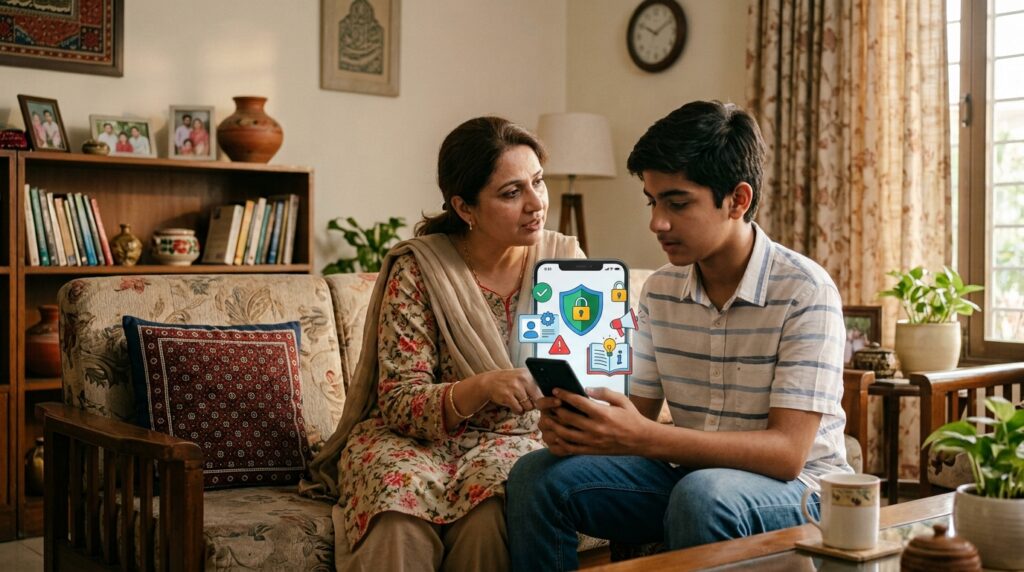
The American Psychological Association recommends active adult monitoring during early adolescence, particularly around ages 10–14, combined with discussion, coaching, and gradually increasing autonomy as digital literacy develops.
That suggests a practical progression.
Young children
Use devices together.
Keep accounts private.
Avoid unsupervised social media.
Use parental controls.
Keep devices out of bedrooms.
Early adolescents
Discuss algorithms.
Review privacy settings together.
Talk about online friendships.
Teach blocking and reporting.
Monitor more actively.
Older teenagers
Increase independence gradually.
Discuss digital footprints.
Talk about AI.
Discuss relationships, sextortion, misinformation and financial scams.
Continue checking in without turning every conversation into an interrogation.
The objective is to move from:
control → coaching → independence.
Build a Family Digital Constitution
Instead of issuing a long list of rules that children eventually ignore, families can create a short written agreement.
For example:
Our family rules
- No phones during family meals.
- No devices in bedrooms overnight.
- No secret accounts.
- No sharing private photographs.
- No meeting online contacts without an adult knowing.
- If something frightening happens online, tell an adult immediately.
- Parents agree not to humiliate or punish a child for reporting a problem.
- Everyone in the family, including adults, follows the same basic rules.
That last rule matters.
Children notice hypocrisy.
A parent who spends dinner staring at a phone has a weak argument for a phone-free dinner.
The AAP similarly emphasises parental role-modelling and the importance of a family media plan rather than relying on children alone to regulate themselves.
Real-Life Lesson From Pakistan: A Teenager Teaching Other Children
One of the most encouraging examples comes from Pakistan.
UNICEF Pakistan reported the story of Shahzeb, a 15-year-old from Rajanpur who used the internet for business and social media but became concerned about the risks children face online.
After receiving child-online-protection training through an initiative involving UNICEF, the Pakistan Telecommunication Authority and partners, he began teaching other children about privacy, bullying, harassment, passwords, reporting and parental controls.
Instead of treating teenagers merely as potential victims, the program turned one teenager into a digital-safety educator.
That is a powerful idea.
Children can be part of the solution.
UNICEF reported that related training and awareness activities reached children, caregivers and educators across several parts of Pakistan.
The lesson is universal:
Sometimes the best person to explain digital danger to a teenager is another teenager who has learned how to recognise it.
Pakistan Is Entering the Same Debate
Pakistan is not standing outside this global conversation.
In October 2025, the Pakistan Telecommunication Authority and Meta launched Instagram’s Teen Accounts initiative in Pakistan, designed to provide stronger default protections for younger users, including restrictions on unwanted contact and sensitive content.
In July 2025, a private member’s Social Media (Age-Restricted Users) Bill proposed restricting social-media accounts for people under 16. However, the Senate record shows that the bill was subsequently withdrawn by its movers on August 18, 2025. It should therefore not be described as a current nationwide under-16 social-media ban.
Pakistan has also continued developing child-online-protection initiatives involving the PTA, UNICEF, the National Commission on the Rights of the Child and National CERT.
This distinction matters.
A proposal is not a law.
And a safety feature is not the same thing as a nationwide age restriction.
For Pakistan, the priority should be a combination of:
- digital literacy in schools
- parental education
- stronger platform accountability
- privacy protection
- effective reporting mechanisms
- child-friendly complaint systems
- age-appropriate defaults
- protection against online sexual exploitation
- AI-generated abuse safeguards
- research into children’s actual digital experiences
Australia: The World’s Biggest Real-World Experiment
Australia provides one of the most significant case studies.
From December 10, 2025, major platforms including Facebook, Instagram, TikTok, Snapchat, Reddit, Twitch, X and YouTube were required to take reasonable steps to prevent Australians under 16 from maintaining accounts. The law places responsibility primarily on platforms rather than punishing children or their parents.
The early numbers were striking.
By mid-December 2025, eSafety reported that approximately 4.7 million under-16 accounts had been removed or restricted.
But this is not the end of the experiment.
Young people can still encounter publicly accessible content, use services outside the restricted category and potentially attempt to circumvent restrictions.
That makes Australia an important test of a larger question:
Can age restrictions reduce harm without simply moving children into less visible corners of the internet?
The answer will require long-term evidence.
Europe: Regulation Is Moving Beyond Simple Bans
Europe is taking a somewhat different approach.
Under the Digital Services Act, the European Commission published guidelines in 2025 focused on protecting minors from risks including grooming, cyberbullying, harmful content, problematic use and manipulative commercial practices.
The EU is also developing privacy-preserving age verification.
In April 2026, the European Commission recommended that Member States accelerate access to age-verification tools designed to let people prove they meet an age threshold without revealing unnecessary personal information. The Commission aims for broad availability by the end of 2026.
This is significant because age verification creates another risk:
Who protects the child from the age-verification system itself?
A solution that protects children but creates a giant database of children’s identities could replace one privacy problem with another.
Good child protection must therefore be:
effective, proportionate and privacy-preserving.
China: From Parental Controls to Device-Level Regulation
China has pursued a much more centralised model.
Its Mobile Internet Minor Mode was formally launched in 2025 after development involving hardware, software and application providers. The system links devices, applications and app-distribution platforms and provides age-based settings, content recommendations and parental controls.
Earlier official guidance proposed default daily limits of 40 minutes for children under eight, one hour for those aged 8–15 and two hours for those aged 16–17, along with a 10 p.m. to 6 a.m. overnight restriction and break reminders.
China’s model illustrates what becomes possible when regulation reaches the device level.
It also raises an important philosophical question:
How much digital freedom should a child have, and who should decide?
There is no universally accepted answer.
What About Social-Media Bans?
Bans are attractive because they are simple.
Parents understand them.
Politicians can explain them in one sentence.
But childhood is not simple.
A ban can reduce exposure.
It cannot teach judgment.
A child who never learns how to identify manipulation may simply encounter it later.
A teenager who has never learned how to handle cyberbullying may be overwhelmed when restrictions disappear.
A child who has never discussed online predators may not recognise one at 17.
Therefore:
Restrictions can create a safer boundary. Education creates a safer person.
We need both.
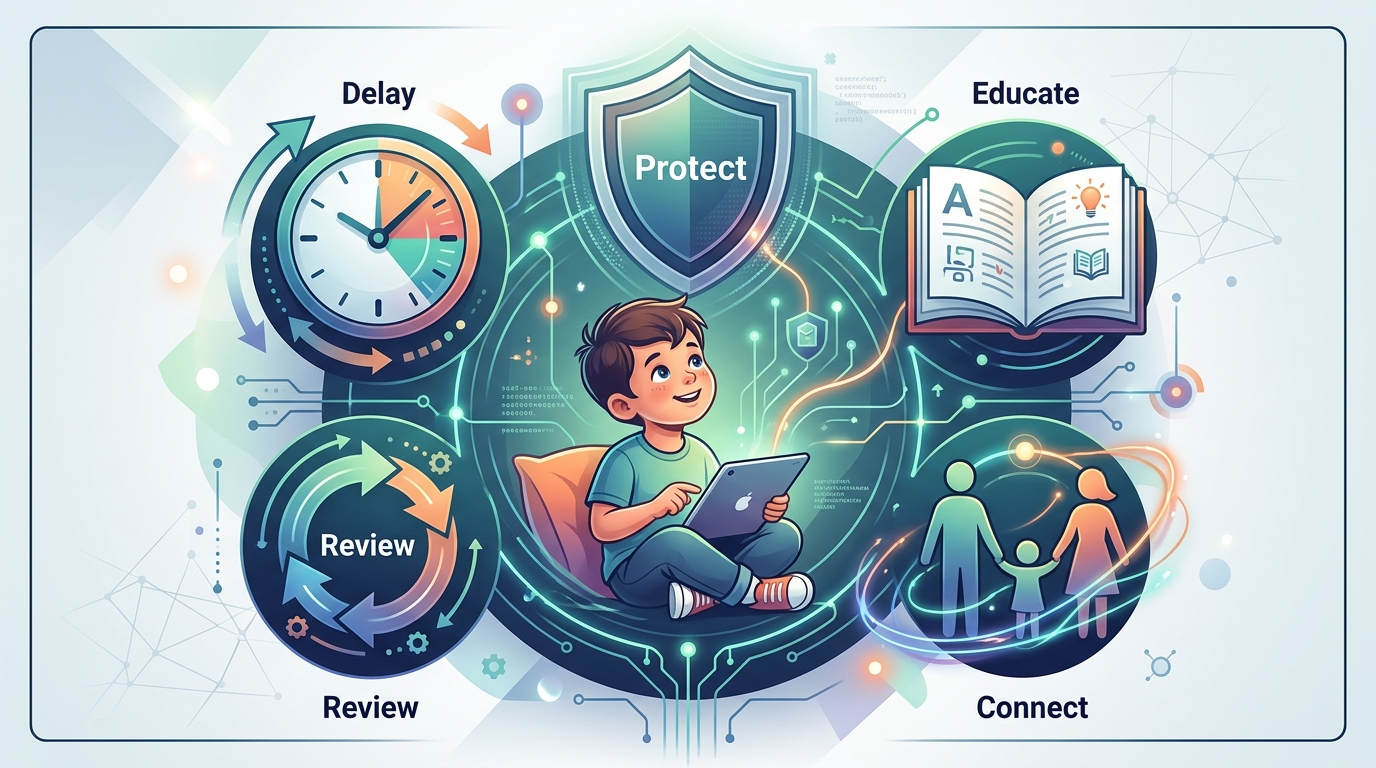
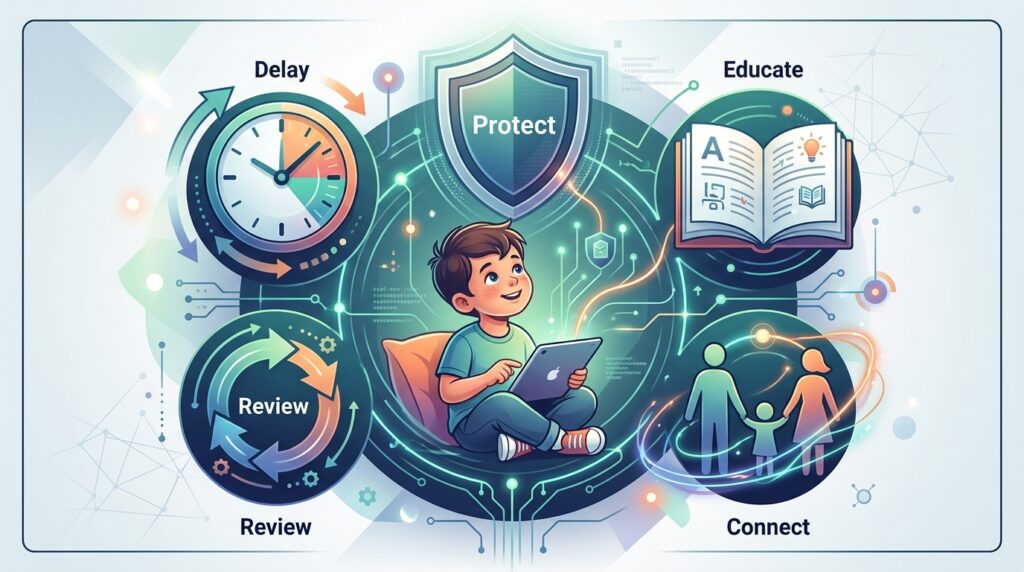
The Five-Part Digital Safety Formula
A practical framework for families, schools and policymakers could be:
1. Delay
Do not rush children into platforms designed for older users.
2. Protect
Use age-appropriate settings, privacy controls, filters and device restrictions.
3. Educate
Teach media literacy, algorithm literacy, privacy, scams, AI literacy and online relationships.
4. Connect
Maintain strong offline relationships so children have somewhere safe to turn.
5. Review
Digital rules should evolve as the child matures and technology changes.
The phone a 10-year-old needs should not be governed by the same rules as the phone a 16-year-old needs.
The Bedroom Test
There is one simple test every family can perform tonight.
Ask:
“Where does the child’s phone sleep?”
If the answer is:
“Under the pillow,”
the family probably has a digital-wellbeing problem.
Sleep should not compete with notifications.
The AAP recommends keeping devices out of bedrooms and avoiding screen exposure before bedtime.
A charging station outside the bedroom may accomplish more than another lecture about screen time.

The Dinner-Table Test
Another simple test:
Can the family eat a meal without everyone checking a screen?
If not, the problem may not be the child’s phone.
It may be the family’s digital culture.
Children learn digital habits partly by watching adults.
If parents constantly interrupt conversations to answer notifications, children learn that every notification deserves attention.
If parents occasionally put the phone away and say:
“This conversation matters more,”
children learn something much more valuable.
When Technology Becomes a Tool Instead of a Trap
A healthy digital childhood does not mean banning every device.
It means designing a better balance.
Encourage children to:
- create videos instead of endlessly watching them
- learn coding instead of only playing games
- make digital art instead of endlessly scrolling
- record music instead of consuming music all day
- research questions instead of accepting the first search result
- use AI to brainstorm rather than outsource all thinking
- video-call relatives rather than only following influencers
- use educational simulations and virtual tours
- collaborate on projects
- combine online learning with outdoor activity
Technology should broaden the child’s mental horizon, not shrink it to the size of a recommendation feed.
What Schools Should Teach
Digital safety cannot remain solely a parental responsibility.
Schools should teach:
Digital citizenship
How to behave responsibly online.
Media literacy
How to distinguish information from manipulation.
Algorithm literacy
Why two people can search for the same subject and see completely different feeds.
AI literacy
How generative AI works, what it can get wrong and why an AI system should not replace human judgment.
Cybersecurity
Passwords, phishing, account protection and scams.
Privacy
What personal information should remain private.
Relationship safety
How grooming, manipulation and coercion can develop online.
Mental resilience
How to respond when online comparison, rejection or bullying becomes overwhelming.
The future citizen will need these skills almost as much as reading and writing.

What Parents Should Never Do
There is one mistake that can make online danger worse:
Punishing the child for telling the truth.
Suppose a teenager admits:
“I sent someone a private picture.”
The first parental reaction may be anger.
Understandable.
But if anger becomes humiliation, the child may hide the next threat.
A safer response is:
“Thank you for telling me. We will handle this together.”
The consequences can be discussed later.
Safety comes first.
Children should know that reporting a dangerous online situation will not automatically result in losing their phone, being shamed or being blamed.

The Future Problem May Not Be Screen Time at All
The next generation of child-safety debates will probably involve questions we are only beginning to understand.
AI companions.
Deepfake abuse.
Synthetic identities.
Hyper-personalised advertising.
Immersive virtual worlds.
AI-generated sexual exploitation material.
Manipulative recommendation systems.
Children may eventually spend less time staring at a conventional screen and more time interacting with intelligent digital environments.
That means today’s parenting question:
“How much screen time?”
may eventually become:
“What kind of digital world is my child inhabiting?”
That is a much bigger question.
The Bigger Principle
Technology is neither a miracle nor a monster.
It is an amplifier.
It can amplify curiosity.
It can amplify creativity.
It can amplify friendship.
But it can also amplify insecurity, misinformation, bullying, exploitation and compulsive behaviour.
The answer is therefore not technological panic.
Nor technological surrender.
It is intentional digital parenting.
Children need boundaries.
They also need trust.
They need protection.
They also need independence.
They need rules.
They also need reasons.
And above all, they need adults who are willing to enter the digital playground with them rather than simply shouting instructions from the gate.
Conclusion: Don’t Just Protect Children From the Internet. Prepare Them For It.
The great mistake would be to frame this as a war between children and technology.
That war cannot be won.
Technology is already woven into education, communication, employment, entertainment and social life.
The real task is more ambitious:
Raise children who can use technology without being used by it.
Australia’s experience shows that governments can impose meaningful boundaries.
Europe demonstrates the growing importance of privacy-preserving age assurance and platform accountability.
China demonstrates how far device-level regulation can go.
Pakistan’s emerging child-online-protection initiatives show the importance of combining regulation, awareness, technology and community education.
But no government can sit beside every child.
No app can replace a trusted parent.
No algorithm can teach wisdom.
And no parental-control setting can substitute for a child who knows how to say:
“Something doesn’t feel right. I’m going to tell someone.”
That may ultimately be the most important digital skill of all.
Because the safest child online is not necessarily the child with the most restricted phone.
It is the child who knows how to recognise danger, question what they see, protect their privacy, ask for help and still walk away from the screen when real life calls.
Frequently Asked Questions
1. What is the safest age for a child to start using social media?
There is no universally established “safe age.” Many major platforms set minimum ages around 13, while some governments are moving toward higher legal thresholds. The American Psychological Association recommends that social-media use be matched to developmental readiness and says adult monitoring is advisable for most young people during early adolescence, typically ages 10–14.
2. Does social media cause depression and anxiety in children?
The evidence does not support such a simple cause-and-effect statement. Social media can contribute to harmful experiences for some young people, but effects vary according to the child, content, platform features and circumstances. The U.S. Surgeon General has warned that social media cannot currently be considered sufficiently safe for children, while the National Academies has cautioned that current evidence does not establish a simple population-level causal relationship.
3. Is screen time more important than what a child does online?
Generally, both matter. A two-hour educational project, video call with family or creative activity is fundamentally different from two hours of passive scrolling. Parents should also consider what screen use replaces, particularly sleep, physical activity, schoolwork and face-to-face relationships.
4. Should parents monitor their children’s phones?
For younger children and early adolescents, active monitoring, discussion and coaching can be appropriate. However, monitoring should gradually evolve as children demonstrate maturity and digital competence. The goal should be developing judgment rather than creating permanent surveillance.
5. What should a child do if someone threatens or blackmails them online?
They should stop engaging with the person, preserve evidence, use blocking and reporting tools, and immediately tell a trusted adult. Parents should avoid blaming or humiliating the child. If sexual images, grooming or exploitation are involved, the incident should be reported through the appropriate child-protection or law-enforcement channels in the child’s country.
6. Will social-media bans solve the child-safety problem?
Probably not by themselves. Australia’s under-16 restrictions demonstrate that governments can substantially disrupt access, but restrictions cannot teach children digital judgment or eliminate risks elsewhere online. The strongest long-term approach is likely to combine age-appropriate restrictions, safer platform design, privacy protection, parental involvement, school-based digital literacy and effective reporting systems.
References and Further Reading
- U.S. Surgeon General, Social Media and Youth Mental Health.
- American Psychological Association, Health Advisory on Social Media Use in Adolescence.
- National Academies of Sciences, Engineering, and Medicine, Social Media and Adolescent Health.
- American Academy of Pediatrics, Digital Ecosystems, Children, and Adolescents: Policy Statement.
- Pew Research Center, Teens, Social Media and AI Chatbots 2025.
- Pew Research Center, Teens, Social Media and Mental Health.
- European Commission, Guidelines on the Protection of Minors under the Digital Services Act.
- European Commission, EU Age Verification Approach.
- Australian eSafety Commissioner, Social Media Age Restrictions.
- UNICEF Pakistan, Safeguarding Your Child in the Digital Age.
- UNICEF Pakistan, Making the Internet Safer for Every Child.
Keyword phrase: Child Online Safety