$40 Trillion Debt, $1 Trillion Interest: Why the World Should Care
America’s Debt Rate Trap
$40 Trillion Debt, $1 Trillion Interest: Why the World Should Care. America has a debt problem. But the more important story is not the size of the debt alone.
It is the price of carrying it.
The United States now operates in an unusual financial environment. Federal debt has moved beyond $40 trillion, federal interest costs have crossed the trillion-dollar mark, the 10-year Treasury yield has reached about 5 percent, mortgage rates are above 7 percent, the Iran conflict has added tens of billions of dollars in military costs, and the global economy remains vulnerable to another energy shock.
At the same time, American technology companies are pouring enormous amounts of borrowed and invested money into artificial intelligence infrastructure.

That creates a much bigger question.
What happens when government borrowing, war spending, household debt, energy security and the world’s biggest technology investment boom all compete for capital at the same time?
This is not a prediction of an American financial collapse. The United States still possesses extraordinary financial advantages, including the dollar’s international role and the world’s deepest Treasury market.
But the mathematics is becoming harder.
The Congressional Budget Office projects that U.S. debt held by the public will rise from about 101 percent of GDP in 2026 to 120 percent by 2036. It also projects federal net interest outlays to rise from about $1 trillion in 2026 to $2.1 trillion in 2036. (Congressional Budget Office)
That is where the real story begins.
Purpose of This Article
The purpose of this article is to explain how America’s debt, Treasury yields, federal interest costs, the Iran conflict, oil prices, household borrowing, global capital flows and AI investment are connected.
Rather than treating each issue separately, it follows the money from Washington to Wall Street, from Wall Street to households and emerging markets, and from the Middle East to the global economy.
Executive Point
America is not simply facing a debt problem.
It is facing a financing problem with global consequences.
If economic growth and productivity rise strongly enough, a large debt burden can become easier to manage. If borrowing costs remain elevated while deficits continue expanding, however, interest payments can consume an increasing share of government resources.
The outcome depends on what happens to growth, inflation, interest rates, government spending, tax revenues, energy prices and investor demand for U.S. debt.
That is why the $40 trillion headline, although dramatic, does not tell the whole story.
US debt crosses $40 trillion threshold after doubling under Trump and Biden
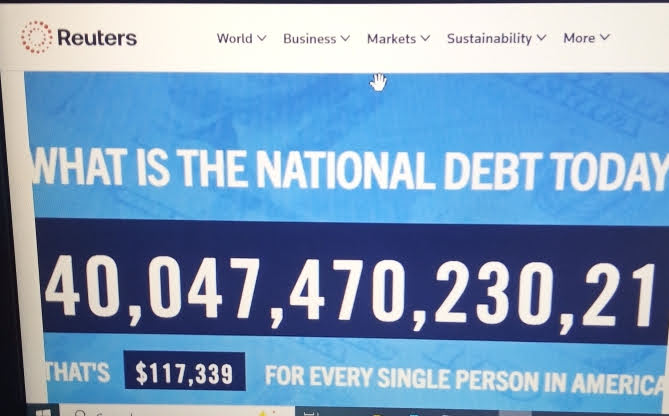
What is the National Debt today?
$117,415
for every single person in America
Why is the National Debt so high?
America’s growing debt is the result of simple math — each year, there is a mismatch between spending and revenues.
When the federal government spends more than it takes in, it has to borrow money to cover that annual deficit. And each year’s deficit adds to our growing national debt.
Historically, the largest deficits were caused by increased spending during national emergencies such as major wars or the Great Depression.
Today, deficits are caused mainly by predictable structural factors: our aging baby-boom generation, rising healthcare costs, higher interest rates, and a tax system that does not bring in enough money to pay for what the government has promised its citizens. Moving forward, it will be critical for America’s leaders to address our rising debt, and its structural drivers, as outlined below.
the more we borrow, the more we pay in interest on that debt.
our debt over time
Three main drivers of our growing national debt
Demographics
America is undergoing significant demographic change. Our society is aging as the large baby-boom generation begins to retire — 10,000 people will turn 65 every day through 2030. Moreover, people are expected to live longer, on average. That is great news, but it means that we must prepare for the financial needs of a longer retirement.
Those huge demographic trends put increasing pressure on the federal budget — and in particular on vital programs that serve older Americans like Social Security and Medicare.
Rising Healthcare Costs
In many ways, healthcare is the most important issue for our nation’s fiscal and economic future. It represents nearly one-fifth of our entire economy, and it is one of the fastest-growing parts of the budget.
The U.S. healthcare system is the most expensive in the world, but we do not really get what we pay for. We spend nearly twice as much on healthcare as other advanced nations, but our system does not provide better overall health outcomes. Improving the performance of the U.S. healthcare system will not only improve Americans’ lives but also help stabilize our fiscal and economic outlook.
Inadequate Revenues
It would be one thing if our tax code were designed to fund all the promises we are making. But it is not.
The U.S. tax system does not generate enough revenue to cover the spending that policymakers have enacted. This rapidly growing imbalance between revenues and spending is driving higher annual deficits and mounting debt.
What is the National Debt costing us?
The interest adds up fast. As the debt grows, so does the interest the government pays.
Similar to a home or car loan, interest payments represent the price we pay to borrow money. As we borrow more and more, federal interest costs rise and compound. Rapidly growing interest payments are a burden that hinders our future economy.
EVERY DAY, WE SPEND OVER$2.8 BILLIONON INTEREST
Interest is the fastest-growing part of the federal budget.
In ten years, interest will nearly double from where it is today.
Why does the National Debt MATTER?
This is about our future. What makes America strong is our willingness to build and leave a better future for the next generation. Unfortunately, our growing debt is doing the opposite.
America faces many challenges, including rising inequality, unaffordable healthcare, climate change, education affordability, and unpredictable security threats. To address these challenges, we will need significant resources. Every dollar that goes toward interest payments means fewer resources available to invest in a stronger, more resilient future.
fewer resources available to invest in a stronger, more resilient future.
Being irresponsible with our budget is simply not fair to our kids and grandkids, who will inherit this burden.
Skyrocketing national debt…
The first mistake in any discussion of American debt is to treat the headline number as though the government must suddenly pay today’s interest rate on every dollar.
It does not.
The Treasury has debt issued at many different interest rates and maturities. Some older securities carry relatively low coupons. When they mature, however, the government must refinance them at prevailing market rates.
That creates a gradual transmission mechanism.
Old debt matures.
New debt is issued.
The new interest rate becomes part of the government’s future cost.
This is why interest rates can become a problem even without another huge increase in the headline debt number.
The Congressional Budget Office estimates that the average interest rate on federal debt held by the public was about 3.4 percent in 2026. It projects that the average rate will rise toward 3.9 percent later in its forecast period as debt is refinanced. (Congressional Budget Office)
The important number is therefore not simply the rate on today’s Treasury bond.
It is the average cost of the entire debt stock as old debt rolls over.
The Interest Bill Is Becoming the Story
In fiscal year 2025, the Treasury recorded about $1.2 trillion in net federal debt interest costs. (U.S. Department of the Treasury)
That is money spent servicing existing obligations rather than building a road, hiring a teacher, buying military equipment, or funding a new program.
And the burden can compound.
CBO projects net federal interest outlays of more than $1 trillion in 2026, rising to approximately $2.1 trillion by 2036. (Congressional Budget Office)
There is an important distinction here.
The government does not have to write one giant check for the entire national debt every year.
It pays interest.
That means the real fiscal pressure comes from the combination of:
Debt size + interest rates + refinancing + continuing deficits.
A government can carry enormous debt for years when borrowing costs are low and economic growth is strong.
The arithmetic becomes more uncomfortable when interest costs grow faster than revenues and economic output.
Why 5 Percent Treasury Yields Matter
The 10-year Treasury yield reached 5.01 percent on September 18, 2026. (FRED)
That number matters far beyond the bond market.
Treasury securities are a benchmark for much of the financial system. Mortgage rates, corporate borrowing costs and many other financial prices are influenced by movements in Treasury yields, although they do not move one for one.
This creates a transmission chain.
Treasury yields rise.
Long-term borrowing becomes more expensive.
Businesses reassess investment.
Home buyers face higher financing costs.
Consumers pay more for some forms of credit.
Government refinancing becomes more expensive over time.
But why would Treasury yields rise?
There is no single answer.
Investors consider inflation, economic growth, Federal Reserve policy, Treasury issuance, fiscal deficits, global demand for U.S. securities and the additional return they require for holding longer-term bonds.
That distinction matters because it prevents an easy but misleading conclusion that one policy decision or one war automatically determines Treasury yields.
The Refinancing Wall
Imagine a homeowner with a mortgage locked at 2.5 percent.
A rise in market rates to 5 percent does not instantly turn that mortgage into a 5 percent loan.
The problem arises when the loan has to be refinanced.
The federal government faces the same basic mechanism, although on a vastly larger scale.
The Treasury continuously replaces maturing securities.
If the new securities carry higher interest rates, the government’s average borrowing cost gradually rises.
That is why today’s Treasury yield can affect tomorrow’s federal budget even when much of the existing debt was issued years earlier.
It also explains why fiscal pressure can build slowly before suddenly becoming visible in budget numbers.
The Household Version of the Same Story
Washington’s debt may seem distant from an American kitchen table.
It is not.
Freddie Mac reported that the average 30-year fixed mortgage rate reached 7.03 percent on September 24, 2026, compared with 6.30 percent a year earlier. (Freddie Mac)
For an existing homeowner with a fixed rate, that may change very little.
For someone trying to buy a house, it can change everything.
The same financial environment affects:
- Home Buyers: Higher mortgage rates can reduce purchasing power.
- Car Buyers: Auto financing becomes more expensive.
- Credit Card Users: Revolving balances become particularly costly.
- Small Businesses: Loans and credit lines become harder to finance.
- Investors: Higher Treasury yields change the attractiveness of competing assets.
- Savers: Higher rates can provide better returns on certain deposits and fixed-income investments.
There is another important point.
High interest rates do not hurt everyone in exactly the same way.
A heavily indebted household can suffer from higher rates.
A household holding substantial savings may receive more interest income.
That is why the economic impact of high rates should be viewed as a redistribution of financial costs and returns rather than a simple story in which everyone loses equally.
The Housing Generation Gap
The difference can also become generational.
A homeowner who locked in a very low fixed mortgage may have little incentive to sell and replace it with a much more expensive loan.
A young person trying to buy a first home faces a completely different calculation.
This can create a strange housing market.
Existing owners may feel relatively protected while potential buyers find homes increasingly difficult to finance.
The result is not merely an interest rate story.
It becomes a story about wealth, mobility, and access to homeownership.
Then Comes War
The Iran conflict adds another layer to an already complicated fiscal picture.
The Congressional Budget Office estimated that U.S. Department of Defense costs associated with the conflict had reached approximately $38 billion by August 1, 2026.
Those costs included expended munitions, lost equipment, increased flying hours, military operations and higher fuel costs. CBO also noted that the estimate did not include costs borne by other parts of the federal government. (Congressional Budget Office)
The important question is not whether $38 billion alone can overwhelm the American economy.
It cannot.
The more important issue is what happens when military expenditure becomes another demand on a government already running large deficits.
CBO projected a federal deficit of about $1.9 trillion for fiscal year 2026. (Congressional Budget Office)
War spending, therefore, becomes part of a much larger fiscal equation.
War Has a Second Bill
Military spending is only one part of the economic cost of a Middle Eastern conflict.
Energy is the other.
The Middle East remains central to global oil and shipping routes. A prolonged conflict can affect oil markets even before a major physical supply disruption occurs because traders price in the possibility of future disruption.
That creates an important distinction.
Oil can rise because barrels have disappeared.
It can also rise because markets fear that barrels might disappear.
For consumers, the effects can eventually travel through:
Oil → transportation → production → food and goods → inflation.
For oil-importing countries, the consequences can be even more serious because higher energy prices require more foreign currency.
The Federal Reserve’s Difficult Equation
This produces a nasty monetary policy problem.
Suppose an energy shock pushes inflation higher while economic growth weakens.
The central bank faces competing pressures.
Higher rates can help restrain inflation, but they also make borrowing more expensive.
Lower rates can support economic activity, but if inflation remains elevated, aggressive easing can create another problem.
And there is a further complication.
The Federal Reserve controls short-term monetary policy directly.
It does not simply dictate the 10-year Treasury yield.
Long-term yields are determined by market expectations, inflation, government borrowing, economic conditions and investor demand.
That means the Fed can lower short-term rates without guaranteeing that mortgage or long-term government borrowing costs will fall by the same amount.
Who Actually Owns America’s Debt?
Another popular misunderstanding deserves attention.
America does not owe its entire national debt to China.
U.S. Treasury securities are held by a vast range of investors.
They include American financial institutions, pension funds, banks, investment funds, the Federal Reserve and foreign investors.
Among foreign holders, Treasury data for July 2026 showed Japan holding about $1.10 trillion, the United Kingdom about $998 billion and mainland China about $618 billion.
That changes the way the story should be understood.
China matters.
But China is not America’s sole foreign creditor.
The Treasury’s own data also warns that country-level ownership figures have limitations because securities can be held through custodial accounts in third countries. (U.S. Department of the Treasury)
So claims that a country has simply “dumped” or “bought” a precise amount of U.S. debt should be treated carefully.
Why the World Watches the Treasury Market
The Treasury market is not merely America’s borrowing machine.
It is a central part of the global financial system.
U.S. government securities are widely used as safe assets, collateral and benchmarks.
That gives America a remarkable advantage.
The United States can borrow in its own currency.
It also benefits from the dollar’s enormous role in global finance.
But privilege does not mean immunity.
If investors demand higher compensation for inflation, fiscal risk or longer maturity, borrowing costs can rise even without a formal loss of confidence in the United States.
That is why the Treasury yield matters.
The Global Dollar Transmission
Now the story leaves America.
Suppose U.S. Treasury yields become relatively attractive.
International investors may find dollar assets more appealing.
Capital can move toward U.S. markets.
A stronger dollar can then place pressure on other currencies.
For emerging economies, this can create a difficult chain:
Higher U.S. yields
↓
Stronger demand for dollar assets
↓
Pressure on emerging market currencies
↓
More expensive dollar-denominated debt
↓
Higher imported energy and commodity costs
↓
Inflation pressure
↓
Higher local interest rates
The effect differs from country to country, but the mechanism explains why an American bond market can matter to someone thousands of miles away.
Why Pakistan, India, Brazil and Indonesia Care
Consider an oil-importing country.
If oil becomes more expensive in dollars while its own currency weakens against the dollar, the local currency cost of energy can rise even faster.
That affects:
- Transport.
- Electricity.
- Fertilizer.
- Food distribution.
- Manufacturing.
- Household budgets.
For countries with substantial foreign currency debt, a weaker local currency can also increase the local cost of servicing those obligations.
This is how an American interest rate story becomes a global cost of living story.
The Emerging Market Squeeze
Emerging markets face another problem.
They compete for international capital.
When U.S. Treasury yields rise, investors may demand higher returns from riskier assets elsewhere.
That does not mean capital automatically leaves every emerging market.
It means the relative attractiveness of assets changes.
The consequences depend on each country’s inflation, fiscal position, currency stability, growth prospects and external financing needs.
This is why a single U.S. Treasury number can become an important variable for policymakers in countries that have never issued a U.S. Treasury bond.
Japan and China Show Why Debt Is Complicated
The world does not have one universal debt formula.
Japan, China and the United States have very different financial systems, currencies, investor bases and government structures.
Japan has carried a very large government debt burden for decades while operating under conditions very different from those of the United States.
China relies heavily on domestic savings and has a financial system with a much greater state role.
America benefits from the dollar and an enormous global market for Treasury securities.
The lesson is simple.
Debt size alone does not determine financial risk.
The composition of debt, who owns it, the currency in which it is issued, interest rates, economic growth and investor confidence all matter.
The AI Debt Paradox
Now comes the strangest part of the story.
At exactly the moment when governments are demanding enormous amounts of capital, the technology industry is doing the same.
Artificial intelligence requires physical infrastructure.
Data centers need land, buildings, electricity, cooling systems, networking equipment and advanced chips.
That infrastructure costs staggering amounts of money.
And not all of it can be financed from current corporate cash flow.
The Bank of England reported in July 2026 that AI companies’ use of credit markets had accelerated rapidly across public debt, private credit, leveraged finance and structured finance. It said the pace of investment was historically unprecedented and warned that future debt sustainability could become more important if expected earnings fail to materialize. (Bank of England)
This creates a fascinating contradiction.
AI could make the economy more productive.
But building AI also requires enormous amounts of capital.
AI Can Help the Debt Problem
The optimistic case deserves serious attention.
If AI significantly increases productivity:
Higher productivity
→ more economic output
→ higher corporate earnings
→ potentially higher wages and tax revenues
→ stronger economic growth
→ greater capacity to support public debt.
In that scenario, today’s huge AI investment could eventually help improve debt sustainability.
The Bank of England also notes that AI has the potential to raise productivity across sectors and support long term economic growth. (Bank of England)
That possibility should not be dismissed simply because AI investment is expensive.
But AI Can Also Create Financial Risk
The other side is less comfortable.
AI companies are increasingly relying on external financing to build infrastructure.
If expected revenues arrive more slowly than expected, companies may still have debt obligations.
That creates a familiar financial problem:
Borrow today against expected earnings tomorrow.
The Bank of England has highlighted increasing complexity in AI debt structures, growing use of external financing and the possibility that a reassessment of future AI earnings could affect financial markets. (Bank of England)
This does not mean an AI crash is inevitable.
It means the financial system is increasingly making bets on future productivity and future revenue.
The AI Electricity Problem
There is another bottleneck that is easy to overlook.
AI needs electricity.
A great deal of it.
Data centers require reliable power around the clock.
That connects the AI boom to:
- Natural gas.
- Nuclear power.
- Renewable energy.
- Electricity grids.
- Transmission infrastructure.
- Land.
- Construction.
- Water and cooling.
- Semiconductor manufacturing.
Suddenly, the AI story is no longer just about software.
It becomes an infrastructure story.
And infrastructure requires financing.
Could AI Crowd Out Other Borrowers?
This is an important question, but it needs careful treatment.
Governments need capital.
AI companies need capital.
Traditional businesses need capital.
Infrastructure projects need capital.
If demand for financing rises faster than available savings, borrowing costs can face upward pressure.
That is the classic crowding-out argument.
However, there is currently no evidence that AI borrowing has broadly prevented governments or other businesses from accessing credit markets. The Bank of England specifically notes that this crowding out has not yet become evident, although it identifies the possibility as a future risk. (Bank of England)
That distinction matters.
A risk is not the same thing as an outcome.
The Commercial Real Estate Connection
Higher interest rates also affect another part of the economy that rarely receives attention in national debt discussions.
Commercial real estate.
Office buildings, shopping centers, warehouses and other properties often rely on financing.
When loans mature, owners may have to refinance at higher rates.
If property income has not increased enough to compensate, the economics of the investment can change.
That can affect:
Property values → lenders → banks → investors → construction → employment.
Again, the transmission mechanism matters more than the headline interest rate.
The Hidden Distribution of High Rates
High rates produce winners as well as losers.
A heavily indebted household may pay substantially more.
A saver may earn more.
A bank may benefit from certain lending spreads.
A pension fund may receive higher returns on newly purchased bonds.
A highly leveraged company may face greater pressure.
A financially strong company with large cash reserves may actually find opportunities to buy weaker competitors.
This is why the question should not simply be:
Are high rates good or bad?
The better question is:
Who pays, who benefits and for how long?
The Global Insurance Bill
Energy is not the only channel through which Middle Eastern conflict affects the world economy.
There is also shipping.
When geopolitical risks rise around major maritime routes, insurers, shipping companies and traders reassess risk.
Higher insurance and freight costs can eventually become part of the price consumers pay for imported goods.
That creates another transmission mechanism:
Geopolitical risk → shipping risk → insurance → freight → imported goods → consumer prices.
For countries dependent on imported food, fuel or manufactured products, this can matter enormously.
America’s Fiscal Choice
Eventually, the numbers come back to Washington.
The United States has several broad ways to improve debt sustainability.
Economic growth can increase the denominator of debt ratios.
Productivity can increase output.
Higher revenues can reduce deficits.
Spending restraint can reduce borrowing requirements.
Lower interest rates can reduce future financing costs.
But none of these options is painless or guaranteed.
CBO’s February 2026 baseline projected the federal deficit at $1.9 trillion in 2026 and $3.1 trillion by 2036. It projected debt held by the public rising from 101 percent of GDP in 2026 to 120 percent in 2036. (Congressional Budget Office)
That means the debt question cannot be postponed simply because the economy is still growing.
Can America Grow Out of Its Debt?
This is perhaps the most important question in the entire debate.
A country does not necessarily become financially unstable simply because its debt is large.
If economic output grows strongly and borrowing costs remain manageable, the burden can become easier to carry relative to the size of the economy.
But the reverse is also possible.
If interest costs rise faster than economic growth, the government must devote an increasing share of its resources to servicing existing obligations.
That leaves fewer resources for everything else.
The problem, therefore, becomes a relationship between:
Economic growth
Interest rates
Debt
Primary deficits
Government revenues
The $40 trillion number is the beginning of the investigation, not the conclusion.
Three Ways This Story Could Develop
A Softer Path
Inflation falls.
Energy markets stabilize.
Treasury yields decline.
AI investment produces genuine productivity gains.
Economic growth remains strong.
Debt continues rising, but the economy grows rapidly enough to make the burden more manageable.
A High Rate Path
Deficits remain large.
Treasury issuance remains heavy.
Long-term yields remain elevated.
Refinancing gradually increases federal interest costs.
Households and businesses continue to face expensive credit.
Economic growth slows but does not collapse.
A Multiple Shock Path
Geopolitical tensions push energy prices higher.
Inflation becomes persistent.
Treasury yields remain elevated.
Government borrowing continues.
AI investment slows because financing becomes more expensive.
Emerging markets experience stronger capital and currency pressures.
None of these scenarios is a prediction.
They are frameworks for understanding which variables matter.
Five Numbers Worth Watching
Readers do not need a degree in economics to follow this story.
Watch five indicators.
1. The 10 Year Treasury Yield
It provides an important signal about long-term U.S. borrowing conditions. It reached 5.01 percent on September 18, 2026. (FRED)
2. Federal Net Interest Expense
This tells us how much of the federal budget is being consumed by the cost of existing debt.
3. Debt Held by the Public as a Share of GDP
This puts the debt into the context of the economy’s ability to support it.
4. Oil Prices
Energy prices can influence inflation, household budgets and the external finances of importing countries.
5. Corporate and AI Credit Conditions
If financing remains easy, investment can continue.
If lenders suddenly demand much higher compensation for risk, heavily financed projects can come under pressure.
Five Myths About America’s Debt
Myth 1: China Owns America’s Debt
China is a major foreign holder, but it is far from the only holder. Japan, the United Kingdom and many other investors also hold substantial amounts of Treasury securities.
Myth 2: A 5 Percent Treasury Yield Means America Pays 5 Percent on Everything
Existing Treasury securities have different coupons and maturities. The average borrowing cost changes gradually as debt matures and is refinanced.
Myth 3: High Interest Rates Hurt Everyone Equally
Borrowers and savers can experience very different effects.
Myth 4: AI Investment Automatically Means a Bubble
AI investment can create genuine productive infrastructure. The financial question is whether expected future revenues justify the capital being committed today.
Myth 5: America’s Debt Problem Is Only an American Problem
Treasury yields influence global financial conditions, while the dollar affects international trade, commodity pricing and foreign currency debt.
What This Means for the Rest of the World
For readers outside the United States, the most important lesson is simple.
You do not have to own American debt to be affected by American borrowing costs.
A change in U.S. Treasury yields can influence the dollar.
The dollar can influence commodity prices.
Commodity prices can influence inflation.
Inflation can influence central bank policy.
Interest rates can influence investment.
Investment can influence employment and growth.
That is how a bond market in Washington can eventually reach a household in Karachi, Mumbai, São Paulo, Jakarta or Nairobi.
The connections are indirect.
But they are real.
The Bigger Question
America’s financial advantage has always rested on more than the size of its economy.
It rests on the dollar.
It rests on deep capital markets.
It rests on Treasury securities.
It rests on global demand for dollar assets.
It rests on America’s ability to borrow in its own currency.
Those advantages remain powerful.
But they do not abolish arithmetic.
The United States is simultaneously financing a large government deficit, servicing an enormous debt stock, managing geopolitical risks, dealing with energy uncertainty and financing one of the largest technology infrastructure expansions in modern history.
The result is a financial balancing act.
The real question is therefore not:
“Will America run out of money?”
It is a much more useful question:
“How much of America’s future economic capacity will be required simply to carry the financial commitments accumulated today?”
If productivity accelerates, inflation falls and growth remains strong, today’s debt burden may prove more manageable than the headline suggests.
If borrowing costs remain high while deficits continue expanding, interest payments could consume an increasingly important share of the federal budget.
And if war, energy disruption and financial stress arrive together, the pressure could spread far beyond American borders.
That is why America’s debt is no longer just a Washington story.
It is a global interest rate story, a household story, an energy story, a technology story and ultimately a story about who gets access to capital when everyone wants to borrow at once.
Frequently Asked Questions
Is the U.S. national debt really above $40 trillion?
Yes. The gross federal debt has moved beyond the $40 trillion level. However, analysts also use debt held by the public, which excludes certain intragovernmental holdings and is more directly relevant to assessing the government’s borrowing relationship with private and foreign investors.
How much does the United States pay in interest on its debt?
Treasury reported approximately $1.2 trillion in net federal debt interest costs in fiscal year 2025. CBO projects net interest outlays of more than $1 trillion in 2026 and about $2.1 trillion by 2036 under its February 2026 baseline. (U.S. Department of the Treasury)
Why does the 10-year Treasury yield matter to ordinary people?
The 10-year Treasury is an important benchmark for long-term financial markets. Higher Treasury yields can contribute to higher mortgage and corporate borrowing costs, although individual lending rates also depend on credit risk, bank funding costs and market conditions.
Does China own most of America’s debt?
No. China is a major foreign holder, but Treasury data show Japan and the United Kingdom also holding very large amounts of U.S. Treasury securities. The majority of U.S. federal debt is not simply owed to China.
Can AI help America manage its debt?
Potentially. If AI produces substantial productivity gains, stronger economic growth could improve debt sustainability. But the infrastructure required for AI is itself increasingly financed through debt and other external capital. The Bank of England has identified both the potential growth benefit and the associated financial stability risks. (Bank of England)
Could America’s debt cause a global financial crisis?
High debt does not automatically produce a crisis. The outcome depends on borrowing costs, economic growth, inflation, fiscal policy, investor demand and the structure of the debt. The important issue is therefore not simply whether the debt is large, but whether the government can continue servicing it without progressively greater pressure on public finances and the wider economy.
Final Takeaway
America’s debt story is no longer adequately explained by a giant number on a government website.
The more revealing story is the chain underneath it.
Debt creates interest.
Interest affects the budget.
The budget determines borrowing.
Borrowing influences bond markets.
Bond markets influence households and businesses.
The dollar transmits those conditions abroad.
War can add spending and energy risks.
AI can demand enormous new pools of capital while potentially generating the productivity needed to justify them.
That is the paradox.
The same financial system that gives America extraordinary borrowing power is now being asked to finance government deficits, military operations, households, businesses, infrastructure and an AI revolution at the same time.
The future will depend less on the headline debt number than on whether economic growth, productivity and government revenues can keep pace with the cost of financing everything America wants to build, defend and maintain.
Author: Maj Hamid Mahmood (Retired), MA Political Science, LLB, PGD (HRM). His military background, political science and legal education inform analysis of international conflicts, security affairs, political developments and the human consequences of war.
References
- U.S. Department of the Treasury, Fiscal Year 2025 Agency Financial Report. (U.S. Department of the Treasury)
- Congressional Budget Office, The Budget and Economic Outlook: 2026 to 2036. (Congressional Budget Office)
- Congressional Budget Office, Estimating the Cost of Combat Operations Against Iran. (Congressional Budget Office)
- Federal Reserve Bank of St. Louis, FRED, 10 Year U.S. Treasury Constant Maturity Rate. (FRED)
- Freddie Mac, Primary Mortgage Market Survey, September 24, 2026. (Freddie Mac)
- U.S. Department of the Treasury, Treasury International Capital Data, July 2026. (U.S. Department of the Treasury)
- U.S. Department of the Treasury, Major Foreign Holders of Treasury Securities.
- Bank of England, Financial Stability Report, July 2026. (Bank of England)