Understanding Humans: Why We Are Brilliant, Confusing, and Full of Contradictions
Trying to Understand Humans
“Understanding humans, I just want someone to help me understand humans, because everything feels blurry and uncertain to me.”
Sometimes I sit quietly and think about our species. The more I observe, the more confused I become. Humans are capable of wonders, yet they often fail in the simplest things. We are a strange mixture of strength and weakness.
https://mrpo.pk/human-creation/

Humans are the most advanced and complicated creatures on Earth. We have achieved unbelievable progress in science, technology, and civilisation. At the same time, we struggle with simple emotions, relationships, and inner peace. This contradiction makes humans both amazing and difficult to understand.
In this article, we will Try to explore the nature of humans, their strengths, weaknesses, and the paradoxes that define them.
As fantastically (and fanatically) self-aware organisms, we humans tend to ascribe great importance to our intellectual processes: We’re rational and reasoning creatures, we assert, capable of stepping back and assessing our own behavior through an analytical lens.
Like any other biological entity, however, we’re interacting with and responding to our environment in myriad ways well beyond the realm of our conscious perception. We usually take these nonconscious, autonomic aspects of our being for granted, but naturally, they’re fundamental to both our appreciation of the world around us and, critically, our day-to-day survival.
We don’t need to compel ourselves to shiver when the mercury drops; our hand recoils at the lick of the flame or the bite of the dog. Thankfully, we don’t have to think our way through the mechanics of walking in order to pull it off – start trying to, and you’re liable to beeline for the pavement.
The conscious and the nonconscious, the voluntary and the involuntary: When it comes to Homo sapiens, these processes aren’t either-or propositions. They’re thoroughly intertwined, influencing and echoing one another. In short, human beings (breaking news) are complicated systems, and the study of human behavior is a complex task. Parsing out behavioral and emotional nuances requires zoomed-in looks at the tempos and intensities of all kinds of physical and psychological networks – and a holistic, big-picture perspective of how those networks interface with one another.
1. Humans: The Greatest Inventors
The Creators of Comfort

Look around your room. Almost everything there is a human idea turned into reality. Chairs, lights, medicines, and mobile phones. We have built machines to cross oceans and rockets to touch the moon. From the wheel to artificial intelligence, from aeroplanes to satellites, human creativity has no limits.
No other creature has changed the world the way humans have.
And still, with all these comforts, peace of mind remains rare. Many people live better lives than kings of the past, yet sleep poorly at night. We solved thousands of problems outside us, but not the restlessness inside us.
We invented machines to make life comfortable. We built cities, hospitals, schools, and communication systems. Today, we can travel across the world in hours and talk to someone on the other side of the planet instantly.
Yet, despite all these inventions, many humans still feel restless, lonely, and unsatisfied.
2. Understanding Humans: The Emotional Side of Humans
Strong Hearts, Fragile Emotions
Humans can be unbelievably brave. They climb mountains, dive into oceans, and rescue strangers without thinking of their own safety. But the same human can cry silently after hearing a sad story or seeing a wounded animal.
I have seen tough men lose their voice when a loved one falls ill. I have seen confident people become helpless in front of loneliness. This softness is not a weakness. It is what makes us human. Humans are not only logical beings. They are deeply emotional.
A person can be strong enough to control a wild animal, but soft enough to cry when seeing a small bird in pain. We celebrate, laugh, dream, and love. At the same time, we fear, worry, and suffer.
This emotional nature makes humans compassionate, but it also makes them vulnerable.
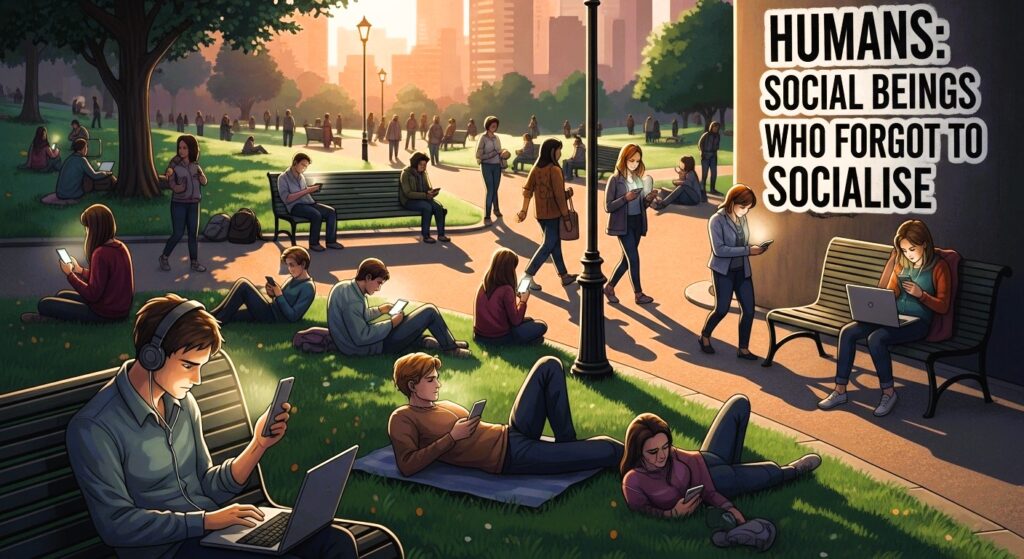
3. Social Beings Who Forgot to Socialise
Understanding Humans : Memories of a Simpler Time
I remember my childhood days in the countryside. In the evenings, people would gather under a big oak tree to talk. In the cities, tea houses were full of conversation and laughter. Neighbours knew each other’s problems and tried to solve them together.
My late aunt used to tell us stories. She would narrate the tales of Umro Ayyar while we children sat around her, completely spellbound. Every story ended with a lesson that stayed in our young minds.
Today, houses are bigger, but hearts often feel smaller. Technology connects the world, but often disconnects people. Many individuals live in the same house but remain busy with their mobile phones. Real conversations are becoming rare.
4. Humans and Contradictions
Builders and Destroyers

This is the most confusing part about humans.
We rush across continents to help victims of earthquakes and floods. But we also damage forests, rivers, and the air without thinking of tomorrow. We start wars that destroy cities and lives. Then, after the destruction, we gather around tables to discuss peace.
No other creature behaves with such contradiction. Humans often behave in opposite ways.
• They help strangers in disasters
• But destroy the nature that protects them
• They start wars
• Then sit to discuss peace
This contradictory behaviour is one of the biggest mysteries of human nature.
5. Understanding Humans: Can Humans Change?
Still, There Is Hope
In spite of everything, I believe humans are not hopeless. Kindness still exists. Compassion still appears in unexpected moments. Parents still sacrifice for their children. Strangers still help strangers. Perhaps understanding humans completely is impossible. But trying to understand them makes us a little more patient, a little more gentle.
And maybe that is enough.
Despite all flaws, humans can learn and improve. Every generation tries to become better than the previous one. Hope, kindness, and understanding still exist.
If humans can balance technology with humanity, the future can be brighter.
Conclusion
Humans are complex, confusing, and incredible. To understand them fully may be impossible, but trying to understand them makes life meaningful.
.