
UK and Europe Israeli settlement Sanctions: Real Pressure or Political Signal?
UK and Europe Israeli settlement sanctions: Britain, France, Canada and other countries are targeting Israeli settlement trade. But can these measures actually change Israeli policy, or are they mainly political signals?
https://mrpo.pk/israels-impending-european-isolation/
The Real Question Behind Europe’s New Settlement Sanctions
For years, Western governments condemned Israeli settlements in the occupied West Bank. They issued statements. They expressed concern. They warned that settlement expansion threatened the two-state solution. Then they went home. That pattern is now changing.
In September 2026, Britain, France and Canada announced measures targeting goods from Israeli settlements, while a wider group of 12 countries said they would introduce, support or consider national or European restrictions. The United Kingdom also announced wider measures affecting services connected with settlement activity.
Israel responded by moving against British diplomatic and security cooperation. This makes the story bigger than a dispute over dates, wine or agricultural products.
The real question is much harder:
Can economic and diplomatic pressure persuade an Israeli government to slow settlement expansion—or are European governments mainly demonstrating that their patience has run out?
The answer is not simple. The immediate financial impact is relatively small. But politics is not measured only in dollars and pounds. A trade restriction can create legal risk for companies, complicate financing, increase diplomatic isolation and signal to other governments that stronger action is becoming politically acceptable. That is where the real story begins.
Purpose of This Article
This article examines the new settlement restrictions as a developing international pressure campaign rather than simply reporting the announcements. It asks:
- What exactly has Britain done?
- How far have France, Canada and other countries gone?
- Which measures are already law and which are still being prepared?
- How can customs officials actually identify settlement goods?
- Why does the Netherlands matter?
- Why is the United States refusing to follow its European allies?
- Where do the UAE and other Arab and Muslim countries stand?
- Why are Abraham Accords states condemning settlement expansion while maintaining relations with Israel?
- What does Israel’s retaliation tell us?
- Could the measures hurt Palestinian workers as well as Israeli businesses?
- Can sanctions against settlement activity actually affect construction?
- What would turn symbolic pressure into meaningful leverage?
‘It’s a good start’: prominent Israelis welcome UK sanctions on illegal settlements
Prominent Israelis have welcomed new UK sanctions as a necessary response to settlement expansion and spiralling violence in the occupied West Bank.
The intervention was described – by the president of the Israel Academy of Sciences and Humanities, a former prime minister, an ex-head of the army and former ministers and diplomats – as an “inevitable consequence” of Israeli government and security failures.
“Sanctions [are being imposed] against Jewish terrorists, and not against the legitimacy of the state of Israel,” they wrote in a joint statement. “There is no basis to the [Israeli] government’s response that the decision to impose sanctions against Jewish terrorists is an expression of antisemitism.”
Ed Miliband, the foreign secretary, had indicated Britain was planning new sanctions but the strength of his language and the scale of the controls he announced on Tuesday were a surprise.
It was the most significant attempt in many years, from a close Israeli ally, to leverage economic power to force change in the occupied West Bank.
“Israel’s government has caused a rupture in the longest-standing diplomatic convention of all: using obfuscation and plenty of ‘very concerned’ statements instead of actually doing anything,” Esther Solomon wrote in the Haaretz newspaper.
The impact was multiplied when France and Canada announced plans for trade bans on settlement goods and 10 other European countries backed similar measures. Nor did any senior figure in the Trump administration, which was briefed in advance on the UK plans, criticise the measures.

What Are Israeli Settlements and Why Do They Matter?
Israeli settlements are Jewish communities established in territories captured by Israel in the 1967 war, particularly the West Bank and East Jerusalem. The settlement question is central to the Israeli-Palestinian conflict because Palestinians and much of the international community view the West Bank as territory intended for a future Palestinian state.
The International Court of Justice’s 2024 advisory opinion intensified the legal and diplomatic debate over Israel’s continued presence in the occupied Palestinian territory. The dispute is therefore not simply about where a particular farm or factory sits.
It is about whether economic activity can help consolidate a territorial situation that many governments believe should not become permanent. That explains why European governments are increasingly trying to separate two things:
Trade with Israel itself—and economic activity connected specifically with settlements in occupied territory.
That distinction is important. The new measures are not equivalent to a general European trade embargo against Israel. They target settlement-related activity.
Why the E1 Area Has Become So Important
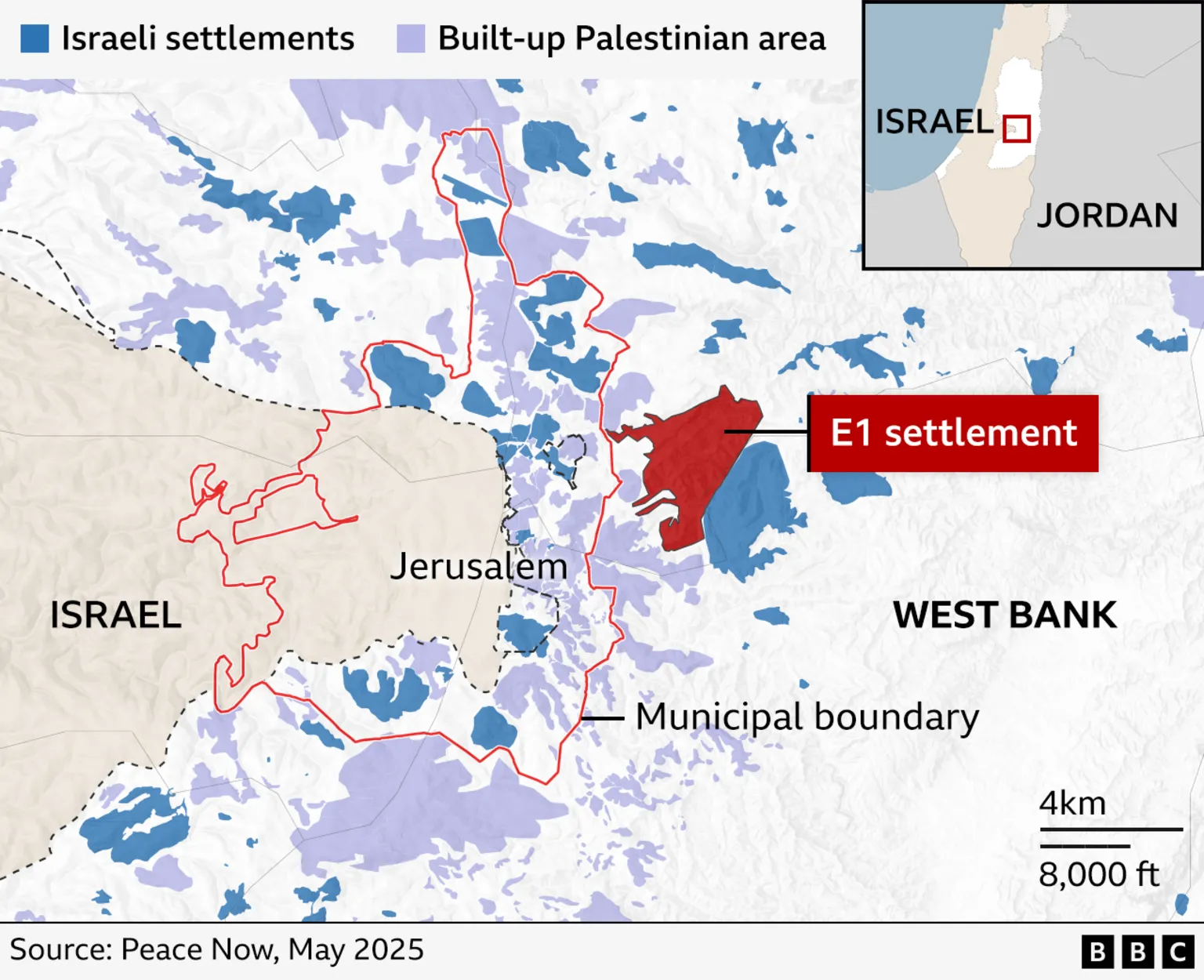
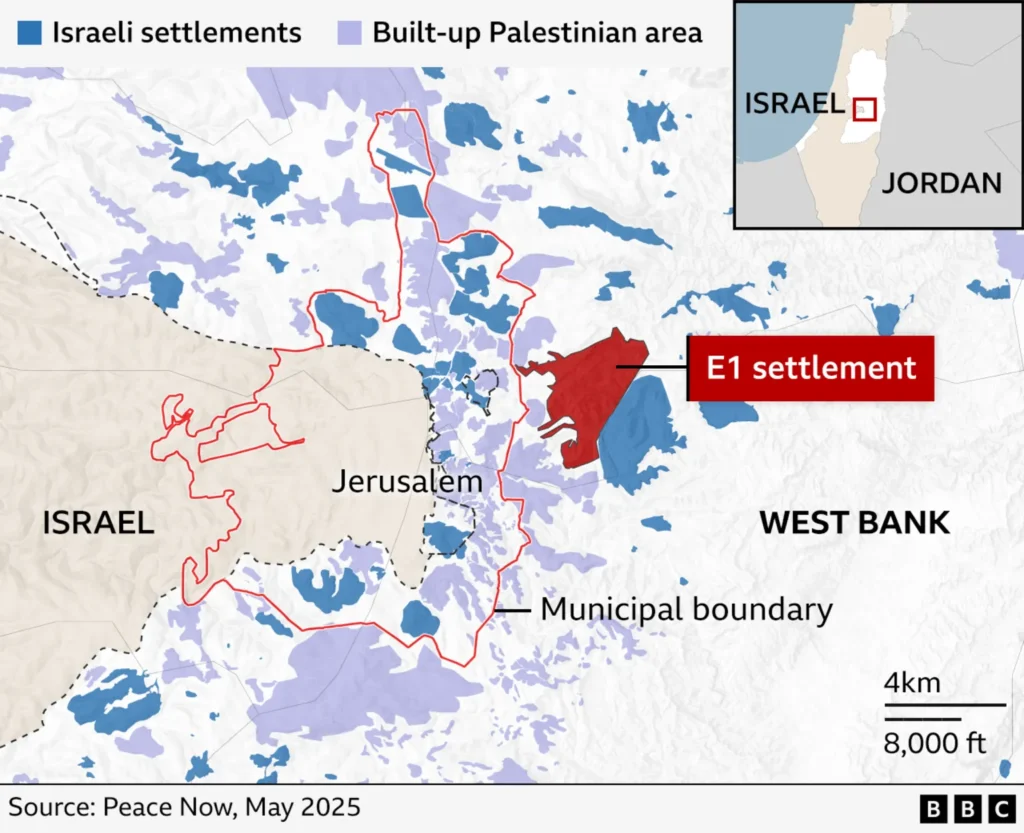
One reason the issue has suddenly acquired greater urgency is the proposed development around E1, a strategically sensitive area east of Jerusalem.
Critics argue that large-scale settlement development there could make territorial continuity between parts of the West Bank more difficult and further weaken the practical possibility of a contiguous Palestinian state.
The 12-country statement specifically cited the E1 settlement project and described settlement expansion and settler violence as threats to the two-state solution. This explains something that can easily be missed in the headlines. Europe is not merely reacting to existing settlements. It is also trying to influence what happens next.

Britain Has Crossed an Important Line
Britain’s September announcement represents a significant departure from the old formula of condemnation without equally strong economic consequences. The UK announced a ban on imports from Israeli settlements and wider restrictions affecting services connected with settlement activity. The government also announced additional measures against people involved in extremist settler violence and tightened restrictions related to the occupation.
That matters because services can be more consequential than supermarket goods. Imagine a settlement project.
It needs land development, construction, engineering, legal advice, insurance, financing, transportation and other professional services.
A government that only bans a box of dates is applying pressure at the end of the economic chain.
A government that begins targeting services and companies supporting settlement activity is moving closer to the machinery that keeps the settlement enterprise functioning.
That is a much more serious question for banks, insurers, construction firms and investors.
But Britain Is Not Cutting Economic Relations With Israel
This distinction deserves emphasis. Britain has not imposed a general trade embargo on Israel. The objective is to isolate settlement-related economic activity rather than shut down normal commercial relations with Israel. That makes the policy politically and economically different from a comprehensive boycott.
It also gives the British government an argument against claims that it is attempting to punish Israeli society as a whole. The intended target is settlement activity. Whether that distinction remains convincing in practice will depend heavily on enforcement.
Israel’s Response Was More Than Rhetoric
Israel reacted quickly.
It announced the closure of the British consulate in East Jerusalem and further restrictions on British diplomatic and security cooperation. British personnel involved in Palestinian security training and other regional activities were affected, while many British politicians were barred from entering Israel.
That response is significant for another reason. If the economic value of settlement exports is relatively small, why respond so aggressively? Because governments do not always react to the financial value of a sanction. They react to what it represents.
Israel has traditionally enjoyed strong relationships with Western governments, particularly Britain, France, Canada and the United States. When traditional allies begin moving from diplomatic criticism toward concrete restrictions, the political message becomes harder to ignore. The Israeli response can therefore be read as an attempt to prevent one important precedent:
The normalisation of economic consequences for settlement expansion.
Twelve Countries Are Moving, but They Are Not All Doing the Same Thing
This is one area where precision matters. Canada, Denmark, Finland, France, Iceland, Ireland, Norway, Poland, Portugal, Spain, Sweden and the UK issued a joint statement on September 8. But they did not all announce identical sanctions on the same day.
The statement reflects different national positions: some governments have already adopted restrictions, while others intend to introduce, support or consider national or European measures according to their own procedures. That distinction matters. There is a growing political coalition. There is not yet a single, uniform European sanctions regime. That difference could determine how effective the campaign becomes.
Spain, Ireland, the Netherlands and Belgium Matter
Spain had already moved against settlement goods.
Ireland has adopted legislation targeting imports from settlements.
The Netherlands is particularly interesting because of its role as a European trading and distribution hub.
If settlement products enter Europe through Dutch infrastructure and are then distributed elsewhere, restrictions there can have effects beyond the Dutch consumer market.
Belgium and Norway have also moved toward restrictions.
France and Canada are now joining Britain in announcing national action.
The result is a gradual change from isolated national measures toward something resembling a wider pressure network.
But it remains fragmented. And fragmented sanctions are easier for businesses to navigate around than a single coordinated regime.
The EU Is the Missing Giant
This may be the most important weakness in the current campaign.
The European Union is one of Israel’s largest trading partners.
EU-Israel trade is worth tens of billions of euros each year.
That puts the current settlement-product bans in perspective.
The settlements themselves do not represent anything close to Israel’s entire economy.
Technology, pharmaceuticals, defence, manufacturing, financial services and other sectors remain vastly more important.
Therefore, a ban on settlement agricultural products cannot by itself threaten Israel’s economic foundations.
But an EU-wide policy affecting settlement goods, services, finance and investment would be a different proposition.
That is the pressure point Europe has not yet fully used.
The Border Problem: How Do You Know Where a Product Really Came From?
This sounds technical. It is actually one of the most important parts of the entire policy.
Suppose a supermarket receives a box of dates.
The box says “Product of Israel.”
But what if the farm is actually inside a settlement?
A customs officer needs more than a general country label.
The authorities need reliable information about the precise origin of the goods.
That means exporters may have to provide farm, factory, address or postal-code information that allows customs officials to establish whether a product originated inside a settlement.
And here is the uncomfortable part:
A ban is only as strong as the paperwork behind it.
If origin information is inaccurate, deliberately misleading or mixed with goods from inside Israel, enforcement becomes difficult.
That creates another battlefield—not between soldiers, but between customs officials, exporters, importers, lawyers and regulators.
The Economic Impact: Small on Paper, Potentially Bigger Through Business Risk
Critics of the sanctions have an obvious argument.
Settlement exports are a tiny part of Israel’s economy.
That is true.
The economic value of settlement goods is small compared with Israel’s overall trade.
But focusing only on the value of exported goods misses the second layer of sanctions.
The important question is not:
“How many pounds of settlement goods does Britain buy?”
It is:
“How much risk does Britain create for anyone helping expand settlements?”
That is a different calculation.
A bank does not need to lose millions of dollars before it decides a transaction is legally or politically troublesome.
An insurer does not need to be sanctioned before it decides a project has become too controversial.
A construction company does not need to be prosecuted before its lawyers advise management to stay away.
This is how sanctions can work indirectly. They can change behaviour before the actual financial penalty becomes large.
Could Banks and Companies Become the Real Pressure Point?
This is where the next phase of the campaign could become far more important. Imagine a company wants to finance a new settlement housing project. If the project involves a bank, insurer, engineering company, legal firm and international investor, each participant must assess the new political and legal environment.
One country imposing restrictions may be manageable.
Several countries doing so simultaneously can create a much larger compliance problem.
Companies hate uncertainty.
Banks hate regulatory uncertainty even more.
If the number of countries involved continues growing, some businesses may simply decide that settlement-related projects are not worth the trouble. That could produce an effect far larger than the value of the goods being banned.
The Missing Pressure From Israel’s Arab and Muslim Partners
Europe is not the only part of the world angry about settlement expansion. Some of the strongest diplomatic condemnation is coming from Arab and Muslim countries, including states that maintain diplomatic relations with Israel.
The UAE, Saudi Arabia, Qatar, Egypt, Jordan, Türkiye, Indonesia and Pakistan have all been part of recent diplomatic efforts condemning Israeli settlement expansion and rejecting the E1 plan. Then came an important development. These countries welcomed Britain’s decision to restrict settlement goods and settlement-linked services. That creates a striking question:
If these governments believe settlement expansion threatens regional peace, why have most of them not imposed similar economic restrictions themselves?
The answer is tied partly to strategy.
The UAE’s Difficult Balancing Act
The United Arab Emirates normalised relations with Israel through the Abraham Accords in 2020. Normalisation did not mean that Abu Dhabi accepted Israeli settlement policy. The UAE continues to publicly support Palestinian statehood, oppose settlement expansion and reject measures that it believes undermine the two-state solution. This creates two parallel tracks.
Political track: Condemn settlement expansion and support Palestinian statehood.
Strategic and economic track: Maintain diplomatic relations and economic connections with Israel. The UAE’s position therefore cannot simply be described as “supporting Israel” or “supporting sanctions.” It is trying to do something more complicated:
Maintain access and influence while opposing policies it considers dangerous.
That distinction is crucial.
Why Doesn’t the UAE Simply Copy Britain?
The UAE has several reasons to hesitate.
First, it may believe that maintaining diplomatic relations gives it more influence than breaking or restricting those relations.
Second, its relationship with Israel extends beyond settlement agriculture into investment, technology, finance, tourism, logistics, energy and regional cooperation.
Third, Gulf governments have a strong interest in preventing another major regional confrontation.
Fourth, the Abraham Accords themselves represent a major strategic investment.
Abandoning them would mean accepting that economic integration had failed to produce the stability and influence their architects expected. But there is a weakness in this argument.
Engagement only provides leverage if the other side believes the engagement can be withdrawn or conditioned.
If settlement expansion continues despite repeated Arab warnings, critics can reasonably ask whether engagement is producing influence, or simply normalising relations while the underlying territorial dispute gets worse.
Bahrain and Morocco Face a Similar Contradiction
Bahrain and Morocco also established relations with Israel through the Abraham Accords.
Both governments have continued to express support for Palestinian rights and a two-state solution.
But neither has emerged as a major supporter of European-style settlement trade sanctions.
That leaves them in a position similar to the UAE.
They can maintain diplomatic channels with Israel while opposing settlement policy.
The advantage is access. The weakness is credibility.
If Israel believes these governments will condemn settlement expansion but continue normal economic relations regardless of what happens, the cost of ignoring their warnings remains limited.
Saudi Arabia Is Different and Potentially More Important
Saudi Arabia is not an Abraham Accords signatory. But it may be the most important Arab country in the normalisation debate. Riyadh has repeatedly rejected settlement expansion and continues to support the establishment of a Palestinian state. Saudi Arabia also possesses something that smaller states do not:
the potential value of normalisation itself.
If Saudi-Israeli normalisation ever returns to serious negotiations, settlement policy could become part of the bargaining equation. That means Arab governments do not necessarily need to impose sanctions today to possess leverage tomorrow. They can condition normalisation, investment and regional integration on Israeli policy. This could eventually become more consequential than a limited ban on settlement goods.
The Arab World Is Not Simply Choosing Between Israel and Palestine
This is where the issue becomes more interesting than the usual political slogans. Arab governments have learned from decades of regional conflict that cutting relations can eliminate channels of influence. They also know that maintaining relations without meaningful conditions can make their diplomacy look toothless. So many are attempting a third path:
Keep relations. Keep talking. Condemn settlement expansion. Support Palestinian statehood. And encourage other countries to impose targeted economic pressure.
Whether that strategy works remains uncertain. But it explains why the UAE can welcome Britain’s sanctions while not immediately imposing identical restrictions itself.
The Abraham Accords Are Now Facing a Real Test
The Abraham Accords were originally sold partly as a new model for the Middle East. The theory was straightforward.
More trade could create more interdependence.
More interdependence could create more stability.
More stability could make conflict less attractive.
But settlement expansion presents the opposite possibility.
Economic relations can grow while the political conflict remains unresolved.
If that happens, the central promise of normalisation becomes harder to defend.
The question therefore is not simply whether the Abraham Accords survive. It is:
Can economic integration influence Israeli political behaviour, or can political conflict eventually overwhelm economic integration?
That is a much bigger test than the latest diplomatic statement.
What If Arab States Eventually Join the Economic Pressure?
This is the scenario European governments and Israeli policymakers should watch carefully.
Britain imposing a settlement-goods ban is one thing.
Britain, France, Canada and several European countries coordinating similar restrictions is another.
But imagine a third stage.
Suppose Arab states maintaining relations with Israel begin restricting settlement products, settlement-linked companies or financial services while keeping diplomatic relations intact.
That would be qualitatively different.
It would remove one of Israel’s easiest arguments, that economic pressure on settlements is simply a Western campaign against Israel. The pressure would then be coming from countries that want Israel to remain part of the Middle East’s political and economic future. That would make the message harder to dismiss.
Settlement expansion would no longer be framed simply as a dispute between Israel and Western critics. It would increasingly become a point of disagreement between Israel and countries seeking normal relations with it.
The Palestinian Complication: Sanctions Can Have Unintended Victims
Sanctions can produce unintended victims.
Some Palestinians work in settlement farms, factories and businesses because those jobs can provide relatively attractive wages compared with alternatives available nearby. If settlement exports decline sharply, some workers could lose income. That creates a difficult contradiction.
A policy designed to protect Palestinian land and weaken settlement expansion can produce short-term economic pain for Palestinians who depend on settlement employment.
Supporters would argue that the long-term objective is more important: preventing further expansion and creating conditions for a viable Palestinian state.
Critics can reasonably ask what happens to workers tomorrow morning.
A serious policy therefore needs to consider both. Punishing an economic structure is easier than replacing the livelihoods connected to it.
The Israeli Argument: “This Targets Us Unfairly”
Israeli officials reject the measures and describe them as hostile and politically motivated. Some Israeli and Jewish voices abroad have also warned that harsh language about Israel can spill over into antisemitism and make Jewish communities feel less secure. That concern cannot simply be dismissed.
There is an important distinction between criticising the policies of an Israeli government and attacking Jewish people. There is also a distinction between opposing settlement activity and denying Israel’s right to exist. The governments imposing these measures insist that their target is settlement policy, not Jewish identity or Israeli civilians. Maintaining that distinction will be crucial.
If the political debate becomes a fight about Jewish identity rather than settlement policy, the sanctions campaign could lose both moral clarity and public support.
The American Problem
Then comes Washington. The United States has refused to copy Britain’s approach. Secretary of State Marco Rubio has said that Washington will not impose the same settlement-trade sanctions as Britain. This creates a serious transatlantic divide. Britain and several European countries are effectively saying:
Pressure is necessary because previous warnings have failed.
Washington is saying:
Pressure of this kind may make an unstable situation worse.
That disagreement matters because American diplomatic, military and economic influence remains far greater than that of any single European government.
Why the US Position Could Matter More Than the British Ban
Israel can absorb a small trade restriction from Britain.
It can absorb another from Spain.
It can probably absorb several more.
But if Washington eventually moves in the same direction, the calculation changes dramatically.
The United States provides Israel with enormous strategic, diplomatic and military support.
Therefore, the biggest unanswered question is not whether Britain can hurt settlement exports.
It cannot do so significantly on its own.
The bigger question is whether European pressure eventually changes the political debate inside Washington.
So far, there is no indication that the Trump administration is ready to follow London.
That makes the European campaign substantially less powerful than it would be if the US joined it.
Is Europe Trying to Change Israeli Policy, or Its Own Political Position?
There is another uncomfortable question.
Are these measures designed primarily to change Israel?
Or are European governments also responding to pressure from their own voters?
Probably both.
Public opinion across Europe has become increasingly critical of Israeli conduct in Gaza and the West Bank. Governments also face growing domestic pressure to demonstrate that condemnation has consequences. That does not automatically make the sanctions meaningless. Domestic politics has always influenced foreign policy. The more useful question is whether the measures continue after the headlines disappear. That is the real test.
The October Election Adds Another Political Layer
Israel’s upcoming election makes the timing particularly sensitive. Israeli officials can portray foreign pressure as interference in Israel’s domestic political process, while European governments argue that action is necessary because settlement expansion is moving too quickly.
This creates an unusual situation.
European governments want Israeli leaders to change policy.
Israeli leaders can portray foreign pressure as an attack on national sovereignty.
For nationalist voters, that can actually strengthen resistance to outside pressure.
This is the classic sanctions dilemma:
Pressure can weaken a government or give it a foreign enemy around which to rally its supporters.
What Would Actually Make These Sanctions Effective?
The answer is not another press conference. Real pressure would require several things to happen together.
1. More Countries Must Join
If Britain acts alone, Israel can absorb the cost.
If France, Canada, Spain, Ireland, the Netherlands, Norway, Belgium and others coordinate, the compliance burden increases. If the EU itself eventually adopts a common position, the pressure becomes much harder to bypass.
2. Services and Finance Must Be Included
Importing settlement products is only one part of the economic system.
Construction, banking, insurance, investment, engineering and property services can be much more important.
That is where future European measures could become consequential.
3. Customs Enforcement Must Be Credible
A ban that can be bypassed through misleading labels is weak. Governments need reliable origin data, audits and penalties for companies that deliberately disguise settlement products.
4. The Measures Must Continue
If governments impose restrictions for six months and then quietly relax them, Israeli policymakers may conclude that political pressure is temporary. Consistency matters.
5. The Policy Must Be Clearly Targeted
The more precisely governments distinguish settlement activity from Israel’s broader economy and Israeli citizens, the harder it becomes to portray the measures as a general attack on Israel.
6. Arab Economic Pressure Would Change the Equation
If Arab states with relations with Israel eventually move from diplomatic condemnation toward targeted restrictions, the political effect could be much larger than the value of the goods involved. It would demonstrate that settlement expansion is creating costs not only in Western capitals but also among countries seeking normal relations with Israel.
7. Washington Would Have to Reconsider Its Position
This is the biggest potential multiplier. European pressure without American support can create diplomatic discomfort. European pressure combined with a future shift in US policy would be something much more serious.
What Could Go Wrong?
The campaign also has risks.
Economic Harm to Palestinians: Workers dependent on settlement businesses could lose income.
Diplomatic Retaliation: Israel can reduce cooperation with European governments, as Britain has already experienced.
Political Backlash: Israeli leaders may portray sanctions as foreign interference.
Antisemitism Risks: Poorly framed criticism can feed prejudice against Jewish communities far removed from Israeli policy.
Trade Diversion: Settlement goods can potentially find alternative markets.
Enforcement Gaps: Different national rules can create loopholes.
European Division: If governments disagree over implementation, Israel and businesses may find ways around the restrictions.
Arab Reluctance: If Arab governments condemn settlement expansion but continue unrestricted economic engagement, Israel may conclude that the economic cost remains manageable. These weaknesses do not make the policy pointless. They show why implementation matters more than announcements.
So, Are the Sanctions Real Pressure or Political Theatre?
The answer is:
They are both, but they could become much more.
Calling them purely cosmetic would be wrong. Britain has created new legal and commercial risks. France and Canada are following. Several other countries are preparing or considering measures. Israel has responded with significant diplomatic retaliation. Arab and Muslim governments have welcomed the principle behind Britain’s action.
That alone demonstrates that the measures have political consequences. But calling them a decisive economic weapon would also be wrong.
Settlement exports are too small to threaten Israel’s wider economy.
The European Union has not yet adopted a single comprehensive settlement-sanctions regime.
The United States has refused to copy Britain.
And most Arab states have not imposed equivalent economic restrictions.
Israel’s core economic sectors therefore remain largely outside the direct reach of these measures.
So the campaign should be understood as pressure at the beginning of a possible escalation ladder.
The first step is trade.
The next could be services.
Then finance.
Then investment.
Then wider diplomatic and economic restrictions.
Whether governments climb that ladder depends on what happens next.
The Bigger Story: The Cost of Doing Nothing Is Changing
For decades, the international community largely operated on the assumption that condemning settlement expansion was preferable to confronting Israel directly. That calculation appears to be changing. The new measures suggest that some governments have concluded that words alone have failed.
That is the real significance of September 2026.
Not the value of a shipment of dates.
Not the number of wine bottles affected.
The important change is the principle:
Settlement expansion may increasingly carry an economic and diplomatic price.
But there is a second development that may prove equally important. Arab and Muslim governments are increasingly endorsing the political principle behind these restrictions, even when they are unwilling to impose identical sanctions themselves. That creates a new form of pressure.
Europe is testing economic pressure.
Arab states are using diplomatic and normalisation leverage.
The United States is maintaining strategic support for Israel.
The future balance among those three approaches could determine whether settlement policy actually changes.
What Readers Should Watch Next
The next developments will tell us whether this is a genuine policy shift or another burst of diplomatic theatre. Watch seven things.
European Coordination
Do more countries turn intentions into actual laws?
EU Action
Does Brussels eventually adopt common restrictions?
Corporate Behaviour
Do banks, insurers, investors and construction companies begin withdrawing from settlement-related projects?
Arab Policy
Do the UAE, Bahrain, Morocco or other Arab states move from condemnation and diplomatic support toward targeted economic restrictions?
Saudi-Israeli Normalisation
If normalisation discussions return, does settlement policy become a formal condition?
Israeli Policy
Does settlement construction slow, or accelerate in defiance of foreign pressure?
American Policy
Does Washington continue opposing European restrictions, or eventually decide that settlement expansion has become too costly to defend?
These indicators are more important than the next headline.
The Bottom Line
Britain and its partners have not imposed an economic blockade on Israel.
They have done something narrower, and potentially more strategically important.
They are attempting to make settlement expansion economically inconvenient, legally risky and diplomatically costly.
At present, the financial impact is small.
The political signal is much larger.
The Arab position makes the story even more complicated.
The UAE and other Muslim countries are not simply standing with Israel against Europe. Nor are they joining Europe’s sanctions campaign.
They are taking a middle position: maintain relations with Israel, oppose settlement expansion, support Palestinian statehood and increasingly welcome international measures aimed specifically at settlements.
That strategy may preserve diplomatic influence. But it also faces a credibility test. If settlement expansion continues despite repeated Arab warnings, the question will become unavoidable:
How much influence does engagement really provide if it carries no meaningful consequences?
The decisive question for Europe is equally clear. Will these measures remain limited national bans on relatively small volumes of agricultural goods? Or will they evolve into coordinated restrictions on finance, investment, services and settlement-linked companies? And then comes the biggest question of all.
What happens if Arab states eventually decide that maintaining relations with Israel and imposing targeted economic costs are not mutually exclusive?
If that happens, the pressure campaign could enter an entirely different phase. For now, the sanctions are neither meaningless nor decisive. They are a test.
The real test is whether Europe is prepared to keep applying pressure after the headlines disappear, and whether Israel changes policy before the pressure becomes much harder to ignore.
Frequently Asked Questions
Are Britain and Europe imposing a total trade embargo on Israel?
No. The measures discussed here primarily target goods and economic activity connected with Israeli settlements in occupied territory. They are not equivalent to a comprehensive embargo on Israel.
Why are settlement goods being targeted?
Governments supporting the restrictions argue that settlement activity contributes to the entrenchment of the occupation and makes a viable two-state solution more difficult.
Will these sanctions stop Israeli settlement construction?
Not by themselves. Settlement construction depends on government policy, domestic financing, land administration, infrastructure and political support. Trade restrictions can increase costs and risks but do not automatically stop construction.
Why is the UAE not imposing the same sanctions as Britain?
The UAE strongly opposes settlement expansion but maintains diplomatic and economic relations with Israel. Abu Dhabi appears to view continued engagement as a source of influence while using diplomatic pressure to oppose policies it considers harmful to Palestinian statehood and regional stability.
Could Arab countries eventually impose settlement sanctions?
Yes, that remains a significant possibility. Arab states could theoretically maintain diplomatic relations while imposing targeted restrictions on settlement goods, companies or financial services. Such a move would carry a different political weight because it would demonstrate that settlement expansion is damaging Israel’s relations not only with Western governments but also with Arab states seeking normalisation.
Why isn’t the United States joining Europe?
The US has chosen not to copy Britain’s settlement trade sanctions. Washington argues that additional pressure could increase instability and has maintained a substantially different approach from Britain and several European governments.
About the Author
Maj Hamid Mahmood (Retired), MA Political Science, LLB, PGD (HRM), is a writer and former military officer, educator and security professional whose work explores geopolitics, security, international affairs and contemporary issues through independent research and practical analysis.
References and Further Reading
- UK Foreign, Commonwealth & Development Office: Joint Foreign Ministers’ Statement on the Two-State Solution, September 8, 2026.
- Government of Canada: Joint statement by the foreign ministers of Canada, Denmark, Finland, France, Iceland, Ireland, Norway, Poland, Portugal, Spain, Sweden and the UK.
- Reuters reporting on Britain’s settlement trade restrictions and Israel’s diplomatic response.
- Associated Press reporting on the British measures and international reaction.
- Guardian reporting on the UK sanctions, British-Jewish community concerns and UK-Israel security cooperation.
- Al Jazeera analysis of the countries restricting or considering restrictions on settlement goods.
- UAE Ministry of Foreign Affairs statements concerning Israeli settlement expansion, the E1 plan and Britain’s September 2026 measures.
- International Court of Justice, 2024 advisory opinion concerning the legal consequences of Israel’s policies and practices in the Occupied Palestinian Territory.
- Relevant national legislation and government announcements from Spain, Ireland, the Netherlands, Norway and Belgium.
- US State Department comments concerning the British measures and settlement policy.
- Abraham Accords diplomatic statements and subsequent UAE, Bahrain and Moroccan positions concerning Israel and Palestinian statehood.
Author: Maj Hamid Mahmood (Retired), MA Political Science, LLB, PGD (HRM).