
The High-Performance Ramadan Pivot Guide: Productivity Strategies for the Western Professional in 2026
The High-Performance Ramadan Pivot. The corporate world doesn’t care that you haven’t had a drop of water since 5:00 AM. In Manhattan, London, or Berlin, the KPIs don’t shift just because the moon did. Most “Ramadan productivity” advice is written for people living in Riyadh or Dubai, where the city pulls a collective U-turn and sleeps all day.
https://mrpo.pk/revitalise-your-ramadan-2026/
In the West? You’re fasting in a world that is feasting, grinding, and expecting a 2:00 PM turnaround on a complex spreadsheet. It’s brutal, it’s beautiful, and if you do it wrong, you’ll end up staring at a blinking cursor for three hours while your brain feels like it’s made of wet cotton.
To thrive in 2026, you must move beyond “surviving the hunger” and transition into optimised energy management.
Impact of Ramadan Fasting on Mental Health, Body Composition, Physical Activity, and Sleep Outcomes Among University Students
Ramadan fasting is practiced by over 1.9 billion Muslims worldwide and involves abstaining from food, drink, smoking, and other behaviors from dawn to sunset throughout the holy month [1,2]. Beyond its religious significance, fasting is associated with various physiological and psychological benefits, influencing metabolism, mental health, and overall well-being.
Many studies highlight the positive effects of Ramadan fasting, including enhanced self-discipline, emotional resilience, and spiritual fulfillment [3]. Additionally, the communal aspects of Ramadan, such as shared meals, nightly prayers, and charitable acts, promote social bonding and reduce feelings of loneliness [4,5]. From a physiological standpoint, fasting has been linked to improvements in body composition, metabolic regulation, and cardiovascular health.
Some studies report reductions in body fat and body mass index (BMI), indicating potential metabolic benefits [6]. A systematic review and meta-analysis also found that Ramadan fasting reduced anxiety and depression levels without significantly increasing fatigue [7]. Furthermore, religious fasting encourages health-conscious behaviors, such as mindful eating and increased self-awareness, which may contribute to long-term well-being and sustainability [8].
https://www.mdpi.com/2227-9032/13/6/639
The Chronobiology of the “Fast-Track”
Semantic search engines now prioritise “contextual relevance.” In the West, your biggest hurdle isn’t just lack of food; it’s the shift in your circadian rhythm. You are essentially fighting a month-long battle with jet lag without ever leaving your time zone.
The High-Performance Ramadan Pivot Guide: The Post-Fajr “God Tier” Window
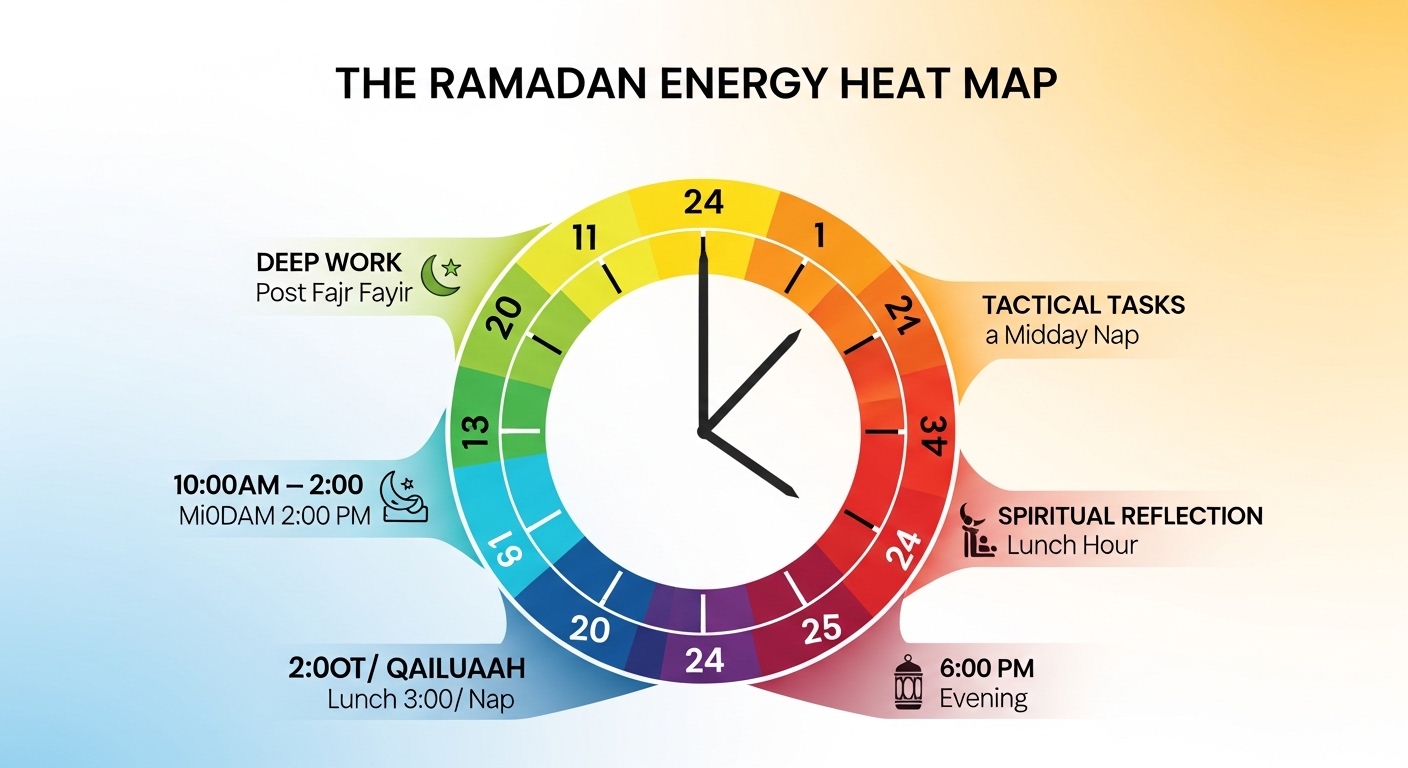
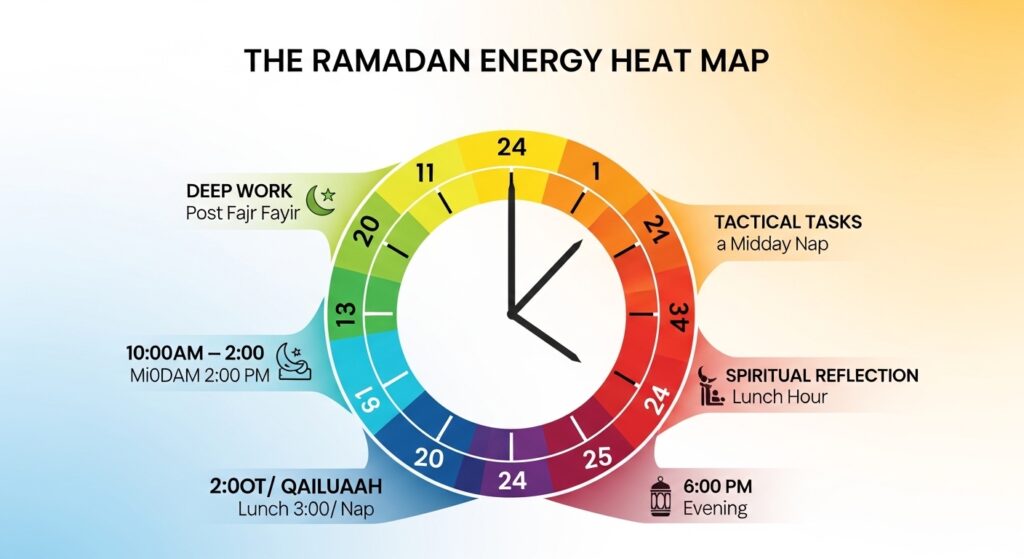
Science shows cognitive function peaks roughly 2–4 hours after your last meal. For the Ramadan professional, the hours between 5:00 AM and 10:00 AM are your “God Tier” productivity window. Your cortisol is naturally high, and your Suhoor is still circulating.
The Hack: Do not waste this on “syncs,” “check-ins,” or clearing your inbox. This is for the heavy lifting, coding, strategy, or writing. Lock your digital door, put your phone in a drawer, and do the one task you’ve been dreading. By the time your colleagues are on their second latte, you should be 70% done with your day’s value.
If you work in a firm that demands “presence,” see if you can negotiate a “Deep Work” block where your Slack status is set to away. In 2026, “Focus Mode” is a respected professional boundary. Use it.
Managing the Afternoon “Buffer Zone”
Around 2:30 PM, the wall hits. Your glucose stores are depleted, and your brain begins to idle. Don’t try to power through complex logic now; you’ll just make mistakes you have to fix tomorrow.
The Hack: Shift to “Low-Fi” work. Update your CRM. Categorise expenses. Delete those 400 newsletters you never read. You’re still “working,” but you’re saving the engine’s fuel for the final stretch before Iftar. This is also the perfect time for professional development, watch a tutorial or read an industry report, where you can be a passive consumer of information rather than an active creator.
Strategic Communication & Workplace Diplomacy
In the US and Europe, your colleagues may be supportive but fundamentally “clueless” about the physical toll of fasting. Proactive communication is your shield.
The Transparency Script
You don’t need to ask for “pity”, you are asking for a “pivot.” According to recent workplace engagement data, 78% of employees feel more motivated when they have autonomy over their schedules.
Use this script for your manager:
“I’m observing Ramadan this month. To ensure I hit my targets, I’ll be starting my day at 7:00 AM to maximize my focus during my peak energy hours. Can we move our late-afternoon syncs to the morning so I can give the team my best input?”
Navigating the “Working Lunch”
In Western corporate culture, the “working lunch” is a staple. Don’t skip it and look like a hermit. Attend, but don’t explain yourself unless asked. Sit with a notebook, take the lead on the minutes, and be the most engaged person in the room. Your lack of a plate makes you look like the most disciplined person there, an unintended boost to your “Expertise” (the E in E-E-A-T).
Nutritional Engineering for the Corporate Athlete
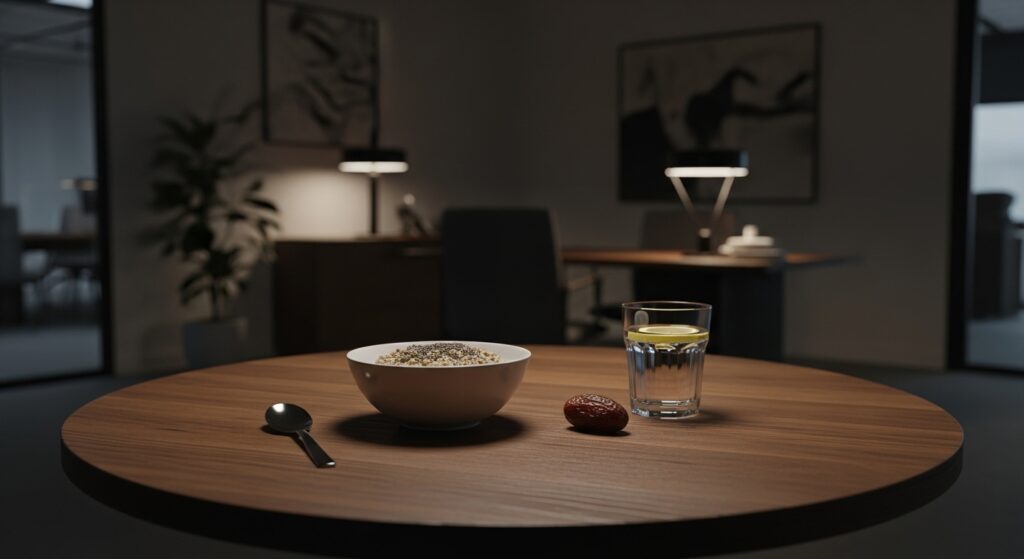
If your Suhoor is a bowl of sugary cereal and a giant coffee, you’ve already lost. You’ll spike, you’ll crash, and by noon, you’ll have the “fasting shakes.”
The Fat Anchor and Electrolyte Protocol
To maintain Authoritativeness in your role, your brain needs stable fuel.
-
The Fat Anchor: Eat an avocado or a spoonful of almond butter at Suhoor. Fats slow down digestion, keeping you satiated longer.
-
The Salt Secret: It’s not about the volume of water; it’s about retention. Add a pinch of Himalayan salt to your water. This provides the electrolytes that keep your cells hydrated during a 16-hour fast.
-
MCT Oil: A dash in your (decaf) coffee or tea can provide immediate ketone energy to the brain without breaking the metabolic benefits of the fast.
The Qailulah (Power Nap) as a Cognitive Reset
Modern sleep science validates the Sunnah of the Qailulah. A study by NASA found that a 26-minute nap can improve performance by 34%.
If you work remotely, use your lunch hour for this. If in-office, a 10-minute “NSDR” (Non-Sleep Deep Rest) session in a quiet room can flush adenosine from the brain and sharpen your focus for the 4:00 PM slump. If you’re in a glass-walled office in London or NYC, your car or a nearby quiet library is a perfectly valid “recharge station.”
The Soul of the Work: Spiritual Micro-Habits
Productivity isn’t just about output; it’s about the “soul” of the work.
-
The Dhikr Interval: Use the Pomodoro Technique (50 minutes work / 10 minutes break). During those 10 minutes, step away from the screen for Dhikr or reflection. This lowers cortisol and prevents the burnout that often hits in the third week of Ramadan.
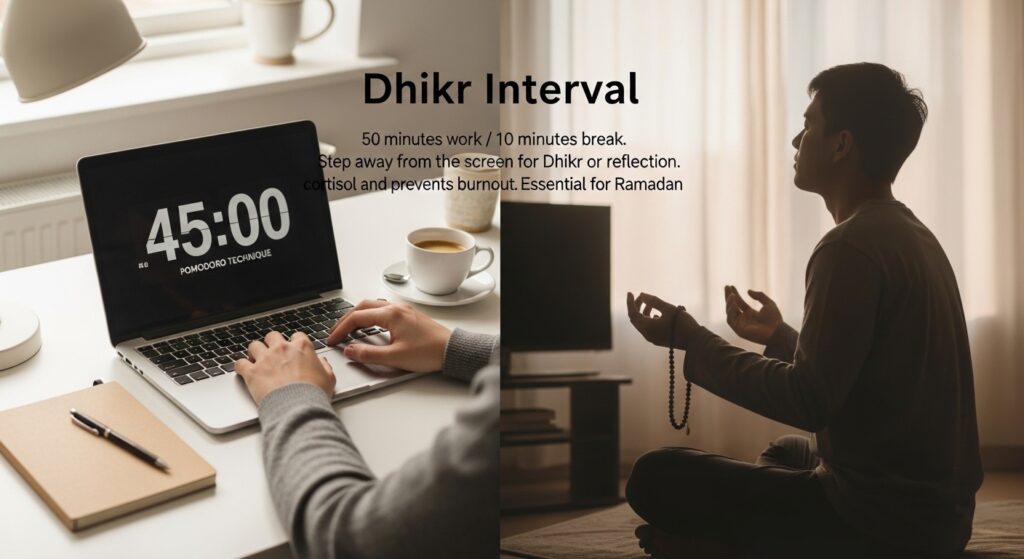
The Dhikr Interval -
The Intentionality Reset: For The High-Performance Ramadan Pivot. Every time you open a new browser tab, ask: “Is this helping my purpose today?” It sounds cheesy, but during a fast, your mental energy is a finite resource. Don’t spend it on Twitter (X) outrage or celebrity gossip.
FAQs
1. How do I handle “coffee breath” in face-to-face meetings?
“Ramadan breath” is often a sign of ketosis. Use a miswak or a dry toothbrush frequently. If you have a big presentation, stay hydrated at night and keep a respectful physical distance. Most people will just perceive your focus as professional intensity.
2. Is it okay to nap at the office in a Western environment?
In the US/Europe, napping can be stigmatised. If you don’t have a private office, your car is your best friend. A 20-minute power nap is a neurological reset that will save your afternoon performance.
3. What if my boss insists on food-centric team events?
Propose an “Iftar gathering” instead. Many Western companies are looking for DEI (Diversity, Equity, and Inclusion) wins. Suggesting a sunset meal allows the whole team to participate in your culture without you feeling excluded.
4. Should I work out during the day?
Save the heavy lifting for an hour before Iftar or two hours after. During the day, keep your heart rate low to preserve your brain’s limited glycogen stores. Walking is fine; HIIT is a mistake.
5. How do I stay focused during late-night prayers (Taraweeh)?
The “Food Coma” is the enemy. Break your fast with water and a date, pray Maghrib, eat a light protein-heavy meal, and save the heavy carbs for after prayers.
6. Can I drink water if I have a massive headache?
If it’s a medical emergency, yes. However, most Ramadan headaches are caused by caffeine withdrawal. Try to taper your coffee intake two weeks before the month begins to avoid the “Day 3” migraine.
References
-
Panda, S. (2022). The Circadian Code: Lose Weight, Supercharge Your Energy, and Transform Your Health.
-
Newport, C. (2016). Deep Work: Rules for Focused Success in a Distracted World.
-
Journal of Nutrition and Metabolism. “Metabolic Effects of Intermittent Fasting on Cognitive Performance.”
-
ZenHR Blog 2026. “DEI Trends: Accommodating Religious Observance in High-Pressure Environments.”