The Commander’s Burden: Where Wars Are Won and Lost
Excerpt: The commander’s burden, as the 2026 Gulf conflict intensifies, the true fault lines aren’t found in the sand, but in the minds of the leadership. Maj Hamid Mahmood (Retired) analyses the strategic blunders, the “resolve gap,” and why technology fails when the “Samson Instinct” takes over.

Author Bio: Maj Hamid Mahmood (Retired) is a former commissioned officer whose career spanned from the tactical grit of a Second Lieutenant to the operational leadership of a Major. He specialises in deconstructing modern warfare through the classical frameworks of Sun Tzu and Clausewitz.
https://mrpo.pk/contradictory-statements-attack-iran/
The View From THE Command Post
In my years as a commissioned officer, from the tactical drills of a Second Lieutenant to the operational planning of a Major, one truth remained constant: A soldier can win a battle, but only a Commander can win a war.
Right now, in 2026, we are witnessing the Commander’s burden, a global masterclass in how NOT to lead. We see the world’s most sophisticated militaries falling into the “Kinetic Trap”, believing that enough precision strikes can substitute for a coherent national strategy. To understand the depth of this failure, we must bridge the gap between ancient wisdom and the modern battlefield.
The “Commander’s Burden” is the intense, multifaceted responsibility that shapes the outcome of armed conflict, often balancing and sometimes failing to balance tactical victory with strategic success, human cost with operational necessity, and immediate, high-stakes decisions with long-term consequences. It is characterised by the immense pressure to manage logistics, maintain morale, and, crucially, to make decisions that often result in the death of subordinates.
The View From THE Command Post
Precision missiles can destroy a bunker, but they cannot penetrate a soldier’s resolve. If the strategy is hollow, the high-tech hardware is just expensive scrap metal.
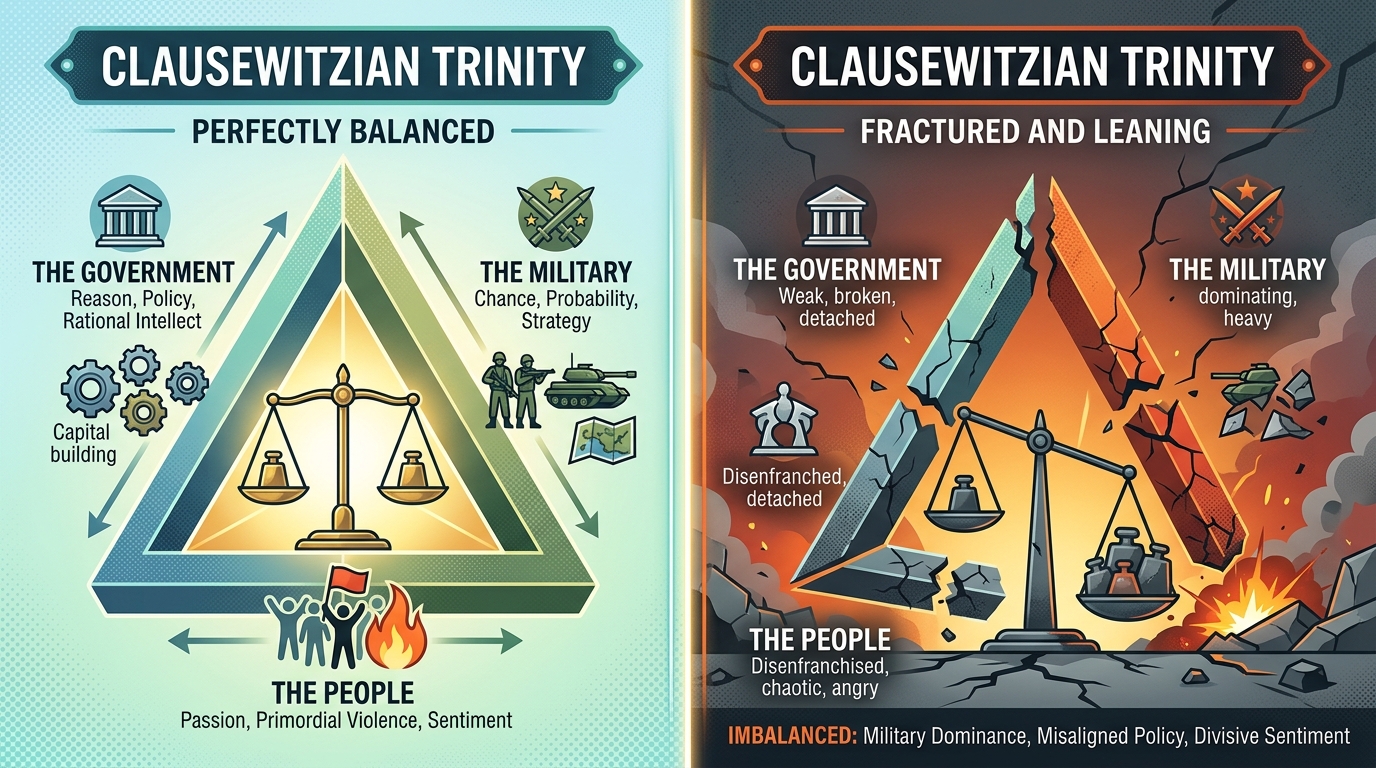
1. The Clausewitian Trinity: A fractured Foundation
Carl von Clausewitz identified what he called the “Remarkable Trinity.” He argued that war is a paradoxical interaction between three distinct forces: The Government (Reason), The People (Passion), and The Military (Chance).
In the current US-Israel-Iran conflict, this Trinity is dangerously out of balance. In the West, the Government is using “Reason” to calculate domestic poll numbers, while the People are largely “absent” from the battleground. There is no collective “Passion” in the US or Europe for this conflict; it is a war of professionals, not a war of the nation.
In Iran, the Government has successfully ignited the People’s “Passion” through the martyrdom of their leader. A military that fights with the passion of the people is a force that mere technology cannot easily break.
2. Sun Tzu and the Tao of Command
Over 2,000 years before Clausewitz, Sun Tzu taught that the first factor of war is the “Tao” (The Moral Law). This represents the harmony between the people and their leader. When the Tao is strong, the people will follow their leader into death without fear of peril.
As a former officer, I see the US leadership violating the “Tao” every time a missile is launched. By “raining death” on Iranian soil while simultaneously issuing appeals to the Iranian people for “regime change,” Trump is attempting to use force without a moral foundation. You cannot “liberate” a population while blacking out their power grids and terrifying their children.
Sun Tzu warned that the greatest victory is to win without fighting. Today, we see leaders who fight without even knowing how to win.

3. Integrity and The Personality of Command: The Commander’s Burden
Donald Trump: Transactional Populism. Trump’s leadership is transactional. While he commands immense loyalty from his base, he lacks a “Solid National Backup” from the broader US population. He treats war like a real estate deal, forgetting that you cannot “evict” a regime that has accepted its own death.
https://mrpo.pk/donald-trump-peace-promises/
Benjamin Netanyahu: The Tactical Nomad. Netanyahu is a master of the “Decisive Strike,” yet he lacks a “Strategic End State.” His public perception in Israel is a paradox: the nation supports his mission but distrusts his integrity.
https://mrpo.pk/netanyahus-thirty-year-nuclear-alarm-on-iran/
The Martyred Imam: Ideological Force Multiplier. The strike that killed Khamenei did not decapitate the regime; it canonised it. He has moved from a political leader to a sacred symbol of “Existential Resistance.” You cannot negotiate with a legacy.
4. The Samson Instinct: Death Ground in 2026
When a “smaller” force realises it faces an existential threat, it triggers the Samson Instinct: “If I go down, you go with me.”
The US and Israel are fighting a “Calculated War.” Iran is on “Death Ground.” In military terms, “Death Ground” is a position where an army can only survive by fighting with desperate ferocity. This asymmetry of resolve is why “small fighters” are currently neutralising larger, more advanced enemy forces.
5. The Folly of The Mixed Message
The supreme blunder of 2026 is the disconnect between kinetic action and psychological objectives. Raining death while asking for friendship is a strategic oxymoron. It ignores the “Human Instinct” to rally around the flag when threatened. The result is a unified enemy and a silent, terrified populace that sees no “Golden Bridge” to a Western-backed future.
Reflective: In the military, we say, ‘Fear the man with nothing to lose.’ In 2026, the West has pushed an entire nation into that corner.
6. The Global Citizen’s Stake: Beyond the Battlefront
While the maps in the War Room focus on troop movements, the maps in the homes of the West focus on something equally volatile: The Cost of Living.
In 2026, we must recognise that modern conflict is no longer “somewhere else.” Through the hyper-connected veins of global trade and energy, every citizen in the US and Europe is now an inadvertent stakeholder in the Gulf. To be a conscientious citizen today is to understand that the “economic fallout” is not a side effect; it is a front line.
a. The “Inflationary Pincer” Movement
The average citizen is currently caught in a strategic pincer. On one side, the closure of the Strait of Hormuz has disrupted 20% of global oil and 25% of LNG (Liquefied Natural Gas) shipments. On the other hand, the rerouting of ships around the Cape of Good Hope has added $1M in fuel costs per voyage.
-
The Result: This isn’t just about gas prices; it’s about the “everything tax.” When energy costs spike, the price of bread, medicine, and technology follows.
-
The Outlook: Analysts suggest that a prolonged conflict could add a full percentage point to global inflation, effectively erasing the “soft landing” many Western economies hoped for in early 2026.
b. Awareness as a Shield Against “Gouging” The commander’s burden
A conscientious public acts as a check on opportunistic economic behaviour. We are already seeing “war premiums” being applied to goods that have no direct link to the Gulf.
-
The Role of the Citizen: Demand transparency from retailers and energy providers. In Ireland and Spain, we’ve already seen government officials warn against “price gouging” at the pump. Civil awareness prevents the “fog of war” from being used as a cover for corporate profiteering.
c. Rejecting the “Mixed Message”
As discussed in the military context, the US and European leadership are sending mixed messages, promising peace while funding escalation. A “civilised world” requires its citizens to hold leaders accountable for the Strategic End State.
-
The Question to Ask: If this conflict continues for six months, what is the plan for energy security? Is there a diplomatic “Golden Bridge” being built, or just more kinetic expenditure?
-
The Danger: Without a clear exit strategy, the Western middle class becomes the “Silent Casualty,” paying for a war of attrition through depleted savings and rising interest rates.
d. The Path of the Conscientious Observer
Being “conscientious” does not mean incitement; it means informed resilience.
-
Diversify Personal Reserves: Just as a General diversifies his supply lines, citizens must diversify their household “logistics”, preparing for temporary energy volatility without falling into panic-buying.
-
Promote De-escalation Discourse: The “Samson Instinct” thrives on binary, “us vs. them” narratives. Civilised citizens can play a role by supporting nuanced diplomacy that recognises the existential fears of both sides.
Strategic Insight: A nation’s true strength is its “Solid National Backup.” If the public is economically broken and ideologically divided, the military’s high-tech edge becomes irrelevant. Economic stability is the bedrock of national security.
Frequently Asked Questions for the Global Audience
Q1۔ How soon will I see the war’s impact on my bills?
Energy markets react instantly. Gasoline prices in the US have already climbed 5–10 cents daily since the initial strikes. Grocery and retail impacts usually follow within 2–3 months as transport costs filter down.
Q2. Is this 2026 crisis worse than the 2022 energy shock?
While gas prices in Europe have spiked, the US is more “buffered” today due to domestic production. However, the global nature of supply chains means no one is truly immune to the “Hormuz Chokepoint.”
Q3. What can one person really do?
Stay informed and stay vocal. The most dangerous environment for a citizen is “apathy.” When the public understands the link between foreign policy and their own bank account, leaders are forced to move toward more sustainable, diplomatic solutions.
Q4. Why is the “Samson Option” so dangerous for a superpower?
Because a superpower relies on global stability. A suicidal enemy only needs to cause enough “friction” to make the American public demand an exit.
Q5. How does martyrdom change military math?
It removes the “off-ramp.” When a leader becomes a martyr, the conflict moves from a political dispute to a generational struggle.
Q6. What is the biggest blunder a Supreme Commander can make?
Ignoring the “Tao” (Moral Law) of the enemy. If you don’t understand why your enemy is willing to die, you won’t know how to make them stop fighting.
Q7. Is technology a substitute for leadership?
Never. Technology is a tool, but leadership is the hand that guides it. Without a clear end-state, tech just creates a more efficient disaster.
Q8. Why isn’t the Iranian public revolting?
Unarmed civilians do not charge into an IRGC on a war footing. Fear, communication blackouts, and the “Samson Instinct” keep the dissent sub-surface.
Q9. Can a war be won without the nation’s participation?
No. History shows that a military without the “solid back up” of its people eventually exhausts its resources and its will. Victory requires a unified Trinity of Government, Military, and People.