
The Sovereign Soul: Reclaiming Identity and Reframing Modernity in Post-Colonial Pakistan
Research Theme
Reclaiming Identity and Reframing Modernity in Post-Colonial Pakistan. In the contemporary post-colonial landscape of Pakistan, the question of national progress is often framed in material and institutional terms—economic growth, technological advancement, and global competitiveness. However, beneath these visible indicators lies a deeper, less examined crisis: the psychological erosion of identity and the gradual internalisation of cultural inferiority.
This study is grounded in the proposition that true national strength originates not from borrowed frameworks but from a coherent civilizational consciousness rooted in linguistic, cultural, and spiritual authenticity. The inherited legacy of colonial education systems and elite social structures has cultivated a mindset where modernity is equated with imitation, and where indigenous identity—expressed through language, names, and worldview—is subtly delegitimised.
This process begins within the home, where the abandonment of the mother tongue disrupts emotional development and weakens intergenerational continuity, and extends into educational and societal institutions that reinforce a hierarchy privileging foreign epistemologies over native intellectual traditions.
https://mrpo.pk/pedagogy-of-estrangement-foreign-education-leadership-crisis/
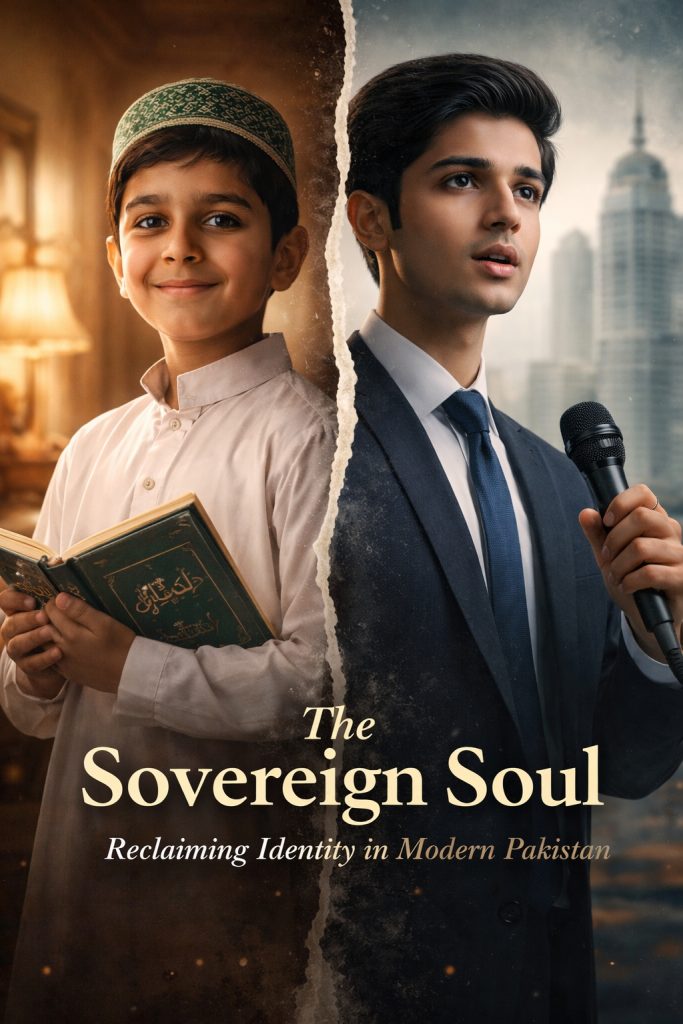
The broader consequence of this layered erosion is the emergence of a generation that is technically equipped yet psychologically dislocated—capable of participating in global systems but lacking the internal anchor required to shape them. In response, this study advances a redefinition of modernity as a theologically grounded and intellectually autonomous pursuit, wherein scientific and technological progress is understood as part of a Divine order to be explored and mastered, rather than passively adopted as a Western construct.
It calls for the cultivation of a “Sovereign Soul”: an individual and collective identity that harmonises faith, character, and intellectual excellence, enabling meaningful engagement with the modern world without surrendering moral and cultural distinctiveness. The objective of this research is to diagnose the structural roots of identity dilution, analyse its psychological and societal manifestations, and articulate a principled framework for achieving authentic national supremacy through originality, self-possession, and civilizational confidence.
Aim of the Study
Reclaiming Identity in Modern Pakistan critically examines the psychological and cultural erosion of identity in post-colonial Pakistan and formulates a principled framework for achieving authentic national supremacy through the integration of indigenous identity, Islamic worldview, and intellectually autonomous engagement with modern science and technology.
Scope of the Study
Given the breadth and multidimensional nature of the subject, this study is deliberately delimited to ensure analytical depth, conceptual clarity, and practical relevance. It focuses on post-colonial Pakistan as a primary case study, while drawing selective parallels from broader Muslim societies where similar patterns of identity transformation and cultural dislocation are observable.
The scope is confined to examining psychological, cultural, educational, and ideological dimensions of identity erosion, rather than conducting a purely economic or policy-driven analysis. It prioritises the formative domains of identity construction—namely the home, the school, and the broader social environment—where linguistic choices, value systems, and aspirational models shape the individual’s sense of self. Within this, particular emphasis is placed on the role of language (especially the displacement of the mother tongue), naming practices, and class-based educational structures as key instruments in the internalisation of inferiority and mimicry.
The study also explores the conceptual and theological framing of modernity, restricting itself to an intellectual inquiry into how science and technology are perceived and pursued, rather than engaging in technical or scientific experimentation. It examines the relationship between faith and modern knowledge, aiming to articulate a coherent paradigm that aligns religious worldview with contemporary advancement.
While the research addresses the idea of national supremacy, it does so within the bounds of moral, intellectual, and civilizational development, explicitly excluding militaristic or hegemonic interpretations. The focus remains on cultivating originality of thought, strength of character, and societal coherence as the foundations of sustainable progress.
Geographically, the study is centred on urban and semi-urban segments of Pakistani society, particularly the emerging and established middle classes, where the tensions between tradition and modernity are most pronounced. Temporally, it engages with developments from the late colonial period to the present, tracing continuity and transformation in attitudes, institutions, and identity constructs.
By defining these parameters, the study aims to provide a focused yet comprehensive exploration of identity, modernity, and national development—offering insights that are both intellectually rigorous and socially transformative.
Pakistani nationalism is the belief in striving for the autonomy and identity of Pakistan as a sovereign nation, as well as its political and socio-cultural aspects. Nationalism in Pakistan is intricately linked with the desire for an independent Islamic state. Its multifarious past, present and future aspirations suggest nationalism to be one of its primary tools. More than in any development in the current socio-political context of divisions and internal chaos, outside dangers and mixed ideologies, it is clear that it needs to be reinforced with more focus.
The roots of Pakistani Nationalism date back to the early 20th-century British colonial era of Indian Rule. Dominating the political and cultural order, subjugating Muslims brought the idea of India as a nation into serious question. It was within this framework that the Two-Nation Theory arose: a notion put forward claiming Muslims and Hindus made two distinct nations with opposing religions, cultures, and values.
https://www.pakistantoday.com.pk/2025/04/24/need-to-reclaim-the-national-spirit
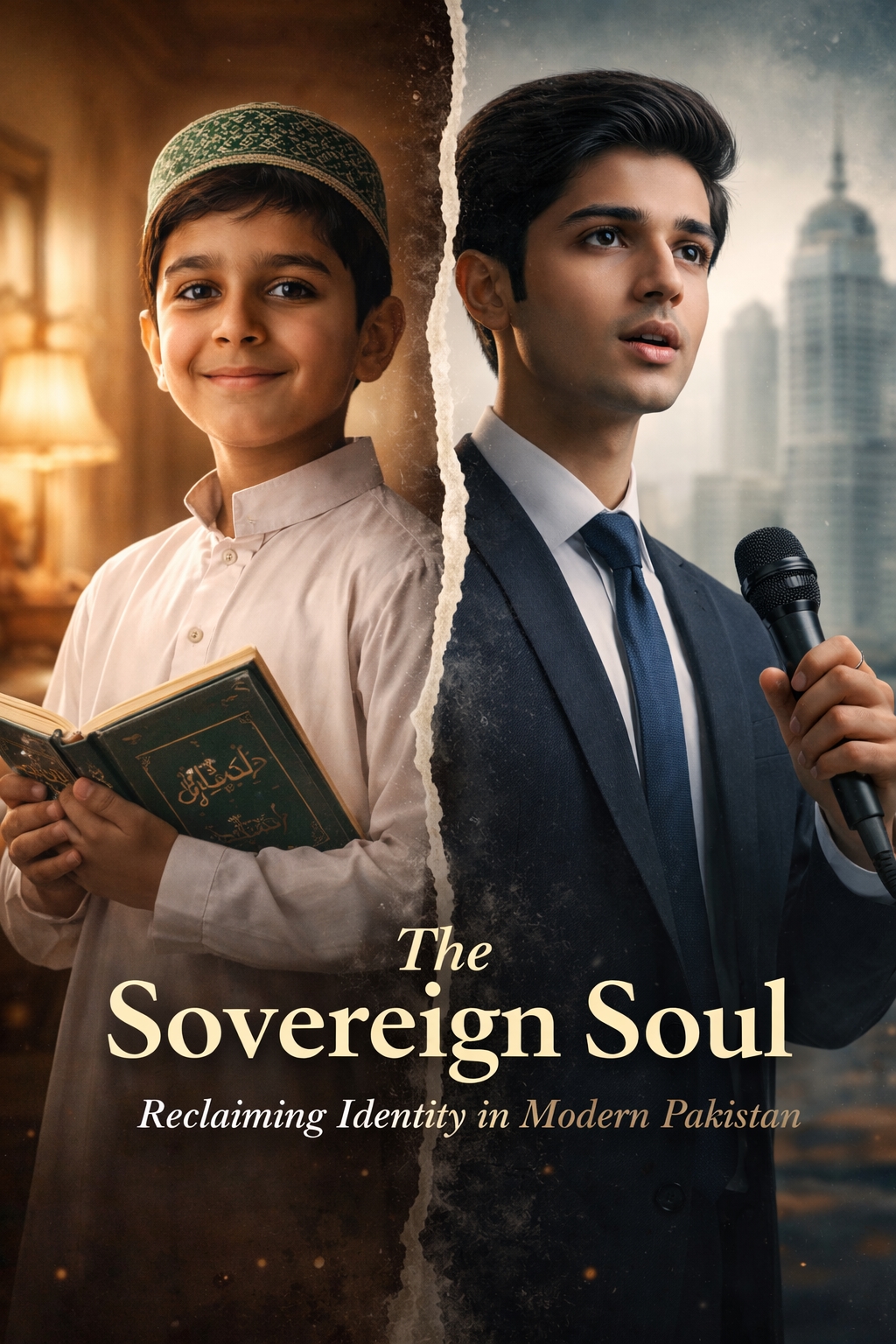
The Sovereign Soul:Reclaiming Identity in Modern Pakistan
-
The Invisible Crisis: A Nation in Quiet Drift
Nations do not collapse in a moment; they dissolve gradually, often invisibly, beginning not at their borders but within their minds. In contemporary Pakistan, the most profound crisis is not economic instability or political fragmentation—though both are visible—but a deeper, less acknowledged condition: a quiet drift of identity.
This drift does not announce itself in dramatic ruptures. It appears in subtle choices—a mother speaking to her child in a foreign tongue to “prepare him for the future,” a father altering the pronunciation of his own name to make it more “acceptable,” a student measuring intelligence not by understanding but by accent. These are not isolated acts; they are symptoms of a deeper psychological condition: the belief that to advance, one must first detach from oneself.
At its core, this is not merely imitation. It is a preemptive surrender—a surrender enacted before any external force demands it.
-
The First Fracture: Home as the Site of Erasure
Every civilisation begins in the home. It is here that a child first encounters language, meaning, and belonging. When this space is altered, the consequences ripple outward across the entire structure of society.
The replacement of the mother tongue with a foreign language at the earliest stages of life is often justified as a practical necessity. Yet, language is not merely a tool of communication—it is the architecture of thought and the vessel of emotion. When a child is denied the language in which emotions are most naturally formed, something essential is flattened.
The result is not bilingual strength, but often emotional dislocation. The child learns to speak, but not always to feel with depth; to articulate, but not always to belong. The bond between generations weakens as the inherited wisdom embedded in the native language loses its immediacy and intimacy.
More critically, the child internalises a silent message: what is yours is insufficient.
This is the beginning of the Sovereign Soul’s fragmentation.
-
The Engine of Reinforcement: School and the Hierarchy of Worth
If the home initiates the fracture, the school often institutionalises it.
The educational structure, particularly in post-colonial settings, frequently operates on an implicit hierarchy where language becomes a proxy for intelligence. Fluency in English is not merely treated as a skill, but as a marker of superiority—social, intellectual, and even moral.
This creates a stratified environment:
- Those who possess the “approved” language gain confidence and validation.
- Those who do not are subtly relegated to the margins, regardless of their innate capability.
Over time, this evolves into what may be termed psychological occupation—a condition in which individuals begin to view themselves through borrowed standards. Knowledge is no longer pursued for understanding, but for alignment with an external model.
The tragedy here is not the learning of a global language—this is, in itself, valuable. The tragedy lies in the replacement of intellectual independence with intellectual dependency.
A nation that thinks in borrowed categories eventually loses the ability to think originally.
-
The Myth of Modernity: Imitation Disguised as Progress
Modernity, in many post-colonial societies, has been narrowly interpreted as convergence with the West. Technological advancement, scientific inquiry, and institutional development—each of these is often perceived not as universal human endeavours, but as cultural properties of a specific civilisation.
This perception produces a subtle but powerful distortion: to be modern is to resemble.
Yet, this equation collapses under scrutiny. Science is not Western; it is universal. Knowledge is not owned; it is discovered. The laws that govern the universe are not the inheritance of a people—they are part of a Divine order, accessible to all who seek them.
From an Islamic intellectual perspective, the pursuit of knowledge is not an act of imitation but an act of fulfilment—a response to the command to observe, reflect, and understand creation.
Thus, the real failure is not in adopting modern tools, but in misunderstanding their nature. When technology is seen as a cultural import rather than a trust to be mastered, it is consumed without transformation.
The result is a society that uses advanced tools but does not produce them; that participates in modernity but does not define it.
-
The Fragmented Individual: Skill Without Centre
Out of this system emerges a distinct personality type: the technically competent but internally divided individual.
Such a person may excel in professional environments, communicate effectively in global settings, and navigate modern systems with ease. Yet beneath this competence lies a subtle instability—a lack of rootedness.
- Identity becomes situational rather than intrinsic.
- Confidence becomes conditional rather than inherent.
- Values become negotiable rather than anchored.
This fragmentation is not always visible, but its effects are profound. A person without an internal center is easily influenced by external pressures. Without a stable sense of self, adaptation becomes absorption—the gradual loss of distinctiveness.
When multiplied across a population, this produces a society that is outwardly functional but inwardly uncertain—a society capable of administration, but not of civilizational leadership.
-
Reclaiming Identity in Modern Pakistan: Reconstructing the Centre
Against this backdrop, the concept of the Sovereign Soul emerges not as an abstract ideal, but as a necessity.
A Sovereign Soul is not defined by isolation or rejection of the world. It is defined by integration without surrender.
Such an individual:
- Engages with modern knowledge confidently, without perceiving it as alien.
- Retains linguistic and cultural grounding, without retreating into insularity.
- Anchors conduct in faith while operating effectively in contemporary systems.
This synthesis requires a deliberate reconstruction of identity at multiple levels:
At the Level of the Home
Reinstating the mother tongue as the primary medium of emotional and intellectual formation, ensuring that the child’s first relationship with the world is one of authentic belonging.
At the Level of Education
Reorienting educational priorities from imitation to critical engagement, where global knowledge is absorbed, questioned, and expanded upon—rather than passively reproduced.
At the Level of Character
Reviving the centrality of akhlaq (character) as the foundation of excellence. Technical skill without moral grounding produces efficiency; with it, it produces leadership.
The Sovereign Soul does not reject modernity—it redefines its relationship with it.
-
From Individuals to Nations: The Logic of Supremacy
Nations are not abstract entities; they are aggregates of individuals. The quality of a nation’s thought, conduct, and ambition is a direct reflection of the individuals it cultivates.
A society composed of fragmented individuals will struggle to produce coherent institutions. Conversely, a society that nurtures Sovereign Souls generates:
- Original thinkers rather than imitators
- Leaders rather than administrators
- Contributors to global knowledge rather than consumers of it
This is the foundation of what may be termed Authentic Supremacy—not dominance over others, but excellence rooted in self-possession.
Such supremacy does not emerge from mimicry. It emerges from the confidence to contribute as oneself.
-
The Final Reckoning: A Choice of Direction
The trajectory before Pakistan—and indeed many post-colonial societies—is not predetermined. It is shaped daily by choices made in homes, schools, and institutions.
If the current pattern continues, the outcome is clear: a generation increasingly disconnected from its roots, proficient in function but uncertain in purpose—capable of sustaining systems, but not of redefining them.
But an alternative path remains open.
It is the path of reclaiming language without rejecting global engagement; of embracing science without surrendering worldview; of producing individuals who move with the world, yet remain anchored within themselves.
True supremacy lies not in becoming someone else perfectly, but in becoming oneself completely.
The question, then, is not whether progress will occur—but in whose image it will be shaped.