Setting Boundaries Without Yelling: Discipline That Builds Trust
Setting Boundaries Without Yelling. Yelling doesn’t mean you’ve failed. It usually means you’re overwhelmed. Most parents don’t want to shout. They just want to be heard.
But here’s the hard truth:
Children don’t learn boundaries from volume.
They learn them from consistency and connection.
(Supporting Article – Healthy Parenting Series) https://mrpo.pk/healthy-parenting/

Setting Limits Without Using Threats to Enforce Them
How do we “make” our child do what we want if we don’t use force?
- One of the most important parent-child interactions in your day, both intellectually and emotionally.
- It creates a power struggle by using threats to gain compliance, instead of creating a relationship where our child WANTS to cooperate. What will we do when our child is not motivated by this particular threat? We’ll have to up the ante by threatening a bigger consequence. Sooner or later, that always leads to a stand-off, unless we’re willing to use violence.
- It teaches our child that disagreements should be resolved with threats and force, rather than recognising both people’s perspectives and finding a win/win situation.
These aren’t results we want. But we do, at times, have to insist on certain things. For instance, brushing teeth. What can we do?
Setting Boundaries Without Yelling: Why Yelling Stops Working
Yelling may stop behaviour in the moment.
But it teaches the wrong lesson.
Children learn:
-
Fear, not responsibility
-
Obedience, not understanding
-
Silence, not self-control
Over time, yelling:
-
Weakens trust
-
Increases defiance or withdrawal
-
Teaches children to yell back
Discipline without connection creates distance.
What Boundaries Really Are
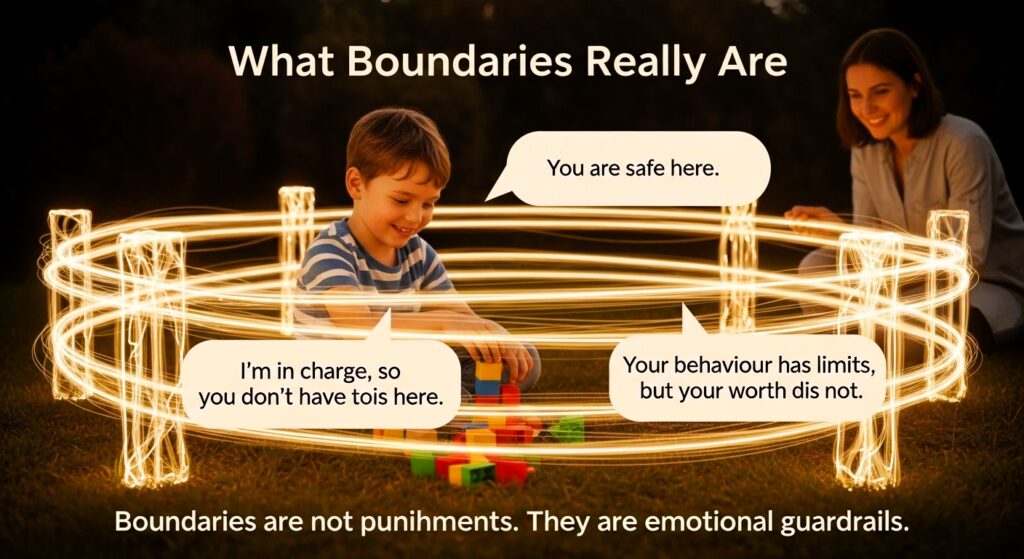
Boundaries are not punishments.
They are emotional guardrails.
Healthy boundaries tell a child:
-
“You are safe here.”
-
“I’m in charge, so you don’t have to be.”
-
“Your behaviour has limits, but your worth does not.”
Our elders didn’t explain boundaries.
They lived them.
Why Calm Boundaries Feel Stronger
A calm voice communicates certainty.
When parents stay regulated:
-
Children feel safer
-
Power struggles decrease
-
Listening improves
Children borrow emotional control from adults.
Calm authority feels unshakable.
How to Set Boundaries Without Yelling (With Real-Life Examples)
1. Decide the Boundary Before the Moment
Unclear rules invite repeated testing.
Children test limits when limits feel negotiable.
Instead of deciding in the heat of the moment, decide ahead of time.
Example:
-
❌ “Stop using the tablet! I said stop!”
-
✅ “Tablet time ends after dinner every day.”
When the rule is pre-decided:
-
You don’t argue
-
You don’t negotiate
-
You don’t escalate
You simply enforce what was already known.
Children feel safer when rules are predictable — even if they complain.
2. Say Less, Mean More
Long explanations weaken authority.
When parents talk too much, children stop listening.
Example:
-
❌ “I’ve told you so many times why this isn’t okay, and you always do this…”
-
✅ “Toys are picked up before bedtime.”
Short. Clear. Calm.
Boundaries are instructions, not debates.
3. Follow Through Every Time
Inconsistency trains persistence, not cooperation.
If a boundary works sometimes, children will push every time.
Example:
-
❌ “Okay, fine, just five more minutes… again.”
-
✅ “I said one warning. Now the toy goes away.”
Follow-through teaches:
-
You mean what you say
-
Arguing doesn’t change limits
-
Calm authority is reliable
This reduces power struggles over time.
4. Separate Feelings From Behaviour
All feelings are allowed. Not all behaviours are.
This distinction prevents shame.
Example:
-
❌ “Stop being angry!”
-
✅ “You’re allowed to be angry. Hitting is not okay.”
Children learn:
-
Emotions are safe
-
Boundaries still exist
-
Self-control is possible
This builds emotional regulation, not suppression.
5. Offer Limited Choices
Control within limits reduces resistance.
Choice helps children cooperate without losing the boundary.
Example:
-
❌ “Get dressed now!”
-
✅ “Red shirt or blue shirt?”
The boundary stays:
-
Getting dressed is non-negotiable
-
How it happens has flexibility
This preserves dignity and reduces defiance.
6. Repair After Rupture
Connection after conflict builds trust.
Even calm parents lose patience sometimes.
What matters most is repair.
Example:
-
“I raised my voice earlier. That wasn’t okay. I was frustrated, but I should have handled it better.”
This teaches children:
-
Mistakes don’t end relationships
-
Accountability matters
-
Emotional safety is real
Repair is not a weakness.
It’s leadership.
Why This Works Over Time
When boundaries are:
-
Pre-decided
-
Calm
-
Consistent
-
Emotionally respectful
Children stop testing as much — not because they fear you,
But because they trust the structure.
When Yelling Still Happens
It will.
Because parents are human.
What matters is what comes next.
A calm repair teaches children:
-
Mistakes don’t end relationships
-
Emotions can be regulated
-
Accountability is a strength
Repair is a powerful discipline.
Discipline Is Teaching, Not Controlling
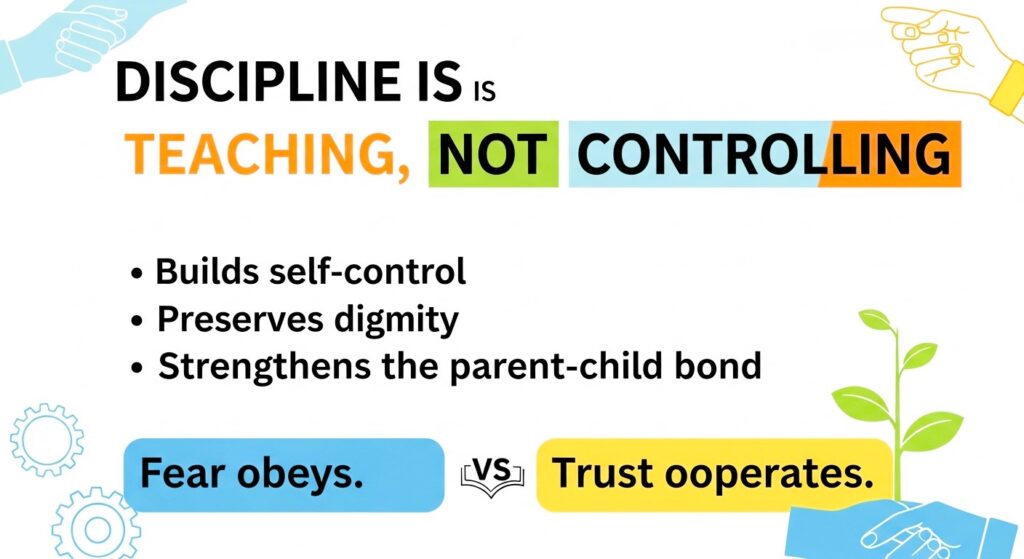
Discipline comes from “disciple” to teach.
Effective discipline:
-
Builds self-control
-
Preserves dignity
-
Strengthens the parent-child bond
Fear obeys.
Trust cooperates.
Closing
Children don’t need louder parents.
They need steadier ones.
Boundaries set with calm and care
become lessons children carry for life.
FAQs – Setting Boundaries Without Yelling
-
Doesn’t yelling show seriousness?
No. Consistency shows seriousness. -
What if my child ignores calm boundaries?
Stay firm and follow through. Calm doesn’t mean weak. -
Is yelling ever damaging?
Repeated yelling can harm emotional safety and trust. -
Can boundaries exist without punishment?
Yes. Natural and logical consequences teach better. -
What if both parents parent differently?
Children feel safest when adults align on limits. -
Can boundaries be taught at any age?
Yes. It’s never too late to reset patterns.
References
-
Siegel, D. J. – No-Drama Discipline
-
Gottman, J. – Emotion Coaching Research
-
American Academy of Pediatrics – Discipline Guidelines
-
Child Development Research on Self-Regulation