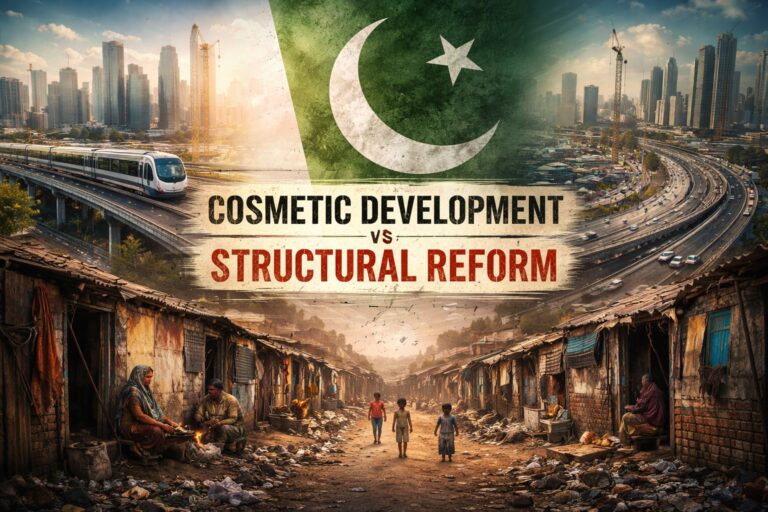

Selective Morality and Justice in Pakistan: Recent Tragedy to Structural Injustice
Abstract
Selective Morality and Justice in Pakistan، the persistent perception that law in Pakistan is applied selectively، strictly for the weak and flexibly for the powerful, has deep historical, institutional, and moral roots. This article takes as its point of departure a recent and widely discussed case in which the son of a sitting judge was involved in a fatal road accident that killed two young women and was cleared of criminal liability within days. Rather than treating this episode as an isolated anomaly, the article situates it within Pakistan’s broader pattern of selective accountability.
Drawing upon Islamic concepts of justice (Qist) and injustice (Zulm), comparative experiences of other post-colonial states, and political–legal analysis, the article argues that Pakistan’s problem is not merely corruption or weak enforcement, but a structurally embedded form of “selective morality.” The study concludes that without a moral re-foundation of law and institutional reform that ensures routine elite accountability, public trust in justice will continue to erode.
Selective Justice serves no justice, rather it sponsors injustice.[1] It contradicts the principle of equality before the law and makes the application of the rule of law difficult. This impairs the efficiency of the criminal justice system as the provision of justice is incomplete without upholding the rule of law. The rule of law which enables the implementation of fair, just, and impartial laws is an essential component of a democratic state, and it ensures a safeguard against tyranny and selective justice.
Selective Justice in Pakistan
The founder of Pakistan, Muhammad Ali Jinnah, delivered a speech on 30 October 1947 on the importance of the rule of law in which he said ‘[t]he scrupulous maintenance and enforcement of law and order are the prerequisites of all progress.’[2] Today, the rich and powerful evade the rule of law giving rise to selective justice. Interference by the executive and legislative bodies in the working of the judiciary and politics in provincial bar associations also enable selective justice.
https://rsilpak.org/2021/selective-justice-a-threat-to-the-rule-of-law/
Introduction: When the Law Bows Before Power
In societies governed by justice, the law stands upright, blindfolded, balanced, and unmoved by lineage or rank. In societies governed by selective morality, however, the law bends. It inclines subtly toward power, softens in the presence of influence, and hardens against those who possess nothing but their vulnerability. Pakistan today finds itself caught in this dangerous tilt.
The recent fatal road accident in Islamabad, in which two young women lost their lives and the accused, son of a sitting judge, was cleared within days, did not shock the nation because it was unprecedented. It was shocking because it was painfully familiar. The speed of legal closure contrasted so sharply with the slow suffering of countless ordinary Pakistanis that it reopened an old wound: the belief that justice in Pakistan is not absent, but unevenly distributed.
This article does not approach the incident as an isolated miscarriage of justice, nor as a personal indictment. It treats it as a moral and institutional mirror, one that reflects a deeper structural disorder. Why does accountability in Pakistan appear episodic rather than routine? Why does morality seem to awaken only when it serves power struggles? And why does the promise of equality before the law collapse so predictably when confronted with privilege?
By grounding the analysis in Islamic moral philosophy (Qist versus Zulm), comparative post-colonial experience, and Pakistan’s own institutional history, this study argues that the country is suffering from a crisis not merely of law, but of moral consistency. Until this crisis is addressed, each new tragedy will merely add another layer to public cynicism, rather than bringing society closer to justice.
-
The Recent Case as a Symptom, Not an Exception
The public response to the judge’s son’s accident case was shaped not only by what happened but by what people had seen happen before. In Pakistan, high-profile cases involving influential families often follow a recognisable trajectory: initial arrest under media pressure, rapid legal manoeuvring, compromise or technical relief, and eventual disappearance from public view. Each time this pattern repeats, it reinforces the belief that the law operates differently depending on who stands before it.
It is important to emphasise that the criticism here is not limited to one individual or one family. The deeper issue is systemic. Pakistani criminal law contains provisions—particularly in cases involving Qisas and Diyat—that allow for pardon by heirs of the victim. In theory, these provisions are rooted in restorative justice and moral reconciliation. In practice, however, they are often embedded in a society marked by extreme power asymmetries. When one party is socially powerful and the other economically or socially vulnerable, “forgiveness” risks becoming coerced, negotiated, or induced rather than freely given.
The speed with which the recent case concluded stands in stark contrast to the everyday reality of Pakistan’s criminal justice system. Thousands of undertrial prisoners remain incarcerated for years over petty theft, minor narcotics offenses, or traffic accidents involving no fatalities. Their cases move slowly, hearings are adjourned repeatedly, and bail is denied as a matter of routine. Against this backdrop, swift relief for a well-connected accused does not appear as efficiency; it appears as privilege.
This disparity is what gives rise to the charge of selective morality: the sense that legal principles are invoked rigorously when the accused is weak, but interpreted generously when the accused is strong.
-
Selective Accountability in Pakistan’s Legal History
The recent tragedy resonates because it fits into a longer historical pattern. Since independence, Pakistan has struggled to establish a culture of uniform accountability. High-ranking officials, political leaders, senior bureaucrats, and influential families have often avoided sustained legal consequences, except in moments of political realignment.
Major accountability drives in Pakistan’s history have rarely been neutral. They have tended to coincide with regime change, military interventions, or intense political conflict. When cases are initiated, they are often perceived—rightly or wrongly—as tools to discipline opponents rather than to uphold principle. Conversely, allies and insiders enjoy informal immunity, or at least the benefit of delay and procedural leniency.
This pattern has produced a paradoxical situation. On paper, Pakistan possesses an elaborate legal and constitutional framework promising equality before the law. In practice, however, the enforcement of that framework is uneven. Law becomes reactive rather than routine, punitive rather than preventive, and selective rather than universal.
The cumulative effect of this history is public cynicism. Citizens no longer ask whether an act is illegal; they ask whether the person involved is powerful. This shift—from moral evaluation to status calculation—is one of the most damaging consequences of selective justice.
-
Justice in Islamic Thought: Qist versus Zulm
To understand why selective accountability is experienced not merely as administrative failure but as moral betrayal, it is essential to examine justice through the Islamic ethical lens that informs Pakistan’s constitutional imagination and social values.
In the Qur’anic worldview, justice (Qist or ‘Adl) is not procedural minimalism; it is moral completeness. Justice is commanded as an obligation owed to God, society, and oneself. The Qur’an repeatedly instructs believers to stand firmly for justice, even when it goes against personal interest, family ties, or social group.
Qist implies balance, proportion, and impartiality. It demands that:
- Status does not confer immunity.
- Power does not justify exemption.
- Weakness does not invite harshness.
By contrast, Zulm is not limited to overt oppression. It includes subtle distortions of fairness: delaying justice, bending rules for some, or denying equal treatment under the guise of legality. In Islamic moral reasoning, a system that applies law selectively—even if technically lawful—can still be unjust.
From this perspective, the problem with cases like the recent accident is not only the outcome, but the moral signal it sends. When the public perceives that lineage or office shields an individual from accountability, the system ceases to embody Qist and begins to resemble Zulm. This perception is corrosive because it suggests that moral worth is indexed to social rank rather than inherent human dignity.
-
Conceptual Contrast: Qist vs Zulm
| Dimension | Qist (Justice) | Zulm (Injustice) |
| Moral Basis | Equality before God and law | Privilege and power-based exception |
| Legal Application | Uniform and principled | Selective and strategic |
| Treatment of Weak | Protection and facilitation | Harshness and neglect |
| Treatment of Powerful | Accountability without fear | Leniency and accommodation |
| Social Outcome | Trust, cohesion, legitimacy | Cynicism, alienation, resentment |
-
Pakistan in Comparative Perspective: Other Post-Colonial States
Pakistan’s struggle with selective justice is not unique among post-colonial societies. Many states that inherited colonial legal frameworks face similar tensions. However, the degree and persistence of selective morality vary.
- India inherited the same colonial legal codes but developed a stronger tradition of judicial activism and institutional continuity. While elite influence exists, there are numerous instances where powerful political figures have faced prolonged trials and convictions. Delays remain a problem, but the expectation of accountability is more widely internalised.
- Nigeria presents a closer parallel to Pakistan. Elite capture, politicised accountability, and selective enforcement are common. Yet sustained pressure from civil society and media has occasionally forced prosecutions of high-ranking officials, signalling that immunity is not absolute.
- South Africa, despite its own inequalities, undertook a conscious moral re-foundation of law after apartheid. Constitutional supremacy, judicial independence, and public accountability were emphasised as moral imperatives, not merely technical reforms.
What distinguishes Pakistan is the normalisation of selectivity. In many post-colonial states, selective justice is contested and disruptive. In Pakistan, it has become routinised—expected rather than exceptional.
-
Structural Causes of Selective Morality
Several interlinked factors sustain the selective application of law in Pakistan:
- Elite Capture of Institutions: Political, bureaucratic, judicial, and economic elites form overlapping networks that resist routine accountability.
- Colonial Legal Legacy: Laws designed for control rather than equality continue to shape institutional behavior.
- Weak Investigative Capacity: Poor policing and prosecution allow influence to substitute for evidence.
- Transactional Politics: Accountability is used as leverage rather than principle.
- Social Stratification: Inequality is internalised, making differential treatment appear normal.
Together, these factors create an environment in which selective morality is not an aberration but a functional feature of the system.
Conclusion: Justice Cannot Survive on Exceptions
Every society is ultimately judged not by the eloquence of its constitutions, but by the moral consistency of its justice. Pakistan’s tragedy is not that laws are absent, nor that courts do not function, but that justice arrives selectively. It visits the powerless regularly and the powerful only occasionally—and usually for strategic reasons.
The Islamabad accident involving the son of a judge will fade from headlines, as similar cases before it have done. Files will be closed, memories will dull, and life will move on. But something far more enduring will remain: the quiet internalisation of injustice by millions who now believe that the law speaks a different language depending on who is addressed.
From an Islamic standpoint, this condition is not morally neutral. A system that applies law unevenly, even when procedurally correct, slides from Qist into Zulm. And Zulm, the Qur’an reminds us, is not merely wrongdoing against others—it is a form of self-destruction for societies that tolerate it.
Comparative experience shows that post-colonial states escape this trap only when justice becomes routine rather than dramatic, institutional rather than personal, and moral rather than transactional. Pakistan has yet to make that transition. Its accountability remains event-driven, its morality situational, and its justice negotiable.
Until the law learns to stand upright—unyielding before office, wealth, or lineage—no reform will be sufficient. For justice cannot survive on exceptions, and societies that normalise selective morality eventually discover that the law, once bent too often, loses the strength to stand at all.