SDG 16: Peace, Justice, and Strong Institutions
Introduction
Peace, justice, and the strength of institutions are the cornerstones of sustainable human civilisation. Without security, societies cannot prosper. Without justice, communities cannot thrive. Without strong institutions, nations cannot guarantee rights or maintain order. SDG 16 calls for inclusive societies where peace is protected, justice is accessible to all, and institutions are transparent, accountable, and effective.
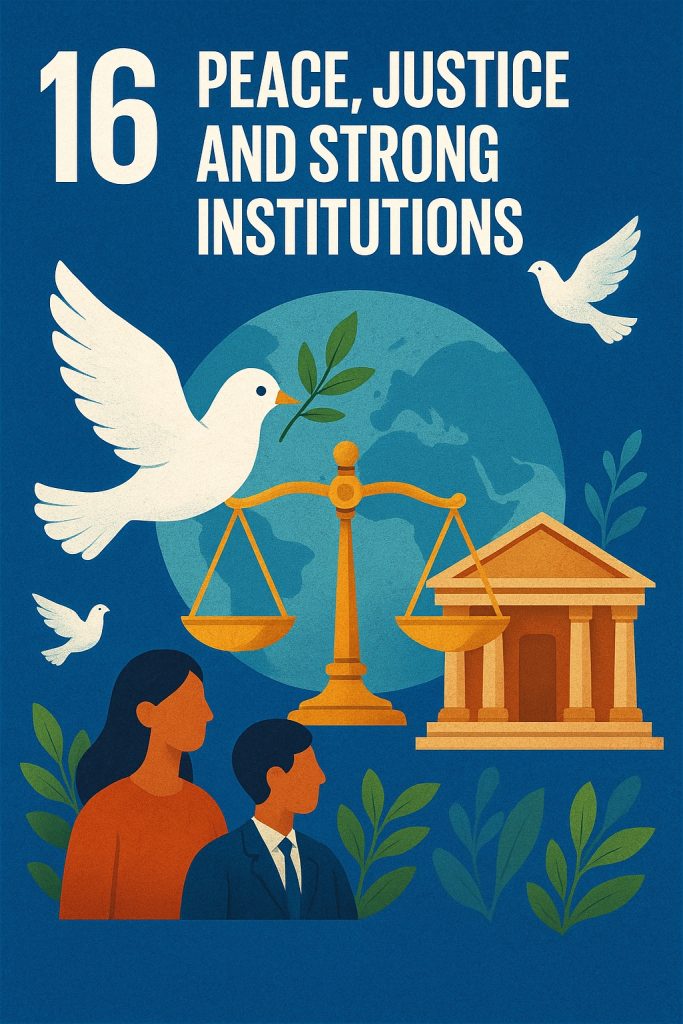
Compassion and a strong moral compass is essential to every democratic society. Yet, persecution, injustice and abuse still run rampant and is tearing at the very fabric of civilisation. We must ensure that we have strong institutions, global standards of justice, and a commitment to peace everywhere.
https://globalgoals.org/goals/16-peace-justice-and-strong-institutions/
Global Perspective
Across the world, conflicts, corruption, and weak governance are major barriers to human progress. From fragile states torn apart by wars to advanced nations struggling with systemic injustice, humanity continues to face the challenge of building societies rooted in peace and fairness.
- Conflict and Violence: Armed conflicts displace millions, destroy infrastructure, and sow mistrust.
- Corruption: Misuse of public funds erodes trust in government and institutions.
- Weak Judicial Systems: Millions lack access to fair trials or legal protection.
- Human Rights Violations: Suppression of free expression, discrimination, and authoritarianism hinder human dignity.
Achieving peace requires more than the absence of war; it demands social justice, equality, and good governance.
Pakistan’s Perspective
Pakistan’s journey towards peace and strong institutions is marked by both struggles and aspirations:
- Internal Security Challenges: Terrorism, sectarianism, and regional conflicts have strained social peace.
- Justice System Limitations: Court cases can take decades to resolve; access to affordable justice is limited.
- Corruption and Mismanagement: Widespread corruption and misuse of authority weaken the legitimacy of institutions.
- Governance and Political Instability: Cycles of instability, weak enforcement of law, and uneven accountability mechanisms slow reforms.
- Positive Developments: National Action Plans against terrorism, reforms in policing, digitisation of services, and awareness campaigns against corruption are steps towards strengthening institutions.
Pakistan’s progress under SDG 16 will depend on building public trust, ensuring equality before the law, and promoting a culture of accountability.
Qur’ānic Callouts on Peace, Justice, and Institutions
📖 Justice as a Divine Command
“Indeed, Allah commands you to render trusts to whom they are due and when you judge between people to judge with justice.”
(Surah An-Nisa 4:58)
📖 Prohibition of Injustice
“And establish weight in justice and do not make deficient the balance.”
(Surah Ar-Rahman 55:9)
📖 Peace as the Basis of Society
“And Allah invites to the Home of Peace and guides whom He wills to a straight path.”
(Surah Yunus 10:25)
📖 Accountability of Leaders
“And do not consume one another’s wealth unjustly or send it [in bribery] to the rulers in order that they might aid you to consume a portion of the wealth of the people in sin, while you know it is unlawful.”
(Surah Al-Baqarah 2:188)
Strategies Recommendations
The recommendations here are strategic options. They must be piloted locally, tested, and adapted before full-scale implementation. Citizen participation and political will are non-negotiable.
- Strengthening democratic processes and the rule of law.
- Ensuring independence and efficiency of the judiciary.
- Enhancing transparency and curbing corruption at all levels.
- Promoting peaceful resolution of disputes and national reconciliation.
- Empowering communities and civil society to hold institutions accountable.
- Using technology for e-governance to reduce human corruption.
Conclusion
SDG 16 is not just a global agenda—it is the foundation of a just society envisioned in Islam and necessary for Pakistan’s survival and prosperity. Establishing peace, ensuring justice, and strengthening institutions are inseparable goals. Nations that succeed in these areas enjoy unity, progress, and stability; those that fail face cycles of conflict and decline.